
by Michael Karadjis
Originally published July 7, 2025 at https://theirantiimperialismandours.com/2025/07/07/israels-aggression-against-syria-the-israel-syria-peace-talks-deceit-the-golani-peoples-national-pact/
In this extraordinary declaration reproduced below, the ‘Civil Assembly of the People of the Golan’ has released a document entitled ‘The National Pact,’ not only condemning ongoing Israeli aggression into the (until recently) unoccupied part of Golan (ie Quneitra province), but also stressing the right of return of the hundreds of thousands of Syrians expelled from the Golan Heights following Israeli conquest in 1967, stressing that Golan is not some regional issue (ie that can be bargained away) but rather is “a purely Syrian national affair,” and calling for enshrining the rights of Golanis in the constitution and for genuine parliamentary representation in the People’s Assembly “proportional to their numbers exceeding one million,” pointing to the “catastrophes and denial of rights” they have been subjected to for 57 years.
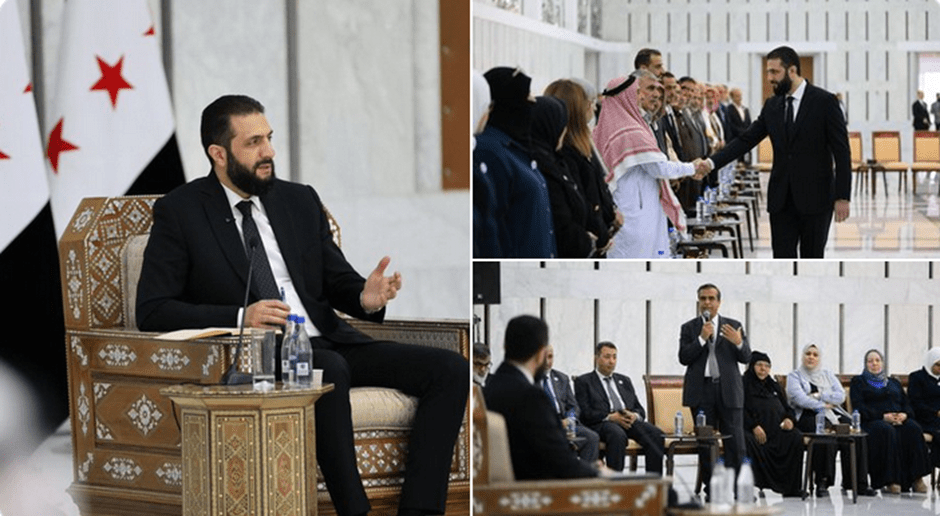
Where did this declaration suddenly come from now? It seems unlikely to be coincidence that this comes just a week after Syrian president Ahmed al-Sharaa held a meeting with dignitaries from Quneitra and the Golan, where among other things Sharaa stressed that “we reject the past where the president’s region ruled everything,” which seems directly connected to the demand for parliamentary representation and inclusion in the constitution, while condemning Israeli attacks and affirming efforts to halt them through indirect talks with international mediators. So while there is no direct evidence that Sharaa’s meeting with the Golanis prompted them to make this declaration, it at least appears they are connected.
And then why did Sharaa make this trip to Quneitra to attend this special meeting? Many would have noticed much media speculation about “Syria-Israel discussions,” either “indirect” or “direct”, supposedly discussing, depending the imagination of the author, everything from “security matters” to “normalisation.”
According to some anonymous “sources,” the Syrian government is “open to normalising with Israel” or even “open” to ceding to occupied Golan Heights to Israel as a price for “normalising,” so desperate they must be normalise, or that “Syrian sources” say a “peace agreement is possible with Israel by the end of 2025.” But then we get to “Israeli sources” claiming that “Syrian sources” told a “Hezbollah-affiliated outlet” that president Sharaa is open to “diplomatic relations” with Israel but “his supporters” are not, “such a step does not enjoy genuine consensus, even within the team loyal to Sharaa,” so Israel “doubts” it will happen.
Whether there really are any such “Syrian sources” saying anything like any of this is anyone’s guess; all of these endless statements which somehow never seem to come from any public statement by any Syrian leader but are always second hand allegations, hearsay and anonymous “sources”, are likely embellishments of Syrian government messages being used as a form of pressure aimed at destabilising the Syrian government and/or pressuring it into something it does not want to do. If the public statements of Syrian leaders matter in any of this, then there has been zero correspondence between these and the hearsay. But even if we are just relying of second-hand “sources,” they are also far from uniform.
For example, according to the Deutsche Presse-Agentur, “According to sources close to the current Syrian leadership, interim President Ahmed al-Sharaa is not prepared to sign up to any broader peace agreement with Israel for now.” Or, according to “anti-Zionist Arab Jew” Alon Mizrahi, based on a “report coming out of Israel,” “Syria is not ready for a permanent agreement with Israel or for joining the Abraham Accords at the moment; it is interested instead in going back to the 1974 ceasefire agreement (signed after the 1973 war), which will force an IDF withdrawal from all the territories captured during the last two years, plus a cessation of hostilities against Syria.” Or then there’s US Syria Envoy Tom Barrack, who while asserting that “both sides” were “open to normalization,” claimed that “Syrian officials hint peace may come by 2028.” 2028? I was pleasantly surprised to read that, and also surprised by Barrack’s gullibility; “2028” is another way of saying “sometime in the undefined future” (perhaps after Israel collapses under the weight of its genocide). Barrack added that “Damascus seeks to halt Israeli attacks in Quneitra.”
As we see from these statements, every single time we hear what the Syrian government says, it comes back to the same thing: the demand that Israel return to the 1974 disengagement line that Assad and Israel respected for 51 years, and Israel end its attacks that it began the morning the revolution overthrew Israel’s man Assad. That’s it. Whether secret “direct negotiations” are going on nobody knows; the Syrian government denies it. When in Paris in May, al-Sharaa admitted to the indirect, mediated discussions; he said they were aimed at deescalating the situation in southern Syria, where Israel has been continually attacking, bombing and occupying; he told Macron that “Israel has bombed Syria more than 20 times in the past week alone.” Once again he demanded Israel return to the 1974 disengagement line and that the UN Observer Force return (they were expelled by Israel after December 8).
A May 27 Reuters report about alleged “direct negotiations” over “security” issues in southern Syria named Brigadier-General Ahmed al-Dalati as heading these discussions, to which he responded “I categorically deny my participation in any direct negotiating sessions with the Israeli side and confirm that these allegations are unfounded and lack accuracy and credibility.” On July 2, the Syrian government officially denied that there were any “peace negotiations” taking place with Israel. Syria’s state-run Al-Ikhbariya TV asserted “There can be no negotiations on new agreements with Israel until it fully respects the 1974 disengagement accord.” Al-Sharaa and the Syrian government have been making the same demand since December. It comes back to that every time. When he met Trump in May, Trump “advised” him to join the Abraham Accords with Israel in return for lifting sanctions, while claiming it was not a condition and Syria needs to “straighten itself out first;” Sharaa’s response was that “we have shown our willingness to implement the 1974 disengagement agreement with Israel.” On July 8, “sources” claimed that Sharaa had met Israeli National Security Council chief Tzachi Hanegbi during his then visit to the UAE, to which the Syrian Information Ministry responded “there is no truth to the reports about any sessions or meetings being held between President Ahmad Al-Sharaa and Israeli officials,” and then Israel denied it too – especially given that Hanegbi was at the time in the US with Netanyahu!
In April, two US Congressmen visited Syria and advocated for the end of sanctions. They reported that Sharaa would be willing to sign the Abraham Accords if “the right conditions were met.” Notwithstanding what the vague “right conditions” could mean – return of Golan, Arab Peace Initiative for a Palestinian state, who knows? – there was no such statement from the Syrian government, though of course Sharaa no doubt would have fudged some response to encourage them encourage Trump to lift sanctions. When asked about this in an April 30 interview, Shaibani responded “In fact, the word normalisation was not mentioned, and I was present during this meeting. What was discussed was that we want Syria to live in security and stability. The Israeli incidents that they talk about are a matter of Israeli threats and doubts about this matter … The Abraham Accords and normalisation were not mentioned.” When pressed about an Israeli newspaper claim that Damascus is considering joining the Abraham Accords, Shaibani insisted “This matter was not discussed at all, and Washington has not asked us about this issue.”
In recent reportage of US discussions with Israel towards a new Gaza truce, it was said that as a prize for Israel to end or pause the war, there would be a “regional” package which would include “bringing Syria and Saudi Arabia into the Abraham Accords.” Trump apparently thinks he can just deliver whole countries to the Accords without their perrmission. Every Saudi statement for years has emphasised that there will be no normalisation with Israel until it withdraws from all territories occupied in 1967 and allows the establishment of a sovereign Palestinian state with East Jerusalem as its capital. Earlier this the Saudi regime released a 3am statement to once again deliver this message – in as strong a way as possible, declaring its “unwavering position” is “non-negotiable” – as an immediate response to Trump claiming the Saudis no longer made that a condition. But Trump would deliver Saudi Arabia, and also Syria?
Yet by the next day, we read, no, it won’t be the Abraham Accords yet, just a “security agreement.” The next day it becomes “Syria will make a statement that the state of war which has existed with Israel since 1948 no longer exists” – a tall order when Israel has been actively making war on Syria for 6 months straight. Next it was going to be a “non-aggression pact,” an odd idea given that only one side has been engaged in aggression. Next the Golan would be turned into a “peace park.” Next we hear that Israel’s alleged “security” concerns in southern Syria will be taken care of by allowing US troops to patrol the “buffer zone,” the euphemism for the part of southern Syria Israel has annexed since December as a “buffer” to its already illegally occupied “buffer” the Golan itself. Then “sources,” citing “Israeli media,” informed us that the deal was that Israel will give back one third of the Golan, or two-thirds but lease back one third, and Syria will be compensated with northern Lebanon, including the city of Tripoli! Apparently the Lebanese government is supposed to simply agree! When it got to actual Syrian government statements, however, that article could only, yet again, cite Syrian foreign minister Shaibani demanding Israel return to the 1974 lines.
Clearly, if we are to take too much notice of all this media manipulation, our heads would spin. As the Syrian government says, there can be no talks on anything before Israel returns to the 1974 disengagement lines. But that’s all it says – that “talks” would thereby be possible. There is no suggestion from Syria that “talks” would lead to the Abraham Accords. People are entitled to think that’s what it means; and given Syria’s precarious situation crushed between the desperate need for reconstruction of its destroyed country, the need to put an end to non-stop Israeli aggression, and the need for investment and above all the full release of US sanctions, the Syrian government is entitled to allow its deliberately vague language to be interpreted by the US government in a way to try to achieve those goals, while in reality not promising anything.
Of course, returning to the 1974 lines does not solve the bigger problem of Israel’s occupation of the Golan Heights. Obviously Syria, a victim of a decade of genocidal mass murder and apocalyptic destruction by the Assad regime, Russia and Iran, is in no position to open a military front on the Golan at this point. As Sharaa put it in December, “the general exhaustion in Syria after years of war and conflict does not allow us to enter new conflicts,” the country must instead focus on reconstruction of half the country Assad destroyed, including housing for the half the country uprooted from their homes either internally or in exile; and indeed, as a transitional leader who simply filled the vacuum opened by the collapse of the Assad regime, before any elections have been held, he has no mandate to open a military front against a crazed nuclear armed genocidal entity and force the Syrian people to commit suicide. His mandate is reconstruction, recovery, and return of refugees. However, for exactly the same reason, he also has no mandate to cede any chunk of Syrian sovereign territory, such as the Golan, for “peace.”
Despite much nonsense from “sources,” every statement made by Syrian leaders on the Golan declares it to be Syrian territory that must be returned. On January 17, Syria’s UN ambassador Koussay Aldahhak, in a UN session condemning Israel’s aggression into the ‘buffer zone’, also “reaffirm[ed] Syria’s inalienable right to recover the occupied Syrian Golan in full.” When asked during a February interview with The Economist whether he would be ready to normalise with Israel, president Sharaa replied “actually we want peace with all parties,” but as long as Israel occupied the Golan, any agreement would be premature. At another UN session on April 10, Aldahhak demanded implementation of UN resolutions 242, 338 and 497 and “the end of the Israeli occupation of the occupied Syrian Golan.” When Shaibani attended the Munich Security Conference with European and Middle Eastern leaders in February, he stated that the “Golan Heights are Syrian land and no one has the right to give it to anyone.” In April, while condemning ongoing Israeli aggression, he again stressed that “the Golan Heights continue to be considered occupied territory, in clear violation of the UN Charter.” In late April, the Syrian foreign ministry, in rejecting speculation about the Abraham Accords, noted that “such agreements do not apply to a country whose land remains under occupation.” The same article above reporting the July 2 statement that no talks are possible without Israeli withdrawal to the 1974 lines, also cited a source within Syria’s foreign ministry adding that Syria’s foremost condition for any “peace process” is a complete Israeli withdrawal from the occupied Golan Heights;” another source claims “Damascus will not consider any diplomatic initiative that falls short of restoring Syrian sovereignty over all occupied territory, including the entirety of the Golan Heights.”
It is also worth noting, given some discourse claiming “the Gulf” is adding to “western” pressure to normalise with Israel (as if “the Gulf” were not divided into different countries with often very different regional politics, especially Qatar, Saudi Arabia and the UAE), that the Gulf Cooperation Council also issued a July 2 statement not only “condemn(ing) Israeli violations and repeated attacks on Syria,” but also “confirm(ing) that the Golan Plateau is a Syrian Arab land.” Given that Israel’s key condition for a “peace” agreement with Syria is that Israel keep the illegally annexed Golan, as Israeli foreign minister Gideon Saar has just reaffirmed, this makes it very clear that there is no basis for any “normalisation” discussions.
To reaffirm: Syria has made no statement to the effect that it would sign a peace agreement with Israel without the return of the Golan; however, again note the language – return of the Golan is the precondition for any “peace process” to (possibly) begin, not for a peace agreement to be made or for “normal relations” to be established. To clarify: Syria has also made no statement that it would sign a peace agreement with Israel even if it did return the Golan – though of course since we know Israel will never return it, it is OK for Syria to hide behind this for now. Incidentally, Assad, by contrast, did explicitly state that he was ready to join his best friends in the Arab world (Egypt, UAE, Bahrain etc) in normalising with Israel if it returned the Golan Heights: “Our position has been very clear since the beginning of the peace talks in the 1990s … We can establish normal relations with Israel only when we regain our land.” Sharaa has NOT said that. Assad mentioned nothing about Palestine or “resistance” in this interview; and in any case, we are well aware that both in 1999-2000 and in 2009-2011, Assad father and son were engaged in precisely such ‘land for peace’ negotiations with Israel (blocked only by Israeli intransigence on returning the Golan). Notably, this statement by Assad puts him to the right of Saudi Arabia on the Israel question.
The problem is, however, not what “sources” imagine Sharaa wants or doesn’t want; nor even necessarily what Sharaa wants or doesn’t want; nor the opinions of leftist keyboard warriors wet dreaming that already massively traumatised Syrians should be engaged in suicidal “resistance” for their benefit (they mostly didn’t care that Assad never engaged in such “resistance” and never opened any front on the Golan for 51 years and was widely praised by Zionist leaders, including Netanyahu, for this). No, the problem is that Syria is not like any other Arab country except Palestine itself (and to some extent Lebanon): Syria is a devastated country under aggressive Israeli attack and occupation, daily attacks, bombings, killings, arrests, destruction of farmland, of water sources, ever since the morning of December 8. And of course, Israel also immediately destroyed 90 percent of all Syria’s strategic weaponry immediately after December 8, weaponry it had no problem with as long as it was in Assad’s hands, because they knew Assad only ever used it against the Syrian people. And in their occupation of extra Syrian lands since December, they are now in control of the al-Mantara dam, the major water source for all of southern Syria: think about that for a moment.
Every day, Netanyahu, foreign minister Saar and defence minister Katz call Syrian leaders jihadists, extremists, terrorists and al-Qaeda (just like western tankies do). Now they say we want to sign the Abraham Accords with them. Really? They want to make a peace accord with jihadi terrorists? No. The demand itself is an act of aggression. The demand says: we will continue to bomb your country, occupy the south, seize farmers land, destabilise the country, and have a stranglehold over your water, unless you both sign away the Golan Heights and sign a “peace” treaty with Israel on that basis. Syria needs our solidarity, not our ignorance or our keyboard heroism.
I read ignorant statements from critics that “the new Syrian government is “rushing” to make peace with Israel, apparently unaware of Israel’s war on Syria. News reports of the indirect or alleged “direct” talks between Syrian and Israeli officials suggest this may indicate “warming” of relations. Strange discourses assert that Syria is engaged in indirect or “direct” talks with Israel “despite” Israel’s ongoing attacks on Syria; the “despite” indicates just how much these writers don’t get it. Israel – a massively armed genocidal entity – is in occupation of Syrian territory and has been constantly attacking Syria – a devastated, disarmed, exhausted country – since December 8. Of course Syria engages in mediated “negotiations” with the aggressor, the occupier, to try to get it to end its aggression and occupation. It is normal that countries negotiate with their enemies, their aggressors. To depict “negotiations” between the powerful occupier and the powerless occupied country as some kind of equal negotiation about to “normalise” is to miss the point fantastically.
I repeat there has been zero suggestion from the actual mouths of Syrian leaders about either ceding the Golan or normalising with Israel. But that does not make it out of the question at some point; this is not a confident prediction of what will or won’t happen in the future, given the situation which Syria is in. On one hand, Israel continues its daily aggression and occupation in the south; at the same time, despite Trump’s lifting of sanctions, the US is capable of slowing down or reversing that process – several days ago Trump stated that “the Secretary of State will reimpose sanctions on Syria if it’s determined that the conditions for lifting them are no longer met.” That’s what all this aggression since December 8 is about. If devastated, destroyed, disarmed Syria were to capitulate at some point (more likely some “security arrangement” than full normalisation), it is important to recognise that it would be something forced on Syria by overwhelming pressure and endless aggression; that must be the greater context through which any “condemnations” of any such capitulation are made.
Now here’s where we return to where we began – up till this point, all this has been on the level of states and geopolitics. By going to the grassroots – by going to the people of Quneitra and the refugees from occupied Golan, and getting this statement from them, Sharaa made a deft move: he helped make it much harder for himself, or any Syrian government, now or future, to sign away the Golan for “peace” with Israel.
Below is the declaration and introduction by the Zaman Al Wasl news agency.
The people of the Golan declare the National Pact: No concession on identity… and no alternative to return
In a remarkable step, the ‘Civil Assembly of the People of the Golan’ has released a document entitled ‘The National Pact,’ in which they outlined a series of demands they considered “legitimate and just,” affirming their commitment to defending them in all Syrian forums, considering the Golan issue “not a local matter, but a purely Syrian national affair.”
The statement, a copy of which was received by Zaman AlWasl, stated that Quneitra Governorate, the heart of the Golan, continues to suffer from Israeli occupation attacks, land confiscation, and home demolitions, while hundreds of thousands of Golanis displaced since the June 1967 setback live dispersed across five Syrian governorates.
The document emphasized the need to unify the voice of the Golanis inside Syria and in displacement camps, in order to crystallize their political, service, and constitutional rights. The signatories emphasized that what they put forward “is not merely sectarian demands, but rather national and moral obligations.”
Key points of the document:
1- Support for the legitimate Syrian leadership:
The people of the Golan declared their support for President Ahmad al-Sharaa, colnsidering that his leadership “represented the will of the people and led the country toward liberation.”
2- Rejection of Israeli attacks:
The statement condemned what it described as “repeated Israeli aggression against Quneitra lands,” warning against “attempts to complete the occupation of the remaining Golan.”
3- Adherence to the right of return:
The people of the Golan affirmed their full commitment to the right of return to their occupied land, based on United Nations resolutions, rejecting any understandings or agreements that would infringe upon or undermine this right.
4- Rejection of the “administrative integration” project:
The statement warned against the project to integrate displaced communities into other governorates, considering it “an attempt to obliterate the Golan identity and a pretext for closing the Golan file internationally.” It also paves the way for the abolition of the Quneitra governorate.
5- Demand for Full Parliamentary Representation:
The signatories demanded that the Golanis be granted genuine representation in the People’s Assembly, commensurate with their population of over one million, pointing to the “catastrophes and denial of rights” they have been subjected to for 57 years.
6- Legal Recognition of the Rights of Displaced Persons:
The demands included the right to adequate housing, employment opportunities, and a decent standard of living, similar to what is stipulated in the United Nations conventions for displaced persons around the world.
7- Enshrining Rights in the Constitution:
The statement called for the inclusion of the rights of the Golanis in the constitution or in a permanent law, “so that the demands do not turn into a seasonal debate that is repeated with each new government.”
8- Moral and National Obligation:
The statement concluded with a recommendation that this document be considered “a moral and national charter for all Syrians,” particularly those who will hold representative positions in legislative bodies.
According to the Golan Heights Civil Gathering, this document emerged after months of consultations between representatives from Quneitra and the displacement camps. It will serve as a reference for any national dialogue on the Golan Heights issue.
– Zaman al-Wasl
July 1, 2025
 Syrian Revolution Commentary and Analysis