
by Michael Karadjis
First published July 22, 2025 at https://theirantiimperialismandours.com/2025/07/22/sharaa-governments-catastrophic-debacle-in-suweida-full-druze-alienation-from-post-revolution-syria-israel-unleashed-to-step-up-ongoing-aggression/
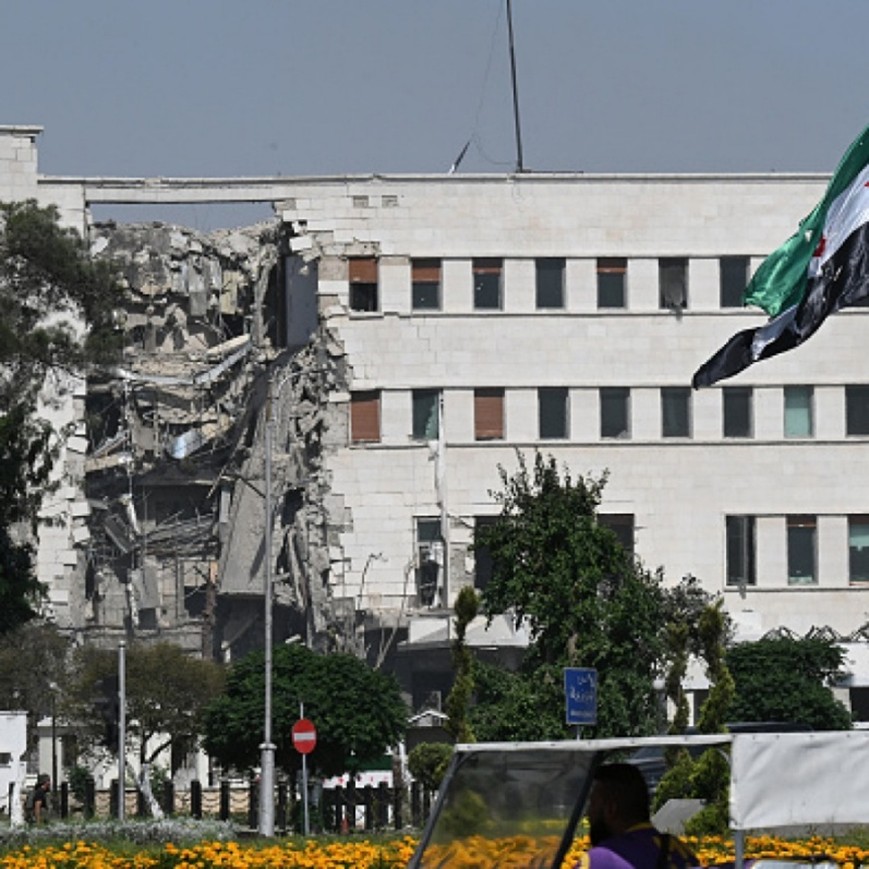
In bombing the Syrian Defence Ministry building in Damascus, and also outside the presidential palace, along with killing 15 Syrian troops and several civilians, Israel was only escalating what it has been doing since December 8, the day the Syrian people overthrew Israel’s preferred leader.
Israel has launched hundreds of airstrikes, possibly over 1000, since December 8. In the first few weeks, Israel destroyed some 90 percent of Syria’s strategic weaponry, in its largest air war ever, while occupying a significant part of southern Syria beyond the already-occupied Golan Heights, in “Syrian Golan” (Quneitra province). While airstrikes have returned with some intensity approximately monthly, in the meantime aggression takes place on the ground, away from headlines: taking over more land, destroying farmland, abducting “suspected terrorists,” attacks into Daraa and Damascus provinces, seizure of south Syria’s water sources and the like. It has not let up. Since February, Israel also banned the Syrian army from entering south of Damascus, ie, Quneitra, Daraa and Suweida provinces, with the threat of bombing.
So, while the latest aggression goes under the title of “protecting the Druze,” this background helps us understand that this is merely one of Israel’s excuses. Since the beginning, Israeli leaders like Netanyahu, foreign minister Gideon Saar, defence minister Israel Katz and others have called the new Syrian leadership “jihadists,” “terrorists,” “extremists,” “al-Qaeda” and so on. Both arch-fascist Ben-Gvir and Israel’s Minister for Diaspora Affairs, Amachai Chikli have now called for assassinating Sharaa; Chikli called the Syrian government an ‘Islamo-Nazi regime’ and ‘Hamas’. Arch-fascist Smotrich has stated that conflict with Syria will end only when Syria is “partitioned.” Israel has said it wants Syria split into “cantons,” and requests the US keep its forces in east Syria, and that Russia keep its air and naval bases in west Syria, as part of dividing up the land.
Now, all that said, there was of course a huge crisis in the southern Druze-dominated province of Suweida, and while for Israel it is an excuse, that does not alter the fact that real crises, and how a government handles them, can be critical in terms of the political facilitation of an aggressor. And while much can be said of the antics of some more extreme Druze leaders, or of Druze revenge attacks against Suweida’s Bedouins – all of which will be discussed below – the main story here is the hellish massacre of the Druze population in Suweida – even Israel’s outrages must be seen within the context of the events that politically facilitated its actions.
It did not need to be this way, especially given the goodwill shown to Damascus by the majority of the Druze leadership, who continually tried to reach agreement with the government on compromise plans to integrate the minority-dominated province, based on locally-controlled security arrangements, and who continually rejected Israeli “protection” and condemned Israeli attacks. But Sharaa’s apparent decision in the midst of the crisis to attempt to impose a military solution, and the resulting horrific crimes imposed on the Druze by government-led fighters – whether planned or not, whether due to state loss of control or state-led sectarian instrumentalisation – has almost certainly resulted in the complete alienation of the Druze minority (like the Alawite minority since March) from the post-Assad polity, from what the Syrian majority still see as their revolution. It also resulted in a total defeat for the government’s position, and an enhancement of both Israel’s position and that of the most pro-Israeli wing of the Druze, as the population is now more united than ever against the Sharaa government.
While there is a great deal of dust to settle, and the “fog of war” makes countless claims and counter-claims still unclear, this is my general understanding of what happened.
Background to the crisis in Suweida
The Druze in Suweida have their own sect-based military formations, which arose during the Syrian revolution; while for the most part they were anti-Assad, they were also strongly independent of the Syrian rebels; their focus was on defence of Suweida, and resisting being recruited by Assad to fight his war. Some parts of the Druze leadership and militia were more pro-rebel than others, some more pro-Assad, but always independent. In a sense, analogous to the Kurdish-led SDF in the northeast, with the difference though that the SDF included large numbers of Arabs and somewhat reflected the multi-ethnic nature of the region, whereas the Druze militia were explicitly Druze. This is not a criticism, but it is important going forward, because while Druze account for 90 percent of the population, their militia do not represent the non-Druze in the province.
Following the overthrow of Assad, the Druze militia have guarded their autonomy, rejected simply dissolving their militia into the new Syrian army, while agreeing in principle to eventual integration; as with the SDF, the question is on what terms. As with the SDF, the government rejects incorporating the Druze militia as ‘blocs’ within the army, but rather wants them to dissolve and for their members to join the army as individuals, which is theoretically what happened with all the mainstream rebel formations in January, including HTS. The problem for minority groups however is that the army and the government itself remains overwhelmingly dominated by the Sunni Arab majority, and, given the kinds of violations which have occurred (such as the large-scale massacre of Alawites in March following an Assadist coup and massacre), minorities need to feel the new Syrian polity is more inclusive than it currently is, and hence the terms of integration are important.
During clashes in late April and early May between Druze security forces and armed jihadi gangs in two outer suburbs of Damascus, Druze militia in Suweida clamoured to enter the fray to protect the Druze, but were attacked along the road north by armed Bedouin fighters. Following these events, the government reached an accord with the majority of the Druze religious and military leaderships, that the government’s public security and police would be activated in Suweida to look after internal security, but would consist only of local people. It was also suggested that a new brigade of the Syrian army could be formed at some stage for local Druze militia to join, but nothing happened due to the differences noted above. In the meantime, the Druze leadership remained opposed to the Syrian army or public security from outside deploying in the province, except to maintain security on the Suweida-Damascus highway.
In the background was a long-term low-level conflict between the Druze and the Sunni Bedouin people in the province, over trade routes, land-use and many similar ongoing issues. These are two very useful background articles.
With the Bedouin minority socially and economically marginalised, the lack of any government security forces – banned by both the Druze leaderships and by Israel for different reasons – meant they were also unrepresented in the region’s security forces, the Druze militia being for Druze. This left their region a kind of lawless no-man’s land. Meanwhile, the government abandoned its obligation to maintain security on the highway in practice.
Onset of armed clashes
Hence the background to the current disaster began with a seemingly random crime, when a Bedouin gang seized a Druze truck on the highway. In response, Druze militia kidnapped eight Bedouins as hostages, from the in the al-Maqhous quarter of Suweida city (although ‘Bedouin’ often denotes ‘nomad,’ the majority in Syria are settled), an escalatory move given that the issue was not with city Bedouin at the time. Bedouin then responded in kind. This soon led to serious clashes and killings.
After two days of clashes, amid calls for the government to do something, it sent in General Security and army units on Monday July 14, defying the ban imposed by the Druze and by Israel. What happened next is disputed. According to Druze sources, government forces took the side of the Bedouin in the clashes. SOHR reporting supports this view. According to many Syrians, as the government security forces entered to separate the sides, they were ambushed by one of the Druze militia, the Suweida Military Council (SMC), whose forces are most associated with former Assadist elements; the SMC seems to take the political of Sheikh Hikmet al-Hijri, one of the three top Druze religious leaders, who has consistently called for Israeli intervention and opposed cooperation with the Syrian government. Some 18 government troops were killed on Monday morning. A third version has it that, yes, the Druze attacked, but it was not only Hijri’s forces; rather, all Druze militia still rejected the government security presence and tried to resist their entry. A version of this is actually cited by Laith al-Bahlous, the most pro-government Druze leader, and Hijri’s main political opponent, yet he absolves Hijri’s forces of these accusations, claiming that the Syrian government told Druze leaders of its intention to enter Suweida, but they did not convey this to the people; therefore, armed Druze fighters, coming across government troops, mistakenly assumed them to be invading so they attacked them.
I don’t have a solid opinion on this, and there may have been a mixture of all these factors. But it cannot be disputed that government security forces were ambushed as they arrived, before being involved in any violence, because Druze fighters posted images of themselves standing over the bodies of the troops, and marching others away in their underwear. These images enraged Syrians, leading to demonstrations around Syria calling for revenge, which included ugly sectarian incitement against the Druze.
The conflict spread to Suweida city, between Druze fighters and Bedouins in al-Maqhous. Again, who shot first is disputed; some report it that Hijri’s militia launched an attack on the neighbourhood to subdue it, while others simply report clashes amid the mutual hostage taking. Either way, it led to Bedouin fighters from the countryside attacking the city in support of al-Maqhous, and also attacking smaller Druze towns. At the same time, in response to what they considered the ambush of their troops by Hijri’s forces, the government massively mobilised troops and began a siege of the city, attacking with tanks, mortars and heavy weaponry. And so, if the government and Bedouin forces were not already one, as claimed by many Druze, they effectively became one in the process. This was a fateful, destructive and unnecessary decision, which I will comment on below. Israel began bombing Syrian tanks on Monday, then stepped it up on Tuesday, killing at least 15 government troops, further fueling sectarian rage around the country.
After some 24 hours of conflict, the government security forces and the main Druze religious and military leaderships, including Hijri, the other two main religious leaders, Yousef Jarbou and Hamoud al-Hanawi, along with Laith al-Balous, associated with the powerful Men of Dignity militia which fought the Assad regime, signed a peace agreement on Tuesday. Fighting would cease, “the entry of the Interior and Defence Ministries’ forces in order to impose control over the security and military centres and to secure the province” was “welcomed,” Druze militia were called upon to “organise their weapons under the supervision of state institutions,” and the state was called on to activate its institutions “in cooperation with the province’s people.”
What happened next is again disputed. Many reports claim that, 30 minutes after the meeting ended, Hijri repudiated his own signature, claiming it was made under pressure, and called on Druze to rise up and attack government forces, and for “external Druze” (ie in Israel) to come to their aid. According to one source, Hijri’s forces “launched simultaneous ambushes against government forces across a dozen locations in the city, timed perfectly with renewed Israeli airstrikes.” The obvious coincidence between Hijri’s and Israel’s actions demonstrates what gave a local Druze leader the kind of confidence to take on the government’s army and security forces. However, Druze sources on the ground, such as this harrowing account of the ensuing massacre, claim that after their militia allowed in government forces, they at first were peaceful but then launched their all-out horrific attack on Druze civilians, and this is what caused the Druze militia to renew the fight, while other Druze sources claim the government forces never stopped attacking.
It seems clear the fighting did stop for some time. The Syrian Observatory for Human Rights (SOHR), which tends to have an anti-government bias in its reporting, reported that “the clashes reached an end, after a ceasefire agreement … SOHR activists have reported seeing tanks and armoured vehicles, which have recently been deployed in Al-Suwaida city, withdrawing from the city … Meanwhile, security forces have been deployed in the city’s major streets, amid tense calm which comes after two days of fierce clashes that left tens of fatalities.”
Therefore, the question really is whether Hijri’s rejection of the ceasefire and renewal of hostilities took place before the government forces renewed their attack, or only as a result of the government re-unleashing hostilities. While it is impossible from this distance to determine who shot first next, a couple of things are clear. First, it was initially only Hijri who rapidly rejected the agreement. The other leaders, including Jarbou, Hanawi and Bahlous, and other militia groups, did not do so until fighting had clearly resumed and it became a defensive war. On the whole, there has been a clear division within the Druze leaderships all along: Hijri and the SMC reject cooperating with the government, reject integration, and call for Israeli intervention; the other main leaders prefer to try to de-escalate, to reach agreements with the government, to negotiate towards eventual integration, and reject Israeli intervention.
While it is possible that outside observers exaggerate the differences amongst the Druze leadership, it is useful to listen to Bahlous. Here he takes aim at some of the Druze “religious and political leadership” for acting “unilaterally,” supporting Israeli intervention and “attempts at division,” and even goes so far as claim they bear responsibility for the bloodshed. Likewise, Sheikh Yusuf Jarbou, claims the agreement had widespread support, but noted “Yes, there is support for al-Hijri’s position. We do not deny that, and sometimes it may have an effect on the ground. We respect their opinion, and they must respect our opinion and the opinion of he majority.” He claimed that supporters of Hijri’s position “burdened society with many losses because of their refusal to accept this agreement,” and vigorously condemned Israeli air strikes.
Massacre
But regardless of who shot first, the second undeniable fact is that once hostilities did resume, elements under the leadership of the government armed forces then carried out large-scale horrific atrocities in the city. In one massacre, 12-15 civilians in a guesthouse were murdered. People saw their neighbours killed on the road, or found them dead in their homes. Dozens, at least, are alleged to have been killed in summary executions. Whole families were murdered. A number of truly horrific crimes were reported. Others were killed by snipers or by mortars being fired in the middle of the city. Looting, home destruction, and acts of sectarian humiliation – such as filmed forced shaving of Druze beards and moustaches – also took place.
Water, electricity and fuel were cut off, and violent clashes took place at the entrance to the hospital, which filled up with corpses. A hospital massacre reportedly took place, though there are sharply different versions of who was responsible, but either way the situation there was catastrophic with complete power cut-off, leading to bodies decomposing. Tens of thousands were displaced. Druze describe a complete hell of helplessness and impunity in this period. Druze activists launched ‘Suwayda is Dying’ humanitarian appeals to the world.
Taking the ‘Men of Dignity’ (Rijal al-Karama) militia again as a kind of bellwether, despite Bahlous’ fierce criticism of Hijri’s actions, they are first of all a Druze militia tasked with defending their people, and as government-led forces went on the rampage, their forces strongly mobilised to fight them. By the end of Tuesday, the ‘Men of Dignity’ issued a statement condemning the “monstrous attack,” claiming it was one of the worst attacks on Suweida in “over a century,” by “the forces of the Syrian government, which has violated all the agreed upon pledges and guarantees made this morning.” They claimed to have lost 50 martyrs among. Other Druze militia not associated with Hijri’s group issued similar statements and likewise went to the defence of their compatriots.
According to the SOHR, by end of the fighting with final ceasefire late Wednesday, some 590 people had been killed over the four days; but given that their figure was only 116 people at the time of the first ceasefire on Tuesday, this means nearly 500 deaths occurred in those last 24 hours after the ceasefire ended. SOHR’s breakdown shows some 154 Druze civilians were killed, along with 146 Druze militia fighters, 257 members of the government’s armed forces (plus another 15 government fighters killed in Israeli airstrikes, and several more in the headquarters in Damascus), 18 Bedouin fighters, and 3 Bedouin civilians killed by Druze militia. However, the fact that SOHR’s claim of only 3 Bedouin civilians killed remained unchanged the entire week, even after large scale Druze attacks late in the week (see below), underlines SOHR’s unreliability in my view, and hence I am not using their later updates, which now report 1448 killed altogether (one third government-led forces), until confirmed by other more cautious bodies; that said, I have no doubt that the numbers now really are drastically higher. The much more cautious Syrian Network for Human Rights (SNHR) has recorded 814 deaths (and 913 injuries) as of July 24, but emphasises these figures are preliminary, and has yet to do a breakdown of the victims.
Many Syrian government supporters are in denial about the extent of the massacre, but descriptions from inside Suweida bear out the gut-wrenching reality. This essentially renders all the discussion about the provocative actions by the more extreme wing of the Druze leadership, such as the initial ambush of government forces and unilateral rejection of the first ceasefire, purely secondary; while essential to a full analysis of the events, none of it can provide excuses for the gigantic massacre that ensued.
First ‘final’ agreement, revenge operations, and tribal offensive
A new agreement was reached late on Wednesday, and following this all government armed forces – General Security and the army – withdrew from Suweida. Once again, the agreement was signed by all major Druze leaders except Hijri, who called for ongoing resistance against “armed gangs falsely calling themselves a government,” and warned that anyone engaging with the government “will face legal and social accountability, without exception or leniency.” Sheikh al-Jarbou accused Hijri of illegitimately seeking to monopolize Druze leadership.
Following their withdrawal, Druze militia launched attacks on at least 10 Bedouin villages throughout the region. According to the Syrian Network for Human Rights (SNHR), Hijri’s militia killed dozens of Bedouin in these attacks, leading to forced displacement and widespread migration, within and outside the province, with reports of other human rights violations, massacres and hate speech (eg threats to “kill and burn all members of the Bedouin tribes in Thaala village”). On July 1, the ‘Gathering of Southern Tribes’ issued an urgent humanitarian appeal, claiming “We are being silently exterminated.” In turn, this led to thousands of ‘tribal’ fighters with links to the Suweida Bedouin in Daraa and Deir Ezzor attacking the province in support of their brethren, once again reportedly carrying out massacres, burning villages, firing mortars, looting and other violations, and again, hate speech (eg “we will burn Suweida completely”), while also escorting besieged local Bedouin across provincial borders. Israel again launched attacks against the Bedouin fighters.
This further conflict then led to further negotiations and new agreements; having just withdrawn, the government was now allowed to send its General Security – but not the military – back in for 48 hours to enforce the ceasefire. On Saturday the alliance of tribal fighters agreed to ceasefire and had withdrawn by late in the day; after ensuring their exit from the province, the security forces took up positions on the provincial border to prevent them re-entering; on Sunday the situation was reported to be “calm.” After exchange of hostages, 1500 Suweida Bedouin civilians who had been held hostage by Druze militia were expelled from the province as part of the agreement.
Analysis of final ceasefire agreement – complete rout of government operation
This second or third “final” agreement did not substantially change the terms of the first “final” agreement on Wednesday. According to this agreement which led to the withdrawal of both the army and government security, security would be kept by internal security and police “staffed by local Suweida personnel,” and “police officers and personnel from among Suwayda residents to assume leadership and executive duties in overseeing security in the province;” yet another of the terms is to “fully integrate Suweida into the Syrian state, including restoring service provision and civil state institutions.” Again, the Suweida-Damascus highway would be secured by the government. In his speech announcing the ceasefire terms, Sharaa also affirmed that “we decided to assign some local factions and Sheikhs of Reason with the responsibility of maintaining security in Suweida.”
This is curious wording, because despite talk of “fully integrating” the province, the security regime described is identical to that before the crisis, identical to the agreement reached in early May, that activated government security and police but to be staffed only locally, with the state only responsible for securing the highway, and otherwise keeping out; a huge amount of blood was spilled for no change. And in the final, final agreement, the terms are even clearer, for the complete exit of public security and the Ministry of Defense from the administrative borders of Suweida, and prevention of them re-entering the province. Essentially a complete defeat for the government.
Furthermore, even though it is consistent with the previous agreement his government made, Sharaa seems to be saying that this was only forced on Syria by Israeli bombing. He claimed the decision was made to “put the interests of Syrians above chaos and destruction” as the alternative was “open war with the Israeli entity” which aims to “drag our people into a war they want to ignite on our land, a war with no aim but to tear our country apart.”
Sharaa analyses Israel’s aims very well in this speech, noting that “the Israeli entity has always targeted our stability and sown discord among us since the fall of the former regime, is once again trying to turn our sacred land into never-ending chaos … to break our unity and weaken our ability to move forward with rebuilding and progress.”
However, the problem is not his analysis of Israel’s goals; rather it is that by blaming Israel for the failure of his goal of “integrating” Suweida,” he demonstrates his incomprehension of the fact that if he really did aim to integrate Suweida, based on real unity among Syrian people, then it is his government that totally blew it by attempting a military solution that resulted in a gruesome massacre of the Druze population. And while he targets Hijri, without naming him, for rejecting all cooperation with the government or moves towards integration, and many Syrian government supporters point to the rejection of Hijri’s extremism and pro-Israel position by other Druze leaders, the likely impact of the massacre will be to weaken the position of those like Bahlous who tried to cooperate, to strengthen Hijri’s position and unify the Druze population and leadership against the government. In fact, word has it that Bahlous has left the province and been labelled a “traitor.” Not because he was; but because all his admirable attempts to cooperate with the government were blown up by the brutal massacre.
As sharp Syria researcher Aymenn al-Tamimi put it, “the Syrian government forces blew an opportunity to show that local concerns about the entry of external military and security forces into the province were unjustified.”
Accountability and its discontents
In his speech, Sharaa stressed that “we are committed to holding accountable anyone who overstepped and wronged our Druze community” and in other speeches stated we “strongly condemn these heinous acts and affirm our full commitment to investigating all related incidents and punishing all those proven to be involved,” and so on. These are very good words. Likewise, the ceasefire terms include “the formation of a joint fact-finding committee to investigate the crimes, violations, and abuses reported during the recent violence in Suwayda while identifying the perpetrators and compensating the victims.”
However, there are some reasons why such fine words are unlikely to win back any support among Druze for current Syrian authorities for the foreseeable future, and not only because it is difficult to come back from such a terrifying massacre even in the best of circumstances.
First, all of this was promised after the massacre of Alawites on the Syrian coast in March – of course, this is not entirely fair, as the investigative commission that the government set up has only just released its report, so it is not out of the question that we will see accountability take place, perhaps that is just a matter of time. Either way, the lack of accountability so far obviously contributes to doubt that it will take place with Suweida. And a bigger problem is that neither have any of the genocidal Assadist war criminals been brought to justice, and some of the most infamous are even walking the streets under government protection, meaning that any attempt to punish killers of the Druze or Alawites may confront Sunni resistance. Moreover, even if it is necessary to wait for this process, the government could have pushed forward with other processes, including compensation, official mourning and inclusion of Alawites into the local security forces, but it has shown frankly little interest.
But more important is the fact that something like this could happen again after the experience of the coast. On the coast, local security was overwhelmed after hundreds of their members were slaughtered in the Assadist coup attempt, and undisciplined military brigades, rootless jihadi groups and armed civilians bent on vengeance went on a pogromist rampage. Arguably, government security did well to clear the region in two to three days and end the carnage. But with this experience, the government has few excuses the second time, especially since in Suweida, unlike the more chaotic descent onto the coast to confront the Assadist insurgency, the government forces clearly led the operation.
It is unclear exactly which forces carried out most of the violations in Suweida – government security forces, military brigades, Bedouin fighters, criminals exploiting the situation – and we will need to await proper investigation. SOHR obtained information from locals that cards issued by the Syrian Ministry of Defence were found in possession of several attackers; countless reports speak of attackers in government military or security uniforms, though others also speak more generally of people wearing ‘fatigues’; videos showed Bedouin fighters, already in conflict with the Druze, riding through the streets on government tanks, brandishing their weapons; videos showed fighters approaching the city expressing hate speech and threatening to kill all Druze.
Some claim that Sharaa and his government planned the massacre as a way of consolidating a sectarian Sunni base of support, but in my view this is unlikely; the massacre has resulted in a massive setback to the government’s efforts to restore some stability to the devastated country. It is more likely that it lost control and that forces under its command ran amok. But in the end it makes no difference; it is the result that counts. This once again demonstrates that the government does not have control over the collection of forces that have been patched together as the ‘Syrian army’, many made up of heavily traumatised young male victims of the Assadist genocide; that it does not have a professional, let alone inclusive, armed force at its disposal, seen as legitimate by diverse parts of Syria; the army remains a de facto Sunni Arab army. And after the coastal massacre, the government should have known this. As such, the last thing a government should do is try to impose a military solution on a minority issue.
Imposing military solutions and alienating chunks of Syria
It seems clear that at some point the government made the decision to go well beyond the initial mandate of separating the Druze and Bedouin forces and instead decided to ‘solve’ the six-month Suweida integration issue militarily. Whether it made that decision at the outset, or after the initial bloody ambush by Druze militia, is unclear. There was no way in Syria’s fragile, sectarian circumstances inherited from the Assadist slaughterhouse, the great sectarian lab par excellence, that the imposition of a military solution by an entirely Sunni military, with a huge volume of sectarian preaching and sloganeering in the background, was not going to lead to catastrophic slaughter. Reportedly, even some of the notoriously undisciplined military units which were widely reported to have carried out mass killings of Alawites in March – such as ‘Amshat’ (the Sultan Suleiman Brigade), were, inconceivably, sent to Suweida.
Such a decision to “solve” Suweida’s integration issue militarily seems the only way of explaining the decision to launch a huge siege of Suweida city itself, with tanks and artillery; attempting to take the city by military force was unnecessary if the aim remained merely separating the parties in conflict; separating the forces in rural Suweida while attempting to de-escalate the clashes in the city via negotiating the entry of public security, without the army, would have been more rational. Worse still, this meant the government forces were now besieging Suweida together with the Bedouin forces, even if that had not been the original aim; the government was now effectively on the side of one of the two forces they were supposed to separate. It also meant that the minority Bedouins, already in conflict with the Druze and with genuine grievances, were thereby given the power of impunity.
In one of Sharaa’s final speeches, at the end of the ‘second round’ when the tribal fighters from outside the province agreed to withdraw, Sharaa praised them not just for withdrawing, but for their “heroic stance”, based on their “lofty values and principles” which “motivates them to rush to the rescue of the oppressed,” meaning the local Bedouin who suffered revenge attacks after the government forces withdrew. But, he said, they “cannot replace the role of the state in handling the country’s affairs and restoring security.” While he also stated “the Druze constitute a fundamental pillar of the Syrian national fabric,” his blame for the crisis was laid entirely on “illegal armed groups,” meaning Druze militia. This double standard is not just hypocrisy, it goes to the core of the problem of the government’s project that there should be no armed bodies outside the control of the state; because the tribal brigades, which entered Suweida heavily armed, are obviously outside state control, yet were praised rather than labeled illegal armed groups; minorities are not going to give up their arms if Sunni tribal fighters, or other Sunni jihadist forces, are not also comprehensively disarmed.
Fadel Abdulghani, director of the Syrian Network for Human Rights, said the unrest stems from Syria’s failure to embrace inclusive governance following years of conflict. “This is not just about security,” he said. “Excluding political participation fuels instability.” The fact of the matter is, neither in the political sphere nor in the military-security sphere is the current regime in any way seriously inclusive of minority groups and regions.
The only way that can be overcome is if integration – particularly of regionally-based minority communities such as the Druze in the south, the Alawites on the coast, and the Kurds in the northeast – is carried out in a way that fully democratic, inclusive and respectful of the needs of these communities, and where they are primarily responsible for their own security. While the government can be accused of doing nothing along these lines with the Alawites, there have been positive negotiation processes with both the Druze and the Kurds.
The government’s catastrophic decision to impose a military solution on the Druze issue has not only led to total defeat, with Suweida more independent than previously, but has left a new massive hole in support for the post-Assad Syrian polity, the second after the huge Alawite hole – yet until then, the Druze were largely a supportive constituency, if on their own terms. For the majority of Syrians, the revolution means freedom – the end of a tyrannical regime, the opening of Sednaya and other torture gulags, the freedom to protest and organise, to reconstruct their country bombed into a moonscape by Assad, to begin the process of return of half the population. And this post-Assad reality, the ‘revolution’ let’s say, maintains overwhelming legitimacy among the Syrian majority, as does the current government.
But for the vast majority of Alawites, and now Druze, the current reality is instead one of exclusion, alienation, insecurity and now slaughter. They would now feel much like the vast majority of Syrians felt under Assad. That is not a political statement, simply a statement of reality. It may be salvageable, but it would take a miracle for it to be salvaged in the foreseeable future, or under this government.
And if support for Israel and its actions among the Druze, and for the more pro-Israel and anti-government Hijri-led wing of the Druze, has come about as a result, the blame lies squarely on the Syrian government for this situation. It is not good, but people react to being slaughtered by accepting help from anyone who offers, regardless of their motivations. Israel’s motivations are to create a ‘buffer zone’ in southern Syria, and using the Druze card is a key part of that strategy. Israel aims to ensure that Syria cannot be re-established as any kind of stable, united state; which means that if the Syrian government acts as a sectarian agent against parts of its population, it plays directly into Israel’s hands – if the regime destroys Syria’s unity, Israel is happy to “help” from the other side.
That said, arguably Israel’s bombings did more to inflame the sectarian situation than help anyone; when looking at casualty figures, the huge numbers of Syrian government troops killed make clear that resistance by Druze militia on the ground was the more decisive factor. Much took place – outrageous Israeli bombing, intransigence and provocative acts by the Hijri wing of the Druze leadership, the violent revenge operations against the Bedouins – but the sheer enormity of the hellish massacre of the Druze is the main story here
 Syrian Revolution Commentary and Analysis