
By Michael Karadjis
Originally published August 11, 2025 at https://theirantiimperialismandours.com/2025/08/11/slaughter-on-the-syrian-coast-ruthless-insurgency-meets-horrific-pogrom-massive-hole-in-syrian-revolution/
The investigative commission report into the March massacre of the Alawite citizenry, set up by the Syrian government at the time, finally turned in its findings on July 10, four months after it was launched. Claiming some 1400 killings, it identified 298 individuals broadly aligned with government-led forces, and 265 individuals who took part in the initial Assadist insurgency, as alleged perpetrators of these killings and other violations. I first held off publishing this report – much of which I wrote months ago – due to the difficulties of establishing facts from afar, but then as time went on decided to await the investigative report. However, as I publish, while press conferences have been held, the government has still not made the report public, though we are aware of its broad outlines, so I am releasing my understanding of the situation now; if and when it becomes pubic, I am happy to be proven wrong on any points; or to acknowledge that the investigation did not live up to expectations. Late Update: the UNHCR Independent International Commission of Inquiry on the Syrian Arab Republic has also finally released its mammoth report, with a huge amount of detailed information.
This is a huge report which I have put together over months. Please don’t complain that it’s too “lengthy.” It is not an essay. In writing this report I am also compiling a huge amount of material. Please treat it as a resource rather than a quick read. There is a bibliography, including main reports, at the end.
Michael Karadjis
Contents
- Introduction
- The Assadist Insurgency
- The Syrian government’s security response – and the sectarian pogrom
- Disinformation overload
- Syrian government reaction
- Arrests
- Who was responsible for the civilian massacres?
- The General Security forces (GSS): Reportedly the most ‘disciplined’ and ‘professional’
- Military ‘factions’, ‘foreign jihadis’, ‘Amshat and Hamzat’ – Heavily reported as responsible for massacres
- However, some military brigades acted with integrity
- Armed civilians and “revenge” killing
- Assad regime slaughterhouse: Incubator of sectarian mayhem
- The initial ‘fairy-tale’ and its abrupt ending
- The unfolding deterioration of the situation from December to March
- Causes of this deterioration of the Alawite situation
- What now? The evolution of the al-Sharaa government
- What needs to be done?
- Bibliography
Introduction
While the Assad regime’s tyrannical rule always contained an unofficial sectarian element, it was only when it came under threat from the people’s revolution in 2011-12 that it made a deliberate decision to sectarianise the conflict on a truly massive scale; Syria turned into a gigantic laboratory of genocidal sectarian engineering, cleansing and massacre. The large-scale sectarian massacres of Alawite civilians over March 7-8, which took place in response to the attempted coup and slaughter of security forces and civilians unleashed by Assadist officers on March 6, demonstrate that the impacts of this policy are ongoing and have boomeranged horrifically against innocent civilian members of the sect that the Assad regime’s rule was based among.
The medium-term impacts of these events are difficult to fathom. Just three months after the glorious revolution against the genocidal regime, characterised precisely by a total lack of revenge, either sectarian or directed, it seems the Assadist coup leaders got what they wanted: a massive hole in the revolution, the alienation from the rest of post-Assad Syria of a large part of the Alawite population now multiplied a thousand-fold. Whether some of that can be undone depends a great deal on what the government does next; but for a great many Alawi who were exposed to the slaughter, the ship has sailed; thousands have fled to Lebanon, thousands more just want to leave.
The Syrian government led by president Ahmed al-Sharaa ordered that civilians not be touched, condemned the massacres, set up a commission to investigate the events and bring perpetrators to trial, and made arrests, and rapidly expelled unruly elements from the region and brought the massacre to a close; the general security forces most directly under its command appear to have been the least involved and the most professional compared to unruly military factions, jihadi groups and armed civilians; propaganda claims that this was a massacre unleashed by the government of “HTS” (which no longer exists) or “al-Qaeda” (which Nusra, the forerunner of HTS, quit in 2016) should be dismissed. Indeed, the UN Commission of Inquiry report “found no evidence of a governmental policy or plan to carry out such attacks” (p.18). Simplistic nonsense serves no useful purpose, though it was very useful to enemies of the new Syria, especially Israel, Iran and various other forces influenced by them.
Nevertheless, that does not absolve the government; the military and other forces that carried out this pogrom were theoretically under the authority of the government, so even though it appears to be mostly a question of massive indiscipline and government lack of control of newly patched-together military forces, in international law it still holds overall legal responsibility. The government was also initially slow to move with the level of urgency that the gravity of the situation required, though this can also be explained by being overwhelmed by such fast-moving events. There are more significant critiques that can be made of its handling of the situation beforehand, which I will touch on later. It is certainly valid to critique its apparent lack of interest in giving the issue the attention it needs since, given that nothing that has occurred since the revolution can be compared to the slaughter of a thousand or so civilians over a couple of days (declaring a day of mourning, for example, would have demonstrated some kind of genuine commitment).
Whatever the case, the future of the revolution – meaning not simply the overthrow of Assad and the ‘democratic space’ now open in Syria, but more broadly the revolution’s promise of a Syria for all its communities, a Syria that rejects the methods of the past regime – now depends on how real, how effective, how transparent, how just this process of identifying, trying and punishing the perpetrators is, as well as working hard with the Alawite community leaders for effective policies related to compensation, reconciliation and above all inclusion in the institutions of the new Syria, especially at the level of security.
I am not making any predictions about how real this process will be, and am interested neither in spreading illusions in the al-Sharaa government, nor of demonising it. Below is my understanding of the situation for now; I can’t guarantee every sentence is correct. Not being in Syria, it has been extremely difficult to get a clear understanding, with Syrians on the ground presenting a myriad of different, often sharply contrasting accounts. That’s one reason I have held off publishing for so long; most of this was written months ago. Nevertheless, I believe the below, and the analysis of the wider background, is fundamentally sound.
[As I publish now, in early August, last month witnessed a disastrous debacle in Suweida with a horrific massacre of the Druze population which suggests the government learned little from these March events; some would say it shows the government still has little control over some of its armed forces, while others would claim it proves the government is deliberately behind such mass violations in order to instrumentalise sectarianism to consolidate its Sunni base, kind of Assad-in-reverse; I have written of these events elsewhere, but it is impossible to do any justice to these huge events here].
The Assadist insurgency
The chain of events began on April 6, when hundreds of former Assadist officers, who had been hiding out in mountainous parts of the two coastal provinces – Tartous and Latakia – where Alawites predominate, with large quantities of weaponry, launched a coordinated ambush on Syria’s new security forces in the region, as well as attacking government buildings, hospitals, power plants, gas and oil companies and attempting to seize control of the region. They also severed an underground power supply on March 7, cutting power to most of Latakia.
According to the Syrian Center for Media and Freedom of Expression (SCM), the Assadists “targeted police stations, checkpoints, and cut the Latakia-Jableh-Baniyas main road, concurrently with attacks on the Naval Forces Command, the Naval College near Jableh, the Criminal Security branches in Latakia and Jableh, Al-Qardaha Regional Command, and Jableh National Hospital, taking full control of them. They also cut the Duraikeish Road, Al-Qastal-Latakia Road, the Beit Yashout Road, and Satamu Military Airport, in addition to seizing control of Tartous port checkpoints. At the onset of the attacks, these groups killed approximately 75 individuals, including members of the General Security, police officers, and civilians. Around 200 personnel were taken captive, and dozens were injured.” The UN Commission of Inquiry report however claims some 175 General Security officers (plus 22 earlier) were killed in these ambushes, plus 61 officers of the army Division 400 stationed in the region (p. 10-11).
Initial reports were that some 25 Sunni civilians were also killed, but later these figures were greatly multiplied, as over 200 civilians “including women and children, were killed in mass executions and systematic attacks targeting residential neighborhoods and public roads.” The first 15 civilians were killed by “gunmen targeting their vehicles on the outskirts of the city of Jableh” on Thursday March 6, according to reportage by the Syrian Network for Human Rights (SNHR), who further reported that “vehicles with Idlib license plates were deliberately attacked, and several victims’ bodies were burned inside them,” claiming at least 32 civilian vehicles were so targeted, as in the example of “Badr Hatem, his wife Walaa Saqr, and his son Ali [who] were killed by remnants of the former regime and their bodies were hidden simply because they were from Idlib Governorate.”
According to Omran in Syria Direct, a resident of Jableh where the insurgency began (and who vigorously condemns the pro-government military factions who later sacked the city), “While first storming the city’s southern neighborhoods, regime remnants carried out sectarian killings against the Sunni component.” The report by the well-respected SCM notes the same. This prompted “Sunni youth to announce a public mobilization in the city and pursue the regime remnants to stop them from taking control of the city. They broke the siege on hospitals that were besieged by groups affiliated with the former regime.” Another report claimed “The coup attempt started in Alawite villages (Beit Aana, Hmeimim, Qardaha), reaching Jableh’s outskirts. Hospitals were used as ambush sites against security forces and civilians providing aid. … By midnight 07/03/2025, regime militias took Umm Barghal checkpoint in the south, attacking Sunni homes & killing 7 young men. … By 07/03/2025 afternoon, 15+ Sunni martyrs had fallen.” This report similarly discusses the decisive role of Jableh citizens in resisting this opening Assadist attack.
While some have attempted to downplay the Assadist insurgency and slaughter as a virtual invention of the Syrian government in order to initiate a sectarian rampage, even this report by a local Alawite which indeed does blame the government, does somewhat downplay the Assadist attack, and describes the slaughter of Alawites in the most horrific terms imaginable, nevertheless states that “at least 120 of them [government security forces] were killed by regime remnants [ie, Assadists]. … A friend who had helped evacuate his Sunni relatives from Snobar, near Jableh, put it bluntly: ‘All the good ones have been wiped out’.”
Similarly, Christian activist ‘S’ who “works with both Sunni and Alawite communities,” describes the night of March 6 in Baniyas, where possibly the most terrible massacres of Alawites subsequently took place (cited in Gregory Waters’ Syria Revisited site):
“ … you could hear and see the bodies of General Security being brought to the hospital. I think 150 bodies of security forces were brought to the hospital in total [from the city and countryside]. Many Alawites here still deny that there was an insurgency, but then why was I warned that evening and how do you explain the killed security forces? After a few hours of the attack and taking over some neighborhoods, most of the insurgents fled. They realized there was no foreign intervention coming and they had been tricked by the regime media and leaders and had made a huge mistake.”
The leaders of the Assadist insurgency are well-known. On March 6, a statement signed by Brigadier General Ghiath Suleiman Dalla, a former commander in the Assad regime’s notoriously brutal Fourth Division, announced the launch of “the Military Council for the Liberation of Syria,” calling for “the overthrow of the existing regime” and “the liberation of all Syrian territory from the occupying terrorist forces.”
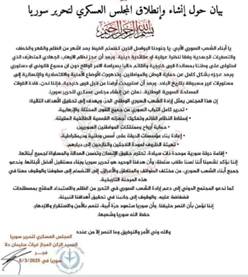
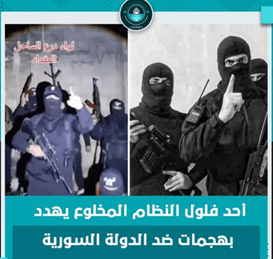

Declaration of the Military Council for the Liberation of Syria; Declaration of the Coastal Shield Brigade; Mohammad Jaber, in his Assadist days, top photo, and in the interview, below photos (middle)
Earlier, on February 7, another former Assadist military officer with a brutal record, Muqdad Fatiha, had announced the formation of the ‘Coastal Shield Brigade’, calling for attacks on government security forces. A series of killings of security forces increased throughout February and early March, leading up to the March 6 mass ambush. Another group are troops linked to Bassam Hossam Al-Din, a former leader of the Assadist Mountain Lions militia, who as early as December 11 threatened to launch an “Alawite military revolution,” and in January kidnapped and threatened to behead a number of security personnel. More recently, it emerged that yet another former Assadist officer, now residing in the United Arab Emirates, Mohammad Jaber, former leader of the Assadist Desert Falcons militia, was also involved in the insurgency, by his own admission.
The massacres targeted both security forces and civilians. In addition to the Sunni civilians targeted on a sectarian basis, it has been widely alleged that the Assadist forces also killed Alawite civilians considered ‘disloyal’ for refusing to support the insurgency. Indeed, Muqdad Fatiha himself released a video in early 2025 where he openly threatened Alawite civilians who had accepted the new Syrian government, or who had denounced his savage crimes: “Your punishment will be severe, boys and girls. I have your names and your social media accounts, I have all the information I need to find you. I’ll be coming to see you soon.” Interestingly, he notes that he has “no problem with HTS,” who “gave me amnesty and treated me well,” but “my problem is with you, my fellow Alawites.” He also confirms that images of him carrying out atrocities under Assad are real.
It is difficult to assess the degree of support among Alawite civilians for the Assadist insurgency. Reportage in the immediate weeks after the overthrow of Assad revealed how hated the Assad regime was among most Alawites, despite them being in many ways ‘favoured’; it massively thieved from them, while treating a generation of their young men as cannon fodder for these thieves. Yet the widespread alienation of much of the Alawite population – discussed below – by March can hardly be denied. There are numerous reports of sections of the Alawite population having been aware of the coup plans and not warning about them. According to another account, “some had prior knowledge of the preparations to target general security, and some hid the remnants and their weapons in their homes, while others participated in hiding weapons near the Ali al-Qadi School in Jableh.” According to ‘S’, a Christian from Baniyas, where the worst subsequent massacre of Alawites took place, in Qusour neighborhood early in the evening of the coup attempt, the Alawite population packed their bags and returned to their villages, one telling him “Close your shop and leave, everything will be settled soon” (though he says Baniyas was the only part of Tartous province where this happened). To be clear – the actions of some alienated Alawites in no way justifies the wholesale slaughter of the Alawite citizenry that took place next, but it is clear that such stories would have provided fuel to the murderous sectarian response.
The Syrian government’s security response – and the sectarian pogrom
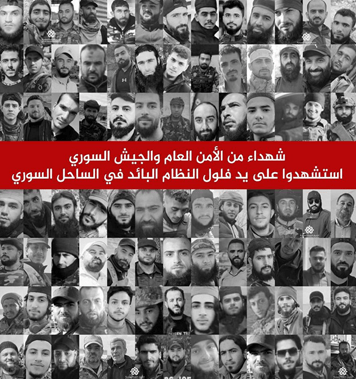
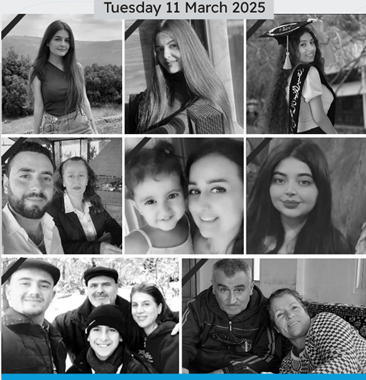
Top: Photos of the first 100 security personnel massacred by the Assadists spread outrage around Syria; Bottom: Cover of the Syrian Network for Human Rights’ preliminary report into the massacres of Alawites.
When news spread of the slaughter of the security forces and civilians, along with that of an attempted comeback by the genocide-regime of Sednaya, demonstrations erupted around the country. While the government sent in many more of its new General Security forces (GSS) to confront the insurgents, the Ministry of Defence (MOD) also began to mobilise forces of the new army, which had only just been stitched together, made up of former rebel brigades and still lacking effective command and control; and in addition, thousands of armed citizens descended on the coast for the same reason, responding to unofficial calls for “general mobilisation.” At least some of these calls for mobilisation were made by sectarian preachers in certain mosques, preaching anti-Alawite hate. As the SNHR reports, “In these operations, local military factions, foreign Islamist groups nominally affiliated with the Ministry of Defense but not organizationally integrated with it, and local armed civilian groups provided support to government forces without being officially affiliated with any specific military formation.”
While their main target was obviously the Assadist killers, among the ranks of these thousands were perhaps hundreds who used the chaos to launch horrific sectarian attacks on defenceless Alawite citizens (often in rural areas), whether driven by thirst for irrational collective ‘revenge’ for the Assadist nightmare they had experienced, hateful jihadist ideology or simply looting and pillaging. While the violators included some security officers, overwhelmingly undisciplined military factions and armed civilian groups were responsible for the killing, as will be documented below; internal security (the GSS) were largely more disciplined and focused on fighting the insurgency. One very important aspect is that the slaughter of hundreds of security personnel stationed there, and then the need to fight the insurgency, severely limited their ability to protect Alawite citizens from the undisciplined sectarian elements theoretically on their side.
The SNHR reported that these “widespread and severe violations” included “extrajudicial killings, field executions, and systematic mass killings motivated by revenge and sectarianism. Additionally, civilians, including medical personnel, journalists, and humanitarian workers, were targeted. The violations also extended to attacks on public facilities and dozens of public and private properties, causing waves of forced displacement affecting hundreds of residents. Dozens of civilians and Internal Security personnel also went missing, significantly worsening the humanitarian and security situation in the affected areas.” Horrific reports included the killing of entire families, killing men in front of their families, the separation and killing of all the menfolk in an area.
Killers who went door to door regularly asked whether the residents were Alawite or Sunni, then proceeding to kill the menfolk if the response was Alawite, according to SNHR. Many such cases are documented in the Amnesty International report released in early April.
Five days passed before the respected SNHR released its preliminary full report; it took some time precisely because it aims to do a proper job, to at least attempt some initial sorting out of facts from the literal mountains of disinformation that spread around the world. The data released by SNHR in its March 11 report is horrendous enough, increasing in several updates. The following main data is from the latest April 16 update, while some extra information is from the more thorough April 9 update:
- 1662 unlawfully killed between March 6 and March 17 (most between March 6-10), of whom:
- At least 445 were killed by the insurgent Assadist forces, a figure which includes:
- – at least 214 members of security, police, and military forces
- – at least 231 civilians
- At least 1217 were killed by “armed forces participating in [government-led] military operations (including “military factions, armed local residents, both Syrian and foreign, General Security personnel”) during the extensive security and military campaign.” SNHR assessed that the “vast majority” were carried out by certain “military factions” that only recently joined the new Syrian army. More on this below.
- These victims were mostly civilians but some were “disarmed members of the [previous] regime remnants.”
- The latter group seems to refer to some who took part in the Assadist insurgency without uniforms, were disarmed in the fighting, and then field-executed. The SCM report noted the same thing, claiming the dead “included disarmed participants in the Assadist insurgency,” stressing this is still a war crime. SNHR reports that “It is extremely difficult to distinguish between civilians and disarmed Assad regime, as the latter were wearing civilian clothing.” However, according to the government’s investigative report, released in July, “some of the victims were former military personnel who had reconciled with the authorities,” which is even worse, because this means by then they were indisputably civilians. It notes that “the presence of Assad regime remnants among the dead cannot be ruled out,” but states “most of the killings occurred either outside combat zones or after the conclusion of military operations.”
- The fact that many Assadist officers were in civilian clothing, or that some Alawite armed civilians joined the insurgency, “emerg[ing] with personal weapons as soon as the attacks began,” is not controversial. According to local Tartous journalist Ram Asaad, the Syrian government is responsible for the outcome “because it confronted them [the insurgents] inside cities and it cannot distinguish between civilians and remnants,” but this is because “the regime remnants wear civilian clothes, and are spread among civilian neighbourhoods. There is no distance between them and civilians.”
- The killings included 60 children and 84 adult women (according to the April 9 update), 51 children and 63 women attributed to the pro-government forces, and 9 children and 21 women to the Assadist insurgents.
- The SNHR notes there were also an unspecified number of Assadist troops killed, estimated to also be in the hundreds, but that it “does not document the deaths of non-state armed group members during clashes, as the killing of these forces is not considered illegal.”
The caution taken by the SNHR in releasing its data is replicated by Amnesty International, which took almost a month to release a report, though Amnesty only interviewed 16 Syrians, all Alawites. Meanwhile, the Syrian Center for Media and Freedom of Expression (SCM) released an updated report on July 11 claiming 1,060 casualties among civilians and some disarmed Assadist insurgents (considerably lower than the SNHR update’s figures), along with 218 deaths of members of the General Security forces (slightly more than SNHR). The government’s Investigative Commission’s report, released in July, reported 1,426 mostly Alawite civilian deaths (while noting, like the SCM, that many Sunni civilians were killed in the initial Assadist attack), thus a higher figure than either SCM or SNHR, as well as the death of 238 security personnel. The UN Commission of Inquiry report, released in August, reported some 1,400 people, “predominantly civilians,” were killed, along with “hundreds of interim government forces.”
Meanwhile, while responsible bodies were taking time and care with their reportage, most of the world’s media impatiently reported the claims of an organisation called the ‘Syrian Observatory of Human Rights’ (SOHR), run by one Rami Abdulrahman, from a computer in Coventry, UK. The SOHR’s numbers of murdered Alawite civilians jumped from 134 to 340 to 745 to 973 to over 1000 all within about 24 hours (and then up to some 1700 within a few days). While the actual numbers were horrific enough, releasing “data” at such a rapid pace would make any cross-checking for accuracy impossible and does not do justice to the victims (by contrast, the well-respected SCM’s 1060 figure was a reduction of some 100 from its initial report “as documentation and verification continued, showing that some of the names were duplicate, and that some individuals were included as dead based on multiple sources, and it was later found that they were still alive”). Notably, the SOHR and Abdulrahman have long been considered either unreliable or suspect by Syrian activists, in particular for claiming at times that the number of Assad regime troops killed was higher than the numbers of civilians killed, a claim defying basic objective logic. We can leave further aside claims of “7000 Alawites and Christians” killed made by various propaganda quarters.
Alawite victims of sectarian killings also included well-known figures who have been involved in the movement against the Assad regime for years or decades.
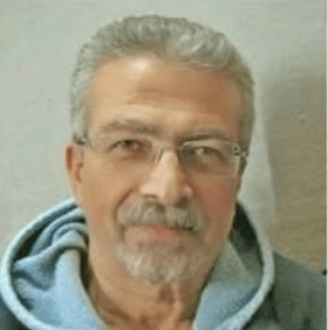

Anti-Assad Alawites, Abdul Latif Ali, murdered, and Hanadi Zahlout, who lost her brothers to murder, by sectarian pogromists.
Opposition activist and former Syrian prisoner Abdul Latif Ali was executed outside his home along with his two sons in front of his wife and other female family members. According to a Syrian friend, “In 1970, he was among a small group of left-wing Alawites from Jableh who attempted, unsuccessfully, to organize protests against Hafez’s coup. Infiltrated by Hafez’s informants, he and his comrades were detained and viciously beaten before they even had the chance. He was ecstatic when the regime fell in December. In his last Facebook post, he urged young Alawite men not to fall for the trap being laid by henchmen of the former regime.” Here’s what his daughter had to say regarding false claims he was killed by the Assadist remnants.
Hanadi Zahlout, a prominent activist who took part in the uprising against the Assad regime in 2011, mourns her 3 brothers, “murdered in cold blood yesterday in Syria’s coastal region.” President al-Sharaa rang her to express his condolences. She thanked him and said she was putting her faith into the official investigation.
The lives of anti-Assad Alawite activists are not more important than those of innocent Alawite civilians slaughtered. But it does highlight the completely counterrevolutionary nature of sectarian crimes, and the stain of sectarianism in general.
These events were horrific for all involved, the terrorised Alawite civilians of course, but also the families of the new security officers and civilians slaughtered by the Assadist officers. However, Assadists can be expected to act like Assadists. It is impossible to overestimate the feelings of sheer terror, as well as betrayal, of Alawite civilians, hoping for something better with the fall of the regime that treated them as a mix of dirt and cannon fodder, now being subjected to such a terrifying pogrom by forces aligned with the government, however undisciplined and in open violation of government orders they may have been.
Disinformation overload
There have also been mountains of misinformation and absurd exaggeration. While none of this changes the reality of what did take place, it is important to understand the levels of nonsense floating around cyberspace. It is unwise to share any images or testimonies you are not absolutely certain are the real thing. Here is just as small handful of examples.

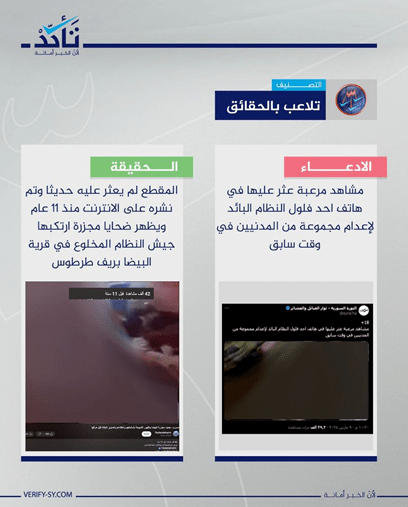
The first is explained in the tweet itself: an example of passing off crimes of the Assad regime as crimes committed now against Alawites. The creator of the original dishonest meme is the strange web-virus calling itself ‘Syrian Girl’, who spent 14 years actively supporting the genocidal crimes of the Assad regime, such as this one she now tries to credit to “Jolani’s gangs.” Similarly, as revealed by the excellent Verify Syria site, the second example is a “widely shared video, allegedly from a fallen regime member’s phone, claimed to show summary executions of civilians. The footage actually dates back to 2013 and documents a massacre committed by Assad’s forces in Tartous.”
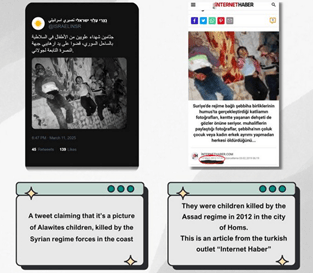
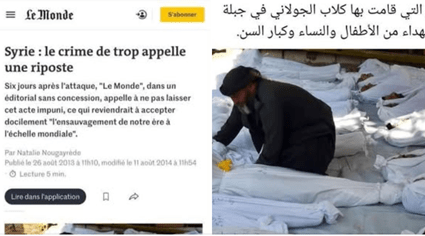
Like here again, from 2012 (top photo above), and even Assad’s sarin massacre in Ghouta in 2013 is now claimed for the Syrian coast in 2025 (bottom photo)!

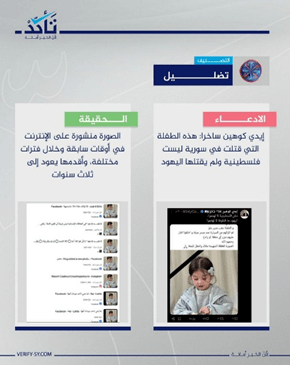

Another class of examples are those that claim crimes committed by Israel were actually occurring on the Syrian coast at the time. Verify Syria exposed this “widely shared video [which] claimed that Syrian aircraft bombed civilian homes with barrel bombs. In reality, the footage shows Israeli airstrikes on Qusaya, Lebanon, in December 2024.” Even crimes committed in India were passed off as crimes on the Syrian coast. The second photo above, showing a Syrian child named Dahab Munir Alou, and claiming her as a victim in the recent coastal violence, “has been circulated online multiple times over the years, with the earliest record dating back three years.” Still another class of misinformation images are countless cases claiming people have been killed who then turn up to demonstrate that are in fact alive. The video above on the bottom claimed that Dr. Kinanah Ali and her children had been killed. The doctor later appeared in this video, denying the news and confirming that she was alive.
There were also false claims about government policy. According to Verify, “claims that Syrian forces banned media from covering arrests and summary executions are based on a forged document. The alleged directive was altered from a February 14 order on military asset transfers.”
One specific aspect of disinformation was the assertion that Christians were also being slaughtered. The fact that these were lies does not make the actual slaughter of Alawites any better, of course, but the claims about Christians were aimed at western Islamophobic audiences. Among leading Trumpist circles, such claims, based on mountains of social media memes, were made by Elon Musk, Tucker Carlson, Vice-President Vance, and even Jim Risch, chair of the Senate Foreign Relations Committee.
The claim was not upheld in any of the human rights reports, and was denied in a statement issued by the Pastors of Christian Churches in Lattakia, who also advised in response to claims being spread on social media pages, “we kindly ask that you always rely on news issued through the official church pages exclusively, and we urge you not to be swayed by rumors, especially after the reassuring message we heard during the meeting we held this evening with a delegation from the leadership of the Syrian General Security Administration.” Syrian Bishop Hanna Jallouf, head of Syria’s Catholic Church in Aleppo, confirmed that “No Christians have been killed in Syria – claims to the contrary are false and misleading.”
Several Christians were killed in the chaos, one father of a priest in a carjacking by some people looting, one over a land dispute, and, ironically, two killed by Assadist gunmen shooting up cars with Idlib numberplates. Clearly, Christians were not specific targets in any of these cases.
Again, none of this means that horrendous killings did not occur. But misinformation does a disservice both to the real victims, by causing doubt about all claims, and to the actual victims in the other cases being misrepresented. The irresponsible spreading of lies by enemies of the Syrian people aims only to inflame the situation.
Syrian government reaction
Confronted with the Assadist insurgency and the slaughter it unleashed, the Syrian government sent in more security forces, but unofficial calls for a ‘general mobilisation’ spread around the country. This was partly responsible for the large-scale descent on the coast by factions and armed civilians from around the country that led to the chaos in which civilians were killed in large numbers. Latakia resident Alaa Awda claims that these calls for a general mobilization opened the way “indiscriminately for everyone to come to the coast, whoever they are, some of whom want to settle scores on a sectarian basis.”
However, already on March 7, the Military Operations Administration declared “the state does not need men to fight in its ranks or to declare a state of emergency in mosques,” and shortly afterwards, al-Sharaa called on “all forces that have joined the clash sites to fully obey the military and security leaders there, and to immediately evacuate the sites to control the violations that have occurred.”
In his first statements on Friday March 7, Sharaa condemned attacks on civilians and stated “everyone who attacks defenceless civilians and attacks people for the crimes of others will be held strictly accountable.” However, it was not immediately clear from this speech that forces fighting for the government side were already responsible for a large part of such attacks and of a most reprehensible form; and his primary attack was on the Assadist forces who had precipitated the disaster with their own massacres. While putting primary blame on the Assadists certainly had validity given their precipitation of the crisis, this statement arguably did not respond with the gravity required given how terrible the situation already was in relation to the slaughter being unleashed by elements of the pro-government side.
Sharaa stated “What distinguishes us from our enemy is our commitment to our principles. When we compromise our morals, we become our enemy on one level.” While this part of the statement is very good, it is still not clear from it that large numbers had already done precisely this, that they were precisely not “distinguishing themselves” from the Assadist enemy. He called on the security forces to “not allow anyone to overstep or exaggerate in their reaction” (to the Assadist insurgency), but it was unclear that overstepping was already going on on a large scale. He stressed it is their role to protect all the citizens of the coast, yet added, “from the gangs of the fallen regime.”
The interior ministry put the killings down to “individual violations” and pledged to stop them. “After remnants of the toppled regime assassinated a number of security personnel, popular unorganised masses headed to the coast, which led to a number of individual violations.” The source stressed that “these violations do not represent the Syrian people as a whole,” a welcome statement to be sure, but the violations were well beyond “individual” and had already become “mass” violations.
By March 8 the tune was changing. “We will hold accountable, firmly and without leniency, anyone who was involved in the bloodshed of civilians … or who overstepped the powers of the state,” al-Sharaa declared. That morning the government halted military operations, having largely defeated the Assadists, and shut all roads in order to remove gunmen not under the command of the Defense and Interior ministries, and began making arrests. By late in the day, “at least five different groups of gunmen had been captured.”
On March 10, Sharaa again upped the rhetoric level. Noting that that “many parties entered the Syrian coast and many violations occurred, it became an opportunity for revenge,” he said. “We fought to defend the oppressed, and we won’t accept that any blood be shed unjustly, or goes without punishment or accountability. Even among those closest to us, or the most distant from us, there is no difference in this matter. Violating people’s sanctity, violating their religion, violating their money, this is a red line in Syria.”
On March 9, the government announced the appointment of an “independent investigation and identification committee, to look into the atrocities committed against both civilians and government forces.” The investigation commission consists of seven people (including two Alawites), made up of five judges, a senior forensics officer and a human rights lawyer.

Its mandate includes “investigating the causes, circumstances and details of the incidents, examining human rights violations suffered by civilians and identifying the perpetrators, investigating attacks on public institutions, security forces and military personnel, and referring those found guilty of crimes and violations to the judiciary.”
The government also announced a High Commission for Civil Peace in the coastal region, tasked with “meeting with communities and listening to them, ensuring their security and safety.” On March 19, the commission held a meeting with senior Alawite notables in Latakia and agreed on a set of measures, including release of Alawite detainees and others currently under investigation, removing any restrictions on former regime soldiers currently holding settlement cards, limiting arrests to those believed to pose imminent security threats, removing government forces from residential buildings which they had occupied as new checkpoints, and establishing phone lines dedicated for receiving complaints.
In addition, according to journalist Haid Haid, local authorities in Latakia announced mourning ceremonies for all victims of the violence, both civilians and security forces. However, they also announced celebrations of the anniversary of the revolution in days soon after the carnage. In Latakia and Tartous, the feelings regarding anything resembling a celebration, even for those most associated with the revolution, would be very mixed in the circumstances to say the least.
I am not citing speeches by al-Sharaa or other government statements, or providing information about the accountability and civil peace mechanisms, in order to sow illusions. Whether these statements are reflected in real action and whether these mechanisms lead to real accountability remains to be seen and should be judged on that basis; that is virtually a life and death test for the revolution. On March 24, the investigative committee met with the UN Commission of Inquiry in Damascus, reportedly planning to coordinate their work on the issue; this certainly seems to be a positive, but again, results are what count.
However, it is important to distinguish the actions of undisciplined sections of security and armed forces from the security operation as a whole, which was unfortunately made necessary by the Assadist insurgency; and to understand that the massacre of Alawites was not a policy of an “al-Qaeda regime” as much anti-Syrian propaganda purports, even if we can be critical of government policy in relation to the events, and in relation to the Alawite question leading up to the events (to be discussed below), and since.
And the improvement in al-Sharaa’s statements, while perhaps simply reflecting the fast pace of events, may also reflect pressure from the outrage expressed by thousands of Syrian revolution activists with the massacres, which goes against all they have fought for the last fourteen years; the revolution is the people and their demands as long as they have not been crushed, the revolution is not the regime.
Arrests
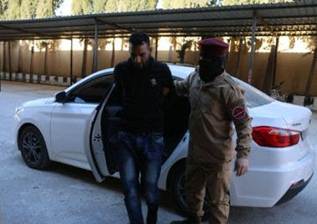
Arrests of perpetrators began on March 8 and has continued. The following two photos are from the ‘Syria Weekly’ compilation of March 4-11.
The first photo below shows a fighter from a MOD formation being arrested by Military Police in Latakia on March 10, accused of committing crimes against civilians which he filmed on his phone; the second photo, another four men arrested on March 11, accused of committing violations “and “unlawful violent acts against civilians” in Latakia.
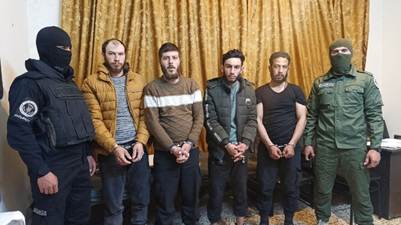
The Military Police also arrested these two MOD fighters below on March 10, after a video of them committing “bloody violations of civil rights in a coastal village went viral.” They were “transferred to the special military court.” Second image is video of the March 9 arrest of “Hussein Wassouf and his group” accused of committing crimes against civilians.
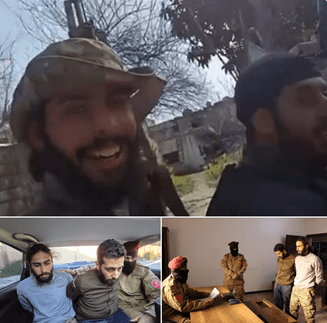

According to long-time and well-known Syrian journalist and activist Hadi Abdullah, “more than 50 elements from the Ministry of Defense have been dismissed and transferred to the investigation for suspicions of their involvement in violations and individual offenses, and a follow-up of those who appeared in videos of other violations is being carried out.”
[Following the release of the government’s investigative committee report in July, which alleged some 298 individuals were involved in these killings, the first 42 have reportedly been arrested].
Who was responsible for the civilian massacres?
Tens of thousands of people both from official security bodies and unofficial armed civilians initially descended on the coast in the chaos to fight the prospect of a return of the genocidal dictatorship and to avenge the initial slaughter unleashed by the Assadists; some 1217 Alawite civilians (or ‘disarmed troops’) were killed according to the SNHR. Such numbers indicate that the vast majority of pro-government combatants did indeed focus their fight on the Assadist insurgents and did not target civilians.
Unfortunately, while war in general brings out the worst in people, in a chaotic situation in which the new government has only just set up new security and military forces, and the whole system of command and control remains rudimentary, violations are even more likely to occur; and even more so in an atmosphere pumped with sectarianism by the genocidal Assad regime sectarian laboratory, with many out for murderous collective ‘revenge’.
While many people on all sides of the debate will not like me making the analogy, I believe these factors also describe what happened in the Gaza pocket in southern Israel on October 7. Likewise the Hamas leadership claims it only aimed at the occupation military bases but that violations took place against the orders. This is not the place to make judgements on this, I’m merely reporting the statements. Like on the Syrian coast, thousands crossed the Israel-Gaza demarcation line (including large numbers outside Hamas leadership control), and hundreds of Israeli and other civilians were killed. In both the October 7 and March 7-8 cases, if anything even close to the majority of fighters were out for civilian blood, we would have seen thousands upon thousands killed. But hundreds, or even mere dozens, of fighters (whether uniformed or otherwise) determined to kill can kill a lot of people.
So who committed most of the sectarian crimes? Violations were reported by elements of all forces involved: elements of the security forces, ‘factions’ of the MOD military forces, and armed civilian groups, but far more from the last two categories than from the first. First, it might just be useful to explain the difference between these groups and who they are:
- The “security forces” refers to the new General Security Service (GSS) set up by the new government under the Internal Affairs Ministry. According to very knowledgeable Syria watcher Gregory Waters, these forces “are generally speaking legacy HTS and Salvation Government formations, at least at the leadership level.” Both local police and GSS units “have roots in Idlib’s SSG political or police offices.” He assesses that this “has resulted in the Ministry of Interior appearing to have better command over its units, who in turn have an overall better track record of professionalism, than the country’s military units.” This assessment fits with the evidence below.
- The new Syrian Army, under the Ministry of Defence (MOD), formed from dozens of former rebel factions, including HTS itself, which were asked to dissolve in January. Most, but not all, did so. However, Waters assesses that “this was almost entirely a symbolic process,” and “by and large, most armed groups have not merged into the new ministry, let alone dissolved.” Moreover, the least integrated into the new structure are the military factions from the Turkish-backed Syrian National Army (SNA), which “retain their own independent revenue streams through both Turkish salaries and years of criminal activity in northern Syria and foreign deployments.” These SNA factions “are only nominally under the Ministry of Defense.” Once again, this fits with the evidence that certain SNA military factions were overwhelmingly responsible for large-scale crimes in the coast.
- Armed civilian groups – this category includes both local Sunni civilians, and civilian groups that initially poured in from outside the coast.
- Foreign jihadi groups, previously associated with HTS but now integrated into neither the GSS nor the Army can be included as a special category.
The General Security forces (GSS): Reportedly the most ‘disciplined’ and ‘professional’
According to the Office of the High Commissioner for Human Rights many of the cases documented were of “summary executions carried out on a sectarian basis reportedly by unidentified armed individuals, members of armed groups allegedly supporting the caretaker authorities’ security forces, and by elements associated with the former government [ie, Assad regime]”. Thus the new security forces (GSS) are not specifically noted. Similarly, the SCM report only notes “armed formations affiliated with or loyal to the Transitional Government’s Ministry of Defense, alongside foreign fighters, were involved in carrying out the violations,” while the Investigative Committee’s report “identified individuals and groups linked to certain military groups and factions from among the participating forces.” The SNHR report does include violations by “General Security personnel” along with “military factions [and] armed local residents, both Syrian and foreign,” but assesses that the “vast majority” were carried out by certain of these “military factions” that only recently joined the new Syrian army, rather than by wayward GSS. The UN Commission of Inquiry report likewise included general security alongside military factions, but stressed that “many interim government forces elements neither engaged in nor condoned the actions of those groups … to the contrary, it has documented their active efforts to evacuate, or protect certain populations and individuals” (p. 17-18).
Long time Syrian writer, activist and former political prisoner Yassin al-Haj Saleh basically concurs with these assessments:
“My impression, which needs verification, is that there are three subgroups within the armed formations that poured into the coastal areas after the bloody events of March 6.
“The first consists of organized forces from the General Security and the new army.
“The second includes sectarian Sunni Syrian groups like Amshat and Hamzat.
“The third consists of jihadist groups, including foreign fighters.”
Regarding the first group, the General Security (GSS) forces, Saleh writes that it appears that “in some cases, [they] exercised excessive repressive violence and captured Alawite civilians. … However,” consistent with the previous two assessments, “it was also the most disciplined, limiting further casualties in some instances, and it suffered significant losses in confrontations with armed Assad loyalists.”
It therefore appears clear that, on the whole, the new General Security forces should be distinguished from certain military “factions” of the army, armed civilian groups and jihadis. That does not mean there were no cases of General Security taking part in violations; there were. But let’s look at some evidence that backs up this general pattern.
The SNHR report claims there were “instances of direct clashes … between armed groups supporting the government’s security forces on one side and elements of the Internal Security forces who attempted to prevent indiscriminate killings on the other. In some cases, these clashes escalated into armed confrontations between the two sides” (p. 13).
In Homs, the government’s security forces formed cordons around areas to protect the Alawite citizens from armed gangs. The effectiveness of this was confirmed by an Alawite woman interviewed on Gregory Waters’ excellent Syria Revisited blog: “We were very scared, I didn’t go to work, we thought our turn would be next and the massacre would reach Homs soon … The General Security forces played a huge role in protecting the Alawite neighborhoods. They gathered more forces and forbade any armed groups to enter our neighborhoods, I may be able to say that without their protection, Alawite Homs could have faced the same destiny the coast had been facing.”
This was perhaps easier as the Assadist insurgency took place in Tartous and Latakia, so the security forces were able to be highly successful in less affected Homs; only three deaths were recorded in Homs over these days. This figure is surprisingly low, because Homs – with its mixed population – was much more the epicentre of sectarian conflict throughout the war, but also in the earlier low-lying post-Assad conflict, overlapping with random killings in a security vacuum, in the late December-January period, Homs had been far more impacted than the coast itself and has continued to be in its aftermath.
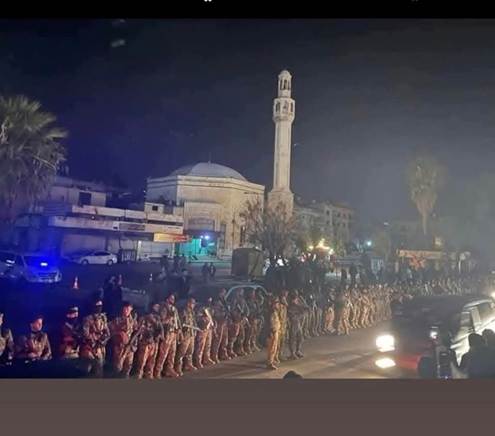
Public Security Forces in Homs forming a human barrier in a majority Alawite neighborhood.
In this report from the town of Qadmus – an Ismaili town surrounded by Alawite villages – the interviewee reports no problems with the police or security forces, but some of the “factions” – meaning military factions – did commit crimes in the countryside (as did the Assadists).
Similarly, Latakia resident Alaa Awda recalled that “the clearing operations on the coast were carried out in several stages. When general security entered for the first time, they were professional.” Then, when other forces entered — factions affiliated with the Ministry of Defense — “they were harsher, with executions, assaults and robberies.” Or this Alawite woman interviewed by the Syria Revisited blog, who claims more generally that “security men are more professional in solving problems peacefully and they try to keep all things under control,” whereas “military members act more quickly and direct … they make a scene every time they do something … [they are] somehow more harsh and cold.”
The SCM report cites a case of killings in the village of Aziziyah in western Hama province carried out by “armed men … from neighboring Sunni-majority villages in the al-Ghab plain.” The witness did not know whether the men belonged to any government military formation, but he stated that “General Security personnel treated civilians respectfully and were not implicated in any violations.”
Researcher Gregory Waters similarly reports that “while some GSS members participated in extrajudicial executions during the March violence on the coast, Alawites and Ismailis have consistently described GSS behavior as much better than that of the [military] factions in Hama, Latakia, and Tartous … This is a trend that the author has found across most minority regions, and seems to reflect a generally higher degree of professionalism on the part of Ministry of Interior units when compared to the various military factions.”
Even this report by an anti-Assad Alawite coastal resident, which is completely gut-wrenching in its description of the mass murder and the terror of the Alawite citizens, and which puts indirect blame on the government itself, nevertheless also reports on an incident in which security forces directly aided Alawite citizens escaping from danger, and speaks of the security forces “trained in Idlib” who were “known for their professionalism and respectful conduct toward the people of the Syrian coast.”
On the other hand, Alawite anti-Assad civilian ‘J’, who reports “all my friends and loved ones are dead now,” claims that some of the security forces in Baniyas were involved in killing and looting, but after a point “the General Security men began to calm things down and stop the looting and fighting.” Clearly as noted above, they were not all innocent, but even this negative report paints them in a different light to the military “factions” and armed civilians that he claims carried out most of the killing (see below).
On the other hand, we sometimes hear that the security forces, while not generally the perpetrators, “did not protect civilians” from them (despite numerous other reports, as cited above, when they did). It is unclear if this means that security forces present did nothing in the face of violence from other factions, or that they were not present to protect. In the latter case, first, the massacre of hundreds of security personnel who had been stationed in the region initially hugely weakened their capacity to protect anyone; secondly, those remaining, and those rushed in from the outside, had as their first priority crushing the Assadist revolt. It appears that many of the massacres took place in vulnerable rural areas away from where the main action was. Therefore, this is difficult to assess.
For example, the Amnesty report notes that “according to residents” in one area of their study [note: Amnesty only interviewed 16 civilians in total], “the authorities did not intervene to end the killings, nor did they provide residents with safe routes to flee the armed men.” But it then goes on, “Three others said the only way for them to flee was when, eventually, they were able to secure car rides from Hay’at Tahrir al-Sham [HTS],a former armed group integrated into the government armed forces.” As noted above, the GSS (security forces) are virtually a proxy for armed HTS cadre. How ironic that Alawites are aided in fleeing from violent factions by forces of what was once the most ideologically anti-Alawite faction.
Countless other examples of security forces acting professionally in contrast to either ‘factions’ or armed civilian groups acting murderously can be cited. The official Syrian Arab News Agency (SANA) also claimed that security forces returned more than 200 vehicles stolen by those they claimed “took advantage of the instability” on the coast.” On the other hand, the Reuters report does document cases where members of the GSS were directly involved in massacres, so this should not be read to mean they were uniformly innocent.
Military ‘factions’, ‘foreign jihadis’, ‘Amshat and Hamzat’ – Heavily reported as responsible for massacres
So, who committed most violations and what were the causes?
Yasin al-Haj Saleh claims that the other two groups [ie, military factions “like Amshat and Hamzat,” and “jihadist groups, including foreign fighters”] “engaged in genocidal violence—killing Alawites solely because they were Alawites. One acted out of a malevolent ideological conviction, while the other was driven by a mix of revenge, warlordism, and looting.”
It is difficult to separate motivations of groups, but my understanding is that Saleh means the third group, the actual jihadists – which includes foreign jihadi factions from the Caucasus or central Asia who were around HTS and have remained in the country since liberation – were those who acted out of “malevolent ideological conviction,” ie pure sectarian hatred of Alawites. While the HTS leadership has moved away from this stance, there remain strong elements of its base who hold these views; and given that foreign jihadi fighters entered Syria for the purpose of “waging jihad,” many may hold firmer to such malevolent ideas than many locals who have to relate to the Syrian society around them. Foreign jihadi fighters were reported in relation to violations in both the SNHR report and the SCM report (p. 19, 31). However, “foreigners” cannot be conveniently singled out for most blame.
Indeed anti-Alawite sectarian hate speech was widely reported to have emanated from various mosques. For example at this Aleppo mosque, a preacher tells hundreds of Syrians that “the land of the Levant cannot, cannot be anything but pure … the Levant was Sunni and will remain Sunni … the Sunnis must now unite and must know who their enemies are … we yearn for martyrdom, we yearn for battles, we yearn for killing.” Many examples of such hate speech spread not only by preachers but other social media influencers are collected in this report. Though it is unclear, it is possible that many of these hate preachers and influencers are associated with unreconstructed sectarian elements of the former HTS base. On the other hand, some preaching mobilisation warned against committing “transgressions.”
I believe Saleh is referring to the second group, “Amshat and Hamzat” – two military factions from the Turkish-backed ‘Syrian National Army’ (SNA) – as those driven by “a mix of revenge, warlordism, and looting.” “Amshat” refers to the Sultan Suleiman Shah Brigade of the SNA, named after its commander Mohammed al-Jassem‘s nom de guerre Abu Amshat. “Hamzat” refers to the al-Hamza Brigade of the SNA. Both brigades have a long history of war crimes and other violations, including abduction, extortion, torture, rape and murder, especially in Afrin, where al-Hamza ran an illegal women’s detention facility. Both militia are under sanctions by the US Treasury Department for violations in Afrin and elsewhere.
It is certainly true that these two SNA factions have been widely reported by countless Syrian sources to have been responsible for most of the sectarian killing. The SCM report specifically describes a number of cases, and the groups identified included Amshat and Hamzat, along with three other notorious SNA brigades, Sultan Murad, Ahrar al-Sharqiya and Jaysh al-Islam (pp. 18-19, 31), as well as a military brigade (Division 400) which was not SNA, but previously belonging to HTS. Likewise, the massive Syrian Archive report, based on open-source information, which documents the presence of every armed group on the coast, gives specific information about killings carried out by Amshat (p. 7-8), Ahrar al-Sharqiya (p. 9), an independent Qalamoun brigade, the ‘Lightning Battalions of Islam,’ which deployed “in coordination with the SNA Muntasir Billah Brigade” (p. 17), and members of the Al-Boushaaban tribe (p. 18). The UN Commission of Inquiry report also specifically documents the involvement of Amshat, Hamzat and several other brigades in various crimes.
“Warlordism and looting,” along with wanton murder, has indeed been the modus operandi of the worst SNA factions for many years, since their role in the Turkish invasion of Kurdish Afrin in 2018, so this is not surprising. These factions, like the rest of the SNA, are officially part of the new Syrian army (as opposed to the General Security), but as noted, this new “army” has only just been formed by cobbling together dozens of military factions from the old opposition throughout Syria, and the SNA brigades have only partially integrated; indeed, there is little evidence that any effective system of control and command has yet been established.
Ideologically, the SNA is an oddball collection which includes former secular FSA brigades and Islamist brigades alike, while the Suleiman Shah Brigade and another SNA brigade, the Sultan Murad Brigade, are Turkmen-based brigades, influenced by Turkish-nationalism. HTS’s origins in Jabhat al-Nusra mean it was more steeped in anti-Alawite sectarianism than any group in the SNA hodge-podge; the SNA in contrast is more likely to have specifically anti-Kurdish biases due to Turkey’s sponsorship. Therefore, it may seem odd that the worst violations appear to have been committed by SNA brigades like Amshat and Hamzat; and likewise the Turkish-nationalist Sultan Murad Brigade of the SNA was also implicated in attacks on Alawites in January, and again in the March massacres. What specific issue would these SNA brigades have with Alawites?
Most likely, it has little to do with Alawites as such, but rather what the SNA represents: a long-term degeneration of a number of groups, whereby Assadist repression forced them more and more under Turkey’s wing; being sponsored and paid by a state to do its bidding – whether anti-Kurdish offensives in Syria or participation in Turkey’s foreign ventures in Libya or Azerbaijan – meant the needs of their local base of support became less important. It is in this context that open criminality became the norm for some SNA groups, and indeed, a major additional form of financing.
That said, the SNA cannot be reduced to its famed criminality; the north near the Turkish border is where hundreds of thousands, indeed millions, from all over Syria took refuge from the Assadist slaughterhouse, fleeing their destroyed homes and towns and cities, and “disappearances” and torture chambers, and many would have had no other options but to sign up to a Turkish-backed militia. Needless to say, irrational collective ‘revenge’ would also likely be a major motivating factor among many of these dispossessed people now in SNA uniform. Finally, some of the SNA brigades, for example Jaysh al-Islam, whose cadres were displaced to the north after being expelled from Ghouta in the south, was always as fundamentally Sunni sectarian, anti-Alawite as HTS, if not more so; and this was alos the case for certain hard-Islamist northern brigades which were incorporated into the SNA, even if that was not a defining SNA charatceristic.
Getting back to the looting and wanton criminality, not all of it can be attributed to these SNA factions, but it is important to note that these motivations were important additions to jihadi ideology or lust for collective ‘revenge’. For example, this account from Jableh from Syria Direct by a Sunni resident al-Abdullah claims that when pro-government armed “factions” arrived in his town after the townspeople had driven back the Assadists, “the city suffered billions [of Syrian pounds] in material losses due to attacks on shops and homes. … [he denounced] “the poor morals of some of the groups, which engaged in vandalism and looting, with no differentiation between Sunnis and Alawites.” His family’s shop was “robbed and vandalized by some of the groups” that ostensibly came to “support” them. Another local, Omran, likewise claimed that “Some of the factions that entered Jableh committed widespread violations, including killings and theft against Sunnis and Alawites.”
The Alawite citizen ‘J’ (cited in the Syria Revisited blog) claims that his house was raided by five separate groups on March 7, of which the first group, a military faction from Hama, “were the worst and most violent and did most of the killings. They also stole gold, phones, cars, anything really.” The other four raids were either by other “factions” or by foreign jihadis, but none were as violent as the first; the next day the region was attacked by armed civilians from the countryside who were once again worse (see below).
HTS, in contrast to the SNA and perhaps some other unruly military factions, had been forced to deal with the Syrian reality where it ruled, and over time it adapted and became somewhat more pragmatic, despite its politically repressive rule and the ongoing existence of hard-line elements within its base.
For example, after taking over the Kurdish region of Afrin in 2022 from the SNA, HTS declared that it “confirms that the Arab and Kurdish people are the subject of our attention and appreciation, and we warn them against listening to the factional interests… We specifically mention the Kurdish brothers; they are the people of those areas and it is our duty to protect them and provide services to them.” In March 2023, HTS confronted the SNA after five Kurdish civilians were killed by members of a Turkish-backed faction during a Nowruz celebration in Jenderes. Jolani met with the Kurdish residents and HTS forces deployed in the town and seized control of headquarters of the military police and the SNA’s Eastern Army, which was accused of the killings.
Of course, Kurds are Sunni; Islamist groups like HTS include Kurds, and tend to be less ideologically Arab nationalist, while being more Sunni sectarian. Yet HTS also moved partially against its own sectarian background in Idlib in recent years, as I have documented here. Of course, these changes do not mean former HTS cadre do not commit violations; no doubt many do (as noted regarding Division 400), and changes at the top do not necessarily alter the long-entrenched sectarianism of sections of the base. However, this does help explain the widespread reports of several SNA factions bearing primary responsibility for the carnage, and of former HTS-led security forces being overall more professional.
However, some military brigades acted with integrity
All that said, the Syrian Archive report documents the presence of some 25 divisions of the new Syrian army (including from former SNA, NLF, HTS and new divisions), plus various independent militia and tribal fighters, on the coast at the time, yet the number of militia or military divisions specifically named in any of the key reports (SNHR, SCM, Syrian Archive, UN Commission of Inquiry, even the somewhat confused Reuters report) as committing violations and killings does not exceed the half dozen or so mentioned above. This is important, as the fact that most violations were carried out by wayward military factions does not indicate that the entire Syrian army acted as a genocidal gang during the events. It should be pointed out that the Syrian Archive report documents several cases where military brigades protected Alawite civilians from sectarian thugs and thus deserve an honourable mention:
First, referring to Faylaq al-Sham, a member of the mostly FSA National Liberation Front (NLF), the report states “On March 9, a civilian from the Jableh countryside posted several times on Facebook begging people to send the General Security to his house, and later wrote “Faylaq al-Sham, I will bear your debt until death. Thank God, members of Faylaq al-Sham saved us from the house before the arrival of undisciplined individuals intent on killing” (p. 11).
Notably, Faylaq was mentioned in another region, Bahluliyah in Latakia, by researcher Gregory Waters:
“According to one local I spoke with, the Faylaq commanders were respectful and professional as they searched the town. When they left, the commander gave everyone his phone number and said to call him if there were any issues. Later that day, another faction arrived – the witness does not know their name – and began looting homes and killing civilians. The man called the Faylaq commander, who returned and expelled the faction from the town. Faylaq al-Sham has remained in the Bahluliyah and Haffeh regions since March where it has a widely positive reputation.”
Getting back to the Syrian Archive report, it also discusses the well-established FSA brigade from northern Hama and Idlib, Jaish al-Izza (now the 74th Division). It was an independent brigade which was never in the SNA; the report claims it as a member of the NLF. Its commander issued instructions to its checkpoints and personnel in north and west Hama: “Random entry into villages and towns without coordination with the division’s leadership is prohibited. Any vehicle not bearing proof of ownership will be confiscated. Entry into neighborhoods and villages with sectarian diversity will not be permitted for the purpose of revenge. Residents of villages and cities are safe as long as they adhere to the instructions and decisions of the Ministry of Defense. Strict orders will be issued to deal with anyone who violates these instructions.” (p. 11-12)
The third group mentioned was the NLF brigade 77th Coastal Division, consisting of fighters originally from the FSA-held southern town of Zabadani, who were expelled to the north in 2016 following prolonged Assadist starvation siege; they were present in the Bahluliyah district of Latakia. According to a report of a villager, “factions [ie, military factions] in the villages of Al-Bahluliya, Da’tour Al-Bahluliya area, were burning houses and killing,” so he contacted 7th Division commander Abu Ahmed. Several villagers were killed by the “factions” and then in half an hour, “Abu Ahmed arrived with members of the 77th Brigade at the Al-Bahluliya junction. The faction said, “We will comb the village.” After some back and forth, the faction left, and Mr. Abu Ahmad and the elements of Brigade 77 spared “the village” from something that would have had undesirable outcome. Now Mr. Abu Ahmed has taken over the area for us. Welcome, may God bless you. Many thanks to the members of the 77th Brigade” (p. 14).
Armed civilians and “revenge” killing
But if unreconstructed sectarianism explained some crimes, and opportunistic wanton criminality others, what of the motivation for ‘revenge’? Lust for revenge by people whose families, friends and communities were slaughtered by the Assad regime, taking out their ‘revenge’ against innocent civilians, was clearly one of the factors here. Stating this is not to justify it. It is merely stating the reality that this is common in conflicts throughout the world. Most people involved in such battles may understand that the ordinary people on “the other side” are not at fault, and to kill ordinary citizens in “collective revenge” is to act no differently to one’s oppressors. However, not every severely damaged individual, who has known nothing but war, killing, atrocities and personal tragedy since their childhood “knows” this. From the atrocities on October 7, to brutal attacks on Kosovar Serbs by returning Albanian refugees driven from their country by Milosevic’s genocidal war, to countless anti-colonial violations and massacres around the world, so-called “revenge” takes place, especially in situations of security vacuum like in Syria where the old regime’s army and police collapsed and new ones take time to build.
The element of “revenge” may have been the most prominent among the undisciplined groups of “armed civilians” who were theoretically on the pro-government side but not under anyone’s command; yet putting on a uniform, whether security or military, does not always prevent these people, especially severely damaged young men, from acting differently. As such, this may have also been a motivation of many violators from other categories, whether General Security or military factions, especially SNA members as noted above.
We have some very direct examples of such collective revenge being taken out against an Alawite village, not by security forces or military factions or even armed civilians coming in from afar, but by local civilians from a neighbouring Sunni village who had been horribly mistreated by Assadist elements of that village under the previous regime; and security forces reportedly attempted to stop their carnage. This was reported in The Guardian:
“In Arza, local people say they know who their killers were. Three survivors accused the residents of Khattab, a nearby Sunni village, of being behind Friday’s massacre. Abu Jaber, a religious notable in Khattab and a former opposition fighter who had returned to the village, described how he and others entered homes, and forced men on to the town’s roundabout, with the purpose of displacing them from the village. “But then people who had their families killed [by the regime] came, and they opened fire,” he said.
“A survivor of the attack described how the killers left the bodies on the roundabout and began to loot houses, killing any men they saw while they pillaged. They said members of the Syrian general security tried to protect town residents, but were quickly overwhelmed.
“They came in the town chanting that they wanted 500,000 Alawites for the people they lost. They came into my house and took my brother and killed him in cold blood,” said a woman who was retrieving her belongings from her looted home, breaking down in tears.
“While Abu Jaber denied personally killing anyone, he said the people of Arza deserved their fate. He claimed that during the civil war the town’s residents had extorted and abused the residents of Khattab, and so the killings last Friday were merely people “claiming their rights”. He recalled a time when a regime official from Arza had bludgeoned a Khattab resident to death with a stone – and claimed the whole of Arza had celebrated after the killing. “What would you imagine that the villages that live around Arza, which committed these acts, what should they do? You think we should give them flowers?” he said.”
“Survivors of the Arza massacre admitted that select regime officials from the town did kill residents of Khattab,but said those officials had fled after the fall of Assad, and those left in the town had nothing at all to do with the previous abuses.”
Video of the attack on Arza show the attackers to be either ordinary villagers and/or criminal elements rather than security forces.
Similarly, the Alawite ‘J’ cited above claims that armed Sunni civilians were responsible for around 40% of the murders” in Baniyas. Importantly, both ‘J’ and Christian interviewee ‘S’ made a distinction between Sunni civilians in the town, who knew their Alawite neighbours and did a great deal to protect them, whereas “most of the local Sunnis who engaged in the murders were from the countryside,” notably, they were “from the areas the regime massacred in 2012 and 2013,” referring to the gigantic Baniyas massacre of that time (see below) – clearly another example of collective ‘revenge’.
On a smaller scale, an incident reported by Amnesty in its report tells of armed men raiding a home and killing the husband of a ‘Samira’, who said one of the men “blamed the death of his brother on the Alawite community.” When she protested that they had nothing to do with the former regime’s killings, he said “they would show him how Alawites had killed Sunnis.”
Such murders are clearly unjustified and appalling. However, these incidents raise the issue of where this came from – and therefore how this cycle can end.
Assad regime slaughterhouse: Incubator of sectarian mayhem
The Assadist slaughterhouse was the laboratory of sectarianism par excellence. This does not mean it was a religiously Alawite regime – it wasn’t, its ideology is better described as secular fascist – or that most ordinary Alawites benefited – they mostly remained poor and were torn apart by losing so many sons as cannon fodder for the regime. Rather, the Alawi-dominated regime weaponed sectarianism as a means of waging its counterrevolutionary war.
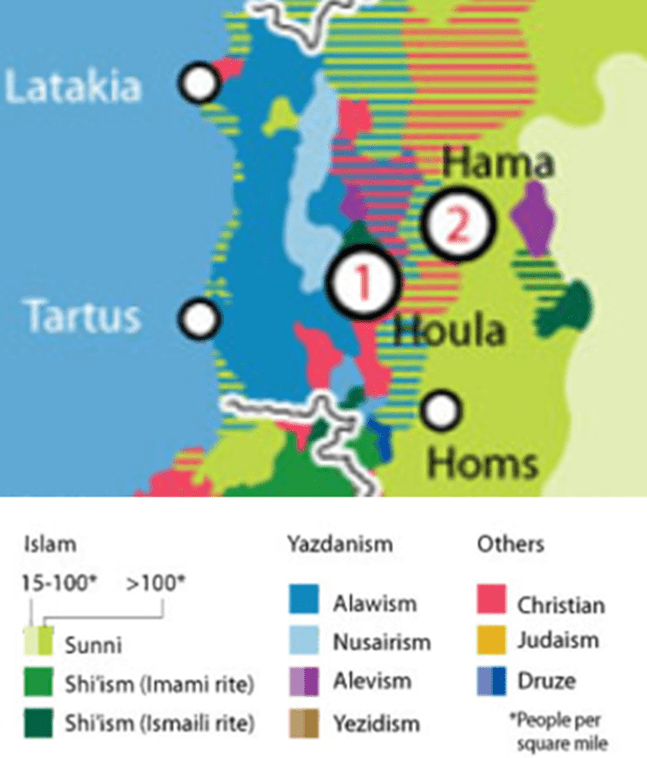
The regime itself was heavily dominated by the 10 percent Alawite minority, as this chart shows, though that was not ideological, but rather due to the nepotistic regime being dominated by the Assad family – who happen to be Alawite – and extended family, friends and connections, who lived like kings while the Alawite masses lived in poverty.
Most of the organs of state were also dominated by Alawites; as Syria expert Fabrice Balanche explains, noting that the initial uprising in 2011 aimed “to get rid of Assad, the state bureaucracy, the Baath Party, the intelligence services, and the general staff of the Syrian Arab Army,” this very fact could not help but tap an existing sectarian dynamic inherent in the Baathist set-up, because “all of these bodies are packed with Alawites, over 90 percent of whom work for the state.” If this figure is even roughly true, then, while certainly “working” for the state does not necessarily convey any kind of upper or even middle class status, it did put the average Alawite in a relatively privileged position compared to the average Sunni, placing two strategic tasks of the revolution – destroying the totalitarian state apparatus, and overcoming the sectarian divides – partially at odds with each other.
Above all, Alawite elements were absolutely dominant within the military and security apparatus of the regime — including head of the Republican Guard, chief of staff of the armed forces, head of military intelligence, head of the air force intelligence, director of the National Security Bureau, head of presidential security. According to Stratfor, quoted by Gilbert Achcar, “Some 80 percent of officers in the army are also believed to be Alawites. The military’s most elite division, the Republican Guard, led by the president’s younger brother Maher al Assad, is an all-Alawite force. Syria’s ground forces are organized in three corps (consisting of combined artillery, armor and mechanized infantry units). Two corps are led by Alawites.” Achcar continues: “Even though most of Syria’s air force pilots are Sunnis, most ground support crews are Alawites who control logistics, telecommunications and maintenance, thereby preventing potential Sunni air force dissenters from acting unilaterally. Syria’s air force intelligence, dominated by Alawites, is one of the strongest intelligence agencies within the security apparatus and has a core function of ensuring that Sunni pilots do not rebel against the regime.”
So when a regime that has ruled for decades, that is overwhelmingly Alawi-dominated, launches unlimited war against its population who rise up for democratic rights, and the majority of the rising population (though by no means all of it) just happen to be Sunni, then Alawite domination of the military-security apparatus waging this war becomes a fundamental aspect fuelling sectarianism. The towns and cities, or districts of cities, targeted for total demolition by this Alawi-led military were Sunni. As Syria expert Thomas Pierret explains:
“The problem is that many people do not even recognize the sectarian character of these atrocities, claiming that repression targets opponents from all sects, including Alawites. In fact ordinary repression does target opponents from all sects, but collective punishments (large-scale massacres, destruction of entire cities) are reserved for Sunnis.”
Pierret explains that understanding the fundamentally sectarian nature of the regime and its war is essential to understanding the scale of repression imposed by the Assad regime, which is not really comparable to elsewhere in the region:
“The kin-based/sectarian nature of the military is what allows the regime to be not merely “repressive”, but to be able to wage a full-fledged war against its own population. Not against a neighbouring state, an occupied people or a separatist minority, but against the majority of the population, including the inhabitants of the metropolitan area (i.e. Damascus and its suburbs). There are very few of such cases in modern history … No military that is reasonably representative of the population could do what the Syrian army did over the last two years [writing in 2013], i.e. destroying most of the country’s major cities, including large parts of the capital. You need a sectarian or ethnic divide that separates the core of the military from the target population. Algeria went through a nasty civil war in the 1990s, and Algerian generals are ruthless people, but I do not think that the Algerian military ever used heavy artillery against one of the country’s large cities.”
This includes the largest single massacre of the entire war – the murder of 1400 civilians in the Sunni, rebel-controlled Damascus suburb of Ghouta in August 2013, when the regime dropped the chemical agent sarin on the town, causing excruciating death.
But it is worse than this. The Assad regime’s sectarian lab was driven even more by its early establishment of proto-fascist sectarian Alawite militias (the Shabiha) to terrorise specifically Sunni populations, through mass murder of hundreds of people at a time and ethnic cleansing. This deliberate cultivation of sectarian mass murder, especially throughout 2012-2013, is what drove thousands into jihadist militia or to be otherwise bent on sectarian revenge.
Writing in the New York Review of Books, Jonathan Littell describes the process of regime-driven sectarian slaughter turning an anti-sectarian uprising into a sectarian war in Homs. On his arrival in Homs in January 2012, he reports “the people were still gathering daily to demonstrate—calling for the fall of the regime, loudly asserting their belief in democracy, in justice, and in a tolerant, open, multi-confessional society,” and notes that “The Free Syrian Army (FSA), made up mostly of army and secret services deserters disgusted by the repression, still believed its primary mission was defensive, to protect the opposition neighborhoods and the demonstrations from the regime snipers and the feared shabiha.”
However, he was able to document “the first deliberate sectarian massacre of the conflict, the murder with guns and knives of an entire Sunni family in the Nasihin neighborhood on the afternoon of January 26, 2012. Many more would follow, first of other families, then of entire Sunni communities in the village belt surrounding Homs to the West, in the foothills of the Jabal an-Nusayriyah, the so-called “Alawite mountain” from which the regime continues to draw its main support.”
He claims that even with this massacre, the FSA response “was not to slaughter an Alawite family, but to attack the army checkpoints from which the murderers had come.” But by mid-2012 this was changing and Assad’s strategy was bearing fruit as “uncontrolled” rebel units were also carrying out sectarian massacres of Alawites.
He also notes that the regime “favoured the rise, throughout 2012, of the radical Islamist armed groups that would soon enter into conflict with the more secular FSA. When Da‘esh first began conquering territory in Syria, in January 2013, “they never fought the Damascus regime and only sought to extend their power over the territory freed by our units,” as an FSA fighter explained. “Before their arrival, we were bombed each day by the Syrian air force. After they [Da’esh] took control of the region, the bombing immediately stopped.”
Following this “first sectarian massacre,” came a string of horrific Shabiha massacres of Sunni communities, of which only the most famous were:
- the massacre of 108 civilians in the town of Houla in Homs, including 49 children and 34 women, killed with hatchets, knives and guns, mostly by cutting throats, in May 2012
- the massacre of 78 people in the town of Qubair in Homs, half of them women and children, once again involving horrific killings with knives, burning and the like, in June
- the massacre of 140 people in the town of Tremesh in Hama, after the town was ‘softened up’ by a combined tank and helicopter gunship attack, in July 2012
- the enormous massacre of some 500 residents of the pro-rebel Damascus suburb Daraya, by regime troops and Shabiha, in late August 2012; under relentless regime shelling for days, the FSA left the town on August 23, in the hope of sparing the local people, yet once the FSA left, the killers went in, a Sabra-Shatilla replay
- a smaller massacre of 107 residents in the south Damascus town of Al-Thiabieh, in September 2012; besieged by Assadist forces, the FSA again tried to save the town by leaving and evacuating residents, who however refused to leave; once the FSA left, Assadist forces moved in for the kill
- the massacre of 106 people, killed and burned in their homes, in the village of Haswiya in Homs, in January 2013.
- the gigantic, horrrifying massacre of some 450 Sunni men, women and children in Banyas and Bayda, in Tartous, in May 2013 (the fact that the worst massacre of Alawites on March 7-8 was in Baniyas is sadly no coincidence)
- the massacre of 288 civilians, including seven women and 12 children, on April 16, 2013, in the Damascus suburb Tadamoun. The victims, randomly selected at regime checkpoints in a Sunni town under regime control, were blindfolded and shackled before being thrown into a pit dug in a street and shot in the back by regime troops. The bodies were then set on fire and the remains bulldozed over
However, the very fame and enormity of these large massacres can overshadow the fact that the slaughter of the Sunni population by the Shabiha regime was a far more widespread phenomenon. Thus though killings of a dozen here and half a dozen there were not so newsworthy, these small-scale massacres, village by village, killing and burning, were ubiquitous across much of Syria. This 2012 report by Amnesty International provides graphic information on the reality of full-scale death squad sectarian terror. One small excerpt:
“Syrian government armed forces and militias are rampaging through towns and villages, systematically dragging men from their homes and summarily executing them. They are burning homes and property and sometimes the bodies of those they have killed in cold blood. They are recklessly shelling and shooting into residential areas, killing and injuring men, women and children. They are routinely torturing detainees, sometimes to death.
“Everywhere, residents described to Amnesty International repeated punitive raids by the state’s armed forces and militias, who swept into their town or village with dozens of tanks and armoured vehicles, in some cases backed up by combat helicopters, firing indiscriminately and targeting those trying to flee. The outcome was the same in every case – a trail of death and destruction, much of it the result of deliberate and indiscriminate attacks.
“Everywhere, grieving families described to Amnesty International how their relatives had been taken away by soldiers and shot dead, often just a few metres from their front doors. In some cases, the bodies had then been set on fire in front of the terrified families. The mother quoted above had found her three sons burning outside her home. Another woman had found the remains of her 80-year-old husband among the ashes of her burned home after she was told by soldiers to look again for him in the house. Traumatized neighbours of a father of eight described how soldiers had dragged him to a nearby orchard, shot him in the legs and arm, shoved him into a small stone building, doused it with petrol and then set it alight, leaving the man to burn.”
More on the Syrian regime’s large-scale use of killing by fire. It is ironic that such practices would now be called ‘ISIS-style’, when in reality the horrific crimes of ISIS were carbon copies of those of the Assad regime, but on a significantly smaller scale.
This continued for years. As Robin Yassin-Kassab states, “The communities subjected to starvation siege were Sunni” [especially a string of Sunni towns surrounding Damascus from 2013 through 2017, like Madaya and Zabadani, where hundreds literally starved to death under regime and Shabiha siege, and of course the mostly Sunni Palestinian Yarmouk neighbourhood]. “The urban neighbourhoods reduced to rubble once housed Sunnis. And the people still living in appalling tent cities on the country’s borders are all Sunnis. The killing and expulsion of these Sunnis was committed by local Assadists – commanded by Alawi officers.”
Vast Gaza-like ghost-towns cover much of what was Sunni-populated Syria, bombed into oblivion. There is a vast belt extending through parts of Homs, Hama, northern Latakia and southern Idlib and Aleppo where no houses remained. As noted above it was in Homs, within earshot of the coast, where the sectarian divide created by Assad first flowered. Homs city is two cities: the Alawite side, with houses, and the Sunni side, an apocalypse. Most of the Sunni who lived in such places, and in the Sunni ring around Damascus, were forced into refuge in the north; returning to their homes means returning to no homes; but also, sometimes attempts to take back homes they were expelled from now occupied by Alawites; or sometimes ‘revenge’ attacks. The same is true for much of the 6.7 million refugee population. Also within earshot of the coast is the province of Hama, likewise divided between Sunni and Alawite; this is where the Assad regime bombed the rebellious city back in 1982 and killed 25-40,000 people.
Even as late as 2018, opposition sources alleged that Shabiha militia had massacred some 200 Sunni civilians in Homs over two weeks in September. And this is all without even getting to Assad’s string of torture dungeons, such as Sednaya, run mostly by Alawite security officials, housing a horrifically tortured prison population that was overwhelmingly Sunni, as were most of the 130,000 ‘disappeared’ into mass graves – “missing” when Sednaya and other torture dungeons were opened after December 8.
In this way, “The Assads made the Alawite community into which they were born complicit in their rule, or at least, to appear to be so.” Not that they necessarily were, of course; we’ve already noted above life-long Alawite anti-Assadists who were tragically slaughtered in March. But under Assad, “independent Alawite religious leaders were killed, exiled or imprisoned, and replaced with loyalists. Membership in the Baath Party and a career in the army were promoted as key markers of Alawite identity. The top ranks of the military and security services were almost all Alawite.” Meanwhile, the Sunni sectarian backlash that this terror produced was precisely one of the diabolical aims of the regime, in order to “frighten Alawites and other minorities into loyalty.”
An understanding of the real depth of the weaponised sectarianism unleashed by the Assad regime is essential to comprehending the extraordinary scale and seeming irrationality of the Assadist slaughter machine.
At a Gaza rally I attended recently, a young Palestinian refugee from Gaza, while speaking of the historical links between Zionism and antisemitism, noted that as a child living in the horror of besieged and traumatised Gaza, it was difficult to distinguish between Jews as people and the Zionist regime “when the only Jews you ever meet were those holding a gun in your face,” or we could add, torturing, disappearing and murdering your family, friends and neighbours; it is not difficult to see the analogy to how a traumatised Syrian Sunni child growing up in these years, now perhaps a severely damaged young man, possibly an orphan, would also not have known what an Alawite was beyond those holding guns to his face or slaughtering his family and neighbourhood.
This deliberate cultivation of sectarian hatred by the Assad regime meant that the necessary and inevitable victory of the Syrian people against the horrific dictatorship always had a serious question mark to it; was liberation for most Syrians going to be accompanied by large-scale sectarian revenge against the Alawite population? Even if the leadership tried its best to prevent it? This is not a “minorities” question as it is often posed; it is not about Christians, Druze, Ismailis, not even Shia, nor the ethnic Kurdish minority; it is a very distinctively Sunni versus Alawite question, created by the Assad regime sectarian lab. And the question was especially posed if victory over the regime was an all or nothing military victory, the only type the uncompromising regime allowed for.
The ‘political solution’ offered to the Assad regime by the UN Security Council and US-Russia agreements from 2012 onwards offered a way out that allowed some kind of transition authority composed of a mix of people from the regime and the opposition leading to elections; then UN Security Council Resolution 2254 of 2015 even dispensed with the transition authority, allowing the Assad regime itself to convene a “constitutional commission” leading to elections under the regime!
This would have prevented outright military victory by the opposition, allowing instead a transition away from dictatorship involving a series of stages and compromises, keeping the state machine intact. This solution offered more to the regime than to the aspirations of the revolution; it offered a conservative transition. Keeping the ‘state’ intact may have been positive in terms of public services and overall security, yet this was the state of the uber-repressive and genocidal regime. But given the sectarian divide created by Assad, it may have offered a safer road for minority populations, and especially the Alawites. Despite the maintenance of the Assadist state machine, if this road had created a more open atmosphere, it may have allowed for the civil democratic movement to re-ignite, opening the path for healing sectarian divides via common popular, democratic and working-class struggles, to hopefully replace the regime later.
But the Assad regime utterly refused to move. Not just the UN and US and EU, and Turkey and the Arab states, but also Russia and Iran attempted to push forward the constitutional commission and UN Resolution 2254. Russia and Iran increasingly saw the regime was rotting from the inside and understood that it needed to compromise, especially with Turkey, given its 3.7 million Syrian refugee population. The regime was unmoved. When the initially defensive push by the Idlib-led rebels (Operation Deter Aggression) came in late November 2024, the hollowed-out and hated regime simply collapsed, rendering the discussion of political versus military solutions irrelevant.
The initial ‘fairy-tale’ and its abrupt ending
Essentially forced by Assad’s obstinacy to take Damascus in this way, the possibility of uncontrollable anti-Alawite revenge was now open. The true miracle of the December revolution was that it did not happen. Despite its distant origins in al-Qaeda, the transformed HTS leadership helped ensure the inclusion of ethnic and religious minorities – Kurds, Christians, Druze, Ismailis, Shia and Alawites – in the immediate transition period. Whether one considers this ‘true conversion’ or ‘hard-headed pragmatism’ was irrelevant to the outcome. Not only was bloody revenge avoided, but arguably this outreach was just as crucial to the success of the revolution as the hollowing-out of the regime itself.
On December 5 HTS issued a statement proclaiming the Alawites to be an indispensable part of Syrian society, calling on them to abandon the Assad regime which it claims “hijacked” the Alawites to conduct a sectarian battle against the opposition. Alawite leaders – “we, the sons of this sect in the city of Homs,” responded by calling on revolutionary forces entering Homs “to maintain civil peace and protect all societal components in the city with all their different spectra,” to spare Homs “from entering a new round of revenge,” to show “the responsibility that you have shown in many cities that you have previously entered,” while also calling on local Alawites to “beware of being drawn into the false propaganda and plots that the regime has been spreading with the aim of sowing fear and terror among you,” and “not to allow the regime to use you again as fuel for a battle that it has in fact been losing since the first day of this revolution.” On the verge of the liberation of Homs, “we aspire for it to become a model to be emulated in affirming the unity of the Syrian people and their ability to overcome the wounds of the painful past.”
These messages on both sides allowed the revolution to proceed bloodlessly. And, whatever the inevitable bumps along the road, this promise of the revolution largely worked for Christians, Druze, Shia, Ismailis and Kurds (the initial Turkey-SNA war on the Kurds and SDF was quite separate from HTS-Syrian government policy). But while there was no revenge massacre of Alawites, things began to sour by the last week of December; yet hope remained, there was potential for improvement.
After the horror of March 7-10, however, many Alawites would find these fine words extremely bitter. The Alawites dumped the hated regime, which stole from them while sacrificing a generation of their sons to war, many greeting the revolutionary forces when they entered. But now that warning by Alawite leaders to not allow the regime to use false propaganda to “sow fear and terror” of the anti-Assad forces must feel ironic and deceitful. While few will begin praising the Assad regime which most know created this dilemma of mutual hatred, it should not be surprising if many or most now believe their lives were more secure before December.
As such, the March massacres can be considered the seemingly ‘inevitable’, delayed three months; as Robin Yassin-Kassab put it, the fairy tale has ended. But it was not inevitable.
A heavy weight lies on the shoulders of the Assadist officers who launched their coup and massacre of hundreds of security and civilians. They knew they had little support and their coup was in vain; the aim was to create massive instability, destroy any possibility of inter-communal reconciliation, and provoke a bloody response in order to call for international intervention, from countries such as Israel (and here), France or Russia. They were willing to sacrifice the Alawite population for these aims, as laid out in the most cynical terms in a March 18 public statement by Assadist insurgent leader Moqdad Fatiha, who, following the massacre of hundreds of his fellow Alawites, declared the uprising a “victory,” because the Syrian government suffered heavy losses “in numbers and equipment,” and was only able to respond “by killing women and children.” Apparently this murder of Alawite civilians, including “women and children,” is a victory because “thanks to our blood and martyrs, the image of al-Jolani and the de facto government was burned.”
The unfolding deterioration of the situation from December to March
Regarding the deterioration of the security situation in the Alawite regions from late December onwards, while one narrative poses this as a gradual lead-up to March – ie, Sunni sectarians or revenge-seekers began killing and kidnapping Alawites on a small scale from December until it evolved into an outright massacre – this omits a great deal of context.
These low-level crimes coincided with a number of things happening simultaneously. First, the government began a campaign to ‘comb’ these regions to arrest prominent Assadist war criminals, something which absolutely must happen. Yet in the process of doing so, some security patrols violated their protocols and carried it out in a heavy-handed way with serious violations. Secondly, the Assadist insurgency of March also had its low-lying predecessor; this began with the massacre of 14 security personnel on December 25, as they were on their way to arrest an Assadist war criminal, and continued sporadically. On January 14, when two security members are killed and seven captured by a militia led by former Shabiha commander Bassem Hossam al-Din near Jableh, al-Din released a video threatening to behead the men if HTS did not leave the coast. Meanwhile, footage was released in late December of the desecration of an Alawite mosque that had taken place weeks earlier as rebels approached Aleppo; this had taken place before the rebels arrived, and the new authorities condemned the action and arrested perpetrators; releasing the video now was aimed at suggesting this was happening then, leading to Alawite demonstrations.
Meanwhile, some of those seeking individual revenge on Alawites dressed as security personnel while carrying out violations. To counter this, on January 16, the commander of the Tartous Region declared that “any force from the General Security or the Authority that does not carry an official mission and does not have a Mukhtar [Alawite village leader] with them are thieves and troublemakers.” This was provoked when an armed group of some 40 men raided a house by in the town of Safsafa claiming to be from the Authority; General Security confirmed they were not from the Authority and the men fled. Further, the security vacuum in these regions meant that many ordinary crimes also took place, eg robbery, looting, kidnapping for ransom, in some cases leading to killing; this was not only happening in Alawite regions but around the country, but the security vacuum was worse in these regions.
The height of these earlier tensions was reached in late January, when a security patrol in the town of Fahel in western Homs kidnapped dozens of local men, most of whom were released, but some 20 found dead. Fifteen of these men were former military officers, but the dead included civilians, and in any case such murderous retribution without trial is unacceptable, and breeds terror, even if the officers were guilty of crimes. The authorities announced that “a number of suspects” had been “arrested and referred to the competent judiciary to receive their just punishment.” Around the same time, a security raid on an Alawite home in Maryamin, also in western Homs, was replete with religious and other violations. The Homs governor visited the house and promised consequences.
However, by February, the data was showing that violations on the coast were in decline, and violent deaths and kidnappings now lower than some provinces where there were new spikes in violence, in particular Aleppo, Idlib, Daraa and Deir Ezzor, that had nothing to do with the Alawite question. According to Gregory Alexander, “in February, all locals interviewed for this paper said that conditions in Tartous and Latakia were continually improving. Damascus had withdrawn almost all of its military factions and ended house raids following the massacre in western Homs in late January. The remaining GSS and police forces were well-regarded.”
There thus appeared to be momentary hope that the worst was over. Moreover, when the data for the number of attacks and killings began to rise again in the region in the last week of February and early March, these were attacks by Assadist remnants on security forces, ie, the galloping insurgency that broke out in earnest on March 6.
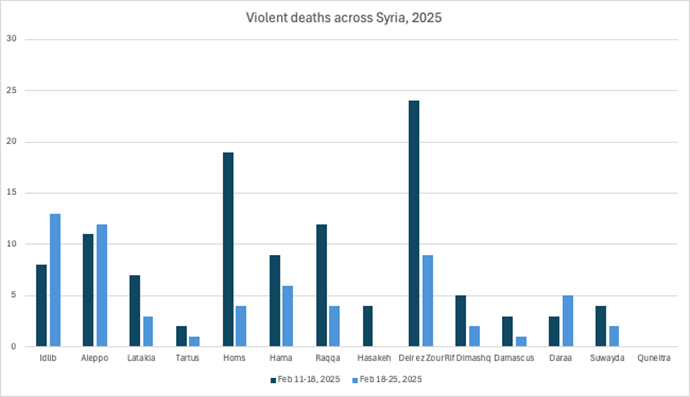
Violent deaths and kidnappings in the weeks February 11-18 and February 18-25 – death figures include those from unexploded ordinance (44 of 111 the first week, 28 of 62 the second week). Clearly, violence in Tartous and Latakia and even Hama was now eclipsed by violence elsewhere; even Homs showed a marked decline the second week.
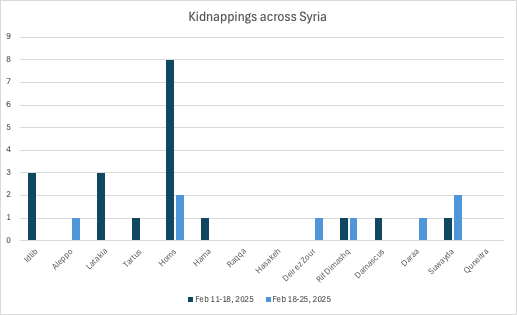
Kidnappings in the weeks February 11-18 and February 18-25. Again, Latakia, Tartous and Hama are either the same or lower than elsewhere, and in the second week they experienced no kidnappings; Homs remained an outlier.
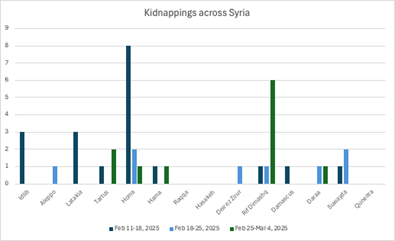
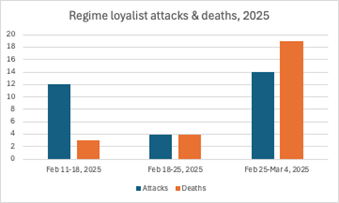
Violence rises in late February and early March, but with kidnappings still low or absent in the four provinces concerned, and a surge of Assadist attacks, it is clear where the new violence was coming from.
Causes of this deterioration of the Alawite situation
What were the prime causes of this deterioration of the situation of the Alawites in Tartous and Latakia, and even more so of the Alawite minorities in the mixed provinces of Hama and Homs, especially in their western rural districts? Two discourses sharply oppose each other.
- One prominent narrative is that the Alawite military and police officers of the Assad regime were granted sweeping amnesties, and have been allowed to wander around and live their lives, with only the most heinous criminals arrested, and none of them have yet faced the judiciary; that there has been no apology from mainstream Alawite leaders for their support for Assad and his genocide against Syrians; that many condemn Assad for “abandoning them” rather than for what he did; that they complain of their difficult situation but at least they have houses, whereas millions of mostly Sunni remain in exile or internally displaced, living in tents in the snow, as their homes and entire cities have been destroyed. Then these heavily armed Assadist insurgents came out of the towns and villages “protected by the local Alawites,” or who at least knew what was coming. Some had come into the streets and celebrated when there were rumours that Mahed al-Assad was returning to the coast. While few spin this story to justify the killings of civilians, they nevertheless claim these factors help explain the horrific retribution. In fact, some claim that al-Sharaa “is the only barrier against a full massacre against the Alawites in Syria,” and (according to another similar voice) “if you don’t believe me, visit us in the old neighborhoods of Homs and see the destruction and graves that have become public prisons.”
- The opposite narrative is that while the Alawite military and police were amnestied, they lost their jobs as the old police and army were disbanded. They have been left to return to their towns and villages with no source of income, with no other work available. The government has also launched sweeping retrenchments from the public sector, which it has justified on the basis that there were large numbers of fake jobs that were just regime favours; and once again, the impact falls largely on Alawites. Meanwhile, the collapse of the old regime’s armed forces has left a security vacuum in the Alawite regions, and while there was no massacre in December, there were constant killings and kidnappings of Alawites over the three months before March 6. In some cases government security personnel are blamed, but while most perpetrators are unknown, there have been few arrests and no indictments. Again, while most do not justify the Assadist insurgency with this discourse, they see this as a reason it did have a degree of support or at least neutrality within the Alawite community.
Both narratives, however sharply opposed, contain much truth.
Yes, there was a sweeping amnesty; tens of thousands of former troops passed through government “resettlement” processes to demonstrate their innocence. However, while a very significant number of Assadist war criminals have been arrested, none have faced the judiciary yet; and even larger numbers of medium-scale criminals have escaped arrest altogether, supposedly in the interests of social peace. In some cases even worse Assadist criminals, unaccountably, walk the streets (eg, Fadi Saqr, former NDF leader who shares responsibility for the Tadamon massacre, was inconceivably amnestied, leading to protests; war criminal Ziad Masouh, responsible for massacres in western Homs region, was released from prison; Khaled al-Qassoum, head of the Shabiha ‘Popular Resistance’ militia and close associate of the ‘Butcher of Baniyas’ Ali Kayali, returned to live in Hama city with security guarantees!).
This has created huge resentment among Syrians whose families were slaughtered and homes and cities destroyed. The lack of a ‘transitional justice’ process in the months since December is widely cited as a factor driving on-the-ground retribution against perpetrators, assumed perpetrators, or in the worst cases, collective retribution against Alawites. Thus while the security forces can in some cases be blamed for being too harsh on the Alawite communities when searching for Assadist criminals, this goes hand in hand with the government being too soft on these criminals in the bigger picture. Al-Sharaa is aware of this; he has regularly declared that justice must take place through the courts, rather than on the streets. Yet there has been little to show for it.
Yes, the collapse of the Assadist repressive forces falls hardest on the Alawite community, yet it is unclear that this as anti-Alawite policy as such; this is an indictment of the extreme sectarian nature of the Assadist military-security complex, overwhelmingly dominated by Alawites at the level of officers. These repressive forces melted away in December, collapsed in a heap, to the relief of millions of Syrians. There is no way they could have remained in existence under their current officers after decades of genocidal violence.
This is the same with the mass retrenchments; they should be condemned as an anti-working class measure. Even if true that the former regime created fake jobs as claimed, this should be something investigated by the workers through unions of workers’ committees, to determine what jobs are actually fake rather than excuses for neoliberal restructuring. But once again, it seems likely that the reason the measure has fallen more heavily on Alawites is due to the overwhelming Alawite domination of public sector jobs.
That said, I do not doubt that the factor I cite here is intensified by unofficial sectarian discrimination, given the domination of the new state by former HTS elements.
But this is not the end of the problem; the problem remains that those who lost jobs as the old police and army collapsed, or in the public sector retrenchments, now do not have work. This in itself is both an injustice, and a source of alienation from the new authorities by the Alawite population who see the measures as directed against them, whether valid or not.
Moreover, the fact that those dismissed from the police and army, and whose status has been “settled,” have not yet been recruited to the new police, general security forces and the new army can both be seen as anti-Alawite discrimination, and in addition as the major reason for the security vacuum in the Alawite regions and the number of killings and kidnappings going unpunished being higher than elsewhere.
Undoubtedly, the government should have moved faster to re-recruit “settled” Alawite former security personnel into the new police and General Security, so that they could have primary responsibility within Alawite regions. Even though I have provided evidence above that General Security were the least guilty of violations and were most often considered to be ‘professional’ compared to military ‘factions’, nevertheless, a security force, however decent, which does not have roots in the area and the specific community, given the deep divisions in Syria, will inevitably not be able to do the job as well as local security forces would, and the paucity of arrest and punishment of the actual violators demonstrates this.
There is no formal ruling that Alawites must not be recruited or that the security forces must remain Sunni, and it is likely more a matter of the new regime only being in existence for three months after the collapse of a 54-year old tyranny and a 14-year war. However, there is much evidence of unofficial barriers, and whether this is due to unwritten understandings from above or merely discrimination on the ground remains unclear. For example, according to a long-time anti-Assad Christian in Latakia, “they are not allowing Christians to join the security forces and I don’t know why. I had a friend try to bring his son to GSS recruitment office. They said thank you we are happy to have you, but after they learned he was Christian they said sorry, we can’t take him,” adding “Still, we love the General Security and they cause no issues for us.”
Likewise, there has been no attempt to recruit “settled” former Alawite troops into the new Syrian army. But the “new army” at this stage is simply the partial patching together of most of the old rebel militia who formally dissolved in January, those which were still surviving after years of defeat, retreat, destruction, exile and in some cases degeneration. As such it is an overwhelmingly Sunni army by default, with scattered individual Christian, Druze, Ismaili and Kurdish members. Until the dissolution of the Emirati-backed 8th Brigade in Daraa in mid-April, not even all the Sunni-based militia had dissolved; and as noted above, many of the Turkish-backed SNA militia had only partially done so.
And herein lies a very important distinction between the Alawites of the coast and other territorially-based minorities, namely the Druze in Suweida and the Kurds in the northeast: the latter two have been able to maintain security in their own regions, and pose a strong negotiating position with the government (ie, neither have yet joined the new army, despite agreeing in principle), because they developed their own armed forces due to their autonomous struggles during the revolutionary period. By contrast, the only de facto Alawite armed forces were those of the Assad regime. When it disappeared, they had nothing else.
Therefore, it is an urgent task for the new Syrian police, security forces and army to recruit former Alawite equivalents whose status has been settled, not simply to provide them with income but to end the security vacuum in their regions and as a step to fuller inclusion of the now effectively excluded Alawite part of the population.
In addition to unofficial discrimination and shortness of time, there is a further reason why recruitment of security and military forces beyond the core group has been slow: the ongoing US sanctions, which are making recovery and reconstruction impossible, and ensuring the government has no money with which to pay new troops from any quarter. Indeed this is also a reason why some of the former militia components of the new army remain in practice autonomous, connected as they are to traditional means of earning income (eg, for some SNA militia, payment from Turkey, criminal activities etc).
What now? The evolution of the al-Sharaa government
The al-Sharaa regime has shown contradictory features since assuming power in December. On the one hand, there is a strong pragmatic streak, whereby many of its moves – beginning with the outreach to non-Sunni minorities during the revolution – stood in stark contrast to HTS’s Sunni Islamist sectarian history, while others show a growing attempt to assert precisely these more Islamist aspects in a gradualist way.
These two sides represent two different pressures on the ruling group: the democratic pressure of the revolution itself, which was never about imposing any kind of religious dictatorship on the people, but on the contrary, overthrowing a dictatorship in order to establish a free Syria for all; and the pressure from sections of the HTS base which had joined HTS precisely due to its Sunni-Islamist heritage. The latter, by the way, is by no means all the HTS base; on the contrary, the pragmatic direction the al-Sharaa leadership took the last few years reflected a significant part of the base who had only joined HTS as it was the most effective fighter against the regime, and after the Assad regime had conquered and subjugated so much of free Syria where a wide variety of more democratic and progressive political forces had dominated among the rebels; HTS remained the only major force outside the direct control of Turkey (which had similarly coopted other beleaguered rebel forces).
The ongoing revolutionary process is manifested in the continuation of a largely free atmosphere for discussion, organisation and protest; the new government does not react to popular protest against its policies with machine gunning, tanks, warplanes, barrel bombs, chemical weapons, mass graves and industrial-scale torture gulags. Anyone believing the new regime is simply an Islamist copy of the old simply has no idea of the Syrian reality (though arguably, after March, it very much does appear this way to the Alawite population).
However, the ruling group around the former HTS leadership has also made various moves to consolidate its power within the new set-up, limiting the move towards democracy at an institutional level: Sharaa being appointed as interim president by a January conference of rebel militia (who agreed to dissolve into the new army), meaning he was appointed by only on section of Syrian society; the long promised National Dialogue Conference did not live up to its promise and was arguably farcical; the government declared it would take some four years to write a new constitution and five years for elections to be held; the interim constitution, to be in effect until a new constitution is written, declares ‘Sharia’ to be the major influence on Syrian law, and that the president must be a Muslim – though in fact in continuity with the Assad regime constitution, revolution supporters would prefer to go beyond the old regime on this (though other aspects were better, including those regarding equality for women and respect for the country’s for ethnic and religious diversity); the interim government appointed by Sharaa to rule for the first three months was heavily stacked with HTS leaders and close allies, but the new transitional government appointed in April was much better, with only 4 HTS members of the 23 members, yet there is only one woman, one Alawite, one Druze, one Kurd and one Christian (who is also the one woman) as opposed to 19 Sunni Arab men (for more detail on all this, see my article ‘Syria 6 months after the revolution – Part I: The domestic situation’).
While there are concerning aspects in all this, the revolution is not the regime, but the people who made it and their continuing ability to organise and influence the direction of policy without suffering repression. The problem is that unions, civil society, grassroots organising, are all in a very weak position due to decades of totalitarian repression and a decade of genocide, the crushing of all revolutionary institutions and councils, and mass exile. This is a dangerous reality, especially given the desperate poverty, the lack of work, the sanctions and the lack of reconstruction, forcing people into the struggle for everyday survival. Nevertheless, we have seen admirable examples of fightback when government ministers have made regressive moves, including significant demonstrations and public meetings by women to protest the anti-woman agenda put forth by some HTS appointees.
Therefore, while many of these institutional moves are concerning, in themselves they do not represent the burial of the revolution or the institution of a ‘dictatorship’. On the contrary, the situation remains fluid and open. The possibility of the revolutionary masses influencing the country’s direction, including altering such institutional aspects, remains potent.
This however is what is different about the slaughter of hundreds of Alawite civilians on the coast in March. Whatever the negatives of the situation, most non-Alawite Syrians consider themselves free, that their freedom was brought about by the revolution, and are optimistic about the direction their country is going. Despite propaganda, Christians on the whole are strongly supportive of the revolution and the government, as are Ismailis; and both Christians and Ismailis have played a kind of mediation role between the Sunni-led government and the Sunni and Alawite communities at times. According to a Christian activist in Latakia, “General Security deployed to all churches during Easter while local Sunni-Christian neighborhood groups also protected churches.” The Druze have likewise generally been supportive of the post-revolution reality. A group of local civil, religious and militia figures in Suwayda called upon the transitional government to review the constitutional declaration and to ensure that those responsible for sectarian violence be held publicly accountable, and the Druze leaderships have been hard-bargaining with the government on the specifics of their integration into the new Syria. Following clashes between armed jihadists and Druze in late April, the government and most of the main Druze leaders reached an agreement that the GSS would enter Suweida, but that it would be composed of local Druze [the terrible conflict in mid-July took place well after this was written and essentially negates this prior reality]. Likewise the Kurds are doing their own hard bargaining but continually stress they see their future in an integrated Syria. The agreement between the Syrian government and the SDF on March 10 – just a few days after the March bloodshed – for the future integration of the SDF and the Rojava statelet into Syrian institutions, represents a huge positive, and both sides appear committed to moving forward, with committees being formed to hash out the details. Even the Shia have continually declared support for the new government, while the government has prevented attempts by ISIS to attack the main Shiite shrine of Sayyida Zeinab near Damascus (indeed it was tipped off by US intelligence).
In contrast, whatever attempts many Alawites initially made to feel the same, as of March, it would be surreal to not recognise that the Alawite citizenry do not feel free; that they feel their torment and manipulation by Assad has been replaced by total alienation and impunity, existential fear and exclusion from the new Syria. The revolution’s aim was to free all Syrians, not 90 percent of them; the exclusion of the Alawite ten percent and the coastal region from the revolution is a massive hole in it. Recovering from it, if possible, is a life and death question of the country’s direction.
Of course, there are different views among the Alawite population, with some elements still open to seeing how the government’s investigation turns out. For example, long-time anti-Assad Alawite Hanadi Zahlout noted above, whose brothers were murdered by sectarian gangs in March, noted that al-Sharaa had called her to express condolences “to my family and to all the victims’ families, and promised to hold the culprits accountable.” She expressed her support to the Commission “and we are ready to cooperate and submit our certificates for justice to be done and the law to prevail in our country and on our land.” Similarly, on March 8, 49 Alawite clerics and civil leaders issued a public statement declaring their support for the interim government and for al-Sharaa’s speech, calling for accountability on all sides and demanding that weapons be restricted only to the state. These two examples suggest that there is still a part of the Alawite citizenry that believes in the possibility of justice being done and of reconciliation; these are significant people, and while their confidence is difficult to even fathom in the circumstances, it must be taken into account.
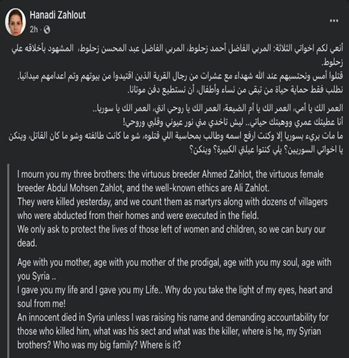
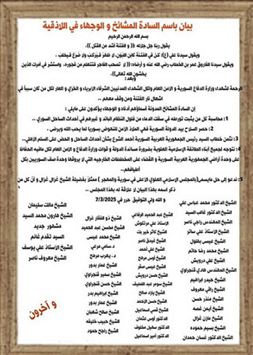
Top: Hanadi Zahlout’s statement mourning her brothers; Bottom: Declaration of 49 Alawite clerics and civil leaders calling for accountability while declaring support for interim government.
However, even such confidence, or hope, is strained to put it mildly. Three months later, on the eve of the release of the commission’s report, Hanout describes the situation grimly: “my home area is still surrounded by checkpoints. The killings continue and people live in constant fear, unable to resume their lives or even perform basic daily tasks like farming or moving along the roads. Families of the victims are still denied the dignity of burying their loved ones. Survivors continue to search in vain for healing. Homes lie in ruins, and children live in perpetual terror.”
Furthermore, some 22,000 Alawites have fled to Lebanon, according to the UNHCR, while 8,000 others took refuge at Russia’s Hmeimim airbase in Latakia, according to the Russian News Agency TASS (it seems Russia more recently encouraged them to leave, in cooperation with Syrian security forces who assured them of their safety). For them and perhaps the majority of the now heavily traumatised population, it is extremely unlikely that any belief in justice or reconciliation is possible, at least for the foreseeable future.
One final point: aside from the severe moral and political imperatives, dealing properly with the massacre and the alienation of the Alawites, as well as dealing properly with other minority issues (Druze, Kurds), is essential to forging a real Syrian unity; far from being seen as a ‘compromise’ with ‘separatism’ as some voices claim, this is essential to standing against not only internal sectarian or separatist threats, but also external (especially Israeli or Iranian, but potentially Russian, Turkish, UAE or US) exploitation of these divides; it is a life and death question of the revolution’s security, given the number of real and potential foreign enemies it has. This will be discussed in a future article: Syria 6 months after the revolution – Part II: New Syria’s Foreign Policy.
What needs to be done?
To salvage the situation, Syria needs to ensure a number of things happen.
First, the investigation must be genuine, fair and transparent, and perpetrators on both sides must be held accountable. While a number of arrests have been made, the danger would be just lower-level perpetrators being convicted, and those responsible at a higher level, with regime connections, not held accountable. In particular, the widespread evidence of the involvement of the ‘Amshat’ and ‘Hamza’ SNA brigades in the crimes against Alawite civilians raises important issues. While HTS has clashed with these forces in the past, in order to coopt them their leaders have now been given important positions.
For example, Mohamed Jassim (Abu Amsha) was appointed commander of the 25th Division within the Defense Ministry (subsequently called the 82nd Division, while somewhat confusingly he still runs his own brigade which is now called the 62nd Division). The 25th Division is based in Hama; he was probably moved there in February precisely in order to get him out of Afrin (and since he vacated Afrin and HTS-led security took over, tens of thousands of Kurds have returned). However, being located in Hama may have facilitated the entry of Amshat militias to the coast in March (though there are also ex-FSA-based divisions in Hama, the 60th and 74th Divisions, which seem to have gained the confidence of the population). Similarly, the former leader of the Hamza Division, Brigadier General Sayf al-Din Bulad (Abu Bakr) was appointed commander of Syria’s 76th Division, based in Aleppo.
In similar vein, while not directly connected to the coastal massacre, in May, the government appointed Ahmad al-Hayes (Abu Hatem Shaqra), head of the notorious Ahrar Al-Sharqiya militia, to lead the new army’s 86th division, responsible for Raqqa, Al-Hasakah and Deir ez-Zor. In 2021, he was placed under US sanctions for crimes including “overseeing summary executions at a prison Ahrar Al-Sharqiya ran outside of Aleppo and trafficking Yazidi children and women,” as well as the murder of Kurdish politician Hevrin Khalaf during Turkey’s 2019 invasion of northeast Syria.
So will the investigation net ‘big fish’ such as these, or just the street criminals and rank-and-file troops we see in the photos of those arrested? But just as important are issues of compensation, reconstruction and inclusion. The outcome is crucially important to Syria.
Secondly, Transitional Justice Is a Must (with this link raising many good arguments). While the lack of it does not justify vigilante justice (let alone collective punishment of Alawite civilians), it would be naïve to think that these will not be the results, as not everyone acts rationally. In fact, while the massacre was brought to a swift end and even the level of ordinary violence is now relatively low, we are now seeing the beginnings of more directed ‘street justice’ moves. In Homs, a former Assadist commander was killed on April 20, and the assassin appeared on video complaining he had raised charges against him related to crimes against civilians, to no avail, so he acted himself; and in Aleppo, a militia calling itself the Special Accountability Task Force was launched on the same day, by former rebels take the law into their own hands and assassinate former Assad regime criminals.
On April 25, Syrian activists called ‘Friday of Rage’ demonstrations around the country under the slogan ‘Transitional Justice and the Beginning of Trials.’ This demonstrates the depth of anger at the lack of accountability of the Assad-era criminals responsible for hundreds of thousands of killings and untold destruction. While this is obviously a crucially important thing to happen in and of itself, its connection is that, if the investigation committee does do its work properly and people are prosecuted for crimes against Alawite civilians, but there have been no prosecutions against those responsible for the Assadist genocide, this may result in popular rejection of the justice meted out to the first group, and further poisoning of community relations. “Ending sectarian tensions,” al-Abdullah, a Sunni resident of Jableh claims, cannot be spoken about “without arresting the remnants of the regime and bringing them to justice.”
Al-Sharaa finally issued a decree on May 17 for the establishment of a Transitional Justice Commission, tasked with “uncovering the facts regarding the violations of the former regime” and to “hold accountable those responsible for the violations … and redress the harm caused to victims and consolidate the principles of national reconciliation.” On the same day, a National Authority for Missing Persons, to be responsible for “investigating and uncovering the fate of the missing and forcibly disappeared and documenting their cases,” was also established. While a hopeful sign, to date there has still been no sign of prosecutions, and the sight of a number of major Assadist war criminals walking free, as discussed above, is not a good sign at all for the prospect of Sunni war criminals from the coastal massacre seeing accountability.
Third, it is urgent to fully include the Alawite population in the new governing structures, including security forces. Despite Alawites being involved in lower-level local councils, all power is with the security forces and new regime officials at higher levels. Alawites need to be appointed to higher level governing positions, recruited to the general security forces to serve in their regions, and “resettled” former troops need to be enlisted into the new army. To date, these remain de-facto largely Sunni institutions. The Alawite woman interviewed by Gregory Waters (cited above) claims that in Homs, “General Security members all come from the same sect, except for one member called George [a Christian] … no Alawite or Shia’a or other minorities have joined the security force till now.”
There have been important developments in southern Syria, where the government has begun recruiting Druze in Suwayda for the army, with significant early turnout, based on a memorandum of understanding with Druze leaders agreed to shortly after the government-SDF agreement on March 11. Local security forces are already Druze. While there is no official impediment to recruiting Christians, and Ismailis have cut out their special place within Syria’s new security architecture, it is moving the dial on Alawite recruitment that is crucial. The Security Forces opened up recruitment centers across the country in April, including in Baniyas and Latakia, as well as Hama, Homs and elsewhere; hopefully this is a sign that Alawites and not just Sunni in these regions are to be recruited.
Again citing the interviewed Homsi Alawite woman, when questioned what needs to be done for the Alawites to feel included in the new Syria, she responded “I think they should allow and chair the Alawite men to join the police and security forces … And the Alawites should elect a group of active and educated and religious men to make a council or something that speak in their behalf and meet with the president Ahmad al-Shara and make some kind of deal to protect and save their rights and to reactivate their existence in society in an effective way.” Something called the Alawite Islamic Council has been set up, but it is unclear how representative it is. Claiming “the former regime is the one that kept us poor, with no way to make a living but to volunteer for the army or state jobs”, the council noted that Alawite notables, in repeated meetings with the new Syrian administration, had called for “security cooperation with the state and its security forces, by forming security committees from both sides,” an end to provocations and inflammatory sectarian slogans and the reinstatement of dismissed state employees.
Fourth, the government needs to crack down on uncontrolled armed jihadi groups, of the type that took part in the Alawite massacre and led the attack on the Druze in southern Damascus. This will be no easy task – their existence is related to a number of factors: first, the lack of transitional justice; second, the lack of jobs in Syria’s current catastrophe (in this sense they have something in common with their Alawite enemies who took part in the Assadist insurgency in March); finally, the fact that many of them belong to the traditional jihadi base of HTS from which the current leadership arose, so despite not wanting the instability they cause, there may be elements within the ruling state apparatus that still have connections to these groups, there may be a spectrum with a lot of grey areas. Either way the government does need to act to prevent their deeply destabilising impact.
Related to this is the necessity of a political struggle against sectarianism. It is one thing when ‘street justice’ in the absence of court justice targets actual criminals; it is an entirely different thing when the entire Alawite population is associated with the crimes of the Assad regime and targeted collectively (and even more when this is extended to other non-Sunni minorities that had no connection to the Assad regime, such as the Druze). While obviously the Assad regime’s criminal weaponisation of sectarianism to carry out its counterrevolutionary war is responsible for this mutual hate, liberation means not simply reversing the victim but fighting the ideology.
Two important steps have taken place. First, on May 30 the Ministry of Defense issued a code of conduct and discipline for the army, which demands troops “treat[ing] citizens with dignity and respect, without discrimination based on religion, race, colour or affiliation,” observe human rights standards, protect civilians and so on, and prohibits any assaults on civilians or property, “engaging in any form of discrimination,” “proclaiming slogans or positions that undermine national unity or disturb civil peace” and the like. While a code itself does not immediately change deep-seated attitudes, it is undeniably an important step in that direction [post-script: though the Suweida massacre in July demonstrates that much more is needed than the existence of a code]. Second, on June 6, the Supreme Fatwa Council issued a fatwa declaring that those who have been wronged are “obligated to obtain their rights through the judiciary and competent authorities, and not through individual action,” declaring acts of “revenge or retaliation” to be forbidden – an important step in the context of ongoing retribution killings which, while mostly directed, can by definition both lead to errors and/or can act as cover for sectarian killings.
Next, the complete end of sanctions against Syria. Fortunately, this is now in progress (which it wasn’t when this piece was started), but the process is not complete, and various US leaders continue to imply that it may be conditioned on certain geopolitical moves by the government (eg, Trump recently threatened that “The Secretary of State will reimpose sanctions on Syria if it’s determined that the conditions for lifting them are no longer met”). The economic strangulation of the Syrian people must end, so that the government has the money to pay proper wages for public services (including security), industry begins to move and creates jobs, and housing, energy and infrastructure can be repaired. The lack of work for a very large part of Syrian society is connected to both alienation of a large part of the Alawite population and a reason some, or many, may have backed the Assadist insurgency, and to the rootless armed jihadi factions. Whether the mass retrenchments from the public sector, and the collapse of the old military and police forces, had their biggest impact on Alawites due to active discrimination, or conversely, due to pro-Alawite discrimination in employment under Assad (and this is most obviously the case with the military-police dismissals), is almost a moot point; the fact of the matter is that the government has no money to either maintain its public sector or to employ greater numbers of new security forces (eg, to re-employ the Alawite security personnel in the GSS and new army) until some level of economic activity, investment, access to loans and so on kicks in. Of course, if the rights of Alawites continue to be violated or the investigation’s aftermath becomes a farce the demand for end of sanctions may seem counterintuitive, but Syria does need to right to recover and ensure rights for everyone else; measures short of devastating anti-people sanctions can be taken if the new government defies its democratic mandate.
Finally, reactivation of civil society, of trade union and worker activism, and push for more democratisation against centralising tendencies – the great range of local coordinating committees and people’s councils that arose during the revolution, and were crushed by the regime, provide a terrific blueprint for what is possible, if sanctions relief leads to people being able to look beyond the everyday struggle for survival. While this point is relevant to Syria’s future in general, it also has specific relevance to the Alawite question because popular anti-sectarian initiatives from below will ultimately be a more powerful antidote to popular-based sectarianism than mere state security action can ever be; while the development of a working-class movement is crucial to enable class to be counterposed to ‘sect’ as a basis for popular identity and organisation.
At the grassroots we have seen things such as:
- Many reports of Sunni civilians protecting Alawite civilians during the crisis, and vice versa (such as in this report from Jableh, one of the centres of the clashes, and this one), as well as Alawite civilians defending towns against the initial Assadist assault. Al-Abdullah, a Sunni from Jableh, says where he lives “in the same building are Alawites, and we are like family. When I go out to shop and buy bread, I buy it for them like family.” When violence erupted in Jableh, “we were checking in on each other. Sunni families embraced Alawites, and Alawites took in our wounded.” Alawite resident Hussam hopes that “good people from all sects and parties will have a role in civil peace in the next phase.” While small-scale, such on the ground reports demonstrate that people can still live together as neighbours. The SCM report “documented testimonies from [Alawite] survivors who affirmed that their Sunni neighbours protected and smuggled them to prevent attacks by factions. Additionally, Alawite families hosted wounded General Security personnel and those injured during the clashes.” This demonstrates that, despite the sectarian atmosphere, a counter-culture based on human solidarity among ordinary people remains a source of hope.
- Inter-communal dialogue initiatives have been taking place on the ground. For example, Gregory Waters reports on a Sunni activist in Latakia who is also a member of the Engineers Syndicate who says that his syndicate “holds different activities and seminars to ensure that all sects are represented and holds dialogues between our members and prevents exclusion against any of the sects;” and when Alawite employees “are scared to travel, I will send cars to pick them up.” This is an example of how working-class organisation can have an anti-sectarian dynamic.
- In addition, there are also neighbourhood meetings (since before March) that aim to build ties between different communities, and after March he launched his own initiative “where we went to the Alawite villages and met with victims from both sides … The Alawites we met said they tried to stop the insurgents and prevent them from doing the attack.” He claims “our larger group is 50 men, including an Alawite sheikh and Christian and Sunni leaders and government officials,” but smaller groups go to both Sunni and Alawite villages to understand their issues, fears and concerns, “and then we bring those issues to the bigger initiative with 50 people. So, in this way the voices of these rural areas are heard.” Similarly, a Christian activist in Latakia said that “Three days after the fall of regime I made a 50-person group with all sects and we went around to different communities to engage with them, but after massacres we cannot do this work.” Nevertheless, he still keeps up mediation work on an individual basis with Alawites and Sunnis, while claiming the local government is now doing effective inter-communal civil peace work – something obviously positive but very difficult to evaluate from afar. The key inter-communal role of the Ismaili community in Qadmus has likewise been discussed above.
- At the level of local councils, while not comparable to the revolutionary councils that existed in the early post-2011 years, a significant network of elected councils has sprung up focusing on the needs of today – eg services, reconstruction, social peace – that have some ability to reflect these better instincts at the grassroots level. According to Gregory Waters (and this article ought to be required reading for anyone interested in this largely overlooked aspect), “many local communities, facing an immediate need to maintain basic services and civil peace, established their own systems in this vacuum, including alternative justice models for overworked or non-operational courts. The new authorities have had little choice but to engage with and work through these new systems, something that has strengthened non-HTS participation in post-Assad state-building at the local level.” As these “bottom-up administrative models are now being merged into HTS’s top-down structure … a hybrid form of governance—in the arenas of local administration, security, and justice—emerged across Syria. Neither decentralized nor centralized, the hybrid governance structures combine elements of central rule with grassroots initiatives and local adaptability.”
- A good example of how such councils can aid with social peace – despite obvious resource limitations – is that of the Alawite town Sabburah in Salamiyah countryside of Hama. “Once the core of the former regime’s shabbiha network in the countryside, the town is now run by a local council established by two ex-political detainees, Tawfiq Imran and Kareem Akkari, both of whom were long-time officials in the local branch of the Syrian Communist Party.” According to Akkari, “a lot of people came here in the weeks after [the fall of] Assad demanding a return of their rights,” referring to neighbouring Sunnis and Bedouins who, according to Waters, “had for years been attacked, detained, and robbed by regime militia networks based in Sabburah.” Therefore, Akkari continues, “we used negotiations and payments to prevent killings and maintain civil peace.”
- The March public statement by 49 Alawite clerics and civil leaders declaring their support for the interim government and calling for accountability on all sides demonstrated, almost unbelievably, a strong desire for integration and inclusion in the new Syria, despite the horrors happening around them. It was not the first such statement. In January, a group of 17 Alawite lawyers released a statement, amidst the growing cycle of violence at the time, declaring their desire “to work together with our brothers in every corner of Syria. Long live Syria, free and proud.” The goodwill in such declarations needs to be met in equal measure. One example was the joint statement by dozens of former anti-Assad activists condemning the slaughter of Alawite citizens. Their concluding statement serves as a useful point at which to conclude this long essay: “There is no dignity for any Syrian when the dignity of the Syrian Alawites is violated, and there is no security for any Syrian when the Syrian Alawite does not feel safe.”
Bibliography
Although all sources are hyperlinked, below is a bibliography of the most important documents plus a number of other articles which demonstrate the variety of source material used in this report:
Al-Jumhuriya, https://aljumhuriya.net/ar/article_types/english/
Amnesty International UK, Syria: ‘Brutal mass killings’ of Alawite civilians must be investigated as war crimes – new evidence, April 3, 2025, https://www.amnesty.org.uk/press-releases/syria-brutal-mass-killings-alawite-civilians-must-be-investigated-war-crimes-new?sfnsn=mo
Aymenn al-Tamimi, Aymenn’s Monstrous Publications, https://www.aymennaltamimi.com/?utm_source=homepage_recommendations&utm_campaign=3063454
Charles Lister, Syria Weekly, https://www.syriaweekly.com/?utm_source=homepage_recommendations&utm_campaign=465186
Enad Baladi, https://english.enabbaladi.net/
Gregory Waters, Examining Coastal Massacre Investigations: How do the Independent Committees findings compare with Reuters, SCM and others, July 28, 2025 https://www.syriarevisited.com/p/examining-coastal-massacre-investigations?utm_source=post-email-title&publication_id=3063454&post_id=169326534&utm_campaign=email-post-title&isFreemail=false&r=8ep9k&triedRedirect=true&utm_medium=email
Gregory Waters, Syria Revisited, https://www.syriarevisited.com/
Gregory Waters, The New Syrian Army: Structure and Commanders, March 29, https://www.syriarevisited.com/p/the-new-syrian-army-structure-and?utm_source=post-email-title&publication_id=3063454&post_id=159884451&utm_campaign=email-post-title&isFreemail=false&r=8ep9k&triedRedirect=true&utm_medium=email
Kamal Shahin, Massacres on the Syrian Coast, March 20, New Lines, 2025, https://newlinesmag.com/first-person/massacres-on-the-syrian-coast/
Office of the High Commissioner for Human Rights, Syria: Distressing scale of violence in coastal areas,11 March 2025, https://www.ohchr.org/en/press-briefing-notes/2025/03/syria-distressing-scale-violence-coastal-areas
Robin Yassin-Kassab, The End of the Fairy Tale, Qunfuz, https://qunfuz.com/2025/03/13/the-end-of-the-fairytale/
Syria Direct, https://syriadirect.org/
Syrian Observer, https://syrianobserver.com/
Syrian Archive, Armed Factions’ Mobilization to the Syrian Coast in March 2025: A Report Based on Open-Source Information, July 8, 2025, https://cms.syrianarchive.org/uploads/Factions_Mobilization_Report_Final_En_080725_8ce101f0ea.pdf
Syrian Center for Media and Freedom of Expression (SCM), Post Assad … Before Building the State – Violations in Syria’s Coast and Hama – March 2025, https://scm.bz/en/post-assad-before-building-the-state-violations-in-syrias-coast-and-hama-march-2025/?utm_source=substack&utm_medium=email
Syrian Coastal Fact Finding Committee Presents Its Findings, Enad Baladi, July 22, 2025 https://english.enabbaladi.net/archives/2025/07/syrian-coastal-fact-finding-committee-presents-its-findings/
Syrian Network for Human Rights (SNHR), Preliminary Report on the Violations that Took Place in the Course of the Attacks Carried Out by Non-State Armed Groups Linked to the Assad Regime, Mostly in the Governorates of Latakia, Tartus, and Hama Between March 6-10, 2025, 11 March 2025, https://snhr.org/wp-content/uploads/2025/03/R250305E.pdf
Syrian Network for Human Rights (SNHR), Daily update: toll of extrajudicial killings that took place in the wake of the events in the Syrian Coastal Region between March 6 and March 10, 2025, April 16 (Update), https://news.snhr.org/2025/04/16/daily-update-toll-of-extrajudicial-killings-that-took-place-in-the-wake-of-the-events-in-the-syrian-coastal-region-between-march-6-and-march-10-2025/?fbclid=IwY2xjawLS7lVleHRuA2FlbQIxMABicmlkETFpZmJTSEdMdVVGTkczTUlEAR74xUsXMzxtIeKnYUCGXX9k7XIlmBWDfe-wEBWRWgM7pTjxAUvpWxA29742ew_aem_pjOgDtO3WsnfKSPXceZSmQ
UNHCR, Independent International Commission of Inquiry on the Syrian Arab Republic, Violations against civilians in Coastal and Western Central Syria in January-March 2025, August 11, 2025, https://www.ohchr.org/sites/default/files/documents/hrbodies/hrcouncil/sessions-regular/session59/a-hrc-59-crp4-en.pdf
Verify Syria https://verify-sy.com/en/
 Syrian Revolution Commentary and Analysis