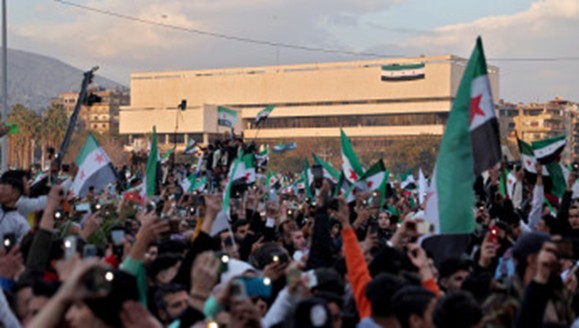
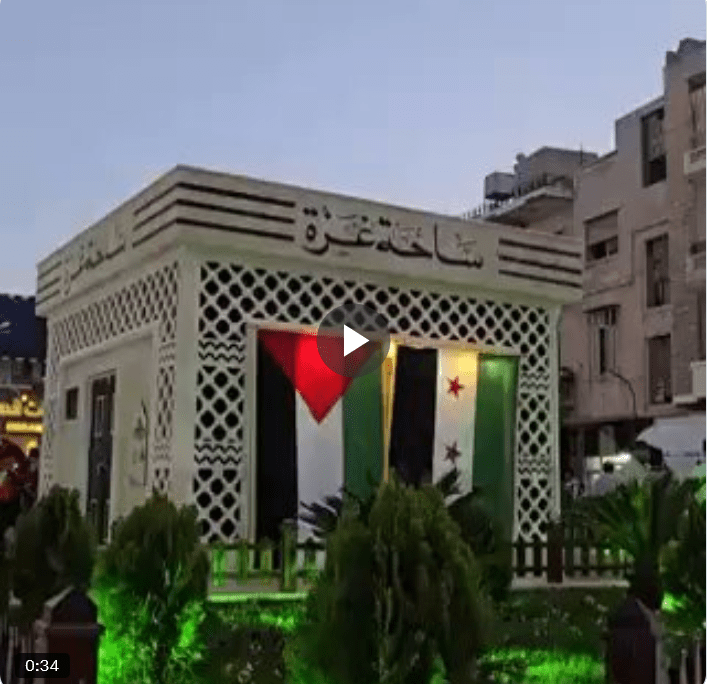
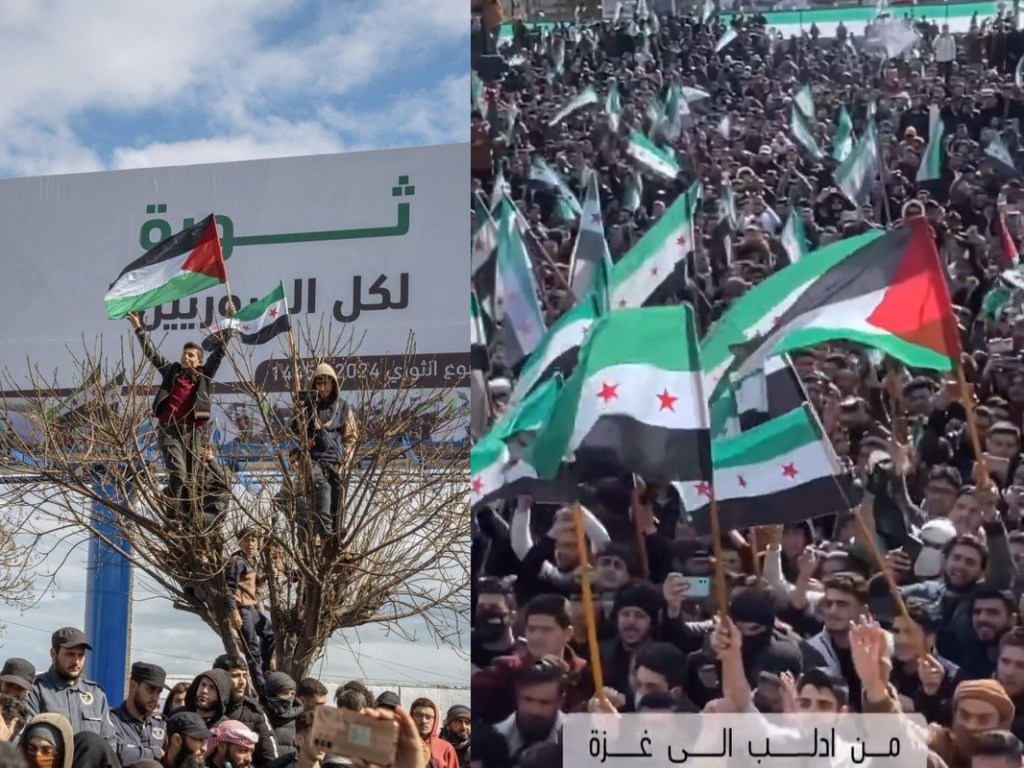
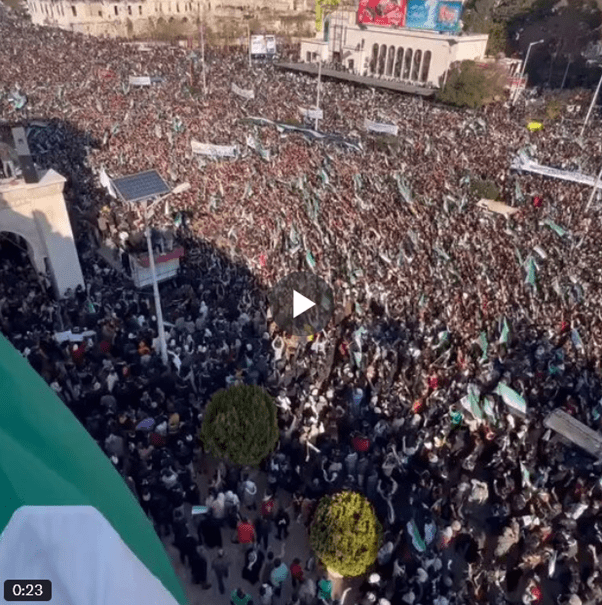
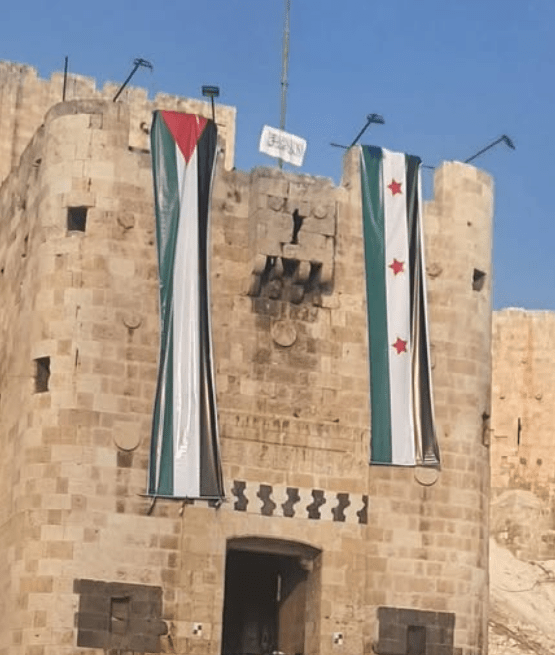
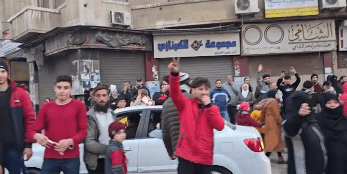
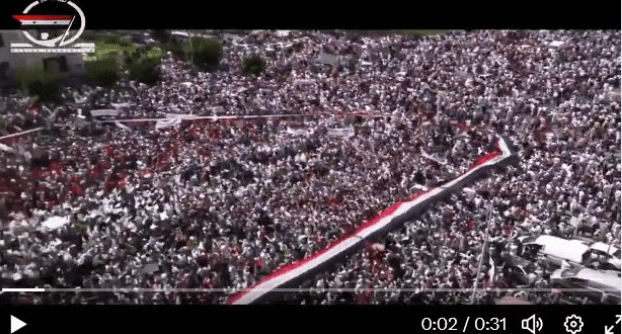
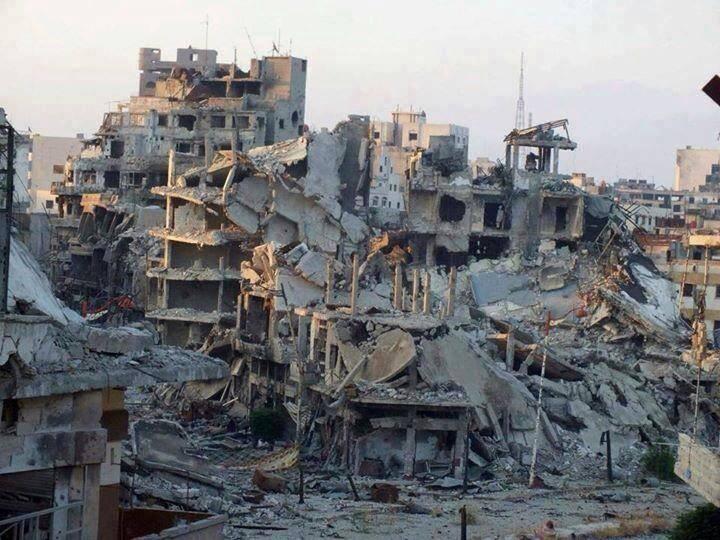
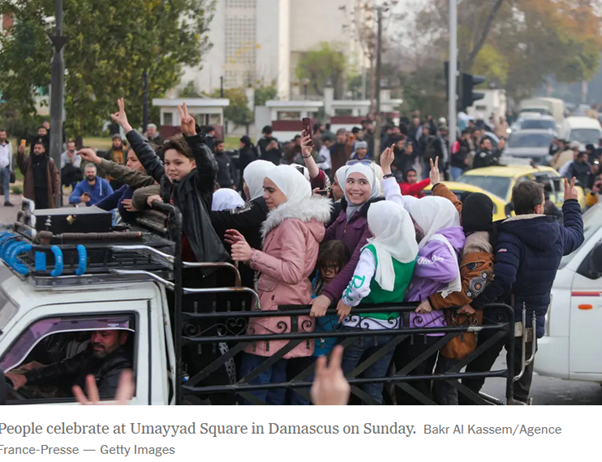
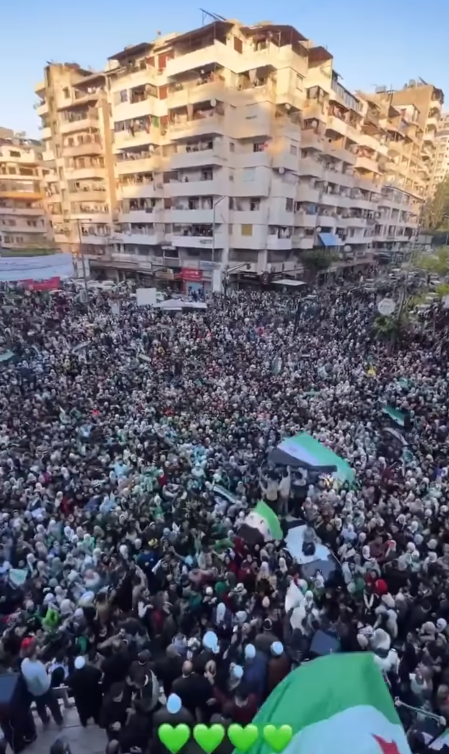
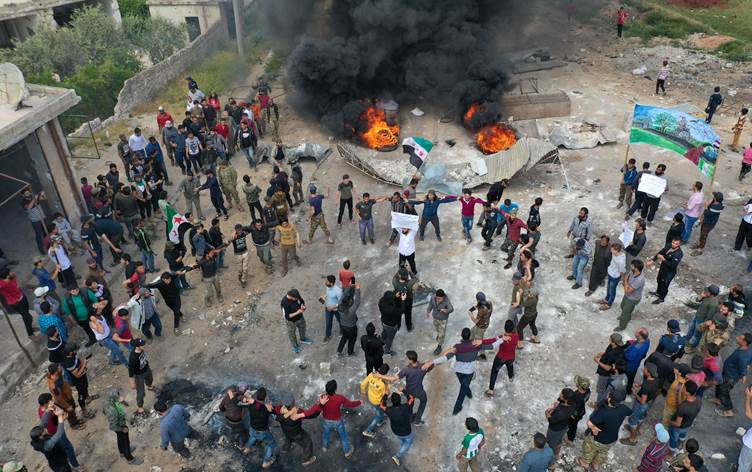
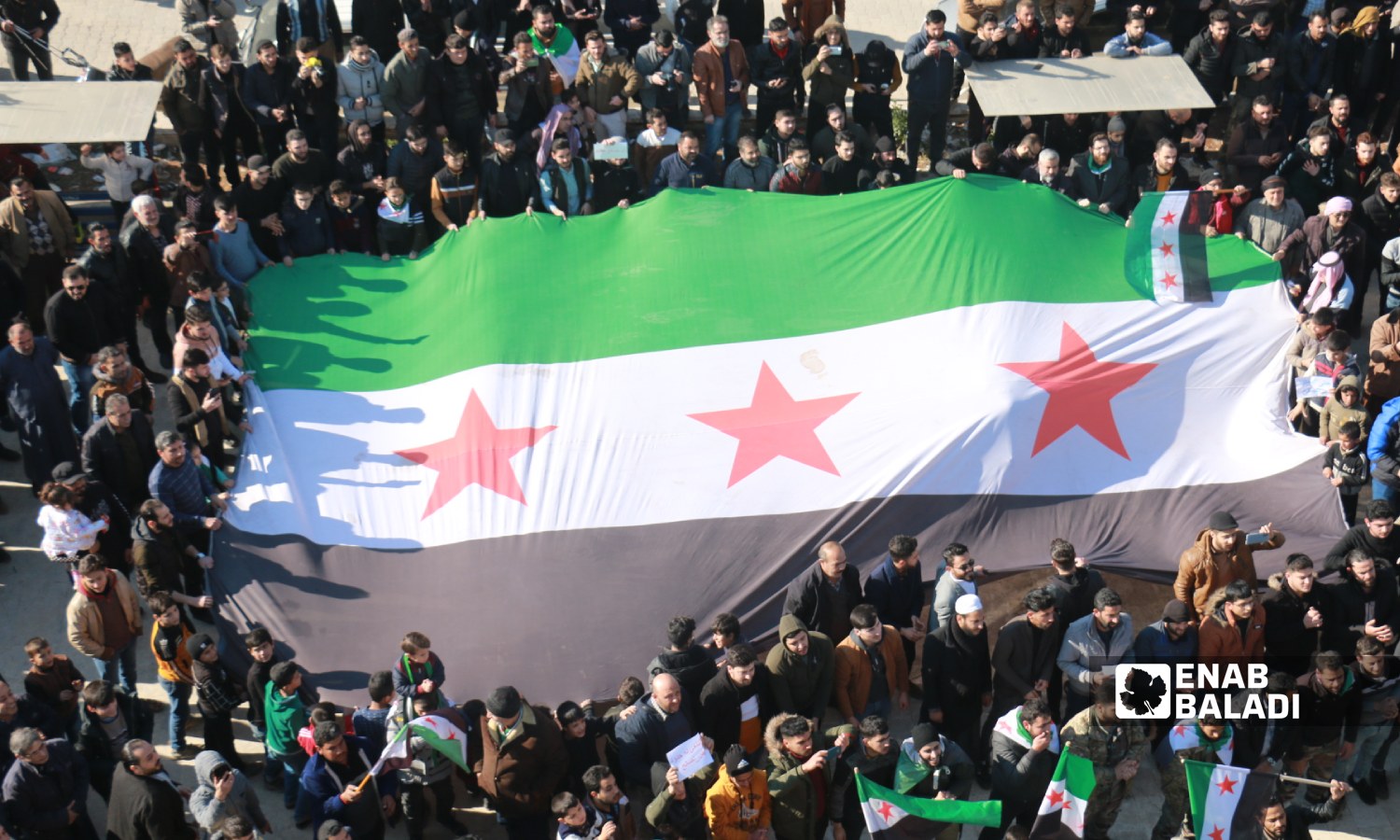
Trump’s proclamation that the US will lift the sanctions on Syria is a tremendous gain for the Syrian people. Everywhere in Syria were scenes of wild celebration. While much can be said about Trump’s motivations or about what concessions may be forced from Syria, the first thing is celebrate with the Syrian people.
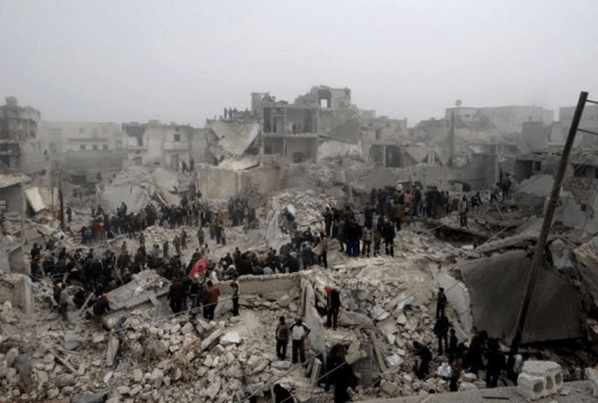
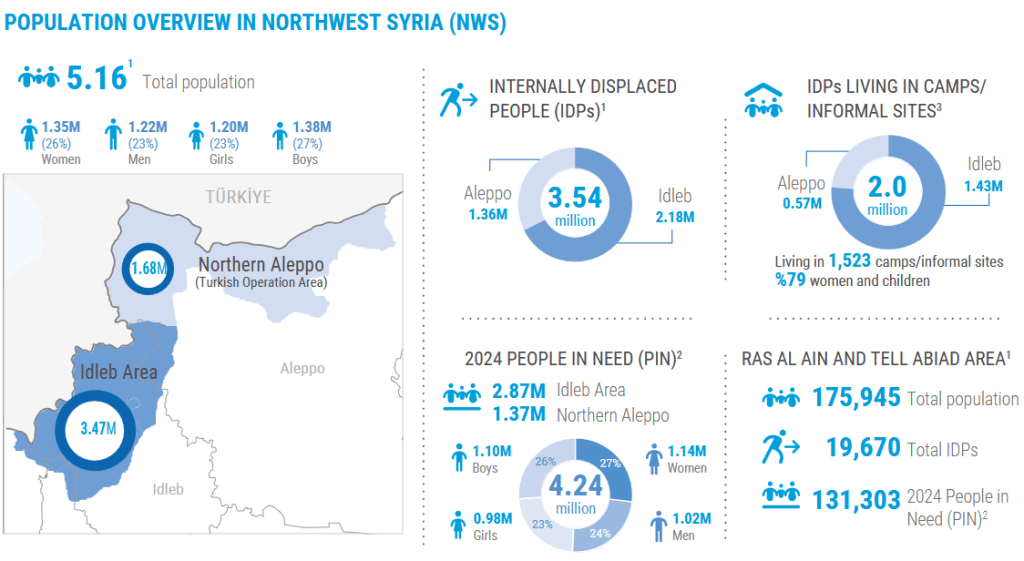
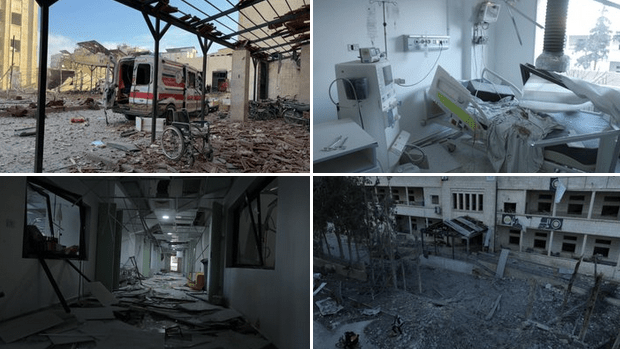
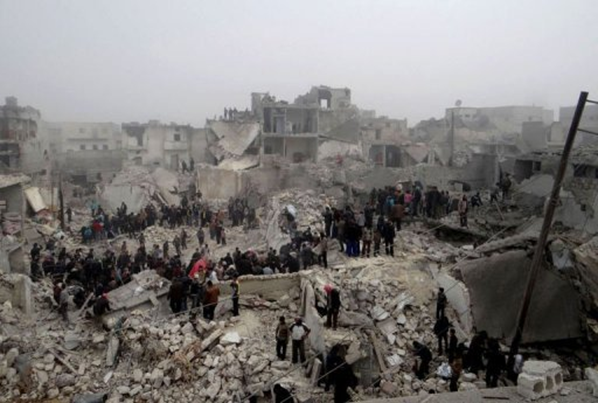
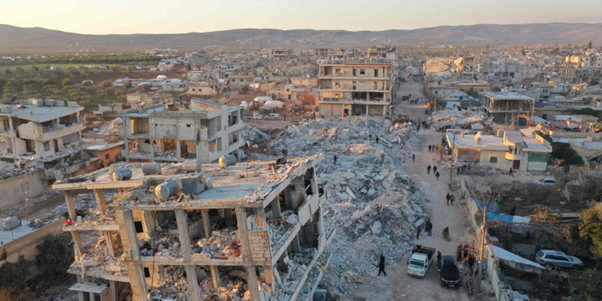
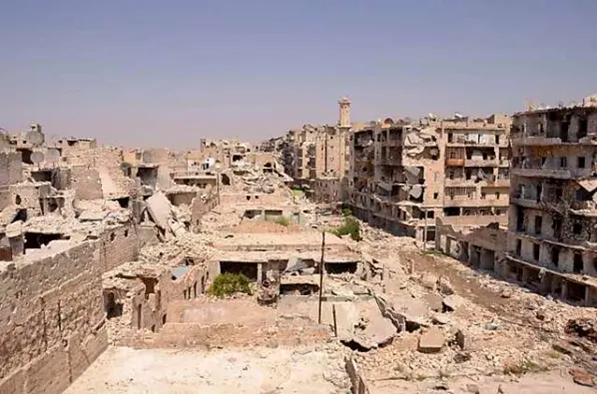
Following the announcement, the Syrian pound appreciated 30 percent against the dollar almost immediately, a sign of things to come. The lifting of sanctions allows for normal economic activity, investment and economic development; currently 90 percent of Syrians live in poverty, Syria ranking as the fourth most food-insecure nation on Earth. Large parts of Syria, entire towns and cities or sections of cities, were reduced to rubble by years of regime and Russian bombing; much of Syria is the closest thing to Gaza in the mideast. Half of Syria’s water systems are destroyed. A 2017 World Bank report estimated that nearly a third of the housing stock and half of medical and education facilities had been damaged or destroyed by regime bombing; two and a half million children are now out of school (among Syrian refugees in the region, half are under 18 and one third of them do not have access to education). One third of the population are out of the country, and even inside the country, some two million internal refugees live in tents. While tens of thousands were released from Assad’s torture gulag in December, some 130,000 remain unaccounted for, slowly being dug out of mass graves, a fraction of the 700,000 killed in the genocidal war; the enormous process of excavation and identification, so essential for the Syrian people to recover, requires technical skill, equipment and a lot of money. Currently there is electricity for a few hours a day, if lucky, food and fuel are absurdly expensive due to being in very short supply, and wages abysmal, the state bankrupt – so bankrupt that Qatar and Saudi Arabia paid off a mere $15 million in debt to the IMF and World Bank that the government could not afford. With the central bank sanctioned, virtually no banks around the world have been able to make financial transactions with Syria; not even remittances could get through much of the time. Even a Qatari attempt from January to pay public sector salaries for a few months was held up by US sanctions until May, when special permission was finally given by the US (except for military and security salaries). Clearly, no reconstruction can occur without the lifting of sanctions.
Already, major French, Chinese, Turkish, Qatari, Saudi and Emirati projects have been launched, focused on Syria’s crucial infrastructure and energy sectors. While renewed capitalist investment and economic activity are obviously no panacea and will introduce their own problems, it would currently be a luxury to worry about that in the context of zero money for investment, development and reconstruction; there was certainly no lack of capitalism under Assad, where his family and cronies owned great chunks of the economy, but Assad’s kleptocratic crony capitalism was little more than a regime of plunder; its collapse has left nothingness in its place.
One thing the Assad regime did leave, however, was some fabulously wealthy individuals, and these Assad-connected capitalists may well be the very people grabbing new investment opportunities. As Syrian writer Mahmoud Bitar notes, “Russia and Iran are not standing aside. Their economic arms, state-linked contractors, businessmen, and cronies are still embedded in Syria’s reconstruction, energy, and infrastructure sectors. … The likes of Mohamad Hamsho, who controls hard currency flows, and Fuad al-Assi, who runs the country’s largest money transfer network, remain central players … Lifting sanctions could make them stronger tomorrow.” Likewise, as Syrian writer Joseph Daher stresses, an economic free for all without clear targets will not lift the country out of its misery, especially given the government’s neo-liberal orientation; he also stresses the necessary political dimension of democratic inclusion and revival of civil activism to assuring the gains are not all made by big capital.
These are critical issues moving forward, but right now Syria does need this massive investment, and so far it has been the most crucial sectors targeted. And for those of us interested in seeing a working-class movement develop, or even for the revolution go beyond capitalism at some stage, there is no short cut without renewed capitalist investment and reconstruction, in the absence of a global socialist development fund: class struggle starts with the very existence of a powerful working class in crucial industries up and moving; it does not happen among a dispossessed people struggling for daily survival.
It is simply impossible to overestimate how important this is for the Syrian people, and their right to recover after the Assadist genocide.
Syria’s reconstruction needs are estimated to range from $400 to $600 billion.
No gift: Continuation of sanctions after Assad was a crime
It should be understood that this is not a gift to Syria, rather, the maintenance of the sanctions placed on the Assad regime for 6 months after the end of that regime was a criminal act in itself that made no logical or legal sense and was an act of violence and pressure against the Syrian people and the new government. For example, the number one condition for the end of the Caesar sanctions imposed on the Assad regime was the release of the tens of thousands of political prisoners in Assad’s gigantic torture gulag; everyone saw the scenes of the mass releases of tortured and emaciated and insane prisoners, many there for decades, in December. Another was creating conditions for the return of the 6.7 million Syrian refugees abroad; 482,000 have already returned to Syria, on top of 1.2 million internal refugees who have returned to their homes, and the main thing continuing to hold up return of both groups is precisely now the sanctions, because no-one has any money in Syria and there is no capacity to begin reconstruction of the half of Syria destroyed by the previous regime – including homes of these millions. Another was to end the bombing of hospitals and medical infrastructure etc – yes, the new government has not been bombing its cities and schools and hospitals and bakeries and markets. So why did the sanctions continue?
Some background on Syria sanctions and US-Assad relations
Before continuing, we will digress a little to look at the historical context of US sanctions.
There were already layers of sanctions before the 2019 Caesar sanctions, for example in 1979 the US imposed hypocritical “sponsor of terrorism” sanctions on Syria, meaning simply that Syria refused to capitulate to Israel, and there were further sanctions in 2004, and then in 2011 following the onset of Assad’s massive crackdown. However, their impact was less severe than the Caesar sanctions; when the US imposed these sanctions, they affected US trade and investment, which, when you look at a map, you could understand would be miniscule for Syria. Nor did they prevent large-scale US-Assad dealing, such as when the Bush administration was sending Islamist suspects during the “war on terror” to Syria to be tortured.
However, the 2019 Caesar sanctions imposed a secondary sanctions regime, whereby the US sanctioned anyone else doing business with the regime. This had a more devastating effect, because as the UAE, Bahrain, Jordan, Egypt and later Saudi Arabia all restored relations with Assad and were determined to invest their money there, they could do little of that without being sanctioned themselves. Sanctions on Syria’s central bank made loans and investment almost impossible. The Caesar sanctions, named after ‘Caesar’, a former Syrian prison photographer who released tens of thousands of photos of tortured prisoners, were therefore a double-edged sword – on the one hand, being a result of years of Syrian human rights activists campaigning, their key demands were absolutely supportable; on the other hand, their draconian nature had a devastating impact on ordinary Syrian people, while the cronies of the Assad regime continued to amass enormous wealth; that everyday struggle for survival also had a negative impact on the ability of Syrians to maintain any kind of anti-regime struggle.
It is mistaken to assume that all anti-Assad Syrians and supporters internationally supported the sanctions in this form, although some kind of more targeted sanctions against such a horrific regime were certainly justified (just as we support sanctions on the genocidal regime in Tel Aviv). But it is also arguable that lifting them under Assad would have made little difference with a regime that was stealing from the population on such a scale; and for the millions abroad, and displaced within Syria, some kind of pressure was the only way they could ever return; they are Syrians too. And lifting sanctions to allow reconstruction – of the millions of homes and entire cities destroyed by the same regime – could also have had criminal consequences, as the regime was passing laws to dispossess the original owners who did not return (and most could not return because they did not want to see their sons and daughters “disappear” into the gulag); therefore, the regime was building new accommodation for new “owners,” including luxury accommodation for cronies.
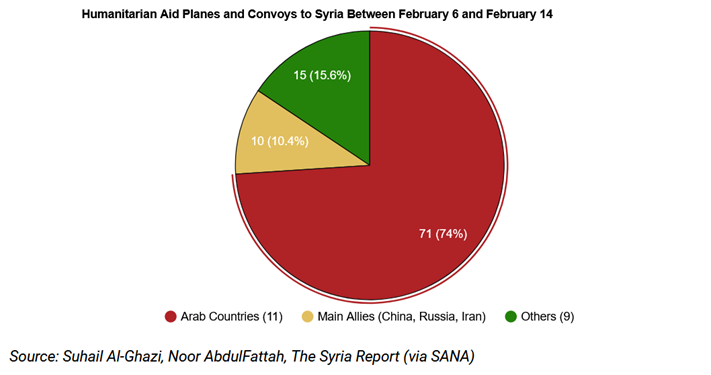
In addition, their impact was partially buffered by Syria’s two main allies – Russia and Iran – being among the world’s largest oil producers, and as victims of US sanctions themselves, there was no impediment on them supplying oil to Syria, while the US-backed Syrian Democratic Forces (SDF) in northeast Syria, which controlled most of Syria’s oil, also traded oil with the regime, with US consent; then there was Assad’s huge Captagon empire, a lucrative trade to enrich some of his support base. All of this ended with the collapse of the regime, although the SDF re-started its small-scale delivery after agreements with the new government this year. Even basic humanitarian aid to Syria via the UN, which has largely been supplied by the US and EU over the years, fell since the overthrow of Assad, because the period corresponded with the Trump administration’s foreign aid freeze; the 9th international donors’ conference on Syria in March raised 5.8 billion Euro, down from 7.5 billion in 2024, due to the US absence.
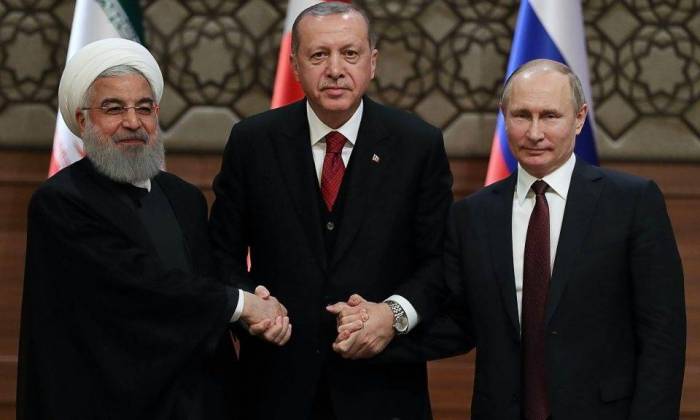
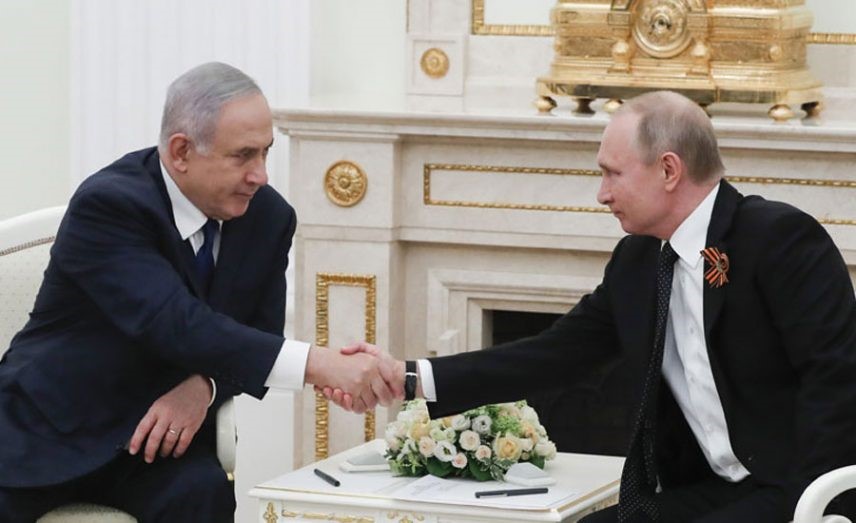
Why did the US impose these drastic sanctions when it did? On one hand, as it came after years of Syrian activism, pressure took time to build up on the US Congress. On the other, the sanctions were imposed in 2019 only after the revolution had been safely crushed by the regime, facilitated in doing so by both the Obama and Trump US administrations. Trump in particular began his rule by ending whatever remained of the limited Obama-era US support to a number of “vetted” Free Syrian Army rebel factions; even in Obama’s time, that aid was mainly aimed at co-opting these factions into the US war on ISIS, and the US vigorously enforced a ban on any country attempting to supply anti-aircraft weaponry to the rebels, in what was primarily an air war (what a contrast to Ukraine!). Trump also ended all Obama-era aid to hundreds of community councils in opposition-held territory, which ran schools, health clinics and other essentials, regardless of the US aiming at NGO-style co-optation. In 2017, Trump bombed an Idlib mosque which he accused of being a headquarters of Jabhat al-Nusra (the predecessor of Syrian president al-Sharaa’s HTS organisation), killing 57 worshippers; under both Obama and Trump, hundreds of Nusra and HTS cadre were killed in US attacks. In 2018, Trump, Putin and Netanyahu coordinated to facilitate Assad’s reconquest of the south from rebel control, right up to the occupied Golan.
US leaders feared the destabilising effects of successful revolution on US control of the middle east more than their distaste for Assad. Once this threat of revolution was crushed by 2018, the US now felt free to sanction the regime whose destruction of its entire country and creation of the world’s most gigantic refugee population was also deeply destabilising to the region; the US aimed to “change Assad’s behaviour” without the danger of revolution. And the deeply demobilising nature of sanctions ensured that continued. While the complete hollowness of the regime led to its collapse with a relatively slight military push in November 2024, the Syrian masses only came out into the streets in response to these victories; the demobilised and demoralised population were unable to play a decisive role in bringing down the regime themselves.
But whatever the case, there was no basis for continuing these sanctions after December 8, yet the Caesar sanctions were extended another four years by Congress in late December!
Of course, one might say, there is good reason to not trust the new government to be all democratic and so on either; but how is that different to countless other governments in the region and the world? Why are western governments the world’s police, and if they are, why don’t they sanction so many repressive regimes that are their allies, not to mention Israel? To not give a new government, that had opened up Assad’s gulag and dissolved the repressive apparatus, at least a breathing space was not only illegal and illogical but also immoral, because it has meant six months of excruciating poverty, inability to begin reconstruction, and was a huge obstacle to the government doing many of the things expected of it precisely by western governments, such as attempting to close the post-revolution security vacuum, because it has so little money to pay its security forces. After all, western governments could always “snap back” sanctions if they decided things went badly. The EU and UK did drastically lighten (though not repeal) their own sanctions, while emphasising it was no ‘blank cheque’ and that sanctions could return if the al-Sharaa government violated human rights or went in an anti-democratic direction; but the US rigidly maintained its sanctions regime, which, with its control of global banking and secondary sanctions, were much more fundamental.
Israel and other sources of US hostility
The hostile US stance was partly related to Israel’s relentless hostility to the new Syrian government – Israel had always preferred Assad – as well as the deeply anti-HTS stance of a number of key White House Islamophobes and “anti-terrorism” tsars in MAGA circles, including Trump’s senior director for counterterrorism Sebastain Gorka (who has “never seen a jihadi leader become a democrat”), Director of National Intelligence Tulsi Gabbard (who visited Assad in 2017), and Israel-connected National Security Advisor Mike Waltz (whose abrupt removal “cut off a chunk of the White House’s ‘wall of resistance’ on Syria”); while VP Vance, Elon Musk, and other MAGA acolytes outside the government like Tucker Carlson were on the same wavelength. Just days before Trump’s announcement, Gorka had called the Syrian government “salafi-jihadist” and praised Israel’s aggression. As Syria watcher Charles Lister writes, “For 5 months, the entirety of President Trump’s national security apparatus — from the National Security Council, to the State Department and intelligence community — has voiced varying degrees of hostility, skepticism and/or indifference to Syria’s post-Assad transitional government.”
In April, the US changed its description of Syria’s UN mission to “the mission of a country the US doesn’t recognise,” with US leaders emphasising that it “does not recognise any Syrian entity as a government.” In February, of 23 European and Arab countries assembled at the Paris Conference on Syria to support Syria’s “transitional phase,” only the US did not sign the final declaration (due to the “reservations the US has on HTS”). In an April 10 UN Security Council session amid Israel’s ongoing aggression against Syria, only the US took Israel’s side, stating that “Israel has an inherent right of self-defense, including against terrorist groups operating close to its border.”
More generally, both the US and Israel understood the danger of a revolution overthrowing an Arab dictatorship, regardless of the particular leadership, and thus Israel’s months of bombing and occupation following December 8, combined with US sanctions, aimed at forcing as many concessions as they could from the new government, and in practice further entrenched its economic and security dependence on conservative regional states, greatly limiting the ‘demonstration effect’ of a successful revolution elsewhere in the region (in particular Jordan and Egypt). Israel was more hostile than the US: the latter would be satisfied with a weakened and humbled Syrian government, whereas Israel openly declares its aim is to partition Syria into cantons and keep it weak forever. For Israel, the possibility of the new Syrian government succeeding in uniting the country even on a quasi-democratic basis was anathema; such a government would be in a position to push for its rights, such as on the occupied Golan. As for the particular leadership, Israel understands that, despite Sharaa’s outward pragmatism, the Islamist movement he comes out of is deeply connected across the region to fellow Islamist movements that consider Palestine a holy cause, so forcing it into a besieged corner also contains such connections.
Harsh US conditions for mere sanctions ‘relief’
Some six weeks ago, the US presented Syria with 8 demands it would need to meet for mere “sanctions relief,” but not abolition. While some were things the government had no problem with, such as cooperating with international anti-chemical weapons inspections, cooperation against ISIS and help with finding a number of American citizens who had disappeared in Syria, others were for the right of the US to bomb “terrorists” in Syria whenever it saw fit, the expulsion of all Palestinian groups from Syria, and that no foreign fighters hold any positions in Syrian governance or security structures. The government responded that some were easy to agree with, but expressed reservations about others which infringed national sovereignty.
Despite much social media misinformation, there was no US requirement for Syria to join the Abraham Accords. It was not in any of the published lists of conditions, and it was explicitly denied by Syrian foreign minister Shaibani. And nor did the al-Sharaa government make any statement about being interested in joining the Abraham Accords, despite a huge amount of misreporting based on second-hand hearsay and embellishment by two American Congressmen (who have Syrian constituencies) who had visited Syria; moreover, the Syrian foreign ministry noted the idea was a non-starter because the accords were signed by states that “do not have occupied lands under Israeli control.” Obviously, the Syrian leadership saw the visit of US policy-makers as a chance to push for the end of US sanctions, and so fudged their questions about the Accords; even their own reports that al-Sharaa allegedly said “in the right conditions” can mean whatever one prefers, eg, the “right conditions” could mean not only Israel’s withdrawal from Golan but also its acceptance of the 2002 Arab Peace Initiative (ie, a sovereign Palestinian state in all of ’67 with Jerusalem as its capital). Another anonymous leak alleged Sharaa said that only when Israel withdraws from Syrian territory can we “talk about” an agreement; there is a big difference between “talking about” an unspecified “agreement”, and agreeing to normalise with Israel – which Assad explicitly committed himself to. The government is “playing the game a little bit here by saying the most that they can say to please their audience without pushing the boat too far and suggesting that they’re about to do something which they’re not,” as Syria watcher Charles Lister explains.
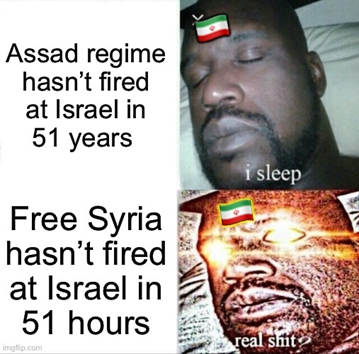
I recommend trying to avoid the avalanche of misinformation flooding social media. The government did, quite sensibly, continually stress that it was not a “threat” to any neighbouring state “including Israel,” that the Syrian people were exhausted and did not want conflict. After all, the Assad regime had kept the quiet on the ‘border’ of Israeli-occupied Golan for 51 years, and was widely appreciated by Israel for this, and that’s when it had a huge military arsenal, all of which was destroyed by Israel in the weeks immediately after Assad fell; any stupid move by the weak, disarmed new government would have resulted in Israel turning Damascus into south Beirut.
Nevertheless, the pressure was on. Reportedly, the eight conditions became twelve in recent weeks. Just several days before Trump’s current trip to the Gulf, on May 11, he reported to Congress that the Syrian “national emergency” sanctions would be extended another year. In justifying the extension, Trump explained that “structural weakness in governance inside Syria, and the government’s inability to control the use of chemical weapons or confront terrorist organizations, continues to pose a direct threat to U.S. interests.”
According to three sources speaking to the New Arab, “the administration has increasingly been viewing relations with Damascus from a perspective of counterterrorism … US officials conveyed to [Syrian foreign minister] Shaibani that Washington found steps taken by Damascus to be insufficient, particularly on the US demand to remove foreign fighters from senior posts in the army and expel as many of them as possible.”
To top it off, Democratic Senator Jeanne Shaheen stated in the Senate that she had become aware that some foreign policy circles of the Trump administration had suggested assassinating al-Sharaa, but Trump had been persuaded against the idea by the King of Jordan, because it could lead to civil war!
So, what changed?
What then changed in a few days for Trump to suddenly announce the end of “all” sanctions, apart from Trump as an individual’s tendency for abrupt and erratic changes based on his temperament? There are several aspects here.
Firstly, while Sharaa was not able to satisfy all US demands, he decided to appeal to Trump on two grounds known to move his instincts: money and flattery. Several days ago the Syrian government offered US companies access to Syrian oil, gas and minerals. Chinese companies have been strongly courting Syria (and at the UN, Syrian Foreign minister Shaibani, meeting his Chinese counterparts, said China and Syria would establish a “strategic partnership”), and in early May, Syria signed a 30-year contract with French shipping giant CMA CGM to develop and run the port of Latakia (followed by Sharaa’s visit to France); however, Syria still needed the end of US sanctions. Offering US companies a special place was aimed at getting these sanctions lifted; it obviously does not mean that French, Chinese or other countries’ business will be turned away. On the contrary, US sanctions hold up these other countries from doing deals in Syria.
In making this offer, Sharaa was following Iran’s similar offer to Trump several weeks ago, that US companies could bid on Iran’s nuclear projects meaning “tens of billions of dollars in potential contracts are up for grabs” if sanctions were removed; more recently, Iran allegedly again proposed a joint nuclear-enrichment venture, involving Arab countries and American investment. Both of course base these offers on the “Ukraine minerals deal” model.
Then more symbolically, yet cringingly, al-Sharaa offered to build a ‘Trump Tower’ in the middle of Damascus if he lifted sanctions, using the weapon of flattery that reportedly works well with Trump. While many Syrians, given the alternatives, may see this as distasteful but symbolic enough to accept if sanctions are lifted, it is hard to imagine an uglier, in all respects, addition to the beautiful Damascus skyline.
Trump’s Gulf extravaganza and growing Saudi-Israeli divergence
It is hard to know how much the economic offer and the Trump Tower impacted Trump’s decision-making, but the other thing of course was Trump’s Gulf trip itself. Trump’s trip to Saudi Arabia, Qatar and the United Arab Emirates was all about money. The three countries have offered to invest trillions in the US economy; the Saudis agreed to $142 billion in arms purchases from the US; Qatar signed over $200 billion dollars worth of deals, including the purchase of 210 Boeing jets. Meanwhile, the Trump family business itself also has huge ventures in these countries.
Trump sees a number of powerful sub-imperial states running the region in their spheres of influence as the US gradually shifts more of its attention to confronting China in east Asia. Saudi Arabia, the UAE and Turkey are key states in this equation; meanwhile Trump sees a new Iran nuclear deal as a way of bringing Iran into the regional system, or at least neutralising another powerful state in its own now reduced sphere; and of him perhaps getting a Nobel Prize. These aims, and the enormous, glittering wealth behind them, somewhat conflict with the priorities of the US’s main regional ally, the Israeli regime currently carrying out a devastating genocide in Gaza, which was in full swing during Trump’s trip.
While Israel was starving Gaza to death and launching horrific attacks on hospitals, these Arab leaders feted the US leader supplying Israel with all its killing equipment, and barely a word was said about Gaza the whole time, yet another stunning indictment on those Arab states who actually have some power to do something if they wished.
But the fact that these rulers don’t care about the Palestinians is a given. When it comes to interests though, they increasingly diverge from the particular priorities of Israel, and especially of this regime. While years of commentary has claimed Saudi Arabia was about to sign onto the Abraham Accords with Israel, and that Trump’s big goal is to get a Saudi-Israeli normalisation happening, in reality the Saudis have stood steadfast on the condition for normalisation: a sovereign Palestinian state in all the territory occupied by Israel in 1967 with Jerusalem as its capital, as per the 2002 Arab Peace Initiative. They are particularly uninterested in even discussing normalisation as long as Netanyahu continues the genocide. In fact, the Saudis made it a condition of Trump’s visit that the idea not even be mentioned. They care nothing for Palestinians; however, they also increasingly care little for the globally isolated genocidal entity as they revel in their own power.
In this context, Trump’s view of US interests in the region also partially diverges from Israel’s extremist regime in a number of ways. If the Saudis and Israel can’t agree, he will deal with each separately. Rather than ‘normalisation’, the Israel issue is now ‘de-coupled’ from other issues in the region. Therefore, what we have seen in recent days and weeks has included:
Trump’s deal with the Houthis in Yemen, to stop bombing them if they stop hitting US vessels in the Red Sea (which in any case they have not been doing for months). The agreement did not include any US reaction to ongoing Houthi attacks on, or attempts to attack, Israel; Israel was not consulted, and was said to be “blindsided.” The Saudis, despite bombing the Houthis for seven years (2015-22), pressured the US to make the deal, determined that the three-year Yemen ceasefire, and two-year Saudi-Iranian normalisation, continue. On the Houthis, Trump said “You could say there was a lot of bravery there,” noting that he “honours their word” on ceasing attacks.
Trump’s decision to begin direct negotiations with Iran to get a new nuclear deal was sprung on Netanyahu at an April press conference in the US; again Netanyahu was blindsided. Israel is determined to attack Iran’s nuclear facilities, and expected US support if not participation; Trump instead wants a deal he can dress up as “better” than Obama’s one he ripped up. Trump sacked his National Security Advisor Mike Waltz, for allegedly going behind his back and planning an attack on Iran with Netanyahu. Again, Saudi Arabia strongly supports US-Iran negotiations and has facilitated them (in stark contrast to last time round) – leading Saudi and Iranian officials have visited each other in recent days and weeks to facilitate the deal; during his meeting with Iranian supreme leader Ayatollah Khameini in April, Saudi Defense Minister Prince Khalid bin Salman called Iran and Saudi Arabia “two main pillars of the region.”
On Saudi Arabia itself, Trump has said he is going to do a Saudi deal “without Israel.” While it is unclear exactly what this means, since “deal” till now meant normalisation with Israel, he has certainly done a massive Saudi deal! It is generally understood that the Saudis want American support to develop their nuclear industry, but until now the US tied this to the Saudis recognising Israel. Trump may now aim to support it without such recognition, though this has not come up during his visit, possibly because it is tied to the question of the Iran deal and how this impacts that country’s nuclear industry.
The US negotiated directly with Hamas to get the hostage US citizen Edan Alexander released, again going behind Israel’s back, which is opposed to direct negotiations with Hamas. So is the US normally, but this was about a US citizen.
So finally, Trump’s abrupt and unexpected declaration that he was lifting “all” US sanctions on Syria must be seen in the same context – as Trump himself admitted, both Saudi Crown Prince Mohammed bin Salman and Turkish leader Erdogan strongly appealed to Trump personally to lift the sanctions; “the things I do for the Crown Prince,” Trump exclaimed, when announcing the lifting of sanctions. Both see this as in their interests, from both common but also somewhat rival perspectives, and a stable Syria is an important economic link between the Gulf and Turkey. By contrast, Israel had appealed to the US to not lift Syria sanctions. Again, Trump went with his Saudi and Qatari hosts, and the Turkish leader, over Israel.
Decision a shock to US leaders; Trump has killed their conditions … or has he?
And really, there is not much more to it. By all accounts, the decision came as a complete shock to senior officials in the US government. “The White House had issued no memorandum or directive to State or Treasury sanctions officials to prepare for the unwinding and didn’t alert them that the president’s announcement was imminent, one senior U.S. official told Reuters. The sudden removal of the sanctions appeared to be a classic Trump move – a sudden decision, a dramatic announcement and a shock not just for allies but also some of the very officials who implement the policy change.”
The importance of this is that, if Trump follows through on this decision to scrap – not reduce – “all” sanctions, this will mean his personal, abrupt, immediate-context driven decision-making will render all the ghastly “conditions” the White House and State Department and NSC have been working to impose on Syria to get sanctions lifted irrelevant! It renders irrelevant his own comments just days earlier. State Department spokesperson Michael Mitchell confirmed that the US “did not request any guarantees from the Sharaa government” before lifting sanctions, that “Trump’s decision came unconditionally.” If this is the case, this is a far, far better outcome than the ongoing strangulation of Syria until it capitulates even on basic national principles.
However, that remains a big “if.” The problem is that while some sanctions can be lifted by presidential order, others, especially the crucial Caesar sanctions, have been voted into law and therefore require Congressional approval, while the “terrorism” label on al-Sharaa would have to be removed by the UN Security Council, and this prevents the US from supporting World Bank loans. “Removing sanctions is rarely straightforward, often requiring close coordination between multiple different agencies and Congress. … Edward Fishman, a former U.S. official, said the unwinding of Syria sanctions, which were imposed under a mix of executive orders and statutes, could take months to ease.”
However, there are provisions in the Caesar Act allowing the president to issue a ‘general license’ to suspend sanctions for a period of time. If Trump wanted to act, he would need to suspend them for at least two years for this to have any effect in terms of giving banks and businesses some confidence to deal with Syria. At this stage they have been suspended for 180 days.
And all this is the catch. If the White House, or Congress, or Trump himself, decide they want to continue the pressure on Syria, they could drag out the process and make it be known to the Syrian government that, if it wants Trump’s order expedited, the conditions in effect still exist. Secretary of State Marco Rubio stated, on the one hand, that US sanctions “relief” was not contingent on Syria immediately acting on US “concerns” such as ISIS resurgence, human rights protections, and the presence of foreign militant groups; but on the other, ominously, that “If Syria makes progress, we will ask Congress to permanently lift sanctions” – suggesting that if no “progress,” they won’t. “We’re not there yet,” he said. “That’s premature.” The next day Rubio went even further, stating that sanctions relief “does have to be conditioned on them [the Syrian government] continuing to live by the commitments” made verbally, i.e., combatting “extremism,” not launching attacks on Israel, and forming a government that “represents, includes and protects” ethnic and religious diversity.
Rubio’s caution reflects a middle position within ruling Republican Party circles between Trump’s sudden conversion on one side, and those like Gorka who are no doubt reeling in shock (saving face, Gorka asserts the lifting of sanctions is “not unconditional … we have made those stipulations very clearly”). Warning that Syria could explode into civil war and partition, Rubio explained that “the transitional authority figures, they didn’t pass their background check with the FBI,” but “if we engage them, it may work out, it may not work out. If we did not engage them, it was guaranteed to not work out.” Clearly, Rubio means that if it does “not work out,” Trump’s announcement is hot air. Another sitting on the fence, Senator Lindsay Graham, stated “waiving congressionally passed sanctions … has to be done in a coordinated fashion with our allies,” which presumably includes a hostile Israel. Graham said that Syria’s designation as a state sponsor of terrorism could “hopefully eventually” be rescinded.” Eventually …
It is deeply ironic and troubling that possibly the best we can hope for is that Trump’s very public and very unconditional statement on lifting “all” sanctions may mean he will feel compelled to honour his word, especially made as it was in front of his Saudi friends.
After the Saudi extravaganza at which he made his declaration about lifting sanctions, Trump met briefly with al-Sharaa and Saudi leader MBS, with Erdogan on call. While there is no recording of the meeting, it is understood that Trump put five points to Sharaa; State Department spokesperson Michael Mitchell stressed that these are “expectations” and are not actual conditions for the removal of sanctions. Trump urged Syria:
to join the Abraham Accords
to expel all “foreign terrorists” (ie Islamist fighters from other countries who helped Sharaa’s struggle)
to “deport Palestinian terrorists”
to help prevent a resurgence of ISIS
to take on “responsibility for ISIS detention centers in Northeast Syria”
In his artful response, al-Sharaa allegedly:
thanked Trump, MBS and Erdogan for arranging the meeting,
noted shared U.S.-Syrian interests in countering terrorism and eliminating chemical weapons (thus avoiding anything specific about points 2,3,4 and 5 – we already know he has no problem with points 4 and 5 on combating ISIS)
reiterated that Syria supports maintenance of the 1974 ceasefire lines with Israel on the Golan, which Assad maintained for 51 years and which a destroyed and disarmed Syria can obviously do nothing about at this stage; this can be considered his response to the first point.
expressed his hope for Syria to “serve as a critical link in facilitating trade between east and west, and invited American companies to invest in Syrian oil and gas”
“Shared Syria’s stance on current conflicts in Ukraine and Gaza, emphasising the need for international accountability,” with no more specific information.
On the Abraham Accords, even Trump seemed to understand that Syria would not be joining any time soon, responding to a question alter about whether he thinks Syria will join them: “Yeah, but I think they have to get themselves straightened out. I told him, I hope you’re going to join once you’re straightened out & he said yes. But they have a lot of work to do.”
Indeed, it will take many years for Syria to get “straightened out.” And in any case, since neither his Saudi nor Qatari hosts, both strong supporters of Syria, have signed or intend to sign the Abraham Accords, Sharaa has plenty to hide behind. And as Shaibani, his foreign minister has stated, only states who do not have territory under Israeli occupation have signed the accords, so we can only “talk” about an agreement when that ends; Israel, of course, never intends to withdraw from the Golan. Another wall to hide behind.
Nevertheless, nothing is certain. Officials in the White House and Congress may put their foot down. If under unbearable pressure Syria’s future capitulation cannot be ruled out; if that happened, it should be condemned as a betrayal of the Palestinian people, while recognising the pressure it was put under. However, the current anti-Sharaa social media circus on this question is condemning something that has not happened, that Syria has been resisting, and that no Syrian leader has ever suggested doing; those involved see their fact-challenged soundbites as more important than this hugely important victory is for the Syrian people.
Sharaa’s response back in Syria
In his first speech back in Syria, Sharaa thanked or mentioned every country in the region, as well as Trump and European governments that have engaged with Syria in recent months. The only relevant countries not mentioned were Israel, Iran and Russia. But despite his special appeal to US companies in the lead-up to Trump’s visit, there was no mention of this; on the contrary, he “welcome[d] all investors — Syrians at home and abroad, as well as Arab, Turkish, and international partners — to seize the opportunities available across various sectors.” He emphasised that Syria would no longer represent one bloc against another, that there are no special privileges.
While thanking various leaders, he also attributed the lifting of sanctions to coordinated diplomatic engagement and “the unity of Syrians at home and abroad,” noting “the interaction of Syrian communities around the world helped convince international actors that it was time to end Syria’s isolation.” Just days before Trump’s trip, 55 Syrian and International NGOs called on Trump to ease Syria sanctions.
Sharaa also declared that “Syria is for all Syrians, regardless of sect or ethnicity … coexistence is our heritage, and the division has always been caused by external interventions. We reject these divisions today.” Good – but now that sanctions are being lifted, it is important that “all Syrians, regardless of sect and ethnicity,” do get to be included in the new power structures and the government ceases its tendency towards an overwhelmingly Sunni-led state, with real accountability for crimes, such as against the Alawite population in March. Otherwise, such words will mean nothing, and division, exploited by foreign parties, will indeed continue.
The Syrian people need jobs, food, water, electricity, housing, reconstruction. Celebrating with them at this moment is the most important reaction, all caution considered. Syria is not a normal state capable of making free decisions. It is a state where much of the country is rubble, just emerging from 54 years of tyranny and 14 years of genocidal war, under attack and occupation by Israel in the south, while Russia, Turkey and the US also occupy parts of the country, over half of whose population is either in exile or uprooted inside the country, while well over 100,000 have still not been recovered from mass graves, with an economy crushed by massive theft by the former regime on top of devastating sanctions. It is not Gaza 2025 – a genocidal crime of an almost unique level of evil – but much of Syria is the closest thing to Gaza in the region. Try to imagine the kinds of “conditions” that will be placed on a future Palestinian state to allow it to breathe.
Touring around Trump while Israel’s holocaust in Gaza escalates to unimaginable levels, with weapons supplied by Trump, was a disgusting spectacle by Gulf rulers, even if, as demonstrated above, these regimes currently have different interests to Israel and Trump has been bending their way. But that’s not Syria’s fault; it lives in the world as is, with horrible choices, of which it had to choose the lesser evil of shaking Trump’s hand at this show.
It would be good to think that Trump’s divergence from Israel’s priorities on Yemen, Iran, Syria, Saudi normalisation and even direct negotiations with Hamas would translate into a Trump break with Israel on its Gaza genocide. Even if nothing more could be hoped for from Trump in terms of long-term justice for Palestine, right now just stopping the genocide is so important that, if he were impelled to do so by the Gulf extravaganza, it would justify the show. Whether the Gulf rulers cared to pressure Trump on this or not, or whether he listened or not, what we know at this moment is that nothing has happened, except for some words like “awful war.” Most likely Trump’s ‘de-coupling’ from Israel’s regional priorities elsewhere will not be repeated for Israel’s own key priority, ie, occupied Palestine, and Greater Israel will continue to be a key US ally alongside the other powerful regimes in the region. I sincerely hope to be proven wrong. It is a sad situation whereby at this particular moment, this seems the best one can hope for.
The investigative commission report into the March massacre of the Alawite citizenry, set up by the Syrian government at the time, finally turned in its findings on July 10, four months after it was launched. Claiming some 1400 killings, it identified 298 individuals broadly aligned with government-led forces, and 265 individuals who took part in the initial Assadist insurgency, as alleged perpetrators of these killings and other violations. I first held off publishing this report – much of which I wrote months ago – due to the difficulties of establishing facts from afar, but then as time went on decided to await the investigative report. However, as I publish, while press conferences have been held, the government has still not made the report public, though we are aware of its broad outlines, so I am releasing my understanding of the situation now; if and when it becomes pubic, I am happy to be proven wrong on any points; or to acknowledge that the investigation did not live up to expectations. Late Update: the UNHCR Independent International Commission of Inquiry on the Syrian Arab Republic has also finally released its mammoth report, with a huge amount of detailed information.
This is a huge report which I have put together over months. Please don’t complain that it’s too “lengthy.” It is not an essay. In writing this report I am also compiling a huge amount of material. Please treat it as a resource rather than a quick read. There is a bibliography, including main reports, at the end.
Michael Karadjis
Contents
Introduction
The Assadist Insurgency
The Syrian government’s security response – and the sectarian pogrom
Disinformation overload
Syrian government reaction
Arrests
Who was responsible for the civilian massacres?
The General Security forces (GSS): Reportedly the most ‘disciplined’ and ‘professional’
Military ‘factions’, ‘foreign jihadis’, ‘Amshat and Hamzat’ – Heavily reported as responsible for massacres
However, some military brigades acted with integrity
Armed civilians and “revenge” killing
Assad regime slaughterhouse: Incubator of sectarian mayhem
The initial ‘fairy-tale’ and its abrupt ending
The unfolding deterioration of the situation from December to March
Causes of this deterioration of the Alawite situation
What now? The evolution of the al-Sharaa government
What needs to be done?
Bibliography
Introduction
While the Assad regime’s tyrannical rule always contained an unofficial sectarian element, it was only when it came under threat from the people’s revolution in 2011-12 that it made a deliberate decision to sectarianise the conflict on a truly massive scale; Syria turned into a gigantic laboratory of genocidal sectarian engineering, cleansing and massacre. The large-scale sectarian massacres of Alawite civilians over March 7-8, which took place in response to the attempted coup and slaughter of security forces and civilians unleashed by Assadist officers on March 6, demonstrate that the impacts of this policy are ongoing and have boomeranged horrifically against innocent civilian members of the sect that the Assad regime’s rule was based among.
The medium-term impacts of these events are difficult to fathom. Just three months after the glorious revolution against the genocidal regime, characterised precisely by a total lack of revenge, either sectarian or directed, it seems the Assadist coup leaders got what they wanted: a massive hole in the revolution, the alienation from the rest of post-Assad Syria of a large part of the Alawite population now multiplied a thousand-fold. Whether some of that can be undone depends a great deal on what the government does next; but for a great many Alawi who were exposed to the slaughter, the ship has sailed; thousands have fled to Lebanon, thousands more just want to leave.
The Syrian government led by president Ahmed al-Sharaa ordered that civilians not be touched, condemned the massacres, set up a commission to investigate the events and bring perpetrators to trial, and made arrests, and rapidly expelled unruly elements from the region and brought the massacre to a close; the general security forces most directly under its command appear to have been the least involved and the most professional compared to unruly military factions, jihadi groups and armed civilians; propaganda claims that this was a massacre unleashed by the government of “HTS” (which no longer exists) or “al-Qaeda” (which Nusra, the forerunner of HTS, quit in 2016) should be dismissed. Indeed, the UN Commission of Inquiry report “found no evidence of a governmental policy or plan to carry out such attacks” (p.18). Simplistic nonsense serves no useful purpose, though it was very useful to enemies of the new Syria, especially Israel, Iran and various other forces influenced by them.
Nevertheless, that does not absolve the government; the military and other forces that carried out this pogrom were theoretically under the authority of the government, so even though it appears to be mostly a question of massive indiscipline and government lack of control of newly patched-together military forces, in international law it still holds overall legal responsibility. The government was also initially slow to move with the level of urgency that the gravity of the situation required, though this can also be explained by being overwhelmed by such fast-moving events. There are more significant critiques that can be made of its handling of the situation beforehand, which I will touch on later. It is certainly valid to critique its apparent lack of interest in giving the issue the attention it needs since, given that nothing that has occurred since the revolution can be compared to the slaughter of a thousand or so civilians over a couple of days (declaring a day of mourning, for example, would have demonstrated some kind of genuine commitment).
Whatever the case, the future of the revolution – meaning not simply the overthrow of Assad and the ‘democratic space’ now open in Syria, but more broadly the revolution’s promise of a Syria for all its communities, a Syria that rejects the methods of the past regime – now depends on how real, how effective, how transparent, how just this process of identifying, trying and punishing the perpetrators is, as well as working hard with the Alawite community leaders for effective policies related to compensation, reconciliation and above all inclusion in the institutions of the new Syria, especially at the level of security.
I am not making any predictions about how real this process will be, and am interested neither in spreading illusions in the al-Sharaa government, nor of demonising it. Below is my understanding of the situation for now; I can’t guarantee every sentence is correct. Not being in Syria, it has been extremely difficult to get a clear understanding, with Syrians on the ground presenting a myriad of different, often sharply contrasting accounts. That’s one reason I have held off publishing for so long; most of this was written months ago. Nevertheless, I believe the below, and the analysis of the wider background, is fundamentally sound.
[As I publish now, in early August, last month witnessed a disastrous debacle in Suweida with a horrific massacre of the Druze population which suggests the government learned little from these March events; some would say it shows the government still has little control over some of its armed forces, while others would claim it proves the government is deliberately behind such mass violations in order to instrumentalise sectarianism to consolidate its Sunni base, kind of Assad-in-reverse; I have written of these events elsewhere, but it is impossible to do any justice to these huge events here].
The Assadist insurgency
The chain of events began on April 6, when hundreds of former Assadist officers, who had been hiding out in mountainous parts of the two coastal provinces – Tartous and Latakia – where Alawites predominate, with large quantities of weaponry, launched a coordinated ambush on Syria’s new security forces in the region, as well as attacking government buildings, hospitals, power plants, gas and oil companies and attempting to seize control of the region. They also severed an underground power supply on March 7, cutting power to most of Latakia.
According to the Syrian Center for Media and Freedom of Expression (SCM), the Assadists “targeted police stations, checkpoints, and cut the Latakia-Jableh-Baniyas main road, concurrently with attacks on the Naval Forces Command, the Naval College near Jableh, the Criminal Security branches in Latakia and Jableh, Al-Qardaha Regional Command, and Jableh National Hospital, taking full control of them. They also cut the Duraikeish Road, Al-Qastal-Latakia Road, the Beit Yashout Road, and Satamu Military Airport, in addition to seizing control of Tartous port checkpoints. At the onset of the attacks, these groups killed approximately 75 individuals, including members of the General Security, police officers, and civilians. Around 200 personnel were taken captive, and dozens were injured.” The UN Commission of Inquiry report however claims some 175 General Security officers (plus 22 earlier) were killed in these ambushes, plus 61 officers of the army Division 400 stationed in the region (p. 10-11).
Initial reports were that some 25 Sunni civilians were also killed, but later these figures were greatly multiplied, as over 200 civilians “including women and children, were killed in mass executions and systematic attacks targeting residential neighborhoods and public roads.” The first 15 civilians were killed by “gunmen targeting their vehicles on the outskirts of the city of Jableh” on Thursday March 6, according to reportage by the Syrian Network for Human Rights (SNHR), who further reported that “vehicles with Idlib license plates were deliberately attacked, and several victims’ bodies were burned inside them,” claiming at least 32 civilian vehicles were so targeted, as in the example of “Badr Hatem, his wife Walaa Saqr, and his son Ali [who] were killed by remnants of the former regime and their bodies were hidden simply because they were from Idlib Governorate.”
According to Omran in Syria Direct, a resident of Jableh where the insurgency began (and who vigorously condemns the pro-government military factions who later sacked the city), “While first storming the city’s southern neighborhoods, regime remnants carried out sectarian killings against the Sunni component.” The report by the well-respected SCM notes the same. This prompted “Sunni youth to announce a public mobilization in the city and pursue the regime remnants to stop them from taking control of the city. They broke the siege on hospitals that were besieged by groups affiliated with the former regime.” Another report claimed “The coup attempt started in Alawite villages (Beit Aana, Hmeimim, Qardaha), reaching Jableh’s outskirts. Hospitals were used as ambush sites against security forces and civilians providing aid. … By midnight 07/03/2025, regime militias took Umm Barghal checkpoint in the south, attacking Sunni homes & killing 7 young men. … By 07/03/2025 afternoon, 15+ Sunni martyrs had fallen.” This report similarly discusses the decisive role of Jableh citizens in resisting this opening Assadist attack.
While some have attempted to downplay the Assadist insurgency and slaughter as a virtual invention of the Syrian government in order to initiate a sectarian rampage, even this report by a local Alawite which indeed does blame the government, does somewhat downplay the Assadist attack, and describes the slaughter of Alawites in the most horrific terms imaginable, nevertheless states that “at least 120 of them [government security forces] were killed by regime remnants [ie, Assadists]. … A friend who had helped evacuate his Sunni relatives from Snobar, near Jableh, put it bluntly: ‘All the good ones have been wiped out’.”
Similarly, Christian activist ‘S’ who “works with both Sunni and Alawite communities,” describes the night of March 6 in Baniyas, where possibly the most terrible massacres of Alawites subsequently took place (cited in Gregory Waters’ Syria Revisited site):
“ … you could hear and see the bodies of General Security being brought to the hospital. I think 150 bodies of security forces were brought to the hospital in total [from the city and countryside]. Many Alawites here still deny that there was an insurgency, but then why was I warned that evening and how do you explain the killed security forces? After a few hours of the attack and taking over some neighborhoods, most of the insurgents fled. They realized there was no foreign intervention coming and they had been tricked by the regime media and leaders and had made a huge mistake.”
The leaders of the Assadist insurgency are well-known. On March 6, a statement signed by Brigadier General Ghiath Suleiman Dalla, a former commander in the Assad regime’s notoriously brutal Fourth Division, announced the launch of “the Military Council for the Liberation of Syria,” calling for “the overthrow of the existing regime” and “the liberation of all Syrian territory from the occupying terrorist forces.”
Earlier, on February 7, another former Assadist military officer with a brutal record, Muqdad Fatiha, had announced the formation of the ‘Coastal Shield Brigade’, calling for attacks on government security forces. A series of killings of security forces increased throughout February and early March, leading up to the March 6 mass ambush. Another group are troops linked to Bassam Hossam Al-Din, a former leader of the Assadist Mountain Lions militia, who as early as December 11 threatened to launch an “Alawite military revolution,” and in January kidnapped and threatened to behead a number of security personnel. More recently, it emerged that yet another former Assadist officer, now residing in the United Arab Emirates, Mohammad Jaber, former leader of the Assadist Desert Falcons militia, was also involved in the insurgency, by his own admission.
The massacres targeted both security forces and civilians. In addition to the Sunni civilians targeted on a sectarian basis, it has been widely alleged that the Assadist forces also killed Alawite civilians considered ‘disloyal’ for refusing to support the insurgency. Indeed, Muqdad Fatiha himself released a video in early 2025 where he openly threatened Alawite civilians who had accepted the new Syrian government, or who had denounced his savage crimes: “Your punishment will be severe, boys and girls. I have your names and your social media accounts, I have all the information I need to find you. I’ll be coming to see you soon.” Interestingly, he notes that he has “no problem with HTS,” who “gave me amnesty and treated me well,” but “my problem is with you, my fellow Alawites.” He also confirms that images of him carrying out atrocities under Assad are real.
It is difficult to assess the degree of support among Alawite civilians for the Assadist insurgency. Reportage in the immediate weeks after the overthrow of Assad revealed how hated the Assad regime was among most Alawites, despite them being in many ways ‘favoured’; it massively thieved from them, while treating a generation of their young men as cannon fodder for these thieves. Yet the widespread alienation of much of the Alawite population – discussed below – by March can hardly be denied. There are numerous reports of sections of the Alawite population having been aware of the coup plans and not warning about them. According to another account, “some had prior knowledge of the preparations to target general security, and some hid the remnants and their weapons in their homes, while others participated in hiding weapons near the Ali al-Qadi School in Jableh.” According to ‘S’, a Christian from Baniyas, where the worst subsequent massacre of Alawites took place, in Qusour neighborhood early in the evening of the coup attempt, the Alawite population packed their bags and returned to their villages, one telling him “Close your shop and leave, everything will be settled soon” (though he says Baniyas was the only part of Tartous province where this happened). To be clear – the actions of some alienated Alawites in no way justifies the wholesale slaughter of the Alawite citizenry that took place next, but it is clear that such stories would have provided fuel to the murderous sectarian response.
The Syrian government’s security response – and the sectarian pogrom
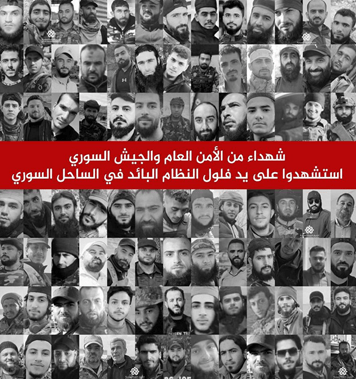
Top: Photos of the first 100 security personnel massacred by the Assadists spread outrage around Syria; Bottom: Cover of the Syrian Network for Human Rights’ preliminary report into the massacres of Alawites.
When news spread of the slaughter of the security forces and civilians, along with that of an attempted comeback by the genocide-regime of Sednaya, demonstrations erupted around the country. While the government sent in many more of its new General Security forces (GSS) to confront the insurgents, the Ministry of Defence (MOD) also began to mobilise forces of the new army, which had only just been stitched together, made up of former rebel brigades and still lacking effective command and control; and in addition, thousands of armed citizens descended on the coast for the same reason, responding to unofficial calls for “general mobilisation.” At least some of these calls for mobilisation were made by sectarian preachers in certain mosques, preaching anti-Alawite hate. As the SNHR reports, “In these operations, local military factions, foreign Islamist groups nominally affiliated with the Ministry of Defense but not organizationally integrated with it, and local armed civilian groups provided support to government forces without being officially affiliated with any specific military formation.”
While their main target was obviously the Assadist killers, among the ranks of these thousands were perhaps hundreds who used the chaos to launch horrific sectarian attacks on defenceless Alawite citizens (often in rural areas), whether driven by thirst for irrational collective ‘revenge’ for the Assadist nightmare they had experienced, hateful jihadist ideology or simply looting and pillaging. While the violators included some security officers, overwhelmingly undisciplined military factions and armed civilian groups were responsible for the killing, as will be documented below; internal security (the GSS) were largely more disciplined and focused on fighting the insurgency. One very important aspect is that the slaughter of hundreds of security personnel stationed there, and then the need to fight the insurgency, severely limited their ability to protect Alawite citizens from the undisciplined sectarian elements theoretically on their side.
The SNHR reported that these “widespread and severe violations” included “extrajudicial killings, field executions, and systematic mass killings motivated by revenge and sectarianism. Additionally, civilians, including medical personnel, journalists, and humanitarian workers, were targeted. The violations also extended to attacks on public facilities and dozens of public and private properties, causing waves of forced displacement affecting hundreds of residents. Dozens of civilians and Internal Security personnel also went missing, significantly worsening the humanitarian and security situation in the affected areas.” Horrific reports included the killing of entire families, killing men in front of their families, the separation and killing of all the menfolk in an area.
Killers who went door to door regularly asked whether the residents were Alawite or Sunni, then proceeding to kill the menfolk if the response was Alawite, according to SNHR. Many such cases are documented in the Amnesty International report released in early April.
Five days passed before the respected SNHR released its preliminary full report; it took some time precisely because it aims to do a proper job, to at least attempt some initial sorting out of facts from the literal mountains of disinformation that spread around the world. The data released by SNHR in its March 11 report is horrendous enough, increasing in several updates. The following main data is from the latest April 16 update, while some extra information is from the more thorough April 9 update:
1662 unlawfully killed between March 6 and March 17 (most between March 6-10), of whom:
At least 445 were killed by the insurgent Assadist forces, a figure which includes:
– at least 214 members of security, police, and military forces
– at least 231 civilians
At least 1217 were killed by “armed forces participating in [government-led] military operations (including “military factions, armed local residents, both Syrian and foreign, General Security personnel”) during the extensive security and military campaign.” SNHR assessed that the “vast majority” were carried out by certain “military factions” that only recently joined the new Syrian army. More on this below.
These victims were mostly civilians but some were “disarmed members of the [previous] regime remnants.”
The latter group seems to refer to some who took part in the Assadist insurgency without uniforms, were disarmed in the fighting, and then field-executed. The SCM report noted the same thing, claiming the dead “included disarmed participants in the Assadist insurgency,” stressing this is still a war crime. SNHR reports that “It is extremely difficult to distinguish between civilians and disarmed Assad regime, as the latter were wearing civilian clothing.” However, according to the government’s investigative report, released in July, “some of the victims were former military personnel who had reconciled with the authorities,” which is even worse, because this means by then they were indisputably civilians. It notes that “the presence of Assad regime remnants among the dead cannot be ruled out,” but states “most of the killings occurred either outside combat zones or after the conclusion of military operations.”
The fact that many Assadist officers were in civilian clothing, or that some Alawite armed civilians joined the insurgency, “emerg[ing] with personal weapons as soon as the attacks began,” is not controversial. According to local Tartous journalist Ram Asaad, the Syrian government is responsible for the outcome “because it confronted them [the insurgents] inside cities and it cannot distinguish between civilians and remnants,” but this is because “the regime remnants wear civilian clothes, and are spread among civilian neighbourhoods. There is no distance between them and civilians.”
The killings included 60 children and 84 adult women (according to the April 9 update), 51 children and 63 women attributed to the pro-government forces, and 9 children and 21 women to the Assadist insurgents.
The SNHR notes there were also an unspecified number of Assadist troops killed, estimated to also be in the hundreds, but that it “does not document the deaths of non-state armed group members during clashes, as the killing of these forces is not considered illegal.”
The caution taken by the SNHR in releasing its data is replicated by Amnesty International, which took almost a month to release a report, though Amnesty only interviewed 16 Syrians, all Alawites. Meanwhile, the Syrian Center for Media and Freedom of Expression (SCM) released an updated report on July 11 claiming 1,060 casualties among civilians and some disarmed Assadist insurgents (considerably lower than the SNHR update’s figures), along with 218 deaths of members of the General Security forces (slightly more than SNHR). The government’s Investigative Commission’s report, released in July, reported 1,426 mostly Alawite civilian deaths (while noting, like the SCM, that many Sunni civilians were killed in the initial Assadist attack), thus a higher figure than either SCM or SNHR, as well as the death of 238 security personnel. The UN Commission of Inquiry report, released in August, reported some 1,400 people, “predominantly civilians,” were killed, along with “hundreds of interim government forces.”
Meanwhile, while responsible bodies were taking time and care with their reportage, most of the world’s media impatiently reported the claims of an organisation called the ‘Syrian Observatory of Human Rights’ (SOHR), run by one Rami Abdulrahman, from a computer in Coventry, UK. The SOHR’s numbers of murdered Alawite civilians jumped from 134 to 340 to 745 to 973 to over 1000 all within about 24 hours (and then up to some 1700 within a few days). While the actual numbers were horrific enough, releasing “data” at such a rapid pace would make any cross-checking for accuracy impossible and does not do justice to the victims (by contrast, the well-respected SCM’s 1060 figure was a reduction of some 100 from its initial report “as documentation and verification continued, showing that some of the names were duplicate, and that some individuals were included as dead based on multiple sources, and it was later found that they were still alive”). Notably, the SOHR and Abdulrahman have long been considered either unreliable or suspect by Syrian activists, in particular for claiming at times that the number of Assad regime troops killed was higher than the numbers of civilians killed, a claim defying basic objective logic. We can leave further aside claims of “7000 Alawites and Christians” killed made by various propaganda quarters.
Alawite victims of sectarian killings also included well-known figures who have been involved in the movement against the Assad regime for years or decades.
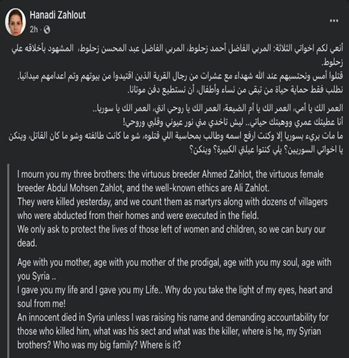
Anti-Assad Alawites, Abdul Latif Ali, murdered, and Hanadi Zahlout, who lost her brothers to murder, by sectarian pogromists.
Opposition activist and former Syrian prisoner Abdul Latif Ali was executed outside his home along with his two sons in front of his wife and other female family members. According to a Syrian friend, “In 1970, he was among a small group of left-wing Alawites from Jableh who attempted, unsuccessfully, to organize protests against Hafez’s coup. Infiltrated by Hafez’s informants, he and his comrades were detained and viciously beaten before they even had the chance. He was ecstatic when the regime fell in December. In his last Facebook post, he urged young Alawite men not to fall for the trap being laid by henchmen of the former regime.” Here’s what his daughter had to say regarding false claims he was killed by the Assadist remnants.
Hanadi Zahlout, a prominent activist who took part in the uprising against the Assad regime in 2011, mourns her 3 brothers, “murdered in cold blood yesterday in Syria’s coastal region.” President al-Sharaa rang her to express his condolences. She thanked him and said she was putting her faith into the official investigation.
The lives of anti-Assad Alawite activists are not more important than those of innocent Alawite civilians slaughtered. But it does highlight the completely counterrevolutionary nature of sectarian crimes, and the stain of sectarianism in general.
These events were horrific for all involved, the terrorised Alawite civilians of course, but also the families of the new security officers and civilians slaughtered by the Assadist officers. However, Assadists can be expected to act like Assadists. It is impossible to overestimate the feelings of sheer terror, as well as betrayal, of Alawite civilians, hoping for something better with the fall of the regime that treated them as a mix of dirt and cannon fodder, now being subjected to such a terrifying pogrom by forces aligned with the government, however undisciplined and in open violation of government orders they may have been.
Disinformation overload
There have also been mountains of misinformation and absurd exaggeration. While none of this changes the reality of what did take place, it is important to understand the levels of nonsense floating around cyberspace. It is unwise to share any images or testimonies you are not absolutely certain are the real thing. Here is just as small handful of examples.
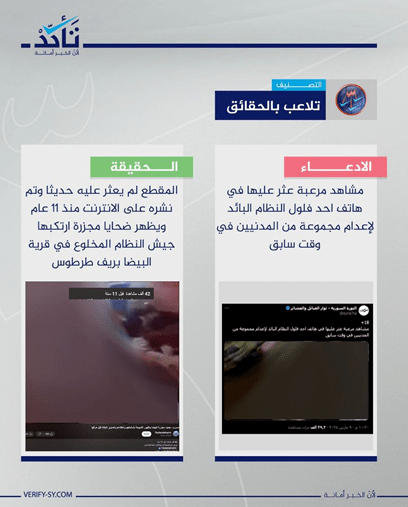
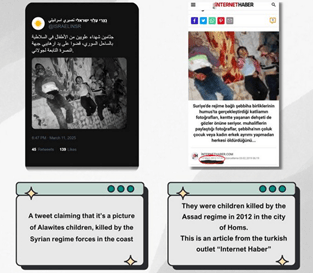
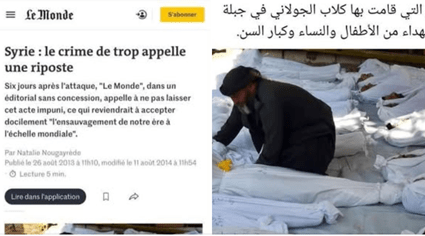
The first is explained in the tweet itself: an example of passing off crimes of the Assad regime as crimes committed now against Alawites. The creator of the original dishonest meme is the strange web-virus calling itself ‘Syrian Girl’, who spent 14 years actively supporting the genocidal crimes of the Assad regime, such as this one she now tries to credit to “Jolani’s gangs.” Similarly, as revealed by the excellent Verify Syria site, the second example is a “widely shared video, allegedly from a fallen regime member’s phone, claimed to show summary executions of civilians. The footage actually dates back to 2013 and documents a massacre committed by Assad’s forces in Tartous.”
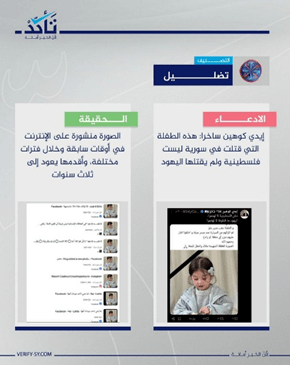
Another class of examples are those that claim crimes committed by Israel were actually occurring on the Syrian coast at the time. Verify Syria exposed this “widely shared video [which] claimed that Syrian aircraft bombed civilian homes with barrel bombs. In reality, the footage shows Israeli airstrikes on Qusaya, Lebanon, in December 2024.” Even crimes committed in India were passed off as crimes on the Syrian coast. The second photo above, showing a Syrian child named Dahab Munir Alou, and claiming her as a victim in the recent coastal violence, “has been circulated online multiple times over the years, with the earliest record dating back three years.” Still another class of misinformation images are countless cases claiming people have been killed who then turn up to demonstrate that are in fact alive. The video above on the bottom claimed that Dr. Kinanah Ali and her children had been killed. The doctor later appeared in this video, denying the news and confirming that she was alive.
There were also false claims about government policy. According to Verify, “claims that Syrian forces banned media from covering arrests and summary executions are based on a forged document. The alleged directive was altered from a February 14 order on military asset transfers.”
One specific aspect of disinformation was the assertion that Christians were also being slaughtered. The fact that these were lies does not make the actual slaughter of Alawites any better, of course, but the claims about Christians were aimed at western Islamophobic audiences. Among leading Trumpist circles, such claims, based on mountains of social media memes, were made by Elon Musk, Tucker Carlson, Vice-President Vance, and even Jim Risch, chair of the Senate Foreign Relations Committee.
The claim was not upheld in any of the human rights reports, and was denied in a statement issued by the Pastors of Christian Churches in Lattakia, who also advised in response to claims being spread on social media pages, “we kindly ask that you always rely on news issued through the official church pages exclusively, and we urge you not to be swayed by rumors, especially after the reassuring message we heard during the meeting we held this evening with a delegation from the leadership of the Syrian General Security Administration.” Syrian Bishop Hanna Jallouf, head of Syria’s Catholic Church in Aleppo, confirmed that “No Christians have been killed in Syria – claims to the contrary are false and misleading.”
Several Christians were killed in the chaos, one father of a priest in a carjacking by some people looting, one over a land dispute, and, ironically, two killed by Assadist gunmen shooting up cars with Idlib numberplates. Clearly, Christians were not specific targets in any of these cases.
Again, none of this means that horrendous killings did not occur. But misinformation does a disservice both to the real victims, by causing doubt about all claims, and to the actual victims in the other cases being misrepresented. The irresponsible spreading of lies by enemies of the Syrian people aims only to inflame the situation.
Syrian government reaction
Confronted with the Assadist insurgency and the slaughter it unleashed, the Syrian government sent in more security forces, but unofficial calls for a ‘general mobilisation’ spread around the country. This was partly responsible for the large-scale descent on the coast by factions and armed civilians from around the country that led to the chaos in which civilians were killed in large numbers. Latakia resident Alaa Awda claims that these calls for a general mobilization opened the way “indiscriminately for everyone to come to the coast, whoever they are, some of whom want to settle scores on a sectarian basis.”
However, already on March 7, the Military Operations Administration declared “the state does not need men to fight in its ranks or to declare a state of emergency in mosques,” and shortly afterwards, al-Sharaa called on “all forces that have joined the clash sites to fully obey the military and security leaders there, and to immediately evacuate the sites to control the violations that have occurred.”
In his first statements on Friday March 7, Sharaa condemned attacks on civilians and stated “everyone who attacks defenceless civilians and attacks people for the crimes of others will be held strictly accountable.” However, it was not immediately clear from this speech that forces fighting for the government side were already responsible for a large part of such attacks and of a most reprehensible form; and his primary attack was on the Assadist forces who had precipitated the disaster with their own massacres. While putting primary blame on the Assadists certainly had validity given their precipitation of the crisis, this statement arguably did not respond with the gravity required given how terrible the situation already was in relation to the slaughter being unleashed by elements of the pro-government side.
Sharaa stated “What distinguishes us from our enemy is our commitment to our principles. When we compromise our morals, we become our enemy on one level.” While this part of the statement is very good, it is still not clear from it that large numbers had already done precisely this, that they were precisely not “distinguishing themselves” from the Assadist enemy. He called on the security forces to “not allow anyone to overstep or exaggerate in their reaction” (to the Assadist insurgency), but it was unclear that overstepping was already going on on a large scale. He stressed it is their role to protect all the citizens of the coast, yet added, “from the gangs of the fallen regime.”
The interior ministry put the killings down to “individual violations” and pledged to stop them. “After remnants of the toppled regime assassinated a number of security personnel, popular unorganised masses headed to the coast, which led to a number of individual violations.” The source stressed that “these violations do not represent the Syrian people as a whole,” a welcome statement to be sure, but the violations were well beyond “individual” and had already become “mass” violations.
By March 8 the tune was changing. “We will hold accountable, firmly and without leniency, anyone who was involved in the bloodshed of civilians … or who overstepped the powers of the state,” al-Sharaa declared. That morning the government halted military operations, having largely defeated the Assadists, and shut all roads in order to remove gunmen not under the command of the Defense and Interior ministries, and began making arrests. By late in the day, “at least five different groups of gunmen had been captured.”
On March 10, Sharaa again upped the rhetoric level. Noting that that “many parties entered the Syrian coast and many violations occurred, it became an opportunity for revenge,” he said. “We fought to defend the oppressed, and we won’t accept that any blood be shed unjustly, or goes without punishment or accountability. Even among those closest to us, or the most distant from us, there is no difference in this matter. Violating people’s sanctity, violating their religion, violating their money, this is a red line in Syria.”
Its mandate includes “investigating the causes, circumstances and details of the incidents, examining human rights violations suffered by civilians and identifying the perpetrators, investigating attacks on public institutions, security forces and military personnel, and referring those found guilty of crimes and violations to the judiciary.”
The government also announced a High Commission for Civil Peace in the coastal region, tasked with “meeting with communities and listening to them, ensuring their security and safety.” On March 19, the commission held a meeting with senior Alawite notables in Latakia and agreed on a set of measures, including release of Alawite detainees and others currently under investigation, removing any restrictions on former regime soldiers currently holding settlement cards, limiting arrests to those believed to pose imminent security threats, removing government forces from residential buildings which they had occupied as new checkpoints, and establishing phone lines dedicated for receiving complaints.
In addition, according to journalist Haid Haid, local authorities in Latakia announced mourning ceremonies for all victims of the violence, both civilians and security forces. However, they also announced celebrations of the anniversary of the revolution in days soon after the carnage. In Latakia and Tartous, the feelings regarding anything resembling a celebration, even for those most associated with the revolution, would be very mixed in the circumstances to say the least.
I am not citing speeches by al-Sharaa or other government statements, or providing information about the accountability and civil peace mechanisms, in order to sow illusions. Whether these statements are reflected in real action and whether these mechanisms lead to real accountability remains to be seen and should be judged on that basis; that is virtually a life and death test for the revolution. On March 24, the investigative committee met with the UN Commission of Inquiry in Damascus, reportedly planning to coordinate their work on the issue; this certainly seems to be a positive, but again, results are what count.
However, it is important to distinguish the actions of undisciplined sections of security and armed forces from the security operation as a whole, which was unfortunately made necessary by the Assadist insurgency; and to understand that the massacre of Alawites was not a policy of an “al-Qaeda regime” as much anti-Syrian propaganda purports, even if we can be critical of government policy in relation to the events, and in relation to the Alawite question leading up to the events (to be discussed below), and since.
And the improvement in al-Sharaa’s statements, while perhaps simply reflecting the fast pace of events, may also reflect pressure from the outrage expressed by thousands of Syrian revolution activists with the massacres, which goes against all they have fought for the last fourteen years; the revolution is the people and their demands as long as they have not been crushed, the revolution is not the regime.
Arrests
Arrests of perpetrators began on March 8 and has continued. The following two photos are from the ‘Syria Weekly’ compilation of March 4-11.
The first photo below shows a fighter from a MOD formation being arrested by Military Police in Latakia on March 10, accused of committing crimes against civilians which he filmed on his phone; the second photo, another four men arrested on March 11, accused of committing violations “and “unlawful violent acts against civilians” in Latakia.
The Military Police also arrested these two MOD fighters below on March 10, after a video of them committing “bloody violations of civil rights in a coastal village went viral.” They were “transferred to the special military court.” Second image is video of the March 9 arrest of “Hussein Wassouf and his group” accused of committing crimes against civilians.
According to long-time and well-known Syrian journalist and activist Hadi Abdullah, “more than 50 elements from the Ministry of Defense have been dismissed and transferred to the investigation for suspicions of their involvement in violations and individual offenses, and a follow-up of those who appeared in videos of other violations is being carried out.”
[Following the release of the government’s investigative committee report in July, which alleged some 298 individuals were involved in these killings, the first 42 have reportedly been arrested].
Who was responsible for the civilian massacres?
Tens of thousands of people both from official security bodies and unofficial armed civilians initially descended on the coast in the chaos to fight the prospect of a return of the genocidal dictatorship and to avenge the initial slaughter unleashed by the Assadists; some 1217 Alawite civilians (or ‘disarmed troops’) were killed according to the SNHR. Such numbers indicate that the vast majority of pro-government combatants did indeed focus their fight on the Assadist insurgents and did not target civilians.
Unfortunately, while war in general brings out the worst in people, in a chaotic situation in which the new government has only just set up new security and military forces, and the whole system of command and control remains rudimentary, violations are even more likely to occur; and even more so in an atmosphere pumped with sectarianism by the genocidal Assad regime sectarian laboratory, with many out for murderous collective ‘revenge’.
While many people on all sides of the debate will not like me making the analogy, I believe these factors also describe what happened in the Gaza pocket in southern Israel on October 7. Likewise the Hamas leadership claims it only aimed at the occupation military bases but that violations took place against the orders. This is not the place to make judgements on this, I’m merely reporting the statements. Like on the Syrian coast, thousands crossed the Israel-Gaza demarcation line (including large numbers outside Hamas leadership control), and hundreds of Israeli and other civilians were killed. In both the October 7 and March 7-8 cases, if anything even close to the majority of fighters were out for civilian blood, we would have seen thousands upon thousands killed. But hundreds, or even mere dozens, of fighters (whether uniformed or otherwise) determined to kill can kill a lot of people.
So who committed most of the sectarian crimes? Violations were reported by elements of all forces involved: elements of the security forces, ‘factions’ of the MOD military forces, and armed civilian groups, but far more from the last two categories than from the first. First, it might just be useful to explain the difference between these groups and who they are:
The “security forces” refers to the new General Security Service (GSS) set up by the new government under the Internal Affairs Ministry. According to very knowledgeable Syria watcher Gregory Waters, these forces “are generally speaking legacy HTS and Salvation Government formations, at least at the leadership level.” Both local police and GSS units “have roots in Idlib’s SSG political or police offices.” He assesses that this “has resulted in the Ministry of Interior appearing to have better command over its units, who in turn have an overall better track record of professionalism, than the country’s military units.” This assessment fits with the evidence below.
The new Syrian Army, under the Ministry of Defence (MOD), formed from dozens of former rebel factions, including HTS itself, which were asked to dissolve in January. Most, but not all, did so. However, Waters assesses that “this was almost entirely a symbolic process,” and “by and large, most armed groups have not merged into the new ministry, let alone dissolved.” Moreover, the least integrated into the new structure are the military factions from the Turkish-backed Syrian National Army (SNA), which “retain their own independent revenue streams through both Turkish salaries and years of criminal activity in northern Syria and foreign deployments.” These SNA factions “are only nominally under the Ministry of Defense.” Once again, this fits with the evidence that certain SNA military factions were overwhelmingly responsible for large-scale crimes in the coast.
Armed civilian groups – this category includes both local Sunni civilians, and civilian groups that initially poured in from outside the coast.
Foreign jihadi groups, previously associated with HTS but now integrated into neither the GSS nor the Army can be included as a special category.
The General Security forces (GSS): Reportedly the most ‘disciplined’ and ‘professional’
According to the Office of the High Commissioner for Human Rights many of the cases documented were of “summary executions carried out on a sectarian basis reportedly by unidentified armed individuals, members of armed groups allegedly supporting the caretaker authorities’ security forces, and by elements associated with the former government [ie, Assad regime]”. Thus the new security forces (GSS) are not specifically noted. Similarly, the SCM report only notes “armed formations affiliated with or loyal to the Transitional Government’s Ministry of Defense, alongside foreign fighters, were involved in carrying out the violations,” while the Investigative Committee’s report “identified individuals and groups linked to certain military groups and factions from among the participating forces.” The SNHR report does include violations by “General Security personnel” along with “military factions [and] armed local residents, both Syrian and foreign,” but assesses that the “vast majority” were carried out by certain of these “military factions” that only recently joined the new Syrian army, rather than by wayward GSS. The UN Commission of Inquiry report likewise included general security alongside military factions, but stressed that “many interim government forces elements neither engaged in nor condoned the actions of those groups … to the contrary, it has documented their active efforts to evacuate, or protect certain populations and individuals” (p. 17-18).
Long time Syrian writer, activist and former political prisoner Yassin al-Haj Saleh basically concurs with these assessments:
“My impression, which needs verification, is that there are three subgroups within the armed formations that poured into the coastal areas after the bloody events of March 6.
“The first consists of organized forces from the General Security and the new army.
“The second includes sectarian Sunni Syrian groups like Amshat and Hamzat.
“The third consists of jihadist groups, including foreign fighters.”
Regarding the first group, the General Security (GSS) forces, Saleh writes that it appears that “in some cases, [they] exercised excessive repressive violence and captured Alawite civilians. … However,” consistent with the previous two assessments, “it was also the most disciplined, limiting further casualties in some instances, and it suffered significant losses in confrontations with armed Assad loyalists.”
It therefore appears clear that, on the whole, the new General Security forces should be distinguished from certain military “factions” of the army, armed civilian groups and jihadis. That does not mean there were no cases of General Security taking part in violations; there were. But let’s look at some evidence that backs up this general pattern.
The SNHR report claims there were “instances of direct clashes … between armed groups supporting the government’s security forces on one side and elements of the Internal Security forces who attempted to prevent indiscriminate killings on the other. In some cases, these clashes escalated into armed confrontations between the two sides” (p. 13).
In Homs, the government’s security forces formed cordons around areas to protect the Alawite citizens from armed gangs. The effectiveness of this was confirmed by an Alawite woman interviewed on Gregory Waters’ excellent Syria Revisited blog: “We were very scared, I didn’t go to work, we thought our turn would be next and the massacre would reach Homs soon … The General Security forces played a huge role in protecting the Alawite neighborhoods. They gathered more forces and forbade any armed groups to enter our neighborhoods, I may be able to say that without their protection, Alawite Homs could have faced the same destiny the coast had been facing.”
This was perhaps easier as the Assadist insurgency took place in Tartous and Latakia, so the security forces were able to be highly successful in less affected Homs; only three deaths were recorded in Homs over these days. This figure is surprisingly low, because Homs – with its mixed population – was much more the epicentre of sectarian conflict throughout the war, but also in the earlier low-lying post-Assad conflict, overlapping with random killings in a security vacuum, in the late December-January period, Homs had been far more impacted than the coast itself and has continued to be in its aftermath.
In this report from the town of Qadmus – an Ismaili town surrounded by Alawite villages – the interviewee reports no problems with the police or security forces, but some of the “factions” – meaning military factions – did commit crimes in the countryside (as did the Assadists).
Similarly, Latakia resident Alaa Awda recalled that “the clearing operations on the coast were carried out in several stages. When general security entered for the first time, they were professional.” Then, when other forces entered — factions affiliated with the Ministry of Defense — “they were harsher, with executions, assaults and robberies.” Or this Alawite woman interviewed by the Syria Revisited blog, who claims more generally that “security men are more professional in solving problems peacefully and they try to keep all things under control,” whereas “military members act more quickly and direct … they make a scene every time they do something … [they are] somehow more harsh and cold.”
The SCM report cites a case of killings in the village of Aziziyah in western Hama province carried out by “armed men … from neighboring Sunni-majority villages in the al-Ghab plain.” The witness did not know whether the men belonged to any government military formation, but he stated that “General Security personnel treated civilians respectfully and were not implicated in any violations.”
Researcher Gregory Waters similarly reports that “while some GSS members participated in extrajudicial executions during the March violence on the coast, Alawites and Ismailis have consistently described GSS behavior as much better than that of the [military] factions in Hama, Latakia, and Tartous … This is a trend that the author has found across most minority regions, and seems to reflect a generally higher degree of professionalism on the part of Ministry of Interior units when compared to the various military factions.”
Even this report by an anti-Assad Alawite coastal resident, which is completely gut-wrenching in its description of the mass murder and the terror of the Alawite citizens, and which puts indirect blame on the government itself, nevertheless also reports on an incident in which security forces directly aided Alawite citizens escaping from danger, and speaks of the security forces “trained in Idlib” who were “known for their professionalism and respectful conduct toward the people of the Syrian coast.”
On the other hand, Alawite anti-Assad civilian ‘J’, who reports “all my friends and loved ones are dead now,” claims that some of the security forces in Baniyas were involved in killing and looting, but after a point “the General Security men began to calm things down and stop the looting and fighting.” Clearly as noted above, they were not all innocent, but even this negative report paints them in a different light to the military “factions” and armed civilians that he claims carried out most of the killing (see below).
On the other hand, we sometimes hear that the security forces, while not generally the perpetrators, “did not protect civilians” from them (despite numerous other reports, as cited above, when they did). It is unclear if this means that security forces present did nothing in the face of violence from other factions, or that they were not present to protect. In the latter case, first, the massacre of hundreds of security personnel who had been stationed in the region initially hugely weakened their capacity to protect anyone; secondly, those remaining, and those rushed in from the outside, had as their first priority crushing the Assadist revolt. It appears that many of the massacres took place in vulnerable rural areas away from where the main action was. Therefore, this is difficult to assess.
For example, the Amnesty report notes that “according to residents” in one area of their study [note: Amnesty only interviewed 16 civilians in total], “the authorities did not intervene to end the killings, nor did they provide residents with safe routes to flee the armed men.” But it then goes on, “Three others said the only way for them to flee was when, eventually, they were able to secure car rides from Hay’at Tahrir al-Sham [HTS],a former armed group integrated into the government armed forces.” As noted above, the GSS (security forces) are virtually a proxy for armed HTS cadre. How ironic that Alawites are aided in fleeing from violent factions by forces of what was once the most ideologically anti-Alawite faction.
Countless other examples of security forces acting professionally in contrast to either ‘factions’ or armed civilian groups acting murderously can be cited. The official Syrian Arab News Agency (SANA) also claimed that security forces returned more than 200 vehicles stolen by those they claimed “took advantage of the instability” on the coast.” On the other hand, the Reuters report does document cases where members of the GSS were directly involved in massacres, so this should not be read to mean they were uniformly innocent.
Military ‘factions’, ‘foreign jihadis’, ‘Amshat and Hamzat’ – Heavily reported as responsible for massacres
So, who committed most violations and what were the causes?
Yasin al-Haj Saleh claims that the other two groups [ie, military factions “like Amshat and Hamzat,” and “jihadist groups, including foreign fighters”] “engaged in genocidal violence—killing Alawites solely because they were Alawites. One acted out of a malevolent ideological conviction, while the other was driven by a mix of revenge, warlordism, and looting.”
It is difficult to separate motivations of groups, but my understanding is that Saleh means the third group, the actual jihadists – which includes foreign jihadi factions from the Caucasus or central Asia who were around HTS and have remained in the country since liberation – were those who acted out of “malevolent ideological conviction,” ie pure sectarian hatred of Alawites. While the HTS leadership has moved away from this stance, there remain strong elements of its base who hold these views; and given that foreign jihadi fighters entered Syria for the purpose of “waging jihad,” many may hold firmer to such malevolent ideas than many locals who have to relate to the Syrian society around them. Foreign jihadi fighters were reported in relation to violations in both the SNHR report and the SCM report (p. 19, 31). However, “foreigners” cannot be conveniently singled out for most blame.
Indeed anti-Alawite sectarian hate speech was widely reported to have emanated from various mosques. For example at this Aleppo mosque, a preacher tells hundreds of Syrians that “the land of the Levant cannot, cannot be anything but pure … the Levant was Sunni and will remain Sunni … the Sunnis must now unite and must know who their enemies are … we yearn for martyrdom, we yearn for battles, we yearn for killing.” Many examples of such hate speech spread not only by preachers but other social media influencers are collected in this report. Though it is unclear, it is possible that many of these hate preachers and influencers are associated with unreconstructed sectarian elements of the former HTS base. On the other hand, some preaching mobilisation warned against committing “transgressions.”
I believe Saleh is referring to the second group, “Amshat and Hamzat” – two military factions from the Turkish-backed ‘Syrian National Army’ (SNA) – as those driven by “a mix of revenge, warlordism, and looting.” “Amshat” refers to the Sultan Suleiman Shah Brigade of the SNA, named after its commander Mohammed al-Jassem‘s nom de guerre Abu Amshat. “Hamzat” refers to the al-Hamza Brigade of the SNA. Both brigades have a long history of war crimes and other violations, including abduction, extortion, torture, rape and murder, especially in Afrin, where al-Hamza ran an illegal women’s detention facility. Both militia are under sanctions by the US Treasury Department for violations in Afrin and elsewhere.
It is certainly true that these two SNA factions have been widely reported by countless Syrian sources to have been responsible for most of the sectarian killing. The SCM report specifically describes a number of cases, and the groups identified included Amshat and Hamzat, along with three other notorious SNA brigades, Sultan Murad, Ahrar al-Sharqiya and Jaysh al-Islam (pp. 18-19, 31), as well as a military brigade (Division 400) which was not SNA, but previously belonging to HTS. Likewise, the massive Syrian Archive report, based on open-source information, which documents the presence of every armed group on the coast, gives specific information about killings carried out by Amshat (p. 7-8), Ahrar al-Sharqiya (p. 9), an independent Qalamoun brigade, the ‘Lightning Battalions of Islam,’ which deployed “in coordination with the SNA Muntasir Billah Brigade” (p. 17), and members of the Al-Boushaaban tribe (p. 18). The UN Commission of Inquiry report also specifically documents the involvement of Amshat, Hamzat and several other brigades in various crimes.
“Warlordism and looting,” along with wanton murder, has indeed been the modus operandi of the worst SNA factions for many years, since their role in the Turkish invasion of Kurdish Afrin in 2018, so this is not surprising. These factions, like the rest of the SNA, are officially part of the new Syrian army (as opposed to the General Security), but as noted, this new “army” has only just been formed by cobbling together dozens of military factions from the old opposition throughout Syria, and the SNA brigades have only partially integrated; indeed, there is little evidence that any effective system of control and command has yet been established.
Ideologically, the SNA is an oddball collection which includes former secular FSA brigades and Islamist brigades alike, while the Suleiman Shah Brigade and another SNA brigade, the Sultan Murad Brigade, are Turkmen-based brigades, influenced by Turkish-nationalism. HTS’s origins in Jabhat al-Nusra mean it was more steeped in anti-Alawite sectarianism than any group in the SNA hodge-podge; the SNA in contrast is more likely to have specifically anti-Kurdish biases due to Turkey’s sponsorship. Therefore, it may seem odd that the worst violations appear to have been committed by SNA brigades like Amshat and Hamzat; and likewise the Turkish-nationalist Sultan Murad Brigade of the SNA was also implicated in attacks on Alawites in January, and again in the March massacres. What specific issue would these SNA brigades have with Alawites?
Most likely, it has little to do with Alawites as such, but rather what the SNA represents: a long-term degeneration of a number of groups, whereby Assadist repression forced them more and more under Turkey’s wing; being sponsored and paid by a state to do its bidding – whether anti-Kurdish offensives in Syria or participation in Turkey’s foreign ventures in Libya or Azerbaijan – meant the needs of their local base of support became less important. It is in this context that open criminality became the norm for some SNA groups, and indeed, a major additional form of financing.
That said, the SNA cannot be reduced to its famed criminality; the north near the Turkish border is where hundreds of thousands, indeed millions, from all over Syria took refuge from the Assadist slaughterhouse, fleeing their destroyed homes and towns and cities, and “disappearances” and torture chambers, and many would have had no other options but to sign up to a Turkish-backed militia. Needless to say, irrational collective ‘revenge’ would also likely be a major motivating factor among many of these dispossessed people now in SNA uniform. Finally, some of the SNA brigades, for example Jaysh al-Islam, whose cadres were displaced to the north after being expelled from Ghouta in the south, was always as fundamentally Sunni sectarian, anti-Alawite as HTS, if not more so; and this was alos the case for certain hard-Islamist northern brigades which were incorporated into the SNA, even if that was not a defining SNA charatceristic.
Getting back to the looting and wanton criminality, not all of it can be attributed to these SNA factions, but it is important to note that these motivations were important additions to jihadi ideology or lust for collective ‘revenge’. For example, this account from Jableh from Syria Direct by a Sunni resident al-Abdullah claims that when pro-government armed “factions” arrived in his town after the townspeople had driven back the Assadists, “the city suffered billions [of Syrian pounds] in material losses due to attacks on shops and homes. … [he denounced] “the poor morals of some of the groups, which engaged in vandalism and looting, with no differentiation between Sunnis and Alawites.” His family’s shop was “robbed and vandalized by some of the groups” that ostensibly came to “support” them. Another local, Omran, likewise claimed that “Some of the factions that entered Jableh committed widespread violations, including killings and theft against Sunnis and Alawites.”
The Alawite citizen ‘J’ (cited in the Syria Revisited blog) claims that his house was raided by five separate groups on March 7, of which the first group, a military faction from Hama, “were the worst and most violent and did most of the killings. They also stole gold, phones, cars, anything really.” The other four raids were either by other “factions” or by foreign jihadis, but none were as violent as the first; the next day the region was attacked by armed civilians from the countryside who were once again worse (see below).
HTS, in contrast to the SNA and perhaps some other unruly military factions, had been forced to deal with the Syrian reality where it ruled, and over time it adapted and became somewhat more pragmatic, despite its politically repressive rule and the ongoing existence of hard-line elements within its base.
For example, after taking over the Kurdish region of Afrin in 2022 from the SNA, HTS declared that it “confirms that the Arab and Kurdish people are the subject of our attention and appreciation, and we warn them against listening to the factional interests… We specifically mention the Kurdish brothers; they are the people of those areas and it is our duty to protect them and provide services to them.” In March 2023, HTS confronted the SNA after five Kurdish civilians were killed by members of a Turkish-backed faction during a Nowruz celebration in Jenderes. Jolani met with the Kurdish residents and HTS forces deployed in the town and seized control of headquarters of the military police and the SNA’s Eastern Army, which was accused of the killings.
Of course, Kurds are Sunni; Islamist groups like HTS include Kurds, and tend to be less ideologically Arab nationalist, while being more Sunni sectarian. Yet HTS also moved partially against its own sectarian background in Idlib in recent years, as I have documented here. Of course, these changes do not mean former HTS cadre do not commit violations; no doubt many do (as noted regarding Division 400), and changes at the top do not necessarily alter the long-entrenched sectarianism of sections of the base. However, this does help explain the widespread reports of several SNA factions bearing primary responsibility for the carnage, and of former HTS-led security forces being overall more professional.
However, some military brigades acted with integrity
All that said, the Syrian Archive report documents the presence of some 25 divisions of the new Syrian army (including from former SNA, NLF, HTS and new divisions), plus various independent militia and tribal fighters, on the coast at the time, yet the number of militia or military divisions specifically named in any of the key reports (SNHR, SCM, Syrian Archive, UN Commission of Inquiry, even the somewhat confused Reuters report) as committing violations and killings does not exceed the half dozen or so mentioned above. This is important, as the fact that most violations were carried out by wayward military factions does not indicate that the entire Syrian army acted as a genocidal gang during the events. It should be pointed out that the Syrian Archive report documents several cases where military brigades protected Alawite civilians from sectarian thugs and thus deserve an honourable mention:
First, referring to Faylaq al-Sham, a member of the mostly FSA National Liberation Front (NLF), the report states “On March 9, a civilian from the Jableh countryside posted several times on Facebook begging people to send the General Security to his house, and later wrote “Faylaq al-Sham, I will bear your debt until death. Thank God, members of Faylaq al-Sham saved us from the house before the arrival of undisciplined individuals intent on killing” (p. 11).
Notably, Faylaq was mentioned in another region, Bahluliyah in Latakia, by researcher Gregory Waters:
“According to one local I spoke with, the Faylaq commanders were respectful and professional as they searched the town. When they left, the commander gave everyone his phone number and said to call him if there were any issues. Later that day, another faction arrived – the witness does not know their name – and began looting homes and killing civilians. The man called the Faylaq commander, who returned and expelled the faction from the town. Faylaq al-Sham has remained in the Bahluliyah and Haffeh regions since March where it has a widely positive reputation.”
Getting back to the Syrian Archive report, it also discusses the well-established FSA brigade from northern Hama and Idlib, Jaish al-Izza (now the 74th Division). It was an independent brigade which was never in the SNA; the report claims it as a member of the NLF. Its commander issued instructions to its checkpoints and personnel in north and west Hama: “Random entry into villages and towns without coordination with the division’s leadership is prohibited. Any vehicle not bearing proof of ownership will be confiscated. Entry into neighborhoods and villages with sectarian diversity will not be permitted for the purpose of revenge. Residents of villages and cities are safe as long as they adhere to the instructions and decisions of the Ministry of Defense. Strict orders will be issued to deal with anyone who violates these instructions.” (p. 11-12)
The third group mentioned was the NLF brigade 77th Coastal Division, consisting of fighters originally from the FSA-held southern town of Zabadani, who were expelled to the north in 2016 following prolonged Assadist starvation siege; they were present in the Bahluliyah district of Latakia. According to a report of a villager, “factions [ie, military factions] in the villages of Al-Bahluliya, Da’tour Al-Bahluliya area, were burning houses and killing,” so he contacted 7th Division commander Abu Ahmed. Several villagers were killed by the “factions” and then in half an hour, “Abu Ahmed arrived with members of the 77th Brigade at the Al-Bahluliya junction. The faction said, “We will comb the village.” After some back and forth, the faction left, and Mr. Abu Ahmad and the elements of Brigade 77 spared “the village” from something that would have had undesirable outcome. Now Mr. Abu Ahmed has taken over the area for us. Welcome, may God bless you. Many thanks to the members of the 77th Brigade” (p. 14).
Armed civilians and “revenge” killing
But if unreconstructed sectarianism explained some crimes, and opportunistic wanton criminality others, what of the motivation for ‘revenge’? Lust for revenge by people whose families, friends and communities were slaughtered by the Assad regime, taking out their ‘revenge’ against innocent civilians, was clearly one of the factors here. Stating this is not to justify it. It is merely stating the reality that this is common in conflicts throughout the world. Most people involved in such battles may understand that the ordinary people on “the other side” are not at fault, and to kill ordinary citizens in “collective revenge” is to act no differently to one’s oppressors. However, not every severely damaged individual, who has known nothing but war, killing, atrocities and personal tragedy since their childhood “knows” this. From the atrocities on October 7, to brutal attacks on Kosovar Serbs by returning Albanian refugees driven from their country by Milosevic’s genocidal war, to countless anti-colonial violations and massacres around the world, so-called “revenge” takes place, especially in situations of security vacuum like in Syria where the old regime’s army and police collapsed and new ones take time to build.
The element of “revenge” may have been the most prominent among the undisciplined groups of “armed civilians” who were theoretically on the pro-government side but not under anyone’s command; yet putting on a uniform, whether security or military, does not always prevent these people, especially severely damaged young men, from acting differently. As such, this may have also been a motivation of many violators from other categories, whether General Security or military factions, especially SNA members as noted above.
We have some very direct examples of such collective revenge being taken out against an Alawite village, not by security forces or military factions or even armed civilians coming in from afar, but by local civilians from a neighbouring Sunni village who had been horribly mistreated by Assadist elements of that village under the previous regime; and security forces reportedly attempted to stop their carnage. This was reported in The Guardian:
“In Arza, local people say they know who their killers were. Three survivors accused the residents of Khattab, a nearby Sunni village, of being behind Friday’s massacre. Abu Jaber, a religious notable in Khattab and a former opposition fighter who had returned to the village, described how he and others entered homes, and forced men on to the town’s roundabout, with the purpose of displacing them from the village. “But then people who had their families killed [by the regime] came, and they opened fire,” he said.
“A survivor of the attack described how the killers left the bodies on the roundabout and began to loot houses, killing any men they saw while they pillaged. They said members of the Syrian general security tried to protect town residents, but were quickly overwhelmed.
“They came in the town chanting that they wanted 500,000 Alawites for the people they lost. They came into my house and took my brother and killed him in cold blood,” said a woman who was retrieving her belongings from her looted home, breaking down in tears.
“While Abu Jaber denied personally killing anyone, he said the people of Arza deserved their fate. He claimed that during the civil war the town’s residents had extorted and abused the residents of Khattab, and so the killings last Friday were merely people “claiming their rights”. He recalled a time when a regime official from Arza had bludgeoned a Khattab resident to death with a stone – and claimed the whole of Arza had celebrated after the killing. “What would you imagine that the villages that live around Arza, which committed these acts, what should they do? You think we should give them flowers?” he said.”
“Survivors of the Arza massacre admitted that select regime officials from the town did kill residents of Khattab,but said those officials had fled after the fall of Assad, and those left in the town had nothing at all to do with the previous abuses.”
Video of the attack on Arza show the attackers to be either ordinary villagers and/or criminal elements rather than security forces.
Similarly, the Alawite ‘J’ cited above claims that armed Sunni civilians were responsible for around 40% of the murders” in Baniyas. Importantly, both ‘J’ and Christian interviewee ‘S’ made a distinction between Sunni civilians in the town, who knew their Alawite neighbours and did a great deal to protect them, whereas “most of the local Sunnis who engaged in the murders were from the countryside,” notably, they were “from the areas the regime massacred in 2012 and 2013,” referring to the gigantic Baniyas massacre of that time (see below) – clearly another example of collective ‘revenge’.
On a smaller scale, an incident reported by Amnesty in its report tells of armed men raiding a home and killing the husband of a ‘Samira’, who said one of the men “blamed the death of his brother on the Alawite community.” When she protested that they had nothing to do with the former regime’s killings, he said “they would show him how Alawites had killed Sunnis.”
Such murders are clearly unjustified and appalling. However, these incidents raise the issue of where this came from – and therefore how this cycle can end.
Assad regime slaughterhouse: Incubator of sectarian mayhem
The Assadist slaughterhouse was the laboratory of sectarianism par excellence. This does not mean it was a religiously Alawite regime – it wasn’t, its ideology is better described as secular fascist – or that most ordinary Alawites benefited – they mostly remained poor and were torn apart by losing so many sons as cannon fodder for the regime. Rather, the Alawi-dominated regime weaponed sectarianism as a means of waging its counterrevolutionary war.
The regime itself was heavily dominated by the 10 percent Alawite minority, as this chart shows, though that was not ideological, but rather due to the nepotistic regime being dominated by the Assad family – who happen to be Alawite – and extended family, friends and connections, who lived like kings while the Alawite masses lived in poverty.
Most of the organs of state were also dominated by Alawites; as Syria expert Fabrice Balanche explains, noting that the initial uprising in 2011 aimed “to get rid of Assad, the state bureaucracy, the Baath Party, the intelligence services, and the general staff of the Syrian Arab Army,” this very fact could not help but tap an existing sectarian dynamic inherent in the Baathist set-up, because “all of these bodies are packed with Alawites, over 90 percent of whom work for the state.” If this figure is even roughly true, then, while certainly “working” for the state does not necessarily convey any kind of upper or even middle class status, it did put the average Alawite in a relatively privileged position compared to the average Sunni, placing two strategic tasks of the revolution – destroying the totalitarian state apparatus, and overcoming the sectarian divides – partially at odds with each other.
Above all, Alawite elements were absolutely dominant within the military and security apparatus of the regime — including head of the Republican Guard, chief of staff of the armed forces, head of military intelligence, head of the air force intelligence, director of the National Security Bureau, head of presidential security. According to Stratfor, quoted by Gilbert Achcar, “Some 80 percent of officers in the army are also believed to be Alawites. The military’s most elite division, the Republican Guard, led by the president’s younger brother Maher al Assad, is an all-Alawite force. Syria’s ground forces are organized in three corps (consisting of combined artillery, armor and mechanized infantry units). Two corps are led by Alawites.” Achcar continues: “Even though most of Syria’s air force pilots are Sunnis, most ground support crews are Alawites who control logistics, telecommunications and maintenance, thereby preventing potential Sunni air force dissenters from acting unilaterally. Syria’s air force intelligence, dominated by Alawites, is one of the strongest intelligence agencies within the security apparatus and has a core function of ensuring that Sunni pilots do not rebel against the regime.”
So when a regime that has ruled for decades, that is overwhelmingly Alawi-dominated, launches unlimited war against its population who rise up for democratic rights, and the majority of the rising population (though by no means all of it) just happen to be Sunni, then Alawite domination of the military-security apparatus waging this war becomes a fundamental aspect fuelling sectarianism. The towns and cities, or districts of cities, targeted for total demolition by this Alawi-led military were Sunni. As Syria expert Thomas Pierret explains:
“The problem is that many people do not even recognize the sectarian character of these atrocities, claiming that repression targets opponents from all sects, including Alawites. In fact ordinary repression does target opponents from all sects, but collective punishments (large-scale massacres, destruction of entire cities) are reserved for Sunnis.”
Pierret explains that understanding the fundamentally sectarian nature of the regime and its war is essential to understanding the scale of repression imposed by the Assad regime, which is not really comparable to elsewhere in the region:
“The kin-based/sectarian nature of the military is what allows the regime to be not merely “repressive”, but to be able to wage a full-fledged war against its own population. Not against a neighbouring state, an occupied people or a separatist minority, but against the majority of the population, including the inhabitants of the metropolitan area (i.e. Damascus and its suburbs). There are very few of such cases in modern history … No military that is reasonably representative of the population could do what the Syrian army did over the last two years [writing in 2013], i.e. destroying most of the country’s major cities, including large parts of the capital. You need a sectarian or ethnic divide that separates the core of the military from the target population. Algeria went through a nasty civil war in the 1990s, and Algerian generals are ruthless people, but I do not think that the Algerian military ever used heavy artillery against one of the country’s large cities.”
This includes the largest single massacre of the entire war – the murder of 1400 civilians in the Sunni, rebel-controlled Damascus suburb of Ghouta in August 2013, when the regime dropped the chemical agent sarin on the town, causing excruciating death.
But it is worse than this. The Assad regime’s sectarian lab was driven even more by its early establishment of proto-fascist sectarian Alawite militias (the Shabiha) to terrorise specifically Sunni populations, through mass murder of hundreds of people at a time and ethnic cleansing. This deliberate cultivation of sectarian mass murder, especially throughout 2012-2013, is what drove thousands into jihadist militia or to be otherwise bent on sectarian revenge.
Writing in the New York Review of Books, Jonathan Littell describes the process of regime-driven sectarian slaughter turning an anti-sectarian uprising into a sectarian war in Homs. On his arrival in Homs in January 2012, he reports “the people were still gathering daily to demonstrate—calling for the fall of the regime, loudly asserting their belief in democracy, in justice, and in a tolerant, open, multi-confessional society,” and notes that “The Free Syrian Army (FSA), made up mostly of army and secret services deserters disgusted by the repression, still believed its primary mission was defensive, to protect the opposition neighborhoods and the demonstrations from the regime snipers and the feared shabiha.”
However, he was able to document “the first deliberate sectarian massacre of the conflict, the murder with guns and knives of an entire Sunni family in the Nasihin neighborhood on the afternoon of January 26, 2012. Many more would follow, first of other families, then of entire Sunni communities in the village belt surrounding Homs to the West, in the foothills of the Jabal an-Nusayriyah, the so-called “Alawite mountain” from which the regime continues to draw its main support.”
He claims that even with this massacre, the FSA response “was not to slaughter an Alawite family, but to attack the army checkpoints from which the murderers had come.” But by mid-2012 this was changing and Assad’s strategy was bearing fruit as “uncontrolled” rebel units were also carrying out sectarian massacres of Alawites.
He also notes that the regime “favoured the rise, throughout 2012, of the radical Islamist armed groups that would soon enter into conflict with the more secular FSA. When Da‘esh first began conquering territory in Syria, in January 2013, “they never fought the Damascus regime and only sought to extend their power over the territory freed by our units,” as an FSA fighter explained. “Before their arrival, we were bombed each day by the Syrian air force. After they [Da’esh] took control of the region, the bombing immediately stopped.”
Following this “first sectarian massacre,” came a string of horrific Shabiha massacres of Sunni communities, of which only the most famous were:
the massacre of 108 civilians in the town of Houla in Homs, including 49 children and 34 women, killed with hatchets, knives and guns, mostly by cutting throats, in May 2012
the massacre of 78 people in the town of Qubair in Homs, half of them women and children, once again involving horrific killings with knives, burning and the like, in June
the massacre of 140 people in the town of Tremesh in Hama, after the town was ‘softened up’ by a combined tank and helicopter gunship attack, in July 2012
the enormous massacre of some 500 residents of the pro-rebel Damascus suburb Daraya, by regime troops and Shabiha, in late August 2012; under relentless regime shelling for days, the FSA left the town on August 23, in the hope of sparing the local people, yet once the FSA left, the killers went in, a Sabra-Shatilla replay
a smaller massacre of 107 residents in the south Damascus town of Al-Thiabieh, in September 2012; besieged by Assadist forces, the FSA again tried to save the town by leaving and evacuating residents, who however refused to leave; once the FSA left, Assadist forces moved in for the kill
the massacre of 106 people, killed and burned in their homes, in the village of Haswiya in Homs, in January 2013.
the gigantic, horrrifying massacre of some 450 Sunni men, women and children in Banyas and Bayda, in Tartous, in May 2013 (the fact that the worst massacre of Alawites on March 7-8 was in Baniyas is sadly no coincidence)
the massacre of 288 civilians, including seven women and 12 children, on April 16, 2013, in the Damascus suburb Tadamoun. The victims, randomly selected at regime checkpoints in a Sunni town under regime control, were blindfolded and shackled before being thrown into a pit dug in a street and shot in the back by regime troops. The bodies were then set on fire and the remains bulldozed over
However, the very fame and enormity of these large massacres can overshadow the fact that the slaughter of the Sunni population by the Shabiha regime was a far more widespread phenomenon. Thus though killings of a dozen here and half a dozen there were not so newsworthy, these small-scale massacres, village by village, killing and burning, were ubiquitous across much of Syria. This 2012 report by Amnesty International provides graphic information on the reality of full-scale death squad sectarian terror. One small excerpt:
“Syrian government armed forces and militias are rampaging through towns and villages, systematically dragging men from their homes and summarily executing them. They are burning homes and property and sometimes the bodies of those they have killed in cold blood. They are recklessly shelling and shooting into residential areas, killing and injuring men, women and children. They are routinely torturing detainees, sometimes to death.
“Everywhere, residents described to Amnesty International repeated punitive raids by the state’s armed forces and militias, who swept into their town or village with dozens of tanks and armoured vehicles, in some cases backed up by combat helicopters, firing indiscriminately and targeting those trying to flee. The outcome was the same in every case – a trail of death and destruction, much of it the result of deliberate and indiscriminate attacks.
“Everywhere, grieving families described to Amnesty International how their relatives had been taken away by soldiers and shot dead, often just a few metres from their front doors. In some cases, the bodies had then been set on fire in front of the terrified families. The mother quoted above had found her three sons burning outside her home. Another woman had found the remains of her 80-year-old husband among the ashes of her burned home after she was told by soldiers to look again for him in the house. Traumatized neighbours of a father of eight described how soldiers had dragged him to a nearby orchard, shot him in the legs and arm, shoved him into a small stone building, doused it with petrol and then set it alight, leaving the man to burn.”
More on the Syrian regime’s large-scale use of killing by fire. It is ironic that such practices would now be called ‘ISIS-style’, when in reality the horrific crimes of ISIS were carbon copies of those of the Assad regime, but on a significantly smaller scale.
This continued for years. As Robin Yassin-Kassab states, “The communities subjected to starvation siege were Sunni” [especially a string of Sunni towns surrounding Damascus from 2013 through 2017, like Madaya and Zabadani, where hundreds literally starved to death under regime and Shabiha siege, and of course the mostly Sunni Palestinian Yarmouk neighbourhood]. “The urban neighbourhoods reduced to rubble once housed Sunnis. And the people still living in appalling tent cities on the country’s borders are all Sunnis. The killing and expulsion of these Sunnis was committed by local Assadists – commanded by Alawi officers.”
Vast Gaza-like ghost-towns cover much of what was Sunni-populated Syria, bombed into oblivion. There is a vast belt extending through parts of Homs, Hama, northern Latakia and southern Idlib and Aleppo where no houses remained. As noted above it was in Homs, within earshot of the coast, where the sectarian divide created by Assad first flowered. Homs city is two cities: the Alawite side, with houses, and the Sunni side, an apocalypse. Most of the Sunni who lived in such places, and in the Sunni ring around Damascus, were forced into refuge in the north; returning to their homes means returning to no homes; but also, sometimes attempts to take back homes they were expelled from now occupied by Alawites; or sometimes ‘revenge’ attacks. The same is true for much of the 6.7 million refugee population. Also within earshot of the coast is the province of Hama, likewise divided between Sunni and Alawite; this is where the Assad regime bombed the rebellious city back in 1982 and killed 25-40,000 people.
Even as late as 2018, opposition sources alleged that Shabiha militia had massacred some 200 Sunni civilians in Homs over two weeks in September. And this is all without even getting to Assad’s string of torture dungeons, such as Sednaya, run mostly by Alawite security officials, housing a horrifically tortured prison population that was overwhelmingly Sunni, as were most of the 130,000 ‘disappeared’ into mass graves – “missing” when Sednaya and other torture dungeons were opened after December 8.
In this way, “The Assads made the Alawite community into which they were born complicit in their rule, or at least, to appear to be so.” Not that they necessarily were, of course; we’ve already noted above life-long Alawite anti-Assadists who were tragically slaughtered in March. But under Assad, “independent Alawite religious leaders were killed, exiled or imprisoned, and replaced with loyalists. Membership in the Baath Party and a career in the army were promoted as key markers of Alawite identity. The top ranks of the military and security services were almost all Alawite.” Meanwhile, the Sunni sectarian backlash that this terror produced was precisely one of the diabolical aims of the regime, in order to “frighten Alawites and other minorities into loyalty.”
An understanding of the real depth of the weaponised sectarianism unleashed by the Assad regime is essential to comprehending the extraordinary scale and seeming irrationality of the Assadist slaughter machine.
At a Gaza rally I attended recently, a young Palestinian refugee from Gaza, while speaking of the historical links between Zionism and antisemitism, noted that as a child living in the horror of besieged and traumatised Gaza, it was difficult to distinguish between Jews as people and the Zionist regime “when the only Jews you ever meet were those holding a gun in your face,” or we could add, torturing, disappearing and murdering your family, friends and neighbours; it is not difficult to see the analogy to how a traumatised Syrian Sunni child growing up in these years, now perhaps a severely damaged young man, possibly an orphan, would also not have known what an Alawite was beyond those holding guns to his face or slaughtering his family and neighbourhood.
This deliberate cultivation of sectarian hatred by the Assad regime meant that the necessary and inevitable victory of the Syrian people against the horrific dictatorship always had a serious question mark to it; was liberation for most Syrians going to be accompanied by large-scale sectarian revenge against the Alawite population? Even if the leadership tried its best to prevent it? This is not a “minorities” question as it is often posed; it is not about Christians, Druze, Ismailis, not even Shia, nor the ethnic Kurdish minority; it is a very distinctively Sunni versus Alawite question, created by the Assad regime sectarian lab. And the question was especially posed if victory over the regime was an all or nothing military victory, the only type the uncompromising regime allowed for.
The ‘political solution’ offered to the Assad regime by the UN Security Council and US-Russia agreements from 2012 onwards offered a way out that allowed some kind of transition authority composed of a mix of people from the regime and the opposition leading to elections; then UN Security Council Resolution 2254 of 2015 even dispensed with the transition authority, allowing the Assad regime itself to convene a “constitutional commission” leading to elections under the regime!
This would have prevented outright military victory by the opposition, allowing instead a transition away from dictatorship involving a series of stages and compromises, keeping the state machine intact. This solution offered more to the regime than to the aspirations of the revolution; it offered a conservative transition. Keeping the ‘state’ intact may have been positive in terms of public services and overall security, yet this was the state of the uber-repressive and genocidal regime. But given the sectarian divide created by Assad, it may have offered a safer road for minority populations, and especially the Alawites. Despite the maintenance of the Assadist state machine, if this road had created a more open atmosphere, it may have allowed for the civil democratic movement to re-ignite, opening the path for healing sectarian divides via common popular, democratic and working-class struggles, to hopefully replace the regime later.
But the Assad regime utterly refused to move. Not just the UN and US and EU, and Turkey and the Arab states, but also Russia and Iran attempted to push forward the constitutional commission and UN Resolution 2254. Russia and Iran increasingly saw the regime was rotting from the inside and understood that it needed to compromise, especially with Turkey, given its 3.7 million Syrian refugee population. The regime was unmoved. When the initially defensive push by the Idlib-led rebels (Operation Deter Aggression) came in late November 2024, the hollowed-out and hated regime simply collapsed, rendering the discussion of political versus military solutions irrelevant.
The initial ‘fairy-tale’ and its abrupt ending
Essentially forced by Assad’s obstinacy to take Damascus in this way, the possibility of uncontrollable anti-Alawite revenge was now open. The true miracle of the December revolution was that it did not happen. Despite its distant origins in al-Qaeda, the transformed HTS leadership helped ensure the inclusion of ethnic and religious minorities – Kurds, Christians, Druze, Ismailis, Shia and Alawites – in the immediate transition period. Whether one considers this ‘true conversion’ or ‘hard-headed pragmatism’ was irrelevant to the outcome. Not only was bloody revenge avoided, but arguably this outreach was just as crucial to the success of the revolution as the hollowing-out of the regime itself.
On December 5 HTS issued a statement proclaiming the Alawites to be an indispensable part of Syrian society, calling on them to abandon the Assad regime which it claims “hijacked” the Alawites to conduct a sectarian battle against the opposition. Alawite leaders – “we, the sons of this sect in the city of Homs,” responded by calling on revolutionary forces entering Homs “to maintain civil peace and protect all societal components in the city with all their different spectra,” to spare Homs “from entering a new round of revenge,” to show “the responsibility that you have shown in many cities that you have previously entered,” while also calling on local Alawites to “beware of being drawn into the false propaganda and plots that the regime has been spreading with the aim of sowing fear and terror among you,” and “not to allow the regime to use you again as fuel for a battle that it has in fact been losing since the first day of this revolution.” On the verge of the liberation of Homs, “we aspire for it to become a model to be emulated in affirming the unity of the Syrian people and their ability to overcome the wounds of the painful past.”
These messages on both sides allowed the revolution to proceed bloodlessly. And, whatever the inevitable bumps along the road, this promise of the revolution largely worked for Christians, Druze, Shia, Ismailis and Kurds (the initial Turkey-SNA war on the Kurds and SDF was quite separate from HTS-Syrian government policy). But while there was no revenge massacre of Alawites, things began to sour by the last week of December; yet hope remained, there was potential for improvement.
After the horror of March 7-10, however, many Alawites would find these fine words extremely bitter. The Alawites dumped the hated regime, which stole from them while sacrificing a generation of their sons to war, many greeting the revolutionary forces when they entered. But now that warning by Alawite leaders to not allow the regime to use false propaganda to “sow fear and terror” of the anti-Assad forces must feel ironic and deceitful. While few will begin praising the Assad regime which most know created this dilemma of mutual hatred, it should not be surprising if many or most now believe their lives were more secure before December.
As such, the March massacres can be considered the seemingly ‘inevitable’, delayed three months; as Robin Yassin-Kassab put it, the fairy tale has ended. But it was not inevitable.
A heavy weight lies on the shoulders of the Assadist officers who launched their coup and massacre of hundreds of security and civilians. They knew they had little support and their coup was in vain; the aim was to create massive instability, destroy any possibility of inter-communal reconciliation, and provoke a bloody response in order to call for international intervention, from countries such as Israel (and here), France or Russia. They were willing to sacrifice the Alawite population for these aims, as laid out in the most cynical terms in a March 18 public statement by Assadist insurgent leader Moqdad Fatiha, who, following the massacre of hundreds of his fellow Alawites, declared the uprising a “victory,” because the Syrian government suffered heavy losses “in numbers and equipment,” and was only able to respond “by killing women and children.” Apparently this murder of Alawite civilians, including “women and children,” is a victory because “thanks to our blood and martyrs, the image of al-Jolani and the de facto government was burned.”
The unfolding deterioration of the situation from December to March
Regarding the deterioration of the security situation in the Alawite regions from late December onwards, while one narrative poses this as a gradual lead-up to March – ie, Sunni sectarians or revenge-seekers began killing and kidnapping Alawites on a small scale from December until it evolved into an outright massacre – this omits a great deal of context.
These low-level crimes coincided with a number of things happening simultaneously. First, the government began a campaign to ‘comb’ these regions to arrest prominent Assadist war criminals, something which absolutely must happen. Yet in the process of doing so, some security patrols violated their protocols and carried it out in a heavy-handed way with serious violations. Secondly, the Assadist insurgency of March also had its low-lying predecessor; this began with the massacre of 14 security personnel on December 25, as they were on their way to arrest an Assadist war criminal, and continued sporadically. On January 14, when two security members are killed and seven captured by a militia led by former Shabiha commander Bassem Hossam al-Din near Jableh, al-Din released a video threatening to behead the men if HTS did not leave the coast. Meanwhile, footage was released in late December of the desecration of an Alawite mosque that had taken place weeks earlier as rebels approached Aleppo; this had taken place before the rebels arrived, and the new authorities condemned the action and arrested perpetrators; releasing the video now was aimed at suggesting this was happening then, leading to Alawite demonstrations.
Meanwhile, some of those seeking individual revenge on Alawites dressed as security personnel while carrying out violations. To counter this, on January 16, the commander of the Tartous Region declared that “any force from the General Security or the Authority that does not carry an official mission and does not have a Mukhtar [Alawite village leader] with themare thieves and troublemakers.” This was provoked when an armed group of some 40 men raided a house by in the town of Safsafa claiming to be from the Authority; General Security confirmed they were not from the Authority and the men fled. Further, the security vacuum in these regions meant that many ordinary crimes also took place, eg robbery, looting, kidnapping for ransom, in some cases leading to killing; this was not only happening in Alawite regions but around the country, but the security vacuum was worse in these regions.
The height of these earlier tensions was reached in late January, when a security patrol in the town of Fahel in western Homs kidnapped dozens of local men, most of whom were released, but some 20 found dead. Fifteen of these men were former military officers, but the dead included civilians, and in any case such murderous retribution without trial is unacceptable, and breeds terror, even if the officers were guilty of crimes. The authorities announced that “a number of suspects” had been “arrested and referred to the competent judiciary to receive their just punishment.” Around the same time, a security raid on an Alawite home in Maryamin, also in western Homs, was replete with religious and other violations. The Homs governor visited the house and promised consequences.
However, by February, the data was showing that violations on the coast were in decline, and violent deaths and kidnappings now lower than some provinces where there were new spikes in violence, in particular Aleppo, Idlib, Daraa and Deir Ezzor, that had nothing to do with the Alawite question. According to Gregory Alexander, “in February, all locals interviewed for this paper said that conditions in Tartous and Latakia were continually improving. Damascus had withdrawn almost all of its military factions and ended house raids following the massacre in western Homs in late January. The remaining GSS and police forces were well-regarded.”
There thus appeared to be momentary hope that the worst was over. Moreover, when the data for the number of attacks and killings began to rise again in the region in the last week of February and early March, these were attacks by Assadist remnants on security forces, ie, the galloping insurgency that broke out in earnest on March 6.
Violent deaths and kidnappings in the weeks February 11-18 and February 18-25 – death figures include those from unexploded ordinance (44 of 111 the first week, 28 of 62 the second week). Clearly, violence in Tartous and Latakia and even Hama was now eclipsed by violence elsewhere; even Homs showed a marked decline the second week.
Violence rises in late February and early March, but with kidnappings still low or absent in the four provinces concerned, and a surge of Assadist attacks, it is clear where the new violence was coming from.
Causes of this deterioration of the Alawite situation
What were the prime causes of this deterioration of the situation of the Alawites in Tartous and Latakia, and even more so of the Alawite minorities in the mixed provinces of Hama and Homs, especially in their western rural districts? Two discourses sharply oppose each other.
One prominent narrative is that the Alawite military and police officers of the Assad regime were granted sweeping amnesties, and have been allowed to wander around and live their lives, with only the most heinous criminals arrested, and none of them have yet faced the judiciary; that there has been no apology from mainstream Alawite leaders for their support for Assad and his genocide against Syrians; that many condemn Assad for “abandoning them” rather than for what he did; that they complain of their difficult situation but at least they have houses, whereas millions of mostly Sunni remain in exile or internally displaced, living in tents in the snow, as their homes and entire cities have been destroyed. Then these heavily armed Assadist insurgents came out of the towns and villages “protected by the local Alawites,” or who at least knew what was coming. Some had come into the streets and celebrated when there were rumours that Mahed al-Assad was returning to the coast. While few spin this story to justify the killings of civilians, they nevertheless claim these factors help explain the horrific retribution. In fact, some claim that al-Sharaa “is the only barrier against a full massacre against the Alawites in Syria,” and (according to another similar voice) “if you don’t believe me, visit us in the old neighborhoods of Homs and see the destruction and graves that have become public prisons.”
The opposite narrative is that while the Alawite military and police were amnestied, they lost their jobs as the old police and army were disbanded. They have been left to return to their towns and villages with no source of income, with no other work available. The government has also launched sweeping retrenchments from the public sector, which it has justified on the basis that there were large numbers of fake jobs that were just regime favours; and once again, the impact falls largely on Alawites. Meanwhile, the collapse of the old regime’s armed forces has left a security vacuum in the Alawite regions, and while there was no massacre in December, there were constant killings and kidnappings of Alawites over the three months before March 6. In some cases government security personnel are blamed, but while most perpetrators are unknown, there have been few arrests and no indictments. Again, while most do not justify the Assadist insurgency with this discourse, they see this as a reason it did have a degree of support or at least neutrality within the Alawite community.
Both narratives, however sharply opposed, contain much truth.
Yes, there was a sweeping amnesty; tens of thousands of former troops passed through government “resettlement” processes to demonstrate their innocence. However, while a very significant number of Assadist war criminals have been arrested, none have faced the judiciary yet; and even larger numbers of medium-scale criminals have escaped arrest altogether, supposedly in the interests of social peace. In some cases even worse Assadist criminals, unaccountably, walk the streets (eg, Fadi Saqr, former NDF leader who shares responsibility for the Tadamon massacre, was inconceivably amnestied, leading to protests; war criminal Ziad Masouh, responsible for massacres in western Homs region, was released from prison; Khaled al-Qassoum, head of the Shabiha ‘Popular Resistance’ militia and close associate of the ‘Butcher of Baniyas’ Ali Kayali, returned to live in Hama city with security guarantees!).
This has created huge resentment among Syrians whose families were slaughtered and homes and cities destroyed. The lack of a ‘transitional justice’ process in the months since December is widely cited as a factor driving on-the-ground retribution against perpetrators, assumed perpetrators, or in the worst cases, collective retribution against Alawites. Thus while the security forces can in some cases be blamed for being too harsh on the Alawite communities when searching for Assadist criminals, this goes hand in hand with the government being too soft on these criminals in the bigger picture. Al-Sharaa is aware of this; he has regularly declared that justice must take place through the courts, rather than on the streets. Yet there has been little to show for it.
Yes, the collapse of the Assadist repressive forces falls hardest on the Alawite community, yet it is unclear that this as anti-Alawite policy as such; this is an indictment of the extreme sectarian nature of the Assadist military-security complex, overwhelmingly dominated by Alawites at the level of officers. These repressive forces melted away in December, collapsed in a heap, to the relief of millions of Syrians. There is no way they could have remained in existence under their current officers after decades of genocidal violence.
This is the same with the mass retrenchments; they should be condemned as an anti-working class measure. Even if true that the former regime created fake jobs as claimed, this should be something investigated by the workers through unions of workers’ committees, to determine what jobs are actually fake rather than excuses for neoliberal restructuring. But once again, it seems likely that the reason the measure has fallen more heavily on Alawites is due to the overwhelming Alawite domination of public sector jobs.
That said, I do not doubt that the factor I cite here is intensified by unofficial sectarian discrimination, given the domination of the new state by former HTS elements.
But this is not the end of the problem; the problem remains that those who lost jobs as the old police and army collapsed, or in the public sector retrenchments, now do not have work. This in itself is both an injustice, and a source of alienation from the new authorities by the Alawite population who see the measures as directed against them, whether valid or not.
Moreover, the fact that those dismissed from the police and army, and whose status has been “settled,” have not yet been recruited to the new police, general security forces and the new army can both be seen as anti-Alawite discrimination, and in addition as the major reason for the security vacuum in the Alawite regions and the number of killings and kidnappings going unpunished being higher than elsewhere.
Undoubtedly, the government should have moved faster to re-recruit “settled” Alawite former security personnel into the new police and General Security, so that they could have primary responsibility within Alawite regions. Even though I have provided evidence above that General Security were the least guilty of violations and were most often considered to be ‘professional’ compared to military ‘factions’, nevertheless, a security force, however decent, which does not have roots in the area and the specific community, given the deep divisions in Syria, will inevitably not be able to do the job as well as local security forces would, and the paucity of arrest and punishment of the actual violators demonstrates this.
There is no formal ruling that Alawites must not be recruited or that the security forces must remain Sunni, and it is likely more a matter of the new regime only being in existence for three months after the collapse of a 54-year old tyranny and a 14-year war. However, there is much evidence of unofficial barriers, and whether this is due to unwritten understandings from above or merely discrimination on the ground remains unclear. For example, according to a long-time anti-Assad Christian in Latakia, “they are not allowing Christians to join the security forces and I don’t know why. I had a friend try to bring his son to GSS recruitment office. They said thank you we are happy to have you, but after they learned he was Christian they said sorry, we can’t take him,” adding “Still, we love the General Security and they cause no issues for us.”
Likewise, there has been no attempt to recruit “settled” former Alawite troops into the new Syrian army. But the “new army” at this stage is simply the partial patching together of most of the old rebel militia who formally dissolved in January, those which were still surviving after years of defeat, retreat, destruction, exile and in some cases degeneration. As such it is an overwhelmingly Sunni army by default, with scattered individual Christian, Druze, Ismaili and Kurdish members. Until the dissolution of the Emirati-backed 8th Brigade in Daraa in mid-April, not even all the Sunni-based militia had dissolved; and as noted above, many of the Turkish-backed SNA militia had only partially done so.
And herein lies a very important distinction between the Alawites of the coast and other territorially-based minorities, namely the Druze in Suweida and the Kurds in the northeast: the latter two have been able to maintain security in their own regions, and pose a strong negotiating position with the government (ie, neither have yet joined the new army, despite agreeing in principle), because they developed their own armed forces due to their autonomous struggles during the revolutionary period. By contrast, the only de facto Alawite armed forces were those of the Assad regime. When it disappeared, they had nothing else.
Therefore, it is an urgent task for the new Syrian police, security forces and army to recruit former Alawite equivalents whose status has been settled, not simply to provide them with income but to end the security vacuum in their regions and as a step to fuller inclusion of the now effectively excluded Alawite part of the population.
In addition to unofficial discrimination and shortness of time, there is a further reason why recruitment of security and military forces beyond the core group has been slow: the ongoing US sanctions, which are making recovery and reconstruction impossible, and ensuring the government has no money with which to pay new troops from any quarter. Indeed this is also a reason why some of the former militia components of the new army remain in practice autonomous, connected as they are to traditional means of earning income (eg, for some SNA militia, payment from Turkey, criminal activities etc).
What now? The evolution of the al-Sharaa government
The al-Sharaa regime has shown contradictory features since assuming power in December. On the one hand, there is a strong pragmatic streak, whereby many of its moves – beginning with the outreach to non-Sunni minorities during the revolution – stood in stark contrast to HTS’s Sunni Islamist sectarian history, while others show a growing attempt to assert precisely these more Islamist aspects in a gradualist way.
These two sides represent two different pressures on the ruling group: the democratic pressure of the revolution itself, which was never about imposing any kind of religious dictatorship on the people, but on the contrary, overthrowing a dictatorship in order to establish a free Syria for all; and the pressure from sections of the HTS base which had joined HTS precisely due to its Sunni-Islamist heritage. The latter, by the way, is by no means all the HTS base; on the contrary, the pragmatic direction the al-Sharaa leadership took the last few years reflected a significant part of the base who had only joined HTS as it was the most effective fighter against the regime, and after the Assad regime had conquered and subjugated so much of free Syria where a wide variety of more democratic and progressive political forces had dominated among the rebels; HTS remained the only major force outside the direct control of Turkey (which had similarly coopted other beleaguered rebel forces).
The ongoing revolutionary process is manifested in the continuation of a largely free atmosphere for discussion, organisation and protest; the new government does not react to popular protest against its policies with machine gunning, tanks, warplanes, barrel bombs, chemical weapons, mass graves and industrial-scale torture gulags. Anyone believing the new regime is simply an Islamist copy of the old simply has no idea of the Syrian reality (though arguably, after March, it very much does appear this way to the Alawite population).
However, the ruling group around the former HTS leadership has also made various moves to consolidate its power within the new set-up, limiting the move towards democracy at an institutional level: Sharaa being appointed as interim president by a January conference of rebel militia (who agreed to dissolve into the new army), meaning he was appointed by only on section of Syrian society; the long promised National Dialogue Conference did not live up to its promise and was arguably farcical; the government declared it would take some four years to write a new constitution and five years for elections to be held; the interim constitution, to be in effect until a new constitution is written, declares ‘Sharia’ to be the major influence on Syrian law, and that the president must be a Muslim – though in fact in continuity with the Assad regime constitution, revolution supporters would prefer to go beyond the old regime on this (though other aspects were better, including those regarding equality for women and respect for the country’s for ethnic and religious diversity); the interim government appointed by Sharaa to rule for the first three months was heavily stacked with HTS leaders and close allies, but the new transitional government appointed in April was much better, with only 4 HTS members of the 23 members, yet there is only one woman, one Alawite, one Druze, one Kurd and one Christian (who is also the one woman) as opposed to 19 Sunni Arab men (for more detail on all this, see my article ‘Syria 6 months after the revolution – Part I: The domestic situation’).
While there are concerning aspects in all this, the revolution is not the regime, but the people who made it and their continuing ability to organise and influence the direction of policy without suffering repression. The problem is that unions, civil society, grassroots organising, are all in a very weak position due to decades of totalitarian repression and a decade of genocide, the crushing of all revolutionary institutions and councils, and mass exile. This is a dangerous reality, especially given the desperate poverty, the lack of work, the sanctions and the lack of reconstruction, forcing people into the struggle for everyday survival. Nevertheless, we have seen admirable examples of fightback when government ministers have made regressive moves, including significant demonstrations and public meetings by women to protest the anti-woman agenda put forth by some HTS appointees.
Therefore, while many of these institutional moves are concerning, in themselves they do not represent the burial of the revolution or the institution of a ‘dictatorship’. On the contrary, the situation remains fluid and open. The possibility of the revolutionary masses influencing the country’s direction, including altering such institutional aspects, remains potent.
This however is what is different about the slaughter of hundreds of Alawite civilians on the coast in March. Whatever the negatives of the situation, most non-Alawite Syrians consider themselves free, that their freedom was brought about by the revolution, and are optimistic about the direction their country is going. Despite propaganda, Christians on the whole are strongly supportive of the revolution and the government, as are Ismailis; and both Christians and Ismailis have played a kind of mediation role between the Sunni-led government and the Sunni and Alawite communities at times. According to a Christian activist in Latakia, “General Security deployed to all churches during Easter while local Sunni-Christian neighborhood groups also protected churches.” The Druze have likewise generally been supportive of the post-revolution reality. A group of local civil, religious and militia figures in Suwayda called upon the transitional government to review the constitutional declaration and to ensure that those responsible for sectarian violence be held publicly accountable, and the Druze leaderships have been hard-bargaining with the government on the specifics of their integration into the new Syria. Following clashes between armed jihadists and Druze in late April, the government and most of the main Druze leaders reached an agreement that the GSS would enter Suweida, but that it would be composed of local Druze [the terrible conflict in mid-July took place well after this was written and essentially negates this prior reality]. Likewise the Kurds are doing their own hard bargaining but continually stress they see their future in an integrated Syria. The agreement between the Syrian government and the SDF on March 10 – just a few days after the March bloodshed – for the future integration of the SDF and the Rojava statelet into Syrian institutions, represents a huge positive, and both sides appear committed to moving forward, with committees being formed to hash out the details. Even the Shia have continually declared support for the new government, while the government has prevented attempts by ISIS to attack the main Shiite shrine of Sayyida Zeinab near Damascus (indeed it was tipped off by US intelligence).
In contrast, whatever attempts many Alawites initially made to feel the same, as of March, it would be surreal to not recognise that the Alawite citizenry do not feel free; that they feel their torment and manipulation by Assad has been replaced by total alienation and impunity, existential fear and exclusion from the new Syria. The revolution’s aim was to free all Syrians, not 90 percent of them; the exclusion of the Alawite ten percent and the coastal region from the revolution is a massive hole in it. Recovering from it, if possible, is a life and death question of the country’s direction.
Of course, there are different views among the Alawite population, with some elements still open to seeing how the government’s investigation turns out. For example, long-time anti-Assad Alawite Hanadi Zahlout noted above, whose brothers were murdered by sectarian gangs in March, noted that al-Sharaa had called her to express condolences “to my family and to all the victims’ families, and promised to hold the culprits accountable.” She expressed her support to the Commission “and we are ready to cooperate and submit our certificates for justice to be done and the law to prevail in our country and on our land.” Similarly, on March 8, 49 Alawite clerics and civil leaders issued a public statement declaring their support for the interim government and for al-Sharaa’s speech, calling for accountability on all sides and demanding that weapons be restricted only to the state. These two examples suggest that there is still a part of the Alawite citizenry that believes in the possibility of justice being done and of reconciliation; these are significant people, and while their confidence is difficult to even fathom in the circumstances, it must be taken into account.
Top: Hanadi Zahlout’s statement mourning her brothers; Bottom: Declaration of 49 Alawite clerics and civil leaders calling for accountability while declaring support for interim government.
However, even such confidence, or hope, is strained to put it mildly. Three months later, on the eve of the release of the commission’s report, Hanout describes the situation grimly: “my home area is still surrounded by checkpoints. The killings continue and people live in constant fear, unable to resume their lives or even perform basic daily tasks like farming or moving along the roads. Families of the victims are still denied the dignity of burying their loved ones. Survivors continue to search in vain for healing. Homes lie in ruins, and children live in perpetual terror.”
Furthermore, some 22,000 Alawites have fled to Lebanon, according to the UNHCR, while 8,000 others took refuge at Russia’s Hmeimim airbase in Latakia, according to the Russian News Agency TASS (it seems Russia more recently encouraged them to leave, in cooperation with Syrian security forces who assured them of their safety). For them and perhaps the majority of the now heavily traumatised population, it is extremely unlikely that any belief in justice or reconciliation is possible, at least for the foreseeable future.
One final point: aside from the severe moral and political imperatives, dealing properly with the massacre and the alienation of the Alawites, as well as dealing properly with other minority issues (Druze, Kurds), is essential to forging a real Syrian unity; far from being seen as a ‘compromise’ with ‘separatism’ as some voices claim, this is essential to standing against not only internal sectarian or separatist threats, but also external (especially Israeli or Iranian, but potentially Russian, Turkish, UAE or US) exploitation of these divides; it is a life and death question of the revolution’s security, given the number of real and potential foreign enemies it has. This will be discussed in a future article: Syria 6 months after the revolution – Part II: New Syria’s Foreign Policy.
What needs to be done?
To salvage the situation, Syria needs to ensure a number of things happen.
First, the investigation must be genuine, fair and transparent, and perpetrators on both sides must be held accountable. While a number of arrests have been made, the danger would be just lower-level perpetrators being convicted, and those responsible at a higher level, with regime connections, not held accountable. In particular, the widespread evidence of the involvement of the ‘Amshat’ and ‘Hamza’ SNA brigades in the crimes against Alawite civilians raises important issues. While HTS has clashed with these forces in the past, in order to coopt them their leaders have now been given important positions.
For example, Mohamed Jassim (Abu Amsha) was appointed commander of the 25th Division within the Defense Ministry (subsequently called the 82nd Division, while somewhat confusingly he still runs his own brigade which is now called the 62nd Division). The 25th Division is based in Hama; he was probably moved there in February precisely in order to get him out of Afrin (and since he vacated Afrin and HTS-led security took over, tens of thousands of Kurds have returned). However, being located in Hama may have facilitated the entry of Amshat militias to the coast in March (though there are also ex-FSA-based divisions in Hama, the 60th and 74th Divisions, which seem to have gained the confidence of the population). Similarly, the former leader of the Hamza Division, Brigadier General Sayf al-Din Bulad (Abu Bakr) was appointed commander of Syria’s 76th Division, based in Aleppo.
In similar vein, while not directly connected to the coastal massacre, in May, the government appointed Ahmad al-Hayes (Abu Hatem Shaqra), head of the notorious Ahrar Al-Sharqiya militia, to lead the new army’s 86th division, responsible for Raqqa, Al-Hasakah and Deir ez-Zor. In 2021, he was placed under US sanctions for crimes including “overseeing summary executions at a prison Ahrar Al-Sharqiya ran outside of Aleppo and trafficking Yazidi children and women,” as well as the murder of Kurdish politician Hevrin Khalaf during Turkey’s 2019 invasion of northeast Syria.
So will the investigation net ‘big fish’ such as these, or just the street criminals and rank-and-file troops we see in the photos of those arrested? But just as important are issues of compensation, reconstruction and inclusion. The outcome is crucially important to Syria.
Secondly, Transitional Justice Is a Must (with this link raising many good arguments). While the lack of it does not justify vigilante justice (let alone collective punishment of Alawite civilians), it would be naïve to think that these will not be the results, as not everyone acts rationally. In fact, while the massacre was brought to a swift end and even the level of ordinary violence is now relatively low, we are now seeing the beginnings of more directed ‘street justice’ moves. In Homs, a former Assadist commander was killed on April 20, and the assassin appeared on video complaining he had raised charges against him related to crimes against civilians, to no avail, so he acted himself; and in Aleppo, a militia calling itself the Special Accountability Task Force was launched on the same day, by former rebels take the law into their own hands and assassinate former Assad regime criminals.
On April 25, Syrian activists called ‘Friday of Rage’ demonstrations around the country under the slogan ‘Transitional Justice and the Beginning of Trials.’ This demonstrates the depth of anger at the lack of accountability of the Assad-era criminals responsible for hundreds of thousands of killings and untold destruction. While this is obviously a crucially important thing to happen in and of itself, its connection is that, if the investigation committee does do its work properly and people are prosecuted for crimes against Alawite civilians, but there have been no prosecutions against those responsible for the Assadist genocide, this may result in popular rejection of the justice meted out to the first group, and further poisoning of community relations. “Ending sectarian tensions,” al-Abdullah, a Sunni resident of Jableh claims, cannot be spoken about “without arresting the remnants of the regime and bringing them to justice.”
Al-Sharaa finally issued a decree on May 17 for the establishment of a Transitional Justice Commission, tasked with “uncovering the facts regarding the violations of the former regime” and to “hold accountable those responsible for the violations … and redress the harm caused to victims and consolidate the principles of national reconciliation.” On the same day, a National Authority for Missing Persons, to be responsible for “investigating and uncovering the fate of the missing and forcibly disappeared and documenting their cases,” was also established. While a hopeful sign, to date there has still been no sign of prosecutions, and the sight of a number of major Assadist war criminals walking free, as discussed above, is not a good sign at all for the prospect of Sunni war criminals from the coastal massacre seeing accountability.
Third, it is urgent to fully include the Alawite population in the new governing structures, including security forces. Despite Alawites being involved in lower-level local councils, all power is with the security forces and new regime officials at higher levels. Alawites need to be appointed to higher level governing positions, recruited to the general security forces to serve in their regions, and “resettled” former troops need to be enlisted into the new army. To date, these remain de-facto largely Sunni institutions. The Alawite woman interviewed by Gregory Waters (cited above) claims that in Homs, “General Security members all come from the same sect, except for one member called George [a Christian] … no Alawite or Shia’a or other minorities have joined the security force till now.”
There have been important developments in southern Syria, where the government has begun recruiting Druze in Suwayda for the army, with significant early turnout, based on a memorandum of understanding with Druze leaders agreed to shortly after the government-SDF agreement on March 11. Local security forces are already Druze. While there is no official impediment to recruiting Christians, and Ismailis have cut out their special place within Syria’s new security architecture, it is moving the dial on Alawite recruitment that is crucial. The Security Forces opened up recruitment centers across the country in April, including in Baniyas and Latakia, as well as Hama, Homs and elsewhere; hopefully this is a sign that Alawites and not just Sunni in these regions are to be recruited.
Again citing the interviewed Homsi Alawite woman, when questioned what needs to be done for the Alawites to feel included in the new Syria, she responded “I think they should allow and chair the Alawite men to join the police and security forces … And the Alawites should elect a group of active and educated and religious men to make a council or something that speak in their behalf and meet with the president Ahmad al-Shara and make some kind of deal to protect and save their rights and to reactivate their existence in society in an effective way.” Something called the Alawite Islamic Council has been set up, but it is unclear how representative it is. Claiming “the former regime is the one that kept us poor, with no way to make a living but to volunteer for the army or state jobs”, the council noted that Alawite notables, in repeated meetings with the new Syrian administration, had called for “security cooperation with the state and its security forces, by forming security committees from both sides,” an end to provocations and inflammatory sectarian slogans and the reinstatement of dismissed state employees.
Fourth, the government needs to crack down on uncontrolled armed jihadi groups, of the type that took part in the Alawite massacre and led the attack on the Druze in southern Damascus. This will be no easy task – their existence is related to a number of factors: first, the lack of transitional justice; second, the lack of jobs in Syria’s current catastrophe (in this sense they have something in common with their Alawite enemies who took part in the Assadist insurgency in March); finally, the fact that many of them belong to the traditional jihadi base of HTS from which the current leadership arose, so despite not wanting the instability they cause, there may be elements within the ruling state apparatus that still have connections to these groups, there may be a spectrum with a lot of grey areas. Either way the government does need to act to prevent their deeply destabilising impact.
Related to this is the necessity of a political struggle against sectarianism. It is one thing when ‘street justice’ in the absence of court justice targets actual criminals; it is an entirely different thing when the entire Alawite population is associated with the crimes of the Assad regime and targeted collectively (and even more when this is extended to other non-Sunni minorities that had no connection to the Assad regime, such as the Druze). While obviously the Assad regime’s criminal weaponisation of sectarianism to carry out its counterrevolutionary war is responsible for this mutual hate, liberation means not simply reversing the victim but fighting the ideology.
Two important steps have taken place. First, on May 30 the Ministry of Defense issued a code of conduct and discipline for the army, which demands troops “treat[ing] citizens with dignity and respect, without discrimination based on religion, race, colour or affiliation,” observe human rights standards, protect civilians and so on, and prohibits any assaults on civilians or property, “engaging in any form of discrimination,” “proclaiming slogans or positions that undermine national unity or disturb civil peace” and the like. While a code itself does not immediately change deep-seated attitudes, it is undeniably an important step in that direction [post-script: though the Suweida massacre in July demonstrates that much more is needed than the existence of a code]. Second, on June 6, the Supreme Fatwa Council issued a fatwa declaring that those who have been wronged are “obligated to obtain their rights through the judiciary and competent authorities, and not through individual action,” declaring acts of “revenge or retaliation” to be forbidden – an important step in the context of ongoing retribution killings which, while mostly directed, can by definition both lead to errors and/or can act as cover for sectarian killings.
Next, the complete end of sanctions against Syria. Fortunately, this is now in progress (which it wasn’t when this piece was started), but the process is not complete, and various US leaders continue to imply that it may be conditioned on certain geopolitical moves by the government (eg, Trump recently threatened that “The Secretary of State will reimpose sanctions on Syria if it’s determined that the conditions for lifting them are no longer met”). The economic strangulation of the Syrian people must end, so that the government has the money to pay proper wages for public services (including security), industry begins to move and creates jobs, and housing, energy and infrastructure can be repaired. The lack of work for a very large part of Syrian society is connected to both alienation of a large part of the Alawite population and a reason some, or many, may have backed the Assadist insurgency, and to the rootless armed jihadi factions. Whether the mass retrenchments from the public sector, and the collapse of the old military and police forces, had their biggest impact on Alawites due to active discrimination, or conversely, due to pro-Alawite discrimination in employment under Assad (and this is most obviously the case with the military-police dismissals), is almost a moot point; the fact of the matter is that the government has no money to either maintain its public sector or to employ greater numbers of new security forces (eg, to re-employ the Alawite security personnel in the GSS and new army) until some level of economic activity, investment, access to loans and so on kicks in. Of course, if the rights of Alawites continue to be violated or the investigation’s aftermath becomes a farce the demand for end of sanctions may seem counterintuitive, but Syria does need to right to recover and ensure rights for everyone else; measures short of devastating anti-people sanctions can be taken if the new government defies its democratic mandate.
Finally, reactivation of civil society, of trade union and worker activism, and push for more democratisation against centralising tendencies – the great range of local coordinating committees and people’s councils that arose during the revolution, and were crushed by the regime, provide a terrific blueprint for what is possible, if sanctions relief leads to people being able to look beyond the everyday struggle for survival. While this point is relevant to Syria’s future in general, it also has specific relevance to the Alawite question because popular anti-sectarian initiatives from below will ultimately be a more powerful antidote to popular-based sectarianism than mere state security action can ever be; while the development of a working-class movement is crucial to enable class to be counterposed to ‘sect’ as a basis for popular identity and organisation.
At the grassroots we have seen things such as:
Many reports of Sunni civilians protecting Alawite civilians during the crisis, and vice versa (such as in this report from Jableh, one of the centres of the clashes, and this one), as well as Alawite civilians defending towns against the initial Assadist assault. Al-Abdullah, a Sunni from Jableh, says where he lives “in the same building are Alawites, and we are like family. When I go out to shop and buy bread, I buy it for them like family.” When violence erupted in Jableh, “we were checking in on each other. Sunni families embraced Alawites, and Alawites took in our wounded.” Alawite resident Hussam hopes that “good people from all sects and parties will have a role in civil peace in the next phase.” While small-scale, such on the ground reports demonstrate that people can still live together as neighbours. The SCM report “documented testimonies from [Alawite] survivors who affirmed that their Sunni neighbours protected and smuggled them to prevent attacks by factions. Additionally, Alawite families hosted wounded General Security personnel and those injured during the clashes.” This demonstrates that, despite the sectarian atmosphere, a counter-culture based on human solidarity among ordinary people remains a source of hope.
Inter-communal dialogue initiatives have been taking place on the ground. For example, Gregory Waters reports on a Sunni activist in Latakia who is also a member of the Engineers Syndicate who says that his syndicate “holds different activities and seminars to ensure that all sects are represented and holds dialogues between our members and prevents exclusion against any of the sects;” and when Alawite employees “are scared to travel, I will send cars to pick them up.” This is an example of how working-class organisation can have an anti-sectarian dynamic.
In addition, there are also neighbourhood meetings (since before March) that aim to build ties between different communities, and after March he launched his own initiative “where we went to the Alawite villages and met with victims from both sides … The Alawites we met said they tried to stop the insurgents and prevent them from doing the attack.” He claims “our larger group is 50 men, including an Alawite sheikh and Christian and Sunni leaders and government officials,” but smaller groups go to both Sunni and Alawite villages to understand their issues, fears and concerns, “and then we bring those issues to the bigger initiative with 50 people. So, in this way the voices of these rural areas are heard.” Similarly, a Christian activist in Latakia said that “Three days after the fall of regime I made a 50-person group with all sects and we went around to different communities to engage with them, but after massacres we cannot do this work.” Nevertheless, he still keeps up mediation work on an individual basis with Alawites and Sunnis, while claiming the local government is now doing effective inter-communal civil peace work – something obviously positive but very difficult to evaluate from afar. The key inter-communal role of the Ismaili community in Qadmus has likewise been discussed above.
At the level of local councils, while not comparable to the revolutionary councils that existed in the early post-2011 years, a significant network of elected councils has sprung up focusing on the needs of today – eg services, reconstruction, social peace – that have some ability to reflect these better instincts at the grassroots level. According to Gregory Waters (and this article ought to be required reading for anyone interested in this largely overlooked aspect), “many local communities, facing an immediate need to maintain basic services and civil peace, established their own systems in this vacuum, including alternative justice models for overworked or non-operational courts. The new authorities have had little choice but to engage with and work through these new systems, something that has strengthened non-HTS participation in post-Assad state-building at the local level.” As these “bottom-up administrative models are now being merged into HTS’s top-down structure … a hybrid form of governance—in the arenas of local administration, security, and justice—emerged across Syria. Neither decentralized nor centralized, the hybrid governance structures combine elements of central rule with grassroots initiatives and local adaptability.”
A good example of how such councils can aid with social peace – despite obvious resource limitations – is that of the Alawite town Sabburah in Salamiyah countryside of Hama. “Once the core of the former regime’s shabbiha network in the countryside, the town is now run by a local council established by two ex-political detainees, Tawfiq Imran and Kareem Akkari, both of whom were long-time officials in the local branch of the Syrian Communist Party.” According to Akkari, “a lot of people came here in the weeks after [the fall of] Assad demanding a return of their rights,” referring to neighbouring Sunnis and Bedouins who, according to Waters, “had for years been attacked, detained, and robbed by regime militia networks based in Sabburah.” Therefore, Akkari continues, “we used negotiations and payments to prevent killings and maintain civil peace.”
The March public statement by 49 Alawite clerics and civil leaders declaring their support for the interim government and calling for accountability on all sides demonstrated, almost unbelievably, a strong desire for integration and inclusion in the new Syria, despite the horrors happening around them. It was not the first such statement. In January, a group of 17 Alawite lawyers released a statement, amidst the growing cycle of violence at the time, declaring their desire “to work together with our brothers in every corner of Syria. Long live Syria, free and proud.” The goodwill in such declarations needs to be met in equal measure. One example was the joint statement by dozens of former anti-Assad activists condemning the slaughter of Alawite citizens. Their concluding statement serves as a useful point at which to conclude this long essay: “There is no dignity for any Syrian when the dignity of the Syrian Alawites is violated, and there is no security for any Syrian when the Syrian Alawite does not feel safe.”
Bibliography
Although all sources are hyperlinked, below is a bibliography of the most important documents plus a number of other articles which demonstrate the variety of source material used in this report:
Syrian Network for Human Rights (SNHR), Preliminary Report on the Violations that Took Place in the Course of the Attacks Carried Out by Non-State Armed Groups Linked to the Assad Regime, Mostly in the Governorates of Latakia, Tartus, and Hama Between March 6-10, 2025, 11 March 2025, https://snhr.org/wp-content/uploads/2025/03/R250305E.pdf
Myth 1: Israel was “behind” the overthrow of Assad – silly conspiracism
Myth 2: OK, it wasn’t, but the fall of Assad serves Israel’s interests – quite the opposite actually
Myth 3: OK, it doesn’t, but Israel’s actions inadvertently facilitated the fall of Assad by weakening Iran and Hezbollah – valid discussion, but in reality makes no sense
Above: The city of Idlib in rebel-held Syria opened Gaza Square in solidarity with Palestine amid Israel’s genocidal war, April 2024; Below: Israeli leader Netanyahu occupying Syria’s Mount Hermon, after his man Assad falls, December 2024.
The massive popular revolution which overthrew the 54-year old Assad dynasty is a momentous event shaking West Asia. As the real scale and depth of the horror of the former regime’s prison-torture gulag is being revealed along with the continual unveiling of mass graves containing some 100-150,000 souls, the enormous significance of the Syrian people’s achievement becomes more undeniable.
Meanwhile, leading up to the Gaza truce, Israel’s holocaust in Gaza became more unspeakably barbaric by the day, if that is even possible. The destruction of the last hospital in northern Gaza, the mass killing of civilians taking refuge there and mass arrest of doctors, the freezing to death of Palestinian infants, were greeted with a collective yawn by the world’s rulers.
While Israel’s aim of annexing northern Gaza appears to have no succeeded as hundreds of thousands of Palestinians return – albeit to rubble – Netanyahu is expecting support from the incoming Trump administration for the annexation of the West Bank as a quid pro quo to consecrate Palestine’s worst catastrophe since 1948.
While the solidarity shown with Palestine by southern Lebanon under Hezbollah’s leadership and by the AnsarAllah authorities in north Yemen was undoubtedly appreciated by Palestinians, the realistic conclusion is that it made no difference to Israel’s ability to commit genocide; and when Israel decided to turn around and “show deterrence” by destroying Hezbollah’s communication network, military capacity and most of its leadership in some ten days, this not only did not detract from its war of extermination in Gaza, but rather Israel accelerated it under the cover of Lebanon, implementing the General’s Plan for the complete ethnic cleansing and demolition of northern Gaza.
This demonstrated two things. Firstly, that any illusions that Israel – an entrenched colonial-settler-state acting as a virtual extension of the world’s most powerful imperialist state – can be defeated purely by military pressure, or that any ‘fronts’ other than Palestine itself could be more than symbolic, ought to have been destroyed; such illusions were particularly high in late 2023-early 2024 before reality set in. This is not an infantile criticism that Hezbollah or the Houthis “should have” done more when no-one else did anything, rather it is simply a statement of reality. Secondly, related illusions that these two outside fronts were driven and empowered by some “axis of resistance” led by the reactionary Iranian theocracy – rather than being more situational – should also have been smashed.
Indeed, the fact that the Iranian regime was unwilling or unable to do anything of note to prevent the defeat of its own close Lebanese ally Hezbollah essentially means the death-knell of “axis of resistance” discourse, if such an “axis” means illusions that repressive capitalist states like Iran are willing or able to aid Palestinian liberation (the fact that Syria’s Assad regime not only did less, but arguably even sabotaged Hezbollah and even minimal Iranian efforts, is much less surprising). In reality, as Palestinian author Rashid Khalidi argues, that was never the purpose of Iran’s “axis” in the first place.
The key date here is November 27. This was both the day of the Israel-Hezbollah-Lebanon ceasefire agreement, and the day that Syrian rebels launched their long-planned ‘Operation Deter Aggression’, which, unbeknown to themselves, landed them in Damascus ten days later. The coincidence of the date, and the fact that both Hezbollah’s defeat and the fall of the Assad regime can be considered defeats to the Iran-led “axis” – even if one was a victory for a genocidal regime and the other a victory against one – has led to much debate about the ‘geopolitical’ relationship between the two events, and their outcome.
There are three main assertions arising from this, which will be disputed here.
The first assertion, made by many so-called “anti-imperialists” who only see the world through the struggle against Israel and the US, and see everyone else’s struggle for freedom as secondary (including the more vile sub-set of shills for the genocidal Assad regime), is that that Israel and the US were “behind” the toppling of Assad. This conspiracism is easy to dispute, but nevertheless will be dealt with seriously.
The second assertion, made not only by this same group but also by many people who welcome the overthrow of Assad and wish the Syrian people well, is that while the fall of Assad may be good for the Syrian people, it also happens to be in Israel’s geopolitical interests, since Assad’s Syria, though it did nothing for Palestine itself, was the territorial ‘link’ across which Iran sent arms to Hezbollah. While more serious than the first assertion, at the outset Israel’s immediate massive attack on free Syria from the moment Assad was gone, to destroy all the weaponry that it never had any problem with the Assad regime possessing, to establish a “safe zone” on the Syrian side, free of weapons and “terrorist” infrastructure” (Israeli defense minister Yisrael Katz), and to ensure that no hostile force embeds itself right next to the border of Israel” (Netanyahu), and Israeli leaders descriptions of the new Syrian government as “a gang of terrorists” (Israeli foreign minister Gideon Saar) and “wolves in sheep’s clothing” (deputy foreign minister Sharren Haskel), and claims that “the events in Syria are far from being a cause for celebration” (diaspora affairs minister Amachai Chikli), do not offer much support to this assertion.
The third assertion is more serious; even among many who reject the first and even the second above, who welcome the Syrian revolution, stress that Syrian freedom should not be hostage to anyone else’s struggle and so on and so forth, nevertheless believe that Israel’s defeat of Hezbollah and Iran and the destruction of many of their assets played a key role – even if inadvertently – in enabling the rebels’ rapid victory and Assad’s collapse. Although the law of unintended consequences is a real thing, I will argue below that when we look at this argument in detail, in reality it played little if any role and makes little sense.
Each of these assertions will be dealt with in depth, but here at the outset, I will note that the explanation regarding the two events coinciding on November 27, 2024 is more simple than many imagine, yet belies precisely the kinds of ‘connections’ many want to make: despite being under constant bombardment by the Assad regime ever since October 7, 2023, the Syrian rebels in Idlib, led by HTS, did not activate their Operation Deter Aggression, to deter this aggression, before the Lebanon ceasefire precisely so as to not help Israel. Once Hezbollah had signed the agreement to implement UN Resolution 1701, requiring it to withdraw north of the Litani River and be replaced there by the Lebanese army, we need to understand that the “axis” – if interpreted in the narrow sense of Iranian arms crossing Syrian territory to reach Hezbollah – had become irrelevant, not only for any symbolic solidarity with Palestine, but for defence of Lebanon itself. At that point, the Syrian rebels made the decision to no longer delay their own struggle against genocide to avoid harming another struggle, as that other struggle had come to a close.
Was Israel ‘behind’ the ousting of Assad? Sure didn’t look like it!
It is difficult to “refute” an argument based on nothing. Just because conspiracists and sad, bitter Assadists on social media proclaim that Israel was “behind” the Syrian rebel offensive, without offering a grain of evidence, does not make it a fact. “On the streets they are saying it is Mossad,” I was reliably informed after December 8. Just exactly how is anyone’s guess, these memers never explain the alleged mechanism – did Mossad secretly pay off every soldier in the Syrian army to not fight? There was no connection between HTS in Idlib, which spent the whole year since October 7 campaigning for Gaza, and Israel, which calls the rebels ‘jihadists’, ‘terrorists’, ‘hostile entity’, ‘al-Qaeda’, you name it – but who knows, maybe this is all just a front, and they “secretly conspired.” Or maybe some people need more appropriate hobbies.
Nonsense aside, there are some points we can make that demonstrate the distance from reality of these assertions, because they show not only that Israel wanted the regime to remain in power, but also that it was as taken aback as everyone else was by its rapid collapse.
The first point concerns the revelations about the long-term intelligence links between Israel and the Assad regime which have been exposed since the overthrow. Classified intelligence documents of the regime came to light after its fall showing the messages exchanged between an Israeli agent code-named Mousa (or Moses) and then Syrian Defense Minister Lt. Gen. Ali Mahmoud Abbas, who then passed the messages onto Assad’s intelligence chief Ali Mamlouk. These documents concerned the long-term well-known ‘mechanism’ by which Israel and Russia collaborated in the Syrian skies, as Russia’s world-class S-400 anti-aircraft missile system gave a decade-long pass to Israel’s attacks on Iranian and Hezbollah assets in Syria, as long as Israel spared the Assad regime itself.
But while it was previously assumed that Israel only coordinated with Russia, acting on Assad’s behalf, these exposures demonstrate Israel’s direct line to the regime itself. While some messages are warnings to Assad to reduce collaboration with Iran, others are Israeli explanations for certain anti-Iranian actions, sounding almost apologetic in some cases, while still others thank the regime for “positive” moves against Iran and show Israel’s respect for the regime meeting its own “security” needs.
For example, Hassan Hassan and Michael Weiss write up a message from ‘Moses’ to Abbas on June 16, 2023, where it was noted that Syrian Airforce planes, which Israel had previously accused of helping transport Iranian weapons to the Hmeimim airport for transfer to Hezbollah, were no longer landing there, and also that the Syrian regime had halted Iranian cargo flights which had been landing at Nayrab Airport. Moses comments that these steps “are regarded (by us) as positive steps that will safeguard your interests. We do not wish to take action against the Syrian Arab Army. Therefore, using the organized mechanism under Russian supervision will allow you to meet the army’s needs without risking infrastructure or sites exploited by the Iranians for weapons transfers, which ultimately cause harm to you. Since you are the party responsible for halting these flights, know that you have successfully prevented an unnecessary confrontation, one that neither side desires.”
The exposed messages only cover the brief period May-July 2023, and as will be shown below, the regime went much further than these “positive” steps away from the “axis” in the year after October 7, with, as we will see below, Iranian suspicions that the direct Israel-Assad communication line may have revealed Iranian assets that Israel subsequently bombed. The idea that Israel would move (somehow) to remove the regime with which it maintained this long-term useful intelligence connection with, through which it was apparently making gains, to replace it with a former Sunni jihadist group with which it has zero links, makes little sense. Israel’s expressed wish to “not take action against the Syrian Arab Army” only turned into its opposite once the regime collapsed.
The second point relates to the visit by Ron Dermer, Netanyahu’s Strategic Affairs Minister, to Russia in early November 2024 (following a visit to Israel by Russian officials on Oct. 27) to discuss Russia pressuring the Assad regime to fully block Iranian arms from reaching Lebanon (which Russian officials affirmed they were prepared to assist with). Writing in the Washington Post, David Ignatius cites Israeli officials being “hopeful that we can get Assad to, at a minimum, stop the flow of arms to Hezbollah through Syria. Maybe more.” More significantly, Dermer told his Russian hosts that Israel would propose to the US to lift or freeze sanctions on the Assad regime in exchange for such efforts; Ignatius also cited Israeli sources claiming that “the U.S. is willing to give the Syrians some benefit if they go down that road.” [Notably, the close ally of both Israel and the Assad regime – the United Arab Emirates (UAE) – also met US officials around this time to request such sanctions relief for Assad in exchange for positive moves]. This demonstrates that Israel still saw working through the regime as the way to go and believed the regime would still be around for some time – why would you request US sanctions relief for a regime you are about to overthrow?
Thirdly, Israeli government and media statements leading up to the overthrow of Assad show either that Israeli leaders were opposed to the rebels (“the collapse of the Assad regime would likely create chaos in which military threats against Israel would develop”, according to Netanyahus’s November 29 security consultation with defence chiefs), and that Israel may be “required to act” to prevent Syria’s strategic weaponry falling into the hands of the rebels, or at best, viewed both regime and rebels as enemies (eg, Israeli foreign minister Gideon Saar’s December 3 claim that “Israel doesn’t take sides” as “there is no good side there”), or in some cases open support for Assad was expressed because “the Islamic opposition that aims to turn Syria into a center of global jihad is a much more dangerous enemy” so “The option of Syria under the rule of Assad under the auspices of Russia is still the least bad from Israel’s point of view,” or because Assad “is a weak enemy and a weak enemy serves our interests” so “we must support Assad’s existence.”
None of this looks like a government or military-security apparatus “behind” the overthrow of Assad; but also, if Israel was carrying out this nefarious plot, it is strange that many of these statements indicate a belief the regime would survive at some level; indeed, the idea of Israel establishing a ‘buffer zone’ in southern Syria between the Golan occupation and the HTS-led forces “guarded by forces of Assad’s regime” was put forward by former senior Israeli intelligence officer Lt.-Col. Amit Yagur!
While the last idea may sound outlandish, it corresponds to the claim made by David Hearst in Middle East Eye that “Israel wanted to keep Assad in power under Emirati tutelage” in southern Syria (while also pushing for Druze and Kurdish states) as a buffer zone against HTS and Turkish influence. Hearst reports that “In the early hours of Sunday 8 December, Mohammad Ghazi al-Jalali, the Syrian prime minister, appeared on video saying he was willing to hand over power peacefully.” As HTS forces approached Damascus to receive this handover, “the Emirati and Jordanian ambassadors in Syria were making desperate attempts to stop HTS from gaining control of Damascus,” and they “encouraged the Free Syrian Army and allied groups from the south to get to Damascus before HTS,” arranging for the prime minister to hand over the state institutions to these southern fighters rather than HTS. “Jalali was filmed being escorted to the (Four Seasons) hotel by soldiers from the Hauran region in southern Syria belonging to the Fifth Corps, a military force made up of former rebels who had previously reconciled with the Syrian government.” This was thwarted when HTS leader, al-Sharaa, told Jalali by phone not to do it.
It is hard to confirm the precise details of Hearst’s story. One problem is that it tends to cast the southern FSA as a treacherous body; in fact the Southern Front of the FSA in Daraa and Quneitra has a very proud history, and their revolt, alongside that of the Druze fighters in neighbouring Suweida, in the final days was every bit as valid as the revolution approaching from the north. However, as noted, much of the FSA Southern Front had been pressured to “reconcile” with the regime and join the Russian-led 5th Corp in 2018, as the regime swept the south, as an alternative to slaughter. While for the majority, overthrowing this forced “reconciliation” in December was a genuine act of revolution, it cannot be ruled out that some elements – those most under Emirati-Jordanian influence – had actually reconciled, and now only came out in order to thwart HTS and to be used by the regional counterrevolution. The recent rise of suspicions among Syrians about the commander Ahmad al-Awda of the Eighth Brigade of the 5th Corp and his Emirati connections, could suggest a future UAE-backed ‘Haftar’ possibility, though at this stage that is rather speculative.
[Incidentally, this Southern Front of the FSA, whatever its divisions, should not be confused with yet another group that western media sometimes calls the ‘FSA’, based in the US al-Tanf base in the southeast desert region. The US-backed ‘Tanf boys’ actual name was the ‘Syrian Free Army’ (SFA), not FSA; they were an ex-FSA brigade which many years ago accepted the US diktat to fight only ISIS and drop its fight against the Assad regime; as such they cannot be called “rebels.” Since around 2016 they have been the minor Arab component of the US war on ISIS, alongside the Kurdish-led SDF. All FSA and rebel brigades fought ISIS, but rejected the US demand they drop the fight against the regime. The ‘FSA’ confusion has been exploited by some tankies on social media claiming the “US-backed FSA entered Damascus from the south;” in fact the US-backed SFA manifestly did not. They did begin moving in the final hours as the regime was collapsing by seizing Palmyra in the central desert to prevent its fall to ISIS after the regime had fled.]
And of course, more generally, the Arab regimes still most cautious about the new Syrian government – Egypt, UAE – are precisely those closest to Israel and its concerns in the region. Israel “behind” the overthrow of Assad? Nothing even remotely there.
Was the overthrow of Assad in Israel’s interests?
Clearly Israel had nothing to do with the rebel advance that overthrow Assad, and was deeply anxious about it. But despite that, was this result in Israel’s interests anyway?
However, the argument is that, since Israel had just emerged from a war against elements of the “axis of resistance,” these traditional Israeli calculations may have changed. The key point is not that the Assad regime offered “resistance” to Israel itself – it had not fired a shot across the Golan in 51 years – but that it played a passive role in the “axis” by allowing Iran to cross its territory to deliver weapons to Hezbollah in Lebanon (in exchange for Iran and Hezbollah sending troops to bolster the genocidal regime against its people).
The regime was an odd geopolitical mix: the existence of the Assad regime was seen as crucial both by Israel for the protection of its Golan occupation, which included ensuring Palestinian factions were kept away, and by Iran, as the bridge to get weapons to Hezbollah, ostensibly to fight Israel, though no such fight took place for the 17 years between 2006 and late 2023, spanning the entire Iran-Hezbollah intervention in Syria (indeed, at the time, Nasrallah told Russian minister Mikhail Bogdanov to tell Israel that “Lebanon’s southern borders are the safest place in the world because all of our attention is focused on” Syria, as Hezbollah “does not harbor any intention of taking any action against Israel”).
As such, one may say, well, for Israel, it’s six of one, half a dozen of the other, whether or not Assad falls. However, what this ignores is:
Firstly, the significant changes in the Assad regime’s geopolitical orientation both before and during the Gaza conflict, and
Secondly, the fact that the Syrian rebels only launched their offensive after Lebanon and Hezbollah had agreed to ceasefire arrangements with Israel that effectively ended Hezbollah’s ability to lead resistance to Israel anyway, Iranian arms or otherwise.
Below both issues will be elaborated on. Plus, an additional claim now – that Israel’s destruction of Syria’s anti-aircraft weaponry leaves the path open for Israel to launch an attack on Iran to destroy its nuclear industry – will also be dealt with.
Changes in the geopolitical posture of the Assad regime
The fact that in the last half-decade or so, the ‘Abraham Accords’ countries (in its broadest sense, all who had relations with Israel) and the ‘Assad Accords’ countries were the same – Egypt, UAE, Bahrain, Jordan etc, with Saudi Arabia supportive but more reticent on both – can be best understood as both an alliance for counterrevolution generally, and an anti-Muslim-Brotherhood (MB) alliance in particular. These repressive states are hostile to the MB’s populist project of mixing democracy and a moderate form of political Islam. As the MB had strong influence over a part of the Syrian rebellion, and Hamas was the Palestinian branch of the MB, the connections here are clear.
While Saudi Arabia was more reticent for some years, it did come round in 2023, restore relations with Assad, set up an embassy, and play a key role in getting Assad to the Arab League Summit in Riyadh. Moreover, while the Saudis were also hostile to the MB, they were equally hostile to the Iranian influence in Syria due to Saudi-Iranian regional competition (despite common perceptions, Iran was not a key concern of the Egypt-UAE axis); yet the Saudis and Iran also restored relations in 2023 in Beijing, which as I have analysed is a regional phenomenon more substantial than many realise. Ironically for much of the excitable western left and mass media alike, it is only Israel that Saudi Arabia still refuses to establish relations with.
What all this meant was that, alongside Russia and Iran, the Assad regime was now gaining a third leg to stand on, that of the Arab reaction, with which the regime felt ideologically most at home. Russia, despite its own relations with Iran, also saw Iran as a competitor for the domination of the Assadist corpse, and had collaborated for a decade with Israel, allowing it to bomb Iranian and Hezbollah forces in Syria; and Russia also has strong and growing relations with Egypt, UAE, Saudis and so on (indeed, the first two are BRICS members and the third a prospective one).
So from the beginning of the Gaza genocide, the Assad regime felt in a stronger position to resist pressure from Iran to do anything even symbolically to support the “axis of resistance.” It refused to open a front on the Golan like Hezbollah did in southern Lebanon, as has been widelynoted in many reports; the Syrian regime, according to the Lebanese al-Modon, instructed its forces in the Golan “not to engage in any hostilities, including firing bullets or shells toward Israel.” Palestinians were arrested for attempting to hold rallies in solidarity with Gaza. In fact, when recently revealed that the regime had killed 94 Hamas members in prison without trial, while this is not surprising in itself, it is notable that “even after Hamas reconciled with the Assad regime in 2022, the targeted executions continued unabated. Prominent figures like Mamoun Al-Jaloudi, a senior commander in Hamas’ Al-Qassam Brigades, were among those executed.”
Several days after the October 7 2023 attacks, the Assad regime expelled the Houthi representatives from the Yemeni embassy in Syria, and restored representatives of Yemen’s internationally-recognised, Saudi-backed government. This was a serious blow to the Houthis, as no other government on Earth, except Iran, recognises them as Yemen’s government. The Assad regime also voted in the Arab League to support its closest Arab ally, the United Arab Emirates (UAE) against its other ally, Iran, on the question of Iran’s occupation of three islands which the former Shah of Iran seized from the UAE back in 1971 (bothRussia and China have done likewise).
Moreover, from September, Israel was already engaged in a small-scale invasion of the Syrian-held part of the Golan. The Syrian opposition news site Enab Baladi reported on September 21 that Israeli forces “penetrated into Syrian territories in Quneitra province, accompanied by tanks, bulldozers, and trench-digging equipment,” to a depth of 200 metres and “began bulldozing agricultural land, digging trenches, and building earthen berms as part of the ‘Sufa 53’ road project,” establishing observation points five meters high. According to the Syrian media organization Levant24, in October “six Israeli Merkava tanks, accompanied by military bulldozers, crossed the border near the town of Kodna, seizing agricultural lands, bulldozing fields and olive groves, constructing “a barbed wire fence” along the ‘Sufa 53’ road, and digging trenches “as deep as seven meters.” Israeli forces established a “security fence” inside Syrian territory along a 70-kilometre stretch, according to the Syrian Observer. The width of the area varies between 100 meters in some sections to 1 kilometre from the border with occupied Golan, or even up to 2 kilometres in some areas.
An Israeli Merkava tank secures protection for a military bulldozer during the clearing of agricultural land in southern Quneitra near the occupied Syrian Golan – September 9, 2024 (Enab Baladi/Zain al-Joulani)
The Assad regime not only did nothing to confront the invasion, but denied it was happening. The pro-regime Al-Watan newspaper claimed “there is no truth to an Israeli incursion … in the countryside of Quneitra, and no Israeli movements in the area.” The Baathist governor of Quneitra, Moataz Abu al-Nasr Jomran claimed “the residents of the villages live their normal life safely.” Regime commanders “ordered paramilitary units to withdraw from areas close to Israeli forces.” As for Russian forces which have been on the Golan line protecting both the Assad regime and the Israeli occupation since 2018, according to Al-Araby Al-Jadeed, the Israeli incursions followed “the withdrawal of a Russian monitoring force in the area,” who stepped aside and made way for Israel.
In fact, this Israeli advance into the non-occupied part of Golan had been going on under the Assad regime’s nose since 2022, as widely reported by various Syrian oppositional news sites such as Enab Baladi, which reported that “in mid-2022, Israel penetrated into Syrian territories eastward,” surpassing the the 1974 armistice line, “and constructed a road called ‘Sufa 53’, which cuts through Syrian territories to a depth of up to two kilometers.” In November 2022, construction of the ‘Sufa 53’ road involved “bulldoz[ing] some agricultural lands of the border villages” and preventing farmers from approaching the area, even opening fire “on a daily basis to drive the farmers and shepherds away from the area.”
Military expert Rashid Hourani believes Israel intended to use this extra Syrian territory “to open up corridors for the entry of more forces, and to secure their route from Syrian territory into Lebanese territory east of the Litani River,” whereas former Free Syrian Army (FSA) commander and military analyst Colonel Abdul Jabbar Akidi, who calls Israel’s incursion “a continuation of the war of extermination in Gaza,” claims Israel aims “to keep the Iranian militias away and besiege them, and so cut off supply lines to Hezbollah.”
Whatever Israel’s purpose, it is clear the Assad regime, and Russia, were in cahoots with it; most people are only aware of Israel’s further incursion into non-occupied Golan after Assad’s overthrow (which the new government has condemned in the United Nations and demands withdrawal of). It was this regime that was brought down in early December. It was not in Israel’s interests to bring down a regime that had been moving so fast in “the right direction” from an Israeli viewpoint and had even been collaborating on renewed occupation of Syrian territory.
Why the Syrian rebels waited until November 27 to begin ‘deterring’ regime aggression
Of course, Israel could still demand more, that Assad completely cut off Iranian access across its territory to Hezbollah, as it was doing in its negotiations with Russia noted above offering US sanctions relief to Assad. But arguably this became irrelevant to any “axis of resistance” when the Israel-Lebanon ceasefire agreement was made.
The fact that the rebel advance began on November 27, the same day as the Lebanon-Israel ceasefire, is precisely the point: despite being under constant attack by the Assad regime since October 7, the Idlib-based Syrian rebels did not activate their Operation Deter Aggression before the Lebanon ceasefire precisely so as to not help Israel against Hezbollah (despite their low opinion of Hezbollah). But this became irrelevant due to the substance of the ceasefire agreement. Let’s look at these two assertions in detail.
First, the offensive did not come “out of nowhere” as we hear widely; in May 2023, Jolani can be seen here promising an offensive on Aleppo, so we can probably assume planning had begun by then (likely soon after Russia got itself distracted in Ukraine). However, it was postponed after October 7 with the onset of the Gaza genocide.
From October 7 onward, the Assad regime, while maintaining complete quiet on its southern frontier with the Israeli-occupied Golan, used the cover of Gaza to step up the slaughter of opposition-controlled Idlib. In October 2023 alone, 366 were killed or wounded by regime and Russian bombing. Attacks on schools sharply increased over the last year, with 43 attacks between September 2023 and November 2024.
Therefore, the rebels now had even more reason to launch an operation to “deter” this “aggression,” but instead, all this time, people in towns throughout opposition-controlled Idlib and Aleppo continually demonstrated in support of Gaza, with ongoing rallies, seminars, donation drives and the like. The campaign ‘Gaza and Idlib: One Wound’, was launched by the HTS-led Syrian Salvation Government soon after October 2023 with an international tele-conference broadcast out if Idlib. In November 2023, this campaign raised $350,000 for Gaza in eight days, a remarkable achievement for a poor rural province under constant Assadist siege. April 2024 saw the opening of ‘Gaza Square’ in the middle of Idlib. One year of genocide in Gaza was marked with actions throughout the region declaring ‘Our hearts are with Gaza.’ Meanwhile, the Assadist “resistance” regime apparently carried out its “resistance” against this extremely pro-Palestine population of the northwest.
Above: Syrian Salvation Government (SSG) Ministry of Religious Trusts and Endowments hands over $350,000 to the Palestinian Scholars Association, November 2023; Below: ; Idlib in solidarity with Gaza, anniversary of Syrian revolution, March 2024.
The question thus should not be why the two events occurred at the same time, but rather why the rebels waited so long to deter regime aggression. While the regime’s ongoing offensive made the necessity of their operation more acute, they refused to wage it as long as Israel’s war on Lebanon continued. As Aaron Y. Zelin, senior fellow at The Washington Institute, explained, HTS waited for a ceasefire “because they did not want anything to do with Israel.” Hadi al-Bahra, head of the exile-based opposition leadership, the Syrian National Coalition (SNC), also claimed plans for the offensive were a year old, but “the war on Gaza … then the war in Lebanon delayed it” because “it wouldn’t look good having the war in Lebanon at the same time they were fighting in Syria,” and therefore waited till the ceasefire.
However, there was no expectation their offensive to deter regime aggression would be so successful; surprised by the rapidity of regime collapse first in Aleppo, their aims then widened, to liberating the whole country from the regime.
The ‘coincidence’ of November 27 is the point: The ‘axis of resistance’ ceased being relevant before the rebels advanced
Now let’s look at the other event on November 27: the Israel-Lebanon ceasefire agreement, based on UN Resolution 1701, means Hezbollah must move its military forces north of the Litani River, while the Lebanese army must move into this region and replace Hezbollah near the Israeli border. What should be clear is that this means the end of any “axis of resistance” even in the most positive sense of the hyped term: Hezbollah no longer controls the Israeli border, so what would be the point of Iran sending more advanced weapons there? Unless Iran plans to arm the Lebanese army. So if the rebel advance “cut off” the Iranian route to Hezbollah, that was no longer relevant even to Lebanon, and certainly not to Palestine [a longer-term point is that the only reason the Syrian rebels would have for cutting this supply line was the actions of Iran and Hezbollah in support of Assad in Syria in the first place].
Besides, Israel is estimated to have destroyed between 50 percent and 80 percent of Hezbollah’s missile arsenal, so what happened to the rest? We were constantly told that Hezbollah possessed “150,000 missiles aimed at Israel,” which we saw little of at any point. These Iranian-supplied rockets were not used, and Hezbollah in any case had no say in the matter: their purpose was not to defend Lebanon or even Hezbollah it turns out (and still less, to aid Palestine during a genocide), rather, they were there for Iran’s own forward defence. Iran didn’t want to waste them. If they were not used, how would it help Palestine or even Lebanon for Iran to send more advanced weapons to Hezbollah?
This is simply a statement of fact, not a childish jibe that Hezbollah “should have” unleashed full force on Israel. Doing so probably would have brought on Israel’s escalation even faster (though not doing so obviously did not prevent it). The point is simply: if the Iranian supply of advanced missiles to Hezbollah was aimed at aiding Palestine, or even defending Lebanon, but they were not used to anything close to full effect when, firstly, Palestine is suffering a holocaust, and, secondly, Hezbollah itself is engaged in an existential battle, then when would they ever be used? What is their purpose?
Of course, Hezbollah still possesses thousands of shorter-range missiles which would be useful if they were still on the ground in the south in the case of a future Israeli invasion, but the ceasefire agreement means they will not be.
Therefore, once the agreement was signed, the Syrian rebels could no longer see any reason to continue deferring their own struggle against their genocide-regime.
Israel’s ‘clear path’ to attacking Iran … err, remember October 26?
One more point: we have heard that Israel’s post-Assad destruction of Syria’s heavy weaponry, including anti-aircraft systems, means it now has a “clear path” to launching an attack on Iran to destroy its nuclear program. Of course, it destroyed these weapons now because does not trust the post-revolution authorities like it trusted Assad, so that is hardly an argument that the fall of Assad is in Israel’s interests, but the issue is simply the fact that Israel has been able to do this.
But this makes no sense at all. The S-300 anti-aircraft system that Russia had provided the Assad regime was of no use against Israel; as we know, Israel launched hundreds of attacks on Iranian and Hezbollah targets in Syria completely unimpeded. Even if this was less due to the uselessness of the S-300 and more due to Assad’s agreements with Israel, the fact remains the same: Assad’s missiles were no obstacle either way. However, what the regime did have was a Russian occupation, which possessed the world-class S-400 air-defence system; which, as we know, Russia never used against Israel when it bombed Iranian and Hezbollah targets, based on explicit Putin-Netanyahu agreements.
People making this argument perhaps forget that on October 26, Israel launched its attack on Iran; with both Jordan and Saudi Arabia banning their airspace to Israel, its F-35 warplanes flew over Syria, whose airspace was under Russian control, and Iraq, whose airspace is under US control. As in every other case, Russia’s air defence system once again gave Israeli warplanes a pass.
So, to conclude this section: Israel had long declared the survival of the Assad regime to be in its interests and certainly preferable to any of the alternatives, and far from this having changed, it was arguably now even less in Israel’s interests for Assad to fall than previously given the Assad regime’s trajectory; and in any case, the Israel-Lebanon ceasefire agreement, moving Hezbollah north of the Litani, had essentially made Iran’s traversing of Syrian territory to supply Hezbollah irrelevant to any regional “resistance” project and the rebels waited until that day, against their own interests, precisely so as not to help Israel; and Israel already had a ‘clear path’ to an attack on Iran if it had chosen, as it did on October 26.
However, did Israel’s damage to Iran and Hezbollah inadvertently aid the overthrow of Assad?
The final argument is even held by many who not only reject the idea that Israel was “behind” the Syrian revolution, but also the idea that the outcome is beneficial to Israel. They argue that even though it was not Israel’s intention, the fact that it did so much damage to Hezbollah and Iranian assets in the region inadvertently facilitated Assad’s fall. Due to their weakness, they were no longer able to defend the Assad regime against the rebellion. After all, since Israel had no more idea than anyone else in the region that the Assad regime was as hollow as it turned out, it is quite possible that their actions facilitated Assad’s overthrow without having that intention.
The law of unintended consequences is a thing; for example, when Japanese imperialism first weakened British, French and Dutch colonialism in Asia, and then US imperialism in turn defeated Japan, this arguably facilitated the Chinese and Vietnamese revolutions, certainly not the aim of either Japan or the US! However, looking at the argument piece by piece in this case, it actually makes little sense.
This argument goes together with the claim that Russia’s decision to plunge itself into the Ukraine quagmire likewise meant that most of its airforce was bogged down in Europe and thus also not in a position to provide the necessary support to the Assad regime.
The Russia argument has slightly more validity, as Russia’s role in saving Assad last decade was overwhelmingly with its airforce, most of which is indeed needed in Ukraine. The main contribution of the Iran-led forces, by contrast, was manpower (and money), not weaponry; they fought with the regime’s heavy weaponry arsenal, under regime and Russian air cover. They were not down on manpower as a result of the defeats imposed on them by Israel.
Either way, the argument remains weak for both, because once they could see the complete hollowness of the regime, that no soldier in Assad’s military was willing to raise a gun, that there was not even any popular resistance from frightened minorities, both Russia and Iran could see the complete futility of fighting on behalf of the empty Assadist shell, regardless of how ‘strong’ or ‘weak’ they were. As Iran began withdrawing its forces from Syria on December 6, Mehdi Rahmati, an advisor to the Iranian regime, told The New York Times that the decision was made “because we cannot fight as an advisory and support force if Syria’s army itself does not want to fight.” On December 8, Iranian foreign minister Abbas Araghchi stressed that Iran was “never supposed to replace the Syrian army in fighting the opposition. Syria’s internal affairs and countering the opposition is an issue for the government and army of Syria, not us. The Syrian army did not carry out its duty properly.”
Moreover, given the scale of the actual or potential geopolitical loss for both – Russia of its Mediterranean bases, Iran of its land link to Lebanon – the best way to attempt to gain some future leverage in Syria with the new regime would be to not shed any blood in vain in the final hour.
Now let’s look in more detail at the common assertions. The most common is that Hezbollah’s smashing defeat by Israel meant it was too weakened to be able to come to Assad’s defence (the interesting thing about this argument is that often the very people making it promote Hezbollah’s “victory” over Israel when it suits a different argument).
The connection, however, is different: at the time most Hezbollah cadre were in southern Lebanon, where it exists, after all, doing what is supposed to be its raison d’etre, resisting Israel, ie, standing on the side of the region’s peoples resisting oppression; therefore it was not in a position to be engaged as a counterrevolutionary force in Syria at the time, with any more than a handful of troops, thus better allowing conditions for popular resistance in Syria too.
In other words, popular resistance against a genocidal regime in southern Lebanon = popular resistance against a genocidal regime in Syria facilitated.
The discourse that it was Hezbollah’s defeat by Israel, rather than its resistance to Israel, that enabled the victory over Assad, makes no sense; victory or defeat are both besides the point. If anything, the ceasefire (whether interpreted as defeat or victory or a bit of both) freed it to send forces back to Syria, had it chosen to. As noted, the Hezbollah/Iranian contribution to the Assadist counterrevolution was essentially manpower. While Hezbollah was certainly defeated by massive Israeli airpower, it was not in any sense “destroyed,” in fact the one aspect where Hezbollah could plausibly claim victory was that its cadres on the ground successfully kept Israel’s land invasion at bay, its fighting prowess was if anything enhanced.
Indeed, during Netanyahu’s November 29 security consultation with “defence” chiefs after the fall of Aleppo, it was assessed (wrongly as it turns out) that Hezbollah’s forces would now shift back to Syria, “to defend the Assad regime,” which would “bolster the likelihood of the Israel-Lebanon ceasefire holding” (ie, keeps Hezbollah away from Israel’s own violations of the ceasefire), making these developments “appear to be positive” in the short-term; similarly, the blows suffered by the Assad regime in Aleppo now “forces all members of the axis to focus on another theater that is not Israel,” likewise considered “a net positive for Israel” by former Israeli intelligence official Nadav Pollak.
Hezbollah, however, had no intention of sending its bloodied troops back to aid Assad. On December 2 it stated, diplomatically enough, that it has no plans to do so “at this stage,” while a Hezbollah spokesperson told Newsweek that “The Syrian Army does not need fighters. It can defend its land,” which given what was happening to the Syrian army sounds almost mocking. Hezbollah had shed blood and honour playing a significant role as Iranian proxy in Assad’s genocidal counterrevolution. Yet when it was in its existential struggle in Lebanon against Israel, the Assad regime did not lift a finger to help or even offer much in the way of verbal solidarity, as outlined above. Why would they now rush troops back to Assad? More likely, those still in Syria would have been the first to withdraw.
In fact, there is some evidence that Hezbollah had told Assad over a year earlier that they would not be coming to his defence again. According to Amwaj.media, “shortly before the Oct. 7, 2023 attack, Assad, Nasrallah and Mohammad Reza Zahedi—the top Islamic Revolutionary Guard Corps (IRGC) commander in the Levant—met for talks,” at which Assad requested the withdrawal Iranian and Hezbollah forces from several regions, including Hama and Homs, no doubt in line with his dealings with Israel described above. In response, Nasrallah allegedly warned Assad that any evacuated forces “will not return [to Syria], no matter how critical the threats become.”
Yes, Israel destroyed a lot of Hezbollah’s missile capacity in Lebanon, but these were rockets aimed at Israel; they had never been used in Syria to defend Assad in the past, why would they be now? This was no more their purpose than liberating Palestine or defending Lebanon was. And as we understand, significant missile capacity still remains in any case. This really is entirely besides the point.
Even Israel’s destruction of a lot of Iranian capacity in Syria means largely the infrastructure (missile sites, storage facilities, missile manufacturing plants etc) involved in delivering weapons across Syrian territory for Hezbollah. Take for example Israel’s September commando raid in the town of Maysaf in western Syria, killing 14 people, which the state recently took responsibility for. According to the Times of Israel, “members of the Israeli Air Force’s elite Shaldag unit raided the Scientific Studies and Research Center, known as CERS or SSRC, in the Masyaf area on September 8, and demolished an underground facility used by Iranian forces to manufacture precision missiles for Hezbollah.” Why would the destruction of this centre affect the ability of Iran-led forces in Syria to defend the regime?
In fact, there were thousands of Iranian fighters in Syria at the time, and thousands more Iran-backed Shia fighters from Iraq, Pakistan and Afghanistan. Al-Dalati, deputy commander-in-chief of Ahrar al-Sham, confirmed that “Iranian-backed militias were present on every frontline, and the party’s (Hezbollah’s) fighters were at certain points,” adding: “Other Iran-backed militias—whether Syrian, Afghan, or otherwise—were there as well. But they lost their motivation to fight when they saw how the regime was behaving. The regime’s troops are ethically deplorable. They are criminals.”
Iran simply ordered them all to withdraw; they did not fight at all. In addition there were the Syrian fighters in the National Defence Forces (NDF) that Iranian officers had armed, trained and led (distinct from the actual Syrian Arab Army, SAA); the NDF was estimated to have 100-150,000 fighters, more than the SAA. The NDF was simply disbanded on December 6 once Hama was lost.
Putin, blaming Iran for Assad’s collapse, claims that while in 2015 Iran had requested Russian intervention, “now they have asked us to help withdraw them. We facilitated the relocation of 4,000 Iranian fighters to Tehran from the Khmeimim air base. Some [other] pro-Iranian units withdrew to Lebanon, others to Iraq, without engaging in combat.” Iran began full withdrawal of its forces on December 6. Members of Iran’s Revolutionary Guards, along with diplomats and families, fled towards Iraq “in large numbers over the past several days” it was reported on December 9.
Direct contact was made between Iran and HTS before Iranian forces began their withdrawal from the country. Citing Iranian officials, The New York Times claimed that HTS “promised that it would protect Shiite religious sites and Shiite minorities and asked Iran not to fight its forces,” while Iran asked HTS to allow safe passage of its troops out of Syria and to protect the Shia shrines.” Speaking on December 29, al-Sharaa, while noting that “Syria cannot continue without relations with an important regional country like Iran,” pointed to this protection of “Iranian positions” by the rebels during their offensive to oust Assad.
So, despite Israeli blows to its command and control system in Syria, Iran did not lack forces on the ground as the regime began to fall, but did not use them. Apart from seeing no point fighting for a regime that wouldn’t fight for itself, Iran, like Hezbollah, had deeper issues with the regime which made wasting troops on it no longer of interest to Tehran.
The Financial Times cites Saeed Laylaz, an analyst close to Iran’s Pezeshkian government, that “Assad had become more of a liability than an ally … Defending him was no longer justifiable … Continuing to support him simply didn’t make sense.” Claiming the frustrations with Assad had been growing “for more than a year,” Laylaz said “it was clear his time had passed.” He was not only a liability, “some even called him a betrayer,” referring to his complete inaction over the year of the Gaza crisis, which “cost us dearly,” his growing alignment with other “regional actors” (eg, UAE, Egypt and finally Saudi Arabia), but even more pointedly, the Iranian perception that “people within his regime were leaking information [to Israel] about the whereabouts of Iranian commanders. Assad turned his back on us when we needed him most.”
Iran’s suspicions had already surfaced earlier in 2024. According to Syria analyst Ibrahim Hamidi writing last January, “relations between the Syrian and Iranian militaries have been strained after Israel’s targeted assassination of Iranian Revolutionary Guard leaders in Damascus. Iranian “experts” and former officials [claim] that these assassinations could only have succeeded if Israel had infiltrated Syria’s security apparatus.” A February 1 Reuters report claims Guard leaders “had raised concerns with Syrian authorities that information leaks from within the Syrian security forces played a part in the recent lethal strikes,” suggesting an “intelligence breach.”
Iran’s top-ranking general in Syria, Brig. Gen. Behrouz Esbati, likewise accused Assad of rejecting multiple requests for Iran-led militias to open a front against Israel from Syria after October 7, despite having presented Assad with “comprehensive military plans.” Esbati also claimed that Russia facilitated Israel’s attacks on Iranian targets in Syria over the past year, by “turning off radars.” While also blaming Russia for Assad’s fall, he nevertheless said it was inevitable given that the regime consisted of nothing but “a bunch of corrupt and decadent individuals disconnected from their society.”
Nicole Grajewski, writing for Diwan, also claimed that the movements of the Revolutionary Guards Quds Force were “increasingly restricted by the Syrian authorities” throughout the Gaza conflict, especially in the Golan region, and that the regime had even “begun limiting Shiite religious activities throughout Syria.” We saw above that Assad was already making important concessions to Israel in obstructing Iranian arms deliveries to Lebanon even before October 7, in the direct intelligence cooperation Israel and the regime were engaged in.
Finally, both Russia and Iran were increasingly frustrated by the regime’s intransigence in relation to the long-term Astana agreements between Russia, Iran and Turkiye, which required some degree of compromise by the regime with the needs of both Turkiye and the opposition to reduce the risk of precisely the kind of destabilising outcome that eventuated. Both were rational enough to understand that if Assad did not salvage something through a political process, they were going to end up with nothing.
In conclusion, the assertion that Israel’s battering of Hezbollah and Iranian assets meant they were unable to save Assad, while a more rational assertion than the first above, and more likely than the second, turns out makes little sense when the specifics are examined. Hezbollah’s large-scale presence in its own country, Lebanon, carrying out resistance to Israel, rather than its defeat, was the reason it could not be in Syria in any numbers to aid Assad; the smashing of Hezbollah’s missile arsenal was completely irrelevant to Syria which they were never designed to be used for; the destruction of many Iranian assets in Syria was largely systems and facilities related to the transfer of weapons to Hezbollah in Lebanon, not for defence of the Assad regime; in terms of manpower, the main asset contributed by the Iran-led forces over the years, there were thousands of Iranian and Iran-led troops from other countries, but they chose to withdraw rather than fight; and given Assad’s inaction and perceived betrayal over the year since October 7, neither Hezbollah nor Iran had much appetite to waste lives defending the regime, and even less so once they realised that if they tried, they would be defending a hollow corpse, which would be useless to them going forward.
Conclusion
The Intercept’s Murtaza Hussain argues: “The liberation of Syria from the Assad family is the most positive development for Palestinian nationalism in decades. The reason that Palestinians bargaining position has been so weak vis a vis Israel and the U.S. is that the surrounding states – where the populations are broadly sympathetic to them – have been caged under absurdly dysfunctional and morally bankrupt regimes who have been unable to offer any effective material, economic, or diplomatic support for their position.”
While this may be optimistic, the basis of the Hussain’s argument is sound: the relationship between Israel and Arab dictatorships is symbiotic; a hyper-repressive Israeli occupation regime hates and fears democracy in the Arab world, as Palestinian academic and activist Amir Fakhory argues, and indeed the prospect of Syria’s revolution spreading to states like Egypt and Jordan is even more frightening to it. With the purely military option for the defeat of Zionism having just been shown to be an incomprehensibly fatal illusion, it raises again the need for better political options, by which I do not mean the moribund, non-existent “peace process,” but rather steps towards the political unveiling of the apartheid state.
At this stage, the impact of Syria is unclear. Within Syria, the struggle to maintain a democratic and non-sectarian course will be a hard one, with the ruling HTS showing both positive and negative aspects in that regard, but the key will be the ongoing mobilisation of the Syrian masses to maintain the course. Israel’s ongoing attacks on free Syria, including now proposals to divide Syria into “cantons,” demonstrate that it is determined to not let the revolution succeed, because even any half-successful democratic project in the Arab world is a threat to Zionism. It is also unclear whether the example of the Syrian revolution will spread to Jordan, Egypt and the Gulf, and pose a more direct threat to Israel, or whether the crushing of the Arab Spring has been more decisive elsewhere – in which case the new bourgeois regime in Syria will come more and more under the conservatising influence of the regional repressive regimes which it must now deal with for investment and indeed survival purposes.
But either way, to argue that the liberation of Syria from a genocidal regime is a bad thing for the struggle of Palestinians against genocide is to hold a deeply reactionary view on what liberation means. As Palestinian-American Ahmad Ibsais writes:
“The Palestinian cause has never depended on dictators who oppress their own people. Our resistance has never needed those who murdered Palestinian refugees, who imprisoned our fighters, and who maintained decades of cold peace with our occupiers. Those of us truly guided by the Palestinian cause cannot separate our struggle for justice from the wider liberation of all peoples. The love that emanates from an unwavering commitment to a just cause has sustained our resistance through eight decades of displacement and betrayal – not alliances with oppressors, not the support of dictators, but the unbreakable will of a people who refuse to accept subjugation.”
You’ve got to admit it, Putin’s got talent. After terror-bombing Syria for a decade – specialising on hospitals, even underground hospitals with ‘bunker-busters – on behalf of the ousted Assad tyranny, he now explains this was not a defeat for Russia at all. He says that Russia’s goal when it intervened in 2015 was to prevent a “terrorist” takeover of Syria. But since the rebels who were “terrorists” back then are no longer “terrorists,” because they have made “internal changes” (and Russia has also announced it is studying removing HTS from its “terrorist” listing), therefore this shows that Russia succeeded in its goals! Presumably all this aerial mass murder is what led to Jolani and the HTS leadership, as well as the Free Syrian Army and various Islamist brigades not associated with HTS (who were the vast majority of rebels that Putin bombed), changing their minds about their alleged “terrorism.”
This is very interesting spin, guided partly by wanting to save face given the defeat of decades of Russian investment in the Assad dictatorship which simply crumbled. But it is also because Russia wants to cozy up to the new authorities in Syria in order to maintain at least its naval base in Tartous, established in 1971, which is crucial to Russian imperialism’s Mediterranean presence, and from there into its African imperial ventures. Russia also has its massive Hmeimim airbase in neighbouring Latakia, which was established in 2015 when Russia intervened to save Assad. For the time being, it seems that Russia and HTS authorities have entered some kind of agreement to allow both bases to remain for now, under a pragmatic policy whereby HTS is even protecting the bases from possible revenge attack. With nuclear-armed Israel bombing and invading free Syria due to it missing its man Assad, Syrian authorities don’t want a military confrontation with another nuclear-armed superpower just at the moment. HTS had already made outreach to Russia during its offensive (claiming Russia is potentially a “potential partner” for the new Syria), which would seem counterintuitive, but the aim was presumably to try to neutralise Russia as victory approached.
However, the Latakia airbase (and a number of other airbases) was where Russia based its warplanes which savagely bombed and killed Syrians for a decade; clearly, Russia must know that they have no future in Syria and their presence would face massive popular opposition. Indeed, Russia has been moving its aerial assets, including its S-400 anti-aircraft system, as well as a lot of other military assets, from some 100 bases and military points in Syria, to its airbases in Libya, in the east of the country controlled by reactionary warlord Khalifa Haftar. But Russia clearly sees its Tartous naval base as having much greater strategic value, being its only real naval base in the Mediterranean. Although there is talk of moving its naval assets to Libyan ports under Haftar’s control as well, Russia is determined to try to maintain Tartous.
In this piece where Putin is cited making these claims, he also says that the fall of Assad was not Russia’s fault, but the fault of Iran. After all, while Russia did not massively intervene to save Assad, especially on the frontlines, it did engage in a certain amount of terror bombing of hospitals (five in Idlib), churches, refugee camps and so on during those ten days as the rebels advanced from Idlib to Damascus, presumably as pure revenge. While much has been made of Russia being unable to save Assad due to its airforce being bogged down in Putin’s Ukraine quagmire, it is likely that Russia could see that the situation was hopeless anyway with the complete collapse of Assad’s forces, so no amount of extra terror bombing would have done much good.
Nevertheless, even Russia’s savage revenge bombing was a lot more than the Iranian and Iranian-backed forces on the ground in Syria did – they did nothing at all. Of course, the main “fault” for the Assad regime’s collapse was the Assad regime – its own army refused to fight, the regime was completely hollow, no soldier in Syria thought they should lay down their life for their brutal oppressor. However, Putin is correct that there were thousands of Iranian or Iran-backed troops in Syria, who simply fled or withdrew; he says that while in 2015 Iran had requested Russian intervention, “now they have asked us to help withdraw them. We facilitated the relocation of 4,000 Iranian fighters to Tehran from the Khmeimim air base. Some pro-Iranian units withdrew to Lebanon, others to Iraq, without engaging in combat.”
This is a bigger issue deserving a separate post – but basically Iran itself has explained that it was angry that Assad had done nothing, even symbolically to aid the so-called “axis of resistance” since Israel’s Gaza war began, but even more, was aware that Assad was collaborating with Israel in its attacks on Iranian forces and likely even giving intelligence on its ‘Revolutionary’ Guard leaders that Israel killed. Declaring him a “liability” Iran made clear it would not fight for the regime. It is not surprising that Assad and family are in Moscow and others from the regime and the extended family in the United Arab Emirates rather than Iran.
But what does Putin mean it was the “fault” of Iran, or of the regime itself, if Putin now claims the rebels are no longer “terrorists” and thus Russia’s goals were achieved? Why did Russia not also try to be more “at fault” for Assad’s fall if therefore there was no reason to back him against the non-terrorists? What was the point of the last minute bombing and revenge-killing on Assad’s behalf, no matter how half-hearted? Did the rebels only cease being terrorists on December 8 due to these “internal changes”?
It didn’t take long: from the moment the Assad regime collapsed and the rebels entered Damascus, Israel’s massive land and air attack began. As long as all these arms depots, military airports, intelligence centres, scientific research centres, air bases, air defence systems, ammunition manufacturing facilities, “small stockpiles of chemical weapons,” and Syria’s entire naval force were safely in the hands of the Assad regime, Israel never touched them. As Syrian revolutionary commentator Rami puts it, Israel has “known their location the whole time but felt safe knowing that they were in Assad’s hands, who uses them exclusively on Syrians,” and certainly never against Israel. “Now that Free Syrians are in control Israel panics and starts bombing them all,” in order to prevent, as countless Israeli leaders have declared, these weapons falling into the hands of the former rebels, who Israeli leaders have described as a “hostile entity.”
According to Ben Caspit writing for al-Monitor, since the rebels took control of Syria, “Israel says it has attacked some 500 regime targets, dropped 1,800 precision bombs, destroyed about half of Assad’s air force, much of the regime’s tanks and missile launch capabilities, 80% of its air defense systems, all its explosive UAVs and 90% of its radar systems as well as the chemical weapons still held in Syria.” The open source intelligence monitor OSINTdefender claims the IDF has eliminated some 70-80 percent of Syria’s military capacity, the locations including “anti-aircraft batteries, Syrian Air Force airfields, naval bases, and dozens of weapons production sites in Damascus, Homs, Tartus, Latakia, and Palmyra,” resulting in the destruction of “Scud Tactical-Ballistic Missiles, Cruise Missiles, Surface-to-Sea, Sea-to-Sea, Surface-to-Air and Surface-to-Surface Missiles, UAVs, Fighter Jets, Attack Helicopters, Ships, Radars, Tanks, Hangars, and more.”
“Israeli warplanes bombed the intelligence and customs buildings in the Syrian capital, Damascus.” The intelligence buildings? Wonder what deals between Israel and the Assad regime they did not want anyone to find there? The Golan sale, perhaps? The dealings between Israel and the Assad regime over Israel’s bombing of Iranian and Hezbollah targets? Indeed, it is feared that Israel may be destroying evidence against Assad that could be used by the new authorities to place charges against him in the International Criminal Court.
Israel then went right on to completely destroy Syria’s naval fleet, under the nose of Russia’s still present air and naval bases in Tartous and Latakia. The massive strikes Israel launched on Tartous on December 15 were described by the Syrian Observatory for Human Rights the “most violent strikes” in the region since 2012. A gigantic mushroom cloud fireball blew up over the region, “the explosion was so powerful that it was measured as a 3.1 magnitude earthquake on the seismic sensor.”
Mushroom cloud from massive Israeli bombardment of Tartous December 15.
Israel expands into the Golan
Israel has also invaded further into the Syrian-controlled side of the Golan to create a “buffer zone” (for its already Golan “buffer zone” 57-year occupation) against the Syrian rebel forces. While it is unclear exactly how much territory has been seized, this map from The New York Times shows the territory held by the IDF as of December 13.
It is clear Israel intends to keep much of the new territory it has conquered. Defense Minister Israel Katz said the IDF would stay on “the Syrian side” of Mount Hermon “during the coming winter months as Israel aims to prevent the border region from falling into the wrong hands.” For Israel, a “temporary” stay has traditionally meant forever, as with the main part of Syria’s Golan Heights which Israel conquered in 1967 and illegally annexed in 1981. According to Ben Caspit writing for al-Monitor, a senior Israeli military source said that Israeli troops “will not retreat until the threat to Israel’s border is removed, which could take “between four days and four years.”
According to Al Jazeera’s Muntasir Abou Nabout, Israeli Defence Forces (IDF) have also destroyed roads, power lines, and water networks in Quneitra province (the Syrian-controlled side of the Golan) when people refused to evacuate. “Israeli tanks are now stationed in towns and villages in Syria’s southwest as the Israeli military expanded its occupation of the Syrian Golan Heights.”
In the villages of the al-Rafid region of Quneitra, Israel cut water and electricity to pressure the people to leave, but they refused, and demanded all weapons be handed over. According to one local interviewed by Aymenn Jawad Al-Tamimi, “no one knows what their aim is, but for sure they have created a new enemy in the future for themselves.” The local also claimed “they [the IDF] removed the people of the village of Rasm al-Rawadhi under threats, and they prevented those who left the village of al-Hamidiya from returning.”
The IDF also invaded Daraa province, troops deploying in Ma’aryah village in Al-Yarmouk Basin, “patrolling and searching some residents.” They also attempted to enter Abdeen village, “but the residents confronted them and prevented them from entering the village.”
Arab League condemns, US supports Israel; Russia hands over posts to Israel
On December 13, the Arab League strongly condemned this Israeli aggression, and separately Turkey, Qatar, Saudi Arabia Egypt and the UAE have issued strong statements.
Not surprisingly, the US has supported Israel’s aggression, National Security Adviser Sullivan claiming “what Israel is doing is trying to identify potential threats, both conventional and weapons of mass destruction, that could threaten Israel and, frankly, threaten others as well, and neutralize those threats,” as Israel destroys virtually the entire Syrian arsenal with its US-supplied weaponry. The US also supported Israel’s expansion into the Syrian Golan, US State Department spokesperson Matthew Miller explaining the collapse of the Assad regime “created a potential vacuum that could’ve been filled by terror organizations that threaten Israel.” Sure, he stressed that Israel’s stay should be “temporary,” but the world knows that US words mean nothing in relation to Israel’s actions – indeed Israel’s occupation of the rest of the Golan in 1967 was also supposed to be temporary.
Meanwhile, it was reported on December 9, just as the Israeli attack was mounting, that Russia, as it withdrew from the south, handed over to Israel two facilities in Daraa, and an observatory on Mount Tel Al-Hara. As Russian forces have been based in the Golan region since 2018 under a Putin-Trump-Netanyahu-Assad agreement to keep both Syrian rebels and Iran-backed forces away – to protect both the Assad regime and the Israeli occupation concurrently – this story rings likely.
Most memes did not go past Israeli propaganda such as Netanyahu’s claim that these events are a “direct result” of Israel’s military campaign against Iran and Hezbollah and his assertion that “this is a historic day in the history of the Middle East.” Sure, who wouldn’t want to feign happiness and try to take credit for the collapse of such a monstrous regime. More important however was what Netanyahu also said: “We gave the Israeli army the order to take over these positions to ensure that no hostile force embeds itself right next to the border of Israel.” On December 15, Netanyahu followed this up claiming that Israel’s actions in Syria were intended to “thwart the potential threats from Syria and to prevent the takeover of terrorist elements near our border”.
Katz also doubled down, declaring on December 15 that “The immediate risks to the country have not disappeared and the recent developments in Syria are increasing the intensity of the threat, despite the rebel leaders seeking to present a semblance of moderation.” On December 18, Israel’s deputy foreign minister Sharren Haskel described HTS as “wolves in sheep’s clothing” and stated “we are not going to be fooled by nice talk,” claiming “these rebel groups are in fact terrorist groups” and went on to remind about Jolani’s past al-Qaeda links.
Likudist Diaspora Affairs Minister Amachai Chikli made the case more openly, stating that “the events in Syria are far from being a cause for celebration. Despite the rebranding of Hayat Tahrir al-Sham and its leader Ahmed al-Shara, the bottom line is that most of Syria is now under the control of affiliates of al-Qaeda and Daesh. The good news is the strengthening of the Kurds and the expansion of their control in the north-east of the country (Deir ez-Zor area). Operatively, Israel must renew its control at the height of the Hermon … we must not allow jihadists to establish themselves near our settlements.”
The Israeli calculus in the days before the fall
All of this was already discussed in the uncertain days between the first offensive that took Aleppo and the collapse of the regime ten days later. As we will see, Israeli leaders were not exactly “delighted,” as a somewhat unfortunate piece by Juan Cole claimed.
Israel has always supported the Assad regime against the opposition (see next section); this put it on the same side as its Iranian enemy, with the difference that it preferred the regime without Iran – hence Israel’s strong decade-long partnership with Russia starting with its 2015 intervention to save Assad; since then, the Israel-Russia agreement has allowed Israel to bomb Iranian and Hezbollah targets anywhere in Syria at will, and the world-class Russian S-400 air defence system will not touch them. But Israel always left the Assadist war machine intact.
Since Israel had just come through a war with Hezbollah, it could see the opportunity presented by Assad’s treachery to pressure Assad for more, ie, to completely cut the Iranian weapons transfers to Lebanon. During his November visit to Moscow, Netanyahu’s Strategic Affairs Minister Ron Dermer told his Russian hosts that Israel would propose to the US to lift or freeze sanctions on the Assad regime in exchange for any such efforts to prevent the flow of weapons to Hezbollah (indeed this demonstrates how outside of reality are the conspiracy theories that claim, with zero evidence, that Israel was somehow “behind” the HTS offensive that led to fall of Assad, whatever that even means).
As such, taken by surprise, like everyone else, by the rapid successes of the Syrian revolution, Israel tended to adopt a plague on both your houses view, ie, withholding support for Assad in order to pressure his regime for more in its moment of weakness, while warning of the dangers from the other side. Israeli foreign minister Gideon Saar’s view expressed on December 3 that “Israel doesn’t take sides” as “there is no good side there” was probably closest to the mainstream Israeli view. Saar also said that Israel should “explore ways to increase cooperation” with the Kurds, “we need to focus on their interests.”
On November 29, Netanyahu held a security consultation with “defence” chiefs. He was told that Hezbollah’s forces will now likely shift to Syria, “in order to defend the Assad regime,” which they assessed would “bolster the likelihood of the Israel-Lebanon ceasefire holding,” making these developments “appear to be positive” in the short-term, but “the collapse of the Assad regime would likely create chaos in which military threats against Israel would develop.” The first point, that the blows suffered by the Assad regime “forces all members of the axis to focus on another theater that is not Israel,” is likewise considered “a net positive for Israel” by Nadav Pollak, a former Israeli intelligence official at Reichman University in Israel. In other words, both sources suggest that Israel saw Iran and Hezbollah being in Syria, fighting for Assad, as a “positive” because they are thereby not focused on Israel.
Regarding the second point, the “military threats” which may arise, Channel 12, reporting that the meeting also raised concerns that “strategic capabilities” of the Assad regime, including “the remnants of [its] chemical weapons,” could fall into the jihadists’ hands, so the IDF “is said to be preparing for a scenario where Israel would be required to act,” ie to destroy this weaponry before it falls into rebel hands, which of course is exactly what has come to pass.
A number of prominent right-wing Israeli spokespeople or security spooks made the case for supporting Assad more forcefully. For example, on November 29, Dr. Yaron Friedman at the University of Haifa penned an article in Maariv claiming that HTS “controls internal terrorism over the entire province of Idlib” and “like Hamas,” receives the support of Turkey and Qatar. He notes that “the opposition consists mostly of Sunni fanatics from the Salafi Jihadi stream” who “look like Hamas terrorists.” He stressed that while “Assad is far from being Israel’s friend … he is the old and familiar enemy” under whom “Syria has not waged a war against Israel for more than fifty years,” while “Bashar al-Assad has not lifted a finger in favor of Hamas or Hezbollah since the beginning of the war in Gaza.” Therefore, “the Islamic opposition that aims to turn Syria into a center of global jihad is a much more dangerous enemy. The option of Syria under the rule of Assad under the auspices of Russia is still the least bad from Israel’s point of view.”
Eliyahu Yosian, former intelligence officer from Israel’s notorious Unit 8200 – suspected of being behind Israel’s massive cyber-terrorist attack on Hezbollah members pagers which blew off people’s faces and hands – explained on December 5, “Personally, I support Assad’s rule, because he is a weak enemy and a weak enemy serves our interests. No-ne can guarantee who will come after Assad’s fall.” He noted that Israel can attack in Syria “every so often in coordination with Russia and without any threat.” Therefore “We must support Assad’s existence.”
This view was put forcefully by Lt.-Col. Amit Yagur, another former senior intelligence officer (who had earlier called for Israel to “drive Iran out of Syria”). On December 6, he claimed that what the rebels had achieved constituted “a tectonic collapse of the Sykes-Pilot agreement, a major collapse of the foundations of the old order,” and therefore “we need to ensure there is a buffer zone between us and the Sunnis.” This buffer zone “could be fully secured by IDF officers,” which however was “less realistic,” or “guarded by forces of Assad’s regime,” which presumably he thought was more realistic, “so that we don’t end up with a shared border with these guys,” making reference to October 7.
Not all Zionist commentators held these views. Eyal Zisser of Tel Aviv University, explained that there are voices now challenging the “the traditional Israeli approach of preferring Assad — the devil we know,” with a view of delivering a blow to Iran by getting rid of the Assad regime. In fact, one of the problems for Israel was the same problem for Russia and Iran – if the despot you have relied on for decades to service your varied and even opposing interests can no longer maintain that “stability,” but on the contrary, his house collapses like a pack of cards, then continued support would not just be a bad investment, but be utterly pointless.
In this light, what is striking about all these views expressed above – even just days before the regime’s collapse – is how extraordinarily unrealistic they were; they all seemed to imagine that Assad still had a chance! Such blindness at such a late date suggests wilfulness, ie, Israel was so invested in the regime’s survival that it impossible to imagine it not being there, even if only running the buffer zone! Indeed, even Zisser notes of the move among some Zionists towards accepting Assad’s downfall as a defeat for Iran, “for the moment at least, the Israeli leadership is not considering such a possibility.”
Background: Israel and the Syrian revolution 2011-2018
Of course that does make them friends, but the “conflict” between Israel and Syria is quite simple: Israel seized Syria’s Golan in 1967 and has steadfastly refused to ever negotiate it back. That is not an Assad issue; it is a Syrian issue, the opposition has made continual statements on Syria’s right to use all legitimate means to regain the Golan. When asked if he would follow his close Arab allies – Egypt, UAE, Bahrain, Jordan – in establishing relations with Israel, Assad’s response noted only the Golan, avoiding mention of ‘resistance’ or Palestine: “Our position has been very clear since the beginning of the peace talks in the 1990s … We can establish normal relations with Israel only when we regain our land … Therefore, it is possible when Israel is ready, but it is not and it was never ready … Therefore, theoretically yes, but practically, so far the answer is no.” Assad, in other words, wanted to be Sadat, but Israel didn’t let him.
From 2012:
Israel’s intelligence chief, Major General Aviv Kochavi, “warned that “radical Islam” was gaining ground in Syria, saying the country was undergoing a process of “Iraqisation”, with militant and tribal factions controlling different sectors of the country”, and claiming there was “an ongoing flow of Al-Qaeda and global jihad activists into Syria”. He said that with the Assad regime weakening, “the Golan Heights could become an arena of activity against Israel, similar to the situation in Sinai, as a result of growing jihad movement in Syria.”
From 2013:
“Prime Minister Binyamin Netanyahu said Israel would erect a new security fence along its armistice line with Syria because “We know that on the other side of our border with Syria today, the Syrian army has moved away, and global jihad forces have moved in.” “We must therefore protect this border from infiltrations and terror, as we have successfully been doing along the Sinai border.”
“Israel’s military chief of staff has warned that some of the rebel forces trying to topple Syrian President Bashar al-Assad may soon turn their attention southward and attack Israeli settlements in the Golan Heights. We see terror organisations that are increasingly gaining footholds in the territory and they are fighting against Assad,” Lieutenant-General Benny Gantz said at a conference in Herzliya, north of Tel Aviv. “Guess what? We’ll be next in line.”
Israel also “worries that whoever comes out on top in the civil war will be a much more dangerous adversary” than Assad has ever been. “The military predicts all that (the 40-year peaceful border) will soon change as it prepares for the worst.” The region near the occupied Golan has become “a huge ungoverned area and inside an ungoverned area many, many players want to be inside and want to play their own role and to work for their own interests,” said Gal Hirsch, a reserve Israeli brigadier general, claiming Syria has now become “a big threat to Israel” over the last two years.
‘Israel’s Man in Damascus – Why Jerusalem Doesn’t Want the Assad Regime to Fall’ – heading in Foreign Affairs (May 10, 2013), article by Efraim Halevy, who served as chief of the Mossad from 1998 to 2002.
Israeli defence ministry strategist Amos Gilad stressed that while Israel “is prepared to resort to force to prevent advanced Syrian weapons reaching Hezbollah or jihadi rebels”, Israel was not interested in attacking Syria’s chemical weapons at present because “the good news is that this is under full control (of the Syrian government).”
[comment: as we can see, the Israeli view that chemical weapons were
no problem in Assad’s hands but must be destroyed if he falls, being
enacted now, goes way back]
From early 2015:
Dan Halutz, former Chief of Staff of the IDF, claimed that Assad was the least harmful choice in Syria, so western powers and Israel “should strengthen the Syrian regime’s steadfastness in the face of its opponents.” Allowing Assad to fall would be “the most egregious mistake.”
From 2015 (shortly before the Russian intervention to save Assad which Israel supported):
IDF spokesperson Alon Ben-David stated that “The Israeli military intelligence confirms that the Lebanese Hezbollah and the Iranian Revolutionary Guard’s ability to protect the Syrian regime has dramatically declined, making the Israeli military command more cautious of a sudden fall of the Syrian regime which will let battle-hardened jihadist groups rule near the Israeli border;” as a result, military intelligence services are “working on the **preparation of a list of targets** that are likely to be struck inside Syria, **after a possible fall of the Assad regime**.”
[two points: first, clearly, that “list of targets” has come in handy
now that “the fall of the Assad regime” has come about; second, this
also suggests that Israel was not against Iran and Hezbollah being in
Syria as long as they were only defending Assad, rather than delivering
missiles to Lebanon]
From 2015 (after onset of Russian intervention):
At the time when Israel is getting ready for the first coordination meeting with Russia over their joint intervention in Syria, Israeli military sources have confirmed the existence of consensus within Tel Aviv’s decision making circles over the importance of the continuation of the Assad regime. Military affairs commentator Alon Ben-David quoted a source within the Israeli Joint Chiefs of Staff as saying “the best option for Israel would be for the Assad regime to remain and for the internal fighting to continue for as long as possible.” In an article published in Maariv newspaper, the military source pointed out that the continuation of the Assad regime, which enjoys international recognition, relieves Israel of the burden of direct intervention and of deep involvement in the ongoing war. He noted that Israel agrees with both Russia and Iran on this matter.
Israel will provide Russia with intelligence information about opposition sites in Syria to facilitate Moscow’s military operations, Channel 2TV reported, noting that a delegation of Russian army officials will arrive in Israel to coordinate the military cooperation.
From 2017:
The ‘Begin-Sadat Centre’ think tank published an article claiming that as Israel is “surrounded by enemies,” it “needs those enemies to be led by strong, stable rulers who will control their armies and prevent both the firing on, and infiltrations into, Israeli territory,” noting that both Assads had always performed this role. The fact that “Syria is no longer able to function as a sovereign state … is bad for Israel” and therefore“a strong Syrian president with firm control over the state is a vital interest for Israel. Given the Islamist alternatives to his rule, Syria’s neighbours, including Israel, may well come to miss him as Syria is rapidly Lebanonised.”
From 2018 (as Assad regime re-took the south all the way to the Golan “border” with Israel from the rebels, with the support of Trump, Putin and Netanyahu):
In case this was not yet clear enough, at a July meeting with his US counterpart, Israeli Chief of Staff Lt. Gen. Gadi Eisenkot stressed that Israel will allow “only” Assad regime forces to occupy the Golan “border”.
After noting that “the Syrian front will be calmer with the return of the Assad rule,” the fascistic Lieberman stressed that “Israel prefers to see Syria returning to the situation before the civil war, with the central rule under Assad leadership.” Further, he noted that “we are not ruling anything out” regarding the possibility of Israel and the Assad regime establishing “some kind of relationship.”
It is clear from this summary that Israel’s attack today as soon as Assad was overthrown has been planned for years for precisely such a time precisely because Israel wanted his rule to continue.
Syria’s condemnation of Israel to UN Security Council – and demands that Syria “fight Israel”
In a joint letter to the UN Security Council and the UN General Assembly dated December 9, the new Syrian government stated that it “condemns in the strongest terms this Israeli aggression, which represents a serious violation of the 1974 Disengagement Agreement … It also constitutes a violation of the sovereignty of the Syrian Arab Republic, the unity and integrity of its territories, and contradicts the principles and Charter of the United Nations, the provisions of international law, and Security Council Resolutions 242, 338, and 497.” The letter then “renews its call on the United Nations and the Security Council to assume their responsibilities and take firm measures to compel Israel to immediately cease its ongoing attacks on Syrian territory, ensure that they are not repeated, and withdraw immediately.”
Much has been made of the fact that, while condemning the Israeli aggression in the UN, the new government has not been very vocal otherwise. There are also literal mountains of disinformation around in social media, in mindless memes and photoshop cut-up jobs, claiming the new government wants to “make peace” with Israel and so on (some useful rebuttals here). Many Assad-loving keyboard warriors are condemning the new government for not “fighting” the Israeli attack.
After 50 years of the Assad regime never firing a shot across the Golan demarcation line, these heroes now condemn a government for not “fighting Israel” in 10 days in power.
One might have noticed that the first thing Israel did was to destroy Syria’s entire military arsenal before it could do anything at all, a military arsenal that Assad never once used against the occupation regime. Presumably they expect Syria to fight the neighbouring genocidal military powerhouse, its warplanes and missiles, with sticks and stones.
As Jolani put it, quite logically, “the general exhaustion in Syria after years of war and conflict does not allow us to enter new conflicts.” That is not a call for a “peace” treaty with the occupation, but a statement of fact. The Syrian people have just come through a 14-year war against their own genocidal regime, the regime of Sednaya-Auschwitz, but these western keyboard heroes now believe that the only way the new Syrian government can show its mettle to them (since this is what is important) is by plunging into war with another genocidal regime.
What they might also consider is that while it is Russia that has been bombing the Syrian people for a decade, the new leadership came to an agreement with Russia that it could keep its naval base in Tartous for now, committing itself to not allowing it to be attacked! That’s because they don’t want conflict with that nuclear-armed genocidal power either. This follows HTS’s overtures to Russia earlier in the offensive, when it declared “the Syrian revolution has never been against any state or people, including Russia, calling on Russia “not to tie [its] interests to the Assad regime or the persona of Bashar, but rather with the Syrian people in its history, civilisation and future” as “ we consider [Russia] a potential partner in building a bright future for free Syria.” The government has also made direct contact with Iran, pledging to protect Shiite shrines, but also giving safe passage to exiting Iranian forces, despite their years of crimes in Syria.
If anything, Jolani’s statement that Syria is in no state to enter a new conflict just now due to exhaustion could well be interpreted by Israel as a medium-term threat. The statements by Israeli leaders justifying their aggression suggest that’s how they view it. Right now, the important thing is for Israeli aggression, destruction and occupation to end, and shooting your mouth off with jihadist slogans, where Israeli leaders and many world leaders and media keep reminding everyone of HTS’s distant past “al-Qaeda” links, would be extremely foolish. No doubt Israel would prefer they did, so it could then bomb Damascus and receive congratulations from its uncritical US backer.
For the entire year since October 7, the Assad regime and Russia had bombed the liberated enclave of Idlib where HTS was ruling, under the cover of Gaza. The entire time, people in Idlib and other opposition-controlled regions were out demonstrating their support for Gaza, while being bombed. The charges against HTS in particular make even less sense, given its strong support for Hamas and for October 7, for better or worse. Jolani has also been filmed boasting that “after Damascus comes Jerusalem,” but of course this kind of rhetoric, so reminiscent of similar Iranian rhetoric, should be taken metaphorically. Yes, any new regime can sell out – there are no guarantees about anything – but if it did, it would face a Syrian population overwhelmingly pro-Palestinian, and there is little point in idle speculation now.
Rather, when Jolani says the focus right now is on stabilising the situation in Syria, this is completely logical. A fractured Syria, getting even more destroyed by foolishness, would have no ability to help Palestinians or to revive its place in the Arab world. More importantly, this is a very critical and dangerous time for the Syrian revolution, when putting a step wrong can have devastating consequences.
With Russia cutting off wheat supplies, Syria is looking for food; the search for literally hundreds of thousands missing is still going on, with the most horrific discoveries turning up in slaughterhouses like Sednaya; people are having to face the grim reality that the majority will not be found alive, as enormous mass graves are being discovered; hundreds of the released have lost their memories and their minds; basic services have had to be restored; the rush is on to preserve as much intelligence information as possible, before being stolen by looters or destroyed by Israeli bombs; the mass return of millions of Syrians has begun. This is what is important; this is what Israel is trying to disrupt with its aggression.
The way in which the Sunni-majority led revolution has made overtures to Christians, Shiites, Alawites, Druze and Kurds has to date been exceptional and has been key to the success of the revolution. The main fault line at present is in the northeast, largely controlled by the Kurdish-led Syrian Democratic Forces (SDF). Two things are happening. On the one hand, some of the Arab-majority regions within the SDF-run autonomous statelet have revolted against the SDF and joined the main body of Syrian governance, particularly in Deir Ezzor and Raqqa. On the other hand, Turkey, via its proxy SNA, is also attacking Kurdish regions aiming to destroy Kurdish self-rule; while Manbij, which they took from the SDF via a US-negotiated agreement, is a majority Arab city, they are now threatening to move on iconic Kurdish Kobani. To date, HTS has had a much better approach to the Kurdish question and to relations with the SDF than Turkey and the SNA have, but the future is uncertain.
This Turkey-Kurdish question cannot be dealt with in this essay, but how the government deals with it is crucial to the revolution. Israel sees division as a means of entry, Israeli propaganda projecting the Druze and Kurds as Israel’s natural allies. As seen in some of the statements above from Israeli leaders such as Amachai Chikli and Gideon Saar, supporting “the Kurds” is promoted as a key Israeli geopolitical interest; meanwhile, Israel is trying to get the Druze in the Golan to join Israel. There are even fantastic ideas of a ‘Druze state’ in southern Suweida, and a Kurdish state in the east, forming a bridge to Iraqi Kurdistan, with an oil pipeline joining them to Israel; “by leveraging ties with the Syrian Druze and fostering collaboration with Israel’s Kurdish allies, the foundation for this corridor can begin to take shape,” claims the Jerusalem Post. Both the main Druze leadership in Suweida – a key part of the revolution – and the Druze spiritual leadership in Hader itself, along with the Kurdish SDF leadership, completely reject such ideas. But this demonstrates how an increased Turkish-SNA attack on the Kurds, or any step wrong by HTS on religious minorities such as the Druze, could be exploited by Syria’s enemies.
Israel’s interests
This example suggests one important Israeli interest – using the instability and moment of weakness of a revolution to make a land grab – no need to explain why the permanent ‘Greater Israel’ project would want to do that – and extending its hegemony into a chunk of the Arab region via “minorities.” However, this exploitation of minority issues is not only about fostering its influence, but also a means to undermine the revolution. There is no mystery about Israel wanting to do this: genocidal colonial settler-regimes like Israel – like other imperialist states – hate popular revolutions, especially in the Arab world. Not only did Israel have a good working relationship with the Assad regime as demonstrated above, but more generally the mutual existence of apartheid Israel and Arab dictatorships has always been symbiotic.
Many “left” Assad apologists, who are embarrassed that Israel has only attacked after the downfall of Assad, are trying to save face by saying “see, Assad’s fall makes Syria weak and Israel can do what it wants.” Think of that for a moment: it is an argument that people should not overthrow dictators, even genocidal ones, because when you make a revolution you get attacked by imperialist powers or other powerful reactionary states. Perhaps Russians should not have made a revolution because Russia first temporarily lost a great chunk of territory to the invading German army at Brest-Litovsk, and then had to face another 20 or so western armies of invasion. The argument is ludicrous, and counterrevolutionary.
Let’s look at three aspects that make Israel terrified of the Syrian revolution.
Concern about ‘jihadists’ and ‘terrorists’
The first, the most superficial, is the one that Israeli leaders promote, and is most useful for mass consumption: as seen in so many of the quotes above, Israel does not want “terrorists” or “jihadists” to get their hands on weapons that were previously safely in the hands of the Assad regime, because they might use them to launch attacks “on Israel” (or more likely, the occupied Golan). This cannot be dismissed out of hand. At an immediate level, Israel would have such a fear, especially in times of “chaos,” when a new government does not have clear control of all armed forces and so on.
But any such attacks would do nothing to help Syria, let alone Palestine, whatever the illusions in certain quarters. On the contrary, it would simply be grist in the mill of Zionist propaganda about being “under attack by terrorists” and allow Israel to destroy the whole of Syria, with full US support. Whatever the past rhetoric of HTS, the fact that it has pledged not to do that is entirely logical, especially in current circumstances, and politically defangs Israel’s arguments.
Threat of spread of uprising via regional Sunni Islamist populism
The second aspect is the regional Sunni ‘Islamist’ aspect, not meaning fanatical ‘jihadism’ but more the populist Muslim Brotherhood-type connections between these activists in Sunni majority countries Syria, Jordan, Egypt, Palestine and the Gulf. HTS’s marked ‘softening’ puts it more in this camp than anything related to its distant past al-Qaeda connections. The support given by Hamas – the Palestinian MB – to the Syrian revolution both in 2011-2018 and now flows quite organicially from these connections, as does the support given to Gaza by HTS and other Syrian rebel groups and a year of demonstrations in Idlib and northern Aleppo. The MB has been a major opposition force in Jordan, Egypt and elsewhere, and in Jordan in particular it has played a major role in mobilising against the Jordanian regime’s collaboration with Israel.
Put simply, a popular revolution in one Arab country may be just too good an example for people suffering under other Arab dictators whose relationships with Israel are more out in the open than the one it had with Assad, and these religious-political connections may facilitate this. The fact that the ‘Abrahams Accord’ countries (in its broadest sense, all who had relations with Israel) and the ‘Assad Accord’ countries were the same – Egypt, UAE, Bahrain, Jordan etc, with Saudi Arabia supportive but more reticent on both – can be best understood as both an alliance for counterrevolution generally, and an anti-MB alliance in particular. The overthrow of the Jordanian or Egyptian regimes in particular would be a huge boost to the Palestinian struggle.
In this light, we read that Israel’s Security Agency (Shin Bet) Director Ronen Bar and IDF Military Intelligence Directorate chief Maj. Gen. Shlomi Binder visited Jordan on December 13 to meet Maj. Gen. Ahmad Husni, director of Jordan’s General Intelligence Department, “amid concerns the unrest in Syria could spill over to the Hashemite Kingdom.” According to the Jewish News Syndicate, “Jerusalem is worried that the overthrow of the Assad regime by Syrian rebel factions including terrorist elements led by the Sunni Islamist group Hay’at Tahrir al-Sham could destabilize Jordan … The talks come against the backdrop of fears in Jerusalem that extremist groups in Jordan could try to replicate the swift ouster of Bashar Assad by attempting to remove King Abdullah II from power.”
According to the Jerusalem Post, “Arab diplomats have also expressed alarm over a potential “domino effect” in the region. … An Arab diplomat from the region said this week that authorities in Egypt, Jordan, and neighboring states are monitoring Syria closely. There is growing apprehension that the Syrian rebellion could inspire Islamist movements elsewhere.” Meanwhile, Anwar Gargash, an adviser to the UAE president, has stated that “the nature of the new forces, the affiliation with the [Muslim] Brotherhood, the affiliation with Al-Qaeda, I think these are all indicators that are quite worrying.”
In this light, the Biden administration has just asked Israel to approve U.S. military assistance to the Palestinian Authority’s security forces for a major operation they are conducting to regain control of Jenin in the West Bank. According to Axios, the PA “launched the operation out of fear that Islamist militants — emboldened after armed rebels took control of Syria — could try to overthrow the Palestinian Authority.” One Palestinian official said “It was a Syria effect. Abbas and his team were concerned that what happened in Aleppo and Damascus will inspire Palestinian Islamist groups,” also claiming that Egypt, Jordan and Saudi Arabia support the operation in Jenin to prevent “a Muslim-brotherhood style or an Iranian-funded takeover” of the PA.
At this stage it is unclear to what extent such ‘fears’ will eventuate, but these moves, visits, talks and statements suggest there is concern within the local ruling classes.
More dangerous threat of democratic, non-sectarian revolution to Zionist project
The third and most fundamental aspect is, once again, related to the spread of revolution, but not specifically the Sunni ‘Islamist’ connection. On the contrary, the extent to which the Syrian revolution can maintain its current popular, democratic and non-sectarian potential could have a dramatic impact on the region – including Israel. It was counterintuitive that a former Sunni jihadist organisation like HTS would lead with the outreach to Christians, Shiites, Alawites, Druze and Kurds, yet it happened. And while the complete hollowness of the regime was the main secret to the rapid success of the revolution, the other crucial ingredient was precisely this non-sectarian element; the descent into sectarianism, deliberately fostered by the Assad regime, was a crucial cause of the failure last time.
Israel’s bluster about being “the only democracy in the region,” while an obvious nonsense in relation to its subjected Palestinian population, holds some truth regarding the Israeli population. By being able to point at ugly dictatorships in the Arab and neighbouring Muslim world, Israeli leaders promote the idea that their anti-Israel agendas are the work of evil tyrants who want to drive out Jews. The fact that many are also run on a sectarian basis – including those are democratic such as Lebanon – further mirrors and is used to further justify Israel’s own racist, sectarian system.
The Arab Spring was the first region-wide attempt at democratic revolution, which however was largely destroyed. In 2019 there was a second round, in Iraq, Lebanon, Sudan and Algeria. What was very pronounced in the first three in particular was their specifically anti-sectarian content. In both Iraq and Lebanon, the movements against sectarian rule were put down, in Iraq brutally crushed by the ‘axis of resistance’ Shiite militia at a cost of hundreds of lives, while in Lebanon Hezbollah also used violence against the movement, thereby saving the rule of all the sectarian elites; in Sudan the democratic opening was overthrown by the military; a few years later, we also saw the Iranian regime crush its own ‘Women, Life, Freedom’ movement. All of this made the region safer for Israel’s own racist, sectarian project.
By contrast, the victory of democratic, non-sectarian forces in Lebanon, Iraq, Iran, Sudan and elsewhere would have represented a far larger political challenge to Zionism than harsh but hollow words from ugly regimes, which only facilitate Zionist siege ideology.
It may well be a struggle for the Syrian revolution to maintain the course; the mobilised Syrian revolutionary population will need to fight all attempts to restrict democratic space or to stir sectarianism tooth and nail. But if their struggle does succeed, a democratic, non-sectarian Syria could likewise have an electrifying regional impact.
Israel is trying its hardest to make sure it does not succeed.
The lightning victories of the Syrian rebel coalition over the Assad regime forces in northwest Syria over a vast area – followed in quick succession by equally rapid victories first in Hama and Homs in central Syria, then the uprisings in southern Daraa and Suweida and the collapse of the regime in Damascus itself – all within ten days – demonstrates the complete hollowness of the regime, based as it is on little more than naked military and police violence. The subsequent revelation to the world of the real level of horror in the Sednaya ‘slaughterhouse’ demonstrates the breathtaking reality of this; one is reminded of Tuol Sleng and Auschwitz. Regime defences simply collapsed everywhere, the rebels facing neither popular nor military resistance.
The Aleppo offensive
Within a day or so of the offensive launched on November 27, the rebels had not only taken vast areas of rural eastern and southern Idlib and western and southern Aleppo, but most of Aleppo city as well; even in the 2012-2016 period, the rebels only ever controlled half the city. By contrast, it had taken large-scale regime, Russian and Iranian offensives, with airpower, missiles and overwhelming military power, several years to conquer the half-city from the rebels. They then advanced south into northern Hama province, where it is now contesting the regime for Hama city.
Syrian social media accounts are full of scenes of joy as political prisoners are released, as people return to their towns and homes they were expelled from. As former mayor of East Aleppo Hagi Hassan writes, stressing the humanitarian aspects of the liberation, “The city’s liberation is allowing tens of thousands of families to return home after years of forced exile. These families, who lived in camps without essential needs, can now find a more stable and dignified life. … Hundreds of thousands of Syrians are still trapped in the regime’s jails, suffering unimaginable atrocities. The release of Aleppo has allowed the release of hundreds of prisoners, including women and children, marking an important step towards justice.” Fadel Abdul Ghany, of the Syrian Network of Human Rights, claimed that among the detainees and forcibly disappeared people who have been released were some who have been detained for 13 years, “and in one case a detainee that had spent 33 years in prison.”
According to Hassan Hassan and Michael Weiss, “events so far suggest HTS [the leading rebel faction] is behaving pragmatically. Its militants were dispatched right away to safeguard banks from looting. On the first night of its occupation, HTS turned off the electricity for factories, thereby affording civilian residences 16 hours of uninterrupted power, something they haven’t enjoyed since 2012. Similarly, Kareem Shaheen writes of “fascinating messages from Christian family/friends in Aleppo about the restoration of electricity and water, garbage collection (apparently the rebels are paying garbage collectors a 1.5 million SYP wage), bread everywhere, active market.”
Aleppo citadel after liberation
Hagi Hassan also claims that “for the first time in years, the city knows some security. Infrastructure has been preserved, public institutions are functioning, and no civil rights violations have been reported since liberation,” stressing that “the military forces that have entered Aleppo have not committed any violations against civilians,” but rather, “they ensured their safety.” Another Syrian reporting from Aleppo, Marcelle Shehwaro, claims there have been violations, though “despite extensive networking around this issue, I’ve only been able to document three violations,” one an infamous Christmas tree incident, though she reports more serious violations between another rebel coalition, the Turkish-backed Syrian National Army (SNA), and the Kurdish-led Syrian Democratic Forces (SDF).
More seriously, Shehwaro noted that, apart from fear of regime and Russian airstrikes, the main fear at present is gun-related chaos, caused by the release of criminal prisoners in the rush to open jails to release political prisoners. However, she reports that “a complaints hotline was activated, and it appears the operations management room is taking this seriously so far. But this is far from a utopia.”
Importantly, she stresses regarding the head-scarf, given the radical Islamist ideology of some of the groups involved, “there are incidents happening related to being told, “Put a scarf on your head.” However, the scale is still very limited (compared to what might be expected). Wearing a hijab hasn’t yet become customary (and may God strengthen the women of Aleppo so it doesn’t become the norm). For now, women are still walking in the streets without hijabs—not as isolated acts of courage or rebellion, but simply because that’s how they dress.” However, she also stresses there should be no complacency on this.
She emphasises that both “alarmist narratives” and “reassuring narratives” should be avoided. This is sensible nuance for any such situation. Revolutions are typically depicted as unmitigated bloodbaths, or as heroic, romanticised utopias. No revolution in history has been one or the other. And from all the above, and more below, what I want to stress here is precisely that this is a revolution, a revival of the Syrian revolution which many considered crushed, warts and all, not simply a “military conquest by Islamists” as some have depicted.
Hagi Hassan notes that “Yes, Hayat Tahrir al-Cham [HTS] is present, but the true liberators of the city are its inhabitants, its youth who, exiled children, returned today as adults to liberate their city from the yoke of oppression.” Shehwaro also stresses the role of ordinary people:
“The grassroots Syrian effort is remarkable. Aleppo is boiling, inside and out. From bread to communications, burial initiatives, pressing the military to take responsibility for every issue that impacts civilians, supporting organizations, bolstering the Civil Defense’s presence in Aleppo, and tracking the conditions of children—there is extraordinary grassroots effort.”
On December 1, an example of such a popular initiative was the Initiative “People of Aleppo for the sake of the Homeland,” which congratulated the Syrian people for being freed from the regime, but made a list of people’s requests including advising “the brothers in military factions to fully discipline the instructions” of their leaders “not to engage in any violation,” recommending “the brothers in military factions to adhere to military fronts, cord holes, military barracks, and complete ban of any armed appearance among civilians,” while calling for “forming a civil administration from Aleppo’s competencies as a transition stage in preparation for the elections.”
As if on cue, on December 4 HTS commander Abu Mohammed al-Jolani stated that “the city will be administered by a transitional body. All armed fighters, including HTS members, will be directed to leave civilian areas in the coming weeks, and government employees will be invited to resume their work.” Here is the order:
Jolani even suggested that that HTS may dissolve itself “in order to enable the full consolidation of civilian and military structures in new institutions that reflect the breadth of Syrian society.”
The rebel operations room also announced a total amnesty for Syrian regime troops, police and security forces in Aleppo, calling on them to submit their paperwork to receive their official clemency and identification cards.
And the surprise is that, after years of brutal suppression of the revolution, after the regime’s genocidal bloodbath of hundreds of thousands of people and its destruction of its own country with its airforce, after the degree of cooption of the popular uprising – either by the Turkish regime or by the hard-Islamist HTS now leading this operation – that such repression inevitably led to, we might have expected the results of a new offensive to be more retrograde, with more violations, more bloody, more divisive, than in the past. Yet so far, we can say that there were far, far more violations by rebel groups in Aleppo in the past compared to what is ensuing at present.
Before going on to look at the rebel forces involved, and then the wider geopolitical framework, it is worth looking at the question of “return” of thousands, and perhaps soon hundreds of thousands, to their homes, which was touched on above.
If we just consider the 7 million plus displaced Syrians in northwest Syria or Turkey (and not even the millions in Lebanon and Jordan), they come from all parts of Syria, including from a string of Sunni-majority towns around Damascus in the south that were ethnically cleansed via starvation sieges in 2015-17, but also from these very regions now being liberated in Idlib and Aleppo provinces, especially after the regime and Russia reconquered about half of these provinces from the opposition in 2018-2020, leading the population to flee. Now, as a result of this current offensive, all the historic revolutionary towns of the region – Saraqib, Maraat Al-Nouman, Khan Sheikun, KafrNabl – which were captured by the regime in this final stage, have been liberated.
Even for those most cynical of the current HTS leadership of the offensive, what we need to recognise is that this has the potential to be a Gigantic March of Return!
The offensive beginning on November 27 is being carried out by a wide coalition of rebel groups under the Military Operations Command, which arose from the Fath al-Mubeen Operations Room in Idlib. The leading force is the hard-line Islamist Hayat Tahrir al-Sham (HTS), while the other two major components are the National Front for Liberation (NFL) and Jaish al-Izzeh, both of which are independent ‘secular-nationalist’ Free Syrian Army (FSA) brigades, while the Islamist factions Ahrar al-Sham and Jabhat al-Shamiya also joined the offensive.
According to the New Arab, “participation of fighters from the secular nationalist Syrian National Army (SNA) factions, which is closely aligned with Turkey,” has been confirmed, but “while the SNA has supported the operation rhetorically, it has not officially confirmed its participation, which is likely due to the influence of Turkey.” That was written before the SNA did step in on November 30 with its own ‘Dawn of Freedom’ operations room (of which, more below), which at the outset was aimed more at the Kurdish-led SDF forces in northern Aleppo than at the regime.
Very broadly, we may divide the rebel groups in this region into three broad categories: HTS itself, which has become the dominant force in Idlib, and which dominates the Syrian Salvation Government (SSG); the factions of the SNA closest to Turkey, including both secular-nationalist and Islamist factions, which is dominant in parts of northern Aleppo province near the Turkish border, and which dominates the Syrian Interim Government (SIG); and organisations like Jaysh al-Izza which are independent, while the NFL, Ahrar al-Sham and Jabhat al-Shamiya have operated both as allies to the HTS-led command and as loose members or allies of the SNA, while maintaining operational independence.
Overwhelmingly, people join these groups not due to some ideological affiliation, which is more an obsession of western leftists, but to defend their liberated towns and regions from encroachment by the genocidal dictatorship. Who they join depends more on who is dominant in a certain region and thus can better effectively defend that region, who has money to pay wages and for better weaponry and so on. These people are mostly fighting in support of the original aims of the revolution, ie the overthrow of the dictatorship and the institution of a democratic Syria for all. What this means in practice is that, while the politics of the leaderships are not irrelevant, they are also not set in stone; to an extent they reflect the ideals and pressures of their fighting base.
And in a revolutionary situation such as this, many of these divisions break down again, are reconstituted along different lines; leaderships will try to dominate, but their need to keep leadership in a revolutionary struggle also means they will be carried by it. As seen above, popular initiatives play a big role. Even the question of government may end up having little to do with the two ‘governments’ discussed above which have ruled so long in their besieged de-facto statelets.
For example, one resident returning to the northern Aleppo town Tel Rifaat after “a forced absence of around 3205 days” was asked whether the town now will be run by the SSG or the SIG, after being liberated by “many of the Free Army’s factions.” He responded that “the people of the town of Tel Refaat have prior administrative experience, and they elect their council through a general commission composed of all the town’s families. This council administers the town’s affairs, whatever its affiliation.”
On the nature of HTS
Many observers are understandably nervous about both HTS, an authoritarian Islamist group which many years ago was affiliated with al-Qaida, and the SNA, given its control by Turkey and Turkey’s anti-Kurdish policy. There is no question that as a result of being bombed for years, driven into a corner, overwhelmed with displaced from all over Syria, and with virtually no support from anywhere in the world, the civil and military formations of the Syrian revolution have been heavily co-opted for years now, especially since the heavy defeats from 2018 onwards. In fact, all the famous revolution-held towns run by popular councils that continually resisted encroachment by HTS, such as Maraat al-Nuuman, Saraqeb, Karanbel, Atareb and others, were overrun by Assad in the final 2019-2020 offensives, removing important strength from the more independent sectors of the revolution.
People need to survive; and they need protection from the regime. Fighters need wages to feed their families. Western leftists often discuss these issues as if it were a market for different socialist and anarchist ideas on a western campus; it couldn’t be more different. In fact, there is much evidence that many of the fighters in HTS’s ranks today were previously fighters in FSA brigades that its predecessor, Jabhat al-Nusra, crushed at various times – they may not like it, but they still need to fight to regime. Nusra’s forces never constituted any more than 10 percent of the rebels’ armed forces; yet now HTS is overwhelmingly dominant, meaning the bulk of HTS fighters had no past in Nusra or al-Qaida.
HTS’s own rule in Idlib has been mixed to say the least. The leading cadre of HTS are mostly derived from the former Jabhat al-Nusra, which in 2012-2016 was affiliated to al-Qaida, a relationship it severed that year, before moving on to form HTS as a coalition with a number of other Islamist groups. On the whole, its rule is seen as repressive, if effective, but in practice this has gone back and forth. It has adopted a number of pragmatic positions, both in theory and in practice (eg in relation to social restrictions) since leaving the jihadist cloak behind. Part of this is simply due to the needs to running technocratic government effectively. On the whole HTS has tended not to use repression against popular protest, but it has been quite repressive against political opposition, probably more so than any other rebel group.
According to a recent report on Syria by the UN Human Rights Council:
“Starting in February [2024], unprecedentedly large protests, led by civilian activists and supported by military and religious figures, spread across HTS areas. Protestors called for the release of political and security detainees, for governance and socioeconomic reforms and for the removal of HTS leader Abu Mohammad Al-Julani. Demonstrations were triggered by reports of torture and ill-treatment of detainees by the HTS general security service, following months of arrest campaigns by HTS targeting their own members, as well as members of other armed groups and political parties, such as Hizb al-Tahrir.”
It notes that Jolani acknowledged the use of “prohibited and severe means of pressure on the detainees” and “pledged to investigate and to hold those responsible accountable.” It also noted that while demonstrations mostly proceeded without HTS state violence used against them, later HTS did begin using force against them.
Despite repressive rule and co-optation by both governments, the populations have engaged in mass popular demonstrations both against Turkey and against HTS at different times, suggesting that, while militarily defeated, the revolutionary masses still believe they have something to fight for and remain committed to the ideals which they rose up for in 2011. Indeed, while some of the demonstrations against HTS were simply against its attempt to impose its rule over areas it does not control, or against its repressive actions, others were against HTS attempting to open a trade connection with the regime; and similarly, the demonstrations against Turkey were against the growing convergence between Erdogan and Assad as they move to ‘bury the hatchet’. And now, just as repression and siege can lead to such co-optation, new revolutionary advances can again liberate popular energies.
It may well be that one of the secondary reasons for the offensive was indeed for HTS to attempt to break out of this increasing unpopularity. If so, there can be no doubt that the offensive has been massively popular, above all by allowing hundreds of thousands to return to their homes.
HTS overtures to Christians, Druze, Shiites, Alawites and Kurds
With this hardline past, it might therefore come as a surprise that HTS has actually come out with some very positive overtures towards the populations in the regions it is advancing into, and towards minority groups in particular, towards religious minorities – Christians, Druze, Shiites and even Alawites – and the ethnic Kurdish minority, despite previously bad relations with all five.
As the rebels advanced towards Aleppo, Jolani addressed his troops:
“We urge you to show mercy, kindness and gentleness towards the people in the city of Aleppo. Let your top priority be the preservation of their properties and lives, as well as ensuring the security of the city. Do not cut down trees, frighten children, or instil fear in our people of all sects [emphasis added]. Aleppo has always been – and continues to be – a crossroads of civilisations and cultures, with a long history of cultural and religious diversity. It is the heritage and present of all Syrians. Today is a day of compassion; whoever enters their home, closes their door, and refrains from hostility is safe. Whoever declares their defection from the criminal regime, lays down their weapon, and surrenders to the revolutionaries is also safe.”
This sounds nothing like the old Nusra, or like any kind of ‘Sunni jihadist’ organisation. Neither does the following declaration from Bashir Ali, Head of the Directorate of Minority Affairs, Department of Political Affairs, of the Syrian Salvation Government (SSG), made as the rebels advanced:
“As many regions are liberated from the criminal regime, I want to assure all minorities, including Christians, that their lives, property, places of worship and freedoms will be protected. … This is your city too, and you are free to stay and live here in freedom and dignity, knowing that your safety and rights are a priority to us just as all other Syrians.”
The Department issued another statement aimed specifically at two Shiite villages of Nubl and al-Zahara, to the north of Aleppo city:
“Out of faith on our part in the principles of the Syrian revolution that are based on justice and dignity, we affirm the necessity of protecting civilians and guarding their property and lives. In this context, we emphasise that the people of the localities of Nubl and al-Zahara’, like other Syrian civilians, must not be targeted or threatened in any way on the basis of sect or ethnic affiliation. We also call on the people of Nubl and al-Zahara’, and all the Syrian regions, not to stand alongside the criminal regime and aid it in killing the Syrian people and deepening its humanitarian suffering.”
Traditionally, Sunni jihadists like Nusra saw other Muslim sects like Shiites and Alawites as worse than Christians and Jews, as they were considered apostates in Islam; this statement was therefore very significant. Given the extreme divisions from the past (caused by both sides) however, it appears that many of the Shia in these two towns decided to leave, but those that have stayed are reporting that there has been no looting or revenge attacks by the rebels.
Perhaps even more stunning for a formation arising from a Sunni jihadist background, on December 5 HTS issued a statement proclaiming the Alawites to be an indispensable part of Syrian society, calling on them to abandon the Assad regime which it claims “hijacked” the Alawites to conduct a sectarian battle against the opposition:
An as the rebel offensive was approaching victory, Alawite leaders responded in kind:
“Given that the regime, during its years of rule, has regularly sought to prevent any form of societal representation of the Alawite sect, we, the sons of this sect in the city of Homs, renew our call at this critical stage:
“First, we address our call to the revolutionary forces entering the city of Homs. We call on you to maintain civil peace and protect all societal components in the city with all their different spectra. We also urge you to spare the city of Homs, which has been exhausted by violence, from entering a new round of revenge, and to work to preserve public and private property. We hope that you will show the responsibility that you have shown in many cities that you have previously entered, to be an example to be followed in strengthening the unity of the national fabric.
“Secondly, we address our Alawite sect in the city, calling on them to beware of being drawn into the false propaganda and plots that the regime has been spreading with the aim of sowing fear and terror among you. We stress the need for you to stay in your homes, and not to allow the regime to use you again as fuel for a battle that it has in fact been losing since the first day of this revolution.
“Homs was and will remain a symbol of diversity and civil coexistence, and today, as we are on the verge of its liberation, we aspire for it to become a model to be emulated in affirming the unity of the Syrian people and their ability to overcome the wounds of the painful past.
“Long live a free and proud Syria.’ December 6, 2024 – Homs Media Center”
So far, reports from the ground suggest there have been very few violations, though of course some are inevitable in any war. Aleppo’s churches have continued their services and celebrations as normal this past week. Here is the first Sunday mass in Aleppo under Syrian rebels/HTS rule, for example:
However, as Syrian Christian Fadi Hallisso returning to Aleppo notes regarding the fears of many Christians, the assurances that the Islamic dress code will not be imposed on them and that there is no threat to their churches are “not helping at all,” because he claims, these are not the main concerns of Christians, but rather the fear of becoming second-class citizens in a new “Ottoman millet” system. Interestingly, Hallisso states that “the only way to reassure Christians in these circumstances is for Aleppo to be run by a civilian administration of the city’s notables after all armed groups retreat from the city” – ie, precisely what has just been announced by the rebel leadership.
The Arab-Kurdish issue in the current conflict
Marcelle Shehwaro claims that “the Arab-Kurdish situation is catastrophic” and that “the polarization is costing lives, displacement, and a lack of any civil structure with even a minimal level of mutual trust.” She blames both “sniper fire from the SDF that claims civilian lives daily,” and “displacement, abuse, and violations [of Kurds] by the National Army [SNA].” It is very important here to distinguish the SNA from HTS.
As the HTS-led coalition approached Aleppo, Turkiye initially ordered the SNA not to take part. This is likely because if Turkiye gave any green light to the offensive (see below), the aim was for a limited operation in the Idlib/Aleppo countryside to pressure Assad; by all accounts, Turkiye was as blindsided as everyone by the speed of the fall of the city. But when the city did fall to the rebels, the SDF moved into some eastern and northern parts of Aleppo that the regime had fled from, which then linked up Aleppo to the SDF-controlled Rojava statelet in northeast Syria, obviously not Turkiye’s plan.
Therefore, Turkiye the next day sent in the SNA with its own ‘Dawn of Freedom’ operation, which began seizing territory from the SDF – it is important to underline that this was an SNA, not an HTS, action, and should not be confused with the main rebel operation. This demonstrated Turkiye’s anti-Kurdish priorities (though the SNA has also since taken former Assadist territory).
However, even with the SNA’s anti-Kurdish policy, it is not as simple as “Turkey-SNA attacking the Kurds,” as much media, and the SDF, suggest, although there clearly have been violations. The problem is that the main areas of northern Aleppo province that the SNA first seized from the SDF – around the Tel Rifaat region – were not Kurdish regions at all, but Arab-majority regions which the SDF had dishonourably conquered from the rebels in early 2016 with Russian airforce backing, uprooting 100,000 people who have been living in tents in Azaz to the north ever since! For the tens of thousands of expelled residents, this is now a homecoming. However again, even this reality is altered by the fact that two years later, in 2018, Turkiye conquered Kurdish Afrin, northwest of Aleppo, so much of the Kurdish population there fled to these now empty homes in Tel Rifaat, and it is now these people having to flee again.
It is striking that HTS – a former jihadist group which, when its core was Nusra, tended to engage in conflict with the SDF more than any other rebel group – is now engaged in “back-channel dialogue and negotiations with the SDF” which are “far more constructive and effective than with the SNA itself.”
On December 1, HTS issued a statement telling the SDF that HTS’ fight was against the Syrian regime, not the SDF, promising to ensure the safety of Aleppo’s Kurds, and describing the Kurds as “an integral part of the diverse Syrian identity” who “have full rights to live in dignity and freedom,” calling on them to remain in Aleppo; notably also is HTS’s condemnation of “the barbaric practices committed by ISIS against the Kurds:”
HTS then called on the SDF to withdraw from Aleppo, promising to take care of civilians in the Kurdish-held neighborhoods, and offering safe passage to the SDF fighters, possibly to avert an SNA-SDF clash; and the SDF quietly withdrew from the parts of Aleppo it had taken, while remaining in the actual Kurdish-populated regions it had long controlled in Aleppo city, Sheikh Maqsoud and Ashrafiyeh, where they have the support of the population. Any attempt to drive them from here would be a massive violation. At the time of writing, the SDF still controls these two neighbourhoods, and much of the population has also remained.
Background: the evolution of HTS on minority issues
I don’t include all these quotes in order to suggest HTS will necessarily live up to all this, the future simply cannot be known; and the concerns that many Syrians have, including many who are ecstatic about the fall of the regime, are absolutely justified [indeed, some point precisely to what happened after the Iranian revolution of 1979]. Rather, the fact that HTS found it necessary to issue these statements is evidence at least of understanding what a revolutionary situation requires of it. The fact that so far it has been living up to this in practice is a very encouraging sign. Rather than declare in advance either that HTS will throw off all this “re-badging” once it has power and return to its dark past, or that it will surely lead a democratic utopia, it is better to cautiously watch and hope that the spread of the revolution continues to dilute HTS power and older HTS ideology; the broader it is, the more difficult it would be for a militia to put popular power back into a box.
However, the discourse stating that HTS is only saying all these things now to “re-badge” for western consumption to be taken off western “terrorism” lists and so on has the problem that very significant changes in relation to minorities have been taking place for a number of years now in Idlib. The oppression of the Druze minority under Nusra rule for example was particularly appalling; they were basically subjected a program of forced Sunnification, one of the ugliest features of Nusra rule.
However, as well-informed Syria-watcher Gregory Waters explains:
“ … the SSG has spent more than six years engaging with both the Christian and Druze communities in Idlib. An independent, region-wide administrative body was created to serve as a focal point for all communities, including those of minorities. Gradually, this body worked to address complaints and return the homes and farmland that had been seized by a variety of opposition groups in past years. This author has met with some of these community leaders, who told him that, while slow, significant progress has been made for their community in relation to security, property rights, economy, and religious discourse.”
This stepped up in 2022, when Jolani visited the Druze centre, Jabal al-Summaq, after which HTS began returning homes and land earlier seized; and visited Christian residents of Quniya, Yaqoubiya, and Jadida, which was followed by the reopening of the St. Anne Church in Yaqoubiya village, for the first time since the rebels entered Idlib in 2015, attended by dozens of people, and then another large mass at the Armenian Apostolic Church, a decade after it was closed.
Just as surprising has been HTS’s outreach to the Kurdish community. After taking over the Kurdish region of Afrin in 2022 from the SNA, HTS declared that it “confirms that the Arab and Kurdish people… or the displaced are the subject of our attention and appreciation, and we warn them against listening to the factional interests… We specifically mention the Kurdish brothers; they are the people of those areas and it is our duty to protect them and provide services to them.”
While this may sound like rhetoric, in March 2023, HTS confronted the SNA after five Kurdish civilians were killed by members of a Turkish-backed faction during a Nowruz celebration in the town of Jenderes. Jolani met with the residents and HTS forces deployed in the town and seized control of headquarters of the military police and the SNA’s Eastern Army, which was accused of the killings.
This outreach has even proceeded to discussions with the Kurdish-led Syrian Democratic Forces (SDF), HTS hosting several delegations from Hassakeh in 2023. An agreement for the SDF to supply oil to HTS-controlled refineries was reached (the SDF already has a large-scale agreement of this kind with the regime). Intriguingly, HTS also proposed participating in the SDF’s anti-ISIS fight, and for the establishment of a joint civilian administration between HTS and the SDF if HTS could gain control of areas currently held by the SNA!
Apart from the needs of technocratic government getting the better of ideology, the evolution of HTS’s Kurdish policy was also partly driven by its rivalry and clash of perspectives with the Turkish-backed SNA. As Turkey’s priorities turned more to confronting the SDF in Syria, it held back the rebels it controlled from confronting the Assad regime, and continually made overtures to the regime for a joint war against the SDF as a basis for restoring relations. HTS however, whatever its past clashes with the SDF, and also the more independent FSA militia groups, continued to see the conflict with the regime as having priority, and were furious with Turkiye’s attempts to reconcile with the regime. This created a cautious, low-level convergence between HTS and SDF priorities.
Why now? ‘Deterring’ regime’s year-long ‘aggression’ waited for Lebanon ceasefire
This offensive did not come out of the blue; by all accounts, the rebels have been planning this for up to a year. However, there was little expectation their offensive would be so successful; the name of the offensive – Operation Deter the Aggression – instead informs us of the original aim: to push back against over a year of renewed aggression, mostly by regime and Russian bombing, against the opposition-controlled regions of Idlib and Aleppo provinces in the northwest.
However, surprised by the rapidity of regime collapse, the aims then widened, to liberating as much territory from the regime as possible.
From the onset of Israel’s genocidal war in Gaza, the Assad regime, while maintaining complete quiet on its southern frontier with the Israeli-occupied Golan, used the cover of Gaza to step up the slaughter of opposition-controlled Idlib right from the start, a stunning example of this part of the ‘Axis of Resistance’ lacking a compass. According to the Syria Response Coordinators, “266 educational facilities in northwestern Syria have been put out of service over the past three years,” with attacks on schools sharply increasing over the last year, with 43 attacks between September 2023 and November 2024.
All this time, people in opposition-controlled Idlib and Aleppo have continually demonstrated in support of Gaza, with ongoing protests, seminars, donation drives etc Gaza (while the Assad regime bans pro-Palestine demonstrations). Assadist “resistance” to the Zionist onslaught was apparently carried out against this extremely pro-Palestine population of the northwest, demonstrating one of numerous examples of the use of phoney “resistance” language by repressive and reactionary regimes who in reality have no interest whatsoever in “resisting” Israel’s genocidal campaign.
People in Idlib have continually demonstrated in solidarity with Gaza, despite being under regime and Russian bombing themselves.
These attacks continued on a daily basis, systematically targeting villages, civilian infrastructure and agricultural zones, impacting some 55,000 families. This has led to new waves of displacement as people fled their homes to escape the bombardment; in late October, the Syrian Response Coordinators “recorded the forced displacement of over 1,843 people from 37 towns and villages in just 48 hours.” According to Ibrahim Al-Sayed speaking to the New Arab, about three-quarters of the residents of Sarmin have fled the town, which is “the largest displacement the city has experienced since the ceasefire agreement was signed in March 2020,” due to “daily artillery and missile shelling.”
It has been widely pointed out that Assad’s Iranian and Hezbollah backers have been weakened due to defeat in Lebanon by Israel. In reality, this makes little sense, and hardly explains the complete rout that the Assadist armed forces have undergone, the fact that virtually no Syrian soldier in the whole country considered it worth laying down his life to save the genocidal dictatorship. No amount of extra Iranian or Hezbollah reinforcement would have made any difference.
In reality, the connection is somewhat different: it is precisely the fact that Hezbollah had to stop being a counterrevolutionary force in Syria but rather return to its resistance origins in its own country Lebanon – ie, return to standing on the side of the region’s peoples resisting oppression – that allowed for similar developments in Syria, ie, the Syrian peoples’ offensive against the Assad regime. Hezbollah is, after all, a Lebanese organisation, and its raison d’etre is supposedly defence of southern Lebanon. It was not Hezbollah’s defeat in Lebanon, but rather its resistance in Lebanon, that meant it couldn’t protect Assad’s tyranny. If anything, its defeat ad the signing of a ceasefire could have freed it to send forces back to Syria, had it chosen to. Yes, Israel destroyed a lot of Hezbollah’s capacity in Lebanon, but that was rockets aimed at Israel; they were never used in Syria to defend Assad in the past, why would they be now? Hezbollah’s role in protecting Assad was essentially manpower. Even Israel’s destruction of a lot of Iranian capacity in Syria means largely the infrastructure involved in delivering weapons across Syria to Hezbollah.
Much has also been made of the fact that the rebel offensive began at almost the same time as the Lebanon ceasefire came into effect, as if the defeat of Hezbollah in southern Lebanon was the signal for the rebels to launch the attack, even leading to conspiracy theories that Israel greenlighted the attack. However, as demonstrated above, it is the regime that has been attacking the rebels for the past year rather than using its forces to open a front on the Golan to aid Palestine or even to aid its ally Hezbollah, while the rebels were trying to ‘deter’ this aggression. The question is rather why the rebels waited so long to deter regime aggression.
In fact, the rebels purposefully waited until the Lebanon ceasefire precisely so as not to be seen breaking any transit of arms between Iran and Lebanon across Syria while the war lasted. While the regime’s ongoing offensive made the necessity of their operation more and more acute, they were reluctant to wage it as long as the conflict continued. As Aaron Y. Zelin, senior fellow at The Washington Institute, explained, HTS waited for a ceasefire “because they did not want anything to do with Israel … HTS is against Israel, it has praised the October 7 attacks, it is for the Palestinian cause, Israel has nothing to do with what HTS is doing.”
According to Hadi al-Bahra, head of the exile-based opposition leadership, the Syrian National Coalition (SNC), plans for the offensive were a year old, but “the war on Gaza … then the war in Lebanon delayed it” because “it wouldn’t look good having the war in Lebanon at the same time they were fighting in Syria,” and therefore waited till the ceasefire. While the SNC itself has no control over the fighters (especially HTS, which is not part of the SNC), the article further notes that “Rebel commanders have separately said they feared if they had started their assault earlier, it might have looked like they were helping Israel, who was also battling Hezbollah.”
This also raises an interesting question about Hezbollah and Iranian intentions now. Hezbollah played a significant role in Assad’s counterrevolutionary genocide, acting as a proxy for the Iranian regime. Yet when it was in its existential struggle in Lebanon against Israel, the Assad regime did not lift a finger to help. The regime’s silence was stunning, it took it 48 hours to even issue a statement about the killing of Nasrallah. Meanwhile, the regime has been closing Hezbollah recruitment centres. Even in its statements on Lebanon it mostly didn’t mention Hezbollah.
Assad’s message to Hezbollah was: thanks for the help back then, was nice knowing you.
How likely then is it that Hezbollah or even Iran will send its own battered troops back to save Assad’s arse again? Hezbollah has already stated, diplomatically enough, that it has no plans to do so “at this stage,” while a Hezbollah spokesperson told Newsweek, comically enough, that “The Syrian Army does not need fighters. It can defend its land.” And this was probably an added incentive for any Hezbollah cadre who did happen to still be in Syria, and even other Iran-backed forces, to flee with the rest rather than stand and fight; and on the whole, there has been surprisingly little action by these Iran-led forces over the last week.
The other “why now” question relates to Russia. While Russian warplanes did bomb the advancing rebels, this was not at a very decisive level. Bombing civilians all year while the population remained largely passive was easy enough for a ramshackle bully state like Russia, but is less effective against an advancing revolution when not used in full force. Of course, some of this is due to Putin’s catastrophic invasion of Ukraine, where most of the Russian airforce is needed to bomb Ukraine in order to maintain its illegal conquest of one fifth of that country, while Putin had thought that Syria was pacified. But, as with the Iranians, there has not been much to show for even the Russian air capacity that is present in Syria, apart from stepping up barbaric attacks on the civilian infrastructure in Idlib, such as the bombing of five hospitals, including a maternity hospital and the university hospital.
But the relatively low profile of both Russian and Iranian backers in the defence of the regime also has two other causes: firstly, the collapse of regime defences itself means it is not just difficult but pointless to fight for a regime which will not fight for itself, indeed, as Mehdi Rahmati, a prominent Iranian analyst who advises officials on regional strategy put it, “Iran is starting to evacuate its forces and military personnel because we cannot fight as an advisory and support force if Syria’s army itself does not want to fight;” and secondly, it may also be related to frustration with the Assad regime itself, which in turn relates to their long-term work with Turkey on the Astana process.
The role of Turkiye
While Turkiye was a major backer of the rebels in the early years, by around 2016 it began prioritising its conflict with the SDF in Syria over support for the uprising. Its series of agreements with Russia and Iran under the Astana process between 2017-2020 to freeze the frontlines in the northwest can be seen in this context. While Turkiye guaranteed rebel compliance, Russia supposedly guaranteed regime compliance. With the frontline quiet – well, quite on the rebel side – Turkiye invaded northeast Syria in October 2019 to drive the SDF from the border region, with the acquiescence of Trump and Putin; the reliance of the rebels on Turkish protection of their remaining enclave allowed Turkiye to coopt some in the SNA to take part in this invasion. The invasion in turn forced the SDF to allow the regime to send troops into part of the ‘Rojava’ region they controlled, especially the border region, thus extending regime control in Syria.
But the reason Turkiye could not simply betray the rebels outright and allow full Assadist reconquest of the northwest in exchange for alliance with Assad against the SDF is because Turkiye already has 3.6 million Syrian refugees within its borders, the largest refugee population on Earth; allowing Assad to completely take all of Idlib and Aleppo provinces would lead to another few million refugees pouring in, at a time when Turkiye actually wants to try to send as many as possible back to Syria. Refugees will not return to regime-ruled Syria as long as Assad remains in power. Therefore, Turkiye has to maintain support a certain amount of territory remaining under opposition control, and has to continue to push Assad to open a dialogue with the opposition under the terms of the Astana process and of UN Resolution 2254, which calls for a Syrian-led ‘political solution’ process, because such a political process, based on compromise, could also open avenues for safe refugee return.
However, while Russia and Turkey, together with Iran, had agreed to certain frontlines in 2017 under the Astana dialogue, between 2018 and 2020 the regime launched several gigantic offensives which cut the region controlled by the opposition in half, losing all of western Aleppo province, southern Idlib province and the parts of northern Hama and Latakia it had controlled. This added an extra 1.4 million displaced people to the 2.2 million already under opposition control, now squeezed into half the area. While Turkish action finally put a stop to the Assadist offensive in early 2020, this could not be satisfactory for Turkey: how could it begin sending refugees back into Syria when the liberated region was smaller than before with even more displaced?
Despite this, the Erdogan regime has continued to push for normalisation with Assad for several years now, with proposals for launching a joint offensive against the SDF in the east, despite US forces stationed there who work with the SDF against any re-emergence of ISIS. Both Erdogan’s ultra-rightist ally, the Nationalist Movement Party (MHP), and the opposition Kemalist CHP, have been strongly pushing for normalisation with Assad, a joint war with Assad against the SDF, and expulsion of Syrian refugees, on the absurd grounds that peace with Assad would allow refugees to return! [Interestingly, a number of European countries, led by Italy’s far-right Meloni government and Austria’s FPO, have been pushing much the same line, that refugee return requires reconciliation with Assad, with Italy recently sending an envoy back to the Assad regime].
Erdogan better understands the contradiction between those two stands: that refugees cannot be sent back if there is no opposition-held territory, that the only way to send them back to Assad would be violently, causing enormous upheaval, and that either expanding opposition territory, or reaching the compromise ‘political solution’, or both, are essential requirements for sending back refugees. Yet Assad, while open to normalising with Turkiye, demands withdrawal of Turkish forces as a precondition – which would likely mean Assadist reconquest – and resists all pressure to engage with the political process of UN Res 2254.
This is why much speculation has it that Turkiye gave the green-light to the offensive, to pressure Assad on these issues.
However, on November 25, just days before the rebel offensive began, Turkish foreign minister Hakan Fidan stated that the withdrawal of Turkish troops was no longer conditional on either the regime reaching an agreement with the opposition, or the opening of the ‘political process’; seemingly, Turkiye was still making concessions to get the normalisation process happening. The fact that the offensive was led by HTS, rather than the SNA which Turkey initially held back, also suggests that Turkiye had nothing to do with the operation.
Others note however that several days after that statement, Fidan stated that Assad is clearly not interested in peace in Syria, so perhaps exasperation did lead to Turkey giving a green light to a “limited operation.” Either way, once the operation began, Turkiye could see its value in terms of pressuring Assad on the issues dividing them and returning non-regime territory to 2017 lines.
Since then, Turkish statements have been cautious. Erdogan has said nothing, while Fidan said that Turkiye had no involvement, declaring pointedly that “We will not initiate any action that could trigger a new wave of migration [from Syria to Turkiye],” and telling US Secretary of State Antony Blinken that Turkiye was “against any development that would increase instability in the region.” On November 29, the Turkish Ministry of Foreign Affairs issued a statement saying that “the clashes experienced in recent days have caused an undesirable increase in tension in the region. It is of great importance for Turkey not to cause new and greater instabilities and not to harm the civilian population.”
One might think, OK, this was not Turkiye’s plan, but if the offensive does lead to the overthrow of Assad, then refugees would be able to return, and Turkish influence extended all over Syria. However, Turkiye has no control over HTS, nor will it be able to control a Syria after a successful revolution. With its main goal still to “leverage[e] the situation to push Damascus and its allies toward negotiations” via pressure from Russia and Iran, and to jointly fight the SDF, the Turkish regime would prefer a more controlled situation. On December 2, Erdogan stressed “the Syrian regime must engage in a real political process to prevent the situation from getting worse,” and that unity, stability and territorial integrity of Syria are important for Turkey.
For HTS, on the other hand, the very threat of a Turkish agreement with Assad, Russia and Iran in which it would be sacrificed was probably another reason to launch the offensive, and the independence it has gained by going so well beyond Turkey’s limited plan will be jealously guarded.
Furthermore, there is also the possibility that Assad, with Russian and Iranian support, may launch a furious counteroffensive if the rebel advance does not stop; Russia has vital strategic interests on the Syrian coastal region, and Iran in parts of the centre and south, and it is unlikely they would give them up without a massive fight beyond a certain line. And if that happened, it could lead to a further refugee outflow into Turkey.
Both Russia and Iran appear to be bending towards the Turkish position, and indeed, frustration with Assad’s intransigence, which led to this explosion, could well be a reason for the lack of Russian and Iranian response. On December 1, Russia emphasised the importance of “coordinated efforts within the framework of the Astana Format with the involvement of Turkey.” On the same day Iran’s foreign minister Abbas Araqchi “held a joint press conference with his Turkish counterpart Hakan Fidan in Ankara, where both agreed that foreign ministers of Iran, Turkey and Russia should meet soon.” Both are rational enough to see that if they don’t try to salvage something through a political process, they may end up with nothing [update: somewhat comically, as Daraa and Suweida and Homs were falling, and hours before Assad and family fled and Damascus fell, and the whole of Syria was celebrating, that Astana meeting did place, with Russia, Turkiye and Iran demanding “an end to hostile activities” in Syria!].
An interesting side-point here is HTS’s unexpected November 29 appeal to Russia, aiming to neutralise support for the regime. While condemning Russia’s bombing, the Political Affairs Administration of the SSG affirmed that “the Syrian revolution has never been against any state or people, including Russia, and it is likewise not a party to what is happening in the Russia-Ukraine war, but rather it is a revolution that was started to liberate the Syrian people from … the criminal regime,” calling on Russia “not to tie [its] interests to the Assad regime or the persona of Bashar, but rather with the Syrian people in its history, civilisation and future” as “we consider [Russia] a potential partner in building a bright future for free Syria.”
Egypt, UAE, Jordan, Iraq: Go Assad!
As is well-known, three of the ‘Abraham Accords’ states – UAE, Bahrain and Sudan – restored relations with the Assad regime during much the same time period as they established relations with Israel, while Egypt, which has had relations with Israel for decades, also established strong relations with the Assad regime following the bloody military coup of al-Sisi in 2013.
Not surprisingly therefore, Egyptian Foreign Minister Badr Abdelatty reiterated Egypt’s support for “Syrian national institutions” to his Syrian counterpart, stressing “Syria’s vital role in fostering regional stability and combating terrorism.” Similarly, UAE President Sheikh Mohamed bin Zayed (MBZ) told al-Assad that his country “stands with the Syrian state and supports it in combating terrorism, extending its sovereignty, unifying its territories, and achieving stability.” MBZ also recently put forward the idea to US officials of lifting US sanctions on the Assad regime if it cut off Iran’s weapons routes to Lebanon (an idea also put forward by Netanyahu’s Strategic Affairs Minister Ron Dermer during his early November discussions with Russian leaders in Moscow). Jordanian King Abdullah II similarly said that “Jordan stands by the brothers in Syria and its territorial integrity, sovereignty and stability.” Prime Minister Mohammed Shia’ al-Sudani of the US-Iran joint-venture Iraqi regime also stressed that “Syria’s security and stability are closely linked to Iraq’s national security,” while a number of pro-Iranian Iraqi militia groups declared they are sending forces to Syria to bolster the regime – curiously after not having sent forces to aid their Hezbollah co-thinkers in Lebanon when under existential attack by Israel.
Juan Cole runs the often very useful ‘Informed Comment’ site, but like everyone, he has his areas of expertise … and not. One of the problems with Syria is the tendency of people who know little about it to make up for its alleged “complexity” by making sweeping statements and buying to crass stereotypes that they normally wouldn’t. In his first piece on this uprising, while correctly discussing the alliance of states like Egypt and UAE with Assad, he then proceeds, based on nothing at all, to claim “these anti-Iran forces include Israel, Saudi Arabia, Bahrain and Azerbaijan, and, outside the region, the United States. All are delighted at the news.” He then goes on to warn them that in reality, this may not be good news for them – as if they don’t already know, since they do not hold the view he so groundlessly ascribed to them!
Saudi Arabia was slower than its main allies (Egypt, UAE, Bahrain, Jordan) in restoring relations with Assad, just as it was with Israel. Despite constant media declarations that Saudi Arabia was about to normalise with Israel, it still hasn’t, but in the meantime it fully normalised with the Assad regime, and even with its great rival Iran, and it played the key role in getting Assad back into the Arab League in 2023. On December 2, Saudi leader MBS met with UAE leader MBZ, for the first time in years – their alliance has been replaced by rivalry – to discuss the Syria situation. There is little doubt MBS shares his partner’s concerns. As for Bahrain, it was one of the first Arab states to normalise with the Assad regime, just after UAE in late 2018, and like Egypt, UAE, Jordan and Israel, Bahrain welcomed the Russian intervention in 2015 to save Assad, as did Saudi Arabia secretly. Cole’s confident speculations are clearly baseless.
“In general, GCC states are supportive of the Assad regime and are firmly against it being challenged or indeed replaced by a coalition of Islamist and jihadi factions formerly associated with al-Qaeda,” according to Neil Quilliam, an associate fellow with Chatham House, while Andreas Krieg, of the defense studies department of King’s College London, stressed the angle of them protecting growing Gulf, especially Emirati, investment in Syria.
USA – rebels “terrorists”
As for the US, on November 30, National Security Council spokesperson Sean Savett released the following statement:
“… The Assad regime’s ongoing refusal to engage in the political process outlined in UNSCR 2254, and its reliance on Russia and Iran, created the conditions now unfolding, including the collapse of Assad regime lines in northwest Syria. At the same time, the United States has nothing to do with this offensive, which is led by Hay’at Tahrir al-Sham (HTS), a designated terrorist organization. [emphasis added]. The United States, together with its partners and allies, urge de-escalation, protection of civilians and minority groups, and a serious and credible political process that can end this civil war once and for all with a political settlement consistent with UNSCR 2254. We will also continue to fully defend and protect U.S. personnel and U.S. military positions, which remain essential to ensuring that ISIS can never again resurge in Syria.”
So, the opposition is terrorist, and we want de-escalation at a time it is winning. Doesn’t sound “delighted” to me. On December 2, the US, France, Germany and the UK released a joint statement urging “de-escalation,” claiming the current “escalation” underlines the need to return to the “political solution” outlined in UNSC Res 2254.
Israel: Collapse of Assad regime could lead to military threats
Israel has always supported the Assad regime against the opposition; throughout the Syrian conflict, Israeli leaders (political, military and intelligence) and think tankscontinually expressed their preference for the Assad regime prevailing against its opponents, and were especially appreciative of Assad’s decades of non-resistance on the occupied Golan frontier. This put it on the same side as its Iranian enemy, with the difference that it prefers the regime without Iran – hence Israel’s strong decade-long partnership with Russia starting with its 2015 intervention to save Assad; since then, the Israel-Russia agreement has allowed Israel to bomb Iranian and Hezbollah targets anywhere in Syria at will, and the world-class Russian S-400 air defence system will not touch them.
But since Israel has just come through a successful war against Hezbollah in Lebanon, and the Assad regime betrayed its ally, Israel can see the opportunity to put even more pressure on Assad, to completely cut the Iranian lines into Lebanon. As such, Israeli foreign minister Gideon Saar’s view that “Israel doesn’t take sides” as “there is no good side there” is probably closest to the mainstream at present. Saar also said that Israel should “explore ways to increase cooperation” with the Kurds, “we need to focus on their interests,” which also seems to be a common view in Israel.
On November 29, Netanyahu held a security consultation with “defence” chiefs. He was told that Hezbollah’s forces will now be shifted to Syria, “in order to defend the Assad regime,” which will bolster the likelihood of the Israel-Lebanon ceasefire holding, meaning that these developments “appear to be positive” in the short-term, but “the collapse of the Assad regime would likely create chaos in which military threats against Israel would develop.” Channel 12, reporting on the meeting, also claimed concerns were raised that “strategic capabilities” of the Assad regime, including “the remnants of [its] chemical weapons,” could fall into the jihadists’ hands, so the IDF “is said to be preparing for a scenario where Israel would be required to act,” ie to destroy this weaponry before it falls into rebel hands.
So, not exactly “delighted.” This raises the question of why Israel apparently has no problem with these chemical weapons currently being in the hands of the regime! As far back as 2013, Israeli defence ministry strategist Amos Gilad stressed that while Israel “is prepared to resort to force to prevent advanced Syrian weapons reaching Hezbollah or jihadi rebels”, Israel was not interested in attacking Syria’s chemical weapons at present because “the good news is that this is under full control (of the Syrian government).”
It is interesting that the first point, that the blows suffered by the Assad regime “forces all members of the axis to focus on another theater that is not Israel,” is likewise considered “a net positive for Israel” by Nadav Pollak, a former Israeli intelligence official at Reichman University in Israel. In other words, Iran and Hezbollah being in Syria, fighting for Assad, is no problem for Israel, as long as they are not focused on Israel. This corresponds to the times when Israel’s support to the Assad regime against the uprising was something stated openly by Israeli political, military and security chiefs, except for the Iranian factor – yet at times it was even let slip that Israel supported Iranian and Hezbollah actions as long as it was focused on support for Assad.
For example, in 2015, IDF spokesperson Alon Ben-David stated that “The Israeli military intelligence confirms that the Lebanese Hezbollah and the Iranian Revolutionary Guard’s ability to protect the Syrian regime has dramatically declined, making the Israeli military command more cautious of a sudden fall of the Syrian regime which will let battle-hardened jihadist groups rule near the Israeli border;” as a result, military intelligence services are “working on the preparation of a list of targets that are likely to be struck inside Syria, after a possible fall of the Assad regime” [clearly, that “list of targets” has come in handy now that “the fall of the Assad regime” has come about].
Other prominent spokespeople in the Israeli media include Dr. Yaron Friedman at the University of Haifa, who penned an article in Maariv which claimed that HTS “controls internal terrorism over the entire province of Idlib” and “like Hamas,” receives the support of Turkey and Qatar. He notes that “the opposition consists mostly of Sunni fanatics from the Salafi Jihadi stream” who “look like Hamas terrorists.” He stressed that while “Assad is far from being Israel’s friend … he is the old and familiar enemy” under whom “Syria has not waged a war against Israel for more than fifty years,” while “Bashar al-Assad has not lifted a finger in favor of Hamas or Hezbollah since the beginning of the war in Gaza.” Therefore, “the Islamic opposition that aims to turn Syria into a center of global jihad is a much more dangerous enemy. The option of Syria under the rule of Assad under the auspices of Russia is still the least bad from Israel’s point of view.”
“The collapse of the regime in Damascus would pose a threat to the whole region, including Israel,” according to Yehuda Balanga, at the Department of Middle Eastern Studies at Bar-Ilan University. Nevertheless, Eyal Zisser of Tel Aviv University, while largely agreeing, thinks there are voices now challenging the “the traditional Israeli approach of preferring Assad — the devil we know,” with a view of delivering a blow to Iran by getting rid of the Assad regime, but, “for the moment at least, the Israeli leadership is not considering such a possibility.”
One of the problems for Israel is the same as the problem for Russia and Iran – if the despot you have relied on for decades to service your varied and even opposing interests can no longer maintain that “stability,” but on the contrary, his house collapses like a pack of cards, then continued support would not just be be a bad investment, but be utterly pointless.
On possibility discussed is for Israel to invade and establish a “buffer zone” in southern Syria if the rebels take Homs. Apparently the Golan Heights is not enough of a “buffer” for Israel [update: this has come to be in a big way!]
With events moving rapidly, the rebels walked into Hama, again the regime simply melting away, with massive scenes of celebratory welcome by the population. Hama was where Hafez Assad slaughtered 40,000 people and bombed the city to suppress another uprising back in 1982, a dress rehearsal for the slaughter of hundreds of thousands and the bombing and destruction of all Syrian cities by the regime airforce during the 2011-2018 round.
For those who don’t know the significance of Hama falling to the rebels, this video is from Hama in 2011, when millions rose against Assad. As Syrian revolutionary Rami Jarrah says, “they were quickly silenced by Assad’s killing machine, these are the people who have just been liberated and this marks the end of the Assad regime.”
The rebels then moved onto Homs and again took it at lightning speed. Just as with Hama, we were warned that the rebels’ victory streak would finally meet resistance because, unlike the north, this is part of regime core areas, and there are more minority (Christian, Alawite and Ismaeli) populations in the region. Aaron Y. Zelin, senior fellow at The Washington Institute, claimed “we will see more hardened lines in the core areas where the regime is strongest,” referring to Tartous, Lattakia, Homs, Hama and Damascus. Even Exile-based Syrian opposition leader, Hadi al-Bahra, declared he was ready to start negotiations with Assad on December 4 [postscript: talk about being out of touch with the people he claims to be a leader of!].
No such luck for the regime. Homs had been a very important centre of the 2011 revolution, in fact was called the ‘cradle of the revolution’, though it is true that there was sectarian division, which however was deliberately created by the regime. The regime bombed the city to the ground, as we see here:
Here is what the regime had done to Homs by 2013. Really, a regime ‘core’ area? The regime popular here?
Meanwhile, former rebels in the southern province of Daraa launched a new front called the Houran Free Gathering, which stormed police stations and local intelligence headquarters, disarmed regime checkpoints, seized weapons, and launched attacks on regime troops.” On December 6, the Free Syrian Army (FSA) took control of the Nassib border crossing with Jordan for the first time since 2018, leading Jordan to close the border, and the same day, these FSA fighting groups announced the establishment of a Southern Operations Room for the south of the country. By December 7, the whole of Daraa had fallen.
Daraa had been the birthplace of the revolution in March 2011; here is some footage from Daraa then showing peaceful protest and massacre. The movement was galvanised in April following the regime kidnap, murder and mutilation of 13-year old Daraa child Hamza al-Khatib and torture of other children for writing anti-Assad graffiti. For several years, Daraa was controlled by the democratic-secular FSA Southern Front, containing some 35,000 troops at its height, in over 50 brigades, but as Assad’s forces rolled in in 2018, as part of a Trump-Putin-Netanyahu agreement, many fighting units underwent forced ‘reconciliation’ with the regime under Russian auspices. These fighters have now reemerged, thrown off their ‘reconciled’ uniforms and were joined by other people rising against the regime.
The neighbouring Druze province of Suweida was something of a prequel of the new revolution when the people rose against the dictatorship back in August 2023, which at the time also echoed around the country; now again people took to the streets and demanded the fall of the regime. On November 28, the ‘Local Forces in Suweida’ issued a statement supporting the “battles to regain the lands in northern Syria against the regime.” On December 1, the spiritual leader of the Druze community in Syria, Sheikh Hikmat Al-Hajri, declared that Syrians were “at a historic turning point to end the conflict and stop the killing machine of Syrians and those who caused their displacement and migration over the years,” vowing support for the “the right of the owners of the land to return to their lands” mentioning Aleppo, Idlib and parts of Hama.” Meanwhile, a Druze militia called the Syrian Brigade Party issued a statement calling on Druze soldiers to defect and return home to Suweida, and soon police station and governent buildings were seized. In coordination with neighbouring Daraa, Suweida was also under the control of the revolution by December 7.
In the east, the Arab-led Deir ez-Zour Military Council in the SDF launched the ‘Battle of Return’ and captured seven villages on the eastern side of the Euphrates from which regime militias had been launching daily attacks on the SDF. According to the SDF, this offensive was in “response to the appeals of local residents amid escalating threats from ISIS, which seeks to exploit the unfolding events in the western part of the country.” Now the SDF has taken control of the west side of Deir ez-Zour city from the regime and Iranian forces (it already controlled the east side).
By early December 8, the combined southern forces from Daraa and Suweida had entered Damascus. All the previously revolution-held towns of the southern and eastern Damascus – Darayya, Moademiya, Madaya, Rabadani, Ghouta and so on – once again fell to revolution, despite the expulsion of their populations to the northwest when they were defeated in 2016-18, and their repopulation by the regime with supporters, including many Iraqi and Pakistani Shia, in a sectarian engineering program, which clearly did not save the regime. Then Damascus itself fell to the southern revolutionaries.
That still left Tartous and Latakia, the two provinces of ‘the Alawite coast’, which were considered very unlikely to fall to the revolution, both due to it allegedly being the strongest base of the regime (some 80 percent of military and security officers were Alawite) but also because this is where Russia would most likely put its foot down to defend its naval bases and airbases. Nevertheless, they collapsed, and as Assad statues came down in Tartous and Latakia, the revolution declared “The city of Tartous has been liberated, we are here with our people from all sects, Christians, Alawites, Sunnis, Druze and Ismailis, the Syrian people are one, to our people in Tartous, work with us to build our country, we will present a model to be proud of”. As one Alawite who was previously in a pro-regime Alawite militia appealed:
“Do not blame us and do not resent us. We were deceived for 14 years. Our awful life was under the delusion that if he [Assad] lost authority, we would be massacred and slaughtered. Our life was filled with great fear about the prospect of our being subject to genocide if he left. No one ever told us that you [the insurgents] would enter in such a peaceful way and without bloodshed. By God we have never treated anyone on a sectarian basis, but rather with all humanity and love. We lost martyrs, and you lost martyrs. God have mercy on all the martyrs. And let’s work together to build a new, free Syria: one hand and one people in all its sects and religions. To the dustbins of history, oh traitor [Assad]!”
The regime disappeared into history in 10 days. The speed of collapse demonstrates that the regime’s base even in what were considered its core areas had disappeared, that no-one is willing to fight for a genocidal and uber-corrupt hereditary monarchy any longer, and the markedly positive attitude of the rebel leadership towards minorities – supposedly one of Assad’s bases – has removed the fear that the acceptance of the dictatorship rested upon. There will be many struggles ahead, but today is the day for Syrians and people fighting oppression the world over to celebrate one of the most decisive and popular revolutions ever.
Myths concocted by Putin shills, but widely believed even by well-intentioned peace activists, anti-imperialists and fence-sitters
by Michael Karadjis
Below are a series of well-known assertions that have been spread about the situation in Ukraine since 2014. All of them are complete myths, as this review will demonstrate. Of course, this is not the only place these myths are demolished, but they are so widespread that the more they are shot down, the better. Because although they may have been invented by apologists for Putin’s war of neo-Tsarist conquest, unfortunately many of them are believed by a large number of western leftists, peace activists and fence-sitters, including many who are well-intentioned and who oppose Putin and simply want the war to end; believing myths that show that ‘both sides’ are at fault often provides some kind of psychological sustenance to these positions. While the Ukrainian government can certainly be criticised for many things, like any government can, there is simply no ‘two sides’ story in a blatant and horrifically brutal act of 19th century style imperialist conquest.
This list of myths is an ongoing project and new ones will be added as time permits. All suggestions welcome. To date, this is the list of myths that will be dealt with below, along with their specific Facebook links where each was originally posted:
Hundreds of thousands of people peacefully protesting in the streets against a malignant government is described, incredibly, as a ‘coup’
Myth 1:The Maidan uprising of 2014 was a “US-orchestrated coup.”
There was no “coup” in Ukraine in 2014, except in Crimea, Donetsk and Luhansk. When hundreds of thousands of Ukrainians marched in the streets in a sustained mobilisation over many months from November 2013 through February 2014 – against the uber-corrupt ruler, Victor Yanukovych – this is not the conventional definition of a ‘coup’, which normally refers to a conspiratorial action of a small but powerful group (eg, a section of the armed forces or other state forces) carrying out a rapid and violent ousting of a government; there are dozens of examples to choose from, for example the US-backed coups that ushered in bloody dictators like Pinochet in Chile, Suharto in Indonesia, Mobutu in Zaire, the Shah in Iran and the list is virtually endless – none of which look remotely like the popular uprising that took place in Ukraine.
Incidentally, since I called Yanukovych’s regime ‘uber-corrupt’, let’s just make an aside to back this up; we read that after his overthrow, “Ukrainian citizens who stormed his Mezhyhirya mansion discovered a palace of cartoonish opulence with guilded bathrooms, a private zoo, and a floating restaurant in the shape of a pirate ship. A good illustration of this extravagance is the $11 million he allegedly paid for a chandelier and his seven tablecloths worth a staggering $13,000.” Interesting the kinds of thieving capitalist rulers that some ‘socialists’ have come to defend in this era of ‘geopolitical’ rather than class analysis.
Yanukovych, like many unpopular despots, reacted first by bashing protestors with iron bars, then with a raft of anti-democratic anti-protest laws, then with guns, and hundreds were shot – but of course each upturn in repression only made the popular movement more determined to get rid of him, despite attempts by some of the opposition leadership in January-February 2014 to do a deal to allow him to stay as president until December 2014. In the end he made their deals pointless anyway, when he fled to Russia with his stolen billions (some estimates as high as $37 billion), following which on February 22 the entire Ukrainian parliament – every member, including every member of Yanukovych’s Party of Regions – voted to oust him as president.
If such a profoundly democratic process involving mass popular uprising and unanimous votes by a democratically-elected parliament constitute a “coup,” then logically we should be in favour of more ‘coups’.
For an excellent blow by blow account of the Ukrainian popular uprising of 2013-14, ‘Ukraine Diaries’ by Andrey Kurkov is a must. Some of it can be accessed at https://books.google.com.au/books?id=fbuUAwAAQBAJ&pg=PA3&source=gbs_toc_r&cad=3#v=onepage&q&f=false but buying the book would give you a fuller picture. Or better still, watch the amazing film, Winter on Fire at https://www.netflix.com/au/title/80031666, which covers the full 3 months of the uprising, the enormity of the demonstrations, the ongoing brutal repression – if after watching it you still think the events were a ‘coup’ rather than truly massive genuine revolution, then we’re speaking a different language.
It is a sad moment when “leftists” decide that massive popular street protests against reactionary capitalist rulers are a bad thing; they thereby reject everything they have claimed to stand for throughout their lives. Unless they think that people have no agency (and no rights to agency) and that these kinds of numbers can all be manipulated the CIA, Victoria Nuland, Hunter Biden etc. Were all these hundreds of thousands of people in the streets, and every member of parliament, personally bribed? That the US (or others) will always attempt to influence, to co-opt, a movement, is of course a given, but that is not a reason to oppose a popular uprising or mass mobilisation and hence essentially give support to a corrupt and repressive regime being overthrown.
‘Coup’ in this case seems to be just an updated version of the infamous term ‘colour revolution’, a nonsense concept invented by tankies who did not like watching the heroic Serbian working class overthrow bourgeois-nationalist butcher Milosevic in 2000, and so then extended its use to entirely different circumstances in Georgia in 2003 and different again in Ukraine in 2004. It is simply a term used for ‘popular uprising’ when it is one disapproved of by this sub-set of western lefties who assume they know what’s best for other peoples, and/or when the regime it is directed against is allied to Russian or Chinese (rather than US) imperialism or otherwise engages in some hollow “anti-imperialist” bluster.
The idea that the popular uprising was “US-orchestrated” stems from attempts by US rulers to co-opt it. One might say, ‘what business do US leaders have turning up to meet with protest leaders in another country?’ I agree – they should keep their noses out of it, just as should the Russians – but the point here is not the political morality of this – it is naïve to think powerful states don’t always try to coopt movements – but rather the fact that they had remarkably little to do with what eventuated, and simply did not have this power.
The main charge is that US advisors like Victoria Nuland played some role in choosing the caretaker who would temporarily become prime minister, after Yanukovych’s prime minister from his Party of Regions, Mykola Azarov, resigned on January 28 amidst the upsurge. Whether or not US advice was decisive in this choice of caretaker is hard to say; the idea is based on leaked correspondence involving Nuland and US ambassador Geoffrey Pyatt, where they did say they preferred the candidate (of three options), Arseniy Yatsenyuk, who was indeed the one subsequently chosen by the Ukrainian parliament as interim prime minister. Is it not possible that the Ukrainian parliament made its own decision that they preferred him of the three options?
Just out of interest though, for those with short attention spans who think jumbling together “coup”, the US, “fascists” and “banning Russian language” explains anything, it is worthwhile briefly looking at the interim leaders chosen. It is clear from Nuland’s leaked correspondence that that candidate she preferred as prime minister, Yatsenyuk, was one of the more liberal ones, as opposed to Oleh Tyahnybok, from the far-right fringe; as Pyatt notes, “we want to keep the moderate democrats together. The problem is going to be Tyahnybok and his guys.” For some reason, they also prefer Yatsenyuk over the other “moderate democrat,” Vitaly Klitschko; Nuland says “I don’t think Klitsch should go into the government. … I don’t think it’s a good idea,” and “what he (Yatsenyuk) needs is Klitsch and Tyahnybok on the outside.” Clearly, they want to keep the far-right out, but as for ‘Yats’ over ‘Klitsch’, the only clue is that Yatsenyuk was probably seen as more of a compromise candidate by Moscow, because Yanukovych had offered Yatsenyuk the prime-ministership on January 25 (before his own pm resigned!).
Indeed, in the same leak, Nuland and Pyatt also speak of the need for “some kind of outreach to Yanukovych.” So, far from the Nuland chat being part of a far-right, anti-Moscow coup, it appears that they preferred as interim pm the candidate who could best build bridges with Moscow. The only way I can read all this is that the famous ‘Nuland leak’ is about Nuland and the US government preferring to hatch a deal with Yanukovych, some kind of compromise government. After all, what most left conspiracists miss in all this is that Ukraine has both a president and a prime minister: Yanukovych was the president; the Nuland discussion did not concern his position at all, but rather who was going to be HIS interim prime minister! Unfortunately for Nuland, the US and the ‘moderate democrats’, the deal stitched together to keep Yanukovych in power till December with a new prime minister was rejected by the Ukrainian masses. US interference! Nuland advocates same interim prime minister for Yanukovych as does Yanukovych to aid the deal to him in power!
As for the interim president, Oleksandr Turchynov was appointed by the Ukrainian parliament on February 23 after it ousted Yanukovych the previous day, and there is no ‘Nuland story’ about this appointment. But did the ‘coup’ leaders (ie, the entire elected parliament) choose some rabid Russophobe to heighten tension with Moscow and with Russian-speakers in Ukraine? Well, when the post-Maidan interim government attempted to overturn the language law which Yanukovych had introduced in 2012, which gave Russian equal status to Ukrainian, this was vetoed by none other than interim president Turchynov. So, very much the moderate, the bridge-builder, trying to hold back the more virulent strains of west Ukrainian nationalism raising their head. Really, these pieces are not falling together very well for tankie fiction stories.
After all, the brief interim period was followed by presidential elections in May in which Ukrainians freely elected Petro Poroshenko; and parliamentary elections in October, in which a government was freely elected by Ukrainians, and chose Yatsenyuk, once again, to continue as prime minister (his party, the Peoples Front Party, received the highest number of popular votes, so I don’t think Victoria Nuland had anything to do with that). Tankies thus can make up stories about the US choosing the Ukrainian government, but what they really mean is that these fine people living in faraway lands disapprove of the choices democratically made by Ukrainians, and believe they have a right to demand they choose otherwise.
Regarding the parliamentary elections, the parties of Yatsenyuk and of Poroshenko received nearly half the votes between them and the majority of seats; the Opposition Bloc (ie, the renamed Party of Regions, which tankies will tell you was banned from standing) received 9.43 percent of the vote and 27 seats; while neither the fascist right (Svoboda and Right Sector, with 4.71 percent and 1.8 percent of votes respectively), nor the Communist Party of Ukraine (with 3.8 percent of votes) cleared the electoral threshold and thus got no seats.
As for Yanukovych, MPs from his own Party of Regions released a statement asserting “Ukraine was betrayed and people were set against each other. Full responsibility for this rests with Yanukovych and his entourage;” as for the allegedly ‘pro-Yanukovych’ populations of Donetsk and Luhansk oblasts, on the question of whether they consider Yanukovych “to be a legitimate President of Ukraine,” in an April 2014 survey only 32% and 28% respectively in Donetsk and Luhansk respectively said “rather” or “certainly yes” (and these were by far the biggest numbers in Ukraine), compared to 57-58% who said “rather” or “certainly no.” Western tankies are well alone on this one, of defending the born-to-rule rights of a murderous, hyper-corrupt multi-billionaire oligarch.
Myth 2: The new government in 2014 banned the Russian language
This is quite an entrenched myth. Claiming that Ukraine changed its language law to downgrade Russian language in 2014, or more colourfully that it banned the language, is a common tankie claim used to justify the Russian quasi-annexation of parts of Donetsk and Luhansk since 2014. Of course, the Russian language was not banned in 2014 nor any time since, and further, there was zero change in the language law in 2014; that did not occur until 2019.
As background, Ukrainian president Zekensky is a Russian-speaker, as are a significant proportion of Ukrainians, and indeed Zelensky was elected in 2019 largely on the votes of Russian-speakers. Russian speakers in eastern Ukraine have been the main victims of Russian mass-killing since February 2022, and have dominated the resistance to it. The famous/infamous Azov Regiment of the National Guard (often confused with the fascistic Azov Battalion which existed in 2014) is largely composed of Russian-speakers. According to a 2017 poll, 67.8% of Ukrainians “consider Ukrainian to be their native language, 13.8% claimed it to be Russian, whereas 17.4% declared that both languages are their native tongues.” However, while in western Ukraine, 92.8% are Ukrainian speakers and only 1.9% are Russian speakers, in eastern Ukraine 36.1% consider Ukrainian their language compared to 24.3% who declare Russian to be; in central regions, the figures are somewhat in between, but generally much closer to the western figures.
The 1996 constitution makes Ukrainian the only state language, indeed it says “state ensures the comprehensive development and functioning of the Ukrainian language in all spheres of social life throughout the entire territory of Ukraine.” However, there were strong protections for Russian and other minority languages, which can play an official role alongside Ukrainian in regions where these minorities are prominent. The constitution thus also states “the free development, use and defence of Russian and other languages of national minorities is guaranteed in Ukraine.”
All the language laws until 2012 were based on this well-balanced constitution. But in 2012, Yanukovych introduced a new language law which made Russian a ‘regional language’ with equal administrative status to Ukrainian wherever Russian was the language of at least 10 percent of the population, and other minority languages could have the same status. Since Russian is the language of over 10 percent in half the regions of Ukraine, this was quite wide-ranging. Many Ukrainians felt this tipped the balance too far.
So what did happen in 2014? Initially, after the fall of Yanukovych, the parliament attempted to rescind this new language law that Yanukovych had introduced just two years earlier, in 2012. The parliament’s aim in overturning this was to return to the previous law which had held sway ever since Ukrainian independence in the early 1990s, based on the 1996 constitution. As we saw, returning to the 1994-2012 linguistic framework was hardly a radical anti-Russian language step; it was merely the reversal of a recent radical change in the other direction. However, even this change did not take place, because it was vetoed by the caretaker president. Yanukovych’s radically pro-Russian 2012 law thus remained the law until 2019.
Therefore, leaving aside the blatant lie that Ukraine banned the Russian language and thus provoked a reaction from Russian-speakers in eastern Ukraine, in fact nothing at all happened to the rights of Russian-speakers in 2014, making the lie even worse. Now, of course, it may well be that just the attempt to change the law back to the original could have been a factor promoting mistrust of the new government by many Russian-speakers in eastern Ukraine; often it is not the actual content of a proposed change but the broader context, and this was the context of the newly assertive Ukrainian nationalism post-Maidan in reaction against Russian backing of Yanukovych and the immediate Russian annexation of Crimea and intervention into Donbas straight after his fall; this Ukrainian nationalism did include a virulent strain which was indeed alienating to many in the east. However, this point can be made without blatantly dishonest lies about what did happen.
It could well be argued that the Yanukovych law of 2012-14 was a better one, based on an abstract notion of complete equality of languages – even a broken clock can be right twice a day, and possibly for the wrong reasons. As a non-Ukrainian, I prefer not to get into that debate. The Ukrainian argument is based on the fact that Ukraine was a colony of Russia for hundreds of years, and the Ukrainian language was actively suppressed and discriminated against throughout that period (both under Tsarism and under Stalinism). There is also an important class aspect: Russian, the language of the colonial administration, came to dominate urban centres, even Kiev, while the villages were overwhelmingly Ukrainian-speaking; it was even considered shameful to speak Ukrainian in late Tsarist Russia, being a sign one was from the village, as rural-dwellers crowded into cities during industrialisation in the early 20th century. Therefore, Ukraine now has a right to promote its language as the national language; Russian-speakers should have the right to use their language, but it is the language of the coloniser which became dominant via colonisation and suppression. Which argument is correct? Both arguments have validity, and much depends on context and manner in which such laws are introduced and implemented. What can be said for certain, however, is that the Ukrainian constitution, and the pre-2012 law, are hardly unusual by global standards; on the contrary, they are the norm. They are even less unusual for former colonies – what of the attempts over many decades in Ireland to promote the Irish language at the expense of English, for example?
The new Language Law of 2019 did partially downgrade Russian, at the time against Zelensky’s opposition (Zelensky was just elected in 2019 with votes of Russian-speakers). This new law was pushed by the outgoing Poroshenko government as it more and more turned opportunistically to the nationalist right (ironically in 2014 Poroshenko, elected then with the votes of Russian-speakers and appealing to unity, claimed the parliament’s attempt to rescind the 2012 law was a grave mistake). This new language law made Ukrainian the only language of state throughout Ukraine. While the law is consistent with the Ukraine constitution which makes Ukrainian the official language, the constitution also has strong protections for Russian and other minority languages, especially in areas where they are the majority. The new law arguably downgrades the status of some of those protections. In schools, for example, Ukrainian is the language of instruction throughout the country; Russian can be learned in school as a language subject. However, in pre-school and primary school, Russian or other minority children can study in their own language, as the language of instruction, in addition to Ukrainian, but they cannot in high school. From an internationalist standpoint, this change is certainly regressive, but it is hardly unique for most of the world.
The new law makes Ukrainian the language of all official communication, ie in government operations, including local government. In itself, this is hardly unusual by world standards. Regarding the media, however, the law is highly regressive and certainly can be seen to violate the Ukrainian constitution. The law stipulates that any publications in Russian or other languages must be accompanied by a Ukrainian version, equivalent in content and volume, a draconian and impractical regulation. There are exceptions for Crimean Tatar language, and for languages of the EU, but not for Russian. While a former colony certainly has the right to promote the national language, doing so in a way that makes everyday life more difficult for speakers of other languages at a practical level violates their rights and divides the working classes.
However, it is the very essence of hypocrisy for Putinite shills to try to use this argument, even after 2019. What they miss is that this law only came in after years of its implementation in reverse in Russian-annexed Crimea. In 2015, Crimea made only Russian the language of school instruction, while allowing students to learn Ukrainian or Tatar as elective languages; in pre-school and primary school, instruction could also be in Ukrainian or Tatar in addition to Russian, but not in high school. It is almost as if the Ukrainian government plagiarised the Russian occupation government of Crimea’s law four years later! But the reality in Crimea is much worse than even this official downgrading; in reality, Ukrainian has been comprehensively eliminated from all Crimean schools and from all official society. One of the first acts of Russian-owned rulers in both Crimea and the Donbas was to replace multilingual signs with Russian only ones.
Likewise, in the Russia-owned Donbas statelets, almost immediately following their quasi-annexation in 2014, “the curricula have been altered to exclude the teaching of Ukrainian language and history, which makes it problematic to obtain State school diplomas,” according to a November 2014 report by the UN High Commission on Human Rights; in 2015, the curriculum was overhauled, with Ukrainian language lessons decreased from eight hours to two hours a week, while Russian language and literature lessons increased. Russia’s five-point grading system replaced Ukraine’s 12-point scheme. School leavers from then received Russian certificates with the Russian emblem, the two-headed eagle. In 2020, Russian was declared the only state language.
That does not justify the Ukrainian law of 2019 (which current president Zelensky opposed), but it is important to recognise that the chronology is in reverse: no change in 2014 in Ukraine, regressive change in late 2014 and 2015 in Donbas and Crimea under Russian occupation, followed years later by copy-cat regressive change in Ukraine – which however in no way ‘bans’ the Russian language’.
Myth 3: The Crimean people voted in a referendum to join Russia, which was an act of self-determination, and it rightfully belonged to Russia historically
Indigenous Crimean Tatars – victims of centuries of Russian colonialism and genocide – protest annexation by Russia in 2014
Russia’s flagrant annexation of the sovereign Ukrainian territory of Crimea in 2014 was the first annexation inside Europe since the (globally unrecognised) Turkish quasi-annexation of northern Cyprus, and in a league with only very few outright annexations globally – Israel’s annexation of Palestinian Jerusalem and the Syrian Golan, Morocco’s annexation of the Western Sahara, Indonesia’s annexation of Irian Jaya and later east Timor (until 1999) spring to mind. Yet Putin apologists have attempted to justify this act of Russian imperial expansionism as an act of self-determination by the ethnic Russian majority in Crimea (which frankly reminds one of Hitler’s claim to Sudetenland), or claim it was ‘always Russia’ and so on.
On February 27, 2014, just five days after the Ukraine parliament’s vote to oust Yanukovych, masked Russian troops invaded Crimea – sovereign Ukrainian territory – attacked government buildings, raised the Russian flag over them, forced out the democratically-elected Crimea autonomous state government, replaced it with stooges from the ultra-right ‘Russian Unity’ party, which had received 4 percent of the vote in the previous elections – surely all this is a coup, isn’t it? It is a textbook coup, combined with invasion. This foreign-installed junta in Crimea then carried out, under Russian military occupation, the illegal “referendum” to leave Ukraine and join Russia, within ten days after calling it. Only two options were presented in the fake “referendum,” neither of which included the status quo. Ukrainian media was closed down.
Of course, the junta declared that 97 percent had voted for joining Russia – the usual figure plucked out of the air by dictators who throw “election” circuses. Yet Putin’s own Human Rights Council claimed the real turnout was 30-50% of voters, and that only 50-60% of those voted to join Russia. Notably, in a February 8-18 2014 Ukraine-wide poll, only 41 percent of people in Crimea favoured joining Russia – and that was far higher than anywhere else in Ukraine; we are supposed to believe that this jumped from 41% to 97% in a month!
International observers – of course, the Russian-installed junta invited various far-right/fascist parties from Europe for this show, indeed the invitees list – the French National Front, Jobbik (Hungary), Attaka (Bulgaria), Austrian Freedom Party, Belgian Vlaams Belang, Italy’s Forza Italia and Lega Nord, and Poland’s Self-Defense – reads virtually like a roll-call of the European far-right. Fascist parties throughout Europe declared their support for Crimea being “reincorporated” into Russia, its rightful place in their view, believers in the restoration of empires after all.
From 100% of the population at Russian conquest in 1783, the Crimean Tatars became a minority 100 years later, but then were 100% deported by Stalin in 1944
The Crimean Tatars were the majority population of Crimea since the 11th century, and remained so long after Russian settler-colonialism began with Catherine the Great’s invasion in 1783. Not until around 1900 did these Russian settlers begin to outnumber the indigenous Tatar population, who also fled Russian oppression in their hundreds of thousands. However they remained some 40 percent of the population until 1944 when Stalin expelled every man, woman and child Tatar from Crimea – hundreds of thousands of people – into central Asia, a torturous journey during which one in three died along the way. While they have been allowed to return in recent decades, such mass displacement tends to have a semi-permanent effect, and numbers were only re-growing slowly, but continually, before this process was halted by annexation. In other words, the “left” (and far-right) assertion that, since 58 percent of the population of Crimea are ethnic Russians, annexation by Russia is an act of self-determination, is a declaration of support for the results of centuries of Tsarist colonialism and the Stalinist genocide.
An interesting comparison could be made to the current debate in Australia about an Indigenous ‘Voice’ to parliament, which will be subject to referendum later this year. While the tepid and powerless ‘voice’ on offer can well be criticised for its limitations, and indeed many Indigenous leaders prefer a ‘treaty-first’ approach which would recognise their sovereignty and cede some actual power to the Indigenous nations, the main opposition is coming from the right who are vigorously opposed to any even symbolic increase in Indigenous representation. From being once the sovereign owners of the whole of Australia, Indigenous Australians have been reduced, through colonisation and genocide, to only a few percent of the population.
So, using the same simple ‘majoritarian’ principles that many Putin apologists are now using to justify the result of the staged Crimea ‘referendum’ (even if we pretend for a moment that it was legitimate and not staged under military occupation) – that 58 percent of the Crimean population are ethnic Russians and so, if that’s what they want, so it should be – what would we say if the large Anglo-Australian majority here one fine day voted to be re-annexed to ‘Great’ Britain, and the 3 percent Indigenous Australian population were opposed? Should we say, well, the (former colons) Anglo-Australians are the majority, so it should be, like the (former colons) Russians in Crimea? Or would we say that Indigenous Australians should have some special constitutional right to not have their lands returned to some foreign colonial power? I suggest that the kind of constitutionally empowered real Indigenous voice via treaty that most on the Australian left are in favour of would indeed empower the Indigenous minority to reject such a move, and rightly so.
And, more generally, when there exists more than one constituent nation in a mixed region – in this case Russians, Ukrainians and Crimean Tatars – is ‘winner take all’ the democratic solution? Take Cyprus (a place I know something about …), with its 80 percent Greek Cypriot majority and 20 percent Turkish Cypriot minority. So if the majority of the majority Greek Cypriot community vote to be united with Greece, so that should be, right? Oh, wait a minute, they tried that, with the movement against British colonialism led by the right-wing and the Orthodox church, calling for ‘Enosis’ (union) with Greece (rather than an independent bi-national federation) … thereby alienating the Turkish minority, driving them into the hands of Turkey’s military regime which eventually invaded in 1974 and the rest is history. No solution in the divided island 50 years later. Or take Bosnia, with its 44 percent Bosniak (‘Muslim’), 30 percent Serb, 18 percent Croat and 8 percent ‘Yugoslav’ (ie too mixed to be anything else) population – no majority, but if the Serbs and Croats voted together for Bosnia to be divided between Serbia and Croatia and got a slight majority of votes, so that should happen despite the views of the other communities? Indeed, since Serb and Croat fascist leaders actually tried to do that militarily in 1992-95, they were in the right, were they? The Crimea ‘solution’, in other words, is the most utterly reactionary solution possible.
On a minor point, one of the justifications often heard from Putin shills is that Russia had to seize Crimea because it has a naval base in Sevastopol (and heaven forbid that an imperialist power should lose a military base in another country, say many on the western ‘left’). Yet the Russian military’s lease on Sevastopol does not expire until 2042.
Myth 4: There were popular uprisings of the ethnic Russian population of the Donbas, who established their own republics in an act of national self-determination
Putin offering to save Russian-speakers in Ukraine from the barbaric assault he is carrying out against them
In answering this, I just want to clarify where I’m coming from: I support the right of nations and peoples to self-determination, and see this as superior to any obsession with “sovereign borders,” which have always changed throughout history, both for good and bad reasons. For example, I support the struggle of the Chechen people for self-determination, including independence, from Russia if that is their choice; I don’t care about the “sovereign” borders of the inheritance of the Russian colonial empire. Ditto for Puerto Rico or Hawaii if they chose to break up the US empire’s “sovereign” borders. I supported the national liberation struggle of the Kosovar Albanians against Serbian oppression, of the Kurds against oppression in Iran, Iraq, Turkey and Syria, and so on: so why don’t I support the same self-determination of “the Russian people in Donbas”? Well, apart from the fact that even if there were such a struggle, it would currently be an irrelevant pawn for Russian imperial conquest, the more fundamental problem is that no such reality exists.
As we saw, almost immediately after Yanukovych fled to Russia (February 22, 2014), Russian forces invaded Crimea (February 27). Just as quickly after this, the first Russian forces, from the neo-Nazi Russian National Unity party, turned up in Donbas, alongside other far-right Russian paramilitary forces who had just helped conquer Crimea; the seizures of government buildings began almost immediately, launching coup d’etats against the very governments Donbas residents had recently elected, bringing to power Russian stooges and fascists in the two oblasts (provinces) Donetsk and Luhansk; indeed, the first coup was the six-day seizure of the Donetsk State Administration Building on March 1, when “a group of activists bestowed the titled of ‘People’s Governor of Donetsk’ on a local nationalist-socialist activist named Pavel Gubarev,” an RNU leader. Such a rapid march of events in itself belies the idea that Russia was only responding to grass-roots movements in these regions staging a popular movement against the new post-Maidan authorities in Ukraine; it looks much more like a planned Russian conquest.
The swastika of the Russian National Unity Party, the first fascist mob to seize power in the coup in Donetsk in March 2014
Let’s look at the three connected myths that make up this grander myth narrative.
Sub-Myth 1: ‘Ethnic Russian Donbas’
First, it is difficult to establish exactly what an ‘ethnic Russian’ is, as opposed to a Ukrainian who speaks Russian as a first language. Think of Irish, Welsh and Scottish who speak English as their first language, and try calling them ‘English’. See what happens. This is what occurs after centuries of colonialism, in both cases. Which in terms of ruthless Russification and physical destruction of the Ukrainian intelligentsia, was probably even worse under Stalin than under the Tsars, though there is not much to choose from between them.
If we go by people’s identity, according to the 2001 census, ethnic Ukrainians formed 58 percent of the population of Luhansk Oblast and 56.9 percent of Donetsk Oblast. Those identifying as ethnic Russians formed the largest minority, accounting for 39 percent and 38.2 percent of the two oblasts respectively. In other words, Ukrainians were the same size majority in Donbas as Russians were in Crimea – yet this (post-colonisation and genocide) Russian majority in Crimea is given as a reason by the same Putin apologists to justify Russian annexation there! Furthermore, much evidence suggests a marked decline in the population identifying as ethnic Russians rather than Russian-speaking Ukrainians: in a 2019 survey carried out by the Centre for East European and International Studies in Berlin, only 12 percent and 7 percent of the residents of the Russia-owned and government-controlled parts of Donbas respectively identified as ‘ethnic Russians’, while 21 percent and 12 percent respectively declared themselves ‘mixed Ukrainian and Russian’. The impact of Russian aggression since 2014 is likely the cause of this declining identification as ‘Russian’ – how ironic given that this Russian intervention is falsely justified as protecting these ‘ethnic Russians’! Indeed, the impact of the current war seems to be even greater, with even use of Russian language among many Ukrainians markedly declining as a political choice due to revulsion against the aggression.
Therefore, to claim that the setting up of ‘independent’ republics in 2014 in Donetsk and Luhansk, and their annexation by Russia in 2022 following fake ‘referenda’ under brutal military occupation, was “the right to self-determination of the ethnic Russian population of Donbas,” is a statement of extraordinary ignorance. The population of Donbas is divided between ethnic Russians, Ukrainians who speak Russian, and Ukrainians who speak Ukrainian.
Before moving on we should clarify: from 2014 to 2022 the Russian-owned forces only controlled some 40 percent of ‘Donbas’ (approximately the same in both Donetsk and Luhansk) while some 60 percent remained under Ukraine government control. So Russia has not just annexed the parts it formerly controlled, but the entire two oblasts, plus two others that it never had any control of (Kherson and Zaporizhzhya) and where there was never any support for Russia.
Sub-Myth 2: The population of Donbas, regardless of ethnicity, wanted self-determination for the region and were oriented more to Russia than to Ukraine
It is certainly true that neither ethnicity nor language tells us anything necessarily about the views of the Donbas residents; neither being an ethnic Russian nor Russian or Ukrainian speaking does not equal a particular political opinion; the opinions of people in all three groups, in both government-controlled and Russia-controlled parts of both oblasts, are mixed. But the data does not support the myth, but rather the opposite.
Two surveys carried out in April 2014 reveal very important information, by the Kyiv International Institute of Sociology (KIIS) and by the Pew Research Centre. In the KIIS survey, to the question ‘Do you support the idea, that your region should secede from Ukraine and join Russia?’, 27 percent in Donetsk and 30 percent in Luhansk answered either ‘rather’ or ‘certainly’ yes – while some 52 percent in both oblasts answered ‘rather’ or ‘certainly’ no. These minority ‘yes’ votes in Donetsk and Luhansk were the only of any significance in all of Ukraine. The Pew research showed similar results, with the question whether regions should be allowed to secede answered in the positive by only 18 percent in eastern Ukraine (and 4 percent in west Ukraine), and only 27 percent of Russian-speakers. The KIIS survey also asked if they were in favour of Russian troops entering the region, to which under 20 percent in both oblasts said yes while substantial majorities said no.
On the question ‘Do you consider Viktor Yanukovych to be a legitimate President of Ukraine?’, only 32% and 28% respectively in Donetsk and Luhansk respectively said rather or certainly yes (by far the biggest numbers in Ukraine), compared to 57-58% who said rather or certainly no. So much for the idea that the people of Donbas were angry that “their president” was deposed.
Larger numbers support some kind of autonomy or ‘special status’ within Ukraine, but with sharp differences in the two parts of Donbas. Surveys carried out in 2016 and 2019 by the Centre for East European and International Studies found that in the Russia-owned regions, some 45% of the population were in favour of joining Russia. Of the majority opposed, 30% supported some kind of autonomy and a quarter no special status. But in the government controlled two-thirds, while a similar 30% favoured some kind of autonomy within Ukraine, the two-thirds majority favoured just Ukraine with no special status; hardly any supported joining Russia. Therefore it is difficult to say whether the overall majority necessarily even favour autonomy. Even this does not necessarily mean that the chunks seized are the regions most in favour of autonomy or separation; given the dispossession of half the Donbas population (some 3.3 of the original 6.6 million people), it more likely means a degree of subsequent relocation between the two zones, while the millions in refuge simply don’t get a say in such surveys.
Therefore, both in Donetsk and Luhansk, in both government and Russian-controlled regions, and among the dispossessed, both ‘ethnicity’ and political opinion are very mixed, there is no ‘Russian’ region or specifically even ‘pro-Russia’ region; so the regions violently seized are entirely arbitrary and correspond to no movement for ‘self-determination’ or necessarily for anything.
Truth 1. There was a degree of alienation from the new government in parts of eastern Ukraine in 2014
This is not to deny that there was broadly a sense of alienation among many in eastern Ukraine from the direction taken by the new post-Yanukovych government, regardless of ‘ethnicity’ or language; there were also geographic and other factors, including more economic connection to Russia in the east. Specifically, the new Ukraine authorities, and even more so the empowered far-right minority, projected an assertive Ukrainian nationalism, and various largely symbolic actions drove this alienation. According to the Pew survey, while 60 percent in western Ukraine thought the new government had “a good influence on the way things are going in the country,” only 24 percent in eastern Ukraine agreed, and 67 percent there assessed this influence as “bad.” Similarly, 66 percent in western Ukraine thought only the Ukrainian language should have legal standing, while 73 percent in eastern Ukraine (and 86 percent of Russian-speakers) said both Russian and Ukrainian should be official languages, underlining the centrality of the language question – my Myth 2 details the comically false assertion that Russian language was downgraded or “banned” in 2014, but even the unsuccessful attempt to revise the language law in this context would have been a factor in this alienation.
But in itself, this is not remarkable: the dominance of certain political tendencies in different regions of a country due to complex combinations of history, culture, economics etc is not uncommon: think of northern and southern England, northern and southern Italy, regions of the US, Aegean Turkey and Anatolia etc. That does not mean that the peoples of such regions would welcome a foreign military intervention because a party perceived to favour a different region’s political proclivities were in power.
Sub-Myth 3: The Russian-backed seizure of power in parts of Donbas represented this alienation of the region’s population from the new government
There was certainly a valid political struggle that could have been waged by many people in the region against certain policies of the new government; the fact that the Maidan was initially confronted by an ‘anti-Maidan’ in the east was in itself a valid expression of popular dissent. What was not valid was the almost immediate militarisation of the anti-Maidan by Russian-backed, funded, trained and armed militia and direct intervention of Russian armed forces, mercenaries, tanks and other heavy weaponry, political operatives and fascists, arbitrarily seizing control of town halls and chunks of eastern Ukraine. Simon Pirani argues that while neither the Maidan nor the anti-Maidan should be stereotyped as reactionary, in fact the “social aspirations” of the two were similar, “it was right-wing militia from Russia, and the Russian army, that militarised the conflict and suppressed the anti-Maidan’s social content.”
The idea that this militarisation, seizing of buildings and coup d’etats were a natural reflection, extension, of the civil ‘anti-Maidan’ in the east is belied by the 2014 KIIS survey. On the question ‘Do you support actions of those, who with arms capture administrative buildings in your region?’, only 18 percent in Donetsk and 24 percent in Luhansk answered rather or certainly yes, while 72 percent and 68 percent respectively in those two allegedly ‘pro-Russian’ oblasts answered rather or certainly no!
I have heard it claimed that Donbas residents were alienated because the government they elected had been overthrown in Kyiv (as if the parliament, which deposed the president – one person – wasn’t also elected by them). But how does this sit with small armed groups launching coup d’etats in Donbas overthrowing the very regional government that Donbas residents had elected?
Nor can militarisation be justified as an act of self-defence against some violent wave of government repression of the anti-Maidan, as nothing of the sort had taken place: the coup d’detats, took place immediately after the deposing of Yanukovych; the armed conflict later.
John Reiman, in his excellent review of the Ukraine Diaries, cites some passages describing this very early intervention (ie, months before the generalised war):
“On March 9 for the first time Kurkov reports on the entry of Russian agents in Ukraine. And not just any Russians – members of the fascist Russian Unity Party (RNE). ‘The members of RNE, swastikas tattooed on their necks and arms, have no qualms about negotiating with Ukraine’s regional governments and making ultimatums…’ … On April 4, Kurkov reports that 15 Russian citizens had been arrested in Donetsk with 300 Kalashnikov assault rifles, a grenade launcher, ammunition and other military equipment. … On April 7, Kurkov reports the arrest of a Russian GRU agent, Roman Bannykh. The Ukraine government seized his telephone records, which revealed that he had been coordinating the actions of the separatists in Luhansk and Donetsk. … pro-Russian activists … walk around in combat uniform, with no badges or other signs of identification, carrying AK-100 assault rifles. The Ukrainian army does not possess those rifles but the Russian army does … Of the 117 Russian citizens arrested for having taken part in disturbances, at least ten are Russian secret service agents. … On April 21 … the separatists in Slovyansk attacked and pillaged the homes of gypsies in that city. Simultaneously, Nelya Shtepa was kidnapped. She was the former mayor of that city and had originally supported the separatists but broke with them because they were being manipulated by Russian secret service agents’.”
Indeed, Russian FSB colonel Igor Girkin, known as Strelkov, one of the leaders of the first gang of far-right Russian paramilitaries in Donbas, admitted that he pulled the first trigger that led to war, stating that “if our unit had not crossed the border, everything would have ended as it did in Kharkiv and in Odesa.”
Finally, regarding the so-called “referendums” that the coup authorities in Donetsk and Luhansk carried out in May 2014, Cathy Young writing in The Bulwark provides a useful anecdote which, as she says, by itself pretty much “tells the tale”:
“On May 7, Ukrainian intelligence released the audio of an intercepted phone call between Donetsk insurgent leader Dmytro Boitsov and far-right Russian nationalist Aleksandr Barkashov (the head, as it happens, of the aforementioned Russian National Unity). In the obscenity-laden exchange, Boitsov complains that the rebels are “not ready” to hold the referendum on May 11 as planned. Barkashov responds testily: “Just put in whatever you want. Write 99 percent. What, you’re going to fucking walk around collecting papers? Shit, are you fucked in the head or something?” “Ah. All right, I got it, I got it,” replies an audibly relieved Boitsov as it dawns on him that he and his pals are not expected to hold an actual referendum, just to produce results. Barkashov continues: “Just write that 99 percent—no, let’s say 89 percent, fuck it, voted for the Donetsk Republic. And that’s it, shit, we’re fucking done.”
I mean, it may as well have been a discussion between blood-drenched Syrian tyrant Bashar Assad and some ‘election’ henchman who thought the ‘election’ circus had to be taken at least partly seriously; hell, some western ‘lefties’ are so thick they even agree with their far-right allies that those ‘elections’ were genuine!
Young continues:
“By amazing coincidence, on May 11, the separatist “election commission” of Donetsk announced that 89 percent of the voters had chosen self-rule. As I have noted earlier, the first prime minister of the Donetsk People’s Republic, “political consultant” Aleksandr Borodai, was not only a citizen of Russia but a reputed officer in the FSB (the Federal Security Service, the KGB’s successor) with a long history of involvement in far-right, ultranationalist circles.”
Conclusion
By intervening and militarising a movement, swamping it from the get-go, forcibly seizing territory, Russia completely changed the nature of Ukrainian politics. From a Ukrainian perspective, Russia, the former colonial power and neighbouring superpower had engineered a violent military conflict, slicing up Ukraine in Crimea and Donbas, thereby completely overwhelming whatever democratic voices could have arisen among Russians or Russian-speakers and supporters, while likewise hardening the right-wing nationalist views of many Ukrainians now seeing a fight for their country’s very existence. This militarisation also strengthened far-right forces in Ukraine at the time because the Ukrainian armed forces were in disarray, and the far-right took the initiative on the military front.
Whatever original support the civil anti-Maidan may have had, it is hard to know what survived the Russian-led military intervention and coups. We know that 3.3 million people of the original 6.6 million have fled Donbass since then, the majority into other areas of Ukraine. We also know that many of the irregular Ukrainian militia on the frontlines in the Ukraine-government controlled two-thirds of Donbas are residents uprooted as a result of the conflict and blame the Russian intervention. The more the far-right and fascist Russian-backed, or indeed actual Russian political figures and militia came to dominate these ‘republics’, imposing essentially totalitarian control and massively violating the human rights of the local population, the less this had anything to do with any expression of opposition to the Ukrainian government’s policies.
Finally, one might rightly ask, does this even have any relevance now, with Russia heavily bombing and destroying Russian-speaking towns and cities in Donbas, including the complete decimation of Russian speaking Mariupol, and the massive rejection of Russian rule by these populations – has anyone seen a single welcoming party in eastern Ukraine for conquerors in the last year? It is almost certain that whatever lingering pro-Russia feeling that may have existed before 2022 has now largely collapsed. Indeed, the problem with this entire discussion, even as I write it, is the danger of implying that Russia’s monstrous war has anything to do with the rights of Russians or Russian-speakers in Donbas: if that were the case, there would have been no reason for Russia to advance an inch from the control it already exerted over 40 percent of Donbas where they perhaps had more support – what would have been the purpose of annexing the more anti-Russian parts of Donbas that had been in government control, let alone annexing the other two oblasts, let alone invading and savagely bombing the whole of Ukraine?
Before February 2022: Russian-backed forces only controlled about 40 percent of each of the two Donbas oblasts, Donetsk and Luhansk.
What Russia controlled in Ukraine by October 2022
Myth 5: The Ukrainian army bombed the Donbas for 8 years before the Russianinvasion, killing 14,000 ethnic Russians between 2014 and 2022.”
As I have already fully dealt with this before, this will merely be a summary of main points; the article provides the detail.
The purpose of this claim is to argue that, while Putin may have overreacted by going all the way to invading, it was the Ukrainian army most at fault before the invasion. Even if it is admitted that Putin’s invasion is criminal and may have imperialist goals and is only using the plight of the Donbas Russians as an excuse, the claim is that this excuse is genuine.
Is any of this true?
Yes – the 14,000 figure. Yes, 14,000 were killed in the conflict in Donbas between 2014 and 2022. That’s a terrible figure, and of course many times that number were wounded, the entire region is a dead zone covered by landmines, and some 3.3 million people fled the region (ie before the millions who have fled Ukraine since the Russian invasion). But what of the rest?
“The Ukrainian army killed.”
Wrong – two sides were involved in the armed conflict – the Ukrainian army, alongside various irregular Ukrainian militia (often composed of people uprooted from their homes) on one side, and the Russia-backed and armed separatist militia of the two self-proclaimed ‘republics’ in eastern Donbas on the other, backed by Russian troops and mercenaries. Both sides shoot; both sides kill.
For example, according to a January 2015 report by Human Rights Watch, “On January 24, unguided rockets, probably launched from rebel-controlled territory, killed 29 civilians and 1 soldier in Mariupol and wounded more than 90 civilians. One rocket struck the courtyard of a school. On January 13, unguided rockets, also probably launched from rebel-controlled territory, killed 12 civilians and wounded 18 at a checkpoint near Volnovakha.” Don’t these 41 civilian lives count? What of the fact that, following the first Minsk Accord in September 2014, the ‘separatist’ militia immediately violated it by launching a 6-month battle, with hundreds of deaths, to seize the Donetsk airport from the government? How was that the Ukrainian army’s fault? What of the 298 people killed when the ‘separatists’ shot down a civilian airline in July 2014?
“ethnic Russians”
Ethnic Russians are a minority of around 38-39 percent of the population in Donbas, so it is unlikely that all or most killed are “ethnic Russians,” but that is not the point of this part of the assertion. The reason this fiction is inserted is to imply that people were killed “by the Ukrainian army” simply for being ethnic Russians, in a war of targeted ethnic extermination, rather than being victims of the cross-fire between the two sides shooting at each other.
But the other problem with the assertion is the implication that these were 14,000 “ethnic Russian” civilians – after all, when you are fighting a military force, you don’t usually describe the ethnicity of the troops killed. For example, now, when the Russian and Ukrainian armies are in combat, no-one refers to the numbers of ‘ethnic Russians’ or ‘ethnic Ukrainians’ dying, when referring to military deaths. So it clearly means ‘ethnic Russian civilians’.
So, let’s be clear: we are talking about 3,404 civilians, killed by both sides, over 2014-2021. And these 3,404 civilians would have included ‘ethnic Russians’ and ‘ethnic Ukrainians’, who both live in Donbas.
However, what about the last part:
“between 2014 and 2022.”
Well, yes, if we make the small change to 2014-2021, then this is correct in the abstract.
But the implication here is that there was a continual, ongoing bloody conflict (allegedly all caused by the Ukrainian army incessantly “shelling ethnic Russians”) right up to the Russian invasion. The invasion, in a sense, is simply the continuation of the ongoing bloodshed, at a perhaps slightly higher level; a reaction to it, even if perhaps an overreaction.
In reality, almost all the 14,000 deaths, including almost all the 3,404 civilians, were killed when the open conflict was raging from 2014 till the ceasefire in mid-2015 – that is, during a time when no-one seriously denies the direct involvement (ie, invasion) by the Russian army. According to the OSCE Status Reports from 2016-2022, even taking into account that the Russian-owned armed forces shoot and shell as much as do the Ukrainians, and that perhaps half if not the majority of deaths were due to landmines and unexploded ordinance, laid by both sides, here are the numbers of deaths in the years before the Russian invasion:
2016 – 88 deaths
2017 – 87 deaths
2018 – 43 deaths
2019 – 19 deaths
2020 – 23 deaths
2021 – 16 deaths, including:
– 11 deaths (Jan-June)
– 4 deaths (June-Sep)
– 1 death (Sep-Dec)
2022 – 0 deaths (before Russian invasion).
As we can see, the rate of death continually declined until it reached zero. The Russian invasion, which resulted in thousands of deaths and untold injuries, destruction and dispossession, was “in response” (allegedly) to the zero deaths in Donbas in 2022.
The total number of civilian fatalities from 2016-2022 was therefore 276, about half due to landmines. Of course any number of deaths is far too many, and neither the Ukrainian side nor the Russia-owned side should be excused for violations and war crimes that resulted in civilian deaths.
But as there were 3,404 civilians killed from 2014 to 2022 before the Russian invasion, that means that 3128 of these (92%) occurred in 2014-15, when no serious observer denies the direct intervention of the Russian armed forces, mercenaries and heavy weapons in the conflict.
Up to half of civilian deaths in Donbas in 2014-22 were from landmines
Myth 6: The Minsk Accords offered a just way out of the crisis, Russia wanted to implement them, but the Ukrainian government refused to implement them, encouraged by the US.
These assertions are entirely fictional as will be shown, but they also raise a number of sub-points; first, there were two Minsk agreements, so what happened to the first?; what is the actual content of the Minsk II agreement?; how was it imposed on Ukraine?; and what is the evidence that it was Ukraine that blocked its implementation?
Following the first few months of armed conflict between the Ukrainian government and the Russian-backed militia in Donbas in mid-2014, the first Minsk agreement was signed between Ukraine, Russia and the Organization for Security and Co-operation in Europe (OSCE), as well as by the Russian-backed junta leaders who had seized power in parts of Donetsk and Luhansk oblasts (provinces), on 5 September 2014.
The main provisions were for
• an immediate ceasefire to be monitored by OSCE,
• “decentralisation of power, including through the adoption of the Ukrainian law “On temporary Order of Local Self-Governance in Particular Districts of Donetsk and Luhansk Oblasts”,”
• the permanent monitoring of the Ukrainian-Russian border by OSCE,
• release of all hostages and illegally detained persons,
• a law preventing the prosecution and punishment of people in connection with the conflict,
• “early local elections in accordance with the Ukrainian law “On temporary Order of Local Self-Governance in Particular Districts of Donetsk and Luhansk Oblasts”,” and
• the withdrawal of “illegal armed groups and military equipment as well as fighters and mercenaries from the territory of Ukraine.”
The Ukrainian government immediately carried out its side of the bargain by adopting the “Law on the Special Order of Local Self-Government in Certain Districts of the Donetsk and Lugansk Regions” on September 16. According to this law, this special status of self-government will be implemented in the districts of Donetsk and Lugansk controlled by the separatists at the time of the ceasefire. The law provides for the freedom of any language to be used and cross-border cooperation with Russia. Local elections were scheduled for the region in December.
However, the Minsk I Protocol was almost immediately violated in a massive way by the Russian-orchestrated ‘separatist’ militia, which launched an attack aimed at seizing the Donetsk airport, which was in the government-controlled part of Donetsk at the time of the ceasefire. This led to a 5-month battle in which the side launching the aggression was in open violation of the Protocol, and as it was a battle to control infrastructure, cannot in any way be excused as a battle to protect hypothetically endangered pro-Russian communities. They further violated the Minsk Protocol by holding their own “elections” in November outside the new Ukrainian special status law, under Russian military occupation, and without any of the other provisions of Minsk adhered to (eg, withdrawal of illegal armed groups, OSCE monitoring of the border etc). In January, the separatists took control of the airport, and also launched attacks on other government-controlled regions, including Mariupol, Debaltseve and Krematorsk, killing dozens of civilians.
So there is no ambiguity regarding Minsk I: Ukraine carried out the political requirements, but the Russia-owned militia massively violated both the political and above all the military agreements.
With large-scale support from direct intervention by Russian forces, the separatists and Russia were able to force a new Minsk agreement, Minsk II, on Ukraine. Minsk II, mediated by France and Germany, was signed on February 12 by Russia, Ukraine, OSCE and the separatist leaders.
Again, it was immediately violated by the Russian-orchestrated militia, who continued their attack on Debaltseve, unilaterally declaring it to be outside the agreement! Hundreds of Ukrainian troops had been holed up and besieged in the town for weeks. It fell to the separatists on February 18, a week after the agreement.
Was Minsk II a good agreement for Ukraine? Well, the first thing that must be noted is that it was imposed on Ukraine by military force, given the large scale and relatively open intervention of Russian forces (as opposed to just Russian-backed forces and Russian heavy weaponry) in the second phase of the Donbas war. Therefore, the way Ukraine “agreed” to it was an act of international injustice, imperialist imposition, so those blaming Ukraine for not implementing it are in effect siding with imperialist bullying.
That said, was Minsk II so much worse than Minsk I for Ukraine, and was it a fair and just agreement anyway, despite the way it was imposed?
1, 2, 3 ceasefire, withdrawal of heavy weapons by both parties at equal distances, security zones for heavy weaponry, monitoring and verification by OSCE
4. On the first day after the withdrawal, to begin a dialogue on the procedures for holding local elections in accordance with Ukrainian law and the Law of Ukraine “On a temporary order of local government in individual areas of the Donetsk and Luhansk regions” … no later than 30 days from the date of signing of this document, to adopt a resolution of the Verkhovna Rada of Ukraine with the specification of a territory subject to the special regime in accordance with the Law of Ukraine “On temporary order of local government in some regions of the Donetsk and Luhansk regions” based on the line set in a Minsk memorandum of September 19, 2014
5, 6 Pardons and amnesties, law prohibiting prosecution and punishment in connection with the conflict, release and exchange of hostages and illegally detained persons
9. Restoration of full control over the state border of Ukraine by Ukraine’s government throughout the whole conflict area, which should begin on the first day after the local elections and be completed after a comprehensive political settlement (local elections in individual areas of the Donetsk and Luhansk regions on the basis of the Law of Ukraine, and a constitutional reform) by the end of 2015, on condition of implementation of paragraph 11.
10. The withdrawal of all foreign armed forces, military equipment, as well as mercenaries from the territory of Ukraine under the supervision of the OSCE. Disarmament of all illegal groups.
11. Conducting constitutional reform in Ukraine, with the new constitution coming into force by the end of 2015, providing for decentralization as a key element (taking into account the characteristics of individual areas of the Donetsk and Luhansk regions, agreed with representatives of these areas), as well as the adoption of the permanent legislation on the special status of individual areas of the Donetsk and Luhansk regions
12. On the basis of the Law of Ukraine “On temporary order of local government in individual areas of Donetsk and Luhansk regions” the questions regarding local elections shall be discussed and agreed with the individual areas of the Donetsk and Luhansk regions in the framework of the Trilateral Contact Group. Elections will be held in compliance with the relevant standards of the OSCE with the monitoring by the OSCE ODIHR.
Minsk II appears more comprehensive than Minsk I, but in certain respects can be considered more disadvantageous to Ukraine; after all, Russia and its proxies did not continue the war for another 6 months for no gain. In addition, there is arguably confusion in the timeline, which allowed both sides to stall. It is generally thought that Ukraine stalled on the political aspects of Minsk, while Russia and proxies stalled on the military-security aspects.
For example, while Ukraine had already agreed to the special status provisions in Minsk I and had immediately passed the relevant legislation (and again, following Minsk II, the Rada (parliament) voted in the ‘special status’ laws for Donbas, Minsk II goes beyond in mandating Ukraine bring into force a “new constitution,” with “decentralisation as a key element.” Understandably, Ukrainians may well wonder why Russia, via military intervention inside Ukraine, has the right to impose a “new constitution” of a specific nature on Ukraine as a whole, as opposed to the provisions already agreed to regarding Donetsk and Luhansk.
If the United States had sent troops into Russian territory to “aid” the Chechens during Putin’s grizzly slaughter in Chechnya over 1999-2001, and then forced Russia to sign a ‘Minsk’ agreement according to which, not only would Chechnya have special status, but Russia had to write a whole new constitution based on the ‘decentralisation’ of the entire territory of Russia, I wonder how many of today’s ‘leftist’ Putin apologists would be demanding Russia ‘sign Minsk, the only road to peace’, and be praising the US for its desire for peace?
In addition, Minsk II says that Ukraine can only regain control over its sovereign border after the local elections have been held in Donbas, and can only be completed after this imposed “new constitution” comes into being. There is nothing remotely as sweeping as this in Minsk I.
However, Minsk II also says that all foreign armed forces, military equipment and mercenaries must leave Ukraine “under the supervision of the OSCE” and that all “illegal groups” must be disarmed. Yet this manifestly never happened. It definitely never happened “under the supervision of OSCE,” because OSCE continually reported over the years ahead evidence of Russian troops and military equipment entering Ukraine.
Indeed, at this point, we should probably demolish this particular sub-myth, because any reasonable person would have to admit that Ukraine could not carry out acts of ‘local self-governance’ in a region occupied by the army of a hostile neighbouring superpower; yet Russia denies its troops were there.
Sub-Myth: There were no Russian troops in Ukraine between the 2015 ceasefire and the 2022 invasion
OSCE had become quite open about its evidence of Russian troops and military equipment entering Ukraine by 2016. By the end of that year, the OSCE observer mission had observed “more than 30,000 individuals in military-style dress crossing just at the two checkpoints to which it has access. … Twenty uniformed persons crossed the border in a single bus with tinted windows in mid-October, according to Observer Mission reports. … On at least 27 different occasions, the Observer Mission has reported seeing funerary vehicles returning to Russia with a sign reading “Cargo 200” or “200,” a well-known code for Russian military casualties. … on June 10 [the Mission] observed the exhumation of a soldier in a Russian military uniform. … On October 17, at the Uspenka border crossing point, the SMM saw one black minivan with tinted windows and black military license plates enter separatist-held Ukraine from Russia, with two men in military-style dress on board.” In 2018 an OSCE drone even recorded footage of Russian military vehicles crossing into Ukraine.
Indeed, the evidence is simply overwhelming. For example, Paul Gregory writes that as of September 2016, the organization Cargo 200 had published “names, photos, addresses, and military records” of 167 troops “killed,” 187 “MIA,” 305 mercenaries “killed” and 796 “MIA.” But these are likely underestimates, as, for example, he continues, the Committee of [Russian] Soldiers’ Mothers “gather information from grieving families to arrive at casualty figures of up to 3,500 KIA [killed in action]” by 2016; the Committee was labelled a ‘foreign agent’ by the Russian Justice Ministry. Furthermore, “Young Russian soldiers in Ukraine routinely post pictures on vKontakte (a Russian version of Facebook) of themselves in Ukraine and identify their unit.”
Bellingcat further demolished the myth by demonstrating “that thousands of Russian soldiers have been awarded the highest honors of the Russian Federation for bravery/distinction in combat,” by gathering images of these medals that the soldiers posted on social media. “Bellingcat’s analysis shows 4,300 medals “For Distinction in Combat” awarded between July 11, 2014 and February 2016,” but this is only one of four kinds of medals awarded.
Unlike the issue of Ukraine regaining control of its border, there is no prior condition in Minsk II for the withdrawal of all foreign troops, mercenaries, equipment etc; therefore, Ukraine quite understandably interprets this refusal by Russia and its proxies to implement these provisions of Minsk as reason not to implement the local elections, despite having passed the legislation for it. Because no sovereign state would be prepared to hold local elections in a region of its country under the control of a hostile foreign military power, which also controls the local militia running the region.
Furthermore, how do we define “illegal groups” as described in this same article of Minsk II? To the Ukrainian government, the Russian armed and financed and often staffed armed militia in control of the parts of Donetsk and Luhansk not in its control are “illegal groups,” but they obviously don’t consider themselves to be, which is a problem of the text. Not that Ukraine has used this as a pretext, however.
The text also says that the regions where this ‘special status’ and hence local elections would be held would correspond to the ceasefire lines of September 2014, ie, when Minsk I was signed. But now the Russian proxies were in control of more territory, including the airport, Debaltseve etc. So while Minsk II calls for immediate ceasefire (ie, on the lines of February 2015), these lines are beyond those of September 2014, on which special status is to be based. So how does Ukraine carry out local elections when the separatist militia control areas beyond the assigned region?
Furthermore, Minsk II says that the local elections are to be held “with the monitoring of OSCE,” but it is unclear how OSCE can monitor a situation in which OSCE itself says a key provision of Minsk, namely withdrawal of all foreign forces and weapons, has not been carried out. In addition, it is unclear how Ukraine can carry out these local elections under its new special status law, as required by Minsk II, when both Russia and its proxy leaders in Donetsk and Luhansk rejected this new law. Finally, just two months after Minsk II was signed, the parts of Donetsk and Luhansk under Russian control held their own local “elections” anyway, neither under Ukrainian government law nor with OSCE monitoring, in outright violation of Minsk II.
For all these reasons, Ukraine not proceeding with the political side of Minsk (local elections under its special status legislation) is arguably completely justified; local elections carried out in such conditions would result in Russia essentially having a permanent place inside the Ukrainian polity. Or, at the very least, even if one accuses Ukraine of not carrying out Minsk II, they must at the same time accuse Russia of also not carrying out Minsk II. For its part, Russia simply claims it is not a signatory to Minsk II and is therefore not bound to it, claiming only the separatist leaders were signatories, but this is simply a lie: the signature of Russian ambassador to Ukraine, Mikhail Zurabov, can be clearly seen on the Minsk agreement, indeed on the Russian version of it. Check the last page with the signatures.
So, while both sides arguably stalled, and, in my view, the Ukrainian side justifiably so for the reasons above, what of anti-Ukrainian or pro-Putin writers who claim either that Zelensky began with a peace platform to implement Minsk II when elected in 2019 but “backed down” due to intimidation from the Ukrainian far-right, or that, even more blandly, Ukraine ultimately “rejected” it (often with the very colourful addition that Russia “wanted to implement it”)?
According to the first charge, after being elected in 2019 on a peace platform, Zelensky signed an agreement for the mutual pull-back of armed forces in order to facilitate the conditions for proceeding with Minsk (based on the new Steinmeier formula which Zelensky had signed onto), but when confronted by the refusal of the far-right and the Azov Regiment to pull back, so the story goes, he “backed down.”
“There had been an agreement [in late 2019] that there would be a troop disengagement at three points of what was then the line between Ukrainian forces and Russian/separatist forces in Donbas. Then people from around the Azov movement, and from the National Corps Party, staged a campaign there, at one of these points, presenting this disengagement as if it represented some kind of gain for the Kremlin, as if Ukrainian troops alone were called upon to withdraw and leave their positions. But this wasn’t what the disengagement required; it required both sides to pull back. But even in this case, which was so crucial for the right, where they tried to achieve their maximum mobilization for this activity, they didn’t succeed in achieving their point of view because Zelensky intervened personally. He traveled to that line of forces and engaged in heated discussions with some Azov members, and eventually Ukraine did carry out this disengagement, which was a prerequisite for resuming the meeting in the “Normandy Format” with France and Germany as mediators between Ukraine and Russia. So even in this case the right was unable to block governmental policy.”
Curiously, the pro-Putin voices often show a video of Zelensky being confronted by the far-rightists at the disengagement lines as evidence of him “backing down” and that the far-right call the shots in Ukraine despite their tiny size. In this video tweet, the pro-Putin clown Denis Rogatyuk writes “The fighter refuses [to lay down arms]. Zelensky is NOT running the show. The neo-nazis are.” I say curiously because the video shows the complete opposite: it shows Zelensky stood his ground. They backed down; as Billous explains, Zelensky did carry out the disengagement; and on December 19, the Ukrainian parliament yet again extended the Donbas special status legislation for another year.
Furthermore, if Zelensky had “backed down” to the far right, and instead decided on “NATO-backed” war to reclaim the Russian-controlled parts of Donbas as the tankie discourse goes, then wouldn’t we have seen an upturn in the fighting? Yet, as I demonstrated in my ‘Myth 5’, the numbers of people dying on the Donbas front quite sharply declined in 2019-2021 under Zelensky (and of course it was already well down in 2016-2018 compared to the hot war of 2014-15 when nearly all the 14,000 deaths (including 3404 civilian deaths) occurred. The total deaths in this conflict dropped to 19 in 2019 (from 43 in 2018) then 23 in 2020, 16 in 2021 (11 in the first half year and 5 in second half) and zero in 2022 before the invasion – and all this taking into account that the Russian-backed side are also responsible for these deaths, and that around half these figures are from landmines rather than shooting and shelling – the evidence suggests Zelensky did largely carry out his peace program. Sure doesn’t suggest much of a ‘NATO-backed offensive’.
On the final charge, that Ukraine actually “abandoned” or “rejected” the Minsk agreement, it is unclear if those making this common charge are simply saying the same, that Ukraine has yet to carry out certain provisions of it, for the reasons described above, but saying it in a more colourful and dishonest way; or if they really are claiming that at some point Ukraine formally renounced the agreement. Since I wouldn’t want to accuse Putin apologists of dishonesty, I will read it to mean what it does mean in English.
In which case, they should provide the source of the statement by the Ukrainian government. Anyone that watches or reads the news might remember that the ‘Normandy’ framework discussions between Ukraine, Russia, France and Germany had continued right up till the eve of Russia’s recognition of the “independence” of the two ‘republics’ it controlled just a few days before the invasion; these were discussions based on trying to negotiate Minsk II. Russia’s recognition and invasion buried the accords. So in its literal meaning, this continual charge is simply a lie.
In order to seem less of a liar, Jacques Baud, the former NATO military analyst turned Putin troll who was widely cited by the tankie left around the time of the invasion, put it this way: “But on February 11, in Berlin, after 9 hours of work, the meeting of the political advisers of the leaders of the “Normandy format” ends, without concrete result: the Ukrainians still and always refuse to apply the Accords of Minsk, apparently under pressure from the United States.” As “evidence” for this claim, he “cites” this article. But of course the article “cited” says no such thing; it reads “Reiterating Ukraine’s commitment to a political and diplomatic settlement of the ongoing tensions, Yermak said the country would continue to take measures to intensify the work of all existing negotiation formats in order to facilitate the peace process.”
Baud, in other words, just made it up. Those of us who are used to this are not surprised; those who are not, try to understand that pretty much all pro-Putin propaganda is of this level.
“The “People’s Republics” also formally adopted constitutions which claimed sovereignty over areas under Kiev’s control – again, in breach of Minsk 2. Over 800,000 inhabitants of the “People’s Republics” have been issued with Russian passports, i.e. Russian citizenship. Higher education institutions have adopted the curricula used in Russia. The Ukrainian language has been banned in schools. In addition to the replacement of Ukrainian television broadcasting by state-controlled Russian television channels, the Kremlin version of current affairs (and world history, in the form of the “Russian world”) is promoted by outlets of the Russian Centre organisation (Russian-state-funded) and the Russia-Donbass Integration Committee (also Russian-state-funded). Russian political parties are now active in the “People’s Republics” and contest elections there, especially the Just Russia Party, the Russian Communist Party, and Putin’s United Russia Party. Those inhabitants of the “People’s Republics” who have Russian citizenship also take part in Russian elections. Minsk 1 and Minsk 2 are dead.”
Myth 7: Russia and Ukraine were ready to sign a peace agreement in April 2022 whereby Ukraine would not join NATO, but then British prime minister Boris Johnston visited Kyiv and told Zelensky not to go ahead with it, after which Ukraine withdrew from the negotiations, scuttling this chance for peace.
This myth has taken on such a life of its own it has probably been re-published in almost every conceivable left and alt-right publication, not only the anti-Ukrainian ones. The tankie and conspiracist etherworld has been full of it, for example Jacobin’s pro-Putin propagandist Branco Marcetic here. Yet there is not an ounce of truth to it.
Of course, the Ukrainians have no agency; they just jump to the alleged commands of some foreign leader that shows up. Yet we don’t even know for sure what Johnston said; it was just a claim by one Ukrainian newspaper, allegedly from some unnamed sources close to Zelensky. Hell, anyone can say anything.
It is certainly true that there was a peace proposal on the table that involved Ukraine scrapping its bid to join NATO. In fact, that proposal was already on the table before the war even began. Ukraine accepted the proposal, but Putin rejected it, because, after all, Putin wanted to conquer Ukraine and restore the Russian Empire, as he openly stated that Ukraine had no right to exist as a separate entity to Russia; the NATO stuff as just a smokescreen, so he saw Ukraine’s acceptance of no NATO as a threat rather than an opportunity.
It is also true that there was a more detailed peace proposal on the table in late March-early April 2022, about a month into the war. Importantly, this was Ukraine’s 10-point peace proposal to Russia on March 29 2022; it was not just some ‘proposal’ floating around in the atmosphere, that some are accusing Ukraine of rejecting (rejecting its own proposal).
The 10 points included that Ukraine would no longer seek to join NATO, would not join any military alliance, that instead it would get sovereignty guarantees from a number of nations instead (including Russia), the statement that there was no military solution to the question of Crimea and the 40 percent of Donbas already occupied by Russia before February 2022, and therefore Russia would withdraw to these pre-February lines, the sovereignty guarantees would not even cover these regions until a solution was eventually arrived at via negotiations, and in the case of Crimea, the negotiations could last 15 years!
For what happened next, I am going to cite US Greens Party leader Howie Hawkins who put together a very clear outline based on easily available sources; above all what this shows is that Russia had already rejected the proposals two days before Johnston’s visit, and that despite horrific Russian massacres in the meantime, Zelensky remained open for negotiations. These facts may not fit with lots of peoples’ favourite conspiracy theory, but they are clearly on the record, so please argue against the facts, not against me or Howie Hawkins. Here is Howie:
…………………………………………………..
“The peace settlement on the table at the end of March provided for Russia to return to the pre-February 24 lands it held in the Donbass and Crimea, for Ukraine to be a neutral non-NATO country without nuclear weapons or foreign troops (the latter two provisions are already in the Ukrainian constitution) in return for a security guarantee treaty signed by the big powers, and for the status of the Donbas and Crimea to be determined over a number of years diplomatically, not militarily.
“According to a Reuters report, that basic proposal was on the table in the days before and just after the invasion, but Putin rejected it because he wanted to annex Ukraine, not just make it militarily neutral.
“Whether Johnson’s April 9 no negotiations message, attributed to unnamed sources in the Zelensky administration only by a single Ukrainian news source, represented the Collective West, as the report said he claimed, has never been confirmed by the US or other Western countries.
“In any case, three days later on April 12, Putin said the negotiations were at a “dead end.” “On April 27, the Financial Times reported in a story entitled, “Vladimir Putin abandons hopes of Ukraine deal and shifts to land-grab strategy,” that Putin had “lost interest in diplomatic efforts to end his war,” citing sources briefed on conversations with Putin.
“Meanwhile, Zelensky remained open to peace talks. At an April 25 press conference, Zelensky had said he is ready to hold peace talks and wishes to do so face-to-face with Putin. “He followed up on May 12, again calling for negotiations. “And again on June 8: Asked about talks with Russia which have been suspended since late March, Zelensky said that Ukraine has not changed his position. He said he maintains the view that war should be ended at the negotiating table. The Ukrainian President also stated that he was ready for direct talks with Vladimir Putin, adding that there was “nobody else to talk to” but the Russian president, news agency AFP reported.
“I think these statements by Putin and Lavrov show it was Russia that didn’t want a peace agreement that would make them retreat to the pre-Feb 24 contact line in late March. Russia was at its peak of territory held, although it was being defeated and about to retreat from Kiev and other northern oblasts.”
…………………………………………………
I would also add another aspect: even though it is clear from this that Zelensky didn’t abandon Ukraine’s own plan, but Lavrov and Putin rejected it, Ukraine would have been fully in its rights to reject it by mid-April, because Russia had given its own response to Ukraine’s generous offer in practice: by organising the Bucha massacre of some 400 Ukrainian civilians as it withdrew from the Kyiv region, and by continuing to besiege and level the city of Mariupol, from where it was then deporting tens of thousands of Ukrainians. Yet, amazingly enough, the sources here suggest it still remained open to a negotiated settlement.
It is also worth noting that in the months ahead, Zelensky continually insisted Ukraine would fight on until Russian forces were forced back to the pre-February 2022 (ie pre-invasion) lines, and then negotiate. For example, here in May he is still saying there can be negotiations, if Russia withdraws “from areas that it seized during the invasion,” as well as intends to negotiate on Crimea and Donbas, while noting that:
“With each new Bucha, with each new Mariupol, with each new city where there are dozens of dead people, cases of rape, with each new atrocity, the desire and the possibility to negotiate disappears, as well as the possibility of resolving this issue in a diplomatic manner.”
If by later in 2022 Zelensky’s statements hardened – since then Ukraine has insisted that all of Ukraine, including Crimea, must be liberated before a ceasefire – then this seems to me to be a sensible negotiating position after continuous Russian rejection, both on paper and more importantly in practice, of all and every Ukrainian proposal before then, including the March-April 2022 peace process.
As for Russia, since illegally annexing four Ukrainian oblasts (as well as Crimea) later in 2022, including two where there was never any support for joining Russia, its ‘negotiating position’ has been that Ukraine must first recognise this theft of five oblasts, of a fifth of its territory!
A further Ukraine Myth to be dealt with next is the big NATO question, ie, the idea that Russia was ‘provoked’ into a genocidal invasion of its neighbour, a non-NATO member, due to its ‘provocative’ unrequited wish to join NATO. But for now, it is obvious from Russia’s rejection of both the pre-invasion proposal for Ukraine to quit its NATO ambitions, and Ukraine’s more developed proposals for the same and more one month into the war, that Russia invaded Ukraine not because of any fear of NATO but rather, as Putin tells us himself, because he believes Ukraine has no right to exist.
Besides, imperialism is a real thing; Russian imperialism wants strategic control of the Black Sea, its resources and its sea lanes; ‘NATO’ is just a good excuse (and useful to bullshit gullible western leftists with), while restoration of the Russian Empire is the ideology to bullshit the Russian masses and consolidate the ruling class with.
Myth 8: Ukrainians are forced by the US and ‘the West’ to continue the war; most Ukrainians would happily trade territory for peace if they had a say
In Myth 7, I already dealt with the claim that Ukraine was “forced” by an alleged Boris Johnston statement to abandon peace talks, and demonstrated that Ukraine never abandoned the path of negotiations.
However, the more general idea that the war continues because the US (before Trump) and European leaders want it to, to grind down Russia, and they therefore use their sway over Ukraine to push it to take uncompromising positions which prolongs the war, remains widespread within a certain “left” discourse. According to this version, most Ukrainians would happily give up some or all of the Ukrainian territory that Russia has conquered in exchange for peace, but their leaders, puppets of the US, UK and EU, keep forcing them into the “meat grinder” over this little bit of borderland.
Before we get onto the main issues, it is worth just noting that if western powers were using Ukraine to grind down Russia by keeping the war going – ie continuing to fund Ukraine’s defence against illegal aggression and occupation – then surely Russia, if it did not want to be “ground down” like this, could withdraw from the illegally occupied territory, and end the war? But yes, simple logic like that is not as much fun as blaming the victim.
For the record, of course it is a legitimate argument that the war has gone on too long, that too many are getting killed, and that this can no longer be justified by the need to regain territory, and therefore Ukraine may be forced to make a compromise that is against its interests, due to Russia’s overwhelming military superiority. Liberation movements have many times been forced into such rotten compromises when the odds are overwhelmingly stacked against them. And if and when they do, supporters in the West would be completely out of order to “condemn” the victim for “capitulating;” in our solidarity, we would continue to condemn the aggressor as the cause of the rotten compromise, the imperial theft, but recognise the right of the oppressed nation, in this case Ukraine, to make its own decision.
And yes, some of the people I might partly disagree with do simply advocate this; they believe there is no alternative; Ukraine’s case is hopeless; being forced to give up territory is unjust, but a necessary pragmatic decision because the number of Ukrainian troops dying cannot be justified by keeping the territory. They don’t necessarily put the blame on Ukraine, the condemn the Russan invasion, but they think if Ukraine does make the rotten compromise now, it will only have to do so later, after countless more have been killed. And this article does not argue against these comrades; that is a valid position.
But when Ukraine has not made such a decision, surely it is just as out of order for people in the West to be “condemning” Ukraine for not making a rotten compromise, for not capitulating, for not agreeing to trade away its occupied territory, and the Ukrainian populations who live or use to live there, while making every excuse under the sun for Russia’s right to aggression, occupation and annexation. When it is not simply a pragmatic argument, like in the previous paragraph, but one that puts the blame on the occupied nation for the war continuing. Yet that is the view of a substantial part of the western left.
Let’s be clear on what kind of compromise Ukraine is being asked to make: Russia has annexed five Ukrainian oblasts – Crimea, Donetsk, Luhansk, Kerson and Zaporizhzhia. Crimea was annexed in 2014, Donetsk and Luhansk were invaded in 2014 but less than half occupied by 2022, while Kerson and Zaporizhzhia were not invaded until after the 2022 war began. Only later in 2022 did Russia formally annex these four oblasts, despite still not controlling all of Donetsk, Kherson or Zaporizhzhia.
Map shows how much of the five oblasts Russian troops currently occupy (red line shows the extent of Russian occupation)
The question is whether Ukraine should give up these 5 oblasts in their entirety, or all the sections of them currently under Russian control, or whatever was under Russian control in February 2022, in exchange for an end to the war. The five oblasts constitute about 20 percent of Ukraine’s sovereign territory. Look at the map: it almost completely cuts Ukraine off from the Black Sea, which, after all, is precisely one of the strategic aims of Russia’s imperialist war of conquest.
We should also be clear that Russia demands formal recognition of all these annexations, made by brute, illegal, military conquest, not simply long-term ceasefire. Take for example the Syrian Golan. Israel conquered the Golan in 1967, Syria made an attempt to regain it in 1973, and then in 1974, recognising the overwhelming odds, signed a long-term demarcation of forces agreement, whereby Israel remains in occupation of the Golan – which it later illegally annexed – and Syrian and Israeli troops were separated by a UN force, and Syria never again attempted to recover its territory – but neither the Assad regime nor the current post-Assad government recognise the annexation; every year, a UN Resolution reaffirms Syrian sovereignty.
To be clear: this kind of pragmatic arrangement is not on offer to Ukraine. In fact, for all those saying Ukraine should just negotiate over territory, and blaming it for not doing so, remember that from Russia’s viewpoint, there is nothing to negotiate: Putin’s regime demands recognition of Russia’s annexation of all five oblasts as a prior condition for negotiations to even begin!
So what do Ukrainians think of territorial compromise?
What the is the truth about the opinions of Ukrainians? Are they being forced by a Zelensky government acting as western “proxy” to fight rather than surrender territory? The easiest way to check is to do 5 minutes of research.
In 2022-23, a full 87 percent of Ukrainians rejected any territorial compromise. But after years of war, surely the figure has gone down? Yes, it has, but not by as much as might be expected.
According to a Gallup poll conducted in late 2024, around 52% of Ukrainians “would like to see their country negotiate an end to the war as soon as possible,” while only 38% “believe their country should keep fighting until victory.” Ten percent didn’t know or didn’t answer. This is a big change compared to previous years.
However, only 52% of this 52% agreed that “Ukraine should be open to making some territorial concessions as a part of a peace deal to end the war.” That is, only 27% of the population agree to even “some” territorial compromise.
Of the 38% who believe in “fighting till victory,” only 19% would agree to some territorial compromise (as the bar chart shows, 81% reject any territorial compromise); that is, only 7% of the population:
Add this to the 27% from the first group, and 34% of Ukrainians are now in favour of “some” territorial compromise. In contrast, around 51% of the population reject any territorial compromise.
These figures tie in well with another survey, by the Kyiv International Institute of Sociology (KIIS), from mid-2024, which found that 32% of Ukrainians were in favour of some territorial concessions, while 55% reject any compromise.
Now, while both surveys show a majority rejecting all territorial concessions, the majority is razor thin, even if the pro-concession group is considerably smaller. However, the devil here is in the details.
In the Gallup poll, as can be seen in the chart above, while 81% of Ukrainians wanting to “fight till victory” believe all territory must be recovered for this “victory, a full 96% believe that Ukraine must regain a substantial amount of territory: 9% want to regain all territory lost since the Russian invasion of 2022 (ie, all of Kherson and Zaporizhzhia and most of Luhansk), about half the occupied territory, while another 6% want to regain all four eastern oblasts but would be prepared to give up only Crimea.
If we were to add these people to those rejecting capitulation to Russia’s territorial demands, the number goes up to 56%, while those in favour drops to 29%.
But as the poll does not give similar breakdown data for the first group, ie the majority wanting a negotiated settlement, who agree to “some” territorial concessions, it is likely to also be the case that many of those who agree to “some” would reject ceding all territory. As such, the numbers rejecting the Russian demand to recognise all annexed territory as Russia’s is likely to rise to some two thirds; the number accepting to be a quarter at most.
Clearly, the vast majority are opposed to ceding all territory to Russia, so it is fiction that the Ukraine government does not represent the popular will. However, it is clear that the majority is declining, and the numbers supporting “some” territorial concession, while still a minority, are now substantial enough to suggest that some kind of compromise is possible for the sake of ending the war. But the problem remains that Russia’s starting point for beginning negotiations is Ukraine’s prior recognition of its annexation of all five oblasts, even the parts it does not control. This makes condemning the Ukrainian government or people for wanting endless war, seeing them as the party that needs to be pressured, is somewhat absurd.
NATO, security guarantees, and Trump
It is also important that Ukrainians in various polls (especially the KIIS poll) see security guarantees as just as an important an issue; if forced to make territorial concessions for peace, they do not want Russia to re-invade again in a few years. And most see NATO membership as the most certain form of security – it is rather obvious to them that Russia invaded a NATO non-member, while Sweden and Finland, the latter with a long border with Russia, have never been touched or threatened since joining NATO.
Yet for all this – and all the non-sequitirs from much of the left about prospective Ukrainian NATO membership being what “provoked” Russia’s invasion, the reality is that NATO membership was never on the cards for Ukraine, and Zelensky was always ready to trade that away – this was offered to Putin before his invasion, and he rejected it, since his aim was territorial conquest, not the NATO bogey; Ukraine again offered it in a formal peace plan a month into the war, to which Russia responded with the Bucha massacre and the complete obliteration of Mariupol (see Myth 7). If there is no NATO membership, Ukraine has been willing to accept other forms of tight security guarantees all along. But the NATO discussion will the topic of Myth 9.
A final note related to what Ukraine may have to compromise on: the problem with Trump’s blatant dealing with Putin over Ukraine’s head about Ukraine is not some pragmatic recognition that the war is a quagmire and requires negotiations and bad compromises; nor that the US wants to get out of Europe, focus elsewhere, and leave European problems to Europe. It is hilarious watching parts of the left cheer Trump – the guy who wants to expel two million Palestinians from Gaza – as a peacemaker!
Because if Trump simply wanted to launch a negotiation, he might have included Ukraine and Russia on equal terms rather than engaging in such blatant imperial carve-up; and he would not have given everything to Moscow in advance, he and his ministers declaring in advance of negotiations both that Ukraine will not recover its territory and that it will not join NATO and that the US will not be involved in any other security guarantees; Trump told Zelensky that he had “no cards,” as he had given all of Ukraine’s cards away to Russia before any negotiations begin. If that is not a blatantly pro-Putin action, I don’t know what is. And if he simply wanted the US out of Europe, it is strange that he invited Zelensky to the White House to get Ukraine to sign a colonial deal to hand over its mineral wealth to the US; Ukraine is in Europe.
It is no accident that Zelensky’s popularity in Ukraine shot up following the Trump-Vance ambush where he left without signing the colonial deal; because whatever else may be wrong with the Zelensky government – a neoliberal government that socialists would take issue with on many fronts – the stance of defending Ukraine’s self-determination against Russian imperialism remains one with significant majority support.
Cataclysmic destruction in Syria: Which were caused by the February 6 earthquake, which by Assad regime bombing?
By Michael Karadjis
Following the 7.8 Richter earthquake of February 6, no disaster relief reached the people of northwest Syria, in the region under opposition control, from the United Nations or any country, in the crucial first week, meaning thousands died under the rubble. This was the part of Syria most heavily impacted by the quake. These people, who had already experienced the full brunt of years of horrific bombing by the Assad dictatorship and Imperial Russia with the full connivance of the “international community”, were yet again condemned to genocide by the world.
In the context of the quake, the Assad regime renewed its push for the lifting of US and EU economic sanctions on Syria. As I will argue in the second part of this series, there are good reasons to lift, or at least radically overhaul, these sanctions in their current form because, regardless of their intention and exemptions, they overwhelmingly impact the civilian population while the blood-drenched regime has consolidated. However, this has nothing to do with the current crisis over earthquake disaster relief.
It is very important that the genocidal regime – which has imposed the equivalent of hundreds of February 6 earthquakes on the people of Syria via its bombing of much of the country into a moonscape over the last decade, and which even bombed northwest Syria within hours after the earthquake, and has reportedly continued to do so since and even bombed Idlib on February 26-27 as the Egyptian foreign minister was meeting Assad – does not benefit from this disgraceful and hypocritical propaganda war. Because while 214 planeloads of disaster aid had arrived in regime-held Syria, via Damascus, Aleppo and Latakia airports, or via Beirut, as of February 24, from dozens of countries – completely unencumbered by sanctions which do not prevent such humanitarian aid – it is the much more heavily impacted northwest, outside regime control, that has been betrayed by the world, received very little, and initially left to die.
As UN Emergency Relief Coordinator Martin Griffiths noted, “The first 72 hrs after a disaster are critical” because this is when people buried under rubble may still be found alive, so the absence of aid in the first week cannot be fixed by (a little) more arriving the second week; as Jasmine Gani explained on February 9, “as a result of the slow international response and lack of aid, residents in Idlib have reported that most of the victims who are still alive and might have been saved are still trapped under the rubble after four days. Tragically, the sounds of people calling for help under the debris are slowly giving way to silence.”
That was obviously not due to sanctions on the regime, but on the contrary, to the regime’s sanctions on sending some of the enormous aid it did receive to the northwest; to the Russian veto in the UN on most cross-border aid crossings from Turkey into northern Syria to “protect Syria’s sovereignty”; and above all the decision by the UN, the US, the EU and others to “respect” this argument about Assadist “sovereignty” or UN “legality” by not sending aid direct to the region – or else back-handedly justifying their lack of aid with these arguments. The regime’s propaganda is so despicable that images of destruction in non-regime Idlib are shown with slogans against sanctions; most people have heard that little aid has reached the victims in northern Syria and hence the disgraceful lie that this is due to sanctions on the genocidal regime often sounds persuasive to those not in the know.
Background: The liberated northwest and years of Assadist terror-bombing
The Assad regime and Russia bombed the people here – as with elsewhere in Syria – for a decade with every conceivable form of “conventional” and unconventional WMD except nuclear, destroying entire cities and towns, turning much of the country into a moonscape, bombing hundreds of hospitals, but the people refused to submit. While the regime, with Russian and Iranian support and US connivance, reconquered most of the regions held by the anti-Assad revolution, two regions remain outside its control – the northwest (much of Idlib and Aleppo provinces), under the control of a range of rebel groups, and partially controlled by Turkish forces in an uneasy alliance with them, and the northeast, under the control of the Kurdish-led, US-backed Syrian Democratic Forces (SDF). Yes, the rebel leaderships in the northwest became heavily co-opted either by Turkey, or by the jihadist militia HTS, in the last few years, inevitable considering their desperation to not be overrun by the genocidal Assad regime, and the lack of support from the West; yet even over the last few months we’ve seen mass popular demonstrations both against Turkey and against HTS at different times, suggesting that, while militarily defeated, the revolutionary masses still believe they have something to fight for and remain committed to the ideals which they rose up for in 2011.
Indeed, while some of the demonstrations against HTS were simply against its attempt to impose its rule over areas it does not control, or against its repressive actions, others were against HTS attempting to open a trade connection with the regime; and similarly, the demonstrations against Turkey were against the growing convergence between Erdogan and Assad as they move to ‘bury the hatchet’, just as Erdogan has also recently moved to patch things up with his former enemies in the UAE, Saudi Arabia, Egypt and Israel (and just as the UAE, Egypt, Bahrain and increasingly Saudi Arabia have re-aligned with both the Assad regime and Israel in an axis of counterrevolution). But the 5 million people in the liberated northwest – including almost 3 million refugees from elsewhere in Syria – are both the main reason for Turkey maintaining some level of commitment to the anti-Assad cause when abandoned by everyone else – because, with 3.6 million Syrian refugees in Turkey already, Erdogan does not want Assad to reconquer the region and send millions more across the border – but therefore also the main obstacle to full Erdogan-Assad rapprochement, and the main potential victims of such a deal. If one were cynical one would suggest the earthquake was too good “an opportunity” for the regional oppressors via the sheer level of death, destruction and demoralisation meted out to the stubbornly resistant people of the region.
Left: demonstration against HTS trying to open trade links with regime; right, demonstration against Turkey trying to reconcile with regime
The impact: Turkey and the two parts of northwest Syria
Let’s clarify what is going on with the earthquake and its victims. Turkey suffered by far the biggest disaster, with over 44,000 killed and 345,000 apartments destroyed (some 160,000 buildings containing 520,000 apartments were either destroyed or severely damaged). Of these, the Syrian Network for Human Rights had already documented 3841 Syrian refugees in Turkey among the dead as of February 15, but at that point overall numbers were much lower so the real figure now may be much higher. The situation is unimaginable. But while no amount of disaster aid is enough, at least it has been arriving on a large-scale, and Turkey has a functioning government dealing with the situation, whatever one’s views on that government.
In Syria, despite relatively smaller numbers, the situation is even more drastic due to the lack of such a government and the politics of aid. Regions both under regime control, and under opposition control, in northwest Syria were heavily impacted by the earthquake; victims on both sides deserve all the aid they can get. But there are two differences: firstly, the level of devastation is far worse in the opposition-controlled regions (4300 dead, 7600 injured, 1700 buildings completely destroyed) than inside the Assad-ruled part (still tragic, 1408 deaths, 2301 injuries, dozens of destroyed buildings), as the opposition-controlled region is closer to the epicentre of the quake in Turkey; and second, thousands of tons of disaster relief have poured into Damascus since the earthquake struck, into the hands of the regime or of humanitarian organisations in regime territory, from dozens of countries from the very first days, whereas hardly anything arrived in the opposition-controlled northwest in the crucial first week after the quake when survivors may still have been found, and only a fraction of what the regime received has arrived since. To this we can add that the opposition region has been destroyed by years of Assadist and Russian bombing already, which not only killed and destroyed on a far vaster scale than the earthquake while also weakening the foundations of its buildings which have now collapsed, and meted out an incomprehensible level of destruction of its hospitals and health infrastructure which were ruthlessly and deliberately targeted; and the conditions the refugees were living in was already dire, before the earthquake hit: 1.7 million are living in refugee camps, while 4.1 million of the region’s population already rely on humanitarian aid.
Regions of Syria under different political control. The green areas in the north-west under opposition/rebel control were the most heavily impacted, but very little disaster aid went there. Parts of the north-west under Assad regime control (in red) were also impacted, to a lesser extent – nearly all disaster aid has gone to the regime.
How can aid get to northwest Syria: its two “borders” and regime sanction on cross-border aid
So, how can aid get into liberated northwest Syria? Well, it has two borders. To the south is regime-controlled Syria. So while all the disaster aid going into Syria is a good thing, it is largely irrelevant to northwest Syria, because the Assad regime does not allow supplies to cross the boundary; “this area is an open-air prison that is disconnected from everywhere else,” according to Zaher Sahloul, the president of the aid organization MedGlobal, which works in the region and in Gaziantep in southern Turkey, home to thousands of Syrian refugees. The regime has also cut off electricity to the region, so search-and-rescue and medical services run on generators. Even within the region of Syria it does control, the regime has a well-documented history of directing aid to politically preferred regions. Nothing crossed the boundary in the first week, indeed, the Syrian Foreign Minister initially declared that no aid should get to what it called “the terrorists in the north,” ie, regions controlled by the rebels. On February 10, four days after the quake hit, the regime finally announced that it would let aid cross (called “cross-line” aid to distinguish it from the cross-border aid from Turkey), clearly timed to allow most under the rubble to die first, and then try to look good afterwards. In any case, only a trickle at most has been sent since the announcement, while even attempts by Syrian citizens to collect and send aid to the northwest, from various parts of Syria, have reportedly been thwarted.
The other border is to the north, the border with Turkey. Turkey has been the main provider to this region, but also, international organisations have accessed this region via Turkey. Turkey itself has 3.6 million Syrian refugees, the world’s largest refugee population, and most live in the region of Turkey just destroyed by the earthquake there. There were long two major routes from Turkey into this region of Syria for humanitarian relief (as well as smaller routes), plus a route from Iraq and one from Jordan. However, since 2020, Russia has blocked the routes from Jordan and Iraq and all but one of the routes from Turkey, via its UN veto. This “resulted in a lack of essential items, building materials and specialist equipment making it impossible to rebuild the region which was devastated by war and bombed by Syrian and Russian forces.” Even the one crossing Russia reluctantly allowed the stay open, the Bab al-Hawa crossing, has to be renewed every 6 months. However, this route was itself badly damaged by the earthquake, and for over a week after the quake, the Syrian regime insisted that all aid must flow through Damascus, even that to the region outside its control, and therefore refused to budge on the question of “allowing” other crossings from Turkey. And the UN did not use the other routes to get in urgent aid, due to this Russian UN veto and respect for this alleged “Syrian sovereignty”, despite the fact that several months ago, before the earthquake struck, a range of international legal experts had already declared that no UN or regime “permission” is needed to send urgent humanitarian aid across borders.
The first crucial week: Massive aid to Assad’s Syria, nothing for the northwest
Now, of course, the main villain here is Putin’s imperialist Russian regime blocking humanitarian corridors on behalf of the alleged “sovereignty” of its satrap in Damascus, and that satrap; however, given the scale of the disaster, the UN could simply have used the other crossings, and put saving lives ahead of such spurious “sovereignty” arguments, as these experts argued.
Not a single search and rescue team arrived in the northwest from anywhere in the world in the first week, and the existing equipment in the hands of the relief organisations such as the absolutely heroic White Helmets was only sufficient to search about 5 percent of impacted areas. According to reporter Ruth Sherlock on February 11, “on a rare visit to this rebel-held enclave of a country broken and isolated by more than a decade of civil war, NPR saw no international crews of rescuers; no trucks loaded with machinery or medical aid; no streams of ambulances to save the wounded. The border crossing into Syria was empty and silent.”
Meanwhile, the damage at the one legal opening did not prevent trucks crossing to bring back bodies of Syrian refugees from Turkey killed in the earthquake there – so why couldn’t relief get in as well as bodies? Some 22 trucks did cross the border on February 9, three days after the earthquake, but that was only to deliver goods ordered before the earthquake, namely backlog supplies of food, water and cleaning materials, hardly what was most pressing at the time. By the end of the first week, northwest Syria had only received five truck convoys, a mere 52 trucks, according to the UN Office for the Coordination of Humanitarian Affairs. This compared with 84 planes and 12 truck convoys that arrived in regime-held Syria by that same point, clearly unimpeded by sanctions. And what about airdrops – couldn’t the UN or US or EU have carried out airdrops of supplies? As Jasmine Gani points out, “in 2016, due to the extent of damage to the roads, the UN was able to airdrop hundreds of supplies to the regime-held area of Deir Ezzor, multiple times; but the UN must first seek approval from the regime, and with a lack of permission, no such airdrops have been made in the North-west of Syria.” So the UN simply capitulated to the regime and continued to send all its aid to regime areas. And couldn’t the US or EU have somewhat pressured the UN on this issue if they really wanted to get aid in, or made airdrops themselves – after all, the US has an airbase just across the border in Turkey. Indeed, Idrees Ahmad shows, both made fancy statements about sending aid to the disaster-hit zone in the first week, but nothing arrived. The fact that they didn’t, and that the UN, US and EU all preferred to send aid via the regime-controlled region, makes extra mockery of the idea that sanctions were preventing aid, as no sanctions prevented them sending aid via Turkey to the north.
Of the 84 planeloads of aid and 12 truck convoys that were sent to regime-held Syria in the first week, the absolute majority, 71, came from Arab countries. Of these by far the largest contribution came from the United Arab Emirates (UAE), which sent 22 planes and one truck convoy, while Iraq, Libya, Algeria, Oman, Egypt, Jordan, Saudi Arabia, Sudan and Tunisia all sent planes. In addition, another 15 planes came from a range of other countries, including the European Union and Italy. The story spread on some “anti-imperialist” sites that only “anti-imperialist” states sent aid was nothing but the laughable fiction we’ve come to expect from such quarters: depending on what this vague and hollow term is taken to mean, the 11 planes sent at this stage by Russia, China, Iran and Venezuela was relative peanuts. Russia, of course, had no trouble sending hundreds of warplanes to bomb Syria to bits for years, but only 3 planes for disaster relief. For many of the reactionary Arab states who sent the great bulk, especially the UAE, Egypt, Jordan and Oman, and partially Saudi Arabia, this massive aid has gone hand in hand with dramatically increasing their political rapprochement with the Assad regime (including top state visitsto Assad and by Assad) which these states have been leading in the Arab world for years now; it is no coincidence that they are the same states which have led rapprochement with Israel in the same period. Only Qatar (which rejects rapprochement with either Assad or Israel) and Kuwait have focused their aid on the northwest.
Cross-border aid “allowed” but remains a relative trickle
Finally, on February 13, a week after the quake, the regime “gave permission” to the UN and other agencies to use the other crossings (Bab al-Salama and al-Rai) to deliver aid to the region it has no control over (apparently at the urging of its close UAE ally), again well-timed to allow maximum death first, and the UN, thanking “his Excellence” genocidal tyrant Assad for such magnanimity, finally delivered the first aid through the Bab al-Salama crossing on February 15.
By the end of the second week, 178 trucks had crossed the border from Turkey in the entire period since the quake hit, a big improvement which continued in the third week (282 trucks by February 24). However, while this may sound a lot, throughout 2022, “some 600 trucks loaded with aid crossed Türkiye each month” in normal times! Moreover, the contrast with the level of aid being sent to regime Syria remained stark: 167 planeloads of disaster aid had arrived in Syria, via Damascus, Aleppo and Latakia airports, in the region controlled by the Assad regime, as of February 18, rising to 214 planes as of February 24 (of which 93 were from the UAE). In fact, the number of trucks which arrived in the first two weeks in the northwest was equivalent to what sometimes arrived in regime-held Syria on a daily basis, for example, on February 18, a convoy of 100 Iraqi aid trucks crossed the Syrian border, plus trucks from various other countries, along with 17 planes, half from the UAE. To put it simply, almost as many planeloads arrived in regime-held Syria (in addition to trucks) as truckloads arrived in the far more impacted rebel-held Syria! Moreover, trucks mostly bring in aid such as food and tents rather than the specialist equipment required for search and rescue or construction materials to rebuild homes and buildings destroyed.
Actually, 120 trucks of aid collected by Syrians in Deir Ezzor, under the control of the SDF in northeast Syria (the Autonomous Administration of North and East Syria, AANES), which was sent to the northwest on February 14, exceeded the amount of aid sent by the United Nations at that point by two and a half times! The aid was transferred by AANES to the opposition Syrian Interim Government (SIG) which controls much of the northwest, despite their otherwise poor relations. Unfortunately, a second convoy of 30 tanks of fuel and 20 trucks of aid sent by AANES to the northwest was apparently blocked by the SIG, possibly due to Turkish pressure.
First week
By February 18
By February 24
Regime-held Syria
84 planes + hundreds of trucks
167 planes + hundreds of trucks
214 planes + hundreds of trucks
Rebel-held northwest
0
178 trucks
282 trucks
Disaster aid arriving in two parts of Syria, first few weeks after earthquake
So, what about the sanctions on the Assad regime?
Given all the above, it appears deeply ironic that the Assad regime is attempting to use this disaster to press for the end of US (and EU) sanctions on the regime, which were imposed in their current harsh form in 2019 after the US had facilitated Assad’s military victory over the armed opposition. This will be elaborated on in the second article of this series, focused on the sanctions.
The key point here is that, while there are good reasons to demand the end, or at least the radical overhaul, of the sanctions in their current form, this question has nothing to do with the current disaster relief issue. Therefore, raising that argument in the midst of the disaster played into the hands of the genocidal regime and its lies. It is abundantly clear from all the above data that the sanctions were not preventing any aid from getting into Assad’s Syria: on the contrary, as massive aid poured in, it was opposition-controlled Syria that was both most devasted, and receiving very little aid, where avoidable mass death took place. And part of the reason for this was the effective ‘sanctions’ imposed by the Assad regime on aid to the northwest, the UN veto imposed by its Russia paymaster on cross-border aid to the northwest, and above all the loyalty of the UN system to these legal fictions of Assadist “sovereignty” and Putinite “legality”, trumping the survival of thousands of Syrians under the rubble.
Therefore, given this combination of facts – the massive disaster relief sent to regime Syria unimpeded by sanctions, the corresponding catastrophic lack of disaster relief being sent to the rebel-held northwest which had borne the main brunt of the disaster, the fact that regime ‘sanctions’ on aid to the northwest and Russian UN veto on cross-border aid corridors worsened the situation of the northwest, the ongoing bombing of the earthquake-hit northwest by the regime, the regime’s theft and manipulation of aid, and the fact that this regime had bombed its country to ruins far, far exceeding what any earthquake could do – the opportunist campaign to use the disaster to call for the end of sanctions on the genocidal regime was deeply flawed and hypocritical, based on lies, and aimed at the regime’s rehabilitation rather than aiding earthquake victims.
But as long as we separate this issue from the current disaster, there are nevertheless good reasons to take a hard look at this question of US and EU sanctions on the regime in their current form. The assessment now that 3-4 years have elapsed appears to be: on the one hand, the ordinary Syrian people feel the major impact of sanctions, because, despite their exemptions, they impact humanitarian relief in countless indirect ways, especially in relation to the banking system, and sanctions on entire sections of the economy (eg energy) inevitably batter the poor regardless of intentions; on the other, the regime appears firmly entrenched in power and its oligarchic circles have always been in the best position to evade, or even profit from, sanctions. This however comes up against the question of, if not sanctions, what can be done with a regime that has destroyed its country, killed hundreds of thousands, still holds tens of thousands of political prisoners in horrific conditions involving systematic torture, while a quarter of the population have fled the country and will not return while Assad remains in power, and more than half of Syria’s pre-war population are outside regime control. This will be discussed in the second part of this series.
Time and time again, we have been told that ‘the Global South’ – ie, the developing world consisting largely of former colonies – does not support Ukraine’s resistance to Russia’s barbaric colonial invasion, or is even supportive of Russia. According to this rendition of reality, support for Ukraine is entirely a project of the imperial West, and this very fact is all the more reason that former colonies of western imperialist states do not want to be on the side of their former colonial masters.
Quite apart from the problematic mathematics involved – 140 countries voted to condemn the Russian invasion, the vast majority of which are in the Global South, and only 5 voted against – there is a more significant problem here: the conflation of ruling classes, governments and often dictatorships with the people of these countries, as if people being gunned down by some regime of exploiters would automatically have the same opinions as their oppressors, because they’re all ‘Global Southerners’. While such a boringly pedestrian assumption is normal in mainstream mass media and bourgeois political discourse, it ought to be second nature to anyone proclaiming some kind of socialist or even vaguely left or progressive ideology that such discourse is inconceivable nonsense.
“Only white nations are supporting Ukraine, the black and brown peoples of the world refuse to support ‘NATO’s war’ against Russia” I have been informed by western leftists, assuming to be speaking on behalf of several billion people in several continents, when in fact only speaking on behalf of their torturers.
This essay will first look at the facts of who voted what and why, and will note the largely sub-imperial nature of major states which either abstained on voting to condemn Russia, or formally voted to condemn but were in other respects pro-Russian in practice; and then will compare this to the overwhelmingly anti-Russian and pro-Ukrainian views of their populations, belying the claims that these abstentions were “reflective” of alleged “anti-colonial” views among the peoples of the South. This will be done via examining a variety of surveys of popular opinion. While it is difficult to vouch for the validity and reliability of these surveys without much deeper research, nevertheless their variety itself, together with the largely similar results, suggests somewhat tentative conclusions can be drawn.
First, the facts
Before we look at what people actually think, let’s first establish the facts regarding the votes of these countries and the views of the governments and ruling elites, because the assertions are not even borne out on this level.
Like most myths, these assertions are based on bits and pieces of truths and half-truths. Both the UN General Assembly vote to condemn the Russian invasion in March, and the more recent one to condemn Russia’s outright theft of a fifth of Ukraine, were supported by over 140 countries and opposed by 5, while some 35 countries in each case abstained. Since nearly all the 30 or so ‘white’ nations of the Global North (European countries, North America, Australasia) voted to condemn, it means all of those who abstained were from the Global South – even if they were vastly outnumbered by the overwhelming majority of South countries who voted to condemn. Of the 5 who voted against both times, two were ‘white’ Global North countries – Russia and Belarus, of course – while 3 were from the South: Assad’s genocide-regime in Syria, which relies on Putin for its existence, the grotesque ‘Juche’ regime in North Korea, and, the first time, the extremely repressive dictatorship in Eritrea, and second time, Ortega’s turncoat regime in Nicaragua.
In other words, even just on this basis, we can say that, within the Global South, over 100 nations condemned the invasion and annexations, while three supported them.
However, it is also more complicated than that, because the reasons that countries vote in favour or abstain can have many dimensions; while, as we will see, some of those which abstained, such as Modi’s regime in India, did so because they actually sympathise with Moscow, many others may have had no such sympathy, but for diplomatic or economic reasons – associated with being relatively poor – felt they could not openly vote to condemn Russia, often due to some important economic relationship with Russia, or with China.
Meanwhile, the other core of truth is that it has only been western countries that have sent arms to Ukraine, and have activated economic sanctions on Russia, despite the overwhelming votes to condemn Russia’s invasion. However, this is hardly surprising for many reasons: the major arms suppliers (and producers) in any conflict are richer countries (western countries and Russia), and are wealthy enough to provide large quantities. It is also only countries of the Global North who can afford the pain to themselves of sanctions on a large country such as Russia, whereas in the South imposing sanctions would often mean impossible pain, especially given the importance of Russia in the global food, fertiliser and energy markets; while also endangering economic links and projects which they have built up with Russia, just as they have with the US and western countries; finally, the Ukraine war is in Europe, so it is logical that European nations have more of a direct stake than others, in the same way that African nations all opposed the Apartheid regime in South Africa and all Arab states give official support to Palestine.
The ambivalent sub-imperialist belt
While, as we will see, some abstaining countries are simple Russian neo-colonies under forms of violent occupation (eg, Mali, Central African Republic), there is a bloc of relatively powerful states that either abstained on all votes (China, India, Iran, South Africa), abstained on some votes (Brazil, United Arab Emirates, both in Security Council votes), or officially voted to condemn to satisfy their Washington connections, but in practice have acted in every possible way to demonstrate the importance they place upon their ties with Moscow and lack of commitment to their votes (Israel, Saudi Arabia and to some extent Turkey).
Putin with Saudi BFF Mohammed bin Salman: destroyer of Yemen laughs with destroyer of Syria and Ukraine
With the exception of Turkey, which has supplied Bakhtiar drones to Ukraine, none of the other “US allies” in the Middle East (Israel, UAE, Saudis) have either helped supply Ukraine with arms, or imposed sanctions on Russia. After the West imposed oil sanctions on Russia, driving the price of oil through the roof, the US aimed to get its Saudi and Gulf allies to increase oil supply to stabilise prices; at the time, Saudi and Emirati leaders reportedly “declined U.S. requests to speak to Mr. Biden.” Following Biden’s low-key July visit to Saudi Arabia in the hope of getting the Saudis on board, they responded in October by leading OPEC into cutting oil production by 2m barrels a day, keeping prices high to their own, and Russia’s, benefit. To double the insult, the Saudis rounded out the year with the lavish welcome to China’s Xi Jinping in December, signing a “strategic partnership.” As for Turkey, “not joining sanctions to keep diplomacy open” apparently includes agreeing to Russia’s plan to turn Turkey into a Russian gas hub, while blocking the NATO membership applications of Sweden and Finland.
In Israel’s case, former (and again current) far-right leader Benjamin Netanyahu long cultivated close ties with Putin, so not surprisingly, his equally ultra-rightist successor, prime minister Naftali Bennett, was the first “world leader” to make a high level visit to Moscow to meet Putin soon after the invasion. Bennett’s first statement affirmed Ukraine’s right to sovereignty, but made no mention of Russia. Following US pressure, foreign minister and more “centrist” Zionist Yair Lapid issued the official, half-hearted condemnation, but Bennett refused to mention Putin or Russia in subsequent statements, and issued a demand that his ministers say nothing; rejected Ukraine’s calls for arms, and promised to block any attempt by Baltic states to send Israeli-made arms to Ukraine. His equally fascistic minister Avigdor Lieberman later refused to condemn Russia following the Bucha massacre, claiming “I support first of all Israeli interests.” Israel also blocked the US from providing Israeli ‘iron dome’ missile-shield technology to Ukraine, as Russian missiles obliterate Ukraine. After Israel’s refusal of a US request to co-sponsor a UN Security Council move to put a motion to condemn Russia to the General Assembly caused rebuke from Washington, Israel voted in favour at the General Assembly, Bennett explaining that Russia understood Israel’s forced stand, and Russia affirmed this would not affect cooperation in Syria. When Lapid replaced Bennet as prime minister late in the year, he was more openly critical of Russia, but refused to supply weaponry. Meanwhile, Netanyahu’s far-right Likud opposition spent the year criticising the government for saying anything at all, and in its first statement, the new Netanyahu government promises to “speak less in public” about Ukraine.
These are not countries that have the excuse of being poor and hence having little bargaining power – Israel is an unquestionably ‘Northern’ economy, Saudi Arabia and the UAE are oil superpowers, and Turkey is a member of the OECD, and, for that matter, of NATO. Their actions are clearly choices: does this mean Israel, Saudi Arabia, the UAE and Turkey are an ‘anti-colonial’ vanguard? Alongside, within Europe itself, the far-right regime of Orban in Hungary, Putin’s best friend in NATO, which almost alone in Europe stands against sanctions on Russia and arms to Ukraine? And when we add other countries ruled by far-right reactionaries like Modi in India and Bolsonaro in Brazil, who are allied both to the US and to Putin’s Russia, we further see the problem with the alleged ‘anti-imperialist’ explanation for going soft on Russia.
We often hear that, despite the numbers in the UN votes, “the majority of the world” abstained and hence refused to condemn Moscow, because between them, China and India, make up two fifths of the world, so when we add other large abstaining countries such as Iran and Pakistan, as well as Brazil which, despite voting to condemn, has rejected sanctions while Bolsonaro declared his “deep solidarity” with Russia in Moscow on the eve of the invasion, we are covering more than half the world’s population.
But that’s where the nonsense peaks: as the mullah regime in Iran guns down hundreds of women and young people demonstrating against tyranny in the streets every day, we are asked to assume that those being shot, tortured, brutally oppressed, have the same opinion on Ukraine as the regime killing them. That Iranian Kurds, Arabs, Baluchis and other oppressed minorities have the same view as their oppressors. That the Muslim population of Gujarat must have the same view as Modi’s Hindu-chauvinist regime, where Modi himself was involved in the huge pogrom in that state back in 2002. That oppressed Indian women, Dalits and minorities all agree with the BJP’s votes in the UN, alongside the world’s largest population living in absolute poverty – yes, of course, they all must agree with the Indian petty-bourgeoisie aggressively proclaiming its pro-Moscow views on the Internet. That the millions in Xinjiang suffering under China’s regime of forced assimilation and cultural genocide must all agree with the regime imposing this upon them, alongside the hundreds of millions of China’s insecure ‘floating population’ of exploited workers, they of course must agree with their exploiters.
The sheer idiocy of such assumptions should stare anyone in the face. That such class-free analysis could ever be considered by anyone claiming left-wing or socialist politics simply underlines the ideological bankruptcy of much of the Old Left (ie, the degeneration of what was once the ‘New Left’).
Rather, what these countries and governments have in common – China, India, Brazil, South Africa, Iran, Turkey, Saudi Arabia, UAE and Israel – is their sub-imperialist (or in some cases arguably imperialist) nature. Far from their positions on the war reflecting any “anti-colonial” consciousness of their people (or reflecting their oppressed and exploited peoples at all), they rather reflect the geopolitical positioning, their global bargaining position, between US, European, Russian and Chinese imperialism, taking advantage of the war to assert their own sub-imperial interests, regional influence and conquests, and oppressive rule over internal and local colonies.
Yes: there is western hypocrisy! Yes, the world’s peoples remember colonialism!
OK, but are not some of the points being made valid in themselves? Of course, it is true that the western imperialist powers supporting Ukraine’s resistance to Russian occupation are hypocritical. None have the same view regarding Israel’s decades-long brutal and illegal occupation of Palestine, and the Golan, and its massive violation of the most elementary human rights of the Palestinians. While some European governments might offer more criticism compared to the unconditional and uncritical support for Israel by the US, there is never a hint of sanctions or breaking ties. We can name any number of other examples, such as Saudi Arabia’s monstrous bombing of Yemen, where western reactions can similarly range from condemnation to support, but even in the cases most condemned, there are no penalties.
The same goes for Russia’s previous actions: neither Putin’s slaughter of the Chechens, the horrific bombing of hospitals, schools, markets in Syria on behalf of Assad’s genocide regime, nor the 2014 annexation of Crimea, evoked the kind of reaction we see now in Ukraine.
Then there are conflicts in which huge numbers of people are killed, such as the two-year genocidal assault on Tigray by Ethiopia and Eritrea, killing 600,000 people, which both western governments and media treat with complete indifference. Not surprisingly, many Africans would have been offended when French minister of state, Chrysoula Zacharopoulou, demanded “solidarity from Africa” because of Russia’s “existential threat” to Europe.
And of course, there is the vastly different treatment of millions of Ukrainian refugees in Europe compared to that of refugees from Syria and elsewhere in the Middle East and Africa.
In this sense we can say the Ukrainians are ‘lucky’ (if such a term can be used for a people being invaded and bombed) compared to others in terms of western support. Western powers act based on their own interests, just as Russia does, and this may rarely coincide with the interests of justice. It is not the fault of Ukrainian men, women and children getting bombed and killed in apartment blocks that the West is more supportive of them than of other struggles. They have a right to resist and to get aid from wherever its offered, as do all peoples fighting liberation and resistance wars.
But the argument that rejection of western hypocrisy is the reason for the ambivalent stance of many governments in the Global South is very problematic. Many of these ambivalent governments are violently oppressive, and don’t really care less about western hypocrisy or alleged ‘principles’; they are often leaders in hypocrisy themselves. In fact, often it is the very beneficiaries of western hypocrisy – such as those just mentioned above, Israel, Saudi Arabia, Ethiopia – which either abstained, rejected western sanctions or otherwise carried out actions that benefited Russia in practice; they have good relations with both imperialist blocs. As for the contention that their stance is a reflection of ‘anti-imperialist’ views among the people they oppress, there is little or no correspondence with popular opinion as will be demonstrated below.
A similar contention is that the ambivalent views of some South governments reflect anti-colonial sentiment: the western governments now supporting Ukraine’s resistance to Russian colonialism were previously the colonialists ruling over the peoples of the South. In itself, this could lead to sympathy for Ukrainians fighting the same anti-colonial fight they once did; but since Russian colonialism expanded across northern Eurasia, not in Africa, southern Asia or Latin America where other colonial rulers were, it may not be so obvious the southern peoples. But again, the idea that many of these reactionary, violent and pro-imperialist regimes are expressing anti-colonial principles is laughable.
What about the people of the South?
The idea that the views and UN votes of the collection of thuggish reactionary regimes listed above represent the views of the people they oppress is unlikely by definition, at least for anyone who understands the concept of class analysis. What is the evidence of any correspondence between the policies of this minority of southern governments and the alleged “anti-colonial” views of their people, which are allegedly expressed via supporting Russia’s colonial invasion of Ukraine?
Brazil
An interesting place to start may be Brazil; since both the outgoing, far-right Bolsonaro regime, and the incoming, soft-left, Lula administration, have been very partial to Putin and Russia’s viewpoint. Bolsonaro was always strongly allied to Putin (and to Trump), seeing both an ideological ally and an important trading partner. On the eve of Russia’s invasion of Ukraine in February, Bolsonaro turned up in Moscow to declare his “deep solidarity” with Russia! While his government went through the motions of voting to condemn the invasion in the General Assembly, Bolsonaro himself blasted that stand, and claimed Ukrainians “trusted a comedian with the fate of a nation.” Later, Brazil abstained in the UN Security Council vote in September to condemn the annexations. Meanwhile, as the West sanctioned Russia, Brazil-Russia trade ballooned. As for Lula, he criticised Russia’s invasion but claimed Ukraine was “as responsible” as Russia and had not tried enough to negotiate with the aggressor.
Yet, according to ‘Morning Consult’, “the share of Brazilian adults with a favorable view of Russia has plunged from 38% to 13% since the day before its Feb. 24 invasion of Ukraine, while the share with an unfavorable view has surged from 28% to 59%.” Meanwhile, 62 percent of Brazilians say they side with Ukraine, compared to only 6 percent who side with Russia. What this suggests is quite the opposite of “pressure from the masses” – both Bolsonaro and Lula, with differing ideological emphases, represent the views of the sub-imperialist BRICS ruling elite and the way it positions itself in the world, not at all the views of the Brazilian masses. As the 9th most unequal country on Earth according to 2023 Gini Index rankings, why would anyone expect the poverty-stricken masse or the Indigenous being destroyed in the Amazon to hold the same views as the elite?
There’s good reason to believe that this is the case throughout Latin America, “despite” (due to?) the strong anti-imperialist traditions throughout the region. Favourable views of Russia are higher in Mexico than in Brazil, yet a late February poll in Mexico showed that only 20 percent of Mexicans had a favourable view of Putin, and 60 percent an unfavourable view.
Putin and recently defeated Brazilian far-right co-thinker Jair Bolsonaro: Real men like us won’t allow the “the gays” and “liberals” to prevent us from destroying Ukraine and the Amazon
Southern Africa
From Brazil, we may jump to another BRICS stalwart which has abstained on the UN resolutions condemning Russia, namely South Africa. In explaining South Africa’s vote, almost every media article in the world has pointed to the “traditional ties” between the African National Congress, which led the fight against Apartheid, and the Soviet Union, pointing to Soviet support for the struggle. Perhaps the government’s vote reflects this popular love for Moscow due to this historic struggle? As if Putin’s Russia were the Soviet Union; Putin doesn’t think so. Ukraine, of course, was also in the Soviet Union.
But here’s the thing: according to a Gallup survey of Africans in 24 countries on their attitude to Russia conducted in 2021 (before the invasion), only 30 percent of South Africans had a positive view of Russia, the second lowest on the continent (the lowest was in Zambia). Even more interesting is the fact that the countries where people recorded lower support for the Russian leadership were mostly in the southern African region, eg, Tanzania (32%), Zimbabwe (39%), Namibia (40%), Mozambique (41%) – ie all countries which abstained, and are ruled by regimes associated with the Soviet-backed anti-colonial struggles in the 1970s and 1980s, connected to the anti-apartheid struggle in South Africa. Hence, where we may expect to see the highest support for Russia based on this ‘anti-colonial’ discourse, we see the lowest – by way of contrast, support for the Russian leadership in 2021 was largely between 50-70% throughout west Africa.
Bear in mind that all these figures, high and low, were from 2021; drastic drops in support for Russia have been recorded in every part of the world since February 2022. Keep this in mind if 30 percent still sounds high. Also worth keeping in mind is that while approval of the Russian government was on average higher in Africa (42%) than globally (33%), this was nevertheless “lower than the approval ratings of the leadership of the U.S. (60%), China (52%) and Germany (49%)” – not sure how we fit the square “anti-imperialist” peg into this round hole! Also notable is that even the 42% average approval for Russia in 2021 was drastically down from 57% in 2011, in the decade since Russia’s global imperialist adventures have become more pronounced; we can be certain that 2022 has not helped.
This data also means that, despite the higher African average, the 30 percent approval in South Africa is below the 33 percent global average.
Therefore, we would probably need to draw the same conclusion about South Africa as about Brazil: far from representing the “anti-colonial” and “anti-apartheid” memories of the masses, the ANC government’s vote represents, once again, the views of the sub-imperialist BRICS ruling elite and the way it positions itself in the world. The working classes and the poor in all these countries where the regimes are now close to Russia – South Africa, Zimbabwe, Namibia, Mozambique etc – are brutally exploited by the capitalist classes that arose out of the ANC, ZANU-PF, Frelimo, SWAPO, the MPLA etc. In fact, South Africa is the most unequal country on Earth, based on 2023 Gini Index rankings, and Namibia, Mozambique, Angola and Zimbabwe are all in the top 15 most unequal (BRICS partner Brazil is number 9).
It is therefore hardly surprising that that many people in these countries share little in terms of views with the sub-imperialist South African or the other neo-colonial regimes tied to South African, Russian, Chinese – and western – imperialism.
Western and northern Africa
What about the higher approval of the Russian leadership in western Africa? According to Eric Draitser, Russia gained support in parts of West Africa by moving in the last few years and ousting French imperialism from its dominant role there. This may well be true. According to the Gallup survey, 84 percent of people in Mali had confidence in Russia in 2021; while popular surveys under military dictatorships are highly suspect, it is quite possible that the figure was in fact at the higher end, perhaps like the more realistic 50-70 percent area (as in Guinea, Cameroon, Congo, Nigeria, Burkina Faso etc). Did Mali’s abstention, and those of the Central African Republic (CAR), and of a couple of other west African states (Guinea, Togo), represent the vanguard of anti-colonialism and this great surge of support for Russia replacing France?
The problem with one imperialist country replacing another is that initial welcome can easily become its opposite when the new power acts the same or worse. In the case of Mali and Central African Republic (CAR) in particular, the fact that this survey was before 2022 not only concerns the global crash in support for Russia following its invasion; it also concerns the Russian-backed dictatorships showing their horrifically brutal fangs in 2022.
Last November, the ‘All Eyes on Wagner’ group linked the Russian Wagner paramilitary force operating in Mali to at least 23 incidents of human rights abuse since the 2020 coup, but the biggest massacres took place in March 2022, when the Malian military, backed by Wagner, executed some 300 civilians in small groups over several days in the town of Moura.
Similarly, in the Central African Republic (CAR), Wagner mercenaries “enlisted to counter rebels since 2018 have abducted, tortured and killed people on an ‘unabated and unpunished’ basis,” according to a UN report, which also claimed a Russian company linked to Wagner “secured gold and diamond mining licenses.” But once again, it was in March 2022 when the brutality hit a peak, when Wagner mercenaries in the CAR carried out a series of massacres around the site of a gold mine in the Andaha region, killing more than 100 gold miners from Sudan, Chad, Niger and CAR.
Wagner began operating in Africa in 2017, invited initially by Sudanese tyrant Omar al-Bashir, who told Putin that Sudan was Russia’s “key to Africa”. In Sudan, Wagner secured gold mining concessions, and this lucrative business then spread to other countries of the region. This led to fierce competition with French imperialism in west Africa, but Russia’s need for gold greatly increased following its invasion of Ukraine and imposition of western sanctions, a likely factor in the upturn on violent repression.
One wonders what the slaughtered villagers and gold-miners would think of the assertions floating around the western left that the abstention votes in the UN by their ruling Russian-backed dictators in Mali, CAR and Sudan represented their “anti-colonial” views, or simply the views of these dictators ruling Russian neo-colonies via the Nazi-linked Wagner plunderers and killers?
Meanwhile, another government which has twice abstained on these UN votes is that of Ethiopia, which has been waging a genocidal war against the people of Tigray for two years, killing some 600,000 people, a horrific crime ignored by the world. If its abstention also signifies a pro-Russian orientation, is it really the voice of anti-colonial liberation? When the regime also has “seemingly unconditional American praise and support”? Did someone ask if its victims got a vote on their killers’ UN vote? And its ally, the Eritrean dictatorship, which the Ethiopian regime invited into its country help it kill its own Tigrayan citizens because it knew it would do so with a vengeance, is the only African state to actually vote against the UN resolution in February; hardly surprising that the only country declaring itself 100 percent in the Russian camp is widely regarded as one of the world’s worst dictatorships, a one-man dictatorship of President Isaias Afewerki, “subjecting its population to widespread forced labor and conscription … with no legislature, no independent civil society organizations or media outlets, and no independent judiciary,” where elections have never been held since independence in 1993.
In fact, while it may be drawing a slightly long bow, the claim in this Conversation article – that the minority of African states that abstained from condemning the Russian invasion or annexations are largely dictatorships (with the exception of South Africa), ie, the regimes most removed from any popular pressure, and vice versa – is not so far from the truth. Certainly there are exceptions – Egypt’s bloody al-Sisi dictatorship voted with the majority, but in fact it falls into the same camp as its Saudi and Emirati allies, ie, making the “correct” vote by Washington while doing everything to maintain its ties to Moscow; indeed, the long-planned construction of Egypt’s first nuclear power plant by Russia got underway in July.
India
As we know, Modi’s India, which has close ties to both Putin’s Russia and to the US – seeing its main rival to be China – abstained on the UN resolutions and has maintained strong ties with Russia. For Modi, this is not only about traditional Russia-India ties, playing Russia against China and, once again, the global positioning of a BRICS sub-imperialist bourgeoisie, but also – as with Bolsonaro in Brazil – deeply ideological, Modi’s Hindu-supremacist BJP being strongly aligned with Putin’s far-right international.
Putin hugs with far-right chauvinist Indian co-thinker Narendra Modi: friendly competition over empire-building; that “war on terror” stuff George Bush came up with been real useful along the way.
This ideological commitment to Russia is more entrenched the further to the right one goes. Shortly after the invasion was launched, members of extreme-right Hindu Sena demontsrated in support of Putin and the invasion. Demonstrators held signs reading “Russia, you fight, we are with you” and some called for an “undivided Russia.” Hindu Sena president Vishnu Gupta even advocated that India put “boots on the ground” to support Russia. Indeed, the concept of ‘Akhand Bharat’, “which envisions the entire Indian subcontinent, stretching from Afghanistan to Myanmar, as belonging to a single, “undivided” nation with India at its core,” is supported by many on the Hindu-chauvinist far-right, strongly reminiscent of the Putinite and Duginite views that former parts of the Russian Empire all belong to Russia.
As the head of a Hindu-supremacist regime that has engaged in open violence against Indian Muslims, and of a deeply socially-chauvinist regime in a country where billionaires today grow on trees while India boasts the greatest number of absolute poor in the world, it is surely extraordinary that many “leftists” and even “socialists” would claim that Modi’s pro-Putin politics is somehow representative of the anti-colonial traditions of Modi’s brutally oppressed and impoverished subjects. “Most of the world” abstained, we hear, not just from common clueless liberals, but from those professing a class analysis, because between them India and China already make up two-fifths of the world!
It is somewhat difficult to discern Indian views on the conflict, and in such a large and diverse country the likelihood of polls capturing much of value is small. From what we have though, an Ipsos poll conducted in May found that, on the one hand, 6 in 10 Indians supported India maintaining relations with Russia and opposed India imposing economic sanctions, yet the same poll found that 77% of Indians believed that the economic sanctions imposed by others were “an effective tactic for stopping the war” and 7 in 10 believe “doing nothing in Ukraine will embolden Russia to take the war to the rest of Europe and Asia.” In a Blackbox Research survey in March, only four per cent of Indian respondents said they had a positive image of Moscow (and only eight per cent in China), and 91 percent in India said they supported or sympathised with Ukraine (compared to an also surprisingly high 71 percent in China). Some 60 percent of Indians blamed Russia for the conflict, though only 10 percent in China did.
While difficult to know what all these polls prove, at face value they suggest that, despite some ambivalence, overall Indian people are more critical of Russia and sympathetic to Ukraine than the Modi regime. Where support for Russia and the government’s position seems apparently strong is on social media, probably representing largely upper middle class Indian views. It is interesting to see what their views are based on; but from this analysis, “anti-colonialist consciousness” does not even get a mention. Rather, it is all about the “historic ties” between India and Russia (ie, blatant geopolitics), the fact that Russia is India’s major arms supplier, and in order to stop Russia from bending too far towards China, which India sees as its chief sub-imperial rival, despite both being part of the ‘BRICS’ framework. And all those masses of advanced weaponry that India buys from Russia are not aimed at fighting … British colonialism, but China, Pakistan, the occupied Kashmiris and so on.
How ironic that India’s pro-Russian position on the war could be considered part of an “anti-colonial” or “anti-imperialist” position when the Russian weaponry, if aimed at China, is done so within the framework of India’s anti-China ‘Quad’ alliance with the US, Australia and Japan.
China
As noted above, “between them India and China already make up two-fifths of the world” is a hipster-leftist meme that implies the abstentions of the BJP and CCP regimes represent their entire exploited and oppressed populations.
As with India, we don’t want to put too much store in surveys of relatively small numbers of people in a country of 1.4 billion; and in the case of China, discerning popular views is made more difficult by the almost total monopoly on media – including social media – by the regime; aside from North Korea, few countries in the world are as effective at suppressing independent social media as is China.
The Blackbox survey cited above for India also contains some alleged views from China. The survey found that a mere 8 percent of respondents had a positive image of Moscow, and a surprisingly high 71 percent in China said they supported or sympathised with Ukraine; on the other hand, only 10 percent of Chinese respondents blamed Russia for the conflict, dramatically lower than in India. What to make of this contradiction is unclear, especially given the context noted above, but we can make some general points.
Firstly, would it be logical to assume that the colonised Tibetan masses, or the largely Muslim, Turkic Uyghur, population of Xin Jiang, where a million people are subject to internment in forced assimilation facilities are likely to hold similar views to the Han-chauvinist regime? In a country which now boasts 1185 billionaires, more than the US, where “the net worth of the 153 members of China’s Parliament and its advisory body that it deems ‘super rich’ amounts to $650 billion,” how likely is it that the brutally exploited, permanently insecure, floating population of rural-to-urban-to-rural migrant workers – one fifth of China’s population upon whose backs China’s “miracle” has been built – would tend to agree with their exploiters? Or that the CCP bureaucracy would “reflect” their views?
Secondly, does anyone really believe that China’s policy – on one hand, abstaining in UN votes and blaming ‘NATO’, on the other, continually sending pointed signals that “the sovereignty and territorial integrity of all countries, including Ukraine, must be respected” – “reflects” anything other than the policy of an assertive new imperialist power? In his first trip abroad after the pandemic, to Kazakistan – a former Soviet republic with a large Russian minority – Chinese leader Xi Jinping offered “strong support to Kazakhstan in protecting its independence, sovereignty and territorial integrity.” Despite the Russian ‘alliance’, Russia is inevitably also an imperialist rival, and China prefers Russia in the position of vassal rather than equal, a position Putin has offered up on a plate with his disastrous Ukraine invasion. Kazakistan and the other central Asian states now see China, rather than Russia, as their key security guarantor. Xi’s major coup, the lavish state visit to Saudi Arabia in December, during which the two countries signed a “comprehensive strategic partnership agreement” and Chinese and Saudi firms signed 34 investment deals, represented a major move into traditional American and more recently Russian territory; China was confident enough to declare itself in support of mainstream Gulf Arab positions as against both Israeli and Iranian positions, while expecting no issues with its strong relations with both those states as well. Xi declared the visit a “defining event in the history of Chinese-Arab relations.” Meanwhile, with Putin’s invasion leading to the rupture of the enormous Russian-German economic relationship and the collapse of Nordstream, Germany opened the way for a major Chinese shipping group to buy a large stake in the strategic port of Hamburg.
It would be foolhardy to confuse the clear and assertive policy choices of a rising imperialist power with some kind of ‘anti-colonial’ consciousness of ‘a fifth of the world’s population’.
Xi Jinping and MBS: Strategic partnership for anti-imperialism … err …
Iran
The mullah regime in Iran has, like China, consistently abstained on UN resolutions condemning Russia, while at the same time holding back from support for the invasion, which goes against Iran’s dogma of allegedly being against invasions (after its experience of being invaded by Iraq), especially when involving “great powers”, due to its own experience of being sanctioned by the US. We can leave aside the obvious hypocrisy here – ie, Iran’s massive interventions in Iraq and especially Syria, bolstering Assad’s genocide regime – because that is “explained” as “defending Syria,” whereas a blatant invasion cannot be explained away like that.
Unlike China, however, Iran has become more directly involved on Russia’s side in killing Ukrainian civilians with its supply of killer-drones to Russia.
Can Iran’s position be explained as a reflection of the “anti-imperialist consciousness” of the Iranian masses, due to decades of US bullying? In other words, does the position of the blood-drenched mullocracy “reflect” the views of ordinary Iranian people, such as the youth and women who have been out in the streets for months protesting the reactionary dictatorship, and who the regime has been gunning down and hanging? How likely is such an idea, at least to anyone with an inkling of class analysis?
Not much, it seems. According to a poll of 1014 people in June-July by the Center for International and Security Studies at Maryland (CISSM) and IranPoll, since the onset of Russia’s invasion, favourable views of Russia have dropped from a slight majority of 56% to a minority of 40%, while unfavouable views of Russia have surged from 42% to 57%, including 32% who now hold “a very unfavorable view.” This should not be seen as contradicting the fact that the vast majority still hold a highly unfavourable view of the US. While 28% chose an overriding statement that Russia had acted in legitimate self-defence, double that number, a clear majority of 55%, chose a statement that Russia is violating the principle that no country should invade another. Specifically on who was to blame for the war, Russia and the West came out about equally, while very few blamed Ukraine.
Iran’s intervention via killer-drones thus goes against the mass of Iranian opinion, and has even led to high-level criticism, with thirty-five former Iranian diplomats issuing a call for Iran to declare neutrality, and strongly criticising this intervention. Iran itself claims the drones Russia is using were sent before the war began, and claims it has sent no new drones since – whatever the truth, it indicates how embarrassing Iran’s actual position is.
Far from representing “popular anti-imperialist opinion,” Iran’s pro-Russia intervention is a high-risk strategy adopted by a sub-imperial power. Like Saudi Arabia, Turkey, Egypt, Indonesia and Argentina, Iran is a BRICS candidate state, and it operates within this framework of sub-imperial rivalry. Iran hopes to swing Russia to its side in its shadow war with Israel in Syria; for years now, Russia, which operates Assad’s anti-aircraft system, has allowed Israel to bomb Iranian and Hezbollah positions as long as it avoids hitting the Syrian regime. Russia, for its part, in accepting Iranian drones, risks moving Israel to a pro-Ukrainian position.
Yet, to date, neither change has occurred. On the contrary, citing its Ukraine military needs, Russia withdrew its S-300 anti-aircraft system from Syria in August, seemingly leaving the field even more open to Israeli bombs, while also reportedly demanding Iranian forces leave western Syria (ie, the side closer to Israel). However, Israeli bombing has markedly declined in recent months, since the signing of its Mediterranean gas demarcation agreement with a Lebanese government which includes Hezbollah. And there are no signs yet of a change in the Israeli position, with Israel abstaining on a UN resolution calling for Russian reparations to Ukraine, and Ukraine voting in support of anti-Israel and pro-Palestine UN resolutions countless recent times.
Whatever the case with this interesting sub-imperial geopolitical positioning, it is clearly unrelated to the views of the Iranian regimes enemies, ie, its people, those being gunned down in the streets.
Putin, Turkish & Iranian despots Erdogan and Khameini: more strategic alliances for … anti-imperialism!
Palestine
One country where we might expect the pervasive hypocrisy of western governments to be so overwhelming that a majority may adopt a pro-Russian position simply out of somewhat justified spite would be Palestine. While such a position would not be justified, it would be somewhat understandable and difficult for most of the world to criticise without further engaging in rank hypocrisy. It would be even more understandable given Ukrainian president Zelensky’s sickening pro-Israeli statements, which look all the more pathetic given Israel’s steadfast refusal to lend Ukraine a hand.
So when we read that in a poll conducted by the Palestinian Center for Public Opinion in April, the high figure of 32.3 percent of Palestinians believed Russia had a right to invade, we are perhaps not surprised. However, the problem is that a greater number – 40.2% – believed that “Russia is waging an unjust war against its neighbour.” The poll of 1014 people was conducted with Palestinians living in the West Bank, including East Jerusalem, and Gaza Strip. In other words, although the western governments backing Ukraine with a host of advanced weaponry to resist the illegal and barbaric Russian invasion prefer to condemn every act of justified Palestinian resistance to the illegal and barbaric Israeli occupation and instead arm Israel to the teeth and give diplomatic cover to even its most flagrant violations, still the humanity of Palestine’s anti-colonial struggle shines through strongly enough for the largest part of the population to identify with another victim of a similar war of colonial dispossession and extermination. Western leftists need to remember that Palestinians are people, not just their ‘project’; they are just as capable as other people of weighing complex issues.
After all, Putin’s white nationalist regime is not exactly any great friend of the Palestinians, with Putin famously declaring “I support the struggle of Israel” during Israel’s 2014 Operation Protective Edge blitzkrieg against Gaza, which killed over 2,300 Palestinians while some 11,000 were wounded, including 3,374 children, of whom over 1,000 were left permanently disabled. From the time Russia began terror-bombing Syrian civilians to save Assad in 2015, Putin and Israeli prime minister and Likud leader, Zionist extremist Benjamin Netanyahu, never stopped having high level meetings – Netanyahu met with Putin more than with any other world leader. In 2018, Netanyahu was one of only two world leaders standing next to Putin in Red Square commemorating the 73rd anniversary of the Soviet defeat of Nazi Germany, alongside Serbia’s Alexander Vucic. Netanyahu even produced a massive billboard showing himself with Putin for the 2019 elections.
Putin and BFF Israeli leader Benjamin Netanyahu: Who else would you invite to the 60th anniversary of the Red Army’s victory than the ethnic cleanser of Palestine? What’s a little illegal occupation between friends?
Ireland
While Ireland may not be conventionally seen as part of the ‘Global South’, it is after all a former colony, for hundreds of years, of Britain – indeed the ongoing British control of Ulster can be likened to the Donetsk and Luhansk ‘republics’ carved out of Ukraine by its former colonial master.
Sinn-Fein, Ireland’s largest party, with its history of resistance to British colonialism, has declared its unequivocal support for Ukraine’s resistance to Russian colonialism at its Ard Fheis (congress) on November 5, 2022, declaring that “The Ard Fheis unequivocally condemns any form of imperialism or colonial aggression; we oppose the denial of national self-determination and all violations of national sovereignty throughout the world, without exception; ee affirm that the rule of international law must be emphasized and reinforced, respectful of the exercise of national self-determination, sovereignty and democracy in all nations.” Sinn Fein therefore demands:
The total cessation of the war in Ukraine;
The complete restoration of the national sovereignty of Ukraine;
The immediate withdrawal of all Russian armed forces;
The maintenance of all political or economic sanctions until these objectives are achieved.
Sinn Fein’s democratic vote would seem to be more representative of the views of a formerly colonised people than abstentions by Modi’s violently chauvinist regime in India, its rival Pakistan, China’s one-party state carrying out forced assimilation against a million people in its internal colony Xinjiang, the bloody Iranian mullahs currently gunning down the women-led uprising, the brutal Wagner-backed dictatorships in Mali and CAR and the like. Also worth noting that “The Ard Fheis’s keynote speaker was Omar Bargouthi, a founder of the Boycott, Divestment and Sanctions movement (BDS), which Sinn Fein supports,” in other words, Sinn Fein are consistent in their approach.
The above relies on a somewhat eclectic variety of national or supranational surveys and it is difficult to vouch for the degree of validity and reliability without significantly deeper research. However, it is difficult to find any better tentative data, and certainly none at all that suggests any groundswell of support for Russia and its invasion, in the Global South of anywhere else. Despite their significant differences, every survey indicates that majorities around the world condemn the Russian invasion, are sympathetic to Ukraine and have a rather low opinion of Russia; they also all indicate quite strongly that, whatever the situation before 2022, approval of Russia and Putin has crashed everywhere in the world since the invasion.
This is also backed up by global surveys. For example, an Open Society survey carried out in 22 countries in July and August, covering 21,000 people, two thirds of whom live in the Global South, found “strong and widespread support” for the view that peace requires Russia to “withdraw from all parts of Ukrainian territory it currently controls.” Majorities in nearly all countries held this view, the exceptions being Senegal (46 percent), India (44 percent), Indonesia (30 percent), and Serbia (12 percent). Among the countries with the strongest support for this view were Kenya (81%), Nigeria (71%), Brazil (68%), Columbia (67%) – all higher than in the US, Japan, France and Germany – and South Africa (59%). Any difference between populations of the North and South were comprehensively absent.
A partial contrast was provided by an Ipsos survey of 19,000 people in 27 countries in March and April, but this focused not so much on attitudes but on what action should be taken, with questions related to sanctions, ‘getting involved militarily’, taking some kind of unspecified ‘action’, taking Ukrainian refugees and so on. In this case, it is not surprising that the higher levels of support for some kind of action were in Europe, and to a lesser extent the US. The Ukraine war is, after all, in Europe; and western countries can obviously better afford both military support, and withstanding the impact of sanctions, than can poorer countries. However, what confuse the ‘anti-imperialist’ argument in this case was that the countries where the largest numbers were against any kind of ‘action’ or ‘interference’ included Hungary, the European state led by the intensely far-right Orban government, Israel, widely considered an extreme outpost of western imperialism, the Saudi monarchy, often considered (somewhat incorrectly) as an unreconstructed US-client regime, and Turkey, a NATO member. Indeed, the assertion that “doing nothing in Ukraine will encourage Russia to take further military action” received the lowest support among the 27 countries in Israel and Hungary, the only countries voting below 50 percent for this view (compared to 71 percent in India, for example). Reality can be rather difficult for campist “thinking.”
Sub-imperialism
I wrote above, in relation to the relatively powerful states leading the abstention or otherwise ambivalent party on Russia’s horrific imperialist war of conquest against Ukraine:
“Rather, what these countries and governments have in common – China, India, Brazil, South Africa, Iran, Turkey, Saudi Arabia, UAE and Israel – is their sub-imperialist (or in some cases arguably imperialist) nature. Far from their positions on the war reflecting any “anti-colonial” consciousness of their people (or reflecting their oppressed and exploited peoples at all), they rather reflect the geopolitical positioning, their global bargaining position, between US, European, Russian and Chinese imperialism, taking advantage of the war to assert their own sub-imperial interests, regional influence and conquests, and oppressive rule over internal and local colonies.”
Patrick Bond , Ana Garcia , Miguel Borba describe “sub-imperial” powers as “featuring the super-exploitation of their working classes, predatory relations regarding their hinterlands, and collaboration (although tensioned) with imperialism, especially as intermediaries in the transfer of both surplus labor values and “free gifts of nature” (unequal ecological exchange) from South to North.” Bond cites John Smith that “dependent economies like Brazil seek to compensate for the drain of wealth to the imperialist centres by developing their own exploitative relationships with even more underdeveloped and peripheral neighbouring economies,” and David Harvey who notes that “each developing centre of capital accumulation sought out systematic spatio-temporal fixes for its own surplus capital by defining territorial spheres of influence.”
But by attempting to carve out such “territorial spheres of influence,” their collaboration with global imperialist powers will also be punctuated by bouts of competition, as their minor exploitative aspirations sometimes come into conflict with the exploitative needs of larger global powers. This “tensioned collaboration” with imperialism was called by leading dependency theorist Ruy Mauro Marini “antagonistic cooperation.” According to Harvey, as the opening of the global market “created openings” for new large regional states “to insert themselves into the global economy.” But “they then became competitors on the world stage.” Importantly, though, becoming (partial) competitors does not make them in any sense “anti-imperialist,” but, on the contrary, these larger centers of economic and military power within the Global South have “aspirations to follow Western expansionary precedents, using instruments of (corporate-oriented) multilateral power.”
It is not surprising that a moment of global crisis such as that ushered in by Russia’s invasion of Ukraine is precisely a perfect moment for a large string of sub-imperial powers to assert themselves, to position, to use the crisis to improve their bargaining position in relation to US and European imperialism – even those often most often considered “western allies” – and, at the same time, with now decrepit Russian, and also globally ascendant Chinese, imperialism; a moment when all are under pressure to do some kind of deal to get them onside.
While this is not the final word on the causes of the abstention and/or effective neutrality or even pro-Russian orientation of a large number of powerful ruling classes in the Global South, it is a far better explanation than the one which tries to claim the vast billions of people of the Global South as their “anti-colonial” project, alleging they are a multi-billion mass of group-think. In this alternative scenario, their ruling elites – those responsible for the “super-exploitation” of these working classes, and of the peoples in the “even more underdeveloped and peripheral neighbouring economies,” are merely reflecting this allegedly “anti-colonial” consciousness of those they oppress and exploit, who in turn naturally support this global stance of their oppressors and exploiters. As we have seen, this is not only inherently illogical, and in conflict with even the most basic concept of class analysis, but also at odds with most of the empirical evidence of popular opinion in the South.
Palestinian children killed by Israeli bombs 5-7 August 2022.Iranian children killed by regime from 20 September to 30 September 2022
By Michael Karadjis
On October 13, I read two news items next to each other:
“Iran’s resilient protest movement. Nearly a month after Mahsa Amini died while in the custody of Iran’s morality police, demonstrations have continued to shake nearly 20 cities, even as the government cracks down on protesters and stifles internet access. Human rights organizations estimate that the crackdowns have left nearly 190 people dead—28 of whom were children—while thousands more have been detained or wounded.”
“Palestinian strikes. Israeli forces killed an 18-year-old Palestinian teenager named Osama Adawi in the West Bank on Wednesday. Adawi’s death is the latest in a spate of clashes between Israeli forces executing raids and Palestinian protesters; so far, over 100 Palestinians living in the West Bank have been killed this year. On Wednesday, Palestinian businesses in east Jerusalem went on strike to protest against the raids.”
This was October 13, but it could have been literally any other day.
We read every day that Israel and Iran are arch-enemies, and, sure enough, they aren’t friends. Israel continually threatens – for decades – to bomb Iran, it regularly hits Iranian and Hezbollah military assets in neighbouring Syria, and its leaders fiercely campaign against any US attempt to revive the JCPOA or ‘Iran nuclear deal’, signed by Obama in 2015 but scrapped by Trump in 2018. For its part, Iranian leaders regularly make fiery denunciations of the Zionist regime, predictions of its immanent collapse, and somewhat laughable threats to help bring this about.
Yet both are monstrous regimes that deserve to be utterly condemned by anyone with a progressive bone in their body.
For the US and other western imperialist states, Israel’s crimes against humanity, massive violations of human rights, flagrant violation, for many decades, of the most basic rules of international law, its apartheid, its ongoing dispossession of the Palestinian people, are met with mild rebuke at best, full-scale encouragement at worst, but whatever the case, ongoing economic, diplomatic and military support and the absence of any kind of sanction; yet for the same powers, Iran’s crimes against humanity, massive violations of human rights, gender apartheid and the like deserve condemnation, economic sanctions and so on.
Unfortunately, this has led a certain section of the western left, especially among those who have a hollow and class-free conception of “anti-imperialism,” to simply reverse the hypocrisy of western leaders, by vigorously denouncing Israel (sometimes to the point of placing the Israel issue at the centre of world politics, in a dangerous tendency), while providing every kind of rationale for the actions of the Iranian theocratic despots, in some cases hailing the mullahs as “anti-imperialist,” and quite often appearing to be sucked in by the hollow support for Palestine expressed by the regime. Many of these people denounce today’s glorious uprising of long-oppressed Iranian women, daily confronted by the bloody regime’s bullets, as a CIA-orchestrated ‘regime-change’ operation or ‘colour revolution’, two of the counterrevolutionary tropes these “leftists” have adopted over the last two decades to condemn people fighting against oppressive and fascist regimes.
Internationalism, by contrast, demands 100 percent support and solidarity at all times to the popular masses fighting for their liberation against all oppressive regimes.
The fact that both are monstrous regimes yet are engaged in hostility is no contradiction: there is no law that says “good” governments like each other, “bad” governments like each other, and conflict only occurs between “good” and “bad” ones, even if one were naïve enough to believe in such terms; while US president Biden recently claimed that the Ukraine conflict was part of a global conflict between democracy and authoritarianism, no serious person believes such fairy tales (and in any case, how would Biden, who wrongly sees Israel as a democracy, explain its steadfast refusal to provide Ukraine with any of its advanced missile defence equipment?). The world is not in some Manichean conflict between good and bad, and the very concept of good and bad governments is, for the most part, absurd.
Even if we use Biden’s “democracy versus authoritarianism” meme to distinguish between governments which currently are some kind of democracy and do not systematically repress, jail or kill political opponents and those that do (and ignore everything else, such as poor people dying in the US due to lack of health insurance, or state violence against the Black Lives Matter uprising), this would tell us nothing about alliances throughout the world: during the Cold War decades of 1945-1990, the ‘democratic’ US installed, financed, backed and armed dozens of brutal dictatorships throughout Latin America, Asia, the Middle East, Africa and even southern Europe. US support today to brutal dictatorships in Saudi Arabia, the UAE, Egypt, to the Israeli apartheid regime, to military coups in Honduras, Bolivia and elsewhere, tell us that ‘democracy’ and ‘dictatorship’ are not exports of like from a mother country.
Comic-book explanations of the conflict
In other words, there is nothing unusual about two brutal regimes being enemies. But why Iran and Israel? One may well ask, since both Israel and Iran have a policy of uprooting and “cleansing” millions of Arabs (in Palestine, Lebanon, Iraq and Syria) as they strive to dominate the region, and since they are effectively separated from each other by the mass of largely Sunni Arab humanity that they both see as Untermenschen, why can they not be allies rather than competitors in this?
Hostility can have many causes; let’s first knock on the head the comic-book explanations. Some wide-eyed “anti-imperialists” believe that Iran, despite its class nature as a brutal capitalist tyranny, is somehow motivated by genuinely emancipatory, anti-imperialist intentions, and via Hezbollah aims to liberate Jerusalem and the Palestinian people. Others who are less sure about such motivations nevertheless believe this alleged Iranian quest to “liberate Palestine” is a remaining impact, via osmosis, of “the Iranian revolution” some half a century ago, somehow pressuring the mullah-fascists from below to engage in regional “liberation” moves. And the reactionaries and racists running Israel pretend to be in full agreement with these starry-eyed leftist admirers of reactionary mullahs, except rather than term it liberation of Palestine, they tell the world that the mullahs are, for reasons unknown, determined to “destroy Israel” and drive them into the sea.
Of course, all this is the purest of fantasy. The mullahs couldn’t care less if the Palestinians were exterminated, and all the bluster about Palestine is done from a safe distance. So unless any serious observer believes that the Iranian regime is either so emancipatory that it wants to liberate Palestine (while oppressing everywhere else it occupies), or so irrationally imperialistic that it aims, come what may, to conquer Israel through several countries in between and annex it to an Iranian empire, then we can now move beyond the realm of fantasy.
“Rivalry”?
The most common explanation for hostility between various capitalist powers is simply ‘rivalry’. Capitalism is built on competition; national capitalist classes rival each other; their state machines reflect this rivalry with policy. It is never as simple as that, but it is a good basis from which to start. However, state regimes also have to maintain support of their own populations, or at least consensus to rule; and this is achieved through hegemonic ideologies which can be based on ‘nation’, ‘race’, religion or other ideologies, which can take on a life of their own and not always correspond neatly to economic interests abroad. Let’s explore these concepts.
If we look at Israel and Iran and decide their conflict is based on ‘rivalry’ for domination of the Mideast region, there are some problems with a simplistic understanding of this.
If we begin by way of contrast, the region-wide conflict between Saudi Arabia and Iran would appear to have a firm basis in ‘rivalry’; both are medium-sized capitalist states in the same region (as is Turkey, which likewise rivals both); both claim to be ‘Islamic’ governments representing the hundreds of millions of Muslims in the region; and therefore, there is a logic to their rivalry, because a larger sphere of influence within the region for one or the other means more trade, more investment, more goods sold, more economic deals and links, more profit. We can say they are engaged in ‘sub-imperialist’ rivalry, which has taken on quite an active form in Iraq, Syria, Lebanon and Yemen in particular. The fact that one is led by a monarchy allied to the Sunni religious hierarchy and the other is run by the Shia religious hierarchy by no means determines who all their allies are; on the contrary, both act out of ‘national interests’, and countless examples can be given for this. However, it does give them a mobilizational arm when necessary, so a degree of sectarianism can be used when necessary to bolster support in some region or another against their competitor in their geopolitical rivalry.
But can we say the same of Israel and Iran? Israel as a colonial-settler state and mini-imperialist power is in the unusual position of being the absolutely leading economic power of the region (the only indisputably ‘First World’ economy), yet not being able to directly “rival” neighbouring capitalist classes in the region itself, because it is effectively locked out of it. High-tech Israeli capitalism is spread far and wide throughout the rest of the world instead. Unless Israel were ever to allow a just peace settlement with the Palestinians – something which essentially defies the very nature of Zionism – then Israeli trade and investment in the region will remain at its current absolutely negligible and in most cases non-existent level. It can therefore not be engaged in ‘rivalry’ with Iran (or Saudi Arabia or Turkey) at least in this common understanding of the term.
For example, despite having relations with Egypt, alone within the Arab world, for over four decades, Israeli exports to Egypt were under $100 million in 2016–2017 (0.1 per cent of total Israeli exports), and Israeli imports from Egypt were around $50 million a year at that time, a similar percentage; likewise, Israel’s share in Egypt’s total exports of goods in 2016 was 0.3 per cent, and its share in Egypt’s imports of goods was 0.1 per cent. Egypt is 39th in the world in value of Israeli trade ties. This is despite Egypt being a very large country directly bordering Israel. While trade has increased and there is potential for better economic relations via Mediterranean gas politics, none of this could be considered to be part of “rivalry” with Iran, or anyone else in the region; while Egypt and Iran have trade relations, they are geographically distant, trade is small-scale, and as a solidly Sunni country, not a potential part of any Iranian-dominated region. All the same points could be made about Jordan, Israel’s immediate neighbour, which established diplomatic relations with it in 1994: Israeli exports to Jordan around 2017 stood at some $50–100 million per year, about 0.1–0.2 per cent of total Israeli exports to the world, Jordan being Israel’s 51st largest trading partner!
Israeli trade and economic cooperation with the United Arab Emirates (UAE), by contrast, has shot up to $1.4 billion just in the first 7 months of 2022, following the establishment of diplomatic relations in 2020, and the free trade agreement signed this year, the first with any Arab country. Yet interestingly, the UAE also has multi-billion dollar trade ties with Iran, indeed the UAE is Iran’s second largest trading partner, and a major conduit for Iranian economic links with the world in the context of western sanctions. Indeed, despite the popular, but false, analysis in the mass media which suggests the Israel-UAE rapprochement was directed against Iran, the UAE is currently busy upgrading its relations with Iran. But it would take a brave person to decide that Israeli-Iranian conflict is due to “rivalry” merely for the small UAE market; on the contrary, the UAE excels precisely in having excellent relations with both.
Of course, Israel would like the opening provided by the UAE to extend to the major prize, the Saudi market, but currently the value of underhanded Saudi-Israeli trade is around $11,000 per year, basically a grain of sand on a beach in terms of economic value. And in any case, being the main actual rival to Iran in the region, Saudi Arabia’s negligible trade with Israel is hardly due to Iranian rivalry! Rather, while Saudi trade with Iran is valued at some fifty times the value of its trade with Israel, it is still only in the hundreds of thousands; in opposite fashion to the UAE, Saudi Arabia maintains only the most minimal relations, trade or otherwise, with both Israel and Iran (the decade-long daily excitable claims that Israel and the Saudis are forever on the verge of establishing relations notwithstanding).
Rather, the essence of the ‘conflict’ – largely a ‘phoney war’ as will be discussed below – is rooted in hegemonic mobilisation: the Zionist and Iranian ethno-theocratic projects both need the “great enemy” of each other to justify themselves. The Iranian “threat” to Israel – whether the “liberatory” or the expansionist-genocidal – is an entirely manufactured threat, but the need for such a major “threat” is crucial to the ideological foundations of the late Zionist state, as it is likewise to the ‘Islamic Republic’ state.
Israel felt so unthreatened by Iran during Iran’s much more “revolutionary” era of the 1980s, just fresh from the revolution and with the firebrand Khomeini still in power, that it armed Iran in its war against Saddam Hussein’s Iraq and openly advocated Iranian victory, as is extremely well-documented. But following the US destruction of Iraq in 1991, Israel began to vocally declare Iran to be its worst enemy.
According to the article ‘The Forever Threat: The Imminent Attack on Iran That Will Never Happen’, Israel has been making noises about launching an imminent attack on Iran, often “within weeks,” since 1994. For example, on December 9, 1997, “The Times of London headline screamed, ‘Israel steps up plans for air attacks on Iran’. The article, written by Christopher Walker, reported on the myriad “options” Israel had in confronting what it deemed ‘Iran’s Russian-backed missile and nuclear weapon programme’.” The Forever Threat shows dozens of similar headlines from the past quarter century about Israel being ready to attack Iran any day now. When an Israeli attack on Iran is not just generally a possibility but is “imminent” in 1994, 1997, 2000, 2003, 2006, 2009, 2012, 2015 and onwards, we start to get what the title of the article means: it will (likely) never happen because there is no Iranian threat to Israel to require it.
This continually repeated “imminent” threat, the permanent call on Israelis and the whole region to be on tenterhooks expecting Armageddon any time, the permanency of a state of advanced paranoia, xenophobia and existential “threat” to Israel and the Jews, serves a purpose: Israel may never attack, but the daily threats that it is always around the corner are their own goal.
For many years now, Zionist ideology has been in crisis. The success of the Boycott, Disinvestment and Sanctions (BDS) movement; the growing questioning of Israel’s savage treatment of the Palestinians; the obvious contradiction between being a “Jewish state” and democracy; support around the world for Palestinian statehood; are all manifestations of this.
But if Israel and “the Jews” are under existential threat, then Israel and its allies have something with which to homogenise Israeli and Jewish opinion about the need for a Jewish homeland. As the alleged “threat” of another Final Solution coming from the oppressed and terrorised Palestinian “terrorists” looks more and more ridiculous to rational people, what can rescue this charade better than a powerful regional state, with a regime that similarly relies heavily on bloated “anti-Zionist” rhetoric, allegedly developing a nuclear bomb with which to wipe out Israel? Israel had found itself the necessary “new Hitler.”
As for Iran, for how many decades has the “road to Jerusalem” gone through either Baghdad, or Damascus or some other unfortunate Arab capital over the bodies of tens of thousands of Arabs? Iran and its proxy forces can slaughter Arabs in Baghdad, in Ramadi, in Mosul, in Aleppo, in Homs, in Damascus, in Qaysar, and claim to be fighting the great battle for Jerusalem! [and an either ethically corrupt or criminally ignorant section of the western “left” can help spread this literally other-worldly propaganda]. The reactionary ‘Islamic Republic’ regime has also been in a long-term crisis of legitimacy, demonstrated by repeated popular upsurges over the last decade and a half, in every case met with bloody repression. The ideological clap-trap about allegedly being a ‘rejectionist’ state in relation to Palestine is key to the regime’s propaganda arsenal throughout the region, and among a section of its own people.
The Iranian regime of Ahmedinejad was particularly adept at pushing rhetoric to the limits and playing into the hands of Likudnik hawks and neo-con nutjobs. While it is true that his statement that Israel will “disappear from the hand of time” was deliberately mistranslated by Zionist and imperialist hacks to Israel will “be wiped off the face of the Earth,” this mistranslation was made more believable by other vile Ahmedinejad noises and actions: Israel could hardly believe its luck when he organised a Holocaust-denial conference and invited, among others, David Duke, former leader of the Ku Klux Klan. Perfect for Zionist homogenisation: a “holocaust denying regime wants to wipe Israel off the face of the earth and is building nuclear weapons to do it with!”
In reality, the geographic distance between Iran and Israel is precisely what makes this propaganda game safe for both. This was also the case for past reactionary Arab dictatorships claiming the ‘rejectionist’ mantle, namely Gaddafi’s Libya and Saddam Hussein’s Iraq; the further away, the louder you can bark. This has also been the case with Erdogan’s Turkey for much of the period since 2009.
It was only the actual contiguity of a Lebanese Shiite population under brutal Zionist occupation in southern Lebanon for over two decades that led to the growth of Hezbollah and thus actual confrontation between Israel and an Iranian-backed force; this was a genuine national liberation struggle, where Iran just happened to be in the right place to be able to gain political credit from afar. But Israel was evicted from Lebanon in 2000 – 22 years ago – and as such Hezbollah has not the slightest interest (let alone ability) in using its position to “liberate Jerusalem” or even to fire a rocket; apart from the 2006 flare-up, the Israeli-Lebanese border has been particularly quiet.
However, the phoney “war” atmosphere requires Israeli strikes when Hezbollah or Iranian-backed forces inside Syria get within striking distance of the occupied Golan. Not because these forces want to use this position to “target Israel” – on the contrary, their presence has only ever been used to kill Syrian people – but because the entire Zionist case that Iran is out to destroy it would go up in smoke if Israel let them be when in “its vicinity” and nothing happened. The fact of the matter is that while Israel has struck Iranian assets in Syria hundreds of times (in open cooperation with Putin’s Russia, which controls Syria’s air defence system and allows all this …), neither Iran nor Hezbollah has ever initiated an attack on the occupied Golan, and possibly only twice have ever even returned fire.
It would certainly be difficult to see Israel’s bombing of Iranian and pro-Iranian targets in Syria as “rivalry” with Iran for influence – economic or otherwise – within Syria. On the contrary, while Israel and Iran agree on one thing – the preservation ofthe Assad regime, and the crushing of the anti-Assad decade-long uprising – Israel knows well it can never gain any support among the Syrian population – pro- or anti-Assad – as long as it occupies the Syrian Golan Heights. Despite bombing Iranian forces – Assad’s allies – Israel never attempted to aid the anti-Assad forces; there was not a singular instance where Israel bombed Assadist or even Iranian or Hezbollah forces while in active conflict with the opposition. And it is no coincidence that Israeli strikes on pro-Iranian forces have increased precisely as the threat to the regime from the largely defeated rebels has receded; as then Israeli Defence Minister, far-rightist Naftali Bennet put it, “Iran used to be an asset for the Syrians [ie, as long as it was useful in crushing the rebellion] … but now it’s a burden.” Similarly, the opposition has always emphasised the need to recover the stolen Golan and expressed its solidarity with Palestine. Rather, Israel’s key alliance within Syria has always been Assad’s most strategic backer, Putin’s Russia, the main actual rival of Iran for domination over the recovered Assadist state and its resources.
Strategic positioning and competition
Nevertheless, there may have been an element of quiet “rivalry” involved in bombing Hezbollah when looked at closely: for many years, Israel and Lebanon (with Hezbollah in the Lebanese government) have been engaged in hard bargaining over demarcating the gas fields in the Mediterranean Sea (and, ironically perhaps, Assad’s Syrian regime also has a demarcation dispute with Lebanon over the gas in the sea in Lebanon’s north).
Therefore, with the just-signed historic US-negotiated Israel-Lebanon maritime agreement – with a Lebanese government that includes Hezbollah, and led by Hezbollah-allied president Aoun – enabling demarcation of drilling rights in the gas fields of the Mediterranean Sea – there is reason to believe that Israel-Hezbollah “tensions” may relax; indeed, notably, the most recent Hezbollah threat of sabotage action was related directly to pressure on Israel’s position during the bargaining over this treaty. It may be too early to say, but it is notable that, while Israel struck Iranian and pro-Iranian targets in Syria at an unprecedented rate throughout 2022, as of late October there have been no more such attacks since September 17 – some six weeks – the maritime agreement, signed on October 11 and welcomed by Hezbollah and Syria as well as the two signing countries being a possible explanation.
At a larger level, the ideological positioning, while driven by the requirements of internal hegemonic mobilisation, has also gained a life of its own as a strategic tool for Israel in the region, in Israel’s drive to open up more of the Arab market via avenues such as the Abraham Accords signed between Israel and the UAE, Bahrain and Morocco, further bolstering relations Israel already has with Egypt, Jordan and Oman, and attempting to drive open the Saudi and further Gulf markets. In particular, by drumming up the Iranian “threat,” Israel’s major military and “security” industries aim to profit via cooperation with the military and repressive forces of these regimes.
Ironically, however, that does not necessarily mean most of these regimes do feel “threatened” by Iran – only Saudi Arabia, Iran’s regional rival, with a large Shiite minority in the east, and Bahrain, where a Sunni monarchy rules over a disenfranchised Shiite majority, have an Iran problem, and while Bahrain has been in the forefront of rapprochement with Israel, the Saudis, as we have seen, are very much the rearguard, at most, of this move.
Rather, for the UAE, Egypt and Jordan, what they share with Saudi Arabia, Israel and the Assad regime is seeing the regional Muslim Brotherhood (sponsored by Qatar and the Erdogan regime in Turkey) as a strategic enemy: a movement which attempts to combine Islam and democracy, no matter how precariously or dishonestly, which was active throughout the Arab Spring, including in Syria and Egypt, and in Palestine takes the form of Hamas, is considered anathema. Military and security cooperation with Israel serve the purposes of internal and regional counterrevolution (something they have in common with Iran in fact), not just against the MB but against democratic upsurge more generally. But the bogey of a large and powerful state like Iran with a very loud mouth, large armed forces and a supposed nuclear threat makes much better propaganda for bolstering “security” cooperation and profiteering than the threat from below. So Israel needs to continually pose as a regional “anti-Iran” leader, the regional First World military hegemon that can offer “security.”
Indeed, it is hardly surprising that all the Arab regimes that have cozied up to Israel the last few years are identical to those who have cozied up to the Assad regime, re-established relations with both, or always had them: Egypt, the UAE, Jordan, Bahrain, Oman and Morocco, with the Saudis more quietly supporting from behind but refusing to openly budge on either. This fact renders all discussion of Middle East “camps” the nonsense they are, leftover ashes of what was perhaps a partial reality some half a century ago that many still live in: the regional counterrevolution is largely the same camp, with bumps at the edges.
Longer term, it could be projected that Israel’s ideology of the phoney “Iran threat” could be related to a kind of future strategic competition between Israel and Iran: competition for this very position of regional cop as recognised by world imperialist powers. There is little doubt that Iran’s role in crushing the Syrian revolution, while the US looked on and did deals, and its role in defeating ISIS in Iraq in cooperation with the US, was widely appreciated, but the stripes gained were looked upon with apprehension by Israel. Of course, most readers would say this is far-fetched, which it is, for now: the mantle of regional cop, especially for US imperialism, clearly belongs to Israel. But the emergence of a powerful, relatively ‘modernised’, non-Arab state of 70 million people from imperialist sanctioned isolation to imperialist-blessed prominence, via the nuclear accord and its possible revival, cannot but be seen as a threat to its position by Israel in the longer term.
In this sense, Israeli leaders are not wrong that US-Iranian nuclear negotiations, and the possibility of a new deal, are an existential threat to Israel, but in a very different way to what they claim. If western imperialism’s need to bring Iranian capitalism more fully back into the world capitalist system leads to a deal that allows Iran to peacefully develop nuclear energy, then 30 years of Zionist bluster is out the window and finding a new “threat” of that magnitude will not be an easy task.