
By Michael Karadjis
Asked about Syria’s view of the current war against Iran at the recent Antalya Diplomacy Forum, president Ahmed al-Sharaa began that for Syria this is a somewhat complex question, because
“Syria has had a negative experience with Iranian aggression over the past 14 years and its involvement in supporting the former regime in its confrontation with the Syrian people. However, despite all these past circumstances, we were not a party to any conflict against Iran during the current war … we were pushing for this war not to break out in the first place, because Iran is a country with a population of 85 million people, and any harm that befalls Iran from within could affect the whole region. We are pushing for a stable region and for its problems to be resolved with dialogue and diplomacy.”
Syria’s extremely negative experience with Iran is a simple empirical fact, but what the current government does with this fact is the issue. The feelings of many ordinary Syrians – much more than the current government – leave Syria open to pressure by the US to take part in some kind of action, whether against Iran or Hezbollah in Lebanon, with the reward of being granted more legitimacy, diplomatic support or funding and investment by the US.
Sharaa’s clear statement here against the war, despite past experience, plus Syria’s clear condemnation of Israel’s attack on Lebanon despite its negative experience with Hezbollah, Sharaa’s statement in London during his recent visit that “we do not have a problem with Iran in Tehran, we had a problem with Iran in Damascus,” but now we aim for reconstruction and economic development and “we have been patient in regard to the relationship with Iran,” whereas as soon as Assad was overthrown, “Israel dealt with Syria negatively by bombing locations, making incursions into Syrian territories, and violating the 1974 agreement,” all point to the fact that the Syrian government resolutely rejects the kind of role some US and Israeli circles might like Syria to play.
This Syrian stance is only partly motivated by the fact that Syria, and Syrians, also have an extremely negative experience of Israel, widely view it as an enemy that occupies their land, and are very strongly supportive of Palestine, as the recent massive pro-Palestine protest wave demonstrated. Just as importantly, having just emerged from the 14-year Assadist apocalypse, during which, again according to Sharaa in London, “Syria suffered from the same thing that the Gazan people have suffered from,” Syria now can only focus on reconstruction, on the recovery of the Syrian people. “The Syrian people empathize with the people of Gaza and are affected by the bombing there,” said Sharaa, but Syria is too exhausted to enter into any new conflicts – hence it has refused to allow 17 months of Israeli aggression in southern Syria provoke it into a major fightback which would lead to Israel flattening Damascus; and for exactly the same reason, it refuses to be drawn into US or Zionist schemes to go to war with Hezbollah – an invitation that they know well is aimed at encouraging fratricide among Israel’s enemies to exhaust them both and leave them open to Greater Israel’s aim of establishing new borders in both countries.
Did US or Israeli circles encourage Syria to attack Hezbollah in Lebanon?
Shortly after the onset of the current US-Israel aggression against Iran, the war spread to Lebanon, with Hezbollah firing rockets into Israel to avenge the killing of Khamenei and Israel launching its massive attack which has uprooted over a million people and looks like resulting in Israel’s effective annexation of the region south of the Litani. One of Israel’s key aims in launching this war on Iran was to create a regional conflagration under the cover of which the borders of Greater Israel could be expanded, while the strangulation of Gaza and the West Bank could be intensified.
Soon after, rumours began to circulate that the US (or in some versions, “the US and Israel”) were pressuring the new Syrian government led by Ahmed al-Sharaa to send troops into Lebanon to “help disarm Hezbollah.” A Reuters report on March 17 launched the speculation, citing alleged “anonymous sources.” These rumours are far from confirmed, but from the outset the Syrian government completely rejected any such action.
First, did it even happen? Tom Barrack, the US ambassador to Turkey who doubles as envoy to Syria and has played an outsized role in US political interventions in the region, claimed “reporting regarding the United States encouraging Syria to send forces into Lebanon is false and inaccurate.” Close Syria watcher Gregory Waters notes that “Reuters [which spread the story] has struggled with framing a lot of things they hear from peripheral sources when it comes to Syria which has resulted in not outright lies but misrepresentation.” Similarly, Syria watcher Charles Lister claims to have been “told by multiple sources that this story is false & no such messages have been conveyed to Syria. It makes no sense anyway, and runs against everything else the USG has invested in stabilizing Syria over the past year+.” The excellent Verify Syria platform also showed that “reports” of such a statement attributed to the US president were false.
Indeed, given Barrack’s large role in US moves in the Turkey-Syria-Lebanon region, the rumour seems unlikely given his known views, which have enraged Israeli leaders. According to Barrack, “We need a path with Hezbollah, and the path has to be not killing Hezbollah.” While the US and Israel have pressured the Lebanese government to disarm Hezbollah by force and have criticised it for not doing so, Barrack by contrast said the troops in the Lebanese Armed Forces “are not going to go shoot their cousins.” He also claimed that he always gets in trouble “because Hezbollah, in American parlance, and most of the West, is a Foreign Terrorist Organization,” but “Hezbollah, in Lebanon, is also a political organization.” He also questioned the current ceasefire, because he claimed “both sides” (ie, Israel and Hezbollah) were “equally untrustworthy,” stating “It says we have a cease-fire except if we, Israel, in our own determination, think we’re being attacked. Is that a cease-fire?” This did not make him popular with a lot of US Republicans. “Everybody is in atrophy over this idiotic war,” he said. That is, the idiotic war launched by his government and Israel.
That said, as Barrack is a loose cannon, it is not out of the question that some other US government agency may have attempted to use the Syrian government against Hezbollah, to try to force the Syrian government to show its “anti-terrorist” value to the US, beyond fighting ISIS and al-Qaeda remnants in Syria; though given the US has tended to reject Israel’s preference for Syria exploding and being partitioned along sectarian lines, and instead has been closer to the Saudi-Turkish position of wanting to unify and stabilise Syria for investment, it seems unlikely that it would encourage such a destabilising move. As for Israel, no doubt it would be happy for the Syrian government and Hezbollah to plunge into sectarian conflict while it seizes territory from both, but as it has no relations with Syria and treats the government with extreme hostility it also seems unlikely it would have done any formal “encouragement.”
Syria: Categorical rejection
Whatever the case, however, the main issue is that Syria rejected the ideas floating around from the outset; even the loosest anonymous “reports” at least conceded that Syria was “reluctant to embark on such a mission for fear of being sucked into the war in the Middle East and inflaming sectarian tensions,” or reacting with “caution,” being “unwilling to be drawn into a neighbouring conflict, prioritising internal stabilisation over regional entanglement,” a posture of “defensive restraint.” This report noted that while Sharaa had given “rhetorical support” to the Lebanese government’s aim eventually disarming Hezbollah, “Syrian officials recognise that Hezbollah’s deep entrenchment within Lebanon makes any forced disarmament a perilous undertaking.”
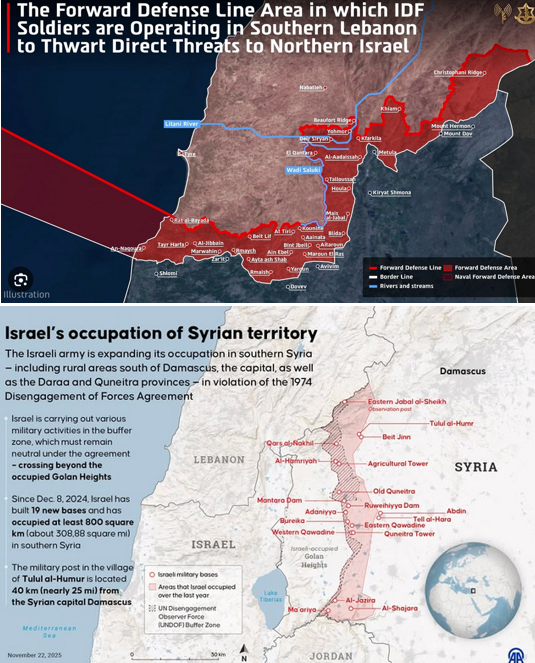
Rumours began when, following the onset of the war, Syria moved troops to its borders with Lebanon and Iraq and south close to the Israeli-occupied Golan Heights. On March 6, Syrian president Ahmed al-Sharaa called Lebanese Prime Minister Nawaf Salam to express “his support for the Lebanese people in these difficult times” and to assure him that Syria’s military deployments were purely defensive and “only intended to ensure control of the borders and to preserve Syria’s internal security”. In fact, Israel condemned the movement of Syrian troops in the direction of the Israeli occupation; amidst “intensified flights of Israeli warplanes and helicopters over southern Syria, the ‘Ultra Syria’ site reported that “officials in the occupation army’s Northern Command claimed the movements violate what they describe as long-standing ‘security understandings’ governing force levels and permitted weaponry in the buffer zone adjacent to the occupied Golan.” Israel has unilaterally declared a “buffer zone,” demanding Syrian troops keep out of the south, and as such is only referring to its own “understandings,” not common ones with Syria.
In his remarks to the UN session on the war on March 11, Syria’s UN representative, Ibrahim Olabi, condemned Israel’s aggression against Lebanon, condemned the policy of “displacing people under the threat of bombing and destruction,” and linked Israel’s actions to its ongoing attacks on Syria. Far from suggesting that Syria would intervene to disarm Hezbollah, he said that Israel’s attack “hinders” the Lebanese government’s aim of disarming Hezbollah – ie, it cannot be done precisely because Israel is attacking the country.
Another report in L’Orient-Le Jour also noted that “Syrian authorities rejected these demands, with backing from Saudi Arabia, Qatar, Egypt and Turkey, all of which encouraged Damascus to hold its ground. These countries also intervened with Washington to ease the pressure on Syrian President Ahmad al-Sharaa, who made it clear he does not want to get involved in Lebanon or repeat past experiences,” referring to the long-term military involvement in Lebanon by the two Assad regimes, beginning in 1976 when Hafez al-Assad, backed by the US and Israel, invaded Lebanon in support of the right-wing Christian Phalange and played a key role in the large-scale massacre of Palestinians at Tel al-Zataar.
According to a March 16 report in Al-Modon, Sharaa’s message to Lebanon’s president Aoun “was unequivocal: Syria is committed to Lebanon’s security and stability.” The report says that coordination with Turkey, Qatar and Saudi Arabia is ongoing, aimed at “reassuring the Lebanese public” and strengthening “security cooperation” between Syria and Lebanon. The central objective is that “Syria remains in Syria and Lebanon remains in Lebanon, each sovereign and non-interfering. This is especially vital amid ongoing Israeli attempts to provoke internal strife, whether between the Lebanese state and Hezbollah or among Lebanon’s communities. The aim is to remain vigilant against any Israeli maneuver designed to ignite a localised, destructive conflict between Lebanon and Syria.” This report further claims Sharaa has been pushing a kind of renewed ‘pan-Arab’ position, as “regardless of whether Iran endures or Israel imposes its terms, only a unified Arab position can prevent states form being isolated and targeted one by one.”
All of this could not be further from any Syrian intention to intervene in Lebanon against Hezbollah, let alone when under attack by Israel. Obviously, the Syrian government’s position should be open to criticism like that of any government. The Syrian position of standing against both the Israeli and Iranian regional hegemonic projects is completely justified, but in the concrete circumstances of it being the US and Israel launching this gigantic criminal aggression against Iran, one might prefer a more forthright defence of Iran in the circumstances. However, if we are to judge Syria on the basis of its own experience – where the Iranian regime participated on the ground on a massive scale in the Assad regime’s genocidal violence against Syrians for a decade that left some 700,000 people dead, entire cities and chunks of the country destroyed, and more than half the country’s population uprooted – then the fact that it sees Israel as an equal enemy is a rather strong sign of its anti-Zionist position to say the least!
Of course, Israel occupies Syrian territory and launched a massive bombing campaign against Syria from December 8, 2024, from the moment when its preferred leader was deposed (it is a curious geopolitical fact that Israel and Iran converged in support of the Assad regime). On the ground, popular hatred of both Israel and Iran is ubiquitous in Syria, and the Syrian population is considerably more anti-Iranian than the government as a result of their horrific experiences. When discussing Israel-Iran conflict, a common Syrian reaction is to cite a popular Islamic expression, “destroy the oppressors with the oppressors,” referring to both sides. Indeed, Syria researcher Aymenn al-Tamimi cites a Syrian X account which at one moment celebrates the killing of Khamenei and the next celebrates the Iranian missiles hitting Tel Aviv, “Praise be to God, Tel Aviv is burning.” Regardless of how privileged western leftists from thousands of miles away who have not suffered under Syria’s genocidal apocalypse may view this, it is clearly a rejection by definition of any aid to Israel’s campaign in Lebanon.
Embittered Assadists
Returning to the point, despite all these clear and unequivocal reports of Syria’s rejection to of any such suggestion, the hyper-world of embittered tankies and antidelluvian Assadists filled the comments section of any article or social media post of the alleged US push with 787,657,479,325 “comments” along the lines of “see, Mossad government,” “al-Qaeda to the rescue of Israel” and similar pieces of sheer brilliance, brilliant, that is, if you happen to have the brain of a jellyfish.
The point is not that the Syrian government of al-Sharaa should not be criticised for any range of issues. It most definitely can and should be. The point is that the tendency to condemn the government for things that it hasn’t done, is not doing or completely rejects doing at the drop of a hat has nothing to do with rightfully subjecting all governments to the fiercest of criticism when necessary – rather these are embittered nostalgists of the genocidal tyranny of Bashar al-Assad, embittered that the Syrian people rose up and destroyed his regime of mass murder and torture on an epic scale, as well as mechanistic western “anti-imperialists” who imagine a regime that tortured Islamist suspects for US president George Bush’s “war on terror” had some “anti-imperialist” credentials, and that the regime that Israel preferred in power and which had solid anti-Palestinian credentials for decades was a “resistance” regime, despite Netanyahu and countless Israeli leaders praising it precisely for decades of non-resistance on the Golan; these tankies for their own reasons attached themselves to it like flies to shit, and continue to do so in their pathetic “comments.”
Ongoing Israeli aggression on Syria amidst wider war
Meanwhile, even though engaged in two gigantic wars against Iran and Lebanon, Israel has still managed time for its smaller scale bombing and other attacks on Syria! On March 20, Israel attacked Syrian army sites, weapons depots and military infrastructure in Daraa, including a building associated with the 40th Division in Izraa; according to the IDF, the strikes targeted a command center and weapons located in military compounds belonging to the Syrian government; local sources reported air raids hitting the Syrian army’s 12th Brigade near Izraa and explosions in the vicinity of the 89th Regiment headquarters near Jabab.
Israel claimed to be “protecting Druze citizens in Suweida.” This referred to a military clash on the Suweida-Daraa border the previous day where the government claims to have foiled an attempt to smuggle weapons by members of the pro-Israel Suweida National Guard. The National Guard, by contrast, claim Syrian forces had carried out attacks against civilians. Israeli Defense Minister Israel Katz stated “we will not allow the Syrian regime to exploit our war against Iran and Hezbollah to harm the Druze. If necessary, we will attack with greater force.” Turkey, Saudi Arabia, Qatar, the Arab League condemned the attacks as a “blatant violation” of Syria’s sovereignty aimed at dragging the region into broader confrontation.
Syrian Defense Ministry sources told Asharq Al-Awsat that Israel “is seeking to widen the regional war and pull Syria into it,” pointing to a “disinformation campaign” about Syria’s ground advance in the south and reports of rockets launched from Syrian territory toward the occupied Golan. In fact, a number of attacks have been carried out against IDF occupation forces over the last month.
Apart from this major attack, Israel has kept up a series of smaller-scale attacks throughout this period. The well-documented Syria Weekly report lists the IDF attacks in southern Syria just in the March 17-24 period when this attack occurred alone:
- Israeli military forces fired at least two artillery shells into agricultural areas outside Tel Ahmar al-Sharqi in southern Quneitra on March 20, causing no casualties.
- Israeli military forces launched a ground incursion towards the al-Mantara Dam in Quneitra on March 20.
- Israeli military forces launched a ground incursion into the Wadi al-Raqad in western rural Daraa on March 20.
- Israeli military forces launched ground two simultaneous incursions into the Tel Kroum and into an area located between the villages of al-Samdaniya al-Sharqiya and Khan Arnabeh in Quneitra on March 21.
- Israeli military forces launched a ground incursion towards the al-Ruwayhina Dam in Quneitra on March 23. Later that day, 3 young men were detained by Israeli forces during an incursion near the al-Mantara Dam in Quneitra; while another incursion was launched into the Wadi al-Ruqad area in western Daraa. Late that night, Israeli forces launched a ground incursion towards Beit Jinn in Rif Dimashq, establishing a pop-up checkpoint near the Druze village of Harfah.
- Israeli military forces launched a ground incursion into the Jubata al-Khashab area of northern Quneitra on March 24.
This week is chosen randomly; each subsequent weekly report has a similar catalogue, and this has also been the case every week since December 2024, except in some weeks much worse, involving large scale air strikes. The Syrian government has no interest in helping the occupation regime to its south in any way whatsoever.
Meanwhile, on April 17, Israel announced plans to fund 3000 new settler families to colonise the occupied Golan to create the region’s “first city,” which Human Rights Watch has described as a “war crime;” while al-Sharaa at the Antalya conference yet again reiterates what he, the Syrian foreign ministry, Syria’s UN ambassador Ibrahim al-Olabi have continually stressed since overthrowing Assad, that the Golan is Syrian and must be returned: “any state’s recognition of Israel’s claim over the occupied Syrian Golan – as happened when president Trump recognised the occupied Golan as Israeli – is invalid, because this is a right belonging to the Syrian people,” also noting that just last November, 134 countries “affirmed that the Golan is Syrian land and is occupied by Israel.”
Below is perhaps one of the clearest enunciations of what appears to be both the Syrian government view and the majority Syrian popular view, by a Syrian member of parliament in Homs and former rebel fighter in the Ahrar al-Sham movement:
I fought Hezbollah in Homs. Seeking revenge in Lebanon is wrong
By Kinan al-Nahhas, Member of Parliament for the city of Homs
19. March 2026
Scarred by the siege of Homs and mindful of the regional war, Syria faces a dangerous temptation: to settle old scores in Lebanon. But intervention now risks entangling a fragile state in Israel’s war.
The fiercest battles I witnessed came in late 2013, when we – rebels besieged in Homs – faced the advancing forces of Lebanon’s Hezbollah. By then, the militia had already seized al-Qusayr and its surroundings, emptying the southwestern countryside of Homs of its Sunni inhabitants. The fighting intensified in the Qusour district of the city, where we, under siege, clashed with regime forces spearheaded by Hezbollah’s elite units.
The defining confrontation unfolded in a residential complex we came to call the “Nahhas block”. There, our fighters killed dozens from Hezbollah’s Radwan Force, even as many of Homs’ own sons fell as martyrs. Despite the ferocity and duration of the battle, neither Hezbollah nor the Syrian army managed to advance.
This was not the Lebanese group’s first intervention in Syria, but it was among the most brutal. It would be followed by the deployment to Syria of more than 70,000 Shia militiamen from across the region – forces tied to Iran’s Revolutionary Guard Corps and coordinated with Hezbollah’s leadership.
Deep scars
To grasp the scale of Hezbollah’s betrayal of Syrians, one need only compare the Syrian response to Hezbollah in 2006 with Hezbollah’s conduct during the revolution. Syrians opened their homes to displaced Lebanese. In return, after 2011 Hezbollah’s fighters turned their guns on Syrian civilians. Among the first were snipers sent to dominate roads and shoot demonstrators in Homs and other rebellious cities.
This, then, is the neat version of events: Syrian hospitality repaid with violence and complicity in tyranny, ending – at least in theory – with victory unmarred by sectarian revenge.
The truth is more complicated. The wounds run deep, and while many Syrians have taken grim solace in seeing Hezbollah’s leadership fall and its supporters displaced, justice has been neither clean nor complete. Innocents, as ever, have paid the price.
Among the most harrowing episodes that I witnessed was the massacre in the orchards of Haswiya in early 2013. More than a hundred civilians – women, children and men – were slaughtered, many with knives, some of their bodies burned. It was violence steeped in sectarian revenge.
History does not write the future
Now, reports circulate that the Syrian army may enter Lebanon. The justification? To hold Hezbollah accountable for its crimes and eliminate the threat it poses to Syria. Some go further, suggesting such a move would defend Lebanon’s Sunnis.
Despite everything recounted above, this must be firmly rejected.
No Syrian should endorse military intervention in Lebanon under the banner of retribution or moral duty – whether framed as “justice for crimes” or “protection of Sunnis”. Lofty slogans often conceal darker motives, and decisions that seem righteous in one moment can prove catastrophic in another.
Lebanon’s own memory of Syrian intervention in the 1970s and 1980s is instructive. It was not a noble endeavour but a functional one: to serve regional and international interests. It helped neutralise Palestinian armed groups seen as a threat to Israel, while simultaneously entrenching Hafez al-Assad’s rule at home and projecting his power abroad.
Nor does the argument for justice withstand scrutiny. Syria has yet to hold its own perpetrators accountable, let alone foreign militias or occupying powers. How, then, can it plausibly pursue justice beyond its borders when it has not begun to deliver it within them?
Betrayal of the Palestinians
Timing, too, is critical. Syria, still fragile and only beginning to recover, cannot afford entanglement in a wider regional confrontation – particularly one intertwined with the Palestinian question.
As this crisis unfolds, Al-Aqsa Mosque has been closed to worshippers during the holiest month, under the guise of “temporary security measures”. Many see this as part of a broader, more troubling trajectory within Netanyahu’s government, influenced by religious extremists who view the present moment as an opportunity to reshape Jerusalem irrevocably. Meanwhile, fringe Jewish groups affiliated with the so-called Temple movement openly speak of rebuilding Solomon’s Temple and ending the Palestinian cause.
In this context, weakening Hezbollah today may inadvertently serve Israeli ambitions to dominate the region, which is a prospect openly entertained by some Israeli and American politicians. The old maxim rings true: the most effective weapon against an enemy is another enemy. Netanyahu himself has suggested as much: when adversaries fight, one should weaken both.
Syria has no stake in choosing sides in such a struggle. It would be folly to intervene at a moment when two adversaries are already engaged, particularly when one continues to oppress Palestinians and destabilise the region.
Between fate and caution
Hezbollah has not escaped what many Syrians see as the curse of Homs. Its leaders have been killed, its ranks shattered. Some see this as divine justice for its role in Syria.
But caution must guide what comes next. Syrians must ensure they do not, in turn, become the authors of injustice. They must not invite the curse of the oppressed – least of all Palestinians, who, even now, find hope in the setbacks suffered by their own occupiers. Nor should Syria’s revolution, so vast in its promise, be reduced to yet another “functional state”: a pawn serving the interests of regional and global powers


