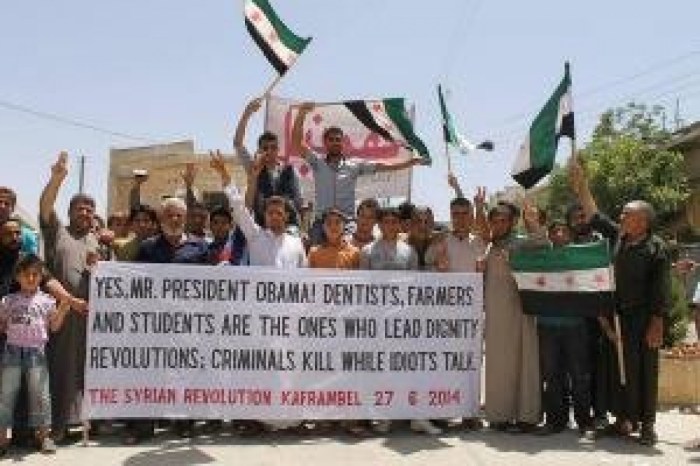
Bloody Counterrevolution in Aleppo: on Russian Blitzkrieg and US “betrayal”

Bloody Counterrevolution in Aleppo: on Russian Blitzkrieg and US “betrayal”

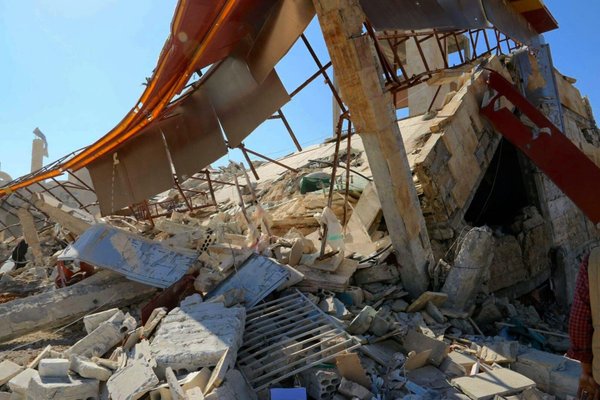
Hospital bombed by Russian warplanes

Today we are watching bloody counterrevolution, imperialist barbarism, in its most naked form, most visibly in the combined Blitzkrieg against the people of Aleppo and its northern countryside being carried out by the invading Russian air force, the fascistic regime of Bashar Assad with his barrel bombs, the invading Iranian Revolutionary Guards and their imports including Iraqi Shiite-sectarian death squads, Hezbollah and various manipulated, impoverished Shia troops from Afghanistan and Pakistan, with ISIS to some extent, and the US-backed Kurdish YPG on a huge scale, opportunistically joining in from either side like vultures.

Meanwhile, much the same continues in the south, with people still starving to death, even as world attention has gone away, in the various towns surrounding Damascus that are being carpet-bombed  by Assad and Russia, besieged and starved by Assad and Hezbollah. This scene from some apocalypse (https://www.facebook.com/photo.php?fbid=10153676629524823&set=gm.495267943990549&type=3&theatre) is actually between Moadamiyeh and Daraya; this picture of Hiroshima is actually what the regime has done to to the once beautiful city of Homs: https://www.facebook.com/Channel4News/videos/10153492613721939/?pnref=story. Further south, regime and Russian bombing continues day and night against the mighty, and starkly moderate, Southern Front of the FSA, which has had its already miserable level of “support” cut off by Jordan and the US; 150,000 people have been uprooted in the latest offensives.

Returning to Aleppo, the bombing has reached extraordinary levels http://www.theguardian.com/world/2016/feb/06/aleppo-under-bombardment-fears-siege-and-starvation?CMP=Share_AndroidApp_Gmail:

“The bombs are falling so fast in Aleppo now that often rescuers don’t have time to reach victims between blasts. If the deadly explosions that struck on just one day last week had been evenly spaced, they would have struck every other minute around the clock.

“Sometimes there are so many airstrikes, we are just waiting and waiting at our headquarters, and the jets don’t leave the skies,” says Abdulrahman Alhassan, a 29-year-old former bank engineer from the city who coordinates “white helmet” rescue teams in the city.

“When at last we can’t see any more, we have to rush to all the sites to rescue people and evacuate them at once,” he said. On Friday, the group counted 900 airstrikes by government forces and their Russian backers, apparently throwing every weapon they have at the already devastated city.”

That is, 900 airstrikes on the city in one day.

As is widely reported, the targets include countless hospitals, schools, markets, bakeries, mosques and so on. This video shows the results of the deliberate Russian bombing of the children’s and maternity hospital in Azaz: http://www.independent.co.uk/news/world/middle-east/not-terrorists-or-fighters-just-babies-syrian-charity-video-shows-devastation-after-azaz-hospital-a6875496.html, on the same day in mid-February that three other hospitals and two schools were bombed (http://www.nytimes.com/2016/02/16/world/middleeast/syria-hospital-airstrike-doctors-without-borders.html).

Of course, a bloody counterrevolution being carried out by a fascistic regime does not always involve “imperialist barbarism,” as I put it above; the Syrian regime has been doing the same for years before the Russian invasion. But as far as any foreign intervention by a world-class military power savaging a small country far from home goes, the current Russian invasion and terror bombing of Syria is second to only few.

However, Russian imperialism has been the chief armer of the regime with massive quantities of advanced weaponry for years, so there are no surprises here, and apart from our outrage, perhaps no need to dwell on the obvious (though if an anti-war movement existed in the West, calling for an end to this Russian barbarism would be its obvious aim; but alas).

US policy and the Oslo-style “peace process”

Yet it is the calculated indifference of the United States that stands out here; while this should not be a surprise, it is to those who still think the US was merely a weak and ineffective supporter of Syrian freedom. In fact, US Defence Secretary John Kerry was being completely truthful when he recently stated, not only that that the US does not support regime change in Syria (old news), but also that the US and Russia see the Syrian conflict “fundamentally very similarly” (http://abcnews.go.com/International/john-kerry-meets-russian-president-vladimir-putin-seek/story?id=35782171).

It may seem ironic that the current Russian Blitzkrieg is taking place in the shadow of the US-Russian driven Vienna/Geneva “peace process.” This process supposedly aimed to forge a ceasefire, and press a select group of oppositionists into a “transitional” government with the regime or parts of it, who would then jointly wage a war, supported by all the imperialist powers, against ISIS, Nusra and any other opposition forces declared to be “terrorists.”

However, while accepting negotiations for some kind of “political solution,” the Syrian opposition had some red lines. One was that, before real negotiations could begin, the regime needed to show some good faith by first implementing UN resolutions on lifting starvation sieges, stopping barrel bombing, releasing detainees and so on. Secondly, while the opposition was willing to begin negotiations with Assad, their bottom line for eventually agreeing to any political solution was that, at some point, Assad himself and his immediate entourage had to step down, so that the “transition” government they were to join would be formed with parts of the regime but not Assad himself.

However, the US, the UK, France and other western states began falling over each other to declare that Assad’s alleged “stepping down” can take place at the “end” of the “transition government” period rather than at the beginning; and then the length of this Assad-led “transition” kept getting lengthened beyond the “several months” initially discussed. This was made even more emphatic in an internal US State Department document which specified that Assad would continue to head the “transitional” regime, which the opposition was expected to join, until March 2017 (http://news.yahoo.com/apnewsbreak-us-sees-assad-staying-syria-until-march-081207181–politics.html); and then further, the US delivered new Russian-Iranian diktats to the opposition, moving from the concept of “transition” to that of the opposition forming a “national unity government” with Assad, while strongly rejecting the opposition’s conditions regarding sieges and so on.

According to Lina Sinjab, writing from the Geneva talks, a “US official was adamant that Secretary of State John Kerry wants to end the violence, and is determined to succeed. But everyone here thinks the opposite. Almost at every corner, you hear the same thought: The US has handed over Syria to the Russians for free” (http://www.bbc.com/news/world-middle-east-35490273). And as Assadist/Russian bombing continually increased throughout the “peace” conference, Kerry claimed on February 5 that “the Russians have made some constructive ideas about how a ceasefire in fact could be implemented” (http://www.todayszaman.com/world_kerry-says-in-talks-on-syria-ceasefire-will-know-in-days-if-possible_411600.html).

As  reported on February 6, Syrian aid workers said Kerry told them on sidelines of the donor conference, after the Geneva “peace” talks broke down, that “the opposition will be decimated” and to expect 3 months of bombing, blaming the opposition for the Russian Blitzkrieg: “He said, ‘Don’t blame me – go and blame your opposition’” (http://www.middleeasteye.net/news/opposition-blame-syrian-bombing-kerry-tells-aid-workers-1808021537). Another source in the same article, who claimed to have been a liaison between the Syrian and American governments, said Kerry had passed the message on to Assad in October “that the US did not want him to be removed,” but that if he stopped barrel bombing, could “sell the story” to the public.

As Russia then launched into the current apocalyptic bombing of Aleppo, Kerry and Lavrov stitched together a “ceasefire,” which, however, would begin after a week, allowing plenty of time for Russia’s hundreds of strikes a day to perform maximum devastation in the meantime, while excluding all operations against ISIS, Nusra and “other terrorists” from the ceasefire. Since Russia and Assad declare everyone they bomb to be either ISIS, Nusra or “terrorists,” this ceasefire was simply a cover for the genocide to continue, while outlawing the rebels from shooting back!

When Kerry announced the “ceasefire” alongside his Russian counterpart, he put all the blame on the Syrian opposition, and as usual praised his (new) allies to the skies, stating emphatically that “it was not Russia or Iran who stopped a ceasefire from being adopted at the very beginning. I want to make that very, very clear” (http://www.theguardian.com/commentisfree/2016/feb/12/russia-big-winner-syria-flawed-truce-assad-europe-us?CMP=share_btn_tw).

Then as Russia and Assad responded to the “ceasefire” by stepping up their genocidal bombing of Aleppo, Kerry said this has to stop, but told the opposition to stop “whining” about it, telling them it won’t stop “by walking away from the table or not engaging” (https://twitter.com/USEmbassySyria/status/696046559486607360).

It may be objected that these are just statements, perhaps driven by diplomacy. However, statements have a context. In the context of such horrific crimes being committed by Russia as we speak; of the US pressuring its “allies” to cut off the miserable aid they had provided the rebels (see below); of the US pushing the opposition into a national unity government with Assad for one and a half years; in the context of US bombing never touching the regime or its death squad allies, but often hitting non-ISIS rebel targets; these “mere statements” represent policy, not diplomacy.

US “betrayal”?

Below I have attached what is one of the better commentaries in mainstream media in recent weeks on the so-called US “betrayal” of the Syrian people in the face of this bloodthirsty Russian-Assadist-Iranian Blitzkrieg on Aleppo.

Of course, its use of words like “betrayal,” and the idea that the US is “handing” Syria over to Russia and Iran (clearly the US is handing it to Assad) still reveal a hint of the grand illusion that perhaps “real” US interests would have been to act differently, or that the open US-Russia ad US-Iran collaboration in Syria somehow represents the US abandoning its own interests in favour of those of others.

Actually, the author only just still borders on these illusions – like any serious observer, the author can see that the facts have long ago depleted most illusions. The author writes for example “Washington seems oblivious to the simple truth that diplomacy has a cost, as does its failure — probably because this cost would be carried by the rebellion, for which the United States has little respect or care anyway.” He is right that the US has “little respect or care” (“none” would be more correct) for the rebellion, but this very fact makes the word “oblivious” at the beginning of the sentence meaningless. This author can at least be congratulated on showing 90 percent cynicism of basic US motives and positions on Syria throughout the conflict, and only 10 percent remaining illusions of the US being “oblivious” to its interests. Far ahead of most.

It is high time, in my opinion, to call a spade a spade. This has nothing to do with the fact that there has been no “US intervention,” still less a call for it. In fact, those constantly warning against “US intervention” wilfully ignore that the US has been bombing Syria for some 17 months, just that it bombs Anyone But Assad (see my article on who the US bombs: . https://mkaradjis.wordpress.com/2015/09/03/who-has-the-us-bombed-for-in-syria/).

At this point, it doesn’t even have that much to do with the many years of very active US intervention against the revolution, to ensure that no Syrian rebels, not even the most “moderate”, could get their hands on any anti-aircraft weapons, the major defensive need of the rebels since mid-2012 when massive airpower became the main form of regime aggression; with the fact that sympathetic regional states were blocked from sending them, and that the FSA was even blocked when it tried to get them from the black market. No, this is all well-established; as one tweet put it concisely, “the only consistent, thorough, well-implemented US Syrian policy is tracking hunting and stopping MANPADS from reaching any opposition group since 2012” (https://twitter.com/THE_47th/status/659114328012931072); and the criminality of denying such weapons as the rebels face such apocalyptic bombing right now is for all to see. But it is even more than that.

All the reports from recent weeks, if not months, tell of the US winding down, if not cutting off, the already pathetic level of “support” to some “vetted” rebels (or, put more correctly, of the US forcing Saudis, Qatar and Turkey to wind down or cut off their support). As the author notes in the article below: “In the south, the United States has demanded a decrease in weapons deliveries to the Southern Front, while in the north, the Turkey-based operations room is reportedly dormant.” According to Syrian National Coalition Khaled Khoja, external support for armed opposition factions in Syria came to a complete halt following the Vienna talks in October 2015 (http://www.alaraby.co.uk/english/indepth/2016/2/6/the-fate-of-the-syrian-opposition-left-without-support), while videographic evidence shows that use of Saudi-supplied TOW anti-tank weapons on the battlefield “had trickled off in the last months of 2015 and totally vanished in the first two weeks of 2016” (http://www.thedailybeast.com/articles/2016/02/05/are-u-s-missiles-taking-out-high-ranking-russian-military-officials.html).

So let’s call the spade by its name: the US is opposed to, and has always been opposed to, the Syrian revolution. Period. Things have worked out this way not because the US was “weak,” or “incoherent,” or endlessly (for 5 years) makes “mistakes,” or “bungled it,” or unwittingly “handed over victory” to someone opposed to US interests etc; no, things turned out this way, have been this way for five years, because it is US policy.


One final comment: The author says it is “ironic” that this international Blitzkrieg against Free Syria is occurring at the moment the US and UN have been organising the Oslo-style Geneva “peace process”. Here I’ll allow a little conspiratorial thinking currently prevalent among many Syrians, who have more right to be cynical than anyone. That the Geneva farce – such an obvious farce – was organised as a cover to politically disarm and distract and try to divide the Syrian rebellion while the “final military solution” was being planned all along.


​


Obama’s Disastrous Betrayal of the Syrian Rebels

How the White House is handing victory to Bashar al-Assad, Russia and Iran.​

​BY EMILE HOKAYEM​

​FEBRUARY 5, 2016​

​https://foreignpolicy.com/2016/02/05/obamas-disastrous-betrayal-of-the-syrian-rebels/

What a difference a year makes in Syria. And the introduction of massive Russian airpower.

Last February, President Bashar al-Assad’s regime and its Shiite auxiliaries mounted a large-scale attempt to encircle Aleppo, the northern city divided between regime and rebels since 2012 and battered by the dictator’s barrel bombs. Islamist and non-Islamist mainstream rebels — to the surprise of those who have derided their performance, let alone their existence — repelled the offensive at the time. What followed was a string of rebel advances across the country, which weakened Assad so much that they triggered Moscow’s direct intervention in September, in concert with an Iranian surge of forces, to secure his survival.

Fast-forward a year. After a slow start — and despite wishful Western assessments that Moscow could not sustain a meaningful military effort abroad — the Russian campaign is finally delivering results for the Assad regime. This week, Russian airpower allowed Assad and his allied paramilitary forces to finally cut off the narrow, rebel-held “Azaz corridor” that links the Turkish border to the city of Aleppo. The city’s full encirclement is now a distinct possibility, with regime troops and Shiite fighters moving from the south, the west, and the north. Should the rebel-held parts of the city ultimately fall, it will be a dramatic victory for Assad and the greatest setback to the rebellion since the start of the uprising in 2011.

In parallel, Russia has put Syria’s neighbors on notice of the new rules of the game. Jordan was spooked into downgrading its help for the Southern Front, the main non-Islamist alliance in the south of the country, which has so far prevented extremist presence along its border. Turkey’s shooting down of a Russian military aircraft that crossed its airspace in November backfired: Moscow vengefully directed its firepower on Turkey’s rebel friends across Idlib and Aleppo provinces. Moscow also courted Syria’s Kurds, who found a new partner to play off the United States in their complex relations with Washington. And Russia has agreed to a temporary accommodation of Israel’s interests in southern Syria.

Inside Syria, and despite the polite wishes of Secretary of State John Kerry, the overwhelming majority of Russian strikes have hit non-Islamic State (IS) fighters. Indeed, Moscow and the Syrian regime are content to see the United States bear the lion’s share of the effort against the jihadi monster in the east, instead concentrating on mowing through the mainstream rebellion in western Syria. Their ultimate objective is to force the world to make an unconscionable choice between Assad and IS.

The regime is everywhere on the march. Early on, the rebels mounted a vigorous resistance, but the much-touted increase in anti-tank weaponry could only delay their losses as their weapons storages, command posts and fall-back positions were being pounded. Around Damascus, the unrelenting Russian pounding has bloodied rebel-held neighborhoods; in December, the strikes killed Zahran Alloush, the commander of the main Islamist militia there. In the south, Russia has fully backed the regime’s offensive in the region of Daraa, possibly debilitating the Southern Front. Rebel groups in Hama and Homs provinces have faced a vicious pounding that has largely neutralized them. Further north, a combination of Assad troops, Iranian Shiite militias, and Russian firepower dislodged the powerful Islamist rebel coalition Jaish Al-Fatah from Latakia province.

But it is the gains around Aleppo that represent the direst threat to the rebellion. One perverse consequence of cutting the Azaz corridor is that it plays into the hands of the al Qaeda-affiliate Jabhat Al-Nusra, since weapons supplies from Turkey would have to go through Idlib, where the jihadist movement is powerful. Idlib may well become the regime’s next target. The now-plausible rebel collapse in the Aleppo region could also send thousands of fighters dejected by their apparent abandonment into the arms of Nusra or IS.

The encirclement of Aleppo would also create a humanitarian disaster of such magnitude that it would eclipse the horrific sieges of Madaya and other stricken regions that have received the world’s (short-lived) attention. Tens of thousands of Aleppo residents are already fleeing toward Kilis, the Turkish town that sits across the border from Azaz. The humanitarian crisis, lest anyone still had any doubt, is a deliberate regime and Russian strategy to clear important areas of problematic residents — while paralyzing rebels, neighboring countries, Western states, and the United Nations.

Assad all along pursued a strategy of gradual escalation and desensitization that, sadly, worked well. Syrians already compare the international outcry and response to the IS’ siege of Kobane in 2014 to the world’s indifference to the current tragedy.

To complicate the situation even more, the regime’s advances could allow the Kurdish-dominated, American-favored Syrian Democratic Forces (SDF) to conquer the area currently held by the Free Syrian Army and Islamist militias between the Turkish border and the new regime front line north of the Shiite towns of Nubl and Zahra. This would pit the SDF against IS on two fronts: from the west, if the Kurds of Afrin canton seize Tal Rifaat, Azaz and surrounding areas, and from the east, where the YPG is toying with the idea of crossing the Euphrates River. An IS defeat there would seal the border with Turkey, meeting an important American objective.

The prospect of further Kurdish expansion has already alarmed Turkey. Over the summer, Ankara was hoping to establish a safe zone in this very area. It pressured Jabhat al-Nusra to withdraw and anointed its allies in Syria, including the prominent Islamist group Ahrar al-Sham, as its enforcers. True to its record of calculated dithering, President Barack Obama’s administration let the Turkish proposal hang until it could no longer be implemented. Turkey faces now an agonizing dilemma: watch and do nothing as a storm gathers on its border, or mount a direct intervention into Syria that would inevitably inflame its own Kurdish problem and pit it against both IS and an array of Assad-allied forces, including Russia.

​Turkey and Saudi Arabia, the rebellion’s main supporters, are now bereft of options. No amount of weaponry is likely to change the balance of power. The introduction of anti-aircraft missiles was once a viable response against Assad’s air force, but neither country — suspecting that the United States is essentially quiescent to Moscow’s approach — is willing to escalate against President Vladimir Putin without cover.

Ironically, this momentous change in battlefield dynamics is occurring just as U.N. envoy Staffan de Mistura yet again pushes a diplomatic track in Geneva. But the developments on the ground threaten to derail the dapper diplomat’s peace scheme. Fairly or not, de Mistura is tainted by the fact that the United Nations is discredited in the eyes of many Syrians for theproblematic entanglements of its Damascus humanitarian arm with the regime. Despite U.N. resolutions, international assistance still does not reach those who need it most; in fact, aid has become yet another instrument of Assad’s warfare. Neither Kerry nor de Mistura are willing to seriously pressure Russia and Assad for fear of jeopardizing the stillborn Geneva talks.

Seemingly unfazed by this controversy, de Mistura’s top-down approach relies this time on an apparent U.S.-Russian convergence. At the heart of this exercise is Washington’s ever-lasting hope that Russian frustration with Assad would somehow translate into a willingness to push him out. However, whether Putin likes his Syrian counterpart has always been immaterial. The Russian president certainly has reservations about Assad, but judging by the conduct of his forces in Chechnya and now in Syria, these are about performance– not humanitarian principles or Assad’s legitimacy. For the time being, Moscow understands that without Assad, there is no regime in Damascus that can legitimize its intervention.

Ever since 2011, the United States has hidden behind the hope of a Russian shift and closed its eyes to Putin’s mischief to avoid the hard choices on Syria. When the Russian onslaught started, U.S. officials like Deputy Secretary of State Tony Blinken predicted a quagmire to justify Washington’s passivity. If Russia’s intervention was doomed to failure, after all, the United States was not on the hook to act.

Russia, however, has been not only been able to increase the tempo of its military operations, but also to justify the mounting cost. And contrary to some pundits, who hailed the Russian intervention as the best chance to check the expansion of IS, Washington knows all too well that the result of the Russian campaign is the strengthening of the jihadist group in central Syria in the short term. This is a price Washington seems willing to pay for the sake of keeping the Geneva process alive.

The bankruptcy of U.S. policy goes deeper. The United States has alreadyconceded key points about Assad’s future — concessions that Russia and the regime have been quick to pocket, while giving nothing in return. In the lead-up to and during the first days of the Geneva talks, it became clear that the United States is putting a lot more pressure on the opposition than it does on Russia, let alone Assad. Just as Russia escalates politically and militarily, the Obama administration is cynically de-escalating, and asking its allies to do so as well. This is weakening rebel groups that rely on supply networks that the U.S. oversees: In the south, the United States has demanded a decrease in weapons deliveries to the Southern Front, while in the north, the Turkey-based operations room is reportedly dormant.

The result is a widespread and understandable feeling of betrayal in the rebellion, whose U.S.-friendly elements are increasingly losing face within opposition circles. This could have the ironic effect of fragmenting the rebellion — after years of Western governments bemoaning the divisions between these very same groups.

It’s understandable for the United States to bank on a political process and urge the Syrian opposition to join this dialogue in good faith. But to do so while exposing the rebellion to the joint Assad-Russia-Iran onslaught and without contingency planning is simply nefarious. Washington seems oblivious to the simple truth that diplomacy has a cost, as does its failure — probably because this cost would carried by the rebellion, for which the United States has little respect or care anyway, and would be inherited by Obama’s successor.

The conditions are in place for a disastrous collapse of the Geneva talks — now delayed until late February — and a painful, bloody year in Syria. All actors understand that Obama, who has resisted any serious engagement in the country, is unlikely to change course now. And they all assume, probably rightly, that he is more interested in the appearance of a process than in spending any political capital over it. As a result, all the parties with a stake in Syria’s future are eyeing 2017, trying to position themselves for the new White House occupant. This guarantees brinksmanship, escalation, and more misery. 2016 is shaping up as the year during which Assad will lock in significant political and military gains.​

Compilation of Recent Russian Crimes Against Humanity in Syria

by Michael Karadjis

Below is a compilation of Russian crimes against humanity in Syria, in early 2016 alone. The last few months of 2015 would show an equally horrific, and longer, toll. As I write, the United Nations has finally postponed its bogus Syria “peace” talks, even they finally recognising that holding a talk fest, while the state-terrorist group currently occupying Damascus, and its invading Russian backer, dramatically step up their already prolific level of mass murder, is not going to achieve anything.

In response to Russia bombing the last hospital in Free Aleppo, my friend and fellow supporter of the Syrian people, Sam Charles Hamad, wrote on his Facebook page https://www.facebook.com/sam.c.hamad/posts/1108767129156898:

“They are quite concretely attempting to destroy the nascent inner workings of Free Syria. Destroying the very functionality of liberty. Russia has been able to do it with brutal precision. The last major hospital in North Aleppo has been destroyed by the Russian air force. Filthy cowards. May they all die horribly.”

Very appropriate words. But of course, despite our justified anger, the cowards won’t all die horribly, just yet, not with the advantage of all that advanced mass-murder equipment they employ safely from the skies. Some will, of course: the ground troops, the cannon fodder. That is, what is today still called, farcically, the Syrian “Arab” Army: the army of Iranian Revolutionary Guards, Hezbollah traitors, Iraqi Shiite death squads, and countless dirt-poor Afghan Hazara and even Pakistani Shia, sent to Syria by the Iranian hang-man regime either by force, manipulation or lies.

Perhaps one reason why Israel has continually declared itself so happy about its alliance with Russia since Russia took the lead role in defending the Assad family’s power away from Iran, is that it kills two birds with the one stone: on the one hand, Israel’s asset in Damascus is defended just as well if not better, by a pro-Israeli ruler like Putin rather than someone who feels compelled to issue a lot of anti-Israel noise like Khameini; on the other, just in case some of these Khameini rabble, particularly a few Hezbollahis, were ever inclined to take the anti-Zionist rhetoric seriously, then using them as cannon-fodder keeps them busy, and buries plenty of them at the same time as they bury Syrian rebels and civilians. As they choose to be cannon-fodder for a gigantic Zionist-style Nakbah in Syria, they won’t be mourned.

But the Assadist and Russian cowards in the skies remain untouched. For now. But the struggle continues. For months and months of Russian carpet bombing, very little was achieved militarily, even as thousands of civilians were slaughtered. But ultimately, the superiority of Russian warplanes will wear down the resistance; and possibly now we may see a victory of Assadist/Russian air power over the people of northern Aleppo. We’ll see.

But even if so, this blood-drenched occupation will confront perhaps years of ongoing guerrilla struggle, during which many of these cowards will be picked off one by one, or blown to bits. The Assad family dynasty may think they can finish this via employing an invasion by the Russian superpower (I don’t really care whether one calls Russia “imperialist” or not in the circumstances; theoreticians may discuss that, but for now, the second major military power on Earth has been savaging a small country for months and months without a peep from those opposed to … “foreign intervention”). But if they think that, they will be entertaining the same illusions that the new Zionist state had in 1948; that it’s all over. Still isn’t.

Meanwhile, anyone on the left still putting up squeamish liberal arguments against the right of the Syrian rebels to receive *massive* quantities of *the best* anti-aircraft weapons (because manpads, which the US has meticulously blocked for years, would only be useful against the lower and slower flying Syrian helicopters barrel bombing the country to pieces for years, but not against this highly advanced Russian mass-murder equipment), from *anywhere* they can get them, *right now*, is a direct participant in this massive new Nakbah.

With no means of defending themselves and their communities against this gigantic aerial massacre, the one and only Russian killer-plane shot down was hit by Turkey a couple of months ago; regardless of Erdogan’s own crimes inside Turkey, I was amazed that when I wrote that the downing of this Russian plane was “one small victory for humanity” (https://mkaradjis.wordpress.com/2015/12/03/turkey-russia-spat-one-standard-for-murdered-syrian-children-another-for-the-warplanes-that-kill-them/), some leftists actually had the gall to condemn this stand. On the other hand, I was most pleased to see ‘Red Flag’, the newspaper of Australia’s Socialist Alternative, take a stand worthy of the left by publishing my article under the heading ‘One Small Victory for Humanity’ (https://www.facebook.com/thomas.tomtom1/posts/10153755391629250). Let there be many more.

Below I have put together a compilation of Russian war crimes from early 2016 alone as a ready reference for anyone remaining confused on this issue (the article on the downing of the Russian plan, just linked to above, begins with a summary of Russian war crimes in 2015, to add to this list).


Summaries of Russian war crimes

The Killing of 1382 Civilians in January 2016, of whom 679 were killed by Russian Forces: http://sn4hr.org/wp-content/pdf/english/1382_civilians_were_killed_in_January_2016_en.pdf

Russian airstrikes have claimed the lives of 1,815 civilians in Syria’s opposition-held areas since September, according to new Syrian Civil Defense Authority statistics:  http://aa.com.tr/en/world/russian-airstrikes-killed-1-800-civilians-in-syria-/511194


Russian Drone Footage of their own bombing among the Apocalypse: Just look at this!

Drone view on battle in dead city Daraya, near Damascus:

https://www.youtube.com/watch?v=ZJl364ovmL8&feature=youtu.be


Syrian Children’s Stories

Russia Is Bombing Syria’s Children: These Are Their Stories

Moscow claims its airstrikes target ISIS in Syria, but the reality on the ground is that hundreds of children, rebels, aid workers, and civilians have been killed. BuzzFeed News’ Borzou Daragahi talks to victims of Russia’s campaign.

http://www.buzzfeed.com/borzoudaragahi/russia-is-bombing-syrias-children-these-are-their-stories#.alBBY4XW7


Where Russia is Bombing: Look at the two maps if you think Russia is “bombing ISIS”

It can be so difficult for those Russian bombers to remember where ISIS is

https://www.facebook.com/photo.php?fbid=1290887497603581&set=a.346517005373973.103161.100000470298957&type=3&theater


Large-scale crimes

 Russia Bombed 25 Schools since Start of Its Aggression Last September:  http://en.etilaf.org/all-news/local-news/syrian-interim-government-russia-bombed-25-schools-since-start-of-its-aggression-last-september.html

War surgeon reveals how healthcare workers are being systematically targeted in Syria: “Nearly nobody is reporting this, the direct attacks on healthcare and healthcare workers,” he told The Independent last month, citing figures from the NGO Physicians for Human Rights, which recorded 23 attacks on medical facilities in Syria in October and November last year – all but one by Syrian government or Russian forces: http://www.independent.co.uk/news/world/middle-east/david-nott-interview-war-surgeon-reveals-how-healthcare-workers-are-being-targeted-in-syria-a6831646.html

Last major north Aleppo hospital destroyed by Russian airstrike: http://syriadirect.org/news/first-responder-last-major-north-aleppo-hospital-destroyed-by-russian-airstrike/

Russia strikes displace over150 000 in Daraa: rebel media: https://now.mmedia.me/lb/en/NewsReports/566560-russia-strikes-displace-over-150000-in-daraa-rebel-media

118 Victims death toll of massacres by Russia and the Assad regime on Wednesday: http://en.eldorar.com/node/1328

Russian Forces killed 99 civilians in 72 hours in Ma’art Al No’man City in Idlib: http://sn4hr.org/blog/2016/01/25/16832/

142 Killed on Friday Amid Russian and US Airstrikes: http://eaworldview.com/2016/01/syria-feature-scores-killed-in-russian-and-us-airstrikes-on-friday/

Russian warplanes conducted several air raids on the town of Al-Bulayl in rural DeirEzzor today, killing at least 12 innocent civilians, including children, and wounding a number of others. Moreover, a number of civilian homes were completely destroyed in the deadly air raids during which cluster bombs were used: http://en.deirezzor24.net/russian-warplanes-perpetrate-a-horrible-massacre-in-al-bulayl-in-rural-deir-ezzor-in-response-to-recent-isis-advance-in-the-region/

Russian warplanes carry out two massacres within 24 hours in rural Deir Ezzor claiming the lives of more than 35 civilians: http://en.deirezzor24.net/russian-warplanes-carry-out-two-massacres-within-24-hours-in-rural-deir-ezzor-claiming-the-lives-of-more-than-35-civilians-2/

Massacre in Raqqa Russian airstrikes slaughtered 42 civilians (from Raqqa is Being Slaughtered Silently): https://twitter.com/Raqqa_SL/status/688473567638323200

More from Raqqa is Being Slaughtered Silently: Russian warplanes kill more than 100 civilians in 3 days in Raqqa, with hundreds injured, “their names are documented”: https://pbs.twimg.com/media/CZuA_JKXEAEdMvx.png

The outcome of the martyrs of Raqqa yesterday, 46 martyrs all of them civilians. And air strikes from coalition and Russia: https://twitter.com/PalmyraPioneer/status/688719285066293249

The Toll of Russian Air Strikes on Kafr Nboudha: http://www.atlanticcouncil.org/blogs/syriasource/the-toll-of-russian-airstrikes-on-kafr-nboudha

Russia Damages Mosque Kills 10 Worshipers: http://eaworldview.com/2016/01/syria-feature-report-russia-damages-mosque-kills-worshippers/

Eight children dead after Russia strike hits Syrian school: monitor: http://www.rte.ie/news/2016/0111/759164-syria-russia-strike/

There has been another mass killing by Russian airstrikes in northwest Syria, with more than 40 people dead and 170 wounded after an attack on the town of Maarat al-Num’an in Idlib Province on Saturday:  http://eaworldview.com/2016/01/syria-daily-another-mass-killing-from-russian-airstrikes/

Russian Bombing Closes Schools for 1000s in Homs and Latakia Provinces: http://eaworldview.com/2015/12/syria-daily-opposition-rebel-bloc-prepares-for-talks-but-assad-must-go/

Russian bombs damage British funded bakery designed to help 18000 Syrians: http://www.telegraph.co.uk/news/worldnews/middleeast/syria/12125968/Russian-bombs-damage-British-funded-bakery-designed-to-help-18000-Syrians.html

Deir Ezzor province is bleeding from Russian airstrikes while the international community keeps watching: http://en.deirezzor24.net/deir-ezzor-province-is-bleeding-from-russian-airstrikes-while-the-international-community-keeps-watching/

Russian planes continue to kill civilians in DeirEzzor province: http://en.deirezzor24.net/russian-planes-continue-to-kill-…/ …

In Homs Russian Strikes on Turkmen Village Kill Seven Women and Children: http://www.syrianobserver.com/EN/News/30490/In_Homs_Russian_Strikes_Turkmen_Village_Kill_Seven_Women_Children


Tweets and videos of grisly slaughter over last couple of days

More than 70 Russian air strikes launched on villages in northern Aleppo this morning. https://twitter.com/RamiSafadi93/status/694817922636709888

5 Russian air raids kill 7 including 2 children in Burj Qai: https://www.youtube.com/watch?v=87TxxZTs9Po …

“I hope you die Bashar” cries this girl after been hit with Russian airstrikes-Kafr Hamra, Aleppo: https://twitter.com/IHWCo/status/694404291788820480

The public information office of the city Haritan || Witness during the work of the civil defence team out of the martyrs from under the rubble: https://youtu.be/wN2CxBrBWO4

More than 50 people were killed by Russian air strikes across rebel held northern Aleppo today:  https://twitter.com/RamiSafadi93/status/694548174904647680

6 martyrs, 30+ wounded victims of ‪#‎Russia airstrikes on Anadan:  https://t.co/h0dCsCO3oy”

Child victim of Russian airstrikes on Haryatan:  https://t.co/nwODee3RuU”

Little girl trying to survive under rubble, victim of Russia on Haryatan: https://twitter.com/AEJKhalil/status/694511390560747520

Aleppo : victims of #Russia airstrikes targeting their homes in #Qabr_alEnglizi area: https://twitter.com/AEJKhalil/status/694891992459816961

Russia warplanes carried out airstrikes w/Clusters Bombs targeting a popular market of Anadan:  https://twitter.com/AEJKhalil/status/694885304616898561

Thousands of residents flee northern #Aleppo towards #Turkey border under nonstop #Russia’n airstrikes:  https://twitter.com/markito0171/status/694879910800789509

The Russian airforce dropped cluster bombs on Palmyra, killing 10 civilians, including 4 women:  https://twitter.com/PalmyraPioneer/status/694975984399970304

Latakia: SAA/ RUSSIA bombed #Aubin IDP Camp again earlier this afternoon: https://twitter.com/AEJKhalil/status/694991410655793152


And who Russia wanted to invite to Geneva as the Syrian “opposition”

One version of Russia’s 15-member “opposition” list. Includes people who assembled in Cairo late last year under auspices of Assad’s ally and fellow blood-thirsty tyrant al-Sisi.

  • 4 members of the Kurdish PYD (OK, regardless of what one may think of the PYD, especially now as it praises the genocidal Russian bombing of Syria, the YPG obviously does represent a force that needs to be represented in any talks, though whether it can be defined as “opposition” is another question; the rest below, however, would appear to represent exactly nobody but themselves)
  • 2 members of the Qamh movement (pro-Assad “authorized opposition,” including the Haytham Manna, who recently praised Assadist death-squad Hezbollah and told them that the Syrian rebels were “terrorists”)
  • 2 members of the “loyal opposition” PCLF (the Moscow-based former Assad regime deputy PM Qadri Jamil and Mazeb Maghribiya )
  • 1 member of the Peaceful Change Path Movement (pro-Russia “authorized opposition”
  • Randa Kassis, Paris-based Pro-Russia leader and probably only member of the Movement for a Pluralistic Society
  • Abbas Habib, general coordinator of the pro-Assad Council of Syrian Tribes’ leadership
  • Samir Aita, the Arabic editor of Le Monde Diplomatique
  • Rim Turkmani, a Syrian-born astrophysicist at Imperial College London
  • 2 unknown guys

From Arun Lund, https://twitter.com/aronlund/status/689448973753430017, descriptions courtesy of Paola Pisi from Revolutionary Syria FB site.

US and Jordan demand Southern Front rebels stop fighting Assad, cut off “support”

By Michael Karadjis

According to two articles attached below this post, a number of changes have been taking place in southern Syria, where the Southern Front (SF) of the Free Syrian Army (FSA) holds sway over much of Daraa and Quneitra provinces, and shares a border with Jordan, through which the US, Saudi Arabia and Jordan itself attempt to exercise sway over the situation.

The first article (https://now.mmedia.me/lb/en/NewsReports/566514-daraa-rebels-ordered-to-stop-fighting-syria-regime-report) claims that the Military Operations Room (MOC) in Amman, Jordan, through which these countries have contact with the SF, has ordered the SF to stop fighting the regime, and even to avoid the more patchy conflicts with ISIS (merely because ISIS has so little presence in the south), and instead to make war against Jabhat al-Nusra. The second article (http://www.mei.edu/content/article/has-jordan-acquiesced-assad-regime-offensive-southern-syria) describes how the Kingdom of Jordan, where the MOC is based, is coordinating with both the US and Russia, and has essentially acquiesced with the Assad regime’s current Russian-backed offensive to re-take the south; and that the US has cut off its already miserable “support” to the SF, a claim in accord with many other sources of late.

Who is the Southern Front

As is widely known by those seriously following Syria, the Southern Front (SF) of the FSA is perhaps the most clearly secular/anti-sectarian part of the anti-Assad resistance in the country. Its founding statement, in February 2014, declared:

“We are the farmers, the teachers, and the workers that you see every day. Many of us were among the soldiers who defected from a corrupt regime that had turned its weapons around to fight its own countrymen. We represent many classes but our goal is one: to topple the Assad regime and give Syria a chance at a better future. There is no room for sectarianism and extremism in our society, and they will find no room in Syria’s future. The Syrian people deserve the freedom to express their opinions and to work toward a better future. We are striving to create in Syria a government that represents the people and works for their interest. We are the Southern Front” (https://www.zamanalwsl.net/news/46545.html).

Moreover, while its similarly secular/non-sectarian FSA allies throughout northern Syria are far more significant than western media, and its leftist echo, make them out to be (an excellent summary of FSA strength in Syria can be seen here: http://blogs.new.spectator.co.uk/2015/11/yes-there-are-70000-moderate-opposition-fighters-in-syria-heres-what-we-know-about-them/), they nevertheless have to share their space with a variety of softer or harder line Islamist factions, whereas in the south the SF is more or less absolutely dominant within most opposition-controlled regions. Consisting of some 54 FSA brigades, it reportedly contains some 35,000 troops in battle against the Assad regime (http://rfsmediaoffice.com/en/free-syrian-army-factions-of-the-southern-front-unite-their-forces-against-the-regime-and-extremists/, http://rfsmediaoffice.com/en/the-free-syrian-army-southern-front-transitional-phase/).

“Support” full of strings and red lines

In order to try to control the SF’s movements and attempt to co-opt it in future, the US and Saudi Arabia have sent a certain amount of aid to the SF via the MOC in Jordan (more specifically, Saudi Arabia has often tried to send more, and the US has tended to restrict this as much as possible even at the best of times). Most of this “support” is nothing to write home about, especially when compared with the need, in confronting the massive arsenal of advanced killing equipment used by the Assad regime and continually re-supplied in enormous quantities by Russia and Iran, not to mention the actual Russian airforce and thousands of Iranian and allied troops.

However, it is the political purpose of such “support” that is the issue here; and this tends to become apparent whenever the SF starts winning.

After the SF made a string of victories in the south in early 2015, taking the last Jordanian border crossing at Nasib, the Sheik Miskeen and Nawa regions, the historic town of Bushra al-Sham and the decisive regime base 52 (corresponding to a similar string of victories by the rebels in the north in Idlib and Hama), the US and MOC imposed a series of “red lines” on the SF, where the SF was not to go. These reportedly included the central al-Mahata area of Daraa city (the regime-controlled capital of Daraa province, which is largely controlled by the SF), the neighbouring Druze-majority province Suweida, anywhere north towards the key city of Sasa, and any attempt to link up with the rebel-held outer suburbs of Damascus or to advance on Damascus itself (http://eaworldview.com/2015/08/syria-daily-regime-carries-out-another-mass-killing-in-douma/#daraa).

SF offensives to take Daraa city, and also the Thala airbase on the Suweida border, were unsupported, or even blocked, by the MOC (http://syria4rev.blogspot.co.uk/2015/07/why-is-operation-southern-storm-failing.html, https://now.mmedia.me/lb/en/commentary/565651-the-southern-front-allies-without-a-strategy, http://eaworldview.com/2015/06/syria-feature-joint-operations-room-in-jordan-halted-rebel-assault-on-key-regime-airbase/). According to some reports, any violation of the “red line” against advancing towards Damascus would be met by US air strikes.

The US interest: Turn the FSA into Sawha

In other words, as elsewhere, the US did not want the regime to totally crush the SF, as this would leave the Sunni populations no alternative but to gravitate to the more Islamist or even jihadist militias; and also because the US hoped to use a weakened, and thus more dependent, SF in future as part of a ‘Sawha’ operation that would make peace with the regime and merely fight ISIS, or Nusra, or both, or even other Islamists; however, it also certainly did not want the SF to advance and threaten victory over Assad.

As we have seen with US attempts to turn some FSA-connected fighters into Sawha, there is never any success; the $500 million attempt to train and equip fighters to fight ISIS only, and give up the fight against Assad, netted about 100 fighters, who collapsed in a heap as soon as they entered Syria last year. This is because the whole point of the FSA’s existence is to overthrow the fascist regime.

Not that the FSA had any problem fighting ISIS; the FSA declared war on ISIS (and vice versa) in July 2013, and from January 2014 led other rebels in launching a nationwide coordinated attack on ISIS that drove it from the whole of western Syria, the most massive defeat for ISIS anywhere in Syria by anyone. But this was on their own initiative; they certainly never dropped the war on the regime, on the contrary the FSA recognised that the Assad regime and ISIS not only tended to collaborate with each other, but moreover were both enemies that needed to be defeated.

On the other hand, while the FSA has continually clashed with Nusra, this has mostly taken a defensive form; Nusra, unlike ISIS, has tended to direct most of its fore against the regime (and against ISIS), and has tended to be much more reticent about imposing the kind of furious theocratic repression that defines the Islamic State. Therefore, the FSA has long rejected the US diktat, active since 2012, to defer the fight against Assad and instead launch an all-out war against Nusra (http://www.thenational.ae/news/world/middle-east/americas-hidden-agenda-in-syrias-war).

The FSA well-understands that Nusra is a sectarian danger to the revolution that will need to be dealt with at a time of their own choosing, but with far more powerful and far more murderous enemies, they also understand that the US demand that it launch a premature attack on Nusra is merely an attempt to get the democratic and Islamist opponents of Assad to eliminate each other while the regime laughs.

Moreover, the Syrian composition of Nusra (unlike much of ISIS) means that a significant section of its ranks are only in Nusra due to its better arms, finance and organisation, and not due to ideological commitment; therefore, the continual US bombing of Nusra since 2014, while the mass-murdering regime remains untouched, is perceived by Syrians as an indirect attack on the revolution, regardless of their opinions on Nusra (see the condemnations of US air strikes by most FSA and rebel forces in 2014: https://mkaradjis.wordpress.com/2014/09/25/syrian-rebels-overwhelmingly-condemn-us-bombing-as-an-attack-on-revolution/).

SF walks fine line: No cooperation with Nusra, but no war with Nusra

In the case of the SF, unlike its FSA allies in the north, where conditions dictate they need to militarily collaborate with a range of Islamists, including even Nusra, the SF declared in 2015 that it would no longer coordinate even on a simple military level with Nusra, due to the fundamental ideological differences:

“[We] reject any military or [ideological] cooperation or rapprochement with the Al-Nusra Front or any takfiri [ideology] adopted by any group among the ranks of the Syrian rebels … [We] consider the Southern Front the only military [entity] representing the Syrian revolution in southern Syria” (https://now.mmedia.me/lb/en/NewsReports/565114-fsa-moves-against-nusra-in-south-syria).

FSA advisor Usama Abu Zeid explained the move as having a number of causes (http://eaworldview.com/2015/04/syria-interview-why-southern-rebels-distanced-themselves-from-jabhat-al-nusra/). First, the FSA said that “from a place of responsibility towards the nation,” Nusra needs to split with al-Qaida. Second, while “the Syrian revolution can absorb differences in ideas and opinions,” they must “fall within the framework of the national Syrian revolution” and thus “transnational agendas” must be rejected. Zeid also noted the tendency of Nusra to claim responsibility for SF victories, and foreign media played this up (whereas the same media tended to blame the SF when there were defeats).

When a mafiosi Nusra unit in northern Idlib province massacred 23 Druze villagers last June, all Syrian revolutionary organisations vigorously condemned this crime (https://mkaradjis.wordpress.com/2015/06/15/revolutionary-forces-throughout-syria-condemn-nusras-massacre-of-druze-villagers/). The Southern Front’s condemnation was particularly strong:

“The Southern Front condemns in the strongest terms the horrible massacre that happened to our people in Luweiza in Idlib committed by the Nusra Front and considers it a crime committed against common living and Syrian diversity in general and announces its readiness to protect Druze villages in Idlib as an additional step to protect Syrian diversity and richness” (https://www.facebook.com/solidaysyria/photos/a.634790499897689.1073741830.625693980807341/913965731980163/?type=1).

However, in the same interview cited above, FSA advisor Usama Abu Zeid emphasised that it has no intention of going to war against Nusra, understanding who the main enemies are:

“Jabhat al-Nusra needs to understand that this is not a declaration of war. The FSA has exercised self-restraint in several situations, and has made the national interest and the gains of the Syrian revolution the top priority. The FSA has not taken upon itself the decision to face off [with Nusra]. Jabhat al-Nusra needs to understand that its connection to Al Qa’eda hurts the Syrian interest.”

This shows the fine line the “moderate” yet revolutionary militant SF has tried to walk.

The context: Regime aims to finish off southern resistance for Vienna “peace process”

This is the general background to the news we read in these two articles below, about the MOC ordering the SF to fight Nusra instead of Assad, and the US cutting “support.” The more specific context of these moves includes the increasingly savage Russian bombing all over the south (ie, of an area where ISIS does not exist) and of regime starvation sieges of the revolutionary towns and suburbs around Damascus.

The US knows it cannot use the proudly independent SF for its own purposes, and so it will only begin again to send some “support” if the SF turns itself into a US proxy to fight Nusra, and enters into alliance with the regime as part of the Vienna ‘peace process’, ie, enters into a “transitional” regime with elements of the regime, and as is now official US policy, these “elements” include Assad himself, and his immediate circle of henchmen – Assad will still head the “transitional” regime till mid-2017!

This entire process needs an article of its own, but its general outline needs to be understood in order to grasp these latest moves of sabotage against the Southern Front (watch this space for that upcoming article, in the meantime I recommend analyses on the excellent Magpie [https://magpie68.wordpress.com/2016/01/25/russias-double-game-in-syria/, https://magpie68.wordpress.com/2015/11/24/syria-peace-in-our-time/] and Eternal Spring [https://eternispring.wordpress.com/2015/12/21/5-points-to-make-on-syria-and-its-future-prospects/] blogs).

In this, the role of Jordan at the southern border is crucial – the Jordanian monarchy has placed itself as the go-between for the US and Russia, both of which it has excellent relations with; Jordan is essentially allied to the line of Egypt’s tyrannical regime of al-Sisi (pro-US, pro-Russia, pro-Assad). It was therefore no surprise that, tasked with drawing up a list of “terrorist” organisations to be excluded from the Vienna “peace process,” against whom all-out war is to be launched by the “transitional” regime and all foreign states currently bombing Syria, Jordan came up with a list of some 160 rebel groups, some half the anti-Assad insurgency (http://www.middleeasteye.net/news/jordan-presents-list-160-terrorist-groups-syria-international-council-2106399989)!

The betrayal of the SF and the question of “moderates”

One final comment about the search for Syrian “moderates.” Most supporters of the Syrian revolution hate the Orientalist way that western imperialists and the western left use this term to decide who are “good” and “bad” Syrians when they are fighting for their very survival against such a barbaric regime bombing its entire country to bits. One would not feel very “moderate” in such circumstances. If being “moderate” means responding to a fascist regime using every conceivable weapon bar nuclear against its people, by forming prayer groups and engaging in letter writing campaigns rather than shooting back, then sure there are few “moderates,” and who would want them.

However, “moderate” might also be used as a not-very-precise political identification. Thus, rebels who are politically “moderate” might either be politically secular, that is believe in full separation of church and state, and the setting up of a civil state, or, if Islamist, be only of the mildest kind, opposed to forcible imposition of so-called “Islamic law” and so on; and more generally, to support democracy, women’s rights, and equality for Syria’s various ethnic and religious groups. That is, “moderate” as opposed to advocates of theocratic repression. In this case, there are of course plenty of “moderates” fighting the regime in Syria (http://blogs.new.spectator.co.uk/2015/11/yes-there-are-70000-moderate-opposition-fighters-in-syria-heres-what-we-know-about-them), of which the SF is a prominent example, and of course they deserve our support.

Using this meaning, the only thing worse than hearing imperialist leaders complaining that there are hardly any “moderates” to support, and if you do arm them, they give their arms to the “extremists,” is listening to the imperial “left” criticising imperialist rulers for ever thinking there were any “moderates” at all, and agreeing that if they did exist, they would give their weapons to “jihadists”. Because, after all, the imperial left knows even better than the imperialist leaders that there can be “no good guys” in a place like Syria; everyone there, of course, is scum.

Unfortunately, finding many among the imperial left to be even more racist than imperialist rulers on this question is no longer surprising.

But what the incident with the failed US attempt to forge an anti-ISIS brigade that would not fight Assad, on one hand, and the betrayal of the genuine, powerful SF, on the other, reveal, is that finding politically “moderate” forces fighting the regime who are powerful enough is not really the problem it is made out to be. The problem is that for the US and other western states, “moderate” also means being ready to serve western “interests” rather than the interests of the Syrian revolution. And the FSA has never been “moderate” like this. Because this means ending the revolution and joining an Assadist regime, with or without Assad (and now it means explicitly with).

Explaining why the US was not arming the Syrian rebels back in 2013, chairman of the US Joint Chiefs of Staff, General Martin Dempsey, said that the Obama administration was opposed to “even limited” US military intervention in Syria as no side represented US interests (http://blogs.reuters.com/david-rohde/2013/08/22/a-moment-of-truth-in-damascus-and-washington): “Syria today is not about choosing between two sides but rather about choosing one among many sides… It is my belief that the side we choose must be ready to promote their interests and ours when the balance shifts in their favour. Today, they are not.”

Thus not “moderate” enough.

……………………………………………………………………………………………………………………………………….


These two articles below describe the current turn of events quite well.

Daraa rebels ordered to stop fighting Syria regime: report

https://now.mmedia.me/lb/en/NewsReports/566514-daraa-rebels-ordered-to-stop-fighting-syria-regime-report

The Amman-based Military Operations Center (MOC) directed Southern Front factions to focus their efforts against Al-Nusra Front.

BEIRUT – The Amman-based Military Operations Center (MOC) that helps coordinate rebel operations in southern Syria has ordered Free Syrian Army-affiliated factions to stop attacking regime forces and instead focus their efforts against the Nusra Front, according to a Lebanese daily.

Al-Akhbar reported that the MOC informed the commanders of several Southern Front coalition fighting forces—including the Omari Brigades, Youth of Sunnah Brigade, and Yarmouk Army— of the new strategy during a meeting January 8 in Amman.

“The goal of the meeting was to inform the armed groups of MOC’s new direction, the schedule for the coming period, and the types of support that [foreign backers] would provide the militants through the operations room,” security sources told the pro-Damascus newspaper in an article published Wednesday morning.

The sources added that the FSA-linked groups were told by Jordanian, US and British intelligence officials to “stop operations against the Syrian army and avoid periphery battles,” in reference to intermittent rounds of fighting between the rebels and ISIS-affiliated groups in southern Syria.

Instead, the Southern Front factions present in the Amman meeting—as well as the allied Army of Free Tribes group backed by Jordan—were instructed to concentrate on fighting both the Al-Nusra Front and Islamic Muthana Movement, which is close to the Al-Qaeda affiliate.

“The decision to liquidate the jihadists in the south has been taken,” the newspaper’s sources claimed.

The Amman meeting, as depicted by Al-Akbhar, would serve as the final blow to the Southern Front’s increasingly struggling efforts to fight regime forces in the Daraa Province.

The FSA-linked coalition had notched a series of stunning successes against government troops in the spring of 2015, however its campaigns ground down in the summer after the failure of the “Southern Storm” offensive to seize the provincial capital Daraa.

Reports began to emerge in September that the MOC had scaled back its support for the coalition, while rebels started complaining about a lack of assistance as their military successes dried up.

MOC promises new aid for new mission

Al-Akhbar claimed that the foreign powers operating the MOC promised rebels renewed aid in return for them agreeing to change tracks and launch a major campaign against Nusra.

“Each faction that joins the campaign will receive five tanks with full training for their crews as well as other incentives related to salaries and armament,” sources told the pro-Hezbollah daily.

The rebel leaders present in the Amman meeting all agreed to the MOC’s new plan, except the Youth of Sunnah Brigade chief, who eventually consented following further guarantees of support.

According to Al-Akhbar, the rebels were also promised training in a US-prepared base that will be staffed by military experts from Britain, Jordan and other Western states.

Russia-Jordan rapprochement

The MOC’s alleged decision comes within the context of “warming ties” between Amman and Moscow following Russia’s aerial intervention on behalf of the Bashar al-Assad regime.

On October 23, Russian Foreign Minister Sergei Lavrov announced in Vienna that his country and Amman had agreed to coordinate military actions in Syria with a “special working mechanism” based in the Jordanian capital.

A month later, Jordanian King Abdullah II met with Russian President Vladimir Putin in the Russian capital during a visit in which he said that the “only way of finding a political solution in Syria is with the strong role that both [Putin] and Russia play.”

Jordan was also tasked in November by Washington and Moscow with formulating a list of terrorist groups in the war-torn country that would be the target of mutually agreed upon airstrikes by the rival powers currently intervening in the conflict.

An unnamed source in the FSA’s Southern Front told Alaraby Aljadeed that coordination between the two countries would not bode well for rebels in the Daraa province.

“The Southern Front have been aware that the Jordanian authorities are in contact with Russia and possibly the Assad regime to coordinate some issues. But the [implementation] of these contracts may signal the start of a new phase, which could have negative implications,” he said in an interview with the London-based newspaper.

In a further sign that Jordan was shifting stances regarding the course of fighting in Daraa, Syrian National Security Bureau chief Ali Mamlouk allegedly recently visited Amman to discuss the border region.

Al-Quds al-Arabi reported in November that Mamlouk had met with high-ranking officials in Amman during his “important and secret” trip to discuss potential security issues.

The newspaper did not go into detail on what specific matters the Bashar al-Assad regime’s pointman broached, however it said they were related “by necessity” to southern Syria.

…………………………………………………………………………………………………………………………………

Has Jordan Acquiesced to Assad Regime Offensive in Southern Syria?

http://www.mei.edu/content/article/has-jordan-acquiesced-assad-regime-offensive-southern-syria

By Osama Al Sharif | Jan 12, 2016

Jordan is yet to react publicly to a fresh land assault by Syrian regime forces, backed by Hezbollah and Iran’s Islamic Revolutionary Guard Corps fighters, against rebel-held towns in southern Syria. The land campaign was launched on December 28 with air support from Russian jets, and has been intensifying since. The governorate of Dara’a, and in particular the strategic town of Sheikh al-Maskeen, has been bombed by the Russian air force on a daily basis since the beginning of the year, in a bid to recapture territories from opposition forces in the south, along borders with Jordan, and in the southwest, close to the cease-fire lines with Israel.

The recent campaign aims at strengthening the bargaining position of the Damascus regime, and its Russian and Iranian allies, ahead of planned negotiations between the government and the opposition later this month.

Russia’s involvement in the campaign has raised questions about an earlier ‘understanding’ reached between King Abdullah of Jordan and President Vladimir Putin not to change the status quo in the south of Syria. The king had met Putin in Moscow on November 25, where it was reported that an agreement with the Kremlin was reached a month earlier to ensure “Russian bombing of targets in southern Syria, which borders the country, does not target Western-backed rebels known as the Southern Front—a grouping it supports as a buffer against the spread of hardline Islamist groups.”

That understanding was dubbed by Jordanian political analyst Mohammad Abu Rumman “a gentleman’s agreement.” He told this author that, according to that deal, Jordan had suspended the work of the Military Operations Command (MOC), an operations room staffed by Arab and Western military forces, including the United States, and “forced its biggest ally, the Southern Front, to halt all military actions.”

The Southern Front, which is largely made up of Free Syrian Army (FSA) fighters and other groups, including elements of Jabhat al-Nusra, had managed to push government forces back at least 30 miles to the north. Jordan has managed to build good working relations with the Southern Front in a bid to stem the flow of Syrian refugees and to create a buffer zone between the kingdom and Islamic State militants, also known as ISIS or Daesh.

The recent conflagration in Syria’s south may have triggered a fresh wave of refugees who are now stranded along the Jordan-Syria borders. Jordan’s State Minister for Information Mohammad al-Momani told AFP on January 11 that at least 16,000 Syrian refugees are now in make-shift camps near the border with Syria. Jordan has been criticized for not facilitating the passage of refugees, claiming that they have to go through security screening first.

Abu Rumman said that there are grounds for Jordan’s concerns regarding the latest military offensive in Dara’a. “There is clearly an Iranian-backed scheme to control southern Syria or at least the Houran plains, which could result in the fleeing of one million Syrians to Jordan,” he said. “Clearly this is a bold challenge to Jordan’s national security.” He added that Jordan’s silence reflects the state of confusion at the decision-making level.

But Sultan Hattab, a Jordanian political commentator, disagrees. He said that Jordan’s lack of response means that the kingdom has no problem with the government forces taking over the southern region. He said that “Jordan wants a safe zone in southern Syria and if the Syrian regime takes over then that goal will be met.” He added that such a development might even allow Syrian refugees in Jordan—numbering more than 1.5 million—to begin to return to Dara’a. “Jordan and Russia are coordinating and Amman must have been informed about the latest campaign,” Hattab said. The Russian intervention in Syria has changed Jordan’s perspective on developments inside that country, he added.

Fahd al-Khitan, a Jordanian political analyst, agreed with Hattab that Jordan and Russia are coordinating militarily, adding that Amman and Moscow “are in agreement over the future of southern Syria.” In his view, Jordan has no problem with the return of the regime to the south since “this could result in reconciliation between Amman and Damascus under Russian auspices.”Khitan added that Jordan must have received guarantees from Russia regarding possible changes in the balance of power in southern Syria.

But in spite of weeks of heavy bombing by Russia and bloody confrontations in Sheikh al-Maskeen, which lies on the Damascus-Amman highway, regime forces have not managed to expel opposition fighters or recapture the town. A spokesman for the Southern Front’s Seif al-Sham Brigades told the Financial Times on January 7 that southern Syria “was one of their last cards (MOC), the one area where there was still a functioning relationship between the rebels and the international community.”

Jordanian military expert Mazen al-Qadi blamed the Americans for “lacking a clear vision on Syria,” which has allowed the Russians to change the reality in southern Syria. He told the author that Jordan has managed its borders with Syria as best as it could—preventing the conflict from spreading into the kingdom and hosting hundreds of thousands of refugees at the same time. “But with the weakening of the U.S. position, which resulted in Washington halting weapons supplies from reaching the FSA, Jordan had to cope with such developments,” Qadi said. He said that the “rules of the game” have changed in Syria and it is Russia that is dictating the new rules.

The United States has not commented on the Russian-backed military offensive in southern Syria. King Abdullah, who is in Washington this week, has met with defense officials but news reports did not say if the latest developments in the south were discussed.

Abu Rumman said that Jordan’s perceptions of various aspects of the Syrian conflict have been pragmatic. “In all its dealings with the regime and some opposition groups, Amman maintained flexible relationships,” he said. “But all along it has kept a safety margin regarding its interests in southern Syria through alliances and understandings with the local community and the FSA. Now, with the latest offensives, such alliances and understandings are being tested,” he said.


What’s at issue in the siege of Madaya: Mass starvation, or a few fake pics?

By Michael Karadjis

Throughout the world, people have been shocked by the scenes of starving people in the Madaya concentration camp in southern Syria, besieged by the Assad regime and its allied death-squad Hezbollah (which has invaded Syria from Lebanon). Some 40,000 people are trapped, besieged and starved as a weapon of war by the dictatorship which has used every conceivable means to maintain its power over the last five years; people are reported to be eating grass, insects and cats and dogs.

Yet it appears that many leftists – ie, many opponents of exploitation, oppression and injustice, advocates of a “another world is possible” – believe the main task confronting us is once again to find whatever excuses, whatever obfuscation, whatever mitigation they can on behalf of the tyrannical fascist regime responsible.

Perhaps not unexpectedly, though, they are often as incompetent as they are mendacious. I am referring to a number of allegations about several false images that have published in some media. As examples, I will just use three links that were sent to a list-serve I am involved with, the GreenLeft Discussion Group:

  1. From the Baathist organ El Akhbar: ‘Fake Images of Starvation in Madaya Surfing the Web’ http://el-akhbar.com/en/Fake-Images-Starvation-Madaya-53082/ (while obviously media connected to a fascist state is not leftist media, it is being spread by leftists)
  1. ‘Madaya: BBC caught recycling footage from Yarmouk’ https://thewallwillfall.wordpress.com/2016/01/11/madaya-bbc-caught-recycling-footage-from-yarmouk/, and
  1. ‘West Media Starves Truth in Syria’, by the indefatigable defender of the Assad regime, Finian Cunningham, on the oddball conspiracist site ‘Information Clearing House’ http://www.informationclearinghouse.info/article43915.htm

Before looking at the charges, we need to underline a couple of important points.

Starvation siege is real

 First, the starvation siege is real (like a host of other medieval sieges, accompanied by massive aerial bombing, throughout Syria). Reports from Doctors Without Borders (MSF: https://www.msf.org.au/media-room/press-releases/press-release/article/syria-siege-and-starvation-in-madaya.html), Amnesty International (https://www.amnesty.org/en/latest/news/2016/01/harrowing-accounts-of-life-under-siege-in-syria/), the Red Cross (http://eaworldview.com/2016/01/syria-1st-hand-from-madaya-first-impression-really-heartbreaking/), the United Nations, the Syrian-American Medical Society (https://www.sams-usa.net/foundation/index.php/component/content/article/2-uncategorised/245-madaya-siege-report), among countless others, testify to this.

The UN humanitarian chief, Stephen O’Brien, said about 400 “are in grave peril of losing their lives” if not evacuated immediately (http://www.independent.co.uk/news/world/middle-east/madaya-un-plan-to-evacuated-400-starving-people-from-village-after-being-trapped-by-assad-regime-a6807006.html), and MSF has reported that 23 patients in the health centre it supports have died of starvation since the beginning of December. MSF Director of Operations, Brice de le Vingne, claiming this “is a clear example of the consequences of using siege as a military strategy,” laid the blame squarely on the Syrian regime:

“Madaya is now effectively an open air prison for an estimated 20,000 people, including infants, children and elderly. There is no way in or out, leaving the people to die. The medics we support report injuries and death by bullet and landmine wounds from people that tried to leave Madaya” (http://www.msf.org/article/syria-siege-and-starvation-madaya-immediate-medical-evacuations-and-medical-resupply).

Thus, even if every image published were fake – which would be a problem, certainly, and call into question motivations etc – it wouldn’t alter the facts of what is going on.

The issue of false images

Second, the overwhelming majority of images would appear to be genuine. According to chief official of the UN representative for the Office of Coordination of Humanitarian Affairs, Yacoub El Hillo, “It was at times difficult to determine whether what we were seeing was actually fabricated or exaggerated,” but after stepping foot in Madaya, he confirmed, “It is not. It is not. I am sad to say it is not. These are true stories coming out of Madaya” (http://mobile.abc.net.au/news/2016-01-12/united-nations-confirm-images-of-starving-children/7084492).

However, it is true that some images have been published which are not from Madaya, whether intentionally or otherwise. Given that the numbers of images coming out of this terrible war are probably in the millions, it is hardly surprising that fake images abound on all sides. The absolute experts on it are the regime and its armies of propaganda outlets, spin doctors, death squad allies and the Russian and Iranian Fox News equivalents. The difference is that, whereas in the case of Madaya, it appears a few fake images have slipped into the story of a genuine tragedy, the regime’s propagandists sometimes create “events” that are backed in their entirety by nothing other than fake images.

One good example was the ‘Adra massacre’ of late 2013. According to the Putinist spin machine RT, the militia Jaysh Islam, based in the bombed out, besieged, Gaza-Plus ghetto of East Ghoutta, invaded Adra, another Damascus suburb held by the regime, and carried out a particularly gruesome massacre of some 80 people of the largely minority (Christian and Alawite) population. The problem is that the entire “evidence” produced for this “massacre” was a bunch of images all of which were fake (see: http://lopforum.tumblr.com/post/70411153632/alleged-adra-massacre-collated-media).

In comparison with this level of dedication to manufacturing “facts” out of air, the relative handful of fake images produced about Madaya, a crisis that cannot be denied, simply does not compare (although such unprofessionalism and sloppiness is not alright – especially because it gives the tyrant-lovers an opening to divert attention from the real issue of mass starvation to their conspiracies and irrelevancies).

But now let’s look at the three stories by Assad-lovers who believe finding fault with the oppressed and terrorised is more important than condemning the oppressors and terrorisers.

The article ‘Madaya: BBC caught recycling footage from Yarmouk’ (https://thewallwillfall.wordpress.com/2016/01/11/madaya-bbc-caught-recycling-footage-from-yarmouk/) shows that the BBC used footage from the Yarmouk Palestinian camp in southern Damascus in June 2014 in a video about Madaya. Yes, clearly a mistake was made. The article shows both youtubes with the image of a young man shouting about the situation. However, on the Madaya video, this scene from Yarmouk lasts a total of two seconds. The rest would appear to be Madaya.

Why would the BBC deliberately fake one image for a mere two seconds, “to build the climate for war on Syria” as the Assadists would have us believe, when they have plenty of genuine footage, especially given that the genuine footage is so much more harrowing than a healthy-looking young man shouting? Surely this is just minor incompetence?

The Baathist el-Akhbar source (‘Fake Images of Starvation in Madaya Surfing the Web’ http://el-akhbar.com/en/Fake-Images-Starvation-Madaya-53082/) provides several images which were taken at other times. It begins with one about a smiling young girl which some twitter sites claimed is a Madaya resident:

“This photo that has gone viral on the web to win the world sympathy and turn it into a global condemnation of the Damascus government has been taken in Amman, the Jordanian capital, and belongs to a Syrian refugee covered in an al-Arabiya news channel report in January 2014, where she was called Syria’s Mona Liza.”

This is true. Here is a story about the original photo: http://www.moroccoworldnews.com/2014/01/118759/picture-of-a-syrian-mona-lisa-selling-gum-in-ammans-streets-goes-viral/

It is certainly incompetent to post a photo previously run in al-Arabiya and claim it is something else. But although Akhbar claims the photo has “gone viral,” I must say that I had not seen it until now on countless pages about the Madaya crisis. There have been a number of photos of starving people, including children, that have gone viral, but none of them that I’ve seen a lot of are among these handful of fakes.

One interesting general point about all this is that Akhbar shows that this one is from Jordan’s massive Zaatari refugee camp, which houses 100,000 who have fled Assad’s terror; the starving boy she is being juxtaposed against (the fake image claims they are the same person) is actually from East Ghoutta; another image of a starving man is from East Ghoutta; and a starving baby is also from Yarmouk. Incompetent, even deliberately, perhaps; but what these Baathist mouthpieces try to skip over is that the reason photos of starving children and adults can be found in Yarmouk and East Ghoutta is the same reason that abundant images are available from Madaya: yes, the Assad regime also bombs, besieges and starves East Ghoutta, Yarmouk, Moadamiyah, Daraya and countless other poverty-stricken southern communities which resist its rule.

For the apologists, mixing up which children are being starved to death by Assad is a much bigger crime than starving all of them to death. For East Ghoutta, Akhbar claims the man “died of cold, malnutrition and disease,” but of course it does not tell us why. With the baby in Yarmouk, it says “Palestinians have long been taken hostage by the ISIL and al-Nusra Front terrorists.” However, the photo was taken on March 31, 2014, according to Akhbar, yet ISIS did not invade the camp until April 2015! The starvation, as is well-known, was due to the long-term Assad-regime starvation siege on Yarmouk, nothing to with ISIS. Baathist organs are thus just as incompetent as those they are critiquing, and in this instance, far more malicious. Nevertheless, this Akhbar article at least has some real exposure, unlike 2 seconds of a 2 minute video, as in the first source.

The third source, Cunningham’s article (http://www.informationclearinghouse.info/article43915.htm), is mostly just his wild Baathist propaganda (he should at least be credited for his good imagination), but it does touch on the question of images, and gets it all wrong. Cunningham begins:

“Take the image of the malnourished little girl whom the BBC and the British Independent newspaper claimed was from the Syrian town of Madaya. Turns out the girl is from south Lebanon. Her name is Marianna Mazeh. The photo published widely this week by Western media is from three years ago … Turns out too that Marianna’s family are infuriated that her forlorn image is being circulated for propaganda purposes. “I live in Tayr Filsey [south Lebanon], not Madaya, and I am fine,” the little girl told Al Manar news agency.” [go to Cunningham’s article for embedded links].

Trouble is, the image that Cunningham shows at the BBC and Independent links – a baby in a hood that has indeed “gone viral” and is seen on a great many Madaya solidarity pages – is not the same image as the one that “Marianna” claims to be in his other link. “Marianna” in Lebanon claims to be the same smiling young girl that Akhbar claims is a Syrian refugee in Jordan – so while Cunnningham gets his images all wrong, Cunningham and Akhbar make rival claims about who the smiling girl is.

Cunningham assures us that “she is now aged seven and apparently has made a full recovery from her earlier emaciated condition,” noting “the reason for her previous illness is not clear.” Of course, the smiling girl photo was not of an emaciated girl with an illness.

Regarding the claim that “Syria’s Mona Liza” is actually “Marianna” from Lebanon, the link provided is a video of Marianna and her father speaking. Is it the same girl several years later? While not impossible for a face to change shape, it is unusual for eye colour to change from green to dark. At no time in the video does Marianna or her family show a photo of Marianna several years earlier, except a blurry one within a family photo, still less a copy of the actual photo which they claim to have taken.

Like much else on the Internet, therefore, the Baathist exercise in disproving either propaganda or incompetence turns out to be propaganda and incompetence. Meanwhile, Assad’s war against the southern communities goes on.

The Political Context

Around a million communities throughout Syria are currently under siege, and of 52 active sieges, 49 are imposed by the regime, 2 by rebels in Idlib (of the Shiite villages Foua and Kefraya) and one – Deir Ezzor – by both ISIS and the regime (https://breakthesieges.org/en).

The context of Assad’s starvation siege of Madaya is his stepped up war against the working-class communities around Damascus which have been in revolt against the regime since the outset, and stepped up Russian bombing all over the south (where, needless to say, Russia engages in its “war on ISIS” in a region where ISIS does not exist, like elsewhere). In the context of the current flurry of imperialist-driven “peace” discussions, the regime is going out of its way to consolidate its position with an all-out carpet-bombing and starve-till-you-submit campaign.

It is deeply ironic that the pro-Baathist propaganda machines claim the “propaganda” around Madaya is, yet again, you guessed it, part of some imaginary imperialist war-drive against the nice “elected, secular government” of Assad (a particularly egregious example of this pro-Baathist propaganda, oblivious to facts is this dreadful piece:  (http://blackagendareport.com/madaya_victim_of_war_against_syria). These people, who presumably still haven’t noticed some 16 months of actual US bombing of Syria – bombing everyone except Assad – have reality turned on its head.

The US, European and Russian Vienna “peace process” aims to get the regime and selected opposition representatives to form a “transitional” authority, which would keep Assad in power till at least March 2017, after which “elections” would allegedly take place. The US has now explicitly accepted this timetable for Assad to remain in power another 14 months (http://news.yahoo.com/apnewsbreak-us-sees-assad-staying-syria-until-march-081207181–politics.html).

In the meantime, this “transitional” regime, and Russia, the US and various other countries currently bombing Syria, would together launch an all-out war against ISIS, Jabhat al-Nusra, and any other opposition militias deemed to be “terrorists” by these countries. An initial list drawn up by the Jordanian monarchy included the names of 160 rebel groups (http://www.middleeasteye.net/news/jordan-presents-list-160-terrorist-groups-syria-international-council-2106399989)!

In the initial discussions, the US and other western governments pushed for a 6-month “transition” period in which Assad would remain in power (note that even this 6 months, or even one day, was rejected out of hand by the every wing of the opposition, who agreed to negotiate with Assad only on the basis that he resign at the beginning, not end, of the transitional regime).

However, as analyst Scott Lucas explains, these earlier goals to get the process moving earlier (and finished earlier) were “ unlikely to be met amid disputes over which opposition and rebel groups are acceptable, continued Russian and regime bombing of opposition areas and assassination of rebel commanders, and Assad’s rejection of discussions until “terrorists” have been defeated” (http://eaworldview.com/2016/01/syria-daily-us-plan-assad-stays-until-march-2017-in-political-transition/).

Put another way, once the regime and Russia responded to these meekly put western proposals by continuing this bombing, assassinating, rejecting and so on, the US and the West decided, OK, let’s give Assad an extra year to finish bombing the opposition to bits, assassinating more leaders, starving more communities to death, torturing to death thousands more, and hence properly defeating all the troublesome “terrorists” (ie, everyone fighting Assad), who, after all, are no more loved by the US than they are by Assad and Russia.

In particular, given that the opposition rejects the US-EU-Russian blueprint for Assad to remain in power throughout the alleged “transition” period, it seems most likely that imperialist rulers have decided to look the other way while Assad bombs and starves their support base into submission; and so given this extra year or more by the “international community” to continue bombing all these “terrorists” (aged from under one to 100 or more), Assad is now going for broke to fulfill this international expectation.

Commenting on the delays by the UN and other international organisations, Ahmed Moadamaini, representative of the Coordination Committees of Moadamiyeh, another southern town under siege, claimed “quite frankly, today the street no longer trusts the United Nations and considers them partners in these crimes.” In reference to the international plan to keep Assad in power till 2017, Ahmed further noted that:

“After all this misery, we are sure that the UN, in one way or another, doesn’t want Assad to leave… so they do not make a move to stop this disaster taking place and to try him for war crimes.”

UN special envoy Staffan de Mistura claims this alleged “political solution” will be facilitated by “local ceasefires” in bombarded and besieged areas, but, according to reporter Imogen Lambert, “Syrians say that this forces them out of their homes and cities, and allows Assad to gain further ground in opposition-held regions,” giving as an example the Assad regime “issuing strongly worded threats to Moadamiyeh that the city will be annihilated if locals do not immediately evacuate, with sieges intended to put more pressure on locals to accept deals.”

However, “we would rather die honest and free than live in humiliation and slavery,” according to Ahmed (http://www.alaraby.co.uk/english/indepth/2016/1/8/starved-into-accepting-a-political-solution-in-syria).

Drop Food, Not Bombs

 For those less concerned with whitewashing fascist regimes and being apologists of the use of starvation as a war tactic, the slogan “drop food, not bombs” became a rallying cry:

“The UK has shown it can drop bombs in Syria: they are no help to the starving. Now it is time to show what good the UK and its armed forces can do for people inside Syria. Protect civilians: Begin RAF food aid drops to Madaya now” (http://leftfootforward.org/2016/01/syrians-call-for-raf-food-drops-on-madaya-where-people-are-starving-to-death/; also http://www.thestruggle.org/air%20drop%20food%20to%20towns%20under%20siege%20in%20syria.htm, http://www.huffingtonpost.co.uk/2016/01/12/snp-mp-calls-for-uk-to-dr_n_8961776.html).

Meanwhile, the international campaign over the starvation in Madaya did score an important success, in forcing the regime to allow the UN to bring in food, thus temporarily breaking the starvation siege. For all the nonsense talk about a “propaganda” campaign uses fake images to beat the war drums, the reality is that the campaign brought food to children’s stomachs (though of course this is only temporary and not nearly enough; people are still dying of starvation).

Importantly, solidarity came from the region as well. Palestinians in Yarmouk refugee camp, similarly besieged and starved by the regime, sent their solidarity on a number of occasions (https://syriafreedomforever.wordpress.com/2016/01/04/messages-of-solidarity-with-besieged-madaya). Palestinian children in Yarmouk sent a message to Hezbollah Secretary General Hassan Nasrallah: “O Hassan the Trumpet [a derogatory name for the ‘resistance’ leader]: The road to Jerusalem does not pass through Madaya or Yarmouk. Try another one” (https://www.facebook.com/RadioFreeSyria/photos/a.382885705129976.91927.363889943696219/959717220780152/?type=3&theater). Likewise, hundreds of Lebanese demonstrators blocked the Beirut to Damascus highway to protest Hezbollah’s involvement and show solidarity with Madaya (http://www.dailystar.com.lb/News/Lebanon-News/2016/Jan-09/330983-protesters-block-masnaa-crossing-over-madaya-siege.ashx#).

Meanwhile, a group of Lebanese Shiites published a document rejecting the siege and Hezbollah’s role in the war in Syria, rightly comparing the “siege logic” to tactics used by Israelis against Arabs and Palestinians for decades, and they condemned the sectarian displacement of population in Syria, declaring full solidarity with the Syrians demanding freedom. They reject Hezbollah’s claim to be acting on behalf of the Shia (https://twitter.com/mustafafahs/status/685527418040270848)

Madaya, and the rebel-besieged towns in Idlib

 While a small victory has been won, it must be noted that this aid had been held up despite the UN knowing for some time how desperate the situation was. As the ‘Break the Sieges’ site (https://breakthesieges.org/en) explains:

“The UN is choosing not to deliver aid to the besieged areas in Syria without the Assad regime’s permission. This is permission the UN does not even need, since Security Council resolutions 2165, 2191 and 2258 authorise it to deliver aid without the regime’s consent. Unnecessary bureaucratic hurdles are being created as people starve, in some cases just a few minutes away from stockpiled aid.”

It seems that one reason for this was to appear so-called “even-handed,” by delaying aid to Madaya until its arrival could be synchronised with aid arriving in the besieged Shiite towns Fuaa and Kefraya in Idlib. While this may sound very fair, the reality was that people were starving to death in Madaya by the day, as delays continued, while this was not the case in Fuaa and Kefraya.

And here may be the place to say a few words about these sieges. The Baathist cheer squad has made much of these two sieges, claiming they allegedly don’t get the same coverage as the 49 sieges the regime is imposing on opposition communities.

Fuaa and Kefraya are not simply “Shiite villages;” they are armed regime outposts in opposition-controlled Idlib province. Surrounded by rebel-held territory, it is hardly surprising that the rebels launch offensives against regime-held territory. Irresponsible claims that they are targeted “because they are Shiite,” and the rebels of course “hate the Shia,” ignoring the fact that they are regime camps, are irresponsible. Moreover, one reason the rebels haven’t prioritised taking these towns, despite being vulnerable and completely surrounded, and instead have pushed south into (mostly Sunni) south Idlib and Hama province, is precisely because of opposition to the rebels within these towns.

However, what this has meant is that the rebels have tended to increase or reduce the pressure on these towns in response to greater or lesser regime pressure on besieged towns in the south, such as Zabadani and Madaya. By thus using them as bargaining chips, however, the rebel leadership is effectively locking in the sectarian logic pushed by the regime. A rebel leadership with a less sectarian outlook than some of the actors in Idlib (especially Nusra) would make genuine anti-sectarian overtures to the Shia communities in these two towns, like the deals they have done with small Alawite communities in neighbouring Hama (http://www.thenational.ae/opinion/comment/even-assads-supporters-are-baulking-now#full – notably, Nusra is less prominent in the Hama front, which is dominated by Ahrar al-Sham and the Free Syrian Army).

Actually, there is some evidence that non-Nusra rebels, even Ahrar al-Sham, have tried to resist the sectarian logic driven by the regime and its Iranian backers. Notably, during the negotiations to end the regime-Hezbollah siege of Zabadani (a town nearby Madaya) several months back, where Ahrar al-Sham negotiated on behalf of the Zabadani population directly with Iran, the Iranian-Hezbollah demand was for a complete population swap between Zabdani and Fuaa/Kefraya. Ahrar, backed by other rebel groups, rejected this plan for mutual sectarian cleansing.

That said, however, there is a difference between legitimate military offensives and actual siege. The difference is that in a siege, civilians are not allowed in and out to obtain food and so on, under threat of violence. If the Idlib rebels are imposing actual siege on Foua and Kefraya, then this must be condemned like all sieges (and of course, it is condemned by every international declaration on Syria; see Amnesty’s even-handed condemnation of both sides: https://t.co/eune0Fd7I8).

An important difference exists, however, related to the question of power in Syria. Only the Syrian regime has an airforce. Apart from using it to bomb the country back to the Stone Age, it also uses it to drop food – and arms – to the besieged communities in Idlib. This is one reason people are not starving in these two towns, though the situation is reportedly grim. In addition, the Syrian Red Cross entered Fuaa and Kefraya in December, with the rebels’ authorisation, and evacuated 450 wounded pro-Assad fighters and civilians as part of the final Zabadani deal (http://www.reuters.com/article/us-mideast-crisis-syria-evacuation-idUSKBN0UB0DE20151228).

Moreover, though further research may be necessary, evidence suggests that “the siege in the two Idlib towns apparently was a lot looser … “In Madaya, food prices have hit astronomical levels with rice costing a staggering $256 per kilogram, according to information collected by the Syrian American Medical Society. In Fuaa and Kefraya, rice cost $1.25 per kilogram prior to this week’s deliveries, while tomatoes cost under a dollar, and potatoes about 50 cents each, according to residents there who were in direct communication with besieged residents in Zabadani … Unlike Madaya, where the siege was enforced by snipers and landmines, some goods could apparently still reach the two Idlib villages” (http://foreignpolicy.com/2016/01/15/u-n-knew-for-months-madaya-was-starving-syria-assad/).

In contrast, it is not only in Madaya, but also in other towns besieged by Assad – towns that haven’t got a mention during the Madaya crisis, such as Moadamiyah – that people are dying of starvation. Thus the mantra of being “even-handedly” giving focus to rebel-besieged towns where no one is starving had the effect of keeping the focus away from other towns where they are.

All sieges must end. But when people are being deliberately starved to death, anyone claiming to believe in justice and to oppose oppression knows what the priorities are. ‘Drop food, not bombs’ to break the siege was a slogan that arose from genuine solidarity, and the very heart of the meaning of being ‘on the left’ is solidarity – if the word is to have any meaning at all.

cropped-cropped-dentists-farmers-and-students-lead-dignity-revolutions.jpgThe “emir” of Jabhat al-Nusra, al-Joulani, in a speech where he blasted all the rebel groups participating in the conference in Riyadh, Saudi Arabia (ie, everyone except Nusra and YPG), as committing “big treason to martyrs’ blood”, also claimed “there is no such thing as the FSA,” echoing Robert Fisk and others like him.
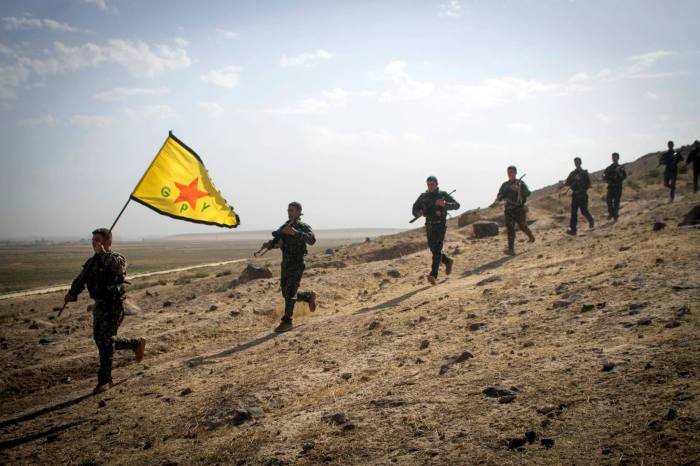
Excellent journalist Rami Jarrah, based in Aleppo, interviewed people about this Nusra/Fisk/imperialist/”left” claim that the FSA doesn’t exist. Here is what they answer.

Rami Jarrah, from Aleppo: no FSA? – رامي جراح، من حلب، مافي جيش الحر؟

https://syriafreedomforever.wordpress.com/2015/12/13/rami-jarrah-from-aleppo-no-fsa

Posted on December 13, 2015

Rami Jarrah: There are claims on Syrian soil that there is no such thing as the Free Syrian Army, We took a stroll around Aleppo today asking the locals their opinion on such a statement.

هناك إدعاءات من عدة جهات تقول إن لا وجود لشيئ اسمه الجيش السوري الحرمواطنون سوريون يردون على تلك الجهات

In a televised interview Mohammad al Jolani, Head of Jabhat Al- Nusra, said that there is no such thing as the Free Syrian Army, this was a video survey done randomly the following day on the 13th of December 2015. Citizens were asked their opinion or response to this claim.

This video is hereby translated under full responsibility of ANA PRESS


Turkey-Russia spat: One standard for murdered Syrian children, another for the warplanes that kill them

By Michael Karadjis

One small victory for humanity

 Naturally enough, when any warplane engaged in mass murder is brought down, humanity wins a small battle. The Russian invaders of Syria have already slaughtered hundreds of civilians (526 in first 45 days http://www.vdc-sy.info/index.php/en/reports/1447972413#.Vlox_STA1sv), have bombed countless hospitals and medical facilities, schools, markets (like the 44 killed in the bombing of an open market in Ariha in Idlib several days ago http://eaworldview.com/2015/11/syria-daily-russia-kills-44-in-market-bombing/), refugee camps, aid convoys etc; have used cruise missiles (https://now.mmedia.me/lb/en/NewsReports/566255-russian-cruise-missiles-pummel-rebel-held-areas-of-syria), cluster bombs (http://www.thetimes.co.uk/tto/news/world/middleeast/article4623770.ece), white phosphorus (http://www.independent.co.uk/news/world/middle-east/is-russia-or-france-deploying-chemical-weapons-against-isis-in-raqqa-a6745171.html); on November 28, Russian airstrikes in Idlib “destroyed an aid dispensary containing a bakery that produced over 300,000 pounds of bread per month and a well providing safe-drinking water to an estimated 50,000 people” (http://syriadirect.org/news/50000-people-without-access-to-drinking-water-after-reported-russian-airstrike-hits-well); ten days earlier, they destroyed the bread oven in Atareb, in Aleppo province, which served some 120,000 people (https://syriafreedomforever.wordpress.com/2015/11/19/russian-bombs-against-civilians-القنابل-الروسية-ضد-المدنيين/).

The Russians have targeted the Free Syrian Army (FSA) nearly all the time, and have mostly bombed provinces with zero ISIS presence, except when slaughtering civilians in Raqqa; and all this to aid a fascist regime that has already been bombing its entire country into a moonscape for years; in just a three-week period in November, regime bombing killed 338 and injured 1607 people in an offensive in the sprawling Damascus outer suburbs of East Ghoutta alone (http://www.alaraby.co.uk/english/news/2015/11/20/syrian-regime-offensive-in-eastern-ghouta-has-killed-338), just one of many theatres of the war; an exterminationist regime.

As such there can be nothing but wild cheers from Syrians for the downing of a warplane that has been slaughtering their children. The fact that these weeks and weeks of the most grueling, the most overt, targeting of civilians by an invading army of a superpower has only resulted in a little chiding by Russia’s imperialist partners, and complete indifference (if not support) by the imperial left; yet when one of the warplanes engaged in this mass homicide comes down it is treated as a big deal; is testament to the sick morality of the imperialist world order, including some of those within it imagining they are not part of it.

But questions of celebration and hypocrisy aside, it is useful to look at some specifics here. And I do not mean the irrelevance of which side of the Syrian-Turkish border the Russian killer plane was technically flying in when shot down; that discussion assumes it had the right to be on the Syrian side of the border in the first place. “Anti-imperialists” who join in this imperialist discussion ought to take a look at a map, and notice that Syria in fact is not part of Russia; actually, it is a significant distance away. Therefore there’s little point in a discussion about who was technically right or wrong, since by any standard, Russia did not have the “right” to be flying around killing Syrian people in the first place.

If, for example, it were American warplanes flying around and carpet-bombing a country far from home – Iraq for example – and one got shot down right on the Iranian border, with a dispute over which set of square inches the plane was in, I imagine we would judge the American and the Iranian actions somewhat differently, and rightly so.


Russian slaughter of the Turkmen people

But more interesting are the specifics of the case. For weeks, Russia had been intensively bombing Turkmen communities in that region near the Syrian-Turkish border, in northern Latakia province (http://www.dailystar.com.lb/News/Middle-East/2015/Nov-20/323898-turkey-summons-russian-envoy-over-bombing-of-turkmens-in-syria-pm.ashx). Russia also fired cluster bombs around Yamadi nearby Aubain refugee camps near the border, housing thousands of refugees, several times in the weeks before (http://www.thetimes.co.uk/tto/news/world/middleeast/article4623770.ece). Several days before the incident, the Turkish government summoned the Russian ambassador to protest this; “it was stressed that the Russian side’s actions were not a fight against terror, but they bombed civilian Turkmen villages and this could lead to serious consequences,” the Turkish foreign ministry said describing the meeting (http://www.vox.com/2015/11/24/9792830/russia-plane-turkmen).

At least 1500 Turkmen had already fled the slaughter and taken refuge in Turkey:
https://www.middleeastmonitor.com/news/europe/22413-turkey-provides-refuge-for-turkmen-fleeing-home-in-syria, while another 5,500 have fled to the Yamadi camp near the border: http://syrianobserver.com/EN/News/30192/Syrian_Turkmen_Flee_Regime_Attacks_Turkey.

Some estimates of the flight across the border are higher. According to Telegraph Middle East correspondents Louisa Loveluck and Richard Spencer, “In recent days, thousands of civilians have fled over the border, saying they feared Russian bombing raids in support of regime forces” (http://www.vox.com/2015/11/24/9792830/russia-plane-turkmen).

One Turkish official, according to Turkey’s Hurriyet newspaper, declared that “Turkey won’t be indifferent to attacks targeting the life security of Turkmen” (http://www.vox.com/2015/11/24/9792830/russia-plane-turkmen) – indicating that the downing of the Russian plane may have had more to do with the context of this slaughter than with the boring “legal” formalities.

Most ethnic Turkmen brigades in Syria are affiliated to the Free Syrian Army (FSA), so it is not surprising that Russia has been bombing them, since the FSA has been Russia’s main target in its alleged intervention “against ISIS.” To state the obvious, the province the Russian plane was bombing, Latakia, has had no ISIS presence whatsoever since the FSA drove them out root and branch in early 2014 (when the FSA drove ISIS out of about half of Syria).

However, there are a couple of side issues raised by this incident. One was the shooting of one of the pilots who was parachuting to the ground after the plane was hit; the other was the fact that the fighter who shot him, Alparslan Çelik, was not an ethnic Turkman, but a Turkish fascist, the son of a Nationalist Movement Party (MHP) mayor (http://anfenglish.com/news/turkmen-commander-turns-out-to-be-turkish-nationalist).

The latter detail is somewhat odd, given that the MHP supports the Assad regime, as we will see below; but first let’s examine the shooting issue, and the state of Turkmen militias in Syria.


Shooting pilots – and a little digression about Vietnam

 Decades ago, US Republican leader John McCain was flying around in an American warplane bombing and killing Vietnamese peasants, that is, engaged in the same kind of activities as the Russian airforce is in Syria. Vietnamese revolutionaries shot him down, using anti-aircraft weapons supplied by the Soviet Union – ie the kind of weapons denied to the Syrian revolutionaries by the US even after years of aerial genocide – and took him prisoner.

McCain spent time in the famous “Hanoi Hilton,” as American POWs nicknamed the main POW prison. For years McCain complained that his Vietnamese captors had tortured him (and as a result McCain, to his credit, was one of the few semi-neocon Republicans who was critical of the Bush regime’s practice of torturing Islamist prisoners, if inconsistently, unlike Bashar Assad who actively participated in the US “rendition” program). I have no real information on whether this was true or not; obviously, if true, then, like all torture it should be condemned.

Yet for anyone whose sympathies were with the oppressed, the terrorised, McCain’s alleged plight could garner little sympathy; when I lived in Vietnam for some years, a common retort by anti-war Americans now living in Vietnam – often working to help Vietnam overcome the ongoing legacies of US genocide such as Agent Orange and unexploded ordinance – regarding McCain’s whinging decades later, was that “he should be happy he wasn’t shot as a terrorist” as soon as he was captured.

Of course, the Vietnamese army, despite the genocide being inflicted on them for years by the US, did not do this; it did the right thing and kept him alive till the war ended. While someone bombing people from the sky arguably is an aerial terrorist, at the end of the day the individual remains an employee in uniform of the political, economic and military regime who sent him there on behalf of a ruling class that doesn’t put their own children in that kind of danger. But it would surely not be difficult to imagine the terrorised people below – whether in Vietnam then or Syria today – wanting to take the aerial terrorist apart.

So while the shooting down of a warplane is something I consider to be a humanitarian action (in pretty much all circumstances), the shooting of a parachuting pilot is to be condemned, and is considered a war crime. Notably, it violates stated policy of the Free Syrian Army and of the Syrian Coalition of Opposition and Revolutionary Forces (usually called “Syrian Coalition”, the exile-based political opposition leadership with which the FSA is vaguely associated with).

Therefore, it somewhat makes sense to find out that the action was carried out by a fascist from Turkey rather than a local Turkman FSA brigade. But that then raises the question of who are the Turkman brigades, and are they all, uniformly, a bunch of fascist ‘Grey Wolves’ as they are being slandered by various racists across the internet?


The Turkmen and their brigades

 There were up to 200,000 Turkmen in Syria before the revolution, but the Assadist aerial slaughter has forced around 90 percent of them over the border into Turkey (a reasonable introduction to the Turkmen issue can be found at: http://www.vox.com/2015/11/24/9792830/russia-plane-turkmen). Turkmen have been involved in the revolution from the outset, in particular, their hostility to the fascistic “Arab” policy of the Baathist regime, which banned their language, being an important factor in addition to the fact that they are also Syrians rising against a dictatorship, like others.

There are many Turkmen brigades of various political shades. There are 8 Turkmen brigades listed as affiliated to the National Coalition (so in this sense we can broadly call them FSA): Sultan Mohamad Al Fatih Brigade, Sultan Suleiman Brigade, Seljuk Brigade, Sultan Selim Brigade, Anwar Al Haq Batallion, Sultan Murad Brigade, Ashab Al Yamin Brigade, Jabal Al Turkman Brigade (http://en.etilaf.org/coalition-components/national-blocks/turkman-component-of-the-syrian-national-coalition.html), along with various Turkmen political organisations which have seats in the Coalition’s parliament. They support the Coalition’s program of the unity of Syria with equal rights for all ethnic and religious minorities. These forces are also organised under the Turkish National Assembly (https://en.wikipedia.org/wiki/Syrian_Turkmen_Assembly), which has declared: “Regardless of any ethnic or religious identity, a future in which everybody can be able to live commonly under the identity of Syrian is targeted in the future of Syria” (http://www.hurriyetdailynews.com/Default.aspx?pageID=238&nid=36998).

A good resource about the formation of Turkmen political and military organisations in Syria can be found at http://www.orsam.org.tr/en/enUploads/Article/Files/2013320_150ing.pdf; though from 2013, it is still very useful.

Thus assertions that all Turkmen brigades are either ‘Grey Wolves” or creations of the Turkish regime’s MIT intelligence agency are irresponsible essentialist claims that deny that Turkmen are just as capable as anyone else of running their own organisations and having a variety of political views.

In contrast, the brigade that Alparslan Çelik is supposedly deputy leader of – the “Turkmen Coastal Division” (or “2nd Coastal Division”) http://www.telegraph.co.uk/news/worldnews/middleeast/syria/12015031/Turkmen-fighters-We-fired-in-the-air.-The-Russian-died-in-the-air.html), is not an affiliate of the Syrian Coalition. Notably, this collection of photos of this brigade at https://www.reddit.com/r/syriancivilwar/comments/3u6im0/the_turkmen_commander_alparslan_%C3%A7elik_who_shot_at/cxcblmd  includes some with them displaying their own emblem or the Turkish flag, but none with the FSA flag, the flag of the Syrian revolution. It is also impossible to find the FSA on their facebook page:  https://www.facebook.com/T%C3%BCrkmen-Da%C4%9F%C4%B1-2-SAHiL-T%C3%9CMENi-947137371997615/.

It is hardly surprising that the MHP, the main ultra-rightist, opposition party in Turkey, associated with the infamous Grey Wolves fascistic militia, would try to get involved and spread their Turko-chauvinist poison where ethnic Turkmen exist; they probably see such areas – especially northern Latakia – as part of a ‘Greater Turkey’, a view sharply at odds with the Turkmen organisations that have been in National Coalition since the outset. Possibly the shooting of the parachuting pilot may have been a deliberate stunt to gain some nationalist/extremist credibility among the Turkmen communities being massacred from on high.

However, this particular brigade is not representative of Turkmen fighters and brigades in Syria, and still less does it invalidate their struggle against the regime and their struggle to survive under regime and Russian bombing.


The MHP in Turkey: Send the refugees back to Assad!

 The irony of the nationalistic MHP seeming to be onside with forces fighting the Russian invasion in a place where ethnic Turkmen exist is that in the bigger picture, the MHP calls for the expulsion of the 2 million Syrian refugees from Turkey and has supported Assad, and condemned the AKP’s anti-Assad Syria policy, since the outset!

As long ago as 2012, MHP leader Devlet Bahçeli condemned the AKP’s support for the Syrian uprising and claimed it “is being used as an instrument for ugly propaganda being carried out [regarding Syria]” (http://www.todayszaman.com/national_mhp-leader-slams-government-on-syria-policy_295521.html).

In May 2015, MHP Antalya deputy Mehmet Günal criticized Turkey’s support to the Syrian opposition and said that under MHP rule, Turkey would have an honorable policy based on mutual interests of both Turkey and Syria (http://www.todayszaman.com/anasayfa_opposition-accuses-ak-party-of-dragging-turkey-into-syria-quagmire_381177.html).

Just before the mid-year Turkish elections, the MHP’s Gaziantep deputy candidate Ümit Özdağ tweeted regarding the Syrian refugees: “The 500,000 Syrians will go, 500,000 tourists will come to Gaziantep.” Talking to the Doğan Media Group right before the elections, the new MHP deputy said the MHP would start negotiations with Assad when they come to power in order to “cut the main logistics behind jihadists who are supported by the U.S.”
(http://www.dailysabah.com/columns/merve-sebnem-oruc/2015/06/10/what-will-turkish-elections-bring-for-syrian-refugees).

“Jihadists supported by the US undermining Assad!” Sounds like the views of a lot of the imperial left!

Unfortunately, the mainstream Kemalist CHP are hardly better:

“The chairman of the Republican People’s Party (CHP), Kemal Kılıçdaroğlu, included an election promise in his campaign speeches, vowing that the CHP will send Syrians back to their homeland if his party comes to power. The CHP, which has supported the Assad regime and has not cut its relations with Damascus yet, has always accused the government of plotting against the Syrian regime. According to the CHP, Syrians were not actually refugees, but were brought to Turkey to destabilize the country.”

The MHP, in other words, not only supports Assad – except against the Turkmen – but has much ideologically in common with the Syrian Baath party. Just as German and French fascists might argue about Alsace-Lorraine, so Assad and the MHP might argue about Turkmen regions.

So while the AKP soft-Islamist regime has opportunistically moved closer to the MHP’s position on the Kurds over the last year (away from its own policy of the “peace process”), the essential difference between the contrasting rightist ideologies of nationalism/fascism and Islamism needs to be understood, to understand why the Islamist AKP can welcome 2 million Syrian Arabs as refugees, and be influenced enough by their catastrophe to want to oust Assad, whereas the ethno-chauvinist MHP wants to return the Arab untermenschen, who they denounce as either criminals or “jihadists”, to Assad’s tender mercies.

And of course none of that justifies the AKP’s own resumption of the Turkish state’s war against the Kurds, which seems at least in part to have been driven by the most narrowly opportunistic political concerns between the two Turkish elections. But beggars can’t be choosers – if Turkey, overwhelmed by 2 million refugees from the Syrian apocalypse, needs to get rid of Assad to help deal with this problem, so much the better for the Syrian rebels, as long as they don’t become mere tools for Turkish policy – something there is no evidence for.

Meanwhile, for Kurdish supporters finding a bad taste in their mouths if anything positive is said about any Turkish action, they might ponder how they would react if a Turkish warplane bombing Kurds in eastern Turkey were brought down by the PKK. Consistency has much to be said for it.


Conclusion

 Of course this has been something of a digression from the issue here. Since the incident, Russia has taken revenge on the people of Syria by stepping up its terror, bombing intensively along the Turkish borders of Latakia, Idlib and Aleppo, all regions with zero ISIS presence, indeed it has launched an intensive bombing campaign against the Syrian rebels in the Azaz region of northern Aleppo, including bombing Turkish aid trucks (http://eaworldview.com/2015/11/syria-daily-russia-hits-back-with-bombing-of-turkish-aid-trucks/). Azaz is the one point in Aleppo where the Syrian rebels have a border crossing into Turkey, and where they are in confrontation with ISIS-held territory just to their east. In fact, while Russia has been bombing the rebels in Azaz in early December, ISIS has also been attacking them, and seized the town of Kafrah from the rebels, essentially under Russian air cover (https://now.mmedia.me/lb/en/NewsReports/566317-isis-advances-in-flashpoint-north-aleppo).

Let me just say that again for anyone *still* spouting nonsense about Russia “fighting ISIS” – Russia is bombing the anti-Assad, anti-ISIS rebels of northern Aleppo, those who have held the main confrontation line with ISIS in the region for two years, while ISIS is attacking those same rebels, with no Russian retaliation. Russia is bombing the rebels in concert with ISIS; but this should not be as surprising as it sounds, because the Assad regime has been doing precisely the same thing the last two years in that region.

Where this ends is unclear. The US is not making any noise about Russia’s Azaz campaign; several days ago, the US demanded that Turkey close its border, and some speculate that the aim now is to allow Russia to forcefully close the border, even if it means temporarily using ISIS, and choke off the rebels; then the US and Russia could join forces to remove ISIS from the border, without the complication of the FSA taking over, who would use it as a base to fight the regime (which ISIS in that region does not do). The picture should emerge more clearly in the next few days.

But to end where we began, with the issue of warplanes and civilian lives; there is a good argument that all air war is almost by definition a war crime. Even genuine concern for civilian life – something the Russian airforce clearly has none of – is almost never any guarantee. For years, Syrians have called for anti-aircraft weapons, to make their own DIY no-fly zone; for years well-known supplies of manpads, shoulder fired anti-aircrafts, have been blocked by the US, fearful that they may actually let the rebels win, which is against US policy, rather than merely hold a little ground. Even when rebels try to get manpads outside official channels, the US remains vigilant; “at least four major Syrian armed opposition groups have tried in recent years to independently purchase manpads on the black market,” according to conversations their leaders had with Charles Lister, yet “somehow, the Americans found out and our purchase was blocked” (http://www.huffingtonpost.com/charles-lister/russias-intervention-in-s_b_8350266.html?ir=Australia).

As one tweet put it concisely, “the only consistent, thorough, well-implemented US Syrian policy is tracking hunting and stopping MANPADS from reaching any opposition group since 2012” (https://twitter.com/THE_47th/status/659114328012931072).

And that’s why, just as when Vietnamese brought down American warplanes, when any Assadist or Russian warplane is shot down in Syria, it is one small victory for humanity.

Anti-Imperialism for Dummies: Ignoring Syrians and Their Own Contradictions

Re–blogging this from Charles Davis, as it is excellent, right to the point, and timely.

Idrees Ahmad's avatarP U L S E

By Charles Davis

12080219_1014749741879955_4184181291067013278_o

One of the iron laws of the know-nothing “anti-imperialists” is that if a group is supported by the United States, however minimally, or even just perceived as being aligned with U.S. interests, it goes without saying that the group is very bad and to be opposed by every good practicing opponent of empire. This is why many see no need to learn a thing about Syria beyond what can be found in 140 characters or less from Julian Assange, left-wing class analysis forsaken for conspiracy and a tautology: The U.S. is bad, and it says Assad is bad – maybe because of a pipeline, or because he made John Kerry pick up their last bar tab – Assad is therefore good, or at the very least less bad than those backed by the empire.

Preferring the simplicity of a “regime change” narrative that went from stale to…

View original post 735 more words

The Ongoing Civil Uprising in Syria

Just as most reportage of the Syrian uprising against the Assad dictatorship in the imperialist media focuses on the role of “jihadists,” and presents a false picture of a largely “jihadist”-dominated armed opposition, in which democratic and/or secular armed rebels are marginal,weak and “fractured” at best, if not non-existent; so likewise an equally false picture is usually presented of the struggle being entirely military, with the civil uprising that launched the revolution in 2011 being allegedly long gone. In reality, the ongoing civil uprising is at the base of the Free Syrian Army and other armed groups that genuinely arose from the grassroots of the Syrian uprising and their connection remains vital to understanding the situation as still a revolution, however imperfect, rather than mere undefined “civil war.”

Without time to write an article on this very important issue, I have here simply gathered some links and snippets from a number of only very recent articles on this issue. Obviously, what this means is that going back into the archives, many more could be gathered, showing the lie that the civil uprising does not exist. And these are only the articles – if I were to present here every minor report of every demonstration going on in Syria, the blog would soon run out of space.

Michael Karadjis


Syrian activists are repairing the fabric of civil society, even as it comes undone

Hania Mourtada 13 November 2015

https://www.opendemocracy.net/arab-awakening/hania-mourtada-penny-green/syrian-activists-repairing-fabric-of-civil-society-even-as-it-comes-undone

Syria has seen the emergence of a powerful culture of resistance, from subversive graffiti to makeshift hospitals, which continues to operate despite the violent and politically fractured terrain.
……

The power of the state has already been contested, and we’ve seen the emergence of a powerful culture of resistance which continues to operate despite the violent and politically fractured terrain. When the uprising erupted, political truth-telling emerged out of the shadows and boldly re-entered the public sphere. People who once operated in underground
meetings are now establishing organisations in broad daylight. In every town or village that fell out of Assad’s control, small civil society groups are working tirelessly to lay the foundations for democracy, justice and a pluralistic society.
Young people, in particular, are determined to show the world that they can build solid institutions from scratch and reinstate order in opposition-controlled towns. Centres concerned with women’s rights and women’s well-being have opened their doors, offering language courses to illiterate women and useful marketable skills to the young. Subversive
graffiti, revolutionary pamphlets, magazines and radio stations, groups offering psycho-social support and makeshift hospitals are all initiatives made possible by Syria’s new and burgeoning civil society. Syrians are experimenting with what might be made possible. Areas that the regime has lost are filled to the brim with possibilities.

…………….

Total collapse of state services in certain provinces has paved the way for experimenting with self-governance. In those areas, civil society is not just protesting against the regime, it is also resisting radical Islamists, the corruption of local militias and ISIS. This new culture of resistance and political truth-telling cannot now be eradicated unless a large-scale massacre permanently wipes it out of existence. And this may very well be what Assad is striving for with his unguided indiscriminate bombs.

Full:
https://www.opendemocracy.net/arab-awakening/hania-mourtada-penny-green/syrian-activists-repairing-fabric-of-civil-society-even-as-it-comes-undone


With Authorities Gone Local Councils Take Charge in Syria
http://www.voanews.com/content/with-authorities-gone-local-councils-take-charge-in-syria/3052990.html

Jamie Dettmer
November 11, 2015 7:33 AM
GAZIANTEP, TURKEY—

In rebel-controlled parts of war-torn Syria, where the forces of President Bashar al-Assad have been expelled, a new breed of local councilors has emerged, administering what relief they can and striving to provide civilians with basic services.

Across parts of Syria, 416 local councils are now functioning in towns and villages and are under the control of neither the Assad regime or Islamic State extremists.In some towns, council officials have been elected in rudimentary-run polls.

For the councils to keep on running, they have to navigate complex politics and negotiate with armed groups, and they are always short of funds. Their work amid Russian and Syrian airstrikes and skirmishes on the ground often leads them to defy Islamist and other rebel militias who want to control civilian as well as military affairs

Full:
http://www.voanews.com/content/with-authorities-gone-local-councils-take-charge-in-syria/3052990.html


Why is Russia bombing my town?
https://www.washingtonpost.com/opinions/why-is-russia-bombing-my-town/2015/11/06/e1084ca0-8274-11e5-9afb-0c971f713d0c_story.html

By Raed Fares November 6 at 8:27 PM

KAFRANBEL, Syria

……………

Kafranbel residents have worked hard to advance women’s rights since Syrian dictator Bashar al-Assad’s forces left the town three years ago. We have established centers to teach women skills such as reading, computing, emergency care and civil activism. We have children’s centers that give our youths some relief from war and take them off the streets,
where extremists could reach them. We even have a radio channel, called Radio Fresh, that reaches many thousands of people and broadcasts a popular program stressing that Islam is a religion of love and peace.

Yes, we still have problems with extremism here, even after kicking out the Islamic State. Unknown attackers planted a bomb next to my car last fall. In January, Jabhat al-Nusra, the Syrian branch of al-Qaeda, attacked our radio offices and the Kafranbel Women’s Center. Jabhat al-Nusra militants also arrested and beat me in December, but they could find nothing to charge me with and they had to let me go. Extremists arrested the director of the women’s center in April, but we were also able to free him. Despite the difficulties, civil society remains strong in and around Kafranbel.

If civil activism in Kafranbel declines, though, I will blame Russia. One reason for our thriving civil society is that we are being defended by Free Syrian Army fighters who grew up in the town and are firmly committed to democracy. These fighters, who have received U.S. assistance, serve as a check on any extremist groups that try to cause trouble. Russia is bombing the pro-democracy fighters of Kafranbel most heavily, almost as if it wants the extremists to grow stronger. For this reason, Russia has emerged as an enemy of civil society here. Local activists have taken the rare steps of burning a Russian flag and protesting alongside local Free Syrian Army fighters to highlight this point.

Full:
https://www.washingtonpost.com/opinions/why-is-russia-bombing-my-town/2015/11/06/e1084ca0-8274-11e5-9afb-0c971f713d0c_story.html


Going Home: An Interview with Tarif al-Sayyed Issa
http://carnegieendowment.org/syriaincrisis/?fa=61724

Posted by: Aron Lund Thursday, October 22, 2015

(report from post-liberation Idlib city – which the imperialist media and the imperial left usually claim is “run by the Nusra Front or some such lie)

What has your role been in Idlib since the army was driven out?

I left Faylaq al-Sham [the rebel brigade he was a member of which was part of the Jaysh al-Fatah coalition which liberated Idlib – MK] once Idlib was liberated. Others continued on toward Jisr al-Shughour and other towns, but I stayed in Idlib and returned to my humanitarian work. There was a lot to do. We had to quickly get aid into the city, set up an administration, and try to activate civil society.During Ramadan, we prepared 7,000 meals and handed out thousands of food baskets. We distributed seven tons of dates in some of the poorer neighborhoods.

When you say we, who do you mean?

I am still employed by Sanabel al-Kheir, the aid group we created a few years ago. I am part of its five-person steering committee. As a member of Sanabel, I work on the ground with several big aid organizations. They include the Ataa Relief and Development Association, which is a Syrian charity registered in Turkey, the White Hands, which is also based in Turkey, the IHH, which is a large Turkish charity, and the Aid Coordination Unit, which is part of the National Coalition and is backed by the Western countries.

Among the other aid groups active in Idlib, there is one named Violet and an Irish one called Goal. These organizations have all been approved to work in the city and we trust them. The armed groups have no real humanitarian work of their own. Some of them claim to run their own aid groups that do all the work.

So far, the armed groups have not interefered with the humanitarian work. The Fath Army leadership has made it clear to them that this could lead to the international aid groups pulling out. It is a sensitive situation since the Nusra Front is active in the area and it is linked to al-Qaeda, while the population depends on donations from nations at war with al-Qaeda. There was an incident early on when some members of the Nusra Front interfered by trying to control the distribution of flour, but this was stopped immediately. After that, the Fath Army decreed that the armed units cannot be involved with the aid work.

Are you also politically active?

I am still part of the Muslim Brotherhood, of course. In the Brotherhood, we have a committee for each Syrian province and I am one of the members of the Idlib committee.

Part of my job now, as I see it, is to convince people of the need for a civilian leadership. I go around mosques and other places, meeting people and trying to explain to them that the country will never get up on its feet again without a strong civil society. I have met with all the workers’ unions in Idlib, with the professional associations, and so on.

Full: http://carnegieendowment.org/syriaincrisis/?fa=61724


The self-government revolution that’s happening under the radar in Syria
https://www.washingtonpost.com/opinions/the-self-government-revolution-thats-happening-under-the-radar-in-syria/2015/07/26/05cffade-313e-11e5-8353-1215475949f4_story.html

By Frederic C. Hof July 26

With Iran circling the wagons around an ever-shrinking Syrian statelet nominally headed by Bashar al-Assad, a key question is coming into sharp focus: Who might ultimately replace the ruling clan if Tehran cannot keep its clients afloat? The answer is both complex and hopeful:
Self-government at local levels is taking root in Syria and forms the basis for what should come next.

One of the few uplifting experiences to be had in any Syrian context these days is to meet with young Syrian activists, as I recently did in Gaziantep, Turkey. A young lawyer said something striking: “This is not just a revolution against Bashar al-Assad. It is a revolution for self-government. Replacing Bashar with someone else issuing decrees from Damascus — even someone much better than Bashar — is not acceptable.”

……

There are today hundreds of local councils throughout non-Assad parts of Syria. Some operate clandestinely in areas overrun by the so-called Islamic State. Some operate in areas where the Assad regime — with Iran’s full support — unloads helicopter-borne “barrel bombs” onto schools, hospitals and mosques. Some operate in neighborhoods subjected to Iranian-facilitated starvation sieges. These local councils are supported by a vast network of civil society organizations — the kinds of voluntary professional associations that undergird Western democracies. All of this is new to Syria. It is the essence of the Syrian Revolution.

This combination of local councils and civil society organizations is a cocktail of bottom-up, localized efforts. The women and men risking all for their neighbors are heroes. Yet these heroes are literally unsung. Everyone in Syria knows of Assad and his rapacious family. Many in Syria know the names of exiled opposition figures and leaders of armed groups
inside the country. Yet those who represent Syria’s future political elite are largely unknown. Getting these battle-tested leaders into Syria’s national political mainstream is essential

Full:
https://www.washingtonpost.com/opinions/the-self-government-revolution-thats-happening-under-the-radar-in-syria/2015/07/26/05cffade-313e-11e5-8353-1215475949f4_story.html


Women Key to Syrian Future

Interview with RAED FARES
http://souriahouria.com/women-key-to-syrian-future-qa-with-raed-fares/?fb_ref=Default&fb_source=message

21 novembre 2015
By Redacteur_ST
« Women have the most critical role in rebuilding Syria and raising the next generation of Syrians, » said Raed Fares, a community leader in Idlib whose plethora of projects aim to strengthen Syrian civil society through a combination of awareness, education and inclusivity

…….

Syria Deeply: Aside from the continuation of your weekly protests in Kafranbel, what other kinds of community projects do you have going on at the moment?

Well, yes, our weekly protests are ongoing, but their number has decreased a great deal. People are afraid of large gatherings, which have been, and are, targeted by airstrikes. But we have many other projects.

The biggest project we have going is our radio station, called Radio Fresh FM. We broadcast 24 hours a day with different kinds of programming – news updates, women’s programming, children’s shows, breaking news updates and warnings about nearby airstrikes or incoming airstrikes. We warn civilians when there are regime or Russian helicopters flying in the sky. We let people know which direction they’re headed. The station is actually one of the most listened to channels in all of Syria. We have more than 400,000 returning listeners – which is a huge number.

The radio also has a few subsidiary projects. There are three affiliated magazines and a training center for media activists, journalists and presenters – all of which is facilitated under the auspices of the radio.

We also have a women’s division that is led by Ghalia Rahal, whom Reuters recently presented with an award for courageous journalism. She is now running seven women’s centers across the south of Idlib that provide vocational training, education, language and computer classes, etc. The point of these centers is to get women out of the home and into
public life, to get them more actively engaged.

Women have the most critical role in rebuilding Syria and raising the next generation of Syrians – that’s the idea behind the project. We also have educational projects aimed at getting kids more involved in their schools and promoting the importance of psychosocial therapy.

We built a small soccer field in Kafranbel – kids are playing on it from sunup to sundown. When they’re playing, everyone is screaming and yelling – it’s the one time of the day they can’t hear the roar of the jets overhead, or gunfire nearby.

These are all projects focused on awareness, but we also have projects focused on the provision of services. We brought running water back to Kafranbel and the surrounding villages. The goal with these projects is to provide people in serious need with the services they simply aren’t getting, in addition to building the credibility of alternative institutions so that people are more willing to work with us on and in our other projects.

Syria Deeply: So what’s your goal in facilitating all these projects?
Raed Fares: The goal is to build a homeland. Everybody knows that we live on a farm owned by Assad’s family. Our goal is to destroy that farm and build a homeland in which Syrians can truly live.

Full:
http://souriahouria.com/women-key-to-syrian-future-qa-with-raed-fares/?fb_ref=Default&fb_source=message


Interview with Joseph Daher On the Syrian Democratic and Revolutionary Opposition
https://syriafreedomforever.wordpress.com/2015/11/17/interview-with-radio-zamaneh-on-the-syrian-democratic-and-revolutionary-opposition/

Posted on November 17, 2015

…..

Nevertheless, many individuals and small groups, although very much weakened, exist in some areas among local coordination popular groups. Pockets of hope and resistance still exist in Syria and are composed of various democratic and progressive groups and movements opposing all sides of the counter-revolution, the Assad regime and Islamic fundamentalist groups. They are the ones still maintaining the dreams of the beginning of the revolution and its objectives: democracy, social justice, equality and no to sectarianism. They can be found in Aleppo, Rural Aleppo, Idlib and Rural Idlib, in Rural Damascus, etc… You can find many examples on my blog Syria Freedom Forever of popular resistance.[3]

The revolutionaries in these areas organise through popular councils at the levels of villages, neighbourhoods and regions. The popular councils have actually been the true spearheads of the movement that mobilized the people for the protests and organisation of daily life in areas where the regime disappeared.  The regions liberated from the regime developed forms of self-organisation based on the organization of the masses. Youth and other form of coalitions also exist in Syria with varying types of activities.

Last Summer, protests were organised in the rural areas around Aleppo, Damascus and elsewhere like in the city of Idlib.  In the small town of Al-Atarib in rural Aleppo, held by the Al Qaeda linked Jabhat al-Nusra there have been several demonstrations against its authoritarian practices. Thousands of people marched in the town of Saqba, in rural Damascus, for the aims of the Syrian revolution on 7 August 2015. A week later a group of women there protested for release of political prisoners held by the Army of Islam organization. They have been protesting for the past few months. Dozens held a sit-in at the office of the local council of Douma near Damascus in July after a councilperson was abducted.[4]  In the end of June, A demonstration was organized in the city of Idlib after the Friday prayer and demanded that the city’s administration hand over to the people, the private military headquarters of Jaysh al-Fatah led by Jabhat al-Nusra outside the city.[5]

On November 10, 2015, civil disobedience actions were organised by activists protesting against the kidnappings of revolutionaries by Jabhat Al-Nusra in the neighborhoods of Aleppo. On October 18, 2015, a campaign of solidarity of revolutionaries in Douma was organised with the Palestinian People and the Intifada. In October 6, 2015, a demonstration was organised by the revolutionaries in Aleppo against Jabhat Al-Nusra and demanded that it exit Aleppo. In September 25, 2015, Kurds, ‪‎Arabs, ‪‎Assyrians & ‪Turkmen marched against IS and Assad crimes in the neighbourhood of Sheikh Maqsoud in ‪Aleppo.

Last Summer (2015) in the province of Suwayda, mostly inhabited by the Druze community, various popular protests were organized against the regime’s policies and lack of services. Demonstrations and protests continued following the assassination of Sheikh Wahid Bal’ous, who is a Druze Sheikh who defended them.   Bal’ous who was known for his opposition to the Syrian regime and to the Islamic fundamentalist forces. Demonstrators protested in front of several regime and smashed a statue of the former Syrian regime dictator Hafez al-Assad.

Sheikh Wahid Bal’ous was a very popular figure among the Druze population and was leading a group called “Sheikhs of dignity”, which was committed to protecting the Druze in the province and was also fighting the Islamic State (IS) and Jabhat Al-Nusra. Sheikh Wahid Bal’ous also opposed to the Syrian army’s recruiting of men originating from Suwayda, to be sent to fight outside the province.

Regarding the three cantons of Rojava, many interesting things are occurring on many aspects (women’s rights, minority participation, secular institutions, etc…), especially in a war situation. These experiences of autonomy are moreover positive for a Kurdish nation oppressed for decades, especially as I support the self determination of the Kurdish people in Syria and elsewhere.

Full:
https://syriafreedomforever.wordpress.com/2015/11/17/interview-with-radio-zamaneh-on-the-syrian-democratic-and-revolutionary-opposition


Plus this important recent report: ‘The Syrian Non-Violent Movement: Perspectives from the Ground’, available at https://dawlaty.org/en/blogs/syrian-non-violent-movement-perspectives-ground

From the Introduction:

The Syrian Revolution is today suffering from various predicaments, from the decline of the non-violent civil movement, which had been its civilizing force, to the complex continually shifting military reality, to the international and regional players which have become more influential and active within Syrian than Syrians themselves. Yet despite this grim reality, there remain a number of Syrian activists working in obscurity and in the public eye, at home and abroad, each according to their capacity and whatever margins, however narrow, reality allows them to keep the flame of Revolution alight and active. These activists explore their tools and roleanewin a series of discussions and dialogues facilitated by Dawlaty.

This report provides an overview of the reflections of Syrian activists on the reality of their movement, as well as the movement’s role, potential and ability to regain the lead. This report documents a process from and for activists, hence its value and significance. It aims to stimulate debate and critical thinking in light of the changing realities on the ground, and through its discussions and recommendations, inspire strategies to open up new spaces and opportunities for the non-violent movement in Syria.


And this, finally, on how important the physical destruction of all such alternative centres of power and authority by the Assad regime’s years  slaughter has been to the survival of the regime:
The Assad Regimes Hold on the Syrian State
Kheder Khaddour
Paper July 8, 2015
http://carnegie-mec.org/2015/07/08/assad-regime-s-hold-on-syrian-state/id3k

How Russian and American bombing consolidates support for ISIS

As is well-known, the ongoing Russian airstrikes, despite Putin’s claim to be carrying out an “anti-ISIS” campaign, have overwhelmingly struck the Free Syrian Army (FSA) and other anti-Assad, anti-ISIS fighters, in regions where no ISIS even exists (western Homs, Hama, Idlib, southern Aleppo, and even Damascus and Daraa).

The terrible civilian toll is also hardly in dispute, from bombing nine hospitals (http://www.alaraby.co.uk/english/news/2015/10/23/nine-russian-airstrikes-hit-hospitals), schools, factories (http://syriadirect.org/news/regime-airstrikes-level-%E2%80%98economic-powerhouse%E2%80%99-in-aleppo/), even bombing the revolutionary town of Kafranbel, the high point of ongoing civil opposition to the regime (https://www.washingtonpost.com/opinions/why-is-russia-bombing-my-town/2015/11/06/e1084ca0-8274-11e5-9afb-0c971f713d0c_story.html),  driving tens of thousands more refugees fleeing north from Aleppo (http://www.theguardian.com/world/2015/oct/20/russia-us-sign-memorandum-syria-bombings-airstrikes).

Indeed, the extent to which this has actually facilitated ISIS advances in the north Aleppo region is a whole story in itself (http://www.thedailybeast.com/articles/2015/10/19/russia-bombs-isis-gains.html; http://www.theguardian.com/world/2015/oct/10/russian-airstrikes-help-isis-gain-ground-in-aleppo; https://now.mmedia.me/lb/en/NewsReports/566032-isis-nears-regime-positions-outside-aleppo). The ongoing attack on the FSA and other rebels in southern Aleppo province by an Assad-Russian-Iranian-Hezbollah coalition directly facilitated ISIS seizing territory from the rebels in northern Aleppo. The Assad-ISIS relationship, which ranges from minor conflict in certain places through détente in others, is best considered to be strategic alliance in the Aleppo region. The farce of all this was further highlighted when ISIS even returned some territory it had seized from the rebels back to the regime! (https://twitter.com/YallaSouriya/status/653278940711157760).

However, if partly to head off the criticism that its “anti-ISIS” war was targeting anyone but ISIS. Russia did eventually begin to strike some ISIS-controlled territory, overwhelmingly in the form of civilian slaughter. Perhaps some 10 percent of Russian strikes have by now been on such ISIS—controlled regions. In contrast, the year-long US airstrikes have overwhelmingly struck ISIS, though there again, some 10 percent or less have struck other anti-Assad, anti-ISIS fighters, mostly Nusra, but also Islamic Front and even the FSA.

This may be described as one of the tactical differences that exist between the Russian and American approaches to the war in which they have much in common. The other tactical difference is the question of how long Assad himself should be allowed to remain in a “transitional” regime, with the aim of saving the regime as a whole, finding a “political solution” and launching a joint US-Russian-regime-former opposition war against ISIS and everyone else the US and Russia consider to be “terrorists.” The US says a few months, because his divisive presence undermines the task of saving the regime as a whole and widening its base, while Russia says it is not enamoured to Assad, but we need to keep him a little longer to batter down more “terrorists” before ditching him. The final declaration from the recent meeting in Vienna, involving countless imperialist and sub-imperialist powers but no Syrians, made this fundamental agreement rather clear (http://eeas.europa.eu/statements-eeas/2015/151030_06.htm).

The article below examines one of the things the US and Russian bombing of ISIS-controlled regions (when the Russian do take a break from bombing ISIS’s enemies) have in common: the callous disregard for civilian lives and/or civilian infrastructure by both, which is actually boosting support for ISIS.

The article focuses on some terrible Russian bombings of civilians in ISIS-controlled Deir Ezzor province in the far east of Syria, and notes that this is on top of the fact that the Assad regime bombings in this region already kill far more civilians than are killed by the ISIS rulers themselves.

But it is not only in Deir Ezzor. According to the anti-ISIS underground activist network, ‘Raqqa is Being Slaughtered Silently’, last week 25 Russian airstrikes on the ISIS capital, Raqqa, hit hospitals, schools, infrastructure, bridges and civilian neighbourhoods https://twitter.com/Raqqa_SL/status/661507443516665856. According to one activist, Hamid Imam, 35 people were killed by Russian bombs and “The city’s infrastructure is almost completely destroyed. Two historical main bridges are gone, and people are currently getting by through small fishing boats. The main public hospital has been bombed. There is no water. ISIS fighters have disappeared and are hiding among civilians. In summary, the target was the life and history of the city (https://www.facebook.com/hamid.imam.1/posts/10207395968833067). Likewise, the Palmyra Revolution site reported on the slaughter of an entire family by Russian warplanes bombing ISIS-controlled Palmyra (https://twitter.com/PalmyraRev1/status/661557079493189633).

Anyway, the excellent article:

Anti ISIL air strikes are in need of greater guidance

Hassan Hassan

http://www.thenational.ae/opinion/anti-isil-air-strikes-are-in-need-of-greater-guidance

November 8, 2015 Updated: November 8, 2015 04:53 PM

Last Thursday, Russian fighter jets carried out devastating raids in the ISIL-held Syrian city of Albukamal, near the Iraqi border. At least 30 civilians were killed in the twin attacks in the city centre. Many more were seriously injured. According to activists who document atrocities, not a single ISIL member was killed in the raids.

Leaflets dropped by the regime also warned this was only the start: “The intensity of the attacks is increasing. The worst is coming. Crushing attacks will be directed to this area.”

The leaflets suggest the raids were not intended to attack ISIL specifically but were part of a systematic campaign against the local population. Also, even before the current intensity of the air strikes increases in Deir Ezzor, the government still kills more than three times the number of those killed by ISIL. According to DeirEzzor24, an organisation whose members inside the province risk their lives to document ISIL’s daily atrocities, 77 people were killed by the regime last month, compared with 25 civilians killed by the terrorist group.

The level of devastation committed by the regime in ISIL-held areas often goes unnoticed. No condemnation was issued from the US-led coalition of the massacre of civilians, which reinforces the feeling often expressed by locals that the regime, Russia and the international coalition seem to be taking turns in attacking residential areas, especially as ISIL has adjusted to the air attacks and evacuated its bases.

If the international coalition believes that ISIL does not command the support of the local population living under it, as officials often claim, then silence over such atrocities cannot be justified. Locals living under ISIL are the international coalition’s safety net against the group and its attempts to ensconce itself in areas under its control, especially in border areas where locals still view it with suspicion.

Silence over such atrocities and failure to distance the anti-ISIL coalition from them only bolsters the group’s claims that there is a global war on those communities. The attacks in those areas, in particular, have no apparent tactical purpose other than to punish the local population.

The Russian planes would have served a military purpose if they had attacked ISIL’s advanced troops that surround and besiege the regime’s strongholds near the city of Deir Ezzor.

For people living under ISIL, the absence of condemnation inevitably makes the devastation caused by Russian or Syrian planes seem part of the overall international offensive, rather than as a continuation of the regime’s military campaign. The international coalition does not have the luxury of remaining quiet about such atrocities while hoping that locals would make a distinction based on the sounds of the different jets above their heads.

As I have written in these pages before, the US-led coalition has already caused suffering for the local population through the targeting of their livelihoods – either by destroying bridges or resources – without disrupting ISIL’s ability to profit. On the contrary, many poor families have allowed their children to join the group to generate income. Since then, similar reports emerged out of ISIL-controlled Iraqi and Syrian areas, such as Mosul and Palmyra, that the poor are drawn closer to ISIL because they were deprived of income as a result of the air strikes.

The arrival of the Russian planes, with their ability to cause more damage, has added to the profound daily suffering of civilians. The intensity of the attacks by different players creates the perfect environment for ISIL to neutralise the population and link communities on the two sides of the border as the victims of one uninterrupted campaign in Iraq and Syria. There is little doubt that locals suffer from the two foreign-led coalitions much more than they suffer under ISIL. How does the anti-ISIL coalition expect that locals will view it as a liberator when its action or inaction is contributing to their daily suffering?

Outsiders normally find it hard to have moral outrage towards atrocities committed in ISIL-controlled territory either because they cannot imagine a worse reality than that of living under the terrorist group or because they suspect civilians are complacent by staying there. But this attitude is dangerous, especially if the cause of that suffering is countries that want to draw a wedge between ISIL and locals as the way to uproot the organisation.

There is also a tendency to think that as locals suffer more as a result of ISIL’s control of their areas, they will somehow reject it. That might be true in some cases, but not when no legitimate and viable alternatives exist and when supposed liberators are conspicuously complicit in the suffering. The current campaign against ISIL lacks many essential ingredients for success – a moral compass should not be one of them.

Hassan Hassan is associate fellow at Chatham House’s Middle East and South Africa Programme, a non-resident fellow at the Tahrir Institute for Middle East Policy and co-author of ISIS: Inside the Army of Terror

On Twitter: @hxhassan

The Israel-Russia ‘Axis of Resistance’: Its place in regional geopolitics

As the gradual Russian build-up went ahead in Syria, bolstering the regime of Bashar Assad, we saw US leaders claiming to have some concerns, while fundamentally welcoming Russia as a new “constructive” ally in the allegedly “anti-terrorist” coalition. US Defense Secretary, John Kerry, declared Russia was largely engaged in “self-protection” of its forces already there (http://www.bbc.com/news/world-middle-east-34329961).

On September 30, this turned into flagrant aggression with devastating Russian airstrikes launched against the Free Syrian Army (FSA) in Homs, Hama, Idlib and Daraa – all major centres of the revolution, where there is no ISIS – killing dozens of civilians on the first day. In response, Kerry announced that “If Russia’s actions reflect a genuine commitment to defeat ISIL, we are prepared to welcome those efforts” (https://twitter.com/JohnKerry/status/649290920739926016), while issuing a joint statement with Russian FM Sergei Lavrov, about their mutual interest in “fighting ISIS” and the need for US and Russian air forces to “deconflict.” The US would agree to the Russian bombing “with conditions” (http://www.alaraby.co.uk/english/news/2015/9/30/us-agrees-to-conditional-russian-deployment-in-syria).

However, while the US position is hardly surprising to those of us closely watching Syria, some may have been more surprised by the even more emphatic welcome given to the Russian moves by Israel.

Russian-Israeli coordination agreement

As with the US, some Israeli leaders expressed some “concerns,” but these were followed by a state visit to Moscow in which Netanyahu took two of his top Israeli Defence Force (IDF) generals (http://www.jpost.com/Breaking-News/In-rare-move-Netanyahu-to-bring-army-chiefs-to-meet-Putin-in-Moscow-416731). The meeting resulted in Israel and Russia agreeing to “coordinate aerial activities over Syria” (http://www.algemeiner.com/2015/09/20/report-israeli-defense-official-says-idf-russia-to-coordinate-aerial-activities-over-syria/), while Israel offered to pass on “quality intelligence” to the Russian military about “everything that is taking place in Syria” as “the Russian army might need Israel’s assistance in confronting the complexities of the fighting there” (http://www.globes.co.il/en/article-netanyahu-to-offer-putin-intelligence-from-syria-1001069759).

To do this, the IDF and Russian military will set up a joint working group “to coordinate their Syria-related activities in the aerial, naval, and electromagnetic arenas”
(http://www.jpost.com/Israel-News/Politics-And-Diplomacy/Israel-Russia-to-coordinate-in-air-sea-and-electromagnetic-arena-417834), or, according to another source, “coordination in the air, sea, on land and in cyberspace” (https://www.middleeastmonitor.com/articles/middle-east/21318-russian-israeli-coordination-in-syria-includes-air-sea-land-and-cyperspace).

Israel’s Walla website stressed the importance of the coordination within electronic cyberspace, as “the Israeli navy is keen to ensure that the electronic activities of Russian aircrafts and ships do not have a negative impact on strategic Israeli submarines that are active opposite to the Syrian and Lebanese coasts,” which “carry out espionage operations and collect intelligence in addition to transporting special units that carry out operations” outside Israel’s borders (https://www.middleeastmonitor.com/articles/middle-east/21318-russian-israeli-coordination-in-syria-includes-air-sea-land-and-cyperspace).

Putin made good on his word just before Russian bombing began:

“Russian government officials made contact with Yossi Cohen, the national security adviser in the Prime Minister’s Office, as well as with senior figures in the Israeli defense establishment about an hour before the Russian attack, saying that Russian planes would shortly thereafter be bombing targets in Syria … In a briefing with reporters in New York after his meeting on Monday with U.S. President Barack Obama, Putin acknowledged that Israel has security interests in Syria, and that he respects this” (http://www.haaretz.com/news/diplomacy-defense/1.678247).

On the same day, Israel’s Vice Prime Minister Silvan Shalom announced his country’s support for Lavrov’s initiative to combat the Islamic State under the auspices of the United Nations: “I think if they will fight Daesh [Islamic State], if they will fight al-Qaeda, al-Nusra, all those crazy and lunatic organizations, we are totally in favor,” Shalom stated (http://sputniknews.com/politics/20151001/1027824084/Israel-Backs-Lavrov-Plan-to-Fight-Islamic-State-Under-UN-Auspices.html#ixzz3nHSnnXl4).

Days into the Russian aggression, Netanyahu refused to join the US and others in mildly criticising the Russian action, declaring “We don’t want to go back to the days when, you know, Russia and Israel were in an adversarial position. I think we’ve changed the relationship. And it’s, on the whole, good” (http://www.reuters.com/article/2015/10/03/us-mideast-crisis-syria-netanyahu-idUSKCN0RX0N520151003). So good, in fact, that, according to Israeli Channel 2TV, Israel “will provide Russia with intelligence information about opposition sites in Syria to facilitate Moscow’s military operations”.

Yet Israel hates Russia’s ally Iran?

There can be little doubt about Israel’s hostility to the Syrian people’s uprising against the Assad tyranny when it offers such a degree of collaboration with the armed forces of the imperial state that has done more than anyone to bolster the Assad regime. Yet, Netanyahu’s rhetoric remains at least partly directed against Iran/Hezbollah as well. But isn’t Russia allied to Iran, they being the two key allies of Assad’s regime? So how to understand such contradictions?

Israel would not have reacted to a massive Iranian build-up in nearby Syria by making some polite rumblings of disquiet for a few days, and followed it with a trip of top IDF generals to Tehran to discuss aerial coordination and intelligence sharing, surely?

No, although before one declares that, on the contrary, Israel would have launched WWIII over that, let’s remember that there already has been a massive Iranian build-up in Syria over the last two years. Iran is the major occupying armed force in Syria, to the point that the Assad regime has almost become an Iranian colony. To the point, in fact, that there are open rifts within the regime over this, and probably even Assad himself feels the need for some room to manoeuvre (see this article on this question: http://www.spiegel.de/international/world/syria-leader-assad-seeks-russian-protection-from-ally-iran-a-1056263.html).

And, no, Israel hasn’t begun WWIII, but the massive Iranian build-up has been enough to shift Israel’s position from the solidly pro-Assad position it held in 2011-2013 to a more “both sides kill each other” position in 2013-2015, combined with taking potshots on Hezbollah forces when they operate in the far south, close to the Israeli-stolen Golan Heights (but quite pointedly, nowhere else in Syria).

So, not WWIII, but also not the robust welcome that Netanyahu is giving his friend Putin, who, last year during the latest Zionist blitzkrieg on Gaza, declared “I support the struggle of Israel” (http://www.israelnationalnews.com/News/News.aspx/182754#.U8HfObHCYTL).

Therefore, the marked contrast between Israel’s welcome of Russian intervention and its anti-Iran rhetoric tells us, once again, that Assad’s regime is not the problem for Israel.

Israel, Russia, Iran: Points of Agreement

Let me put it right out there in a way many people will say is just wrong: Iran, Russia and Israel have the same fundamental view on Syria.

Of course, Iran and Israel haven’t much looked like they do over 2013-2015. That’s because Israel and Iran have a clash over the broader region, which then gets partly played out in Syria when Iranian proxy forces (eg Hezbollah) get close to the stolen Golan, or when Iranian missiles are getting moved across Syria to Hezbollah in Lebanon. But that’s not really about Syria, or Assad, as such; that’s about Assad’s survival becoming increasingly dependent on the Iranian occupation.

So what do I mean the three countries, including two declared enemies, “agree” on Syria?

Basically, Plan A is that the the Assad regime must be preserved, and if possible restored to control over larger areas of Syria, as the power to look after their interests in Syria. These interests include, for Russia, its Mediterranean naval bases in Tartous on the north coast; for Iran, its connection to Hezbollah in Lebanon via the Qalamoun region between the Lebanese border and Damascus; for Israel, restoration of Assad to his role as best border cop protecting Israel’s control over the Golan.

More generally, all three are threatened by a revolutionary uprising dominated by the largely Sunni Arab masses of Syria, but then again, so are the Gulf states, Turkey, US imperialism etc, without such specific interests; and all three, like their mutual friend al-Sisi of Egypt, are particularly good at using “anti-jihadist” language to justify this stance.

However, if this is impossible, then Plan B calls for the creation of an Alawite-dominated statelet (even if unofficial), consisting of the heavily Alawite coastal provinces (Latakia and Tartous) through the Lebanese border region (Homs and the Qalamoun) down to Damascus. Such a sectarian partition would aim to keep the “great unwashed” Sunni masses of “jihadists” (ie, the worker-peasant Sunni Arab majority, the backbone of the revolution) at bay behind defensible lines.

Such a statelet would serve the key Iranian interest, which is centred on the Qalamoun, and the key Russian interest, which is centred on the coast. But if it didn’t reach beyond Damascus down to the Golan “border,” it would not be able to serve the key Israeli interest.

While Israel has relied on a pliable Assad to not fire a single shot on the stolen Golan for 40 years, and to prevent Palestinians or anyone else getting near the “border,” the reality now is that Assad is unable to re-take control of Daraa and Quneitra provinces (those adjoining the Golan); and he can only even try with the help of Iran/Hezbollah, in precisely the part of Syria Israel doesn’t want them, creating a clear dilemma for these two “non-allied allies.”

However, for Israel, this idea a sectarian Alawite statelet faced against the bulk of the Arab masses – similar to the sectarian Christian-dominated Lebanese state for decades, and similar to itself – has been a long-term option. For example, the Jerusalem Post in 2011 wrote that “the result would be the formation of a bloc of states in the western Levant which would share the common interest of avoiding Sunni domination. For the first time, Israel would have actual state allies in the region, as opposed to temporary peace treaties” (http://www.jpost.com/Features/In-Thespotlight/The-Alawites-and-Israel). This echoed a view expressed by US geopolitical strategist Robert Kaplan two decades earlier: (http://www.fairobserver.com/article/could-demise-assad-lead-israel-alawite-alliance).

And since Iranian domination of the region is proceeding on the basis of sectarian conflict, cutting out an Alawite-dominated statelet in part of Syria is precisely an Iranian plan as well. With the difference that, unlike Israel, Iran is actually able to make it happen, with its prominent role in the massive sectarian cleansing of the Qalamoun region which connects Damascus to the Lebanese border, and of the Homs province connecting this to the Alawite coast (and thus resulting in 1.1 million refugees in Lebanon). The role of Hezbollah in the recent two-month Assadist siege of Zabadani (http://www.syriauk.org/2015/08/the-cleansing-of-zabadani.html) – the first town liberated and run by the FSA in 2012 – and the role of Iran in leading “ceasefire” talks on behalf of the regime, that involved an exchange of populations – ie completion of the ethnic cleansing of Qalamoun – makes this Iranian strategy clear (http://english.palinfo.com/site/pages/details.aspx?itemid=73098).

Behind the Israel-Iran conflict

The problem being, of course, that this makes – *at least for now* – this cleansed statelet an Iranian rather than an Israeli asset. The “enmity” in this case expresses itself in competition over hegemony within such schemes of sectarian statelet creation.

However, one might still ask – if both Israel and Iran have a policy of uprooting and “cleansing” millions of Arabs as they strive to dominate the region, and since they are effectively separated from each other by the mass of largely Sunni Arab humanity that they both see as Untermenschen, why can they not be allies rather than competitors in this?

For some, that is easy: they believe, comic-book-style, that Iran, despite its class nature as a brutal capitalist tyranny, is motivated by anti-imperialist intentions, and aims to use Hezbollah to fire rockets on Israel until Jerusalem and the Palestinians are liberated (even those less sure about such motivations believe this Iranian quest for liberation is a remaining result of the “forever deepening and broadening Iranian revolution” some half a century or so ago). And the Netanyahu-type reactionary populists running Israel pretend to be in full agreement with these starry-eyed leftist admirers of reactionary mullahs. But now, moving beyond the realm of fantasy.

I’ve discussed this issue recently (https://mkaradjis.wordpress.com/2015/02/24/the-syrian-war-israel-hezbollah-and-the-us-iran-romance-is-israel-changing-its-view-on-the-war/), and my basic view is that the Zionist and Iranian theocratic projects both need the “great enemy” of each other to justify themselves. Israel couldn’t believe its luck when a nutty mullah like Ahmedinejad organised a Holocaust-denial conference and invited the KKK, and the same regime pushed a nuclear program. Perfect for Zionist homogenisation: a “holocaust denying regime wants to wipe Israel off the face of the earth and is building nuclear weapons to do it with!” Nothing quite like having a 4th Reich in the neighbourhood. As for Iran, well, for how many decades has the “road to Jerusalem” gone through either Baghdad, or Damascus or some other unfortunate Arab capital over the bodies of hundreds of thousands of Arabs?

In reality, their distance from each other is precisely what makes this propaganda game safe. It was only the actual contiguity of a Lebanese Shiite population under brutal Zionist occupation in southern Lebanon for two decades that led to the growth of Hezbollah and thus actual confrontation. But Israel was evicted from Lebanon in 2000 – 15 years ago – and as such Hezbollah has not the slightest interest in using its new Syrian presence (or even its Lebanese presence) to “liberate Jerusalem,” or even to fire a rocket. However, the propaganda “war atmosphere” requires occasional Israeli potshots when Hezbollah gets within striking distance of the Golan.

Actually, I believe there is another reason: there is a specific kind of strategic competition. Not the kind of competition that exists between Iran, Saudi Arabia and Turkey, who are all medium-level Muslim capitalist states who can actually compete for economic/ideological hegemony among the masses of the Mideast – Israel by its nature can only lose hands-down in that competition. No, competition for the position of regional cop as recognised by world imperialist powers, especially the US.

Now of course, most readers would say that is far-fetched, which it is, for now: that mantle currently belongs to Israel. But the emergence of a powerful non-Arab state of 70 million people from imperialist sanctioned isolation to imperialist-blessed prominence, via and since the nuclear accord, cannot but be seen as a threat to its position by Israel in the medium-term – if not to replace it, at least to rival it – especially as this rival gets stuck in its own corner of enmity to the Arab world via a Zionist-style program of sectarian cleansing.

But whatever the case, let’s just agree that Israel sees the Iranian-Hezbollah role in bolstering Assad differently to how it sees the Assad regime itself. Therefore: Enter Israel’s friend Russia to help deal with these dilemmas.

So, enter Russia

Enter Russia on the same side, as a balance against the regime’s Iranian dependence: Russia thus saves Israel from the dilemma of wanting to support Assad but not his Iranian benefactors (as this Foreign Affairs article, among many others, argues: https://www.foreignaffairs.com/articles/israel/2015-10-03/strange-bedfellows-syria). So we have a rather different reaction from Israel. Not only from the Zionist military/intelligence elite – which has been far less enthusiastic about playing Netanyahu’s strictly political anti-Iranian game of showmanship – but from showman Netanyahu himself.

What was Russia’s response to Netanyahu’s “concerns” that Iran was supplying Hezbollah with weapons and his fantasy that they might use the Russian presence to launch attacks on Israel from southern Syria?

Putin’s response was rather clear: According to Netanyahu, after telling Russia Israel would continue to strike Hezbollah targets if they “threaten” Israel, “there were no objections to our rights and to what I said.” Putin declared:

“All of Russia’s actions in the region will always be very responsible. We are aware of the shelling against Israel and we condemn all such shelling. … In regard to Syria, we know that the Syrian army is in a situation such that it is incapable of opening a new front. Our main goal is to defend the Syrian state. However, I understand your concern” (http://www.timesofisrael.com/russia-to-allow-israeli-strikes-on-syrian-arms-transfers-pm-says/).

Of course, there has been no shelling of “Israel;” except for one recent incident, the only shells that have fallen have been within the Israeli-stolen Golan Heights. Moreover, even these mere handful of times have mostly been accidental spill-overs of the conflict in southern Syria. Hezbollah hasn’t shelled Israel at all, except in January in response to Israel killing some of its members; Hezbollah is far too busy killing Syrians to indulge in any of that. Netanyahu lies for a reason, of course: he wants Israel to have full freedom of action within an undeclared zone close to the Golan. By agreeing with this lie, Putin gave him this.

And if Russia is giving Israel freedom of action in its zone of interest, we can be sure that Israel has promised Russia the same freedom of action over the rest of Syria, ie, playing a vanguard role in Assad’s bloody counterrevolution. Referring to Netanyahu’s meeting in Moscow, Zvi Magen, a former Israeli ambassador to Moscow, explained “Israel made clear to him (Putin) that we have no real problem with Assad, just with Iran and Hezbollah, and that message was understood” (http://www.economist.com/news/middle-east-and-africa/21669563-though-opposite-sides-syrian-conflict-binyamin-netanyahu-and-vladimir-putin-agree).

Actual Israeli interests

However, what of the fact that Russia is also coordinating with Iran in its current operation? Two points are worth considering here. First, while obviously preferring Russian to Iranian leadership in defence of Assad, is Israel necessarily hostile to Iranian/Hezbollah activity further north, away from the Golan? Secondly, even on the Golan, if I believe that Netanyahu’s expressed “fear” of Hezbollah rockets liberating Jerusalem, or even landing on the Golan at all, is a farce, then what is the Israeli interest in the south?

These two questions were more or less answered together by IDF spokesman Alon Ben-David in May:

“The Israeli military intelligence confirms that the Lebanese Hezbollah and the Iranian Revolutionary Guard’s ability to protect the Syrian regime has dramatically declined, making the Israeli military command more cautious of a sudden fall of the Syrian regime which will let battle-hardened jihadist groups rule near the Israeli border.”

The article continued: “Therefore, he reported that the Israeli Air Force and the Military Intelligence Service are preparing a list of targets that are likely to be struck inside Syria, after a possible fall of the Assad regime (http://aranews.net/2015/05/israel-prepares-for-a-post-assad-phase-in-neighboring-syria/).

This tells us that: further north from the Golan, Israel is essentially supportive of Iranian/Hezbollah action to defend the regime; and that Israel wants leeway in the south not only to carry out its current potshots at Hezbollah, but to be in a position to resist the dangerous future scenario of a fall of the Assad regime and the likelihood that any successor would be less amenable than Assad to continuing Israeli occupation (“battle-hardened jihadists” needs to be understood as code for any Syrians resisting occupation).

Moreover, as we saw when the Druze issue raised its head some months ago, Israeli interests in the south go beyond any immediate issues it may have with either Hezbollah or “battle-hardened jihadists.” Israeli propaganda then focused on threatening to intervene to “protect” the Druze in south Syria against Nusra, even “mulling the creation of a safe zone” – ie, a new Zionist land grab – “on the Syrian side of the Golan Heights in order to aid Druze refugees” (http://www.timesofisrael.com/israel-weighs-safe-zone-for-syrias-embattled-druze/).

A stance which raises yet another option for Israel if Syria comes apart: if an unofficial Alawite-Shiite statelet stretching from Damascus northwest to the coast can only be formed under Iranian rather than Israeli hegemony, Israeli could try to opt for its own sectarian project in the far south, focused on the Druze, thus forming a new “buffer region” to protect its 50-year Golan “buffer region.”

While that may be just speculation, it is clear that the wording of Israeli and Russian statements about their agreement strongly indicate that Israel’s key demand was freedom of movement in the south, and that Russia acquiesced with that.

Russian-Iranian rivalry and differences?

Which raises the further question of whether Moscow and Tehran are working together, or as rivals, in their support for Assad. Of course, reality is likely to be a combination of the two. There is little love lost between any of the regional or global powers on either “side,” all are rivals advancing their own capitalist interests in the region. While Saudi Arabia and Turkey may be both aiding the anti-Assad side, they are also bitter rivals (especially in conflict over the Turkish-supported Muslim Brotherhood); so likewise Russia and Iran have every reason to distrust one another.

Indeed, while Russia supported the US opening to Iran, in the long-term it cannot but be concerned about the possibility of a post-isolation Iran becoming more of an American partner, especially if the faction around Rafsanjani gains an upper hand. Much commentary has speculated that this is at least part of the motivation for both Russia and Israel to strengthen their own bonds.

One issue is that, while Russia is bolstering the regime along the coast where the Alawite population is concentrated and where Russia has naval bases, for Russia this is only a pragmatic step to strengthen the Russian position, but still with the ultimate aim of finding a deal that preserves – or creates – a stable bourgeois regime in Syria. To this end, the current Russian strengthening of the regime in its “natural” regions is not necessarily counterposed to a negotiated solution that could see Assad himself “transitioned” aside, and an ‘Assadist state without Assad’ forms a coalition with conservative sectors of the opposition leadership, ie, the US-favoured ‘Yemeni solution.’ However, Russia insists that for now, until the “defeat of ISIS” (by which it means the defeat of all Assad’s opponents), Assad must stay.

As such, the differences between Russia and the US and others over how long a “transitional” role for Assad may be allowed are tactical: all believe that preserving some kind of reformed regime over the whole of Syria is key to the solution that preserves imperial interests in the region. While Russia has recently floated that it is not enamoured to Assad in the longer term, British Foreign Secretary Phillip Hammond suggested Assad could stay for a “transition period” of 6 months (http://www.theguardian.com/politics/2015/sep/09/no-10-plans-limited-syria-strikes-isis-transition-assad), US Secretary of State John Kerry stated that “Assad doesn’t have to leave on day one, or month one, or whatever” (http://www.wsj.com/articles/john-kerry-eases-demands-on-syrian-presidents-departure-1442672253), German chancellor Angela Merkel recommended Assad be involved in negotiating a solution (http://www.al-monitor.com/pulse/contents/afp/2015/09/syria-conflict-germany.html), and in face of Russian aggression insists that Russia is essential for ending the conflict (http://uk.reuters.com/article/2015/10/01/uk-mideast-crisis-syria-germany-idUKKCN0RV5GT20151001), Austria’s president Sebastian Kurz claimed the West needs to involve Assad in the war to defeat ISIS (https://www.dailystar.com.lb/News/Middle-East/2015/Sep-08/314446-austria-says-fight-against-isis-needs-assad.ashx), while Australia’s Foreign Minister Julie Bishop declared “the only conceivable option would be a national unity government involving President Assad” (http://www.theaustralian.com.au/national-affairs/foreign-affairs/assad-part-of-solution-in-syria-julie-bishop-signals-policy-change/story-fn59nm2j-1227544502722?sv=73a358828d8d737433cc8b39f524c09f).

Both Egypt and Saudi Arabia fundamentally agree with this “conservative” position, for want of a better word. But on the one side, Egypt under al-Sisi’s bloody dictatorship is very close to the most pro-Assad Russian position, and it has welcomed the Russian invasion as a blow to “the spread of terrorism” (http://news.yahoo.com/egypt-says-russias-intervention-syria-counter-terrorism-222034415.html?soc_src=mediacontentstory&soc). In contrast, the Saudis are at the opposite end of the conservative spectrum, the most trenchantly opposed to any role for Assad, due to KSA’s role as official head of Sunni Islam and the thrashing it would get from anti-Saudi Sunni Islamist movements if it compromised on Assad himself.

On the other hand, Iran on the regime side, and Turkey and Qatar on the opposition side, have tended to be less “conservative” in as much as they have been willing to rely on a certain amount of controlled “mass” politics, the former with Hezbollah, the latter with the Muslim Brotherhood and other mainstream Syrian Islamists. Russia may find Iran’s sectarian project too potentially destabilising (see http://www.spiegel.de/international/world/syria-leader-assad-seeks-russian-protection-from-ally-iran-a-1056263.html for excellent discussion of this); what for Russia may be tactical, may be more strategic for Iran. Russian connections have also been mostly with the national Syrian Army rooted in the traditional state apparatus, Iran has built up its own sectarian Alawite-based militia, the National Defence Forces.

Israel straddles the two tendencies; while the preference would be for a conservative solution that restoes the regime right to the “border” to carry on its traditional role of border-guard, the recognition that this may be impossible makes Israel go for the best of both worlds via the Russian agreement: everywhere beyond the far south, Russia leads a war against the rebellion with the ultimate aim of a state-preserving conservative solution, while Israel is allowed to toy with its own partitionist solutions in the “buffer” region if it finds it necessary.

Admittedly this is speculative, and the two “tendencies” here should not be mistaken for hardened “positions,” but they can indicate tactical differences among the powers involved.

Israel’s shift back and forth on Assad

Washington’s one-year war, in which it has hit not only ISIS, but every other armed force in Syria except the Assad regime (https://mkaradjis.wordpress.com/2015/09/03/who-has-the-us-bombed-for-in-syria/), has seen the US and Assad’s barrel bombers share control of Syria’s skies. This is called bolstering the Assad regime without saying so. The difference with Russia is that it openly says and does so.

So it is hardly surprising that the US has largely welcomed Russia’s move, while being concerned about the loss of face and “credibility” that such bold actions by the rival superpower have caused. Over the 2013-2015 period, US and Russian positions on Syria have converged. In the first two years of the revolution, 2011-2013, while fundamental US policy was the same – preserve as much of the regime as possible by politely asking Assad to “step aside” – the anti-Assad rhetoric was influenced by the preferences of its Gulf and Turkish allies, and by the pro-Arab Spring pretences of the Obama administration.

The rise of ISIS from late 2013, by contrast, has allowed the more pro-Assad shift since then to be couched in traditional “anti-terrorist” rhetoric.

However, some may have been more surprised by the even more emphatic welcome given to Russia by Israel. If it had been in 2011-2013, there would have been no surprise; Israel’s then dominant view was resolutely pro-Assad (https://mkaradjis.wordpress.com/2014/01/03/israel-and-the-syrian-war/). Even the key move that highlights the US shift in September 2013 – the US pull-back from the alleged threat to launch strikes against Assad for his chemical attack – was the result of a deal with Assad to hand over his chemical weapons, in which both Putin and Netanyahu were involved (http://www.bloombergview.com/articles/2015-06-15/israel-helped-obama-skirt-red-line-on-syria).

But Israel soon after this “crossed-over” the US road in the opposite direction, turning up the rhetorical heat on Assad over 2013-2015. This occurred when it became clear that the new US accommodation with Assad was intertwined with the US move to relaunch negotiations with Iran, following the rise of the Rouhani pseudo-reformist leadership there – especially given that Assad was becoming increasingly dependent on Iran in the same period.

That is why the new Russian move to take leadership of the fight to defend the regime has allowed Israel to slip back into its more natural position. Writing in the Maariv newspaper, IDF spokesman Alon Ben-David quoted a source within the Israeli Joint Chiefs of Staff saying that “although no one in Israel can say this publicly and explicitly, the best option for Israel would be for the Assad regime to remain and for the internal fighting to continue for as long as possible” (https://www.middleeastmonitor.com/articles/middle-east/21318-russian-israeli-coordination-in-syria-includes-air-sea-land-and-cyperspace).

Meanwhile, also in Maariv, right wing writer Caroline Glick stressed that Israel must provide Russian with the necessary intelligence to help them in their fight against the mainstream Syrian opposition, which unlike ISIS actually threatens the Assad regime. She claimed the Russians will find “the appropriate way to pay Israel back for its help.” Israel’s former Foreign Minister, Tzipi Livni – of Operation Cast Lead fame – went one step further, claiming “the world looks at Iran and Hezbollah as legitimate partners in the confrontation against Daesh” (https://www.middleeastmonitor.com/news/middle-east/21466-israel-to-provide-russia-with-intelligence-about-syrian-opposition).