Qatar: The strange fall guy for the regional counterrevolution

by Michael Karadjis

Qatar – a tiny piece of fabulously wealthy real estate run by an emir as an absolute monarchy, relying even more than most of the other Gulf states on the large-scale exploitation of migrant labour – an icon of revolution in the Middle East?

Hardly.

Yet that doesn’t alter the fact that it is now the fall guy for the regional counterrevolution. It is an unfortunate reality that, in today’s Middle East, calling a particular state “reactionary” is mere tautology, and within that context, it is possible for some to push ahead here or there in a slightly more progressive direction than others.

The current siege of Qatar by Saudi Arabia, the United Arab Emirates, Bahrain, Egypt, and some of their proxies – involving ending diplomatic ties, closing airspace and ports to Qatari flights and ships – has created a great deal of confusion, especially among those who, for years, have fantasised about a joint Saudi-Qatari-jihadist “war on Syria” or even about spurious “Gulf pipelines” being the root of the heroic uprising of the Syrian masses against the genocide-regime of Bashar Assad.

This is not the first such break in relations between the Saudi-led bloc and Qatar; similar events took place in 2014, coinciding with a renewed crackdown by these states on the Qatari-backed regional Muslim Brotherhood, but this round appears more intense.

US president Donald Trump immediately tweeted his support for the Saudi-led action, charging that Qatar had “historically been a funder of terrorism at a very high level.” Trump’s view appears to represent the views of a section of the US ruling class (there has been talk within the Republican Party right-wing of declaring the Muslim Brotherhood a terrorist organsisation): according to Qatari foreign minister Mohammed bin Abdulrahman al-Thani, there were 13 hostile opinion articles focused on Qatar in the US media in the five weeks leading up to the crisis.

While much focus has been placed on Trump’s view, as we will see, things are not so straightforward, firstly because Trump’s visit was followed by a high level Saudi visit to Moscow, and secondly because the Pentagon seems to have a sharply different view to Trump’s.

A US-Saudi plot against Iran?

The focus on an alleged US role is not only due to Trump’s tweets, but also because the Saudi-led attack on Qatar took place shortly after Trump’s trip to Saudi Arabia, where he sought to please his Saudi hosts by barking out his government’s exaggerated rhetoric about Iran being “the world’s leading sponsor of terrorism” and the like.

Saudi Arabia has been engaged in regional rivalry with Iran for some time, and being the leading powers where Sunni Islam and Shiite Islam, respectively, are centred, this rivalry carries with it a powerful sectarian under-current, which often explodes into fierce rhetoric. So Trump’s rhetoric looked a lot like a declaration of support for Saudi against Iranian positions in the region.

Whether Trump’s rhetoric really means any more concrete support for pro-Saudi against pro-Iranian assets in the region, rather than a mere sop to his Saudi hosts to push through his magnificent multi-billion dollar weapons contracts with the Saudis, remains to be seen. There is simply no evidence of any change in US policy towards “supporting conservative Sunni states against Iran”, as much shallow media coverage puts it, anywhere in the region.

And unless the US were about to abandon the joint venture it runs with Iran known as the “Iraqi government”, together with which it is currently waging an unremitting and horrific war against the population of Mosul which has left thousands of civilians dead, the idea has no meaning.

Why Qatar?

Emboldened by this US support for Saudi positions on Iran, so the story goes, the Saudis and their allies decided to act against … Qatar.

Qatar, however, is not Iran. This part of the story is, in fact, stupid.

Of course, the Saudi-led group did not only talk about Iran. They accused Qatar of “sponsoring terrorism” in the region, by which they did not mean the real terror unleashed by Iranian-backed Shiite jihadists in Iraq and Syria (where they have played a key role in Assad’s counterrevolutionary butchery), but rather Qatar-backed Sunni Islamists, namely the Muslim Brotherhood, while also falsely accusing Qatar of backing the Sunni terrorist organisations al-Qaida and ISIS.

But, as Qatar is a tiny state and Iran is a great power, the Iranian bogey-man is more useful; so the Qatari Emir Sheikh Tamim bin Hamad al-Thani’s official news agency was hacked and messages were created where he praised Iran. Furthermore, the fact that Qatar has maintained strong economic ties to Iran, partly due to their joint exploitation of a gas field which they share, was blown up to suggest Qatar was allied to the Saudis’ Iranian enemies.

Here I will demonstrate that not only is this nonsense, but in certain respects the opposite of the truth.

Qatar v the Egypt-Jordan-UAE counterrevolutionary bloc

The Saudi-led offensive against Qatar has nothing to do with Iran. That is just part of the Saudi-Iranian war of rhetoric.

Qatar supported the Arab Spring, Hamas and the Palestinian resistance, the Egyptian revolution, the Syrian revolution, and Islamist forces in Libya opposed to Egypt-UAE-backed general Khalifa Haftar’s attempt to seize control of that state. That is why the regional counterrevolution has united against Qatar, not due to spurious alleged connections to Iran.

Throughout these conflicts, Qatar has supported, or attempted to saddle these movements with, soft-Islamist forces linked to the Muslim Brotherhood. While a conservative and very pro-capitalist force, through which Qatar tries to contain these movements, the Brotherhood nevertheless works via these popular movements rather than head-on clashing with them. In recent decades, it has adopted a strikingly ‘moderate’ Islamist posture, claiming to be dedicated to democracy with a mere “Islamic” reference, opposed to forcible imposition of theocratic laws, and relatively ecumenical in its relations with other religions, including Shiite Islam.

This “mass approach” horrifies the regimes of Saudi Arabia, the UAE, Egypt and Jordan, who are threatened either by the Brotherhood’s populism, its republican tendency, the idea of Islamist democracy, and/or its international appeal, and so prefer the head-on confrontation approach to Qatar’s high risk strategy. In Jordan, the MB is the main opposition to the king. Qatar’s support for the elected MB regime of Morsi, overthrown by the Saudi-UAE-backed coup that instigated al-Sisi’s bloody dictatorship, is a particularly sore point. In this, they are in agreement with both Israel, which confronts the Brotherhood in the form of Hamas (whose leadership is based in Qatar), and the Assad regime, which confronts it in the form of many of the Islamist forces in the rebellion; and with alt-rightists around Trump in the US.

As for Qatar’s economic relations with Iran, the UAE – the most virulently anti-Qatar and anti-Muslim Brotherhood member of the coalition – has a raging economic relationship with Iran. Dubai “has operated as a nerve center for Iran’s banking and trade since the 1980s.” According to an aide to Iranian ruler Khamenei, Iranian investment in Dubai amounts to “over 700 billion US dollars.” Further, Iran has used the UAE as an intermediary to sell Iranian oil products, manoeuvring around international sanctions. “Oil purchased from the UAE accounted for more than 60 percent of Egypt’s total imports for the year 2014,” much of it Iranian oil.

A couple of years ago, the UAE compiled a list of regional “terrorist” organizations, which included the Muslim Brotherhood of the whole region (thus covering MB-aligned groups in Syria), and specifically included a significant section of the Syrian insurgency, most of which (except Jabhat al-Nusra and other tiny hard jihadist groups allied to al-Qaida) are backed by Qatar, basically everyone within the softer to mainstream Islamist constellation. That is, the Qatari-backed forces in Syria, that the UAE calls terrorists, have been at war against Iran’s sectarian mass killers operating in Syria for Assad.

The UAE is tightly allied with the Kingdom of Jordan (which has so far only downgraded diplomatic representation with Qatar rather than joining the siege) and al-Sisi’s murderous dictatorship in Egypt. Along with Saudi Arabia, the UAE was a key enabler of al-Sisi’s bloody coup against the Qatari-backed government of Morsi in Egypt. Since then, Sisi’s Egypt and the UAE have intervened in Libya in support of the rebellion led by the military strongman Haftar, in its conflict with Qatari-backed Islamists.

The Egypt-Jordan-UAE alliance has also launched fierce rhetorical attacks on Qatar’s key regional ally, the AKP regime in Turkey (which is also close to the Muslim Brotherhood), claiming it is the sponsor of the “Islamist” problem in Syria. Egypt and the UAE (along with Assad’s Syria) explicitly supported the botched coup in Turkey. As David Hearst writes in the Huffington Post, “Jordan, the Emirates and Egypt are happy for Assad to stay, as long as Syria suppresses its Arab Spring. The last thing the king [of Jordan] wants is for its northern neighbour to hold real elections, form coalition governments and share power and wealth.”

There is evidence of a joint Egypt-Jordan-UAE plan to oust Palestinian president Abbas and replace him with his rival Mohammed Dahlan (the right-wing Fatah strongman and security adviser to Mohammed bin Zayed, crown prince of Abu Dhabi-UAE), as a ‘stronger’ leader who could better defeat Hamas and thus more convincingly offer surrender to Israel than the hapless Abbas has been able to achieve, however much he has tried.

Then Sisi of course is an avid supporter of Assad, has sent arms to the Syrian regime, and has even sent pilots to help Assad bomb Syria. The Assad regime, in turn, profusely praises al-Sisi. Jordan was jointly tasked by the US and Russia about a year ago to draw up a list of terrorist groups to be excluded from peace negotiations, and it came up with a list of 160 rebel groups: a greatly expanded version of the UAE list of Qatari-supported groups.

Even more explicit was the welcome given to Russia’s September 2015 invasion of Syria to bolster Assad by Egypt, Jordan and the UAE. As David Hearst writes, “Putin got Jordan’s King Abdullah and Crown Prince Sheikh Mohammed bin Zayed al-Nahyan of the United Arab Emirates and Egypt’s president Abdel Fattah al-Sisi to attend a military airshow in Moscow in August. As MEE reported, Jordan recently withdrew its support for rebel forces on the southern front … Egypt’s Foreign Minister Sameh Shoukry said on Saturday: ‘Russia’s entrance, given its potential and capabilities, is something we see is going to have an effect on limiting terrorism in Syria and eradicating it’.” Egypt, in particular, has developed very strong economic and military ties with Russia since Sisi’s coup.

In other words, despite Saudi rivalry with and hype about Iran, the core group in this current anti-Qatar alliance is in closer agreement with the Iranian-led bloc on the question of Syria and Assad, and the region, than either are with Qatar. Of course, it is also not that simple: their connection to Assad is much more via Russia, with its conservative ‘state preservation’ strategy (which in fact coalesces with US positions, with tactical variation standing between them), than with Iran, with its more divisive sectarian-based strategy; and of course, while allies, Russia and Iran are also rivals, with interests that do not entirely converge.

Nevertheless, it is abundantly clear that, at least from the point of view of this counterrevolutionary axis, Qatar is an enemy at least partially due to its support for the “wrong” anti-Assad forces, not due to Saudi rhetoric about Qatari connections to the pro-Assad Iranian regime.

Yes, Egypt/Jordan/UAE, but the Saudis?

Of course the question mark about the Saudis is not about the tyrannical Saudi regime being a bastion of regional counterrevolution, which is evident from its crushing of the Bahraini uprising in 2011 through its sponsorship of Sisi to crush the Egyptian revolution.

But the statement that its key allies are closer to Iran on the question of Syria would not appear to apply to Saudi Arabia itself. While Saudi Arabia is a rival to Qatar’s ambitions in the region, there is no doubt that it sees Iran as its major regional rival. There is also genuine fear of Iranian influence among the oppressed Shia minority in eastern Saudi Arabia and majority in Bahrain.

As such, the Saudi “war of rhetoric” with Iran has a somewhat stronger base in reality than the more pure “war of rhetoric” that exists between Israel and Iran (one largely conditioned on geographic distance); however, that does not mean Iran is either the Saudis’ only concern, or one they wish to lead to war. There is conflict with Iran, but the very useful (for both theocracies) war of rhetoric exaggerates it enormously.

In addition, while Saudi Arabia (along with the UAE, and Qatar and Turkey) initially supported Assad’s crackdown on the Syrian uprising, once it began to blow up the region, there is no doubt Saudi opposition to Assad became real. One reason was simply its rivalry with Iran, as Iran more and more became the key protector of Assad; the other was that Assad’s war more and more turned into a sectarian slaughter throughout Sunni towns and villages in 2012-2013, which enraged the Sunni populations of the Gulf, who were far ahead of their rulers on this. Saudi Arabia joined Qatar and Turkey in a joint statement denouncing the Russian invasion in September 2015; Egypt, Jordan and the UAE refused to sign it.

However, while the Russian invasion was initially followed by some Saudi hyperactivity over Syria (it made a one-off delivery of 500 TOW anti-tank missiles to the FSA), over the last year or more since then the Saudis, bogged down in their own criminal yet unwinnable war bombing Yemen (ironically to stave off the counterrevolutionary putsch by former tyrant Saleh, overthrown in the Arab Spring, but in a very “Saudi” way), have essentially lost interest in Syria.

Even when the Saudis were more involved in supporting the Syrian uprising, they were often in direct rivalry with Qatar. Many casual observers of the Middle East believe that, to rival Qatar’s support for the moderate Islamists, Saudi Arabia’s more reactionary theocracy naturally backed more extreme ‘Salafist’ groups, or even that it is behind Al-Nusra and even ISIS. Yet this is the opposite of the truth: the ultra-conservative Saudi rulers are even more hostile to the jihadists than they are to the MB: all these global revolutionary Islamist currents, from soft to hard, see the Saudi monarchy as apostates, and the jihadi fringe in particular promise to overthrow and destroy it.

If we look who the Saudi rulers support in the region – Mubarak, and then Sisi, Hafter in Libya, Harriri in Lebanon, Abbas in Palestine and so on – almost all are right-wing secular, if nominally Sunni, rulers. In Syrian terms, to counter the Qatari-backed forces, but also the Iranian-backed Assad, the Saudis have mostly supported the Free Syrian Army (FSA) and the exile-based Syrian Coalition, with their democratic secular program. Not out of love for democracy and secularism, of course, but for the same reason they bankrolled democratic-secular al-Fatah in Palestine for decades and opposed Hamas – like Fatah, the FSA and the Syrian Coalition are politically heterogeneous forces with limited programs beyond overthrowing Zionism or Assadism; as such, vastly different political forces can support them against Islamists to push different agendas. The Saudis’ aim, in other words, was to find at least a Syrian Abbas, at best (from their viewpoint) a Syrian Sisi, to take part in the “political solution” with elements of the Assad regime in a reformed state preservation project.

However, their American partners were not even willing to go this far with them – the US was giving much more limited support to these same democratic-secular forces for a slightly different reason, namely to turn them away from any struggle against Assad into mere US proxies to fight ISIS and Nusra only as part of the US “war on terror.” The resultant military victories of Assad in western, populated, Syria, have led the Saudis’ main interest now being to preserve, via Jordan, some role in the resource-rich Sunni east of Syria once ISIS is driven out.

As such, whatever their fierce anti-Iranian rhetoric, the Saudis no longer have any interest in ousting Assad, but rather are engaged, like all the other foreign powers intervening in Syria – the US, Russia, Turkey, Iran, Israel – in preserving their interests in the coming carve-up. And as always, the Saudis see Qatar and the Muslim Brotherhood as arch-rivals in this process.

This reached almost farcical proportions when Turkey declared support for Qatar in this clash, and the Kurdish-led Democratic Union Party (PYD) in Syria, which has been the main US ally on the ground in its war against ISIS, declared its readiness to cooperate with Saudi Arabia.

It is also useful to remember that the Saudi action took place not only after Trump’s visit. Almost immediately afterwards, the Saudi Deputy Crown Prince Mohammad bin Salman flew to Russia to meet Putin, where they lavishly praised each other, and announced that their new oil alliance would be extended to one that would try to sort out Syria as well. “Relations between Saudi Arabia and Russia are going through one of their best moments ever,” declared the Prince.

As such, action against Qatar, seen as the key backer of the Syrian rebels, could just as well be connected this new Saudi love affair with Putin as with Trump’s lavish praise.

And then there is Israel

And then of course Israel also welcomed the campaign against Qatar. There is much exaggerated rhetoric coming from the ‘anti-imperialist’ camp about a blooming Saudi-Israeli alliance. In fact, while Sisi’s Egypt and Jordan have open relations with Israel, and the UAE has well-publicised under-handed connections, this is a more difficult road for the Saudis.

Of course it is not impossible; the fact that the Saudis demanded Qatar kick out Hamas, along with the rest of the MB, does suggest a move to please Tel Aviv, though it could more simply be a move to bolster Mohammed Abbas’s toothless Palestinian Authority. The guardian of Mecca and Medina cannot so simply make full peace with the occupier of Jerusalem without massive repercussions; it is no coincidence that Saudi Arabia was the power behind the Arab plan of 1982 and the almost identical Arab plan of 2002, both of which require full Israeli withdrawal from all territories occupied in 1967, including Jerusalem, and the establishment of a Palestinian state. In other words, the very opposite to the trajectory of all Israeli governments of the last two decades, if not ever, which refer to make no concessions at all.

Even al-Sisi’s openly and miserably pro-Zionist regime has found taking the deal further not so simple. Sisi allegedly attended secret meetings with Israeli Prime Minister Benjamin Netanyahu and opposition leader Isaac Herzog in April 2016 to work on a plan to recognize Israel as a Jewish state, with Jordan and the US allegedly involved. The aim was to push for a coalition between Netanyahu’s Likud party and Herzog’s centrist Zionist Union party, given the unlikelihood that Likud’s far right coalition with the fanatic Jewish Home Party would make the kind of concessions to the Palestinians necessary, even the minor kind that Sisi was prepared to accept.  But in any case, this initiative broke down when Netanyahu not only rejected coalition with Herzog but also expanded his right-wing coalition to incorporate defence minister Avigdor Lieberman’s even more ultra-right Yisrael Beiteinu party, creating what has been called the most right-wing Israeli government ever; any concessions are further away than ever.

Nevertheless, there is a case of “watch this space.”

Despite the Saudi-Israeli convergence on Iran, this Israeli support to the Saudi-led move pointed the finger squarely at Qatar as the enemy: a “new line [has been] drawn in the Middle Eastern sand,” declared Michael Oren, Israel’s deputy minister for diplomacy. “No longer Israel against Arabs but Israel and Arabs against Qatar-financed terror.” Qatar, after all, hosts al-Jazeera, Hamas and Azmi Bishara, the most prominent former Palestinian leader from ‘Israel proper’ who was forced to flee Israel and took up refuge in Qatar. And Qatar in particular supplied hundreds of millions of dollars in reconstruction aid to Gaza after the last genocidal Zionist Blitzkrieg in 2014.

Israel, even more than Saudi Arabia, finds having a rhetorical enemy in Iran a Godsend. There is nothing quite like an alleged “Fourth Reich” in the region, supposedly calling for Israel’s destruction, for Israel to likewise issue fierce rhetoric about, in both cases from a safe distance. In both cases it ideologically bolsters their theocratic projects, as they continue to slaughter Arabs in the regions that separate their states, always with the excuse of “resisting” the enemy they in fact have little to do with.

In the case of Syria, this involves Israel in a complicated way, whereby Israel leaders and strategists have stressed their preference for Assad to remain in power, but their opposition to the Iranian and Hezbollah role that bolsters his rule. So on the one hand, Israel’s Maariv newspaper recently reported that Israel would agree to allow the return of Al-Assad’s forces to the occupied Golan “border” which it kept quiet for 40 years, and the Begin-Sadat Centre released a report re-stating that Assad’s survival is in Israel’s best interests; on the other, US and Russian talks to set up another “de-escalation” zone in the southwest near the Golan, involving Jordan and Israel, notably do not involve Iran (which is involved in other “de-escalation” zone negotiations); Israel made clear its opposition to an Iranian presence near the occupied Golan.

Putin claimed these discussions are getting somewhere: “We are now considering how the interests of all the countries to the south of Syria can be best served, with consideration for the concerns of all the countries that face issues in this region. I am referring to Jordan, Israel and Syria itself.” (The Russian Embassy in London even sent out the cryptic tweet that “Russia is effectively working with Jordan and Israel on issues of a new Constitution of Syria”). Israel’s enthusiastic embrace of the Russian invasion of Syria, followed by four high-level Putin-Netanyahu love-fests, was based on this contradiction in Israeli policy: Israel saw the opportunity for Russia to outflank Iran as Assad’s chief backer.

But Qatar, a revolutionary icon?

As we said at the outset: hardly.

Qatar is an absolute monarchy like the other Gulf states who are now besieging it, but, as they say, contradictions, comrades. The mystery is not that one reactionary state could be playing a slightly more progressive role in certain areas than all the others in the region, it is more that there is simply no-one in the region, or even in the world, even among actually progressive governments in distant Latin America, that chose to occupy this position as the Arab Spring broke out and the traditional imperial order was swept aside. Quite the opposite, in fact; with the Latin American “Pink Tide” governments wedded to the Middle Eastern counterrevolution, the position remained open for an opportunist and risk-taking rising star that had no progressive credentials whatsoever to push a little ahead of the pack.

In 2006, when Venezuelan leader Huge Chavez stood steadfast with Hezbollah against the bloody Zionist Blitzkrieg on Lebanon (back in those ancient historical times when Hezbollah was an anti-occupation resistance organization in Lebanon rather than an occupationist death-squad in Syria), he rightly earned the title of being the most popular leader in the Middle East, ahead of all the Kings and tyrants of the region. Now the idea that Venezuela would be more popular than Qatar in the region would be a particularly bad joke.

With the world’s highest per capita GDP, Qatar felt its quest for a regional role independent of both the Saudi and Iranian blocs could be based on supporting the Arab Spring revolutions (except in Bahrain) with no danger of this leading to uprising or revolution at home – unlike the rest of the Gulf. It also sought to use the soft approach of supporting the uprisings while trying to safely saddle them from within with a conservative, very pro-capitalist, soft-Islamist/MB style leadership. No-one else in the region (except its ally Erdogan’s Turkey for its own reasons, largely due to being overwhelmed by literally millions of refugees from Assad’s slaughterhouse) was willing to take that kind of risk, so Qatar has now emerged as the fall guy for the regional counterrevolution: Russia, Israel, Syria, Saudi Arabia, Egypt, UAE, with the US and Iran in more ambivalent positions.

This odd situation of the Qatari state not only allowed it to promote the Arab Spring, but also to maintain a relationship with US imperialism, and a strange working relationship with Iran. It has always been an odd symbiosis, being the host of the US air-force on one hand, and of Hamas on the other; maintaining better relations with Iran than the other Gulf monarchies on one hand, yet being the main sponsor of the Syrian rebels who fight Iranian forces on the other.

Qatar’s ultimate contradiction all along has been that its territory hosts the largest US air-base in the region, from where the US bombs Syria, Iraq, Afghanistan and Yemen in its “war on terror.” So while Trump happily joins the regional reaction in calling Qatar a terrorist state, the Pentagon seems to want to take into account the fact that, for now anyway, Qatar hosts the al-Udeid US Air Base, where some 11,000 troops are based, along with around 100 US aircraft, from where they bomb Iraq, Syria and Afghanistan for the US “war on terror”.

The Pentagon’s moves in the midst of the crisis appear almost a direct affront to Trump, if not to Saudi Arabia. Within days of the announcement of the siege, two US navy vessels arrived in the Qatari capital Doha to take part in a joint military exercise with the Qatari Navy, and the same day US Defence Secretary Jim Mattis welcomed his Qatari counterpart Khalid al-Attiyah to Washington to sign a $12bn agreement for the purchase of 36 F-15 fighter jets. The US and Qatari navies began manoeuvres the following day.

The Pentagon also praised Qatar for its “enduring commitment to regional security.” This coincides with the Iranian position (but not that of the viciously anti-MB Assad regime), with Iran also opportunistically declaring its “support” for Qatar.

Of course, this does not mean that either the Pentagon or Iran are supporting Qatar for doing the things that the regional counterrevolution opposes. Rather, both for their own reasons seek to use the pressure Qatar is under to push it in their direction – adopting the same “soft” approach to Qatar as Qatar adopted towards the regional revolutionary wave. In any case, with this wave largely suppressed, the Pentagon probably has a clearer view that the dangers of the Qatari approach are thereby receding, and thus question why Trump and the regional counterrevolution are so determined to upset the status quo for the US air force; and a certain pragmatism within the Pentagon/NSC circles (the leftist tendency to call them “neo-conservatives” is more a reflection of the limited vocabulary of many leftists than having any connection to reality) may also understand that Qatar’s approach was far less dangerous than depicted.

Another aspect is that Qatar’s key regional ally, Turkey’s AKP government, has gone through a drastic change in policy since the middle of last year, following the suppression of the botched coup. Patching things up with the Turko-nationalists at home and with Putin’s Russia abroad, determined to look after its own interests in an even narrower way than before, Turkey has largely abandoned the rebels it once supported against Assad, except in as much as they are part of its anti-ISIS and anti-YPG intervention in northern Syria. Since Qatar largely operated via Turkey in supplying rebels in northern Syria, it is unclear whether it is still in any position to do so.

Squeezed between its giant Saudi and Iranian neighbours, and supported only by the third giant, Turkey, which has largely abandoned the pretence, and with mixed signals coming from the US, Qatar will probably have little choice but to give up its over-sized ambitions of rival regional leadership, and junk whatever remnants it still supports among the leftovers of the Spring.


The Syrian Cause and Anti Imperialism

While my blog is mostly for my own articles, I do very occasionally put up something else I think is exceptional. This is definitely an example. Yassin al-Haj Saleh is a well-known Syrian leftist dissident who spent 16 years in Assad’s torture chambers for having an opinion. When you read his opinions, you can see why. This is a masterful essay, and should be read from start to end by anyway concerned with these issues.

 Yassin al-Haj Saleh

Translated by: Yaaser ElZayyar

Posted on May 5, 2017

In memory of Michel Seurat, our martyr.

http://aljumhuriya.net/en/critical-thought/the-syrian-cause-and-anti-imperialism

I was in Istanbul for about ten days when I met a Turkish communist who explained to me that what was going on in Syria was nothing but an imperialist conspiracy against a progressive, anti-imperialist regime. The Turkish comrade’s talk contained no novel information or analytical spark that could suggest something useful about my country, and everything I tried to say seemed utterly useless. I was the Syrian who left his country for the first time at the age of fifty-two, only to be lectured about what was really happening there from someone who has probably only visited Syria a few times, if at all.

Incidents like this are repeated over and over in both the real and virtual worlds: a German, a Brit, or an American activist would argue with a Syrian over what is really happening in Syria. It looks like they know more about the cause than Syrians themselves. We are denied “epistemological agency,” that is, our competence in providing the most informed facts and nuanced analysis about our country. Either there is no value to what we say, or we are confined to lesser domains of knowledge, turned into mere sources for quotations that a Western journalist or scholar can add to the knowledge he produces. They may accept us as sources of some basic information, and may refer to something we, natives, said in order to sound authentic, but rarely do they draw on our analysis. This hierarchy of knowledge is very widespread and remains under-criticized in the West.

There are articles, research papers, and books written by Westerner academics and journalists about Syria that do not refer to a single Syrian source–especially one that is opposed to the Assad regime. Syria seems to be an open book of a country; anyone with a passing interest knows the truth about it. They particularly know more than dissidents, whom they often call into question, practically continuing the negation of their existence which is already their fate in their homeland. Consequently, we are denied political agency in such a way that builds on the work of the Assad regime, which has, for two entire generations, stripped usof any political or intellectual merit in our own country. We are no longer relevant for our own cause. This standpoint applies to the global anti-imperialist left, to mainstream western-centrists, and of course to the right-wing.

The Western mainstream approaches Syria (and the Middle East) through one of three discourses: a geopolitical discourse, which focuses on Israeli security and prioritizes stability; a culturalist or civilizationalist discourse, which basically revolves around Islam, Islamists, Islamic terrorism and minority rights; and a human-rights discourse, which addresses Syrians as mere victims (detainees, torture victims, refugees, food needs, health services, etc.), entirely overlooking the political and social dimensions of our struggles. These three discourses have one thing in common: they are depopulated (Kelly Grotke), devoid of people, individuals, or groups. They are devoid of a sense of social life, of what people live and dream.

The first two discourses, the geopolitical and the culturalist, are shared by the Western right as well.

But what about the left? The central element in the definition of the anti-imperial left is imperialism and, of course, combatting it. Imperialist power is thought of as something that exists in large amounts in America and Europe. Elsewhere it is either nonexistent or present only in small amounts. In internationalist struggles, the most important cause is fighting against western imperialism. Secondary conflicts, negligible cause and vague local struggles should not be a source of distraction. This depopulated discourse, which has nothing to do with people’s lived experiences, and which demonstrates no need for knowledge about Syrians, has considered it unimportant to know more about the history of their local struggles.

The Palestinian cause, which was only discovered by most anti-imperialists during the 1990s, has paradoxically played a role in their hostility towards the Syrian cause. From their far-off, transcendent position in the imperialist metropoles, they have the general impression that Syria is against Israel, which occupies Syrian territory. Thus, if Syria is with Palestine and against Israel, it is against imperialism. At the end of the day, these comrades are with the Assadists, because Syria has been under the Assad family rule for nearly half a century. Roughly speaking, this is the core of the political line of thinking which can be called ivory-tower anti-imperialism. That Syrians have been subject to extreme Palestinization by a brutal, internal Israel, and that they are susceptible to political and physical annihilation, just like Palestinians, in fact lies outside the clueless, tasteless geopolitical approach of those detached anti-imperialists, who ignorantly bracket off politics, economics, culture, the social reality of the masses and the actual history of Syria.

This way of linking our conflict to one major global struggle, which is supposedly the only real one in the world, denies the autonomy of any other social and political struggle taking place in the world. Anti-imperialists, especially those living in the allegedly imperialist metropoles, are most qualified to tell the truth about all struggles. Those who are directly involved in this or that struggle hardly know what’s really going on – their knowledge is partial, “non-scientific”, if not outright reactionary.

During the Cold War, orthodox communists knew the real interests of the masses, as well as the ultimate course of history. This was sufficient reason for a communist worldview to be always in the right, without fail. But this position, which looks down on history, has placed itself in an overly exalted position with relation to the masses and their actual lives, and in relation to social and political battles on the ground. In fact, this position can be accurately described as imperialist: it expands at the expense of other conflicts, appropriates them for itself and shows little interest in listening to those involved or in learning anything about them. The distinguishing feature of most Western anti-imperialists is that they have nothing but vague impressions about the history of our country; they cannot possibly know anything about its potential adherence to –or noncompliance with– “the course of history.” This makes their meddling in our affairs an imperialist intervention in every sense of the word: interference from above; depriving us of the agency and capacity to represent our own cause; enacting a power relation in which we occupy the position of the weak who do not matter; and finally the complete absence of a sense of comradeship, solidarity, and partnership.

This remains true even when the anti-imperialist left stands with the Egyptian or Tunisian revolutions. It stands by their side on the basis of stereotyped and simplistic discourses that are inherited from the Cold War era. The anti-imperialist comrade is with the revolutions in Tunisia and Egypt for the same reason that led him to “resist” alongside the Syrian regime: to stand in opposition to the great amounts of imperialist power that are concentrated at the White House and 10 Downing Street. Whether in Tunisia, Egypt, or Syria, people are invisible, and their lives do not matter. We remain marginal to some other issue, the only one that matters: the struggle against imperialism (a struggle that, ironically, is also not being fought by these anti-imperialists, as I will argue below).

The anti-imperialist left remembers from the Cold War era that Syria was close to the Soviet Union, so it sides with this supposedly anti-imperialist regime. Consequently, those who resist this regime are “objectively” pro-imperialists. Framing imperial power as something that only exists in the West ascribes to the anti-imperialists a Western-centric tendency, which is no less severe than that of imperialist hardliners themselves.

The response to this discourse need not be to point out the truth, that the Assadist state is not against imperialism in any way whatsoever. First and foremost, the autonomy of our social and political struggles for democracy and social justice must be highlighted and separated out from this grand, abstract scheme. It should be said that this particular mode of analysis, which belongs to the transcendental anti-imperialism, is a belittling imperialist tendency that should to be resisted. There is no just way, for instance, to deny the right of the North Koreans to resist their fascist regime on the basis of such an abstract scheme. Instead, such a scheme can only serve to silence them, just as their regime does.

It is absolutely necessary to rebuild an intellectual and political foundation for criticism and seeking change in the world, but metropolitan anti-imperialism is totally unfit for this job. It has absorbed subordinating imperialistic tendencies, and it is fraught with eurocentrism and void of any true democratic content. A better starting point for criticism and change would be to look at actual conflicts and actual relationships between conflicting parties. This could involve, for example, thinking about how the structure of a globally dominating Western first world has been re-enacted in our own countries, including Syria. We have an “internal first world” that is the Assadist political and economic elites, and a vulnerable internal third world, which the state is free to discipline, humiliate, and exterminate. The relationship between the first world of Assad and the third world of “black Syrians” perfectly explains Syria’s Palestinization. Imperialism as such has shifted from an essence that exists in the West to a major aspect of local, domesticated power structures. Ironically, the power elites protecting this neo-imperialism may well draw on classical anti-imperialist rhetoric in order to discredit local dissidence and suppress potential political schisms. This is especially true in the Middle East, the world’s most heavily internationalized region. It is characterized by an extensive and aggressive imperialist presence that is directed mainly at suppressing democracy and political change.

From this perspective, working to overthrow the Assadist state is a grassroots struggle against imperialism. Conversely, the victory of the Assadist state over the revolution is a victory for imperialism and a consolidation of imperialist relations in Syria, the Middle East, and the world. Meanwhile, thetranscendental anti-imperialists continue to be mere parasites who barely know anything, practically contributing to the victory of imperialism by opposing the Syrian revolution.

In short, it must be stressed that individual struggles are autonomous, and that their internal structures and histories should be understood, rather than dismissed and subordinated to an abstract struggle that looks down on whole societies and people’s lives. Only then would it be meaningful to state that there is nothing within the Assadist state that is truly anti-imperialist, even if we define imperialism as an essence nestled in the West. Nor is there anything popular, liberatory, nationalist, or third-worldly in the Syrian regime. There is only a fascist dynastic rule, whose history, which goes back to the 1970s, can be summed up as the formation of an obscenely wealthy and atrociously brutal neo-bourgeoisie, which has proved itself ready to destroy the country in order to remain in power forever. As I have just mentioned, in its relationship with its subjects, this regime reproduces the structure of imperial domination; this is a thousand times more telling than any anti-imperialist rhetoric. Significantly, there exists a strong racist predisposition that is inherent to the structure of this neo-bourgeoisie and its ideology, which celebrates materialist modernity (the modernity of outward appearance and not of relationships, rights, values, etc.). This privileged class regards poor Syrians –Sunni Muslims in particular– just like Ashkenazi Jews regard Arab Muslim Palestinians (and even Sephardic Jews, at an earlier time), and just like whites of South Africa regarded the blacks in the last century. The colonized groups are backward, irrational, and savage, and their extermination is not that big of a deal; it may even be desirable. This attitude does not exclusively characterize the Assadist elite. In fact, the regime and its supporters are emboldened by identification with an international symbolic and political system in which Islamophobia is a rising global trend.

It is well known that the Assadist state has succumbs throughout its history to what can be assumed as imperialist preferences: guarding the borders with Israel since 1974, ensuring stability in the Middle East, weakening the Palestinian resistence independency, treating Syrians as slaves, and destroying all independent political, social, and trade organizations. Indeed, the Assadist state is an integral part of what I call the “Middle Eastern system,” which was founded upon Israeli security, regional stability, and the political disenfranchisement and dispossession of our countries’ subjects. Herein lies the secret of Arab/Islamic exceptionalism with regards to democracy – in contrast to the popular interpretations of cultural critics in the West. Imperialist self-fashioning in such a regime, or the reproduction of imperialism therein, invalidates the conventional notion that imperialist power only exists in America, or in both Europe and America. This suggests that the anti-imperialist left has deep anti-democratic and patriarchal tendencies and suffers from intellectual primitiveness.

We have our own local anti-imperialist communists who adhere to the Assadist state, the Bakdashists. They are named after Khalid Bakdash, who was the Secretary-General of the official, Moscow-aligned Syrian Communist Party since early 1940s up to his death in early 1990s (his wife WissalFarha inherited his post after him, and their son Ammar subsequently inherited it after she passed away). These communists are exactly those who were faithful followers of the Soviet Union within Syrian communism during the Cold War. Today, Bakdashists are middle-class apparatchiks, enjoying a globalized lifestyle and living in city centers, completely separate from the social suffering of the masses and utterly lacking in any creativity. While a diverse array of Syrians had been subject to arrest, humiliation, torture and murder throughout two generations between the 1970s and the 2010s, Bakdashists have persisted in recycling the same vapid anti-imperialist rhetoric, and have paid nothing in return for their blindness to the prolonged plight of their country. This plight has included a sultanic, patriarchal transformation of the regime, the outcome of which was turning Syria into what I am calling the Assadist state, a country privately owned by the Assad dynasty and its intimates. This demonstrates a clear example of the collusion of transcendental anti-imperialism with domesticated imperialism.

In the third place, i.e. after stressing the autonomy and specificity of each conflict, and then emphasizing that nothing about the Assadist state is anti-imperialist, the anti-imperialists should be questioned about their own struggle against imperialism. I do not know of a single example of someone from Western anti-imperialist circles who has been subjected to arrest, torture, legal and political discrimination, travel ban, dismissal from work, or deprivation from writing in his “imperialist” country. I believe that these deprivations do not belong to their world at all, and that perhaps they do not know what a travel ban, deprivation from writing, or torture could possibly mean. They are just like the African who does not know what milk is, the Arab who does not know what an opinion is, the European who does not know what shortage is, and the American who does not know the meaning of “the rest of the world,” as in/goes the famous joke in which four people were asked their opinion about food shortage in the rest of the world. I have never heard of an anti-imperialist comrade who is resented, persecuted, personally targeted or subjected to smear campaigns by imperialism. Actual and moral assassination had actually been common imperialist practices until 1970s. This was especially true in the third world, but also true to a certain extent in the West. Names like Guevara, Patrice Lumumba, Mehdi Ben Barka, and Angela Davis, among others, come to mind.

Neither does it seem that these comrades are aware of how privileged they are compared to us Syrians. I do not wish to evoke the guilt of traditional Western leftists. I am merely asking them for humility, to direct their eyes downwards to the laymen in Syria and elsewhere, not towards murderers like Bashar al-Assad and his ilk, and not to a bunch of hypocritical Western journalists who grew bored with London, Paris, Berlin, Rome and New York and now find amusement and a change of scenery in Damascus, Cairo and Beirut– knowing that their monthly multi-thousand dollar salary allows them to live wherever they wish.

As democratic Syrians, we do not wish upon them that they lose the rights to travel and freedom of speech that they enjoy. But how can they not be required to stand in solidarity with us, we who are deprived of such rights, and to denounce the junta that persists in subjugating us?

What I am arguing based on the three points discussed above is that, our comrades are making three major mistakes, all of which are unforgivable: they appropriate our struggle against a regime with which imperial sovereignty in the Middle East is perfectly in peace, for an alleged struggle against imperialism to which they are not even remotely close, supporting an extremely brutal and reactionary bloc about which they are utterly clueless. I will conclude that their anti-imperialist tendencies signify a desirable identity-form for these groups, not an actual mode-of-action in which they are engaged. The transcendental anti-imperialist left today is but a small, bigoted sect, which is not only incapable of taking power, but is also arrogant, reactionary, and ignorant. Gramsci deserves better heirs.

The root of these three mistakes lies, in my view, in the worn-out nature of the essentialist theory of imperialism, which reduces imperialism to Western hegemony. This theory fails to recognize imperialism as a system of international relations that manifests in different ways throughout the various spheres of political and social conflict that span all countries and regions. Syrians live in one of the cruelest forms of this relational system, deprived of political liberties and exposed to a corrupt and criminal junta, which has turned Syria into a hereditary monarchy owned by a dynasty of murderers.

*****

I mentioned above that there is something imperialistic inherent in leftist anti-imperialism. The Syrian struggle is a good example of this.

The US administration, along with Russia’s autocratic regime, denies the Syrian struggle an independence from the war on terror. The Obama administration has done everything to avoid doing anything that the Syrians could benefit from in their struggle, even after Bashar al-Assad broke Obama’s red line. Why? Because this administration preferred the survival of Bashar al-Assad –Israel’s favorite candidate for the rule of Syria– to a transfer of power that would not be fully controlled by them. It was not in favor of Syrian citizens steering political change in their country. The United States has been involved militarily in Syria since September 2014, targeting Daesh and al-Qaeda. The anti-imperialists do not seem to object to this war, however, as much as they did when the Obama administration considered punishing Bashar al-Assad for violating the red line (not for killing Syrians, by the way) in August, 2013. This is despite the fact that US officials rushed to say that the strike would be limited; John Kerry stated in London in the beginning of September, 2013 that the potential strike would be an “unbelievably small, limited kind of effort!”

The root of all of this is that the US administration has annexed the Syrian conflict to its own war on terror. It has tried to impose its battle on Syrians so that they will abandon their own battle against the tyrannical discriminatory Assadist junta: This is what imperialism has done.

In this regard, the anti-imperialist promulgators of the concept of terrorism fail to realize that the war on terror is centered around the state; it is a statist conception of the world order which strengthens states and weakens communities, political organizations, social movements, and individuals. It is furthermore a war in which Bashar al-Assad, who has been in direct conflict with his people for two years, is made partner in a cause that favors the continued domination of the world’s powerful. But perhaps it is not just a matter of realizing or not realizing. There is an inherent statist component in the structure of the anti-imperialist left, which has originated since the Cold War era. This statist quality confirms the observation that the typical anti-imperialist leftist has a geopolitical mindset. Perhaps this is why Trotskyists and anarchists, who are less state-centered and more society-oriented, have stood by Syrians in their struggle.

In the record of this endless fight against terrorism there has not been a single success, and thus far three countries have been devastated over its course (Afghanistan, Iraq and Syria). Yet this record is not surprising, considering that these imperialist forces are characterized by arrogance, racism, and immunity vis-a-vis the crimes they commit and the destruction they leave behind in foreign societies.

The anti-imperialist left, just like imperialism itself, has supplemented the Syrian-struggle to something else, “regime change.” From the point of view of anti-imperialist comrades, regime change in Syria appears to be an imperialist plot. This is a hundred times worse than any mistake. This is an insult to Syrians, to our struggle over two generations, and to hundreds of thousands of victims. This is an insult to a struggle that most of these comrades know nothing about.

I repeat: imperialism, and the Americans in particular, have not wanted to change the regime at any time. Following the chemical massacre in August 2013, they strived to invent reasons not to hurt it, despite the fact that, at the time, they had a very strong justification had they wanted to change –or simply hurt– the Assad regime. The change in Syria is our initiative, and it is our project. Anti-imperialists must consider us agents of imperialism, then. Some are not far from saying so outright – a few months ago, a number of Italian “comrades” attacked an exhibition displaying photographs of the victims of Assad’s killing industry. Otherwise, any change to any regime is a bad thing and serves imperialism. But isn’t that a rather wonderful definition for reactionism?

Annexation is a fundamental aspect of imperialism, and the anti-imperialist activists who deny the autonomy of our struggle and supplement it to their pseudo-struggle are no different from imperialist powers. The two parties find common cause in the denial of our struggle, our political agency, and our right to self-representation. Practically, they are telling us that they are the ones who can define which struggles are in the right; and that we are not worthy of either revolutions or the production of knowledge. But isn’t that a wonderful definition of imperialism?

It is worth mentioning that subordinating our struggle for another one is the defining characteristic of the Assadist rule. For almost half a century, and in the name of yet another pseudo-struggle against Israel, the Assad regime has not ceased to suppress the rights and freedoms of its subjects and to crack down on their attempts to assume political agency in their country. Meanwhile, it has showed a great willingness to wage two hot wars inside Syria, the first of which resulted in tens of thousands of deaths, and the second in hundreds of thousands of deaths, up to now. Additionally, subordinating our struggle to something else is also a feature of Islamisms that have worked to appropriate the Syrian struggle for political agency (freedom) in the name of something external to this cause (sharia law, Islamic statehood, and a really imperial caliphate).

Here we have four specific cases of our cause’s subordination; the American government and its followers, Russia and its followers, and Iran and its followers all making our revolution secondary to endless war against terrorism; the Western anti-imperialist left making our opposition secondary to its struggle against imperialism, understood as something practiced only by Western powers; the Assadist rule making our emancipatory aspirations secondary to a struggle with Israel that it has never been engaged in; and Islamists making our common struggle secondary to their own sectarian leanings. The four cases have one thing in common; a patriarchal view. Each of these powers acts like a archetypal father who knows everything, and decides alone what is proper for us, the little boys. Those who reject being infantilized in this manner are considered ignorant, agents of the enemy, or infidels, deprived of speech and of political action. They may even be deprived of life itself, annihilated by chemical weapons, barrel bombs, starvation, or an organized death industry in prisons and hospitals.

The basis of these reactionary patriarchal attitudes by our fellow anti-imperialists contains two important issues. The first is the transformation of the communist left and its heirs into the educated middle classes, which is separate from human suffering and incapable of creativity, just like our local Bakdashists. This is in part due to economic transformations in the central capitalist countries, deindustrialization, the decay of the industrial working class, and the emergence of the “campus left,” which does nothing and knows very little despite its position within academia. There is no longer anything revolutionary or emancipatory in the formation of the contemporary left, and it is not engaged in any real conflicts. The second important issue that underpins these patriarchal attitudes is the intellectual maps that have been inherited from the Cold War (knowledge by recollection, following the Platonic method), added to intellectual sterility and a severe lack of creativity.

Among the main sources of knowledge about Syria for this left are the likes of Robert Fisk, the embedded journalist who accompanied the regime tanks as they stormed Darayya and killed hundreds of its inhabitants. His work later evolved into interviewing notorious murderers such as General Jamil Hassan, of Air Force Intelligence. He publishes his pieces in what are supposedly pro-democratic independent platforms such as The Independent. Another main source of information is Patrick Cockburn, who is Fisk’s partner in friendship with the Assadist junta, and who I doubt knows a single Syrian leftist dissident, just like Fisk. Also in their ranks is Seymour Hersh, who was spoiled by the Pulitzer Prize he had received, becoming fixated on thinking exclusively about “high politics” and seeing nothing down below. In fact, Bashar al-Assad himself is a source of knowledge for this left, as he is frequently interviewed by Western media and visited by delegations from the Western left (and fascists and Western Christian rightists as well), enjoying a status that he had not dreamed of before killing hundreds of thousands of his subjects.

This left no longer has a living cause of any kind. It merely intrudes upon causes like our own, about which it hardly knows and to which it ultimately does a great deal of harm. This left feels guilty because it lacks nothing, so it directs its disordered anxiety at Merkel, Teresa May, Obama, and Trump. It stands with Bashar al-Assad after it has convinced itself that this vile person is against those Western politicians. It is far less knowledgeable or curious about the fate of Bashar al-Assad’s subjects, about whom it knows nothing other than confused impressions it draws from watching TV or reading newspapers.

*****

None of the above is to suggest that Western leftists should not interfere in our affairs or should not comment on what we say about our conflicts. We want them to interfere. In turn, we do and we will interfere in their affairs. We live in one world, and universality must always be defended in both analysis and action. What we expect is that they become a bit more humble and willing to listen, less eager to give lessons, and that they develop knowledge that is not based on recollection. We expect them to be democratic, not to make our conflict secondary to others, to take our opinion into account on the subject of our affairs, and to accept that we are their equals and peers.

Neither am I suggesting that we, the Syrian democrats opposed to the Assadist state, are correct in everything that we say simply because our cause is just, or that we do not accept criticism from others. We want to be criticized and advised, but our critics do not seem to know anything about us or to even be offering criticism or advice. They do not see us at all. Their lofty perspectives render us invisible. Had they been more open over the years to the realities of the Syrian conflict, its dynamics and transformations, they would have been in a better position to synthesize more informed perceptions and to offer more nuanced criticism. Our leftist partners in the West, a multitude of radical democrats, socialists, anarchists, and Trotskyists, have come closer to the grassroots Syrian world and have listened to Syrian narratives. None of them has shaken the blood-stained and pillaging hands of the likes of Bashar al-Assad and the murderers and thieves that constitute his circle.

We are not simplistic, and we do not reduce our struggle to the single dimension of bringing down the Assadist junta. There is another dimension, the struggle against nihilist Islamic organizations. But only among us, the people who are involved in the Syrian struggle on a democratic and emancipatory basis, can radical democratic politics be formed regarding Islamists. We do not approve of essentialist hatred of Islamists, which may be driven by class or sect, and which is definitely reactionary and most probably racist. The most optimal position for a struggle against Islamism is undoubtedly the revolutionary democratic position that also resists Assadist fascism.

Having said that, we are not unaware of a third dimension to our struggle, which pertains to various interventions by conventional or emerging imperialist centers; interventions which are carried out either directly or through regional proxies, in the form of states or sub-state organizations. Here, too, we find that the most coherent and radical position against imperialism is that which takes internal, Assadist colonization into account, and takes sides with the weak and disadvantaged, in Syria and the region at-large. Those who think that Bashar al-Assad and his junta are supportive of the struggle against imperialism are insensible fools at best, and anti-democratic racists at worst.

This three-dimensional struggle defines universality for us, and perhaps for the world as a whole.

Moreover, I am not suggesting that we have no short-comings, or that what we say about these causes and others should be the final word. We work and we learn. Our greatest shortcoming is that we are dispersed and our forces are unorganized. This has been exacerbated by the conditions of detention and killing under torture, which have mainly targeted the social base of the revolution; by the condition of displacement and the extensive destruction of Syrian society by the tyrannical andsectarianAssadist junta and its imperialist partners; and finally by nihilist Islamist organizations. Our efforts are constantly at odds with the shocking and unprecedented extremes that the Syrian tragedy has reached. But we continue to work.

In short, for us, Syrian democrats and leftists, the struggle is a fight for independence. First, we seek the independence of our country from colonial powers, which have donned false masks that boast about sovereignty, territorial unity, pluralism, or the war on terror, much like all colonial powers have throughout history. Second, we seek the independence of our struggle from other colonists, who don equally false masks, such as anti-imperialism and also the war on terror, demanding that we stay silent or act as local copies of them.

This criticism of Western and non-Western anti-imperialist left is both a contribution to the struggle for independence, that is, for freedom, and an effort to own authority over our own discourse. It remains open to partnerships that are based on comradeship and equality.

*****

This article is part of a book about Syria, edited by FouadRoueiha and due to be published soon in Italian


No, US bombing of Syria did not begin today

Chemical massacre in Syria

by Michael Karadjis

US bombing of Syria did not begin on April 7, it began in September 2014, two and a half years ago. Nearly 8000 US air strikes have been launched, in which, according to the monitoring organisation Airwars, at least 1400 civilians have been killed. This includes killed hundreds just in recent weeks in some horrific strikes, like the slaughter of some 57 worshippers in a mosque in western Aleppo – which Trump’s Russian friends defended as aimed at “terrorists” – and the massacre soon after of dozens of displaced people in a school in Raqqa. In fact, US bombing in March killed more Syrian civilians (260) than either Russia (224) or ISIS (119), dwarfed only by the massive toll of the Assad regime itself. This bombing has included the use of deadly depleted uranium. Not to mention the mass killing of hundreds of civilians in Mosul in Iraq in just one week in March, just a few of the thousands killed in recent months in the joint US, Iranian and Iraqi regime (ie, the US-Iran joint-venture regime) offensive in that city.

No “anti”-war movement has protested all this US bombing. No “anti”-imperialists have ever cared less about any of this. Because all these years of US bombing have been of opponents of Assad, have often been in direct collaboration with Assad, and have had the tacit support of the Syrian regime.

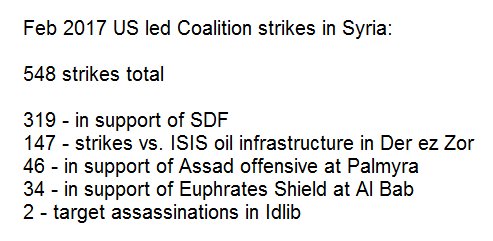
Then in recent months, under both the late Obama administration and Trump, this US role had become even clearer. From December, the US launched a more intense bombing campaign against Jabhat Fatah al-Sham in Idlib and western Aleppo, thus joining the Assadist and Russian slaughter from the skies in that region. Hundreds of JFS cadre were killed, and the bombings also hit other rebel groups at times. The US role alongside Assad, Russia and Iran in the latest reconquest of Palmyra was widely reported on. Calculating all US bombings in February from the US CentCom site (ie, the site of the US-led Coalition bombing Syria) shows that while 60 percent of US bombings were carried out in alliance with the Syrian Democratic Forces (SDF, mainly the Kurdish People’s Protection Units, YPG), most of the other 40 percent was in alliance with Assad in Deir Ezzor, Palmyra and Idlib, some 195 strikes of the 548 in total. And that was in a month when the bombing of Idlib was minimal, compared to January and March. Even in SDF-controlled Manbij, the US landed forces to patrol the region with Russian and Assad troops to block the Turkish-led FSA Euphrates Shield forces from advancing.

Despite countless assertions that Trump’s Syria policy was “unclear,” everything Trump has said was very clear: for many months, he insisted the US must ally with Russia and Assad to “fight ISIS,” as he believed Russia and Assad were doing; and that the US should cut off whatever remaining fragments of “aid” he believed were still going to some vetted Syrian rebels. Even Defence Secretary James Mattis, who many have mistakenly seen as more anti-Assad than Trump, has always opposed “no fly zone” plans, and announced several years ago that the time to support Syrian rebels fighting both Assad and ISIS “had passed,” ie, he agreed with the Obama-Kerry line that the US would only support rebels who fought ISIS and Nusra only, not the regime.

Then in the very days just before Assad’s monstrous chemical attack on Khan Sheikhoun, three prominent US leaders made Trump’s US policy even clearer, announcing that Assad should be allowed to stay. On March 23, US UN representative Nikki Haley announced that the US was “no longer” (sic) focused on removing Assad “the way the previous administration was”; the Russia-connected US Secretary of State, Rex Tillerson, used Assad’s very words on March 30, declaring that the “longer term status of president Assad will be decided by the Syrian people” – a would-be obvious statement, if one assumed Syrian people could hold a democratic election under a tyrannical dictatorship; and the foillowing day, White House spokesman Sean Spicer declared that “with respect to Assad, there is a political reality that we have to accept.” Of course this had long been unofficial US policy; and had even become partly official under Obama and Kerry when they agreed that Assad could continue to rule in an allegedly “transitional” regime following a political process. But the Trump team made this clear.

Then Assad goes and blows it by throwing sarin in their faces! The interesting issue is why Assad was stupid enough to do this, just days after he received so much explicit US support. Presumably, he was encouraged precisely by all this US verbal and actual military support, and so he decided to test the waters, to see if this meant that even sarin could now be re-normalised. But that just highlights the arrogance of power. The US was giving him everything; Obama’s “red line” against chemical weapons in 2013, and then his withdrawal from action, in the US-Russia-Israel deal that saw Assad’s chemical weapons removed, was saying to Assad you can use everything else except chemical weapons; and thus Assad did use everything else in the four years since, in unbelievable quantities, with complete US indifference, if not support. For Assad to then go and use the very weapons that the deal supposedly removed, and show off that he still has them, was simply impossible for the US to ignore in terms of its “credibility.” Assad was reading the messages correctly from this last week, that US leaders were encouraging him; he just read it wrongly that this could include sarin. Look at Nikki Haley, fuming in the UN; she had to fume, because three days earlier the same Nikki Haley had made the official announcement about Assad being good to continue ruling. Assad should have been more gracious about being kissed like that.

The US thus had no choice but to respond in some way for the sake of its alleged “credibility.” Many are claiming Trump is “taking advantage” of Assad’s action to launch a war, just because he likes war, to show what he is made of, to show that he did what Obama didn’t have the spine to do and so on, or alternatively that the strike aims to cover up Trump’s Russia connections that are under investigation at home, by showing he can stand up to the Russians, and so on. This is all a misunderstanding. Certainly, these may well be useful by-products of “taking action” for Trump. But they do not explain the action at all. No, Trump sent a bunch of missiles against the Assadist military facility responsible for the chemical attack, going against everything he wanted to do, and that his entire team wanted to do, as seen by their declarations in the very days beforehand, because Assad’s use of sarin had put US “credibility” at stake.

That is all from the point of view of US imperialism. But from the point of view of supporters of the Syrian revolution, and of liberation and humanity in general, can I ask in all honesty, what is the big deal? Why are 8000 strikes on opponents of Assad (and not only on ISIS), killing thousands of civilians, not “intervention,” yet when you finally get one strike against the biggest, most heavily armed and most highly dangerous terrorist group in Syria, the one currently occupying Damascus, after it slaughters dozens of children with chemical weapons, only that is considered “intervention,” that is supposedly something more significant, that is something we should protest. Really, what is the difference? Surely, if we oppose all US intervention on principle, then this particular bombing is nothing worse than all the other bombings against Anyone But Assad the last two and a half years; and if the left, on the whole, has not been actively demanding the end of US bombing of Syria – far from it – then surely we can say in as much as the US is already there, at least this particular bombing hit the most appropriate target to date.

Frankly, whoever has not been protesting the US bombing of Syria all along the last two and a half years, and who now suddenly protests this US “intervention” today, cannot in any sense be considered anti-war, or anti-imperialist, but simply an apologist for the Assad genocide-regime. As Joey Husseini Ayoub, who runs the excellent Hummus for Thought site, wrote, “For those who care, this is 7,899th US airstrikes in Syria since 2014. I don’t remember 7,898 waves of outrage or concern.”

And that is only noting the absence of protest against US bombings before this one. One might rightly criticise my post for focusing on these US crimes, terrible as they are, rather than the truly massive crimes against humanity that have been carried out by the Assadist regime, its airforce and torture chambers, and the Russian imperialist invader that backs it, the crimes that have left at least half a million dead and turned the entire country to rubble, even before this latest horrific atrocity. That is simply because I have been focusing on the issue of the inconsistency of those allegedly “opposing US imperialism,” indicating that this is entirely fake. But from the point of view of humanity, from the perspective of the part of the left that still believes in the politics of liberation, the malignancy of those “anti-imperialists” who only protest bombing now, but who have never protested the Assadist and Russian bombing, or in fact support this genocide, is far worse.

Meanwhile, while launching a singular “punishment” strike may have the potential to escalate beyond its purpose, this seems almost certainly not the intention of any wing of the Trump regime. As State Secretary Rex Tillerson explains, this punishment strike should not be confused with a US change of line on Syria:

“US Secretary of State Rex Tillerson said the attack showed the President “is willing to take decisive action when called for. ‘I would not in any way attempt to extrapolate that to a change in our policy or posture relative to our military activities in Syria today’, he said. ‘There has been no change in that status. I think it does demonstrate that President Trump is willing to act when governments and actors cross the line and cross the line on violating commitments they’ve made and cross the line in the most heinous of ways’.”

Brief comments on the Russia-Turkey colonialist “ceasefire”

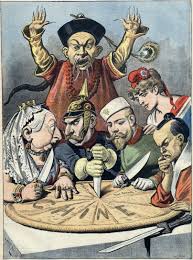
the-powers-carve-up-china
The colonialist Russia-Turkey imposed Syria “ceasefire” is a disaster, yet at the same time unavoidable at this point. A disaster because of the way that it came about (ie, via defeat, a ceasefire where the cards are stacked against the revolution side, no prisoner releases, no siege endings, expulsion from Aleppo, regime upper hand etc), and because it excludes war against Nusra, giving Assad, Russia and the US (and perhaps Turkey and the YPG) the excuse to make Idlib a legal Kill Zone without “violating the ceasefire.” Even outside of Idlib, does the “ceasefire” mean the regime will end its current savagery in Damascus suburbs? And indeed, we have already seen constant regime violations. Unavoidable because, given the relationship of forces on the ground, Turkey’s obvious betrayal, the Gulf’s complete lack of interest, the continued US-Jordan-imposed freezing of the southern front etc, we need a ceasefire, for the revolutionary forces, both civil and military, to regroup, for the people to breathe etc. I guess the civil movement needs to try to make the most of it while it lasts, as it did earlier this year, bring people into the streets, keep the end of Assad as the target, revive popular committees etc. However, if the regime uses it to continue to massacre in Idlib, East Ghouta etc, then what is the FSA to do? If it doesn’t fight back because the regime is (allegedly) “only bombing Nusra” which is outside the ceasefire, while in fact committing its usual massacre, then this will greatly boost Nusra vis a vis FSA – and, in a sense, rightly so. So the FSA is in a bind.
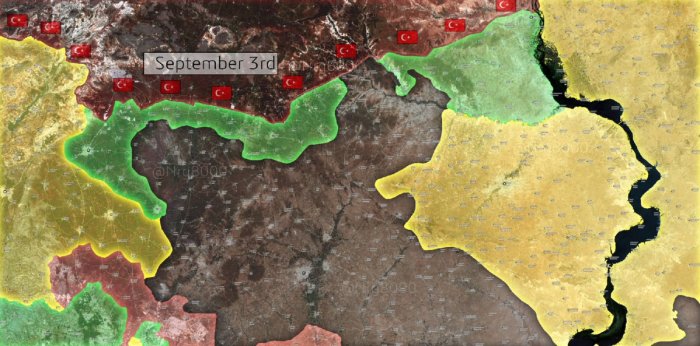
As for the media pointing out that the US is not part of the ceasefire agreement (only Russia, Turkey, Iran), this seems a moot point (apart from the fact that Putin has made clear the US will be brought into the process when his mate in ultra-right politics, Trump, is inaugurated), as the US is not a belligerent in the main part of the Syrian war. The US role has been to (1) bomb ISIS, (2) bomb Nusra, (3) bomb in favour of the YPG. But the ceasefire doesn’t involve any of these forces or conflicts. Clearly, the “ceasefire” is part of the colonial unofficial soft partition “solution” with Russia, Assad and Iran getting what they want of “useful” and western Syria, Turkey getting its own northern zone (filling it with right-wing Turkish nationalists who believe in Greater Turkey, want to expel Syrian refugees into the zone, but have no quarrel with Assad, while blocking (and not unjustly) the YPG’s irridentist “linking” project, the AKP’s change of policy represented by its current alliance with fascistic Grey Wolves and MHP). But the US has manoevured its way into 3 air bases in YPG-controlled territory, so the large Manbij to Hasake region is effectively a “US-backed” zone anyway; the zone controlled by the Southern Front in Daraa has been converted from a fighting front to a strip protecting the Jordanian border from Daesh; and the prizes are Raqqa and Deir Ezzor in the east: as the US has bombed on Assad’s side for 2 years against ISIS in Deir Ezzor, that will probably go to Assad. Not sure they’ve worked out Raqqa just yet, with so many contenders; for a while probably just another Kill Zone. I suspect the Saudis will want some kind of Sunni entity in the east to expel ISIS in exchange for accepting Assad’s “temporary” rule (according to the Russia-Turkey agreement) and being left out of the process.

Save Aleppo! Oh, hang on, Aleppo is not Kobani …

Please help the people of Aleppo, just like we helped the people of Kobani. Oh, hang on, Aleppo? Kobani? Oh, that’s right. In Kobani they were Kurds. Civilised, secular, “progressive”, feminists, even green warriors apparently. They were like “us.” “We” (western imperialists and western … “anti-imperialists”) understand them. Therefore, they deserved to be saved from ISIS beasts, said the imperialist leaders, and their “anti-imperialist” echo in unison. Aleppo? Facing a fascistic enemy that has massacred twenty times as many people as ISIS fascists could ever manage, is not full of Good Kurds. It is full of Arabs. And we all know what western imperialist leaders, the far-right, neo-Nazis, Trumpists, racists, and “left-wing anti-imperialists” think of Arabs, especially when they live in Syria. They are all backward, blood-thirsty, barbaric, “jihadis” and “head-choppers,” *all* of the above categories tell us, yes, the left-fascists just as emphatically as any of the others. So those men, women and children, schools, hospitals, markets, every sign of life, are not deserving like Good Kurds are. Indeed, the left-fascists are now all over social media, in unison with their far-right co-thinkers, expressing their great joy with the victory of the most violent, most mass-murderous counterrevolutionary massacre of our era, expressing how happy they are that a fascist regime with an airforce, backed by an imperialist state invading with its airforce, have together bombed a whole country to pieces for 5 years, but moreover have bombed 300,000 people cramped into east Aleppo for months with every conceivable weapon of mass destruction except nuclear, ripping children to pieces on a daily basis, destroying hospital after hospital till none left.

See, when US imperialism intervened in Syria with its airforce in September 2014, bombing ISIS away from Kobani, many “anti-imperialists” decided that just this time they were not opposed to imperialist intervention, because Kurds and especially the PKK are “Good”, and ISIS are Really Bad. And so even though US imperialism has gone well beyond the emergency of defending Kobani from being overrun by ISIS, and has continued to bomb Syria for over 2 years, bombing not only ISIS, but also Nusra, other (non-jihadist) Islamists, and even on occasion non-Islamist FSA fighters, that’s OK; even though every time the US airforce has fought ISIS on behalf of the Kurdish YPG, in full coordination, in full-scale cooperation, including with US special forces, and even US air-bases, that’s OK; even though, beyond the Kobani emergency, all the rest of the US/YPG war on ISIS-controlled territory has been offensive, not defensive, operations, and the US airforce has killed 850 “collateral damage” civilians in these operations, that’s OK say the “anti-imperialists,” because the one armed force the US has never attacked are the armed forces of the Assad fascist dictatorship. Yet, when Aleppo (and countless other towns before this) have been confronted with murderous sieges by an enemy far more murderous than ISIS, and the US has not ever even hinted at helping the people against Assad, the same “anti-imperialist left” that hails the YPG, and did not organise a single “anti-war” demonstration for two years as the US bombed Everyone But Assad, has the impossible gall to slander the heroic Syrian revolutionaries as … “US proxies.” And when Hilary Clinton meekly implied that she might be in favour of some kind of “no-fly zone” to prevent Assad’s airforce from bombing children to bits – not to bomb Assad on behalf of the rebels with the US airforce, to drive back Assad and help the rebels advance, as the US does for the YPG against ISIS, but rather to prevent an airforce from bombing – the “anti-imperialist left” decided that this meant Clinton would bring “World War III”, and so the KKK-loving Trump team were preferable because Trump openly declared his love for Putin and Assad.

Hypocrisy is nothing new historically from any quarter, of course. However, it is rather difficult for me to conceive a level of hypocrisy coming from “our” side – the left, those supposedly dedicated to human liberation – that comes close to this.

Now, before continuing, I can already hear many supporters of Rojava feel they are under attack here. So to clarify, this post is not directed at the Kurds in Syria (despite my political criticisms of the PYD leadership), and still less anyone in the western left who gives solidarity to all equally, those expressing solidarity to both Kurdish and Arab resistance to both Assad and ISIS. The post rather is about the gross Orientalism of parts of the pro-Rojava movement. Further, I am not at all suggesting support for the defence of Kobani was wrong. And for all the anti-imperialist-intervention principles that many of us grew up on, when the US intervention did finally take up the defence of Kobani (about a month into its bombing campaign, which I did oppose from the start – for the first month, the US bombed anywhere but Kobani, especially in Aleppo and Idlib where there was no ISIS), it never occurred to me to go out in the streets and demand “US out now” at that point! Yes Kobani was in danger of being overrun by ISIS maniacs who had just acquired a windfall of US advanced weaponry courtesy the US-Iranian regime in Iraq which handed them Mosul, and the YPG was squeezed into a corner. Like with the defence of East Timor in 1999, I very reluctantly understood that at this point, the US was doing something necessary. For its own reasons. Even though I regard the rest of the US intervention in Syria highly negatively. I am also deliberately making a distinction between the US/YPG defensive, emergency operation then and the more general offensive operations since because I frankly do not support permanent US intervention in Syria to help one side militarily, with all the “collateral damage” and more general political damage it causes (including to the Kurds), yet even then I certainly prefer the YPG/SDF to ISIS rule, whatever criticisms I have of the former. No, the post is about selective solidarity. About those saying ‘Yes to the defence of Kobani against ISIS, including even 2-year ongoing US air support to the YPG’, but ‘no to even a single US gun to help the people of Aleppo (and elsewhere) resist Assad’s bloody dictatorship, Russian imperialism and the global Shiite-jihadi invasion forces’. That hypocrisy has just turned genocidal.

While it may be true that Syria is “complicated”, and not everyone has the time or interest to study the most profound revolutionary upheaval of the 21st century (except a bit of it in “Rojava”, the bit allied to US imperialism to the hilt and also the bit never hit by Assad or Russia), nevertheless, mass murder is not “complicated.” Of course, many on the left are not in the category of the left-fascists, who are a breed of their own which are indistinguishable from their right-wing co-thinkers. Many are personally appalled, but seek to relativise the slaughter (isn’t Qatar also arming some rebels? Oh yeh, that’s why the rebels are SO able to protect themselves and the civilians from the 5-year aerial massacre), or satisfy themselves with the fact that they can do little about it since it is not their own government doing it. Apparently, that makes active solidarity a bad thing, in their view. Whatever. I don’t have a big beef with those genuinely appalled who are simply confused. What we need to stress however is this. Far too much of the western left have labelled themselves the “revolutionary” left, by which they mean that, unlike some other leftists, who they see as mere reformers, they are “the revolutionaries.” Well, revolution, as Grenada’s Maurice Bishop once said, is not like making a cup of instant coffee. In the real world, revolutions are extremely complicated and messy. People like those in Syria, living for decades under a totalitarian tyranny that brutally suppressed all opposition thought, do not emerge from this with fully developed “revolutionary” programs and “correct” ideas that those of us living our entire lives in the relative comfort of western cities may think are necessary. Yes, there is much we need to evaluate in terms of lessons of lost revolutions (if the crushing of Aleppo does end the revolutionary process, by no means a given). But that is entirely different to not knowing which side you are on. The fact is, much of the self-declared “revolutionary” left turned out to be only marginally better than the centrist/Stalinist/”mainstream”/pacifist/”anti”-war left, who were the most resolutely counterrevolutionary. That is, confronted by an actual people’s revolutionary uprising, warts and all, they decided either to support bloody counterrevolution or to declare a plague on both your houses or to use the same racist discourse about “jihadis” and “liver-eaters” etc or one way or another simply had no idea what to do or what to say.

So, while many of these people and groups indeed do an enormous amount of highly dedicated great work around concrete *reforms* in their own countries (eg, they campaign to defend refugees – even Syrian refugees from Assad’s holocaust, ironically enough – among many other valuable campaigns), a very good thing, how about we drop the BS about being the “revolutionary” left? No great harm in being honest. In Australia, two far-left socialist organisations, Socialist Alternative and Solidarity, have distinguished themselves with their unstinting support for the Syrian people’s revolution, to the bloody end, and the same is true of countless other left and socialist organisations around the world, mostly also parts of the far-left alongside many individuals from among the more honest sections of the reformist left. Although I am a member of neither, I am proud to be associated with these comrades.

Turkey, Rebels, Kurds & Assad in northern Syria: Contradictions in moves towards regional counterrevolutionary alliance

Two linking operations in northern Syria
Two rival linking plans at expense of Daesh (Grey area on map) in northern Syria: Green – FSA/rebels, Yellow – YPG/SDF. Pink area underneath controlled by Assad regime. At time of writing, the distance between rebel-controlled territory beyond the towns of al-Rai and Jarabulus was only 10 km, as shown on map. Since then, they have fully linked and Daesh expelled from the border.

By Michael Karadjis

(An abridged version of this article appeared in ‘The New Arab’ under the title ‘Tensions tried and loyalties tested in northern Syria’, at https://www.alaraby.co.uk/english/comment/2016/9/2/tensions-tried-and-loyalties-tested-in-northern-syria).

One week the United States rushed to the defence of its Kurdish allies, People’s Protection Units (YPG), when the Assad regime bombed them in Hasake; the following week many pro-YPG voices were accusing the same US of betrayal, for supporting Turkey’s intervention into Syria, with up to 5000 Free Syrian Army (FSA) troops, to expel ISIS from the border town of Jarabulus.

However, fickleness would not be a useful explanation of US behaviour. Rather, both events suggest that the outlines of a regional understanding on a reactionary solution to the Syrian crisis may be in the making. If this sounds conspiratorial, let me stress at the outset that none of it is set in concrete, much could change, and many of the players may be only half-pleased; nevertheless, the fact that states that appear at odds with each other conduct behind-the-scenes negotiations is hardly a huge revelation.

And above all, it is always important to keep in mind that when capitalist states half-back revolutions for their own geopolitical or other reasons, the aim is some kind of pressure or manoeuvre; it has always been the ultimate aim of all regional and global powers for the magnificent people’s uprising in Syria to be defeated, one way or another, even if via different routes.

Turkey: the AKP’s diplomatic back-flips

Some of this relates to the recent diplomatic back-flips of the Turkish government of Tayyip Erdogan and his ruling Justice and Development Party (AKP), a decisive supporter of the Syrian rebels. This includes Turkey’s widely publicised reconciliation with Russia and Israel (who themselves have been forming a very close alliance over the last year, with countless high-level visits between Putin and Netanyahu); the further strengthening of its relations with Iran (which have always remained strong despite backing opposite sides in Syria); and the declaration by prime minister Binali Yildarim (who recently replaced Ahmet Davutoglu) that Turkey is no longer opposed to a role for Assad in a “transitional” government consisting of elements of the regime and opposition, a position bringing Turkey into line with the position of the United States and in conflict with that of the Syrian opposition. Yildarim also recently stated that Turkey’s ties to Syria will “return to normal.”

US imposes first No Fly Zone in Syria: To defend Rojava

As is widely known, the YPG – connected to the Democratic Union Party (PYD) – and the Assad regime have had a long-term, pragmatic non-aggression pact, which sometimes breaks into minor conflict, and at other times leads to collaboration – including aiding in the recent siege of rebel Aleppo.

However, the ferocity of the latest clash in Hasaka was new; this was the first time Assad launched his airforce against the YPG; the airforce is normally dedicated to slaughtering the civilian population of rebel-held areas.

This may have been a message from Assad to Turkey, a response to Turkey’s own feelers. A senior AKP official recently noted that while Assad is a killer, “he does not support Kurdish autonomy … we’re backing the same policy.” This is true; despite YPG pragmatism, Assad has forcefully rejected Kurdish autonomy. And given the current rise in the Kurdish struggle in Iran, the prominent Turkish-Iranian meetings are most certainly anti-Kurdish in content; Iran may be acting as a link between Erdogan and Assad.

Both Russia and the US have been key backers of the YPG. From the outset of the Russian invasion last September, the PYD/YPG declared in favour of Russia bombing “jihadists” (even though in practice it mostly bombed mainstream rebels and very rarely ISIS). In return, Russian air strikes were employed to aid the Afrin YPG against the rebels in February, helping it seize a number of rebel-held, Arab-majority towns in northern Aleppo, including Tal Rifaat, an iconic centre of resistance to both Assad and ISIS. But Putin’s high-level reconciliation with Erdogan, while being Assad’s main backer even as he attacks the YPG, suggests Russia has dropped the YPG like a hot potato.

The US alliance with the YPG, however, is far more fundamental. The US has been the permanent air force for all anti-ISIS operations led by the YPG, and the Syrian Democratic Forces (SDF) alliance it leads which includes small non-Kurdish components, for two years now. The US has also fielded “special forces” to work with the YPG, and has set up its first military base in Syria in the eastern part of Rojava.

With so much invested in its SDF alliance, the US imposed its first No Fly Zone (NFZ) in Syria, over eastern Rojava. After Syrian SU-24 attack planes bombed the area on August 18, Pentagon spokesman Captain Jeff Davis warned that regime aircraft “would be well-advised not to do things that place them at risk,” as US warplanes intercepted regime jets. US Coalition aircraft confronted regime warplanes again the next day, which “encouraged” them “to depart the airspace without further incident,” Davis said.

As an aside, the ease with which the US effected this NFZ belies all the talk about an NFZ to protect civilians from Assad’s genocidal bombing leading to WWIII. Of course, most of the world won’t notice the imposition of this NFZ, as long as it is imposed by the US to protect US forces, or the YPG; it will certainly not be seen as any kind of “US intervention” by the western “anti-war movement,” any more than two years of bombing , with hundreds of civilian casualties, has been seen as such; a huge uproar against “US intervention” will only occur if the US, in some parallel universe, uses the forces already intervening in Syria to protect hospitals and schools from being blasted to bits in rebel-controlled areas.

But then again, the irrelevance of the dinosaur which calls itself an “anti-war movement” even while, in large part, shilling for one of the most brutal wars on civilians in modern history, is hardly new information. Its irrelevance to world politics today is richly deserved indeed.

Beyond ‘New Cold War’ nonsense: Regional alliance for counterrevolution

Recent discussion of an alleged “Russia-Turkey-Iran” understanding on Syria usually claims that Erdogan’s new tilt to Moscow was caused by the reticent support the US gave to Turkey’s government against the recent coup attempt, the US refusal to hand over Gulen, who Turkey blames for the coup, and the large-scale support the US gave the YPG/SDF in helping them expel ISIS from Manbij in northern Syria, not far south of the Turkish border.

However, the discourse that Turkey was thereby “moving towards Russia and away from the US on Syria” is based on the idea that the “Cold War” still exists. In Syria at least, the US and Russia see the Syrian conflict “fundamentally very similarly” as US Secretary of State John Kerry has made clear. While this does not exclude minor rivalry or tactical differences, in reality Turkey’s new position that Assad can remain “temporarily” means that Turkey has now reached the US position via coming half-way towards the Russian position.

This “Cold War” discourse fails to explain the prominent US-Russian negotiations to engage in joint bombing of Jabhat al-Nusra, which would almost inevitably mean bombing non-Nusra rebels as well, given the actual geography of the uprising. Indeed, there were even reports of the US-led Coalition bombing rebels in Aleppo during the recent siege.

In fact, the “Russia-Turkey-Iran” understanding is better seen as a “Russia-Turkey-Iran-US-Assad” understanding, with, of course, points of difference.

Part of this understanding is anti-Kurdish, though, as we saw in Hasake, this will be only partial in the US case, especially as it still wants to use the YPG for the potentially suicidal task of taking on ISIS in its capital Raqqa, due south of Kobani.

Another part of this understanding is anti-rebel, but this is only partial in Turkey’s case. Turkey allowed arms to flow to the rebels as they fought to successfully break Assad’s recent total siege of 300,000 people in Aleppo, which if unbroken would have led to catastrophe. This aspect does not entail aiding the regime in the impossible task of totally crushing the rebels, but rather in restricting them to current areas, forcing them to stop fighting the regime while using them only to fight ISIS or even Nusra, and pushing them into a deal with the regime that includes Assad “temporarily.”

This was the model the US has enforced on the politically moderate, but militarily tenacious, FSA Southern Front. The US held it back from advancing towards Damascus, thereby helping the regime force the surrender of the revolutionary town of Darraya. Thus, while outside the scope of this article, the surrender and ethnic cleansing of Darraya, and now a number of other small revolutionary centres, appears to be part of this same counterrevolutionary “tidying up” process.

The Turkish intervention in Jarabulus: Between liberation and slaughter

It was in this context that the US – while guaranteeing for now YPD-SDF rule over the territory it controls east of the Euphrates River (ie, from Kobani through to Hasake and Qamishle) – sought to “balance” between its Turkish and SDF allies by providing air support to Turkey’s direct intervention into Syria, along with 5000 FSA fighters from the Azaz-Mare and Idlib regions, to evict ISIS from the border town of Jarabulus.

The Turkish regime, of course, has its own aims in this operation, which may coincide at times with, but are distinct from, the aims of the Syrian rebels. And there are indications that FSA fighters are not unaware of the dangers of being entrapped by interests different to their own. However, it must be emphasised that these north Aleppo-based rebels, who have fought ISIS for years, acted in their own interests in liberating the Arab-majority town of Jarabulus.

Squeezed into the Azaz-Mare pocket in northern Aleppo since the Russian-Assad-YPG offensive in February which cut them off from Aleppo city, these rebels needed to expand their area of operation. Unnoticed by the world, they had just liberated – largely on their own – the important town of al-Rai on the Turkish border the previous week, in an offensive from Azaz eastward. By now seizing Jarabulus, they aim to link back to al-Rai and thereby Azaz, gaining full control of this section of the border from ISIS.

In both Manbij and Jarablus, video evidence showed the populations were relieved to be rid of ISIS tyranny (and in Manbij, of US bombing which had claimed hundreds of lives), despite the two different liberators.

Turkey has long said it would not allow the YPG to move west of the Euphrates river. To the east of the Euphrates is the iconic Kurdish town Kobani, which resisted a furious ISIS siege in late 2014, and the PYD/YPG/SDF controls the entire Turkish border from there to Hasake and Qamishle in the northeast (ie, the Kobani and Jazirah cantons of ‘Rojava’). Kobani itself, and much of the Hasake-Qamishle region, is majority Kurdish, and the Kurds have exercised their rightful autonomous rule there for a number of years, carrying out their own revolutionary process.

However, the Tal Abyad region in between Kobani and Hasake, which the SDF and US airforce liberated from ISIS in 2015, is majority-Arab; the defection just days ago  of the main Tal Abyad-based FSA component  of that operation, Liwa al-Tahrir, from the SDF, suggests the driving back of ISIS may reduce the need of FSA-connected rebels east of the Euphrates to remain under YPG domination.

The Arab-majority town of Jarabulus is opposite Kobani on the west side of the Euphrates. Arab-majority Manbij is also west of the Euphrates, but not on the border; several months ago Turkey accepted the large-scale US air support to the YPG/SDF offensive to expel ISIS from Manbij, on the condition that the YPG then returned east once Manbij was secured. This was understood to mean leaving Manbij to the Arab, non-YPG components of the SDF, in particular, to the ‘Manbij Military Council’.

After liberating Manbij, SDF forces called the ‘Jarabulus Military Council’ moved north and seized a number of villages from ISIS, with the ultimate aim of taking Jarabulus. Turkish and FSA troops pre-empted this, however, by seizing Jarabulus first. As a strategic Arab-majority border town, the fact that the FSA received direct support from Turkey in expelling ISIS is no different fundamentally to the SDF receiving direct support from the US in expelling ISIS from Manbij.

However, what happened next was much more concerning. While information is scarce on the ethnic composition of these small villages south of Jarabulus, and of the local people’s relationship to the SDF liberators, these are issues that need to be worked out by local Syrian forces – the FSA and the SDF – on their own, without the Turkish military playing a role. However, when the FSA began fighting these SDF forces south of Jarabulus, Turkey took a direct role. This almost immediately degenerated further, as the Turkish airforce began bombing these SDF-held villages, leading, as may be expected, to war crimes, such as the slaughter of 28 civilians in Amarinah on August 27.

It is crimes such as these that further drive wedges between Arabic and Kurdish civilians, and between liberation movements among both peoples, just as the far larger-scale YPG collaboration with the Russian Luftwaffe in February, in seizing non-Kurdish territory from the rebels, had already done. While the current clashes are not on that order, any participation by the Syrian rebels in a possible Turkish drive to seize Manbij would certainly reach the heights of the Tal Rifaat disaster (though the US appears to also oppose such a move).

Turkey claims it is fighting YPG fighters, who haven’t gone east; Kurdish leaders such as PYD official Nawaf Xelil have publicly agreed that moving east was the understanding, and claim they have done so, so Turkey is fighting the local SDF; whereas others have charged the US with “betrayal,” and YPG spokesman Redur Xelil rejected the demand to move east and denied leaving Manbij. Meanwhile US Vice president Biden, on a state visit to Turkey at the time, sought to please his Turkish hosts, warning the YPG that it would lose US support if it stayed west of the Euphrates.

Some of this appears to be sabre-rattling, for public consumption, or to test the waters; both Turkey and the PYD have ambitions beyond the agreed-upon terms. Turkish leaders talk about clearing “all terrorists” – ISIS and YPG – from the region, and many critics of the Turkish operation claim that Turkey’s real aim is to destroy ‘Rojava’. Any Turkish adventure to attack actual ‘Rojava’ – ie, the SDF-run, Kurdish-majority regions east of the Euphrates – should indeed be condemned, but is unlikely to occur on any scale (despite some border clashes around Kobani) because it will be strongly opposed by the US.

Indeed, as the SDF was pushed south of the Sajoor river separating the Jarablus and Manbij regions, Pentagon spokespeople demanded the fighting stop, calling it “unacceptable,” called on Turkey to focus on ISIS, and stressed their continued support for the SDF.

This re-focus appears to have occurred; on September 3, more Turkish tanks crossed over in to al-Rai, to aid the rebels who have captured about a dozen more villages from ISIS in the region, hoping to close the gap with Jarabulus. [And since the time of writing, Turkey and the FSA have linked al-Rai to Jarabulus and completely expelled ISIS from the border, an unquestionably positive thing].

The YPG’s plans to “link” to Afrin: A catastrophe well-avoided

The SDF had already alienated rebel supporters with its unilateral imposition of its system in Manbij, by scrapping the popularly-elected Manbij council which governed the city before ISIS seized Manbij in 2014. As reporter Haid Haid explains:, quoting Hassan Hamidi, an activist from Manbij:

“We really appreciate everything the SDF fighters did in order to push ISIS out of Manbij. But it seems that we are moving from one dictator to another. Manbij’s local council, which was elected to run the city, was uprooted by ISIS before and now it is dissolved by the SDF.”

Haid also quotes  Mustafa al-Nifi, a local resident from Manbij:

“We were really hoping that the SDF would be able to share power with locals and allow them to govern themselves. However, it seems that it was a trick. Everything has been planned long in advance. They appointed people, who we do not know, to run the city. They also gave Manij a Kurdish name, which is ‘Mabuk’, and imposed a federal system on us. There is nothing left for us to decide.”

Haid notes that the PYD denies such accusations. “We are not imposing anything on anyone. We created a new local council and appointed people to run it temporarily, as it is difficult to organize elections in Manbij now,” said Kadar Biri, a member of the PYD party from Afrin. However, according to Haid, “although the creation of a local council was a positive step, imposing membership of the PYD’s choosing without coordinating with local notables, activists and members of the previous council has sent the wrong signals about the PYD’s commitment to inclusiveness and power-sharing with non-Kurdish communities in northern Syria.”

Further, according to leading spokesman on Kurdish issues, who is close to the PYD, Mutlu Civiroglu, the primary aim after taking Manbij was to “link” up with Kurdish Afrin in northwest Syria, by seizing the region in between (the PYD has been openly stating this was their goal for some time, eg, PYD co-chair Salih Muslim on July 3, PYD senior official Polat Can  some months earlier). Indeed, some of the talk of US “betrayal” is simply sour grapes that Turkey’s intervention has blocked this “linking” project; and many of the assertions that Turkey is “destroying Rojava” or denying the right of “the Kurds” to have their united autonomous region are based on the disruption of this link.

However, most of the border region from Jarabulus to Azaz is ethnically non-Kurdish, mostly Arab and Turkmen, and the claim that the entire north is all ‘Rojava’ appears to be based on nothing more than the fact that the PYD has declared it to be so. In fact, the area unilaterally claimed as the ‘Rojava/North Syria Federation’ is triple the size of Kurdish majority regions, and double the size of the areas even where Kurds exist as minorities. This region has no ethnic, historic, geographic or cultural validity as a separate region.

To conquer these thousands of square kilometres of ethnically mixed, largely non-Kurdish, territory would be impossible without the support of either US or Russian air power. Both have decided, wisely, to avoid this, and there is zero validity in complaints about such an adventurous scheme not being supported. Indeed, if either imperialist power were to force through such an operation, it would lead to catastrophic loss of life, and an enormous new refugee outflux.

While Turkey’s own aims in preventing such a unified PYD-run state are of course anti-Kurdish and connected to its brutal war against its own Kurdish minority in southeast Turkey, it also just happens to coincide with the justifiable desire of the largely Arab and Turkmen rebels to liberate areas which are their natural support base.

On the other hand, the situation is not without its dangers. There are Kurdish minorities in this mixed region, in particular in some rural areas further away from the Turkish border strip (see the demographic map linked to above). If Turkey does not rapidly withdraw, or if the FSA fighters become too closely connected to the intervening Turkish forces, they could risk being drawn into conflict with their Kurdish brethren at the behest of an outside power.

US, Russia, Iran, Assad: Why it became OK, for now, to allow an FSA operation  

Like the US, both Russia and Iran appear to have greenlighted the Jarabulus operation. While Russia has merely expressed “concern,” Iran initially remained “conspicuously silent,” while later suggesting that Turkey needs to move more quickly to complete its “anti-terrorist” actions in order to withdraw. Iranian sources have claimed that Turkey and Assad are coordinating through Iran.

While the Assad regime formally denounced a violation of its alleged “sovereignty,” Turkey claims to have informed it beforehand, with the deputy prime minister noting that “we believe Damascus is also bothered by what was happening in and around Manbij. They recently hit PYD targets.” Yildarim also suggested that Damascus understands that the PYD “has started to become a threat.” In the midst of the Jarabulus operation, Yildarim declared on September 2  “We have normalised our relations with Russia and Israel. Now, God willing, Turkey has taken a serious initiative to normalise relations with Egypt and Syria.”

However, the implication here that Assad may be secretly approving the Turkish operation, due to joint hostility to a Kurdish entity, has some holes in it. Most obviously, the fact that Turkey is working with the FSA, who are the very forces trying to overthrow his regime, regardless of his opposition to Kurdish autonomy.

Furthermore, the US support for this operation also comes with a question mark (and not only because Turkey apparently acted unilaterally at the last moment and upstaged US plans to exercise more control over the operation). To date, the central condition for US support to any rebels to fight ISIS has been the demand that they drop the fight against Assad – this was the case both with the ill-fated Division 30 in the north (indeed, the reason its numbers were so pathetically tiny), and the New Syrian Army in the southeast; while of course the SDF, the US’ favoured anti-ISIS force, mostly doesn’t fight Assad by definition. By contrast, while the Azaz-Mare-Tal Rifaat rebels have confronted ISIS in that region for years, they have never before received any substantial US support against ISIS (in fact, they normally get bombed by Assad whenever they fight ISIS in northern Aleppo).

Thus Erdogan’s push for a “safe zone” in northern Syria last year met out-of-hand US rejection, because the Syrian rebel groups who Erdogan wanted to let control it would have used it as a base to fight the regime. US State Department spokesman Mark Toner stressed “we’ve been pretty clear from the podium and elsewhere saying there’s no zone, no safe haven, we’re not talking about that here,” insisting it could only support an “ISIS-free zone” but not any kind of safe zone and certainly not one patrolled by the rebels.

But something important changed in February this year. By bombing the YPG/SDF into Tal Rifaat and other Arab-populated northern Aleppo regions, Russia cut the rebels in the Azaz-Mare pocket off from Aleppo city and thus effectively cut them off from the front against Assad. So now even though they want to fight Assad, and hardly any have made the pledge to drop that fight, effectively they can’t. So backing them to take over the Jarabulus-Azaz border strip became “safe” from the American point of view – and safer than previously from Assad’s view as well. How ironic that it was the YPG’s own eviction of the rebels in Tal Rifaat that has enabled US support for the Turkish operation that has blocked the YPG’s “linking” scheme!

Then there is a final reason why Assad may be grudgingly approving of Turkey launching an FSA-led operation against ISIS in the north: aside from the fighters from Azaz-Mare, the operation has also meant fighters from Idlib moving to a distant theatre rather than the key battleground of southern Aleppo. By early September, in the midst of the northern operation, the regime began a new determined attempt to re-impose the total siege that was broken several weeks ago in the truly magnificent operation by some 30 rebel groups working together [Update: since the time of writing, the full encirclement has been re-imposed]. This again raises theory popular among some pro-revolution circles: Assad allows Turkey to stop YPG in return for Turkey abandoning Aleppo rebels to Assad. Conspiracy theory? Perhaps. But not out of the question. And if true, catastrophic in its implications.

Changes in internal Turkish politics in relation to the safe zone

Turkey is overwhelmed by some 3 million Syrian refugees; the basis for much of the AKP’s opposition to Assad has been the need to remove the source of this massive instability, alongside the solidarity felt by much of the AKP’s moderate-‘Islamist’ base with these Syrian Arab refugees and their struggle – the same base which propelled the AKP to break Turkey’s decades of alliance with Israel and take up a pro-Palestine position. Ironically given the resurgence of the Kurdish war since 2015, this same moderate ‘Islamism’ had allowed the AKP to reach out to the Kurds in a way that the Kemalist Turkish-nationalist regimes had not done in 80 years, instituting important language and cultural reforms for the Kurdish minority and beginning a ‘peace process’ involving the PKK. Palestinians, Syrian Arab refugees and Kurds were all ‘Muslims’ after all, during the decade in which ‘Islam’ was temporarily elevated above ‘Turkishness’ as part of carrying out important changes in capitalist class rule in Turkey.

Erdogan’s regime needed to consolidate the new position in the state of the traditionalist Anatolian bourgeoisie that the AKP represented, after decades of playing second-fiddle to the big ‘secular’ Kemalist bourgeoisie. But once this new unwritten power-sharing arrangement was complete, the reconstitution of the Kemalist regime, albeit with slightly more ‘Islamist’ coloration, was on the order of the day. The contention that Erdogan’s increasingly repressive moves, since re-launching the war against the PKK and the Kurds in mid-2015, is part of setting up an ‘Islamic state’ is wide of the mark, and the contention that it is related to a new ‘Ottoman Empire’ is just Orientalism. The Kemalist Turkish national state is the vehicle through which the Turkish bourgeoisie rules.

In this context, Turkey can have its “safe zone” in northern Syria, that both prevents ‘Rojava’ from linking right across its southern border, and also allows a space for Turkey to transfer a section of its massive Syrian refugee population back into Syria. Indeed, Turkey aims to build whole “refugee cities” in the safe zone. Both aims allow for Erdogan to strengthen his new alliance with the opposition moderate (CHP) and right-wing (MHP) Turkish nationalists, both of whom despise Syrian refugees as much as they are hostile to the Kurdish struggle, and who have opposed Erdogan’s Syria policy from a pro-Assad angleboth support the current operation, as they can drive out refugees without the same “danger” of supporting the struggle against Assad as last year’s proposed zone entailed.

Yildarim’s statements on reconciliation with Syria since he replaced Davutoglu correspond closely with this general direction, as do Turkey’s increasing restrictions on the entry of Syrian refugees, which has led to a number of previously unthinkable brutal killings by Turkish border guards this year, and even the building of border walls.

Moreover, the strong ethnic Turkmen presence in this region also allows Turkey to attempt to control the safe zone via proxy ‘national’ forces, which gives Turkish nationalists an extra reason for intervening in this particular region. The relatively recent appearance of occasional pro-MHP fighters in Turkmen regions is connected to this new focus, following years of MHP opposition to the AKP’s anti-Assad policy.

Which rebel brigades are involved in the operation?

However, it remains a big question whether or not this will succeed. While the general analysis here indicates that the Assad regime may be, behind the scenes, generally part of this new consensus, this is only grudging, and Assad would also have reason to be nervous. Even if the analysis is correct that Turkey aims to hold the rebels in check within this zone, there is no guarantee that it will be able to control the significant rebel coalition now in operation in the region. The big majority of the FSA and rebel forces involved are neither ethnically Turkmen forces, nor specifically proxy forces in any other way. Most are genuine representatives of the Syrian revolutionary forces in the region. According to Charles Lister, who is someone who certainly knows what he is talking about, the groups involved in this Jarablus operation are:

  • Sultan Murad (ethnic Turkmen FSA brigade, now thought to be heavily infiltrated by Turkish nationalists)
  • Faylaq al-Sham (MB-aligned, very moderate; in Idlib it had been a member of the Jaysh al-Fatah coalition, but split away rejecting Nusra’s heavy influence in it)
  • Jabhat al-Shamiya (the ‘Levant Front’, a very moderate-Islamist coalition, which generally takes the FSA label, includes many former fighters from Liwa al-Tawhid, Jaysh al-Mujahideen etc; those who think there can only be moderate Christians but certainly not Muslims could look at this video made by them)
  • Nour al-Din al-Zinki (independent soft-Islamist, though recently roguish behaviour seems to have increased)
  • FSA 13th Division (who have led the multi-month fight against Nusra in Idlib that erupted during the mass demonstrations during the ceasefire earlier this year)
  • Suqor al-Jebel (FSA brigade from Idlib, formerly part of Syrian Revolutionaries Front, then the 5th Brigade)
  • Jaish al-Tahrir (ie, just defected from SDF, FSA from Tel Abyad)
  • Hamza Division (FSA coalition of 5 groups, set up in Mare to fight ISIS)
  • Jaish al-Nasr (FSA coalition of 16 groups, mostly in Hama and Idlib)
  • Mutassim Brigade (well-armed by US, includes some of the former Division 30 fighters who the US armed to fight ISIS only; this appears to be the only of these FSA brigades known to have accepted this US diktat to drop the fight against Assad)
  • Ahrar Tel Rifaat (ie, FSA fighters expelled by the Russian-YPG conquest of Tal Rifaat in February)
  • Liwa al-Fateh (Islamist, formerly part of Liwa al-Tawhid)

Meanwhile, the latest news is that they have now been joined by fighters from:

  • Jabhat al-Haq
  • Syrian Revolutionaries Front
  • Harakat Hazm

These last two were large FSA coalitions destroyed by Nusra in Idlib and Aleppo in late 2014-early 2015, some of whose commanders then took refuge in Turkey.

By no means can this collection be brushed aside as a “Turkish proxy force” (and as an aside, the commonly stated claim that Turkey backs Nusra is shown as obvious nonsense by the composition of this list). The very different reactions to Turkey’s intervention from revolution supporters reflect the fact that the final outcome will depend on the relationship of forces on the ground, regardless of varying motivations; the situation is fluid and contradictory.

Al-Bab

Even the fact that they are unable to fight Assad due to being cut off, as explained above, is a factor that can change. In particular, the fate of the very next big prize in the region – al-Bab, which is the last ISIS-controlled town in eastern Aleppo, away from the border, south of rebel-controlled al-Rai, west of SDF-controlled Manbij – is of critical importance. Both the rebel coalition and the SDF have indicated it is their next target; ISIS may try to hold onto it; and the regime may also try to take it, being just north of regime-controlled Aleppo. A catastrophic four-way contest is not out of the question.

Al-Bab’s fate probably depends on who the US and Russia will allow or facilitate to take it. Keeping the Turkish-backed rebels and the regime apart, which this analysis suggests is the plan, would require either ISIS remaining, or the SDF being allowed to take it, and thus establishing their “link” via occupied Tal Rifaat, but not on the Turkish border. But the momentum set in motion by Turkey’s action may make that unfeasible; and even if an ‘Assad-Erdogan Aleppo for Kurds’ deal is behind the events, it may not be easy for Turkey to hold back rebels who would be even more determined to take al-Bab, to pressure the regime from behind, if Assad’s full encirclement of Aleppo is re-imposed.

Conclusion: Necessity of people’s unity beyond ethnicity and sect

Of course, this is all very volatile, because no side comes out fully happy. But my conclusion remains that Turkey wants to cut an anti-Kurdish deal with Assad and Iran, with Russian backing, to include a Turkish-influenced ‘slice’ of the north; the US is in on it partly but won’t completely abandon the YPG, as long as it knows who is boss; and Turkey on its side won’t completely abandon the rebels, again, as long as they know who is boss.

The conflicts between Arab and Kurdish rebels, or between the FSA and its allies, and the YPG and its allies, and their pragmatic foreign connections, may not be responsible for this unwritten new reactionary alliance, but they most certainly facilitate it. Neither side is innocent in this regard – a long story in itself – but as a general statement, the current state of affairs underlines the necessity of finding a more cooperative relationship between forces fighting for liberation on the ground, of a more serious drive on all sides for Arab-Kurdish, and non-sectarian, unity in the struggle against tyranny and oppression in Syria.


Downing warplanes, Orwell and “US-backed” rebels

Russian helicopter on humanitarian mission
The Russian helicopter shot down by rebels on August 1, showing the “humanitarian” cargo Russia claimed it was carrying.

Originally published in The New Arab with the title ‘Anti-aircraft missiles could be a game-changer in Syria’: https://www.alaraby.co.uk/english/comment/2016/8/9/anti-aircraft-missiles-could-be-a-game-changer-in-syria

Comment: Syrian rebels are frequently portrayed as US-armed western stooges. The truth couldn’t be more different, as Washington denies opposition fighters the weapons needed to protect lives, writes Michael Karadjis

On August 1, Syrian rebels shot down a Russian armoured assault helicopter in Idlib which was returning from neighbouring Aleppo, where Russian and Syrian regime aircraft have been waging a merciless aerial massacre.

The ongoing slaughter in Aleppo, Idlib, Daraya and elsewhere highlights the rebels’ dire need for anti-aircraft weaponry. However, the United States has vigorously enforced an embargo against the rebels receiving these crucial weapons throughout the war.

While rebel downings of air-war vehicles have thus been few and far between, this latest hit followed the downing of some half a dozen warplanes or helicopters around Damascus in June and July.

A handful of Russian-made SA-8 anti-aircraft missiles, which were used in these hits, were captured by the rebels from the regime back in 2012. As they were few, they are used sparingly, and it took them years to make them functional.

Likewise, most weaponry in the hands of the Free Syrian Army (FSA) has been gained by capture or made in back-yards. As one (more honestly titled) article put it: ‘Syria’s ‘Western-Backed’ Rebels? Not in Weapons’.

The routine use of the adjective “US-backed” for non-jihadist rebels – a grossly Orwellian piece of media-speak – greatly obfuscates the real US connection to the indigenous mass uprising against the Assad dictatorship.

By mid-2012, a flow of weapons from former Libyan rebels began to reach Syrian rebels via Turkey. Later that year the US began its first major intervention in Syria, positioning CIA agents in Turkey to restrict the quality, quantity and destination of these arms.

While warplanes and helicopters had replaced tanks as the main form of regime slaughter by mid-2012, this US embargo blocked not only anti-aircraft but also anti-tank weaponry. Thus only small arms and ammunition were allowed, in the face of a massively armed regime continually supplied by Russia and Iran.

Such weapons were barely enough for survival, but this was no oversight; despite calling on Assad to “step down,” the US government made clear that the aim was precisely to bolster the regime as a whole. Therefore, these arms were not even remotely intended to be of the quantity or quality necessary to aid a rebel victory, but more to the point, they were not even aimed at enhancing tactical rebel victories on the ground. In fact, not even creating a permanent ‘balance’ with the regime, so that “no-one wins”, was the aim, despite this being a common claim; even an objective as limited as that would have required a more consistent amount of better weaponry, given what the regime possesses.

No, allowing for the bare survival of the rebels was the US (and western) aim: western policy-makers knew if the rebels were totally crushed, this would bolster Sunni jihadist forces as the only opposition to which the dispossessed Sunni majority could gravitate; whereas if they survived but were weakened, the moderate opposition leaderships could hopefully be pressured into accepting a role within a “reformed” regime, which would then wage war on the jihadists – and anyone else still resisting, who would be labelled “terrorists.”

This ‘Yemeni solution’ has been US policy all along, from Geneva I and II through the current round in close cooperation with Russia. In its latest edition, even Assad himself could remain as head of an “transitional” government.

Thus while the US itself restricted its own support to non-lethal aid, the only arms it would allow regional states to send the rebels were those of the quality they already had. This could allow the US to attempt to contain and co-opt the uprising, while leading to no “danger” of strengthening them.

When the US did start supplying some “vetted” rebels with light arms in late 2013, the fact that the aim was bare survival plus co-optation is exemplified by reports of rebels getting supplied 16 bullets a month. As for the CIA training program that went with this, many rebels – who already knew how to fight – felt the main American interest was surveillance.

Why then did the US lift its embargo on anti-tank weapons in 2014? Of course, to do this two years after tanks had been superseded by aircraft as the main killer was far too late; nevertheless, ground warfare still plays a crucially important role.

The first reports of US-made TOW anti-tank guided missiles (ATGM’s) supplied to the FSA group Harakat Hazm emerged in April 2014. They were mainly supplied by Saudi Arabia from its stocks, but it is believed that the Saudis need US permission to supply US weapons, though this may often be a tussle between the two.

US pressure is clear: only “vetted” groups get TOWs, sometimes only 3-4 at a time, they have to apply for them for specific operations, they have to return the shells to make a claim for more, which may or may not be approved. Even favoured groups soon found supplies dwindling, and the program had greatly diminished by late 2014.

However, after Russia invaded in October 2015, Saudi Arabia sent some 500 Tows to Syria, which led to the famous “tank massacre.” The furious Saudis had promised a swift response to the Russian invasion, so it is likely they would have sent these TOWs regardless of US permission. Even if the US gave permission for a large supply in this instance, to remind Russia it was there and to treat it as a partner, it was a one-off; supplies again dwindled to nothing by late 2015.

While the TOW was a significant improvement in US support, in fact the same pattern applied as with small arms. By the time the US began allowing the Saudis to send TOWs, the rebels had already acquired a large range of ATGMs, which had already taken out 1800 tanks by late 2013. Nearly all were Russian or East European made, that is, they were captured Syrian army weapons.

So again: as the rebels already had them, opening an “official” supply allowed for influence for future co-optation and some US control of who gets what, while not upping the quality of rebel weaponry. In fact, the TOW is reportedly less efficient than Russian-made Konkurs and Kornets which the rebels have captured from the regime.

This leads to the current appearance of anti-aircraft activity, which as explained did not result from any loosening of the US embargo on anti-aircraft weapons. In fact, in the last 6-8 months the US has tightened its arms embargoes on all weapons against the rebels, while more or less openly collaborating with Russia against them.

In theory, the embargo aims to prevent anti-aircraft weapons getting into the hands of terrorists who might down civilian planes. Yet such weapons exist on the black market; the US, however, has gone out of its way to prevent the FSA from getting any even from there. What this means is that the anti-aircraft weapons that do get snapped up from the black market end up in the hands of anyone other than the FSA.

This thereby reduces whatever control western states might seek to have over the destination of black market anti-aircraft missiles. Most of the six southern hits are thought to have been made by the Islamist militia Jaysh Islam, which captured the weapons from the regime in 2012. While not strictly speaking FSA, neither is JI a “terrorist” group that would hit civilian aircraft.

However, ISIS also recently shot down a Russian warplane. Thus, US policy of blocking these arms to the FSA has not prevented the most uber-terrorist organisation getting its hands on them.

Will this appearance of captured anti-aircraft weapons lead the US to ease its embargo on providing them to the FSA, in the pattern of small arms and later anti-tank weapons? The likelihood would appear remote.

These weapons are simply too decisive. The fundamental US and western opposition to significant military defeats for the regime – requiring as they do weakened rebels for an Oslo-style capitulation – remains the underlying reason for the embargo on decisive weapons reaching the rebels, rather than the scarecrow of them reaching terrorists.

How the Syrian Revolution has transformed me

Extraordinary read. The great Palestinian activist Budour Hassan in occupied Jerusalem shows more genuine solidarity with Syrians than all the rest of the world’s selective solidarity activists combined.

BudourHassan's avatarRandom Shelling قصف عشوائي

582059_396650947065704_1113138623_n

The world revolves around Palestine, or so I thought until 2011.

The Palestinian cause, I argued, was the litmus test for anyone’s commitment to freedom and justice. Palestine was the one and only compass that must guide any Arab revolution. Whether a regime is good or bad should be judged, first and foremost, based on its stance from the Palestinian cause. Every event should somehow be viewed through a Palestinian lens. The Arab people have failed us, and we inspired the entire world with our resistance.

Yes, I called myself internationalist. I claimed to stand for universal and humanist ideals. I blathered on and on about breaking borders and waging a socialist revolution.

But then came Syria, and my hypocrisy and the fragility of those ideals became exposed.

When I first heard the Syrian people in Daraa demand a regime reform on 18 March 2011, all I could think about…

View original post 1,785 more words

FSA appeal to Kurds

Above: Aleppo Free Syrian Army statement calls on “the honorable Kurds” in Efrin “to put pressure on those gangs to withdraw from those violated towns.”

by Michael Karadjis

This piece deals with an aspect that many involved in the Syrian issue have strong views on, and no doubt will make some very unhappy – the issue of the Kurdish Democratic Union Party (PYD) and its Peoples Protection Units (YPG) and their role in the current Russian-led Blitzkrieg against the Syrian rebels in Free Aleppo. As a long-time supporter of the Kurdish struggle for justice and self-determination, who formerly admired the PYD for the significant achievements it has made in Rojava, I had no interest in reaching such conclusions, but reality needs to be looked at in the face and analysed, not obscured by ideology and myths.

I welcome comments and discussion, and if that includes a reasonable amount of hate mail, that will indicate more about the haters than about my attempt at honest, if forthright, discussion of this important issue. All constructive criticism, even if harsh, will be seriously taken on board.

This piece is much too long, as much of it documents what exactly has been going on, and in particular which rebel groups are/were in control of various parts of Aleppo province that are under attack from the Russian-YPG alliance; both issues have been deliberately clouded by those defending this catastrophic course. Therefore, I have produced it more as a resource than an easy-reading essay.

…………………………………………………………………………………

Introduction

Once the Russian Reich began its all-out Blitzkrieg against the Syrian revolutionary forces in Aleppo on behalf of the Assad regime – a massacre that has involved massive displacement, with tens or hundreds of thousands fleeing north towards Turkey, and the large-scale, deliberate targeting of hospitals, schools and other basic civilian infrastructure – a most unwelcome development occurred, that has led to much heated debate among supporters of the Syrian revolution.

Namely, the Kurdish-based People’s Protection Units (YPG), based in the Kurdish canton of Efrin on the western side of Aleppo province, launched an all-out attack on the Free Syrian Army (FSA) and other rebels in Aleppo – ie, the very forces being bombed by the Russian imperialist onslaught – attacking and conquering rebel-held, Arab-majority towns throughout the region with the direct aid of Russian bombing.

Whatever the ups and downs in the relationship between the Syrian revolution as a whole and the ‘Rojava revolution’ before this point (and I believe both Syrian opposition and Kurdish leaderships can be faulted on many points), the only possible conclusion at this point is that the PYD/YPG has joined the counterrevolution on a massive scale, at its most murderous moment, the biggest knife that could possibly be put through any chances of Arab-Kurdish unity against the regime.

As many of the more progressive aspects of the Rojava revolution became apparent during 2014, I was as supportive and impressed as countless others were (though always holding back from the over-romanticisation of the process); I was also strongly supportive of what appeared to be a growing convergence between the YPG and the FSA during the defence of Kurdish Kobani against genocidal ISIS siege in late 2014.

Subjectively, therefore, I had no reason to want to reach such conclusions. However, for the Syrian revolution, the Russian imperialist Armageddon in Aleppo is every bit as decisive as Kobani’s resistance to the ISIS siege was for Rojava; yet, in contrast to the solidarity that the FSA extended to Kobani, the PYD has become a direct participant in the counterrevolutionary siege of Free Aleppo.

Of course, the YPG is a very small player in this act of mass homicide, whose major practitioners are Russia, Assad and Iran. Devoting an article to the role of the YPG does not suggest it bears the same level of responsibility. But these reactionary states do what reactionary states do; by contrast, when a supposedly revolutionary organisation claiming to be running a quasi-state on a radical-democratic basis joins the actions of imperialist invaders and the local fascist state, that deserves analysis.

One final point: Turkey. For months now, the Turkish regime has been waging its own war of terror against the Kurdish population in eastern Turkey, a brutal counterinsurgency against the PKK. Hundreds of civilians have been killed as the regime uses tanks, artillery and other heavy weaponry to terrorise the population into submission. Turkey, for its own reasons, is a main supporter of the anti-Assad rebellion in Syria. The difference in scale, is of course, phenomenal; Erdogan’s operation has been going on for months and has killed hundreds; Assad’s has been going on 5 years and has killed nearly half a million. Anyone with an ounce of human solidarity should have no trouble supporting the popular uprisings, and opposing regime counterinsurgencies, in both cases, regardless of issues of geopolitics or tactical alliances. Opponents of oppression do not see this as a contradiction.

The excuse of the PYD/YPG, that it is fighting “Turkish-backed groups,” is cynical in the extreme; if the YPG could employ US imperialism, which has committed far more crimes on a world scale than the Turkish regime, to help defend Kobani from ISIS, why is it wrong for the Syrian rebels to get essential help from Turkey against this gigantic genocidal assault? After all, if anyone has their backs to a wall, and tgus forced to get help fromm wherever they can, it is the Syrian rebels; by contrast, ‘Rojava’ has been untouched by Assad and is permanently protected by the US airforce. If Turkey were invading and bombing Kurdish Efrin and Syrian rebels were acting as ground troops and expelling the YPG from Kurdish areas, it should be vigorously condemned, yet this is not happening; the exact opposite of that is happening.


Background: PYD, YPG, SDF

The three main concentrations of Kurdish population in Syria, Efrin in northwest Aleppo province, Kobani in the far northeast of the province, and the larger Jazirah canton, including the city of Hasaka, in northeast Syria, have been ruled since mid-2012 by the PYD, a political party allied to the Kurdish Workers’ Party (PKK) in Turkey. The YPG, and its sister militia, the Women’s Protection Units (YPJ), are the armed forces led by the PYD, though theoretically other non-PYD elements participate as well. They have declared these regions to be ‘Rojava’, meaning West Kurdistan, but do not aim to separate from Syria to form an independent Kurdish state. Rather, their official policy is to promote “Democratic Confederalism” throughout Syria, whereby the current Kurdish-majority Rojava regions are a mere nucleus, which allow them to demonstrate their model.

Supporters claim this model is based on radical council-based grass-roots democracy, is strongly feminist, and is multi-ethnic and non-sectarian. Critics claim that while democracy may well thrive at the council level, all major decisions are made by the PYD, which rules a one-party state that represses political opposition. Nevertheless, there does seem to be genuine drive to empower women, which is far ahead of much of the region; while assessments of the multi-ethnic element are mixed, with constitutional aspects that appear very good combined very serious charges – disputed by the PYD – of large-scale mistreatment of Arabs in some areas where the YPG has driven out ISIS. It is beyond the scope of this piece to seriously discuss this issue.

In 2015, the ‘Syrian Democratic Forces (SDF) was set up as a front led by the PYD/YPG to incorporate some of its smallish non-Kurdish allies. Its aims speak only of fighting ISIS, not the regime, and it has been strongly backed by the US, which sees it as a useful vehicle via which to blunt Turkey’s objections to its military alliance with the YPG, while supporting an anti-ISIS force that makes no problem for the Assad regime, which the US aims to keep in power.

  • In the Jazirah region, the YPG’s main Arab ally in the SDF is the al-Sanadid militia, based among the Shammar tribe (which indirectly involves the YPG in inter-tribal rivalries in the region). While the Shammar have mostly been anti-regime, there are some indications that al-Sanadid itself has had regime connections in the past. Whatever the case, it was never an FSA-connected group.
  • In the Kobani-Raqqa region, the YPG was allied to a number of FSA groups in the defence of Kobani in late 2014, but the major local FSA group involved – the Raqqa Revolutionaries Brigade – has seriously fallen out with the YPG (http://syriadirect.org/news/tribes%E2%80%99-army-disbands-in-north-amidst-accusations-of-ypg-blockade/), and so the US has refused to arm it to liberate its Raqqa homeland (http://www.mcclatchydc.com/news/nation-world/world/article41559747.html); there are however a few smaller FSA groups (eg Northern Sun Brigade) still allied to the YPG in the SDF; and if this includes some representation from Arab opposition in tiny Jarablous, this could give some validity to a YPG-led move against the far eastern end of the ISIS-held border strip.
  • In Aleppo, the main non-YPG element of the SDF is Jaysh al-Thuwar, which seems to consist of a handful of ex-FSA fighters mainly motivated by vengeance against Nusra after the latter attacked and destroyed the FSA brigade Harakat Hazm in January 2015 (the vast majority of ex-Hazm cadres likewise detest Nusra, but continue to see the main enemies as Assad and ISIS and so joined other FSA brigades or the Shamiya Front in the region). In Idlib, Jaysh al-Thuwar/SDF seems to be essentially mythical.


‘Linking’ Kobane and Afrin: a reactionary irredentist plan

First I want to clarify something about the ethnic configuration of the region in question, which is very relevant in understanding the current conflict, and one reason for the PYD’s fateful decision. The PYD states that it plans to “link” the Kurdish canton of Efrin with the Kurdish canton of Kobane. Polat Can, a senior PYD official, recently stated that “We in the YPG have a strategic goal, to link Afrin with Kobani. We will do everything we can to achieve it” (http://www.mcclatchydc.com/news/nation-world/world/middle-east/article41559747.html).

Aleppo is a very large province, not just the large city that is its capital. The Kurdish majority cantons of Efrin and Kobani, both along the northern border with Turkey, are situated at the far west and the far east of Aleppo province respectively. Both are part of the PYD’s ‘Rojava’ state.

However, the 60-mile stretch between Efrin and Kobani is not ‘Rojava’, as is often blithely claimed by Rojava-Firsters. Here is a demographic map http://gulf2000.columbia.edu/images/maps/Syria_Ethnic_summary_lg.png:
Syria demographic map

Enlarge the Aleppo section of it, and you can follow what I am talking about below:

  • Beginning in the north-west of the province, the green section is Kurdish Efrin
  • Next along the northern border is the yellow section, the heavily Arab-populated territory controlled by the rebels, currently under attack by the Russia/Assad/YPG alliance, beginning with a narrow neck on the Turkish border with the town of Azaz, just to the east of Efrin, and then widening out south of Azaz and forming the great bulk of western and southern Aleppo province (which then connects to rebel-held territory in neighbouring Idlib and northern Hama); this includes half the city of Aleppo itself (the other half is controlled by the regime, which is connected to a thin neck of territory further south, but it controls nothing north of the city).
  • Back north to the Turkish border, to the east of the rebel-controlled Azaz-Marea-Aleppo ‘vertical’ corridor begins ISIS-controlled eastern Aleppo province. The bluish-coloured western part of the ISIS-run border strip is heavily Turkmen-populated, one of the most Turkmen-populated parts of Syria;
  • Further east again, still under ISIS, is the Arab-populated Jarablus region, coloured yellow, on the west side of the Euphrates
  • Just to the east of Jarablus, across the Euphrates, is green-coloured Kurdish Kobani

Quite simply, therefore, the PYD/YPG has no god-given right to “link” separate Kurdish-majority regions by annexing Arab-majority and Turkmen-majority territory! Yes, there are other Kurdish—majority regions under ISIS control further south from the Turkish border, which the YPG has a right to seize (eg Manbij, south of Jarablus), but clearly the only “link” that can be established between Afrin and Kobani is one based on Arab-Kurdish-Turkmen solidarity (ie, the thing that is being blown to bits at the moment)

Turkey’s opposition to the PYD’s aim of “linking” Kobani and Efrin is, of course, based on Turkey’s anti-Kurdish interests; it does not follow, however, that just because Turkish nationalist motivations are bad, that Kurdish nationalist plans to ride roughshod over non-Kurdish populations are justified. Thus the opposition of the local rebels, based among the local peoples, to this PYD plan, while it happens to coincide with Turkey’s interests, is just in its own right.

The dangerously Kurdish chauvinist aim would, if carried out, lead to massive bloodshed; is this part of the aim of the current YPG offensive under Russian air cover? And if so, doesn’t this suggest that the rebels were right all along to be suspicious of the PYD’s motives?

As for Turkey itself, the regime has two separate motivations in its Syria policy; one is its reactionary anti-Kurdish interest, especially as it now wages its own war of terror against its Kurdish population in eastern Turkey; the other is its interest in getting rid of the source of the massive instability on its borders that has led to Turkey being overwhelmed by 2.5 million Syrian refugees, ie, the Assad regime. Thus the article cited above by Roy Gutman is not wrong where it says that one of Turkey’s reasons to oppose such a move is that it “fears that if the YPG seizes the corridor, millions more Syrian Arabs and Turkmens will flee to Turkey” (http://www.mcclatchydc.com/news/nation-world/world/middle-east/article41559747.html, though “millions” is certainly an exaggeration).

Moreover, as Leila al-Shami, co-author of ‘Burning Country’, puts it, the very “attempts to carve out a new state through linking the cantons” is in sharp contradiction to “the idea of democratic confederalism” which she says she “strongly supports” (https://leilashami.wordpress.com/2016/02/25/the-assault-on-aleppo/#more-368) – let alone  when such a state is created via military conquest, Russian air power and destruction of the revolutionary councils of the Arab peoples living in this “link.”


The demand for “evidence” of Russia/YPG coordination

Faced with the reality of the YPG’s flagrant participation in the Russian-led Blitzkrieg, a number of Rojava-Firsters have been demanding “evidence.” I have some trouble understanding the demand, since it is all over the news that the YPG has been attacking and conquering these rebel-held towns; and also that Russia is bombing these rebel towns. I was therefore unsure whether this meant that some hadn’t been reading the news, or whether it was a demand for secret documents proving coordination; because, for example, maybe Russia and the YPG attacking the same towns at the same time was just coincidence. Since I don’t have such documents, and consider such coincidence unlikely, I have just put together some “evidence” for those who simply haven’t been watching.

First though, it is true that there were initial reports that a few villages had asked the rebels to leave, and for the YPG to take over, not out of love for the YPG, but so that they wouldn’t get bombed into oblivion by Russia. In these instances, we cannot fault the YPG. But the idea that this was the rule, rather than the exception, was soon belied by massive evidence of fighting and armed resistance to these YPG conquests by the local FSA defenders.

But then there are other excuses. The PYD’s Salih Muslim asks “Do they want the Nusra Front to stay there, or for the regime to come and occupy it?” This actually combines two excuses. First, he asserts that it is OK for the YPG to seize these towns (even with the help of Russian bombing) if they are run by Nusra (me: it still wouldn’t be); implying that they are mostly run by Nusra (me: they’re not, as we will see below), indeed, the YPG has a habit of calling whichever rebels it is fighting, or Russia is bombing, “Nusra.”

Second, he is claiming that it is OK for the YPG to conquer these towns while the Russians bomb them, because the YPG’s intentions are good; the Russians are bombing them anyway, and Assad will try to conquer them, so better we conquer them, even against local resistance, because we are preferable to the regime.

Yet if the YPG had stood in solidarity with the local rebel brigades and said “we will not conquer you, but if the regime comes, we will help defend you,” then they would have been able to keep Assad out – not to mention what it would have done for Arab-Kurdish solidarity.

An even more fantastic version of the events is given by İlham Ehmed, Co-President of the Syrian Democratic Council, the political body connected to the SDF, in an unfortunate article in Green Left Weekly (https://www.greenleft.org.au/node/61132). Repeating the disgusting slander that “the majority of the opposition forces in the region are loyal to Jabhat Al-Nusra,” and “are proxies with no political program, she added the further lie that this “is why they ran away after recent Russian bombardments”! Ehmed claimed that the YPG was therefore “trying to prevent the advance of regime forces by capturing the areas evacuated by jihadis.” So all the countless reports, and videos, of YPG fighting against local FSA and rebel forces as they conquer these towns under Russian bombs are just phantoms; the YPG is merely occupying empty towns. I’m sure Orwell would love to meet these folk.

Below is some evidence of the YPG-Russian attack on rebel towns, and of rebel resistance:

Syrian Observer reports on how the Aleppo province council “has been forced to leave its main base in the town of Hreitein and carry out its work from inside a tent east of the city of Azaz” after being attacked by Russian warplanes and “the advance of Assad’s forces,” but this was not the first displacement of the council, as it was preceded by the displacement from its previous base in the town of Deir al-Jamaal, which the Kurdish People’s Protection Units seized months ago, as a result of Russian aircraft targeting the base” (http://syrianobserver.com/EN/News/30611/Aleppo_Province_Council_Operating_Out_Tent_Near_Azaz).

In the article “Moderate Syrian rebel factions face wipeout’ (http://www.voanews.com/content/moderate-syrian-rebel-factions-face-wipe-out/3180474.html), we read:

“YPG and rebel factions have been protecting civilians as they travel from Azaz. But at the same time the YPG has launched attacks on Islamist and moderate rebel factions around Afrin, seeking to expand the Kurdish enclave. Russian airstrikes on Saturday helped Kurdish fighters alongside militiamen from Jaysh al-Thwar, a YPG Sunni Arab ally, to capture the strategic Tal Zinkah hill north of Aleppo,” and in the same article, PYD leader Salih Muslim is quoted as saying that “the Russian airstrikes are targeting terrorists, Ahrar al-Sham and Jabhat al-Nusra.”

Likewise, Syria Direct (http://syriadirect.org/news/side-campaign-in-north-aleppo-raises-fears-of-sdf-linking-kobani-to-afrin/), reports on the lead-up to the SDF capture of the Minagh airbase:

“Russian warplanes, which have been essential to the Syrian regime’s progress in the north, bombed rebel positions around the Minagh airport Wednesday as battles raged between the SDF and rebels, reported pro-opposition Aleppo News Network Wednesday. A war journalist present at the airport front confirmed to Syria Direct that Russian planes had carried out 16 airstrikes Wednesday on rebel positions there. On Tuesday, the SDF took control of two villages and a military base on the outskirts of the Minagh military airport” (and captured the base on Wednesday).

The same article, also reports on the truce negotiated at the end of the December skirmishes between the FSA and the YPG/SDF, stipulating that “the FSA would not move towards Kurdish-controlled areas and vice-versa.” It is fairly obvious who broke that eminently sensible truce, as the article continues:

“This week’s incursion into rebel-held areas in northern Aleppo is the fourth truce violation between them and the Marea Operations Room, Mohammed Najem a-Din, correspondent with pro-opposition Smart News, told Syria Direct Wednesday. “The SDF and Jaish al-Thuwwar have taken advantage of rebels being busy fighting the regime on Nubl and Zahraa” in order to make gains into their territory, said Najem a-Din.”

Syrian Observer (http://www.syrianobserver.com/EN/News/30560/Syrian_Democratic_Forces_Advance_Towards_Tel_Rifaat_Under_Russian_Air_Support) reported that:

“The Western-backed Syrian Democratic Forces achieved a significant military victory in the area of Tel Rifaat in the northern Aleppo countryside, seizing control of the village of Kafrnaya to its south … one day after they captured Ayn Daqnah, in an effort to blockade the town from three sides. The sources said that Russian warplanes had been providing covering fire for the SDF during its attempt to enter the town and attacked opposition positions with dozens of rockets and bombs.”

According to Scott Lucas (http://eaworldview.com/2016/02/syria-daily-kurdish-pyd-we-will-not-pull-back-v-turkey-and-rebels/):

“With rebels under pressure from a regime-Russian-Iranian-Hezbollah offensive north of Aleppo city, Kurdish forces began advancing earlier this month into rebel areas, taking a series of villages and the town of Deir Jawad on the Turkish border. … Despite the Turkish intervention, the Kurdish forces are still advancing. They captured Ayn Daqna, east of Azaz, on Sunday. They also are continuing assaults on the important town of Tal Rifaat, having been repelled on Friday and Saturday. Russia is now openly supporting the Kurdish attacks with airstrikes — at least 15 were reported on Tal Rifaat on Sunday.”

Lucas report also noted that the media activist Ahmad Khatib “was killed in the fighting for Tal Rifaat,” as was his brother.

According to the just-released Amnesty report on the deliberate Russian/Assadist campaign to bomb hospitals (https://www.amnesty.org.uk/press-releases/syrian-and-russian-forces-have-deliberately-targeted-hospitals-near-aleppo#.Vtfha0kwkrg.twitter):

“Two doctors and an activist from the city of Tel Rifaat who left two days before the People’s Protection Unit (YPG), part of the Syrian Democratic Forces, took control of the town on 15 February, told Amnesty that all three health facilities – including a field hospital, a rehabilitation centre and a kidney dialysis centre – were directly targeted by missiles during the week of 8 February, just as the ground offensive on the town began. The attacks injured six members of the medical team and three civilian patients, leaving the population with no working medical facility. Doctor “Faraj” (his real name has been withheld for security reasons), who manages the field hospital, rehabilitation and kidney dialysis centre, told Amnesty:

The Kurds started gaining control of some villages in the northern part of Aleppo Countryside at the beginning of February and they were advancing towards Tel Rifaat. As they approached, Russian and Syrian forces targeted medical facilities. As a result, the civilians injured from the indiscriminate shelling had to be transferred to the Syrian-Turkish border because the hospitals were no longer operational.”

Meanwhile, Roy Gutman (http://foreignpolicy.com/2016/02/16/syria-ceasefire-brings-turkey-closer-to-war/) writes:

“Moscow actually stepped up its barrage of missiles and cluster bombs targeting primarily rebel-held towns close to Aleppo and on their main supply route to Turkey. Russia has even coordinated its airstrikes with the Kurdish People’s Protection Units (YPG) militia, which captured towns and villages held by anti-Assad rebels after an intensive bombing campaign,” going on to give some stunning detail:

“In Tal Rifaat, a town of 30,000 that lies close to the main route from Turkey to Aleppo, Russian aircraft carried out an average 100 airstrikes a day this past weekend, emptying the town of its inhabitants and thousands of displaced, who fled to the Turkish border, according to humanitarian aid officials. The YPG captured the town on Monday.”

Gutman continues with the claim that:

“Faced with a manpower shortage, the Assad regime is relying on the Kurdish YPG to seize key real estate from rebels on the main route to Turkey.”

I mean, is all this what is meant by evidence? Or is this all just coincidence?

Meanwhile, there have been so many tweets/direct reports from the field of YPG attacks/conquests with Russian air support that I could fill pages with them, but hopefully the facts are now clear. Here’s a few:

Syrian Kurds backed by Russian airstrikes advance on Syrian airbase
http://rudaw.net/NewsDetails.aspx?pageid=193414
Aleppo: Syrian Rebels recaptured Al Alagamiyah & Al Shil’aa after heavy clashes with YPG & treacherous so called “Jaish Thuwar” https://twitter.com/Malcolmite/status/697120652218798080
YPG has sent an ultimatum to the FSA and Ahrar Al-Sham and other groups, either give them the Menagh Airbase or they will take it militarily https://twitter.com/VivaRevolt/status/697096507250581506
Following airstrikes by the Russian Air Force, the Kurdish People’s Protection Unit (YPG) in the enclave of Afrin in northern Aleppo province took control of Ziyarah
http://www.almasdarnews.com/…/ypg-take-ziyarah-in…/
YPG has captured Maarnaz from FSA-Ahrar Al-Sham. https://twitter.com/VivaRevolt/status/696428417584070657
YPG seized Maranaz and Deir Jamal villages in northern Aleppo after clashes with the rebels, mainly Shami front (former Tawheed brigade) https://twitter.com/Abduhark/status/696646293536563200
YPG/Jaish al-Thuwar have taken Deir Jamal from the rebels , with Russian air support https://twitter.com/Paradoxy13/status/696476896616390656

With Russian Airstrikes, YPG progressing around Azaz
https://twitter.com/DrPartizan_/status/695386827541184516

Kurds militias withdraw their positions surrounding #Azaz after heavy clashes with #FSA HEROES. #Aleppo cs #Syria FEB 11 https://twitter.com/AEJKhalil/status/697894948109225984

Finally, Jim Rodney M points us to http://syria.liveuamap.com/en/time/01.02.2016, which shows the day to day events; he has been following it closely and says its shows “the SAA and allies pushed up through the east of Aleppo city while Russian bombers destroyed everything in their path. They met resistance all along the way but advanced to Nubl and Zahraa where they were then face to face with the YPG between Dayr Jamal and Mayer but instead of confronting each other they shared a battle line against free Syrians while the YPG advanced west under Russian air power taking town after town culminating in completely cutting Arab rebels off from Aleppo. … There is no other way to describe the events other than to say the YPG and the Assadi axis are allied with each other in a common assault against free Syrians.”

Meanwhile, the #‎Aleppo LCC reports on alleged meetings between SDF, Russian and Assad regime representatives in Efrin, and claims “The Russian side asserted to SDF intensifying the airstrikes on Azaz city and Aleppo northern suburb so SDF can advance and take over ‪#‎Izaz city and ‪#‎Tal_Rafaat town and Assad’s forces can advance toward Aleppo city,” as well as an earlier meeting where they allegedly agreed for the SDF to take the Menagh airbase: (https://www.facebook.com/LCCSY2011/posts/1720204668120076?fref=nf).


Which rebel groups control the towns under Russian/YPG attack?
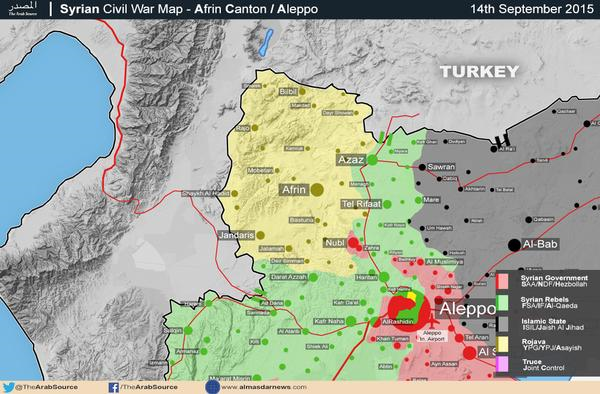
Aleppo map who controls what

Map of northern Aleppo before latest fighting, showing control by Rojava Kurds (yellow), rebels (green), regome (red) and ISIS (black), source: https://media.almasdarnews.com/wp-content/uploads/2015/09/untitled24.png

The other main issue often arising in discussion is that of which rebel groups control the various parts of Aleppo now under attack.

For many Rojava-Firsters, this is a good excuse to support this counterrevolutionary action: “Oh, but that area is controlled by Nusra, so it’s good that the “democratic” forces are ejecting them” (even if with Russian air power – let me try that: Oh, but Iraq is run by Saddam Hussein, who is an extremely brutal tyrant, so of course we need to fight on the side of the US Blitzkrieg to unseat him, etc etc).

A particularly disgusting (and disappointing in the extreme, given the source) example of this was a tweet sent by the head of the leftist/Kurdish-based HDP in Turkey, Selahattin Demirtaş: “Davutoğlu says #Azez won’t fall. Who’s in Azez? Al Nusra and Ahrar ash-Sham. Rapists & people who sell women” (https://twitter.com/hdpenglish/status/701036280751247361).

Now the level of outright racism and dehumanisation in this tweet is unbelievable (so ordinary Arabic people don’t live there? Were the babies killed by Russian bombing of the maternity hospital there also rapists?); and of course it is also a lie that either Nusra or Ahrar al-Sham engage in a policy of rape (that would be the Assad regime) or sell women (ISIS), regardless of their other sins. But as we will see, it is also a lie about who is actually in control of Azaz.

………………………………………………………………………..

First, however, I disagree with the premise in any case. It is up to the local peoples to choose their political/military leaderships in revolutionary situations (in the same way as the PYD/YPG is in control of Kurdish regions), and to change them; and even if we dislike some of them, it is not up to an outside force; still less one operating with Russian air support, to forcefully eject them; and the ethnic factor in a military attack cannot be ignored, even if the SDF may theoretically be very good on the multi-ethnic issue.

And even in the case of Nusra, a group I detest, it is a new development in left-wing thinking that it is OK to be on the side of an invading imperialist power bombing the country to bits against even a reactionary local militia; in the conditions of this genocide from the sky, if even Nusra got its hands on good anti-aircraft missiles and shot dozens of Russian warplanes out of the sky it would be a victory for all humanity (and anyone wanted to now express outrage, kindly express it to children ripped to bits by Russian bombs in Aleppo).

In addition, most areas have been controlled by coalitions of rebel groups. Trying to single out areas allegedly controlled only by “Nusra” would be very frustrating; in general there is a loose military alliance between all the factions confronting the Assad regime/ISIS, necessary due to the overwhelming military superiority of those two (especially the regime), and their cooperation. Politically, Nusra tends to stand out on a limb compared to all other groups, but in military terms, it is entirely sensible for the FSA to reject the years-long US-prodding to wage war on Nusra now (though the FSA often finds itself clashing with Nusra *in defence* against Nusra transgressions). And in any case, as we’ll see below, Nusra has much less to do with the Aleppo fighting than is commonly made out.

But anyway, below is a little summary.


Azaz

First, on Azaz. In September 2013, ISIS seized Azaz from the ‘Northern Storm’ brigade of the Free Syrian Army. Before that, Northern Storm had put up a several-month resistance to furious ISIS siege, thereby also protecting PYD-controlled Afrin further west; the YPG did not lift a finger. But in January 2014, the FSA and other rebels drove ISIS out of the whole of western Syria (and temporarily much of eastern Syria), and so it was of course driven from Azaz. Since January 2014 Azaz has again been the major connection between the rebels and sources of funds, arms, trade, refuge etc in Turkey. That is why it is so crucial for the rebels to keep control of Azaz.

Since then, the main militia controlling it has again been FSA Northern Storm (Liwa Asifat al-Shamal (according to this well-researched article from January 2015: http://www.aymennjawad.org/15865/special-report-northern-storm-and-the-situation), just as it was before September 2013; therefore, the YPG has attacked, with the aid of Russian airstrikes on children’s hospitals, those who previously protected it. This article continues: “also present within Azaz town but lacking any governing authority is Syria’s al-Qa’ida affiliate Jabhat al-Nusra” (it runs a mosque), while Northern Storm “also solely controls the (nearby) town of Sawran” (http://www.aymennjawad.org/15865/special-report-northern-storm-and-the-situation).

Notably, despite long-term tension between Azaz and Efrin, there has also been significant cooperation, which underlined the potential, and the folly of the YPG’s siege of Azaz:

“However, there was some limited cooperation of convenience in the fight to drive ISIS out … Since Northern Storm returned to Azaz officially under the authority of Liwa al-Tawhid and the Islamic Front in Aleppo (now the Levant Front), there has been official neutrality despite suspicion that reinforcements come from Afrin to the regime-held Shi’a villages of Nubl and Zahara. Securing water from Afrin would therefore require greater outreach to the PYD, which may be one of the underlying reasons behind the agreement publicly announced in February (2015) between the PYD’s military wing the YPG and the Levant Front, stipulating a united judicial system, establishing joint Shari’a and da’wah offices in Aleppo and Afrin, and working together to crack down on crime. Of course, Jabhat al-Nusra is opposed to any such arrangements with the PYD/YPG, which it considers to be apostate entities” (http://www.joshualandis.com/blog/the-administration-of-the-local-council-in-azaz/).


Menagh airbase

Syria Direct (http://syriadirect.org/news/side-campaign-in-north-aleppo-raises-fears-of-sdf-linking-kobani-to-afrin/) reports that the base had been held by a combination of Ahrar a-Sham and Jabha al-Shamiya (also known as Shamiya Front, or Levant Front). Meanwhile, we also read that the “YPG has sent an ultimatum to the FSA and Ahrar Al-Sham and other groups, either give them the Menagh Airbase or they will take it militarily” (https://twitter.com/VivaRevolt/status/697096507250581506), while a statement by the FSA FastaqemUnion claims it was “under the national brigades of the FSA” (https://twitter.com/FkoUnion/status/698990013007196168). Rudaw also claims the YPG seized it from “the Levant Front,” ie, Shamiya Front (http://rudaw.net/english/middleeast/syria/11022016).

Thus it seems we had FSA, Shamiya Front, and Ahrar al-Sham. The claim that “Nusra” was there at all now seems most likely to just be standard YPG propaganda. Leaving aside the FSA, these other two forces may be called ‘Islamists’; as Leila al-Shami explains, “the Islamists represent the conservative culture of rural Aleppo. They are comprised primarily of Aleppo’s sons, brothers and fathers” who “have strong local support” (https://leilashami.wordpress.com/2016/02/25/the-assault-on-aleppo/). However, they are two very different strads of ‘Islamist’. Ahrar al-Sham is a relatively hard-line Islamist militia, but as al-Shami says, genuinely based in the community, and moreover, it has continually condemned violations by Nusra (eg, see this vigorous condemnation of Nusra’s attack on the Druze in northern Idlib https://twitter.com/Charles_Lister/status/609449774673211392), and even clashed with it recently.

As for the Shamiya Front, while it can also be broadly described as ‘Islamist’, this is only true in the same sense that various Christian “liberation theology” movements could be described as “political Christian” (for those who immediately express outrage, I recommend quickly checking your pulse for Islamophobia levels). A coalition of starkly moderate, FSA-aligned ‘Islamists’ – nothing like Ahrar al-Sham or Jaysh Islam – who have all played leading roles in the war against ISIS, the Shamiya Front’s ‘Islamist’ credentials are best shown in this video where they treat ISIS prisoners to a mock execution, with a terrific ending: http://www.news.com.au/technology/syrian-rebel-brigade-al-shamiya-front-punk-isis-prisoners-with-mock-execution/news-story/a70b7280f010cccbd6a7136c03848e84.

In a recent Op-Ed in FP, Shamiya Front leader Abdallah al-Othman says they are “local fighters who wish to attain democracy and defend our hometowns from slaughter,” and declares “the Levant Front desires a Syria that is free and pluralistic, with respect for human rights, peaceful elections, and the rule of law” (http://foreignpolicy.com/2016/02/17/fighting-for-aleppo-abandoned-by-the-world-islamic-state-levant-front-isis/).

Does an ‘Islamist’ group like this really deserve to be attacked by YPG/SDF thugs supported by Russian terror bombing?


Tel Rifaat

 It is very difficult to get a clear idea of who exactly “controls” the iconic revolutionary town Tel Rifaat, if not simply a coalition like elsewhere. What we do know is that it was in Tel Rifaat that ISIS mastermind, Hajji Bakr, was killed by rebels as the anti-ISIS war began in earnest early January 2014; and his family was taken prisoner by Liwa al-Tawhid, the strikingly moderate ‘Islamist’ brigade that previously dominated Aleppo before breaking apart when its leader was killed by Assad. So ‘moderate’ in fact, that one former part of it, the Northern Sun Brigade, is now with SDF (so they have ‘Islamists’ too!), though most simply became Shamiya Front.

Tel Rifaat has seen months of demonstrations in support of the revolution, demanding that the revolutionary brigades unite to face their enemies (https://www.youtube.com/watch?v=1hEBtN-RK-Y), where the only flags we see are FSA flags; activists in Tel Rifaat released a statement demanding leaders resign to take responsibility for recent defeats , leading to the deputy commander of the Shamiya Front doing just that, in a small sign of grass-roots democracy in action (http://syriadirect.org/news/rebel-leader-resigns-amidst-aleppo-protests/). Not quite the kind of town that needs to be “liberated” by hundreds of Russian air strikes (as one of the sources I quoted above described).

Meanwhile, here is a charming video showing victorious YPG fighters (well, that is if you call victory by Russian air strikes a “victory” by the YPG) gloating over the bodies of FSA defenders of Tel Rifaat: https://www.facebook.com/BABAMAMABOBO/posts/1118834781494675


Mare (Marea)

In fact it is still uncertain whether or not Mare – another iconic revolutionary centre and the front-line in the war against ISIS – has fallen to the Russian-YPG offensive or not. Some days ago, YPG sources claimed that the local rebels had reached a deal with them. Of course this is possible – when confronted with the dilemma “do you want to let our Russian allies obliterate you, and Assad forces take over, or just give up and let us take over?” Which is hardly an argument that that YOG is carrying out a humanitarian operation. But in any case, FSA sources claim to still be in control.

Mare is run by the Mare Operations Room. According to the very reliable ‘archcivilians’ site (https://twitter.com/archicivilians/status/671741957706788864/photo/1), this consists of the Suqor al-Jabal Brigade (FSA, also known as the Falcons of Mount Zawiya Brigade, previously part of the 5th Corp), the Fursan al-Haq brigade (FSA, now fused with other FSA groups as the Northern Division), Liwa Ahrar al-Surya (FSA), the Fastaqim Kama Umirt Union (FSA), and Faylaq al-Sham, the Muslim Brotherhood connected brigade, also loosely associated with the FSA on the same ‘soft-Islamist’ wavelength as the Shamiya Front. A Wikipedia page adds the Shamiya Front, which would seem likely. Some sources (http://syrianobserver.com/EN/News/30384/Free_Syrian_Army_Expels_ISIS_from_Aleppo_Villages), add the Turkmen-based Sultan Murad Brigade (FSA), and some add Ahrar al-Sham, both of which also seem likely. No sources anywhere suggest Nusra.

It has been the Mare Operations Room that has been signing ceasefires with the YPG over the last 6 months of on and off skirmishes connected to the appearance of a handful of embittered ex-FSA fighters known as ‘Jaysh al-Thuwar’ (the main non-YPG component of the SDF in Aleppo). The last ceasefire in December called for neither side to cross into the other side’s territories (which Jaysh al-Thuwar had done in December, seizing four FSA-held towns, with Russian air support). It is pretty obvious who has now broken the ceasefire.

According to this article, ISIS and the YPG are both attacking revolutionary Marea at the same time: http://syriadirect.org/news/is-and-sdf-each-attack-rebel-held-marea-%E2%80%9Cevery-brigade-is-striving-to-build-their-dreams-on-our-guts%E2%80%9D /


Aleppo City

As for Aleppo itself, a mega-coalition, Fatah Halab (Aleppo Conquest), dominates here, initially set up by 31 mostly FSA brigades (all the big ones, eg Fursan al-Haq, Divisions 13, 16 and 101, others listed above in Marea), along with all the soft-Islamist brigades (Shamiya Front, Nour al-Din al-Zenki, Authenticity Front, Jaysh Mujahideen, Faylaq al-Sham), and also Ahrar al-Sham, but not Nusra (http://archicivilians.WORDPRESS.com/2015/06/18/infographic-fatah-halab-military-operations-room-coalition-of-31-rebel-factions-syria). It was later joined by another 19 small, locally-based FSA brigades (https://twitter.com/BosnjoBoy/status/626060428519571456).

Much has also been written about the system of local councils in Aleppo, though years of barrel bombing have no doubt made these much less functional than they might be. However, this description of grass-roots struggle in Aleppo by Leila al-Shami gives a good picture of what is at stake:

“When we talk of ‘liberated areas’ it’s more than just rhetoric. Under threat in Aleppo are the different local councils which ensure the governance of each area and have kept providing services to the local population in the absence of the state. We are talking about more than 100 civil society organizations (the second largest concentration of active civil society groups anywhere in the country). These include some 28 free media groups, women’s organizations and emergency and relief organizations such as the Civil Defense Force. It also includes educational organizations such as Kesh Malek which provides non-ideological education for children, often in people’s basements, to ensure school continues under bombardment. Under Assad’s totalitarian state, independent civil society was non-existent and no independent media sources existed. But in Free Aleppo democracy is being practiced as the people themselves self-organize and run their communities” (https://leilashami.wordpress.com/2016/02/25/the-assault-on-aleppo/).


Where is Nusra?

It is interesting to note that, despite the constant refrain of “Nusra” being everywhere, this close reading of the sources suggests Nusra only has a secondary presence in Azaz, that it may or may not be represented at the Menagh base (and if it is, again in a very secondary role), that it does not exist in Mare or Tel Rifaat, and that in Aleppo it is the only militia excluded from the grand military coalition. Of course, Nusra does exist, and operates more on its own, as well as in a separate military front with Ahrar al-Sham (Ansar al-Saria, ie, Ahrar operates in both Fatah Halab and in Ansar al-Sharia); and appears to be more present further south, in southern Aleppo near its main base in Idlib.

But its relative absence is in fact no mystery: mid-last year, when Turkey began calling for a “safe zone” along the Turkish border to settle refugees, allegedly to include a Turkish-backed push by rebels to expel ISIS from the region between Azaz and Jarablus – a plan blocked by the US – Nusra was the only brigade in Aleppo to oppose this plan. Strikingly, for a group that is often bandied about as “Turkish-backed,” Nusra declared Turkey to be motivated only by its “national security interests” and not by Syrian interests, declaring it to be “not a strategic decision emanating from the free will of the armed factions,” though the rebels “have the ability to combat ISIS — if they unite through means sanctioned by sharia law… without seeking the help of international or regional forces” (https://now.mmedia.me/lb/en/NewsReports/565709-nusra-withdraws-from-turkey-border).

Therefore, Nusra  announced its withdrawal from Azaz, Marea, Tel Rifaat and all the more northern and eastern regions, which have now been under attack (thus even the first link above, which in January 2015 said Nusra had a secondary presence in Azaz, may be old information).

In a later interview, Nusra chief Joulani explicitly declared that Turkey’s “national security” issue, which Nusra did not want to be involved with, was “the Kurds,” and clarified, that Nusra withdrew from northern Aleppo countryside not to ease the way for the Turkish zone as some had suggested, but because “we don’t see it permissible to fight ISIS under a Turkish or an international coalition air cover” (https://t.co/3gldQBYqY9).

(As an aside: Regardless of my very low opinion of Nusra, this declaration actually showed a strange political intelligence; much as I would be sympathetic to the reasons for the entire non-Nusra rebellion supporting such a Turkish move, it is interesting that the most reactionary organisation had the clearest understanding that Turkey would be acting in its own interests which do not necessarily coincide those of the Syrian masses. So calling Nusra a Turkish-backed group has no basis. And the fact that Nusra saw these Turkish interests, which it wanted no part of, as being anti-Kurdish, indicates that Nusra’s hostility to the PYD is more political (opposed to the PYD’s politics) and monopolistic (Nusra has attacked FSA brigades far more than it has attacked the YPG), rather than “anti-Kurdish” as such).


Conclusion: An attack on the Syrian revolution and possible suicide for Rojava revolution

It is difficult to call this turn of events anything other than an outright betrayal of the revolution by the YPG leadership, with likely catastrophic results for all concerned. Right now, the YPG is a direct participant in the catastrophe of the Arabic peoples of the Aleppo region and their revolution, in direct partnership with the Russian Blitzkrieg and therefore indirect (to be charitable) partnership with the fascist regime and its Iranian-led global sectarian invaders.

Tomorrow, this betrayal may also be catastrophic for the Kurdish civilians and their own revolution as well. While it is not unusual for nationalist leaderships to make decisions based on the narrow interests of their own nation (one would have expected better from an officially left leadership, but anyway), in this case it is short-sighted even from this narrow point of view. The Assadist representative at Geneva, Bashar al-Jaafari, made a point of telling the PYD that they should forget about autonomy or federalism, “take the idea of separating Syrian land out of your mind” … “we have said before our theme for these talks is Syrians in Syria and our precondition is to protect the unity of the land and Syrian nation” (http://rudaw.net/english/middleeast/syria/310120162). When you add to this a couple of recent regime bombings of the YPG, the regime is essentially laughing at the Kurdish leadership even as it declares that “these Syrian Kurds supported by the American administration are also supported by the Syrian government” – a “support” which goes for now as the YPG serves its purposes (http://www.trtworld.com/mea/assads-un-envoy-reveals-regime-support-for-pyd-49189), but certainly not for the day after.

Hence, the position now being implemented by the PYD/YPG in this conflict is crucial both to the future existence of the revolution as a whole, and to the Rojava revolution. Getting it wrong here can mean that all the stories of setting up a radical-democratic, non-sectarian, multi-ethnic, feminist model – and despite exaggerations and romanticisation, a certain amount of this is undoubtedly true – may shortly afterwards turn to dust. What has protected the Rojava revolution for three years, while it was untouched by Assad’s barrel bombs, ballistic missiles, sarin etc, so that this model could be built, was none other than the enormous sacrifice by the rest of the country, the Syrian revolution in Arab Syria, the blood of hundreds of thousands of people outside Rojava, who continually fought and died in the struggle against Assad (and whose similarly revolutionary-democratic councils were bombed into oblivion); they were a wall protecting Rojava, and the moment they fall, Assad, with mathematical precision, will turn Rojava into dust, with no-one left to help (I’m reminded of a poem by Martin Niemoller: http://allpoetry.com/First-They-Came-For-The-Communists). At that point, Assad and Erdogan may find they have less problems with each other than they thought.

The PYD appears to be relying on the idea that its current US and Russian sponsors will save it some autonomy due to their own interests, even if it means Assad, or an ‘Assad regime without Assad’, won’t be able to fully carry out the threat to “unify” the country. Nothing is out of the question. As SDF Co-President İlham Ehmed speaks of Syria being divided into three “federal regions,” with the northern one ruled by them (https://anfenglish.com/features/ehmed-three-federal-regions-will-be-formed-in-syria-part-ii), corresponding closely to the plan recently flagged by the US Rand Corporation (http://www.rand.org/pubs/perspectives/PE182.html), John Kerry now says that partition may be part of a ‘Plan B’ if a ceasefire cannot be achieved (http://www.theguardian.com/world/2016/feb/23/john-kerry-partition-syria-peace-talks?CMP=Share_AndroidApp_Gmail). Yet putting the PYD/SDF in charge of a “northern” federal unit outside that extends beyond ethnically Kurdish areas is not the same as Kurdish autonomy, and would instead turn it into a US-Russia-backed police force guarding a brutal occupation of land seen as occupied by the Sunni Arab majority there, not to mention by those millions driven from northern Syria in this gigantic Nakbah. WE are reminded of other dark events in Mideast history. Even then, I suspect this “solution” would be temporary while the post-Assadist state re-gathers its resources.

I have no interest in reaching these conclusions. I always supported the Rojava revolution along with the rest of the revolution, and despite disagreeing with many uncritical supporters of the PYD leadership and its views, I was willing to recognise the relatively politically advanced nature of the process in Rojava. Moreover, regardless of this process, I’ve always supported the right of self-determination for the Kurds throughout the region, including, if they choose, an independent state. But the leadership has made these decisions, and needs to be held accountable.


Responsibility of Arab and Kurdish leaderships for Arab-Kurdish disunity

It is true of course that the various opposition leaderships, both political and military, share responsibility, for not having taken a clear position in support of Kurdish national self-determination. The initial refusal of the exile-based Syrian opposition to agree to dropping the word “Arab” from “Syrian Arab Republic” was an important symbolic example. The opposition advocates general rights for Kurds and other minorities, and the Kurdish National Council (KNC) consisting of some 15 parties, is part of the Syrian National Coalition. When it officially joined the Coalition in 2013, a joint declaration was released in which the Coalition confirmed its commitment to “constitutional recognition of the Kurdish people’s national identity, considering the Kurdish affair an integral part of the general national cause in the country, the recognition of the national rights of the Kurdish people in the framework of the unity of the Syrian people and lands, the cancelation of all discriminatory politics, decrees and measures against Kurdish citizens, the treatment of their effects and repercussions, granting the victims compensation and returning rights to their rightful owners.”

Nevertheless, the KNC still fights within the Coalition for a clearer position on the issue. A crystal clear position in support of self-determination (as opposed to the emphasis on “the unity of the Syrian people and lands”), is essential to win national minorities such as the Kurds to the side of revolution. Significantly, however, the Syrian National Coordination Body for Democratic Change, to which the PYD has long been affiliated with, does not have no clearer position on the Kurdish issue than the Syrian National Coalition.

This is a longer-term discussion that needs to be had about the ultimate fate of the revolution. However, supporters of the Syrian revolution have rarely given their support on the basis that its various leaderships are politically advanced; the exile-based leaderships are conservative and bourgeois, and widely criticised by the revolutionaries on the ground; while the internal civil and military leaderships of the FSA and the LCCs etc are empirical revolutionaries who arose from the grass-roots, without strong traditions of political consciousness, crushed as political thought was for 40 years under the Assads. In contrast, the PYD leadership comes from a consciously left-socialist tradition, and one would therefore have expected a better approach than the treacherous one now being implemented.

Moreover, it is not even clear that the Kurdish masses – whatever suspicions they may rightly have about sections of the opposition – are necessarily in support of these current moves, or that their mistrust of the opposition is driving the PYD’s current actions (here is statement of a Kurdish FSA faction condemning the PYD’s actions: http://en.eldorar.com/node/1500). While the Kurds have been nationally oppressed in Syria – especially by the Assad regime – it has been the Sunni Arab majority that has suffered far and away the most over the last five years, subjected to massive slaughter and large-scale dispossession, while the Kurds in Rojava were left alone. In such circumstances, it is just as much the stance of the Kurdish leadership – especially a leftist Kurdish leadership – towards their Arab brothers and sisters that is crucial as is the reverse. Moreover, the position of the PYD leadership in relation to the uprising against Assad was unclear from the outset, and over time evolved into a “plague on both your houses” position, casting themselves as a third alternative, rather than seeing their role as providing a critical left perspective in support of the revolution.

Assad withdrew from the main Kurdish regions in late 2012 and handed them over to the PYD. Of course, Assad did not do this to support Kurdish autonomy, but to be able to focus on slaughtering the more immediate threat of the rest of the revolution; the PYD did not accept because it is pro-Assad, but because it saw the sense of building their own Rojava project rather than demanding to be barrel-bombed. They can hardly be condemned for the latter. However, this situation tended to harden this position of “third-force” neutrality, leading many oppositionists, rightly or wrongly, to see the PYD as a stalking horse for the regime, which often led to, mostly small-scale, clashes (as well as other instances of revolutionary cooperation).

While the PYD claims its Rojava project is multi-ethnic, and in some places this seems to be valid, the momentum of Arab-Kurdish joint demonstrations against the regime throughout 2011-2012 took place independently of the PYD (see this article to get a feel for this period: http://www.developmentperspectives.ie/serdar-ahmad-the-story-of-a-syrian-grassroots-leader/). Some have even argued that the separation of Rojava and its withdrawal from the anti-Assad struggle tended to dull this momentum, ironically enough. I have no information to sustain this view, but it is notable that when the PYD used repression against Kurdish opposition – most famously in Amuda in 2013 (http://www.syriauntold.com/en/2013/07/amuda-shouts-once-again-he-who-kills-his-people-is-a-traitor/) – it was directed against Kurdish activists with strong links to the wider revolutionary movement.

The rise of jihadist forces, first Nusra and then ISIS, led to further conflict, especially as these forces were based mostly in the north and east of the country, and thus tended to vie for some of the same regions, resources and border crossings as the PYD. In late 2013 in particular, they launched murderous attacks on the Kurds in the northeast. While the Syrian opposition did not endorse these jihadist attacks, some small rebel formations on the ground in eastern Syria found themselves stuck between the jihadists and the YPG, where local, conjunctural factors often played a role in deciding who was their chief opponent at the moment’ and in some cases local FSA groups seem to have taken an anti-YPG position. However, the simplistic assertion that “the FSA joined the jihadist attacks on the Kurds” in late 2013 is essentially slander, especially as the FSA was also already at war with ISIS in this period.

Considerable study would be required to ascertain the various errors made by both Arab and Kurdish leaderships. Yet ultimately, it is difficult to see the PYD’s current actions in Aleppo as mere “mistakes” of a revolutionary left leadership under extreme pressure of events, as has been put to me (and amusingly, the same people often tell me how wicked it is for the Syrian rebels to be receiving aid from the Erdogan regime in Turkey – as if it is not the rebels who are the ones under extraordinary, super-human, pressure, and for whom the opening to Turkey, and the little support they get via Azaz, is an absolute lifeline; talk about the pot calling the kettle black!).


How did the PYD arrive here?

No, the PYD’s current betrayal is rooted precisely in it not surpassing the bounds of being a nationalist force, despite the rhetoric. In particular, this is combined with the nature of large-scale decision-making in a one-party state, no matter how much power the democratic councils have in local decision-making. For example, the PYD has just banned the Kurdish publication ‘Rudaw’ from operating in Rojava, and “also banned journalists and freelancers from sending their work to Rudaw and warned all agencies and organizations to cut off all contacts with the media network” (http://rudaw.net/english/kurdistan/250220161). Was this act of political repression decided upon by local councils, with relevant information, discussing the issue across Rojava and coming to this decision? Or was it a ruling by some Political Committee of the PYD?

Further, it is my view that the road to becoming a ground force for Russia’s counterrevolutionary Blitzkrieg in Aleppo today was set by the evolution of the PYD/YPG into the main ground force for the US-led Coalition also bombing Syria.

The initial cooperation with the US, when the US airforce came in to bomb ISIS away from Kobani in late 2014, was undoubtedly necessary, when defence against the threat of ISIS subjugation and terror in Kobani was a question of survival. When FSA forces formed an alliance with the YPG for the defence of Kobani, this was also a high point of revolutionary unity between the Arab and Kurdish masses and their leaderships.

However, the US-YPG arrangement then turned into a long-term alliance, and not one for immediate defence as in Kobani, but one for offensive operations against ISIS. Much as the Islamic State is a monstrously reactionary state that needs to be overthrown, it is questionable that this can be achieved via the military actions of a nationalist Kurdish militia on the ground, completely reliant on US air strikes, where the Islamic State is based among Arabs. Since early 2015, every offensive operation by the YPG against ISIS relies on US air-strikes; these US bombings are netting an increasingly higher number of civilian casualties (even this week, the US bombed a bakery and killed 28 civilians in the town of Shadada in Hasaka region, at the onset of a YPG offensive against ISIS: http://www.orient-news.net/en/news_show/103136/0/US-led-coalition-jets-kill-civilians-in-Hasakah-countryside); the YPG is the only ground force sharing coordinates with the US; US special forces have arrived in Rojava and work with the YPG; and even a US airbase has been set up on Rojava soil.

This pattern of dependence on foreign imperialist powers thus emerged, along with a haughtiness, an arrogance, that comes with the idea that you will always be protected by powerful foreign states. This has now reached a tragic climax.

One final point: there is some talk that this move by the PYD is a “pro-Russian” move away from alliance with the US. It isn’t. This view relies too much on the “Cold War” myth, and ignores the “fundamental similarity” of US-Russian views on Syria, as John Kerry rightly put it – especially the studied, deliberate, cold US indifference to the current Russian-led slaughter of the revolutionary forces in Aleppo.

Is it really surprising that the very weeks that the YPG is acting as the Russian ground force in Aleppo, the US and YPG launch a new offensive in Hasaka region; that the SDF includes the logo of the US-led Coalition in their list of allied militias (https://twitter.com/defenseunits/status/700741630618370049); that US Government Counter Terrorism Center, which had linked the PKK and PYD in 2014, removed this reference in 2016 (https://twitter.com/Charles_Lister/status/701451967692845056); and that Brett McGurk, the US envoy to the anti-ISIS Coalition, paid an official visit to the PYD in Kobani “in what appeared to be the first official trip to Syrian territory for several years” by an official from the Obama administration, where he was presented with a plaque by YPG founding member, and former PKK member, Polat Can (http://www.nrttv.com/en/Details.aspx?Jimare=5199). Thus, the counterrevolutionary position currently adopted by the PYD is an embodiment of the US-Russia agreement on Syria, not a problem for their alleged “Cold War.”

Bloody Counterrevolution in Aleppo: on Russian Blitzkrieg and US “betrayal”

Bloody Counterrevolution in Aleppo: on Russian Blitzkrieg and US “betrayal”

Hospital bombed by Russian warplanes

Today we are watching bloody counterrevolution, imperialist barbarism, in its most naked form, most visibly in the combined Blitzkrieg against the people of Aleppo and its northern countryside being carried out by the invading Russian air force, the fascistic regime of Bashar Assad with his barrel bombs, the invading Iranian Revolutionary Guards and their imports including Iraqi Shiite-sectarian death squads, Hezbollah and various manipulated, impoverished Shia troops from Afghanistan and Pakistan, with ISIS to some extent, and the US-backed Kurdish YPG on a huge scale, opportunistically joining in from either side like vultures.

Meanwhile, much the same continues in the south, with people still starving to death, even as world attention has gone away, in the various towns surrounding Damascus that are being carpet-bombed  by Assad and Russia, besieged and starved by Assad and Hezbollah. This scene from some apocalypse (https://www.facebook.com/photo.php?fbid=10153676629524823&set=gm.495267943990549&type=3&theatre) is actually between Moadamiyeh and Daraya; this picture of Hiroshima is actually what the regime has done to to the once beautiful city of Homs: https://www.facebook.com/Channel4News/videos/10153492613721939/?pnref=story. Further south, regime and Russian bombing continues day and night against the mighty, and starkly moderate, Southern Front of the FSA, which has had its already miserable level of “support” cut off by Jordan and the US; 150,000 people have been uprooted in the latest offensives.

Returning to Aleppo, the bombing has reached extraordinary levels http://www.theguardian.com/world/2016/feb/06/aleppo-under-bombardment-fears-siege-and-starvation?CMP=Share_AndroidApp_Gmail:

“The bombs are falling so fast in Aleppo now that often rescuers don’t have time to reach victims between blasts. If the deadly explosions that struck on just one day last week had been evenly spaced, they would have struck every other minute around the clock.

“Sometimes there are so many airstrikes, we are just waiting and waiting at our headquarters, and the jets don’t leave the skies,” says Abdulrahman Alhassan, a 29-year-old former bank engineer from the city who coordinates “white helmet” rescue teams in the city.

“When at last we can’t see any more, we have to rush to all the sites to rescue people and evacuate them at once,” he said. On Friday, the group counted 900 airstrikes by government forces and their Russian backers, apparently throwing every weapon they have at the already devastated city.”

That is, 900 airstrikes on the city in one day.

As is widely reported, the targets include countless hospitals, schools, markets, bakeries, mosques and so on. This video shows the results of the deliberate Russian bombing of the children’s and maternity hospital in Azaz: http://www.independent.co.uk/news/world/middle-east/not-terrorists-or-fighters-just-babies-syrian-charity-video-shows-devastation-after-azaz-hospital-a6875496.html, on the same day in mid-February that three other hospitals and two schools were bombed (http://www.nytimes.com/2016/02/16/world/middleeast/syria-hospital-airstrike-doctors-without-borders.html).

Of course, a bloody counterrevolution being carried out by a fascistic regime does not always involve “imperialist barbarism,” as I put it above; the Syrian regime has been doing the same for years before the Russian invasion. But as far as any foreign intervention by a world-class military power savaging a small country far from home goes, the current Russian invasion and terror bombing of Syria is second to only few.

However, Russian imperialism has been the chief armer of the regime with massive quantities of advanced weaponry for years, so there are no surprises here, and apart from our outrage, perhaps no need to dwell on the obvious (though if an anti-war movement existed in the West, calling for an end to this Russian barbarism would be its obvious aim; but alas).

US policy and the Oslo-style “peace process”

Yet it is the calculated indifference of the United States that stands out here; while this should not be a surprise, it is to those who still think the US was merely a weak and ineffective supporter of Syrian freedom. In fact, US Defence Secretary John Kerry was being completely truthful when he recently stated, not only that that the US does not support regime change in Syria (old news), but also that the US and Russia see the Syrian conflict “fundamentally very similarly” (http://abcnews.go.com/International/john-kerry-meets-russian-president-vladimir-putin-seek/story?id=35782171).

It may seem ironic that the current Russian Blitzkrieg is taking place in the shadow of the US-Russian driven Vienna/Geneva “peace process.” This process supposedly aimed to forge a ceasefire, and press a select group of oppositionists into a “transitional” government with the regime or parts of it, who would then jointly wage a war, supported by all the imperialist powers, against ISIS, Nusra and any other opposition forces declared to be “terrorists.”

However, while accepting negotiations for some kind of “political solution,” the Syrian opposition had some red lines. One was that, before real negotiations could begin, the regime needed to show some good faith by first implementing UN resolutions on lifting starvation sieges, stopping barrel bombing, releasing detainees and so on. Secondly, while the opposition was willing to begin negotiations with Assad, their bottom line for eventually agreeing to any political solution was that, at some point, Assad himself and his immediate entourage had to step down, so that the “transition” government they were to join would be formed with parts of the regime but not Assad himself.

However, the US, the UK, France and other western states began falling over each other to declare that Assad’s alleged “stepping down” can take place at the “end” of the “transition government” period rather than at the beginning; and then the length of this Assad-led “transition” kept getting lengthened beyond the “several months” initially discussed. This was made even more emphatic in an internal US State Department document which specified that Assad would continue to head the “transitional” regime, which the opposition was expected to join, until March 2017 (http://news.yahoo.com/apnewsbreak-us-sees-assad-staying-syria-until-march-081207181–politics.html); and then further, the US delivered new Russian-Iranian diktats to the opposition, moving from the concept of “transition” to that of the opposition forming a “national unity government” with Assad, while strongly rejecting the opposition’s conditions regarding sieges and so on.

According to Lina Sinjab, writing from the Geneva talks, a “US official was adamant that Secretary of State John Kerry wants to end the violence, and is determined to succeed. But everyone here thinks the opposite. Almost at every corner, you hear the same thought: The US has handed over Syria to the Russians for free” (http://www.bbc.com/news/world-middle-east-35490273). And as Assadist/Russian bombing continually increased throughout the “peace” conference, Kerry claimed on February 5 that “the Russians have made some constructive ideas about how a ceasefire in fact could be implemented” (http://www.todayszaman.com/world_kerry-says-in-talks-on-syria-ceasefire-will-know-in-days-if-possible_411600.html).

As  reported on February 6, Syrian aid workers said Kerry told them on sidelines of the donor conference, after the Geneva “peace” talks broke down, that “the opposition will be decimated” and to expect 3 months of bombing, blaming the opposition for the Russian Blitzkrieg: “He said, ‘Don’t blame me – go and blame your opposition’” (http://www.middleeasteye.net/news/opposition-blame-syrian-bombing-kerry-tells-aid-workers-1808021537). Another source in the same article, who claimed to have been a liaison between the Syrian and American governments, said Kerry had passed the message on to Assad in October “that the US did not want him to be removed,” but that if he stopped barrel bombing, could “sell the story” to the public.

As Russia then launched into the current apocalyptic bombing of Aleppo, Kerry and Lavrov stitched together a “ceasefire,” which, however, would begin after a week, allowing plenty of time for Russia’s hundreds of strikes a day to perform maximum devastation in the meantime, while excluding all operations against ISIS, Nusra and “other terrorists” from the ceasefire. Since Russia and Assad declare everyone they bomb to be either ISIS, Nusra or “terrorists,” this ceasefire was simply a cover for the genocide to continue, while outlawing the rebels from shooting back!

When Kerry announced the “ceasefire” alongside his Russian counterpart, he put all the blame on the Syrian opposition, and as usual praised his (new) allies to the skies, stating emphatically that “it was not Russia or Iran who stopped a ceasefire from being adopted at the very beginning. I want to make that very, very clear” (http://www.theguardian.com/commentisfree/2016/feb/12/russia-big-winner-syria-flawed-truce-assad-europe-us?CMP=share_btn_tw).

Then as Russia and Assad responded to the “ceasefire” by stepping up their genocidal bombing of Aleppo, Kerry said this has to stop, but told the opposition to stop “whining” about it, telling them it won’t stop “by walking away from the table or not engaging” (https://twitter.com/USEmbassySyria/status/696046559486607360).

It may be objected that these are just statements, perhaps driven by diplomacy. However, statements have a context. In the context of such horrific crimes being committed by Russia as we speak; of the US pressuring its “allies” to cut off the miserable aid they had provided the rebels (see below); of the US pushing the opposition into a national unity government with Assad for one and a half years; in the context of US bombing never touching the regime or its death squad allies, but often hitting non-ISIS rebel targets; these “mere statements” represent policy, not diplomacy.

US “betrayal”?

Below I have attached what is one of the better commentaries in mainstream media in recent weeks on the so-called US “betrayal” of the Syrian people in the face of this bloodthirsty Russian-Assadist-Iranian Blitzkrieg on Aleppo.

Of course, its use of words like “betrayal,” and the idea that the US is “handing” Syria over to Russia and Iran (clearly the US is handing it to Assad) still reveal a hint of the grand illusion that perhaps “real” US interests would have been to act differently, or that the open US-Russia ad US-Iran collaboration in Syria somehow represents the US abandoning its own interests in favour of those of others.

Actually, the author only just still borders on these illusions – like any serious observer, the author can see that the facts have long ago depleted most illusions. The author writes for example “Washington seems oblivious to the simple truth that diplomacy has a cost, as does its failure — probably because this cost would be carried by the rebellion, for which the United States has little respect or care anyway.” He is right that the US has “little respect or care” (“none” would be more correct) for the rebellion, but this very fact makes the word “oblivious” at the beginning of the sentence meaningless. This author can at least be congratulated on showing 90 percent cynicism of basic US motives and positions on Syria throughout the conflict, and only 10 percent remaining illusions of the US being “oblivious” to its interests. Far ahead of most.

It is high time, in my opinion, to call a spade a spade. This has nothing to do with the fact that there has been no “US intervention,” still less a call for it. In fact, those constantly warning against “US intervention” wilfully ignore that the US has been bombing Syria for some 17 months, just that it bombs Anyone But Assad (see my article on who the US bombs: . https://mkaradjis.wordpress.com/2015/09/03/who-has-the-us-bombed-for-in-syria/).

At this point, it doesn’t even have that much to do with the many years of very active US intervention against the revolution, to ensure that no Syrian rebels, not even the most “moderate”, could get their hands on any anti-aircraft weapons, the major defensive need of the rebels since mid-2012 when massive airpower became the main form of regime aggression; with the fact that sympathetic regional states were blocked from sending them, and that the FSA was even blocked when it tried to get them from the black market. No, this is all well-established; as one tweet put it concisely, “the only consistent, thorough, well-implemented US Syrian policy is tracking hunting and stopping MANPADS from reaching any opposition group since 2012” (https://twitter.com/THE_47th/status/659114328012931072); and the criminality of denying such weapons as the rebels face such apocalyptic bombing right now is for all to see. But it is even more than that.

All the reports from recent weeks, if not months, tell of the US winding down, if not cutting off, the already pathetic level of “support” to some “vetted” rebels (or, put more correctly, of the US forcing Saudis, Qatar and Turkey to wind down or cut off their support). As the author notes in the article below: “In the south, the United States has demanded a decrease in weapons deliveries to the Southern Front, while in the north, the Turkey-based operations room is reportedly dormant.” According to Syrian National Coalition Khaled Khoja, external support for armed opposition factions in Syria came to a complete halt following the Vienna talks in October 2015 (http://www.alaraby.co.uk/english/indepth/2016/2/6/the-fate-of-the-syrian-opposition-left-without-support), while videographic evidence shows that use of Saudi-supplied TOW anti-tank weapons on the battlefield “had trickled off in the last months of 2015 and totally vanished in the first two weeks of 2016” (http://www.thedailybeast.com/articles/2016/02/05/are-u-s-missiles-taking-out-high-ranking-russian-military-officials.html).

So let’s call the spade by its name: the US is opposed to, and has always been opposed to, the Syrian revolution. Period. Things have worked out this way not because the US was “weak,” or “incoherent,” or endlessly (for 5 years) makes “mistakes,” or “bungled it,” or unwittingly “handed over victory” to someone opposed to US interests etc; no, things turned out this way, have been this way for five years, because it is US policy.


One final comment: The author says it is “ironic” that this international Blitzkrieg against Free Syria is occurring at the moment the US and UN have been organising the Oslo-style Geneva “peace process”. Here I’ll allow a little conspiratorial thinking currently prevalent among many Syrians, who have more right to be cynical than anyone. That the Geneva farce – such an obvious farce – was organised as a cover to politically disarm and distract and try to divide the Syrian rebellion while the “final military solution” was being planned all along.


Obama’s Disastrous Betrayal of the Syrian Rebels

How the White House is handing victory to Bashar al-Assad, Russia and Iran.​

​BY EMILE HOKAYEM

​FEBRUARY 5, 2016​

https://foreignpolicy.com/2016/02/05/obamas-disastrous-betrayal-of-the-syrian-rebels/

What a difference a year makes in Syria. And the introduction of massive Russian airpower.

Last February, President Bashar al-Assad’s regime and its Shiite auxiliaries mounted a large-scale attempt to encircle Aleppo, the northern city divided between regime and rebels since 2012 and battered by the dictator’s barrel bombs. Islamist and non-Islamist mainstream rebels — to the surprise of those who have derided their performance, let alone their existence — repelled the offensive at the time. What followed was a string of rebel advances across the country, which weakened Assad so much that they triggered Moscow’s direct intervention in September, in concert with an Iranian surge of forces, to secure his survival.

Fast-forward a year. After a slow start — and despite wishful Western assessments that Moscow could not sustain a meaningful military effort abroad — the Russian campaign is finally delivering results for the Assad regime. This week, Russian airpower allowed Assad and his allied paramilitary forces to finally cut off the narrow, rebel-held “Azaz corridor” that links the Turkish border to the city of Aleppo. The city’s full encirclement is now a distinct possibility, with regime troops and Shiite fighters moving from the south, the west, and the north. Should the rebel-held parts of the city ultimately fall, it will be a dramatic victory for Assad and the greatest setback to the rebellion since the start of the uprising in 2011.

In parallel, Russia has put Syria’s neighbors on notice of the new rules of the game. Jordan was spooked into downgrading its help for the Southern Front, the main non-Islamist alliance in the south of the country, which has so far prevented extremist presence along its border. Turkey’s shooting down of a Russian military aircraft that crossed its airspace in November backfired: Moscow vengefully directed its firepower on Turkey’s rebel friends across Idlib and Aleppo provinces. Moscow also courted Syria’s Kurds, who found a new partner to play off the United States in their complex relations with Washington. And Russia has agreed to a temporary accommodation of Israel’s interests in southern Syria.

Inside Syria, and despite the polite wishes of Secretary of State John Kerry, the overwhelming majority of Russian strikes have hit non-Islamic State (IS) fighters. Indeed, Moscow and the Syrian regime are content to see the United States bear the lion’s share of the effort against the jihadi monster in the east, instead concentrating on mowing through the mainstream rebellion in western Syria. Their ultimate objective is to force the world to make an unconscionable choice between Assad and IS.

The regime is everywhere on the march. Early on, the rebels mounted a vigorous resistance, but the much-touted increase in anti-tank weaponry could only delay their losses as their weapons storages, command posts and fall-back positions were being pounded. Around Damascus, the unrelenting Russian pounding has bloodied rebel-held neighborhoods; in December, the strikes killed Zahran Alloush, the commander of the main Islamist militia there. In the south, Russia has fully backed the regime’s offensive in the region of Daraa, possibly debilitating the Southern Front. Rebel groups in Hama and Homs provinces have faced a vicious pounding that has largely neutralized them. Further north, a combination of Assad troops, Iranian Shiite militias, and Russian firepower dislodged the powerful Islamist rebel coalition Jaish Al-Fatah from Latakia province.

But it is the gains around Aleppo that represent the direst threat to the rebellion. One perverse consequence of cutting the Azaz corridor is that it plays into the hands of the al Qaeda-affiliate Jabhat Al-Nusra, since weapons supplies from Turkey would have to go through Idlib, where the jihadist movement is powerful. Idlib may well become the regime’s next target. The now-plausible rebel collapse in the Aleppo region could also send thousands of fighters dejected by their apparent abandonment into the arms of Nusra or IS.

The encirclement of Aleppo would also create a humanitarian disaster of such magnitude that it would eclipse the horrific sieges of Madaya and other stricken regions that have received the world’s (short-lived) attention. Tens of thousands of Aleppo residents are already fleeing toward Kilis, the Turkish town that sits across the border from Azaz. The humanitarian crisis, lest anyone still had any doubt, is a deliberate regime and Russian strategy to clear important areas of problematic residents — while paralyzing rebels, neighboring countries, Western states, and the United Nations.

Assad all along pursued a strategy of gradual escalation and desensitization that, sadly, worked well. Syrians already compare the international outcry and response to the IS’ siege of Kobane in 2014 to the world’s indifference to the current tragedy.

To complicate the situation even more, the regime’s advances could allow the Kurdish-dominated, American-favored Syrian Democratic Forces (SDF) to conquer the area currently held by the Free Syrian Army and Islamist militias between the Turkish border and the new regime front line north of the Shiite towns of Nubl and Zahra. This would pit the SDF against IS on two fronts: from the west, if the Kurds of Afrin canton seize Tal Rifaat, Azaz and surrounding areas, and from the east, where the YPG is toying with the idea of crossing the Euphrates River. An IS defeat there would seal the border with Turkey, meeting an important American objective.

The prospect of further Kurdish expansion has already alarmed Turkey. Over the summer, Ankara was hoping to establish a safe zone in this very area. It pressured Jabhat al-Nusra to withdraw and anointed its allies in Syria, including the prominent Islamist group Ahrar al-Sham, as its enforcers. True to its record of calculated dithering, President Barack Obama’s administration let the Turkish proposal hang until it could no longer be implemented. Turkey faces now an agonizing dilemma: watch and do nothing as a storm gathers on its border, or mount a direct intervention into Syria that would inevitably inflame its own Kurdish problem and pit it against both IS and an array of Assad-allied forces, including Russia.

​Turkey and Saudi Arabia, the rebellion’s main supporters, are now bereft of options. No amount of weaponry is likely to change the balance of power. The introduction of anti-aircraft missiles was once a viable response against Assad’s air force, but neither country — suspecting that the United States is essentially quiescent to Moscow’s approach — is willing to escalate against President Vladimir Putin without cover.

Ironically, this momentous change in battlefield dynamics is occurring just as U.N. envoy Staffan de Mistura yet again pushes a diplomatic track in Geneva. But the developments on the ground threaten to derail the dapper diplomat’s peace scheme. Fairly or not, de Mistura is tainted by the fact that the United Nations is discredited in the eyes of many Syrians for theproblematic entanglements of its Damascus humanitarian arm with the regime. Despite U.N. resolutions, international assistance still does not reach those who need it most; in fact, aid has become yet another instrument of Assad’s warfare. Neither Kerry nor de Mistura are willing to seriously pressure Russia and Assad for fear of jeopardizing the stillborn Geneva talks.

Seemingly unfazed by this controversy, de Mistura’s top-down approach relies this time on an apparent U.S.-Russian convergence. At the heart of this exercise is Washington’s ever-lasting hope that Russian frustration with Assad would somehow translate into a willingness to push him out. However, whether Putin likes his Syrian counterpart has always been immaterial. The Russian president certainly has reservations about Assad, but judging by the conduct of his forces in Chechnya and now in Syria, these are about performance– not humanitarian principles or Assad’s legitimacy. For the time being, Moscow understands that without Assad, there is no regime in Damascus that can legitimize its intervention.

Ever since 2011, the United States has hidden behind the hope of a Russian shift and closed its eyes to Putin’s mischief to avoid the hard choices on Syria. When the Russian onslaught started, U.S. officials like Deputy Secretary of State Tony Blinken predicted a quagmire to justify Washington’s passivity. If Russia’s intervention was doomed to failure, after all, the United States was not on the hook to act.

Russia, however, has been not only been able to increase the tempo of its military operations, but also to justify the mounting cost. And contrary to some pundits, who hailed the Russian intervention as the best chance to check the expansion of IS, Washington knows all too well that the result of the Russian campaign is the strengthening of the jihadist group in central Syria in the short term. This is a price Washington seems willing to pay for the sake of keeping the Geneva process alive.

The bankruptcy of U.S. policy goes deeper. The United States has alreadyconceded key points about Assad’s future — concessions that Russia and the regime have been quick to pocket, while giving nothing in return. In the lead-up to and during the first days of the Geneva talks, it became clear that the United States is putting a lot more pressure on the opposition than it does on Russia, let alone Assad. Just as Russia escalates politically and militarily, the Obama administration is cynically de-escalating, and asking its allies to do so as well. This is weakening rebel groups that rely on supply networks that the U.S. oversees: In the south, the United States has demanded a decrease in weapons deliveries to the Southern Front, while in the north, the Turkey-based operations room is reportedly dormant.

The result is a widespread and understandable feeling of betrayal in the rebellion, whose U.S.-friendly elements are increasingly losing face within opposition circles. This could have the ironic effect of fragmenting the rebellion — after years of Western governments bemoaning the divisions between these very same groups.

It’s understandable for the United States to bank on a political process and urge the Syrian opposition to join this dialogue in good faith. But to do so while exposing the rebellion to the joint Assad-Russia-Iran onslaught and without contingency planning is simply nefarious. Washington seems oblivious to the simple truth that diplomacy has a cost, as does its failure — probably because this cost would carried by the rebellion, for which the United States has little respect or care anyway, and would be inherited by Obama’s successor.

The conditions are in place for a disastrous collapse of the Geneva talks — now delayed until late February — and a painful, bloody year in Syria. All actors understand that Obama, who has resisted any serious engagement in the country, is unlikely to change course now. And they all assume, probably rightly, that he is more interested in the appearance of a process than in spending any political capital over it. As a result, all the parties with a stake in Syria’s future are eyeing 2017, trying to position themselves for the new White House occupant. This guarantees brinksmanship, escalation, and more misery. 2016 is shaping up as the year during which Assad will lock in significant political and military gains.​