Conspiracy theories that “the US fuelled the rise of ISIS”: Why they are a back-handed attack on the Syrian uprising


By Michael Karadjis

In early June, journalist Seamus Milne penned a piece for the Guardian entitled ‘Now the truth emerges how the US fuelled the rise of Isis in Syria and Iraq’ (http://www.theguardian.com/commentisfree/2015/jun/03/us-isis-syria-iraq).

Of course, we all wait for “the truth.” The nickname “truth” has been used by every kind of religious organisation for centuries – indeed they all had opposing “truths.” Generations of Americans saw the reflection of their own imperialist leaders in Superman fighting for “truth, justice and the American way.” For decades Soviet citizens were told their leaders spoke only “the truth” in a newspaper by that name.

Milne, in other words, is in good company.

For an article that promises to show that the US “fuelled the rise of ISIS,” it begins, oddly enough, with a failed “terrorism” case in the UK that had zero to do with ISIS. Perhaps Milne was just making a separate point with this example, despite the title. But there is so much wrong with the “example” and Milne’s implications about it that the case is worth looking at in its own terms.

Milne writes that “on Monday the trial in London of a Swedish man, Bherlin Gildo, accused of terrorism in Syria, collapsed after it became clear British intelligence had been arming the same rebel groups the defendant was charged with supporting.” Further, the defence “argued that going ahead with the trial would have been an “affront to justice” when there was plenty of evidence the British state was itself providing “extensive support” to the armed Syrian opposition.”

Milne also claimed that alleged British aid to “the armed Syrian opposition” was not only non-lethal aid but also training, logistics and secret supply of “arms on a massive scale”.

Gildo’s defence lawyers used a number of articles from the media to help their case. According to the article about the trial that Milne links to, by Richard Norton-Taylor, these included “one from the Guardian on 8 March 2013, on the west’s training of Syrian rebels in Jordan,” New York Times articles on 24 March and 21 June 2013 (in fact, 2012), “and an article in the London Review of Books from 14 April 2014, (which) implicated MI6 in a “rat line” for the transfer of arms from Libya” (http://www.theguardian.com/uk-news/2015/jun/01/trial-swedish-man-accused-terrorism-offences-collapse-bherlin-gildo?utm_source=Sailthru&utm_medium=email&utm_term=*Mideast%20Brief&utm_campaign=New%20Campaign).

Now, I agree with Milne that it would be absurd to send someone to prison “for doing what ministers and their security officials were up to themselves,” and indeed I am pleased that it is thus more difficult to prosecute people going to fight Assad’s tyranny on trumped up “terrorism” charges.

But Milne’s points here seem to be more about using the case (1) to claim that Britain and the US really were “massively arming” the Syrian rebellion, (2) to suggest that, if true, this would not be a good thing to do, and (3) to try to connect the alleged “terrorists” that he alleges Britain and the US were supporting to those that Gildo was fighting with, and both to the actual ISIS terrorists. In other words, making the case that any support to the great Syrian uprising against a fascist regime leads directly to support for ISIS; it’s the same thing. As Milne asserts: “American forces bomb one set of rebels while backing another in Syria.” Thus to Milne, both ISIS, and the Syrian rebels – who have done more to fight ISIS than anyone else in the region – are both “rebels.”

It therefore becomes a political issue. It is worth clarifying a number of points here: what exactly the court said; what these articles alleged about who the British government (or the US government, which Milne’s title refers to) was aiding at this time (2012), and the reality of this aid; who Gildo was alleged to be fighting for; and what any of these organisations have to do with “the rise of ISIS in Syria and Iraq.”

“The truth,” it turns out, is something based on “amalgam” theory taken to an absurd level. An example of amalgam theory would be to say, for example, that since the Cuban and Venezuelan revolutionary leftist governments, ISIS, al-Qaida, the Iranian regime, Hamas, the French National Front and a wing of the US paleao-right (Buchanan etc) are also vocally opposed to US intervention around the world, that they therefore must all be allied or have something in common.

What the court say in the Gildo case?

First of all, the role of a court of law was not to do in-depth research into who exactly was aiding who and how much and what relationship they had to each other and so on. While I have not read the court transcripts, Milne’s assertion that “it became clear” in the court that British intelligence “had been arming the same rebel groups” as Gildo was fighting for would seem highly unlikely because it flatly contradicts what is in all the media articles referred to. Rather, the Norton-Taylor article says that “Gildo’s defence lawyers” asserted this.

Milne simply made up the “it became clear” stuff.

And actually, when the defence lawyers are quoted in that article, it seems that even Norton-Taylor was simply being “journalistic” in using the term “the same rebel groups.” In reality, the article quotes defence counsel Henry Blaxland QC:

If it is the case that HM government was actively involved in supporting armed resistance to the Assad regime at a time when the defendant was present in Syria and himself participating in such resistance it would be unconscionable to allow the prosecution to continue … “if government agencies, of which the prosecution is a part, are themselves involved in the use of force, in whatever way, it is our submission that would be an affront to justice to allow the prosecution to continue.”

So, nothing to do with “the same rebel groups” at all; on the contrary, merely the fact that both whoever M16 was allegedly supporting, and the group Gildo was in, were both part of the (broad, multi-faceted) “armed resistance” to Syria’s fascistic regime, if it involved some “use of force, in whatever way.”

Moreover, it is also not true that the defence lawyers, let alone the court, decided it was ‘clear” that British intelligence had been involved in these activities (after all, imagine if our courts decided what was “the truth” based on articles in the mass media); rather, what Gildo’s solicitor, Gareth Peirce, said was that:

“Given that there is a reasonable basis for believing that the British were themselves involved in the supply of arms, if that’s so, it would be an utter hypocrisy to prosecute someone who has been involved in the armed resistance.”

The CIA role in Turkey: preventing the Syrian rebels getting the arms they needed

The second question is who these articles alleged about who the British or US governments and intelligence agencies were aiding at this time, and the nature and quantity of this alleged aid.

Firstly, looking at the two New York Times articles mentioned, there is no mention of British intelligence. The allegations there are entirely about the CIA. A number of things are clear from these articles. First, that the role of the CIA officers, based in Turkey, was not to supply arms (“the Obama administration has said it is not providing arms to the rebels”), but rather to “help” those supplying arms “decide which Syrian opposition fighters across the border will receive arms.” Those allegedly supplying the arms were “a shadowy network of intermediaries including Syria’s Muslim Brotherhood and paid for by Turkey, Saudi Arabia and Qatar” (http://www.nytimes.com/2012/06/21/world/middleeast/cia-said-to-aid-in-steering-arms-to-syrian-rebels.html).

What was the nature of the decision-making “help”? According to the same New York Times article (June 21, 2012), “the C.I.A. officers have been in southern Turkey for several weeks, in part to help keep weapons out of the hands of fighters allied with Al Qaeda or other terrorist groups.”

Further details are in the March 24, 2013 New York Times (http://www.nytimes.com/2013/03/25/world/middleeast/arms-airlift-to-syrian-rebels-expands-with-cia-aid.html). This article gives details on very significant arms shipments from Qatar throughout 2012 and into 2013, and then later arms shipments from Saudi Arabia beginning at the end of 2012. The supply of arms to Syrian rebels by these two countries is a well-established fact.

Milne may have a problem with that; but Syrian victims of Assad’s genocidal slaughter, and for opponents of tyranny everywhere (myself included), their arming of the Syrian rebels, for their own reasons, might be seen as one of the few good things they do (and from this article, we see that the rebels on the ground, facing such a massive military machine as Assad’s, had a very different assessment of how significant these shipments were to western media claims). But this are not the issue here. The issue is the actual role of the CIA and who they were supporting.

According to the article, “Qatar has been an active arms supplier — so much so that the United States became concerned about some of the Islamist groups that Qatar has armed … The American government became involved, the former American official said, in part because there was a sense that other states would arm the rebels anyhow. The C.I.A. role in facilitating the shipments, he said, gave the United States a degree of influence over the process, including trying to steer weapons away from Islamist groups and persuading donors to withhold portable antiaircraft missiles … But the rebels were clamoring for even more weapons, continuing to assert that they lacked the firepower to fight a military armed with tanks, artillery, multiple rocket launchers and aircraft … Many were also complaining, saying they were hearing from arms donors that the Obama administration was limiting their supplies and blocking the distribution of the antiaircraft and anti-armor weapons they most sought.”

Regarding the Saudi shipments, which the US was allegedly more OK with, they were via Jordan and explicitly for rebels in the south. Even today, secular FSA forces have absolute dominance in the rebellion in the south; back at that time Islamist and definitely jihadist forces were next to completely absent there.

To summarise: the two NYT articles say nothing about British intelligence; do not tell us exactly which groups were being armed, but that the role of the CIA was to prevent weapons getting to “Islamist groups” or “fighters allied with al-Qaida;” they don’t say the US supplied arms but that it “limited supplies;” and specifically, that the CIA ensured the rebels could not get the only weapons of any use against Assad’s massive air war, manpads (portable anti-aircraft weapons).

Indeed, this last point turned out to be by far the most crucial result of this entire episode of US intervention: according to a report by Nour Malas in the Wall Street Journal (http://online.wsj.com/article/SB10000872396390443684104578062842929673074.html) “the Pentagon and CIA ramped up their presence on Turkey’s southern border” precisely after more weapons began to flow in to the rebels in mid-2012, especially small numbers of portable anti-aircraft weapons (Manpads), some from Libya, “smuggled into the country through the Turkish border”, others “supplied by militant Palestinian factions now supporting the Syrian uprising and smuggled in through the Lebanese border”, or some even bought from regime forces. “In July, the U.S. effectively halted the delivery of at least 18 Manpads sourced from Libya, even as the rebels pleaded for more effective antiaircraft missiles to counter regime airstrikes in Aleppo, people familiar with that delivery said.”

I’ve dissected these reports in more detail here: https://mkaradjis.wordpress.com/2014/09/28/yet-again-on-those-hoary-old-allegations-that-the-us-has-armed-the-fsa-since-2012/.

What was the British role in Jordan?

What of the Guardian on 8 March 2013 (http://www.theguardian.com/world/2013/mar/08/west-training-syrian-rebels-jordan)? Finally, this one does talk about a British role. The article begins:

“Western (including British – MK) training of Syrian rebels is under way in Jordan in an effort to strengthen secular elements in the opposition as a bulwark against Islamic extremism, and to begin building security forces to maintain order in the event of Bashar al-Assad’s fall.” The alleged training was “focused on senior Syrian army officers who defected.”

The article says the UK Ministry of Defence denied providing military training to the rebels, but claimed instead they have been training the Jordanian military, but the Guardian had “been told” that British intelligence were providing the rebels “logistical and other advice in some form.”

There had been “no “green light” for the rebel forces being trained to be sent into Syria.” That is because their purpose was not to fight the regime. Rather, “they would be deployed if there were signs of a complete collapse of public services in the southern Syrian city of Daraa, which could trigger a million more Syrians seeking refuge in Jordan, which is reeling under the strain of accommodating the 320,000 who have already sought shelter there. The aim of sending western-trained rebels over the border would be to create a safe area for refugees on the Syrian side of the border, to prevent chaos and to provide a counterweight to al-Qaida-linked extremists who have become a powerful force in the north.”

Regarding Jordan’s interest in all this, the article noted that “for the first two years of the Syrian civil war, Jordan has sought to stay out of the fray, fearing a backlash from Damascus and an influx of extremists that would destabilise the precariously balanced kingdom.” However, there has been a tactical shift precisely because “Islamist forces have been gaining steam in the north and Jordan is keen to avoid that in the south. Having been very hands-off, they now see that they have to do something in the south.”

To sum up again: there was a British role in Jordan; it was explicitly to support “secular” groups and “defected Syrian army officers” in the south to balance them against the “Islamist” or “al-Qaida” forces gaining strength in the north; there was nothing whatsoever about supplying arms; and the purpose of training a small core of western-leaning military officers in Jordan was to help fill a catastrophic vacuum in case the Assad regime collapsed. There is a very clear fear of such a collapse in the article.

The other article mentioned (The Red Line and the Rat Line http://www.lrb.co.uk/v36/n08/seymour-m-hersh/the-red-line-and-the-rat-line) is Seymour Hersh’s widely discredited attempt to claim the Assad regime did not launch a chemical attack on rebel-held Damascus suburbs in August 2013 and that instead the rebels, supplied by Turkey, gassed their own children to death. Hersh’s entire story relies on the alleged testimony of an unnamed source in the US intelligence community. What it says on this “rat-line” issue likely has about the same amount of credibility. The significant addition to the above New York Times stories is Hersh’s assertion that “the CIA, with the support of MI6, was responsible for getting arms from Gaddafi’s arsenals into Syria.” Hersh is the only source that makes such a claim; but he is unable to verify it for us because the whole alleged agreement is in a secret annex to a Senate Intelligence Committee report that only a few people have ever seen. It is therefore difficult to know what to make of any of this.

For good measure, Hersh adds “many of those in Syria who ultimately received the weapons were jihadists, some of them affiliated with al-Qaida.” Of course he provides not a shred of evidence for this and it appears more a statement of ideology than fact. Ironically, he later notes that the US quit this rat-line because it got concerned that Turkey and Qatar were letting Islamists get some of the arms and even that, heaven forbid, some manpads may have got through to the rebels, at least in this instance agreeing with all other sources regarding the US view of Islamists.

From all these articles – and from a wealth of others I have read – I can say with confidence that Milne’s assertion that Britain had been involved in the secret supply of “arms on a massive scale” to Syrian rebels is entirely made up; actually no evidence of any arms being supplied by the US, let alone Britain, appears anywhere. But to the extent any kind of “training” or logistical help occurred, or to the extent that the US allowed other countries to supply a certain amount of light arms, in every case it was to some described as secular or defected Syrian military with the specific objective of blocking any Islamist forces, and especially al-Qaida.

The absolute discontinuity between the US, the FSA and Nusra

Now getting to the next main question: who is Gildo charged with joining in Syria? While it is difficult to get clear information, it seems “the group he had joined, Kataib al-Muhajireen, had gone on to work with Jabhat al-Nusra,” that is, the Syrian al-Qaida group
(http://www.dailymail.co.uk/news/article-3105884/Terror-suspect-Bherlin-Gildo-freed-intelligence-services-refuse-hand-evidence.html). At that time, late 2012, Nusra was only just emerging from the shadows, till then mainly known for a string of car bombings. From the outset, its relationship with the mainstream rebels of the Free Syrian Army was difficult; a range of more moderate to hard-line Islamist militia stood between them, but on the whole were more closely allied with the FSA than with Nusra.

Clearly, the group Gildo joined was exactly the group that the US and UK were most concerned with attempting to thwart, with blocking arms from getting to, according to all the relevant articles. And in fact it went beyond this.

In late 2012, US officials met with FSA leaders, the latter trying to see if it was possible to get any US arms for their fight against the fascist regime. However, the Americans only seemed interested in getting information about Nusra, and then surprised the FSA with the demand that it turn its guns on Nusra if it wanted any US arms. When the FSA rebels said their current priority was fighting the regime, the US agents told them they had to fight Nusra now, and worry about the regime later (http://www.thenational.ae/news/world/middle-east/americas-hidden-agenda-in-syrias-war).

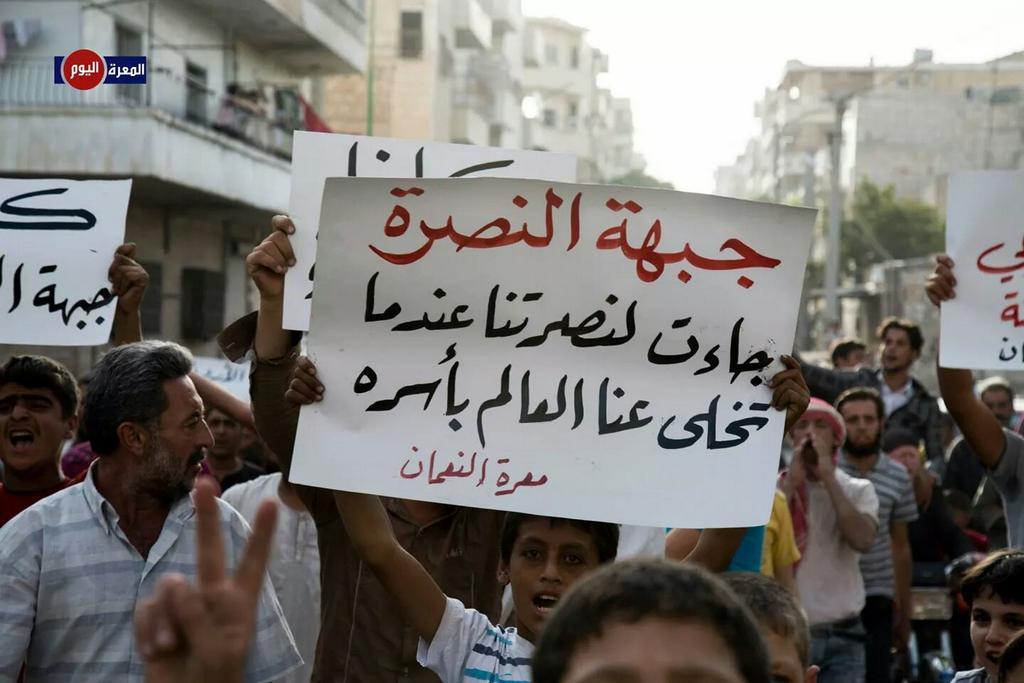
In the awkward world of anti-Syrian revolution conspiracy theory, the FSA and other Syrian rebels are “US-backed jihadists.” To deal with the “US-backed” part first, while they are entitled to try to get arms from whoever they can, it is notable that the FSA rejected this US condition for getting arms, understanding it to be what it was: not an expression of US preference for secular rebels, nor any honest move to arm them, but rather an attempt to get the democratic-secular and jihadist wings of the uprising to slaughter each other while the Assad regime laughs. And given that Nusra had already demonstrated some prowess in fighting the regime, and the US had provided nothing, when in December 2012 the US declared Nusra a terrorist organisation, demonstrations broke out in Syrian cities declaring “we are all Nusra” (http://www.dailystar.com.lb/News/Middle-East/2012/Dec-14/198527-syrian-protesters-slam-us-blacklisting-of-jihadist-group.ashx#axzz2F62w5Yns). And two years later, when the US began bombing ISIS, but also immediately bombed Nusra but left the regime alone to continue its mass murder, the FSA defended Nusra against US bombing and most major rebel groups condemned the US intervention as an attack on the revolution (https://mkaradjis.wordpress.com/2014/09/25/syrian-rebels-overwhelmingly-condemn-us-bombing-as-an-attack-on-revolution/). So much for the FSA being “US proxies” and so on.

However, did this slogan “we are all Nusra” prove the Syrian rebellion was all “jihadist”? In reality, this slogan was merely a declaration of rejection of US imperialism’s attempts to set conditions on the uprising. The reality was very different from the slogan; the first half of 2013 was continually punctured by FSA armed clashes with Nusra throughout Syria. But these were not attempts by the FSA to do the US bidding to launch an all-out offensive against Nusra; on the contrary, they were either defensive actions against Nusra attacks or actions to defend local people in revolutionary areas against Nusra attempts to impose theocratic repression.

For example, on June 19, 2013 in Jabal al-Wastani in Idlib, Nusra fighters assassinated two civilians in the village of al-Hamama, accusing of owning a bar, and tried to arrest someone, who they accused of working for the regime, in another village. Fighters from the National Unity Brigade of the FSA prevented their entry, telling them it was the court’s jurisdiction to investigate. The FSA then gathered 7 battalions and forced Nusra out of the area. Following this, ten brigades formed an alliance against the jihadists and when Nusra returned to try to force a checkpoint in another village on July 2, they were arrested (http://www.arab-reform.net/empowering-democratic-resistance-syria).

And so what we are left with from this attempt to impose amalgam theory to the US or British governments, the FSA and mainstream Syrian rebels, and al-Nusra, is exactly nothing.

What does any of this have to do with “the rise of ISIS”?

Yet even more intriguing is what any of this could possibly have to do with “the rise of ISIS.” Because whether we are talking about the FSA, Islamist rebels, or al-Nusra, all of them have played a prominent role in fighting ISIS – actually the most prominent role of any armed forces in either Syria or Iraq, and certainly far more prominent than the Assad regime.

Indeed, one reason why we could even talk about the FSA and Nusra fighting in the same trench, following the clashes in the first half of 2013, is precisely because the rise of ISIS forced all Syrian rebels together in order to fight to the death against the now double (and essentially allied) fascist threat of the Assad regime and ISIS.

ISIS was after all not part of any Syrian rebellion, but rather an invasion from across the Iraqi border – simply the new name of “al-Qaida in Iraq.” When it openly split with its Nusra child in mid-2013, it was a fairly straightforward result of the Syrianisation of the ranks of Nusra, as many rebels with no commitment to jihadist ideology joined an organisation with more arms and money, which it could get due to the open Iraqi border. This in turn somewhat moderated Nusra’s practice. By exactly the same token, as the split meant ISIS was now even more dominated by Iraqis and global-jihadists with no relationship to the Syrian masses, and owing their very existence in Syria to the organisation, ISIS’ practice moved from extremely repressive to openly barbaric.

Thus the FSA clashes with Nusra largely ended by mid-2013 but instead a more or less open war began with ISIS from at least July, especially following ISIS’ assassination of an FSA officer, the first of countless. In January 2014, all the mainstream Islamist groups, and Nusra, joined the FSA’s open offensive which drove ISIS out of the whole of western Syria and even significant parts of the east (even briefly Raqqa itself). Once again, this war was launched by the Syrian revolutionary forces based in their own decision-making regarding the threat posed by ISIS to the revolution; it had nothing whatever to do with following US encouragement or orders; they still saw their main enemy as the regime.

In contrast, as is well-known, the Assad regime never managed to drive ISIS out of anywhere at all, and the regime and ISIS both largely avoided hitting each other and instead concentrated all their fire on the Syrian rebels (http://www.nbcnews.com/storyline/isis-terror/syria-isis-have-been-ignoring-each-other-battlefield-data-suggests-n264551), sometimes even jointly (eg, Deir Ezzor July 2014, today in Aleppo). The only time the Syrian regime began bombing ISIS (or at least civilians in ISIS-ruled areas) was after the US began bombing ISIS in Syria since September 2014, as the regime shows its worth to the bogus US “war on terror.” And since then, the regime and the US intervention have essentially been allies, including joint bombing of cities (especially Raqqa, eg http://leftfootforward.org/2014/12/raqqa-to-appease-iran-obama-gives-assads-air-force-a-free-pass-for-slaughter/ and http://aranews.net/2015/05/u-s-and-syrian-warplanes-launch-simultaneous-strikes-against-isis-in-raqqa/), the explicit intervention of US bombing to save the Assad regime’s control of Deir Ezzor airport from ISIS later in 2014, and US bombing of Nusra and other non-ISIS opponents of the Assad regime.

Given all this, what does either the alleged (extremely limited) western aid to the secular rebels, or Gildo’s membership of Nusra, have to do with the rise of ISIS, the enemy of both? And the answer again is absolutely nothing.

The famous DIA document

Of course this was rather a long way of answering one “example,” but that’s because such illogical “examples” are continually used to slander the magnificent Syrian people’s uprising as either an American plot or a jihadist war or, more commonly and absurdly, both. So I just wanted to get a few things established before dealing with the second part. Milne claims:

“A revealing light on how we got here has now been shone by a recently declassified secret US intelligence report, written in August 2012, which uncannily predicts – and effectively welcomes – the prospect of a “Salafist principality” in eastern Syria and an al-Qaida-controlled Islamic state in Syria and Iraq. In stark contrast to western claims at the time, the Defense Intelligence Agency (DIA) document identifies al-Qaida in Iraq (which became Isis) and fellow Salafists as the “major forces driving the insurgency in Syria” – and states that “western countries, the Gulf states and Turkey” were supporting the opposition’s efforts to take control of eastern Syria.”

Milne then comments that this is “pretty well exactly what happened two years later” … a year into the Syrian rebellion, the US and its allies weren’t only supporting and arming an opposition they knew to be dominated by extreme sectarian groups; they were prepared to countenance the creation of some sort of “Islamic state” – despite the “grave danger” to Iraq’s unity – as a Sunni buffer to weaken Syria.”

One of the best refutations I have seen of this interpretation of the DIA document was by the excellent ‘magpie’ site at https://magpie68.wordpress.com/2015/06/05/who-are-the-real-godfathers-of-isis/. Below I will give a few thoughts of my own, largely in agreement with this view.

First I might just correct part of Milne’s presentation of the document. It does not exactly claim that al-Qaida in Iraq and “fellow Salafists” were the “major forces driving the insurgency in Syria.” It claims “the Salafist, the Muslim Brotherhood and AQI” are the major driving forces. But either way, what this tells us is that this is hardly the declaration of an “intelligence” organisation such as the DIA, which would know better than this. Dated August 2012, the rebellion was then overwhelmingly dominated by the FSA; several Islamist militia had been set up but were far from being the “driving force” at that stage; the Muslim Brotherhood was and is overwhelmingly an exile-based organisation, but even Qatar’s attempt to insert the MB into the rebellion only really began around mid-2012; and AQI was entirely marginal. Regardless of how one assesses the evolution of these factors later, there is simply no evidence in the factual record for such an assessment at that time.

So, if they could get it so wrong, what does this tell us?

It is first important to look at the actual document (http://www.judicialwatch.org/wp-content/uploads/2015/05/Pg.-291-Pgs.-287-293-JW-v-DOD-and-State-14-812-DOD-Release-2015-04-10-final-version11.pdf), and not word documents that have transcribed it. The first thing one will notice is that the first couple of pages, and sporadically elsewhere, are heavily “redacted,” that is, the DIA is protecting confidential sources. In other words this is not an expression of the DIA’s opinion, but “information” being given to the DIA by some source. Indeed, the second thing to notice is that it proclaims itself to be “information report: not finally evaluated intelligence;” one would think that was clear enough. A third noticeable aspect is the clear concern with the security of Iraq, with the Iraq-Syria border, and with the danger posed by the AQI.

This strongly suggests an informant from the Iraqi regime. And the interesting thing about the Iraqi regime is that it bridges being a US satellite derived from the US invasion and being an Iranian satellite allied to the Assad regime and which tends to talk with the same story, such as vague assertions about unnamed “western countries” supporting the “opposition.”

Incidentally, the idea that this vague claim about “western countries” supporting the “opposition” means US support for AQI is quite a stretch – it would indeed be interesting to see the US Defence Department declaring its support for al-Qaida; it is simply not what is being said.

Now even when we deal with what the (probably) Iraqi informant is telling the DIA, it doesn’t exactly say what Milne and the entire Assadophilic cybersphere wants it to say. Where the informant claims that opposition forces are trying to control eastern Syria (Hasake and Deir Ezzor) and that “western countries, the Gulf states and Turkey are supporting these efforts,” it is somewhat unclear if the informant is talking of the present or the future, since the grammar (like elsewhere in the “intelligence” document), is so bad: because this is listed under the sub-heading of “the future assumptions of the crisis,” where the first such “assumption” is the survival of the Assad regime, and the quote above is part of the second “future assumption” that the situation develops into “a proxy war.” In fact, in the text, the alleged support from western and other countries is also called a “hypothesis” and even this is based on the idea that “safe havens under international sheltering” will be set up – a weird “hypothesis” given the fact that this was never on the agenda of the US or other “western countries” and still isn’t.

Moreover when it comes to the effects on Iraq, the document expresses how alarmed the source is about this dangerous situation, a view almost certainly shared by the DIA. The fact that the FSA (the only time the document mentions it) had taken over parts of the Syrian-Iraqi border is presented as “a dangerous and serious threat” since the border is “not guarded by official elements” (ie, the Assad regime). And it is in the context of this dangerous situation, of “the situation unravelling,” that the informant raises the “possibility of establishing a declared or undeclared Salafist principality in eastern Syria” – from the context, the informant sees that as part of this “dangerous and serious threat,” rather than advocating such a possibility, indeed they go straight on to discuss the “dire consequences” of this, including the possibility of AQI declaring an Islamic state across Syria and Iraq which would create a “grave danger” to Iraq’s unity!

Small wonder then that when the US finally did intervene in Iraq and Syria in 2014, it was to bomb this Islamic State, even if Milne thinks the US is not bombing it enough. It must be so difficult for the Assadophilic “left” to see, day after day, that the US is not only not bombing the greatest purveyor of massive violence in the region – the Assad regime – but in addition is sharing intelligence with Assad, sometimes launching joint bombing of ISIS—ruled territories and civilians with Assad, and also bombing other, non-ISIS, opponents of Assad, especially Nusra, but also even the Islamic Front.

Comment by Gilbert Achcar:


My final point on the DIA document is to just quote a response from Gilbert Achcar:

  1. Much surprised that an “intelligence” report would in the most banal way describe the geography and ethnography (THE POPULATION LIVING ON THE BORDER HAS A SOCIAL-TRIBAL STYLE, WHICH IS BOUND BY STRONG TRIBAL AND FAMILIAL MARITAL TIES) of the border area in a region that was under US occupation for nine years, and from which the US had completed withdrawal less than one year earlier. Reads as if the report is based on a loose talk by an “informant” and written by a novice.
  2. The document formulates a *HYPOTHESIS*:
    OPPOSITION FORCES ARE TRYING TO CONTROL THE EASTERN AREAS (HASAKA AND DER ZOR), ADJACENT TO THE WESTERN IRAQI PROVINCES (MOSUL AND ANBAR), IN ADDITION TO NEIGHBORING TURKISH BORDERS. WESTERN COUNTRIES, THE GULF STATES AND TURKEY ARE SUPPORTING THESE EFFORTS. THIS HYPOTHESIS IS MOST LIKELY IN ACCORDANCE WITH THE DATA FROM RECENT EVENTS, WHICH WILL HELP PREPARE SAFE HAVENS UNDER INTERNATIONAL SHELTERING, SIMILAR TO WHAT TRANSPIRED IN LIBYA WHEN BENGHAZI WAS CHOSEN AS THE COMMAND CENTER OF THE TEMPORARY GOVERNMENT.

Since the *hypothesis* is predicated on the view that “Western countries” are preparing a repetition of the Libyan scenario, it is clear that the “informant” is closer to the opposite side (most probably, the Iraqi government) than to those to whom he (certainly not a she in the context!) attributes this intention.

  1. It is against the backdrop of this much biased and flawed hypothesis-making that one should read the “sensational” statement:
    IF THE SITUATION UNRAVELS THERE IS THE POSSIBILITY OF ESTABLISHING A DECLARED OR UNDECLARED SALAFIST PRINCIPALITY IN EASTERN SYRIA (HASAKA AND DER ZOR), AND THIS IS EXACTLY WHAT THE SUPPORTING POWERS TO THE OPPOSITON WANT, IN ORDER TO ISOLATE THE SYRIAN REGIME, WHICH IS CONSIDERED THE STRATEGIC DEPTH OF THE SHJA EXPANSION (IRAQ AND IRAN).
  2. The assumption that this is an Iraqi government source is confirmed by statements like this one: THE IRAQI BORDER GUARD FORCES ARE FACING A BORDER WITH SYRIA THAT IS NOT GUARDED BY OFFICIAL ELEMENTS WHICH PRESENTS A DANGEROUS AND SERIOUS THREAT.

Actually the whole document reads very clearly like one coming from a source from within the Iraqi government, or close to it. Basing “revelations” on this is like taking a “secret” report by a source close to the Syrian regime as a proof of what the Syrian opposition had in mind. No surprise that it is “NOT FINALLY EVALUATED INTELLIGENCE”. It is actually just worthless rubbish of the kind the files of the “intelligence” services are full of.

(end of Achcar’s comment)

Conclusion

ISIS of course is an arch-enemy of the Syrian revolution, so ironically enough, as a supporter of this revolution, it might actually serve my purposes to also go all conspiratorial and assert that “US imperialism created ISIS,” not to get at the Assad regime of course, but precisely in order to help Assad derail the uprising into a sectarian war. The reasons I oppose this conspiracism are two-fold. First, because I believe basing arguments on facts is better than writing endless bullshit, which should be a severe embarrassment to those on the left promoting it. Secondly, because most of this conspiracism is not motivated by showing that imperialist powers tried to derail the revolution by backing ISIS, but on the contrary, they want to claim that the US and the West “backed ISIS” in order to overthrow the Syrian tyranny, a laughable idea.

In particular, this leads them into these grossly dishonest and fact-free amalgam between ISIS and its arch-enemies among the Syrian revolutionary forces; and hence the continuous assertion, backed by the flimsiest of evidence or none at all, that the US and the West have backed other parts of the Syrian rebellion (something regarded to be bad) is also described as part of the how the West allegedly helped “fuel the rise of ISIS,” as if the FSA, the force in the region that has most successfully beat back ISIS, is in some way related to ISIS or gave rise to it. And all these forces, not only ISIS, or even Nusra, but all Syrian armed rebellion against the fascist regime are labelled “terrorists” by this “leftist” hasbarra, mimicking the very worst forms of imperialist and Zionist propaganda. This is particularly disgusting slander, especially considering that the big majority of ISIS victims have been Syrian rebel fighters.

Yes, the US created ISIS alright – by invading Iraq and launching an apocalyptic occupation and then bolstering a Shiite-sectarian regime allied with Iran which launched a sectarian war against the Sunni population – yes, this did bolster the most extreme Sunni sectarian forces among the Iraqi resistance, namely al-Qaida in Iraq which became ISIS. Many “anti—imperialists” are at least able to admit this part, because it puts direct blame on the US. Why is it so difficult to see that exactly the same dynamic occurred in Syria, not from some non-existent US invasion, but due to the similar apocalyptic sectarian war the Assad regime waged against the Syrian revolution and also specifically against the Sunni majority, precisely in order to turn the non-sectarian uprising into a sectarian war.

Again: Who are the real Godfathers of ISIS? https://magpie68.wordpress.com/2015/06/05/who-are-the-real-godfathers-of-isis/

Assad is now ISIS’s airforce and the US is Assad’s airforce: The moment the counterrevolution joins hands

A

Assad is now ISIS’s airforce and the US is Assad’s airforce: The moment the counterrevolution joins hands

Key parts from the attached article below:

1. Even those handful of Syrian fighters (“rebels” is the wrong word since they are individuals, not actual Free Syrian Army groups) that the US has been trying to recruit to fight ISIS (nearly all actual rebels told the US to shove the very idea from the outset) are now rebelling and quitting. I guess, like a lot of pro-Assad “leftists” from the opposite angle, they also never bothered to read every announcement that has ever been made about the program from the outset: that it was very explicitly ONLY to fight ISIS and NOT the fascist regime (eg, see, for the 100th time, the actual CENTCOM announcement of the program: try to even find a mention of Assad:
http://www.centcom.mil/en/news/articles/initial-class-of-syrian-opposition-forces-begin-training).

As the article below states: “The issue: the American government’s demand that the rebels can’t use any of their newfound battlefield
prowess or U.S.-provided weaponry against the army of Bashar al-Assad or any of its manifold proxies and allies, which include Iranian-built militias such as Lebanese Hezbollah. They must only fight ISIS, Washington insists.”

And so since the rebels – who have done more to actually fight ISIS and drive it out of great chunks of Syria than have any other armed force in either Syria or Iraq – know that the main enemy remains the regime, which massacres around 100 people every day, and that in any case it is impossible to defeat a symptom (ISIS) without defeating the cause (Assad), they in their mass never signed up; and the US, always hostile to the actual revolutionary forces like the FSA, never tried to sign up actual FSA brigades, but rather tried to “vet” individual fighters to form a new US-puppet armed force from scratch. But now it is even many of these individual few hundred potential mercs that are quitting: I guess some people are slow.

2. Even more startlingly (not for me, of course, but for anyone who STILL doesn’t get that the US intervened in Syria as Assad’s airforce): Right now, as ISIS, from its base in northeastern Aleppo province, is attacking the revolutionary forces in Aleppo, the Assad regime’s warplanes are directly helping ISIS by bombing the rebels in Aleppo: http://eaworldview.com/2015/06/syria-daily-assads-bombs-aid-islamic-state-offensive-in-aleppo-province/.

So many rebels ask the US: OK, if you say you are here in Syria to defeat ISIS (even though in fact the US spent last week being Assad’s airforce by … bombing Nusra, which is allied to the rebels, in Aleppo …), then why don’t you strike ISIS now that it is besieging Aleppo, just like you bombed ISIS when it was besieging Kobane to help the YPG?

And then the punch-line: the grossly hypocritical and self-perpetuating answer we have come to expect from the US – we can’t help the rebels as long as they are allied with Nusra – was not the one used in this case. This time, the US did us one better: the US said, we can’t bomb ISIS to help the rebels, because if we help the rebels in Aleppo, that would hurt Assad:

“We were rebuffed for the astounding reason that aiding the rebels in Aleppo would hurt Assad, which would anger the Iranians, who might then turn up the heat on U.S. troops in Iraq.” Wow. The problem with helping rebels, even against ISIS, is that it would hurt Assad, and the bigger problem is this in turn would hurt Iran. But in my opinion, while the added on bit about not wanting to get on Iran’s bad side etc is no doubt valid in itself, the quote may as well have stopped with the word “Assad.” Let’s cut to the chase: the US is not bombing Syria to help the armed masses overthrow a capitalist dictatorship, but quite the opposite.

Assad is now ISIS’s airforce, at least in selected parts of Syria, and the US is Assad’s airforce. Conspiracy? Call it whatever you like, the facts have been in our faces all along, and especially since the US began bombing.

That doesn’t have to mean they love each other or that it is a dark and deliberate conspiracy. Counterrevolutionaries can also hate each other: the US does bomb ISIS in eastern Syria, where there are few rebels, and the Assad regime also began bombing ISIS out in the east (or at least bombing civilians in ISIS-ruled areas) after the US began bombing it, in order to show its worth to the bogus US “war on terror” (in the whole year before that, Assad’s warplanes never touched ISIS). The one thing none of them will do however is help the revolutionary masses to stave off one another. This last week or so we are seeing one of the rare moments when not just two (eg Assad and ISIS, or Assad and US) line up – that’s really, really old by now – but all three.

Some of us still use the language of class interests. While not a crystal ball, it generally seems to me to get things right – sometimes astonishingly so in the case of Syria.

Key Rebels Ready to Quit US Fight Vs ISIS
http://www.thedailybeast.com/articles/2015/05/31/key-rebels-ready-to-quit-u-s-fight-vs-isis.html

They were ready to accept American guns and training. But a key rebel group can’t accept the Obama administration’s insistence that they lay off Syria’s dictator.
A centerpiece of the U.S. war plan against ISIS is in danger of collapsing. A key rebel commander and his men are ready to ready to pull out in frustration of the U.S. program to train a rebel army to beat back the terror group in Syria, The Daily Beast has learned.
The news comes as ISIS is marching on the suburbs of Aleppo, Syria’s second-largest city. Rebels currently fighting the jihadists there told The Daily Beast that the U.S.-led coalition isn’t even bothering to respond to their calls for airstrikes to stop the jihadist army.
Mustapha Sejari, one of the rebels already approved for the U.S. training program, told The Daily Beast that he and his 1,000 men are on the verge of withdrawing from the program. The issue: the American government’s demand that the rebels can’t use any of their newfound battlefield prowess or U.S.-provided weaponry against the army of Bashar al-Assad or any of its manifold proxies and allies, which include Iranian-built militias such as Lebanese Hezbollah. They must only fight ISIS, Washington insists.

“We submitted the names of 1,000 fighters for the program, but then we got this request to promise not to use any of our training against Assad,” Sejari, a founding member of the Revolutionary Command Council, said. “It was a Department of Defense liaison officer who relayed this condition to us orally, saying we’d have to sign a form. He told us, ‘We got this money from Congress for a program to fight ISIS only.’ This reason was not convincing for me. So we said no.”
“[My men] don’t want to be beholden to this policy because it can be used against them in Syria—that they’ve betrayed the revolution and now they’re just mercenaries for the coalition forces.”
Sejari’s possible departure wouldn’t just mean the loss of a few fighters for the anti-ISIS army the U.S. is trying to assemble. It could mean a fracturing of the entire program—a cornerstone of the Obama administration’s plan to fight ISIS in Syria. (The Pentagon was unable to respond to requests to comment for this article.)
“The train and equip program will be structurally impaired for as long as those taking part in it are asked to target jihadists first and the regime second,” Charlie Winter, an ISIS specialist at the London-based Quilliam Foundation, told The Daily Beast. “It would be naïve to think otherwise: no opposition group will take kindly to being told that they can only be assisted if they focus their efforts on ‘terrorists’ and not the regime that got Syria to this position in the first place.”
Even worse, Sejari added, is that by openly aligning with the United States as a counterterrorism proxy, his troops will have a bullseye
painted on its back for all comers, al Qaeda, the regime, Iran and Hezbollah. That force, the al-Ezz Front, broke off from Saudi-backed umbrella opposition group that was routed by Jabhat al-Nusra, the al Qaeda affiliate, in northern Syria in March.
“[My men] don’t want to be beholden to this policy because it can be used against them in Syria—that they’ve betrayed the revolution and now they’re just mercenaries for the coalition forces,” Sejari said.
Sejari has worked for years with the so-called “joint operations command” in Turkey, where the CIA and a host of Western and regional spy agencies have coordinated with vetted moderate rebels—sometimes arming them, although without the stifling proscription on whom they couldn’t fight. “In the past, we got some support through the [Western-backed] Friends of Syria group. Very small amounts. We were hoping there would be more support from the Americans,” Sefjari said.
“The American intelligence services have a fair idea who the good guys and bad guys are in Syria and they know which groups are fighting both extremism and dictatorship,” Sejari said. “If the Obama administration were sincere in putting an end to the suffering of the Syrian people, they could do that in three months.”
As approved by Congress, the Syrian train-and-equip program would be overseen not by intelligence officers but by the American
military—definitely in Jordan and Turkey, and likely also in Saudi Arabia and in Qatar. But Ankara and Washington have never agreed on the remit of the mission, with Turkey insisting that these rebels be given air support given that they’ll be targets of the regime’s fighter jets and attack helicopters. Although U.S. Defense Secretary Ash Carter has floated the idea of American air support for the rebels publicly, the administration hasn’t committed to that and likely won’t. According to the Wall Street Journal, Obama worries that if any of his built-up Arab strike teams go after the regime in Syria, then Iran’s Revolutionary Guards Corps-Quds Force will instruct its Shia militias to turn their guns on U.S. personnel in Iraq.
The original goal was to graduate 5,000 battle-ready rebels per year, although the program has suffered numerous setbacks and delays since its inception. In early May, Carter told reporters at a Pentagon press conference that just 90 rebels were being put through the first round of training in Jordan. Col. Patrick Ryder, a spokesman for CENTCOM, claimed that 3,700 Syrians had volunteered in total, but of that number just 400 were approved with another 800 were being processed. This followed from an earlier announcement, in April, that Major General Michael Nagata, the man tapped by Obama spearhead train-and-equip, was stepping down for unknown reasons. It doesn’t inspire confidence, Sejari said, that he didn’t know who was in charge of the program he wants nothing to do with anymore. “We don’t know what happened to Gen. Nagata. No one tells us anything,” he added. Sejari said that even if he were to sign up, he doesn’t think the result would greatly alter the balance of power in Syria or further stated U.S. objectives. “If anyone with any military knowledge examines this program, he will realize this program is not designed to make an impact or support the Syrian people. It will only contribute to dragging out this conflict much longer,” Sejari said. “We’ve been fighting for four years. Program, no program— we’ve been fighting for four years. If the Americans don’t change this precondition, we will carry on fighting.”
In another uninspiring development for the Levantine arm of the war, a major rebel commander has told The Daily Beast that no matter how hard he tries, he still cannot get the coalition’s attention for directing airstrikes against ISIS. And that’s allowing the jihadists to make major gains near the city of Aleppo, a stronghold of both moderate and Islamist rebels.
“We were hoping that we could work hand-in-hand with coalition forces to defeat ISIS and that the coalition would launch strikes against ISIS-held positions in northeast Aleppo. We called on them to do so,” Brig. Gen. Zaher al-Saket told The Daily Beast in a May 29 Skype interview.
Al-Saket defected from the Syrian Army in March 2013. He had been an officer in Assad’s chemical weapons division and today heads both the Aleppo Military Council and the Chemical Weapons Documentation Center, which compiles evidence of chlorine gas attacks perpetrated by his former comrades on Syrian civilians.
“For the past 24 hours, numerous towns in the northern Aleppo suburbs have been under constant bombardment by Daesh,” al-Shaket said, using a derogatory name for ISIS. “The jihadists captured Sarwan, a key town, and is now advancing on two others including Marea, the nerve center for the rebel groups in Aleppo. The fall of Marea would severely weaken our capacity across the province. Hundreds of shells have rained on houses in Sawran and Marea. Ninety percent of the civilians in Marea had to flee to neighboring areas because their houses were destroyed. The terrorism carried out by ISIS is not very different from the terrorism being carried out by Assad.”
And in some ways, Assad’s Syria Arab Army (SAA) and ISIS are helping one another around Aleppo, where the regime is reported bombing rebel positions. “By attacking opposition positions around northern Aleppo, ISIS has granted the Assad regime a tactical opportunity, one that it has already begun exploiting,” Winter said. “This is not the first time the SAA and ISIS have benefited each other, and it will not be the last.”
For weeks, al-Saket has made numerous media appearances in Arabic-language outlets such as Al Jazeera and Orient TV calling for close coordination between his rebels and the coalition. He said he has precise coordinates for ISIS-controlled installations and materiel in towns such as Raei, Manbej, al-Bab in the Aleppo suburbs. But so far, no one from U.S. Central Command—the arm of the American military responsible for the Middle East—has reached out to him.
ISIS launched their assault on northern Aleppo before the weekend, apparently after it caught wind of a the Syrian opposition’s plan to retake the rest of the province from the Assad regime, putting it in control of key supply corridors currently trafficked by ISIS.
The rebels’ idea is to replicate the success of Jaysh al-Fateh, a
consortium of Islamist and jihadist rebel groups, largely led by al-Nusra, which has had stunning successful in driving the regime out of Idlib province over the past month. Al-Saket said that while al-Nusra is not part of forces under his command, there was no denying that the al Qaeda franchise was also at war with ISIS in the province. “If ISIS is able to capture all the northern suburbs of Aleppo, that would mean they’d control the borders with Turkey. I don’t have to tell you what this means for the rebels.”
As al-Saket spoke to The Beast, he was interrupted by a fresh intelligence report from his field commanders saying that that white cars with blue covers were currently en route from Dabiq, an
ISIS-controlled town in northern Aleppo, toward Hetemlat whence they’d no doubt proceed onto Marea. The cars were outfitted with explosives and driven by ISIS suicide bombers.
“The Syrian-American community asked the Obama dministration for airstrikes on ISIS near Marea many months ago,” complained Mohammed al-Ghanem, the senior political advisor for the Syrian American Council, a Washington, D.C.-based opposition group in constant contact with the Aleppo Military Council. “We were rebuffed for the astounding reason that aiding the rebels in Aleppo would hurt Assad, which would anger the Iranians, who might then turn up the heat on U.S. troops in Iraq. The rebels are the only ones who can fight ISIS in northern Syria—Assad forces are losing ground rather quickly now—so I hope President Obama will reconsider his willingness to compromise the ISIS fight for the sake of an Iran deal.”
“ISIS is a metastasizing threat, not just for Syria but for the world,” al-Saket agreed, before hanging up to tend to the incoming car bombs.

Countering apologetics for the Baathist apocalypse: Once again, Assad regime responsible for sectarianism in Syria

By Michael Karadjis

Long ago, someone called Jay Tharappel (see note* on Tharappel at end of this contribution) responded to my article ‘Assad Regime Responsible for Rise in Religious Sectarianism’ (http://links.org.au/node/3714) with an article, Syria: Countering Sectarian Apologetics for Imperialist Sponsored Bloodshed (http://dissidentvoice.org/2014/04/syria-countering-sectarian-apologetics-for-imperialist-sponsored-bloodshed/).

While my reasons for not responding were related to time and priorities, as it turned out precisely this passage of time has allowed us to better judge Tharappel’s premise in his title: the idea that the Syrian rebellion against Bashar Assad’s tyrannical sectarian regime is “imperialist-orchestrated bloodshed,” a view that allowed him to slander me as a “loyal servant of U.S. imperialism,” in the best traditions of the so-called “anti-imperialist” left.

Like the rest of this bogus “anti-imperialist” camp, he will have wilfully refused to look reality in the face ever since, and no doubt pretends that the last 8 months of *actual* imperialist intervention (unlike the imaginary one in August 2013) doesn’t exist. That is, the real intervention of US imperialism, with the full and open support of the Syrian regime, in collaborating with Assad in joint bombing expeditions against Raqqa civilians (nicknamed “against ISIS”); in actively bombing ISIS to defend the regime’s control over Deir Ezzor airport (so that regime can continue to use the airport to bomb children to bits all over Syria); in sharing intelligence with the regime; in mysteriously having US drones flying overhead just before regime bombings; in bombing not only ISIS but also Nusra and even the Islamic Front and sometimes even, mistakenly we assume, the FSA, anyone in Syria other than the regime; at the same time as the US is in an even more open joint war on the side of Iran and its proxy Iraqi regime and Shiite sectarian death squads against the Sunni population of Iraq.

Perhaps I could now respond and declare Tharappel and his ilk “loyal servants of U.S. imperialism,” but I don’t need to: for me, being a servant of a regime as fascistic and barbarous as that of Assad, which has turned the whole of Syria into a blood-drenched moonscape, was already damning enough long before the US-Assad alliance came out in the open, even when the “anti-imperialist” left actually had an argument, of sorts: fact is, I don’t share their logic, so I don’t feel the need to slander them for being anything other than they openly claim to be, ie, loyal servants of a savage capitalist tyranny.

So formalities out of the way, let’s get down to the content of Tharappel’s arguments.

My main contentions

The main part of his argument, on the sectarian or otherwise nature of the Syrian regime, is in fact a relatively coherent argument, and if he’d stuck to that as an empirical exercise, then I concede he has some good points, while some of mine could be seen as problematic. My argument was based on an analysis of the make-up of important parts of the regime, revealing the overwhelming domination of the Alawite element, and in particular, of the Assad family, and the connection of this largely Alawite, family-based elite with the country’s mega-capitalist oligarchy, both Alawite and Sunni.

Moreover, it is the open sectarian war waged against the Sunni masses by such a regime, including by irregular sectarian Alawite-based death squads, that is the main cause of the rise of sectarianism within sectors of the opposition and among significant sectors of the Sunni population. My view was that this cause was primary and overwhelming compared to the important, but secondary, role of sectors of the Gulf bourgeoisie (mostly the oppositional bourgeoisie rather than the regimes) in fomenting Sunni sectarian politics, which in turn has played into the hands of the regime and undermined the revolution.

Note that, when Tharappel writes that “according to Karadjis, the insurgent-led campaign of hatred and violence against Alawis is the government’s fault because it’s dominated by sectarian Alawis,” even if we ignore the sweeping nature of the slander against the vast and multi-layered uprising much of which was never sectarian, he is also only telling his readers the first half of my argument. The sectarian dynamic was not created because the regime is “dominated by sectarian Alawites,” but because this effectively Alawite-dominated “secular” regime launched an unlimited war against the Sunni populations for reasons of preserving a dictatorship, not because the Baathist criminals are ideologically “sectarian Alawites.”

In my view, the fundamentals of what I wrote were correct and are well-known. However, Tharappel makes a number of reasonable points in relation to the make-up of the regime and my argument.

The offending chart

First, he points out that the chart I base my claims on (http://www.washingtoninstitute.org/policy-analysis/view/all-the-tyrants-men-chipping-away-at-the-assad-regimes-core) was provided by the US think tank, the Washington Institute for Near East policy, which specialises in strategic concerns for US domination and US war-making in the Middle East. He implies that this may make the chart doubtful. Anything coming from such a source needs to be treated with caution, and if Tharappel had better information about its claims he could have provided it. As he didn’t, I suggest the data was broadly correct; “think tanks” do not exist to spread public propaganda to bullshit the masses; imperialism has different institutions, such as Fox News, for that purpose. Think tanks are aimed at readers and ideologues from the ruling class itself, and a certain level of accuracy –within their framework – is necessary for them to be of any use.

The chart, after all, was not something flashed all over the world via some screaming headline, but on the contrary, something one would need to dig hard to get hold of.

What then of the content? Tharappel writes that the chart “doesn’t actually specify what exactly is being mapped … it doesn’t provide any categories, it’s nothing more than a collection of some but not all military figures, cabinet ministers, and business people.” Since I used this chart to create some crude figures about the proportion of Alawites in the regime (eg, “some 10-15 per cent of the population, occupy some 72 per cent of the regime”), he derides this is as “incompetent and lazy” analysis.

I concede his point that one cannot tell exactly what the composition of the entire regime is based on this data, and therefore my precise-sounding figures were rather sweeping. However, a close look at the “some but not all” important posts makes it clear that these are of central importance to the regime, and the positions listed are the leading positions within these central areas, and therefore the data is not quite as anarchic as Tharappel suggests.

Absolute Alawite domination of the military-security apparatus

Moreover, as I wrote:

“Alawite elements are absolutely dominant within the military and security elements of the regime — including head of the Republican Guard, chief of staff of the armed forces, head of military intelligence, head of the air force intelligence, director of the National Security Bureau, head of presidential security.” Given that my main point was about the total war being waged against the Sunni masses by the military-security apparatus, Alawite domination of these sectors is the fundamental issue. In any case, the chart also shows a number of centrally important sections of the regime outside the military-security apparatus.

These are well-established facts and hardly controversial. In fact, according to Stratfor, quoted by Gilbert Achcar, “Some 80 percent of officers in the army are also believed to be Alawites. The military’s most elite division, the Republican Guard, led by the president’s younger brother Maher al Assad, is an all-Alawite force. Syria’s ground forces are organized in three corps (consisting of combined artillery, armor and mechanized infantry units). Two corps are led by Alawites.” Achcar continues: “Even though most of Syria’s air force pilots are Sunnis, most ground support crews are Alawites who control logistics, telecommunications and maintenance, thereby preventing potential Sunni air force dissenters from acting unilaterally. Syria’s air force intelligence, dominated by Alawites, is one of the strongest intelligence agencies within the security apparatus and has a core function of ensuring that Sunni pilots do not rebel against the regime” (http://www.opendemocracy.net/arab-awakening/gilbert-achcar/syrian-army-and-its-power-pyramid).[1]

Therefore, though not all areas of government are shown in the offending chart, if we find out that non-Alawites happen to run ministries concerned with health or local environment or roads etc, then surely Tharappel would agree that this would be largely irrelevant, especially when discussing a dictatorship? In other words, if this chart showing 23 Alawites compared to only five Sunni in top positions in these central parts of the government and state apparatus is not representative of other parts of government, this may be largely irrelevant.

Moreover, I also pointed out the direct connection between the Assad-family-based Alawite clique and the Syrian big bourgeoisie, “who absolutely dominate the economy.” I pointed out that they are connected to the regime via two main branches, “large companies (oil, banking, telecom etc.) connected via Alawite, and Assad-family connected, members of the regime” including Assad’s cousins, the Makhlouf family, and “big businesses connected via the “Sunni business elite” who are in turn connected by marriage to Maher al-Assad, the president’s brother and head of the Republican Guard.” This class connection between Alawite and Sunni mega-capitalists is the main “non-sectarian” aspect of the regime.

Tharappel comes up with what he considers a better set of figures: the sect-based composition of successive Syrian cabinets up to the mid-1990s averaged 68.37 percent Sunnis and 20.41 percent Alawites. He notes that no figures exist since then, and claims there is no reason to think this has changed in the last 20 years, but precisely this is entirely unclear given the data presented. Let us say that neither he nor I know this for sure. All we do know for sure is that, even if these figures have remained much the same, they are overruled precisely by the overwhelming Alawite domination of the military-security apparatus.

Still, he points out that the mere “overrepresentation of a particular sect” in a state’s institutions “doesn’t mean the state actively discriminates on the basis of sect, which is what the label “sectarian” would suggest.” This may or may not be true. But also a red herring, because neither my article, nor the main experts I quoted from, eg Thomas Pierret, made this claim. No, the Assad regime is not religious-sectarian like its Iranian and Iraqi allies. Its Baathist ideology truly is “secular,” in the same way, for example, as mainstream Zionism, and fascism, and American neo-conservatism, are secular. Rather, the long-term sect-based nature of the regime is due to the very nature of capitalist power in Syria (something not unusual for secular regimes, eg, the Sunni political domination in Baathist Iraq); and the post-2011 decision to wage a sectarian war was a cynical and diabolical political decision aimed at keeping the ruling clique in power, nothing to do with any ideological sectarianism.

And apart from the fact that this regime-imposed sectarian war is the main cause for the more general descent into sectarianism in Syria, the other relevant issue arising out of such absolute sect-domination of the state I pointed out in my original article, and I’ll repeat here, by again quoting Syria expert Thomas Pierret:

“The kin-based/sectarian nature of the military is what allows the regime to be not merely “repressive”, but to be able to wage a full-fledged war against its own population. Not against a neighboring state, an occupied people or a separatist minority, but against the majority of the population, including the inhabitants of the metropolitan area (i.e. Damascus and its suburbs). There are very few of such cases in modern history … No military that is reasonably representative of the population could do what the Syrian army did over the last two years, i.e. destroying most of the country’s major cities, including large parts of the capital. You need a sectarian or ethnic divide that separates the core of the military from the target population.” (http://angryarab.blogspot.com.au/2013/04/angry-arab-interviews-thomas-pierret-on.html).

And this remains clearer than ever: Pierret is correct – I cannot think of such a total war being waged by a ruling class against “its own” population rather than against “a neighbouring state, an occupied people or a separatist minority;” the medal for this remarkable achievement goes to the regime that the likes of Tharappel defend.

Sources of Alawite domination of the repressive apparatus

Tharappel continues that even “to the extent that Alawis are overrepresented in government, their power doesn’t stem from their Alawi heritage” – exactly true, my article after all stressed that elite power in Syria is as much “Assad-family based” as “Alawite” in general and no one suggested anything about “Alawite heritage” (??), and more importantly, that “their sect holds no official privileges, and they’re not economically better off than other Syrians.”

By and large I agree with this, and the fact that a great many Alawites are as poor as the bulk of Sunni who are in rebellion against the regime means we need to distinguish between this situation in Syria and the situation in Israel, for example. In the latter, although an Israeli working class exists, and we would need to distinguish between the actions of the ruling class and Israeli people in general, nevertheless we recognise that this is made difficult by the vast level of privilege which the Israeli Jewish population derives from the Zionist conquest of Palestine.

Generally speaking, the Israel situation is similar to that which previously existed in apartheid South Africa in terms of white privilege, while the Syrian situation is analogous to that that existed under Baathist rule in Iraq (or in reverse under Shiite sectarian rule now): Hussein-connected Sunnis dominated the state apparatus and a narrow clique derived great power and privilege from these positions, but the Iraqi Sunni then (and the Iraqi Shia today) are “not economically better off than other Iraqis.” Incidentally, I wonder if the average Shiite in Saudi Arabia or Kuwait is necessarily worse off than the average Sunni in those countries.

However, Syria expert Fabrice Balanche, noting that the initial uprising in 2011 aimed “to get rid of Assad, the state bureaucracy, the Baath Party, the intelligence services, and the general staff of the Syrian Arab Army,” that is, was at heart a democratic revolt against a repressive state, goes on to explain how this very fact could not help but tap an existing sectarian dynamic inherent in the Baathist set-up, because “all of these bodies are packed with Alawites, over 90 percent of whom work for the state” (http://carnegieendowment.org/syriaincrisis/?fa=58875). If this figure is roughly true, then, while certainly “working” for the state does not necessarily convey any kind of upper or even middle class status, it does clearly put the average Alawite in a relatively privileged position compared to the average Sunni, greatly complicating the central strategic task of the revolution of overcoming the sectarian divides.

Tharappel, however, has a theory as to why Alawites are “overrepresented in the military” (ie, why they *overwhelmingly* dominate among top military *leadership*, to put it honestly):

“Prior to Syria gaining independence in 1946, families who wished to exempt their boys from military conscription (under the French mandate) would have pay a fee, which many Alawis, being a generally poorer community, couldn’t afford to pay. Moreover many considered it a lucrative career option because the military in their eyes was one of the few meritocratic institutions they could join to get ahead in life, and one where they wouldn’t be discriminated against because of their beliefs. According to former President Hafez Al Assad’s biographer Patrick Seale, “young men from minority backgrounds made for the army in droves rather than for other professions because their families did not have the means to send them to university” (p. 38).”

He concludes that the more striking thing about the Syrian armed forces today is not “the overrepresentation of any particular sect,” but “rather its class character. After independence, young men from poorer rural backgrounds began swelling the ranks of the army whereas their urban counterparts were more likely to serve their two year term in the military before returning to more profitable careers in the cities.” Tharappel adds that “For someone who loves talking about class, Karadjis is unable or unwilling to recognise the elitist origins of anti Alawi sectarianism.”

There is so much in this loaded section that it is hard to know where to begin. Even if all this were true, one might well quip that some people live so far in the past that they believe they can analyse politics as if nothing has changed in the world in the last 50 or 70 years. British rulers, for example, promoted members of the Tamil minority to high positions in Sri Lanka to divide and rule; after independence, the new Sinhala dominated state actively oppressed Tamils for decades. Perhaps the Sinhala chauvinists refer back to the past in the same way Tharappel attempts to. Similar points could be made about north and south in Uganda, about Hutu and Tutsi in Rwanda and Burundi, about Greeks and Turks in Cyprus, about indigenous Fijians and Indians in Fiji and countless other places ruled by colonialism.

Thus even if entirely true, I’m not sure how the fact that poorer, marginalised Alawites joining the military back in French colonial times (up to 1945) would justify decades of absolute Alawite domination of the Baathist state, especially since the Assad coup in 1970. One might expect a modern state to try to overcome colonial legacies in 70 years. Speaking of “class,” one might wonder whether, even if anti-Alawite sectarianism had “elitist origins,” decades of incorporation of a highly disproportionate number of the Alawite minority into the ruling class via the military and state apparatus, while the overwhelming mass of Sunni are desperately poor peasants and slum-dwellers, might have changed the class arrangement?

In fact, far from declining with time, the domination of the state apparatus by Alawites greatly increased under Assad, decades after the end of colonialism. Achcar quotes from Hanna Batatu (http://www.opendemocracy.net/arab-awakening/gilbert-achcar/syrian-army-and-its-power-pyramid):

“Out of the thirty-one officers whom Assad singled out between 1970 and 1997 for prominent or key posts in the armed forces, the elite military units, and the intelligence and security networks, no fewer than nineteen were drawn from his ‘Alawite sect, including eight from his own tribe and four others from his wife’s tribe; and of the latter twelve, as many as seven from kinsmen closely linked to him by ties of blood or marriage.…

“Apart from the special regime-shielding military formations, over which they had all along exclusive control, ‘Alawite generals commanded in 1973 only two out of the five regular army divisions but in 1985 no fewer than six – and in 1992 as many as seven – out of the nine divisions now constituting Syria’s regular army.”

In fact, while the early more leftist Baath regimes (1963-70) may have attracted a lot of Alawite support partially for the class reasons Tharappel claims, Achcar notes the irony that Assad’s right-wing coup in 1970 was more welcomed by many Sunni, ie, the Sunni mercantile elite, who he began the process of enriching. However, when Assad was confronted by the 1978-82 rebellion, his “dependence on his kinsmen and the Alawite brass and soldiery intensified and became the indispensable safeguard of his paramount power,” in other words, the beginning of the real effective sectarianisation of repressive forces’ officialdom was entirely about maintaining an elite in power and divorced in time and substance from class-related issues of earlier periods.

Nevertheless, returning to the issue of colonial legacies, is it possible that Tharappel is telling only part of the story? What about the part in which the French deliberately promoted the Alawite minority, in the same way as the British promoted certain minorities (or like the current Baathist regime continues to do), precisely in order to divide and rule, to have a bulwark against the Sunni Arab majority they ruled over?

According to Daniel Pipes, the Alawites adopted a pro-French attitude even before the French conquest of Damascus in July 1920. “The ‘Alawis … were dedicated to the French mandate and did not send a delegation to the [General] Syrian Congress.” Using French arms, they launched a rebellion against Prince Faysal, the Sunni Arab ruler of Syria in 1918-20. In 1919, French General Gouraud received a telegram from 73 ‘Alawi chiefs asking for “the establishment of an independent Nusayri union” under French protection. Following the establishment of French rule, the state of Latakia was set up in 1922, with legal autonomy. Alawis “turned out in large numbers when most Syrians boycotted the French-sponsored elections of January 1926. They provided a disproportionate number of soldiers to the government, forming about half the eight infantry battalions making up the Troupes Spéciales du Levant, serving as police, and supplying intelligence. As late as May 1945, the vast majority of Troupes Spéciales remained loyal to their French commanders. ‘Alawis broke up Sunni demonstrations, shut down strikes, and quelled rebellions” (http://www.danielpipes.org/191/the-alawi-capture-of-power-in-syria). We may not like Pipes (though not sure about Tharappel – Pipes began calling on the US to support Assad from 2013), but this historical article appears very well-referenced.

Moreover, the holes in the theory Tharappel proposes are obvious, even if it is undoubtedly based on a kernel of truth. Yes, the bulk of Alawites were extremely poor. But were the bulk of Sunni really wealthy enough for their families “to send them to university”? Why are poor Alawites being compared here with Sunni merchant families in the big cities? Tharappel imagines a rather skewed class structure in French-ruled colonial Syria, one in which the Alawite 10 percent of the population were the poor, and thus had to pursue military careers, while the Sunni 70 percent of the population were the middle and upper classes who sent their kids to university! How then did we get to the stage that the overwhelming bulk of the poor peasantry, and the urban poor on the city fringes, ie, the classes today engaged in the uprising against Assad regime, are Sunni? Did this vast wealthy university-going majority all become poor under Assad? If true, it would be quite an inditement of the regime!

More likely, however, the overwhelming majority of Sunni – the majority of the population – were also desperately poor back then. So his theory may well explain the differences between a certain social layer among Sunnis and Alawites in terms of middle class social advancement, but the overwhelming bulk of the Sunni peasantry are simply left out of this picture.

So why did the majority Sunni poor not also join the army like their poor Alawite cousins? On the one hand, it is likely that many did, but the French colonial rulers (like their Baathist inheritors) tended to promote Alawite (and minority) officers for divide and rule purposes; but on the other hand, a great many didn’t precisely for nationalist reasons; according to the same Patrick Seale, who Tharappel quotes extensively, Sunni landed families “being predominantly of nationalist sentiment, despised the army as a profession: to join it between the wars was to serve the French.”

Class, the peasantry, the Baath, the Brotherhood and western leftists stuck 50 years ago

Tharappel is on somewhat firmer ground when he discusses the class issues involved at the onset of the conflict between the Muslim Brotherhood and the first Baath governments after 1963:

“The Brotherhood ultimately represented the interests of the landed elites and merchant classes … the Brotherhood’s counterparts in Syria always clashed with the post-Baathist state for entirely reactionary reasons. In 1964, just a year after the Baath party had seized power … the Muslim Brotherhood began their first insurrection, and for what reason? According to Seale it began in the souks (bazaars or marketplaces) with “prayer-leaders, preaching inflammatory sermons against the secular, socialist Baath”, that the anger stemmed from “merchants, dreading the inroads of Baathist radicalism”, and that “country notables resented the rise of the minority upstarts and their humble Sunni allies” (from Patrick Seale’s book ‘Asad’, 1995, p. 92). The Hama elites backing the Brotherhood associated the Baathists with peasant uprisings, especially since prior to the land-reforms that followed the 1963 coup, four extremely wealthy (Sunni) families owned 91 of the 113 villages in the Hama region (Seale, 1995, p. 42).”

It is widely known that the MB at the time represented urban Sunni mercantile interests and the Baath became the party supported by the poor peasants (both Sunni and Alawite) via these land reforms. Similar events were occurring at that time in Iran; while the Shah was a much more reactionary figure than the early Baath, nevertheless, the onset of his top-down bourgeois-modernising reforms in the 1963 “White Revolution” brought about a reaction led by the alliance between the bazaar and the fundamentalist Shiite clergy and headed by Khomeini, which rejected land reforms and equal rights for women.

Most people understand that it was incorrect to see the Iranian revolution, 16 years later, led by these same reactionary forces, as a simple continuation of the 1963 revolt; they understand that social changes undermine traditional class patterns. The mullahs in 1979 still represented the same bazaar merchant class, but by then the more modern, imperialist-linked mega-capitalist class that had grown up via the patronage of the Shah regime was so dominant that the bazaar merchant-mullah alliance seemed positively small-scale and petty-bourgeois and were able to lead a vast worker-peasant uprising that overthrew the Shah. Of course, the problem of being saddled by this reactionary leadership became more obvious after the Shah was overthrown, but there was little point in the left standing aside from the masses; if they were to have any chance, they needed to be in the thick of it, trying to push forward the progressive demands of the masses and defending them against the reactionary moves of the new bourgeois-clerical state that tried to consolidate itself after 1979.

Unfortunately, as history showed, they were not strong enough and the reaction won the day, and thus today we see this reactionary mullah-state acting as the phalanx of counterrevolution across the northern part of the Middle East, especially in Syria. But I assume that is not a problem for people like Tharappel who think Iran, like its Assad ally, is a “resistance” state.

But the point  here is that while most of the left could understand there had been some transformation in the mere 16 years between 1963 and 1979 in Iran, people like Tharappel imagine there to be no difference in the 50 years between 1963 and 2011 in Syria. Thus they are incapable of staring reality in the face; they tell you about the poor peasant base of the Baath in 1963, apparently clueless as to why since 2011 the revolt against Assad has above all been centred around the poor peasantry and their cousins among the first generation of urban poor on city fringes (many supporting organisations akin to the Muslim Brotherhood), while the big bourgeoisie in Damascus and Aleppo is now the main base of the Baath regime.

Indeed, already by 1979, as in Iran, there had been significant changes. On the one hand, there is no doubt that the Brotherhood’s base was still among urban mercantile interests; but the growth of the state-spawned big bourgeoisie had also come a long way. This change had begun slowly after Assad’s 1970 coup – a coup by the right-wing of the Baath Party – when a “corrective movement” against the ‘socialist’ 1960s was launched. “This new alliance strengthened over time thanks to the development of close relationships between high-ranking officials and some entrepreneurs. These relationships became so important that in 1982 Elisabeth Picard described the regime as a ‘military-mercantile’ complex – an alliance between an Alawite-dominated security apparatus (Army and Intelligence services) and some parts of the business community. The appeasement of the bourgeoisie and the co-optation of the representatives of the middle merchants and of the top layer of the commercial bourgeoisie, have lain at the core of Hafez’s strategy of consolidating the regime’s grip over the country” (http://crisisproject.org/syria-its-the-economy-stupid/).

This process, together with the weight of such a repressive state, had gone far enough for vast layers of the ordinary masses, and for a great variety of political forces, including among the left, to loosely align with the Brotherhood in a movement demanding democratic change in the late 1970s and early 1980s (this vast alliance is well-described in Merip Report No. 110, ‘Syria’s Troubles’, which I only have as hard copy). The ferocity of the regime’s repression, slaughtering tens of thousands of people in Hama and Homs in 1982, showed the regime well understood it was not merely confronting reactionary merchants and clerics. Nevertheless, the movement was of a very mixed character, with the bourgeoisie itself divided:

“When the Aleppo merchant community called for a nationwide strike in 1980, serious doubts were raised about the regime’s capacity to survive. At this moment, the Damascus merchants directly took sides with the regime and decided to keep their shops open. Despite the fact that this crisis was only overcome in 1982 with a military intervention and the shelling of Hama, killing over 20,000 people, the Damascus merchants’ spectacular support of the Ba’athist state in 1980 is said to have prevented the regime from collapsing (http://crisisproject.org/syria-its-the-economy-stupid/).

And these changes had already occurred within only 16 years after the Baath took power in 1963, yet the Tharppels write as if nothing continued to change in the next 30 years after that! Most analysts know that Bashar Assad’s neo-liberal transformations since the onset of this century radically changed the support bases of regime and opposition; cutting agricultural and other subsidies, launching industrial and agricultural privatisation, allowing renewed land concentration (ie reversing precisely what had gained the Baath peasant support in 1963), and countless other well-known moves drove poverty rates, especially rural rates, sky high. “Development” was concentrated in areas where state-connected capitalists could make a buck, leaving major rural-based cities – places where the uprising has been concentrated – to rot. Meanwhile, the rural disaster led to mass migration to city peripheries, another base of the uprising. These changes have been very well-documented, I hardly feel the need to give references; perhaps I would just recommend you reading anything by Bassam Chit, among countless others.

In a word, the poor rural dwellers had been transformed from the base of the Baath in 1963 to base of the anti-Baath uprising in 2011, but some still haven’t noticed; the big bourgeoisie of Damascus and Aleppo have become much bigger and largely transferred their allegiance from the traditionalist MB to the modernised, neo-liberal Baath; and a variety of grass-roots Islamist organisations, mostly of a moderate nature and sometimes tenuously connected to the MB (which as an organisation is mostly exile-based) have tended to express the social conservatism among the traditional layers of the poor peasantry and urban poor leading the uprising, layers who were never actually “secular” even when they were Baath supporters.

Needless to say, as in Iran long ago, many of these petty-bourgeois Islamist leaderships also pose political problems for the future, which the left and democratic forces and the masses will have to confront. One of the differences with Iran before 1979 is that organisations like Jabhat al-Nusra, and the Jaysh Islam group in Damascus, have already given a ‘heads up’ to the FSA and the democratic revolutionaries more generally, and so we see the latter walking a fine line between the necessary cooperation with groups like Nusra in fighting the regime, and continual FSA clashes with Nusra and demonstrations against Nusra’s actions amongst revolution-supporting populations. A recent popular revolt against Jaysh Islam (described below), indicated in a particularly clear way the kinds of class cleavages that we should expect more of if we were to see the regime’s overthrow.

Apologetics for the Assadist mega-capitalist plutocracy

On a side-point, Tharappel, in his odd attempt to give Bashar Assad’s neo-liberal disaster some ‘social’ characteristics, claims that the state economic sector still accounts for 40 percent of GDP, failing to note that this was considerably lower than that of Mubarak’s Egypt (supposedly 70 percent of GDP in the 1990s according to the World Bank, http://tinyurl.com/ptj22n), and many other countries (at a socialist conference in Turkey in the 1990s, I was told the state still held, officially, some 80-90 percent of industry, decades after the death of Ataturk, and with the Turkish military-state already a long-term NATO asset). The trajectory of all the state-centric bourgeois-nationalist regimes that arose in the Middle East (and elsewhere) in the 1950s and 1960s was that of consolidating a new bourgeoisie via the “middle class” elements (military officers, intellectuals etc) that took over the bourgeois state apparatus. There was never anything “socialist” about it – Nasserism led to Sadatism without a whimper. But what this also means is that figures such as “40%” or “70%” and so on often have little meaning, because the actual state of privatisation and even of sheer plunder of the state apparatus by these layers and their families and connected businesses is often well in advance of the official state of affairs.

And a good example of this outright plunder is precisely that of Assad’s first cousin, Rami Makhlouf, which my article showed was an example of direct connection between the mega-capitalist class and the military-security apparatus (and of course the extended tentacles of the ruling family). Rather than grapple with this reality, Tharappel chooses a side-point – my assertion that Makhlouf “controls 40-60 percent of the Syrian economy” – to claim this is an example of my “Alawi-phobic conspiracy.”

Tharappel questions what this figure means and suggests instead that as Makhlouf’s net worth is reportedly about $5 billion, we can say that he owns “roughly 6 percent of Syria’s GDP.”

OK, so let’s go with that for the moment. Australian GDP in 2014 was reported to be some US$1560 billion, while Forbes Asia estimated Gina Rinehart’s wealth in 2014 to be US$17.6 billion. This means the wealth of Australia’s richest person is about 1.3% of GDP, less than a quarter of the equivalent percentage of Syrian GDP he says is owned by Makhlouf. I think Tharappel knows what most leftists and socialists in Australia think about Rinehart and about a system that allows such sensational concentrations of wealth. Yet he draws no conclusions about this in relation to the economic system presided over by Makhlouf’s cousin, the Syrian tyrant. He merely thinks there might be some problem of “corruption.”

But of course the 60 percent figure does not mean personal wealth; “control” of the economy is estimated via the various holding companies that he has significant or dominant stakes in. According to the Financial Times,

“Mr Makhlouf controls as much as 60 per cent of the country’s economy through a complex web of holding companies. His business empire spans industries ranging from telecommunications, oil, gas and construction, to banking, airlines and retail. He even owns the country’s only duty free business as well as several private schools. This concentration of power, say bankers and economists, has made it almost impossible for outsiders to conduct business in Syria without his consent” (http://www.ft.com/intl/cms/s/0/e29a73f8-6b78-11e0-a53e-00144feab49a.html#axzz3Uq0sUEsa). Likewise Gilbert Achcar gives a good description of what this means in his excellent book, The People Want, see the page at http://tinyurl.com/q956w44.

Once again, we are left wondering how someone claiming to be a leftist can draw no conclusions about a system that allows a single individual (not to mention the dictator’s cousin) to control telecommunications, oil, gas, construction, banking, airlines, retail, duty free business and education, while also being directly connected to the repressive forces.

The ubiquitous sectarian war waged by the Assad regime from Day One

Returning to my *main* point – that the Syrian regime is responsible for the rise of sectarianism not simply because of its domination by one sect but because this sect-heavy regime has waged bloody sectarian warfare against the Sunni majority from Day One, both via the irregular Alawite death squads (Shabiha) and the regime’s destruction of entire Sunni cities, Tharappel attempts to discredit this, asserting:

“the three examples he cites to support this point, i.e. Houla, Bayda and Banyas, are ALL proven false flag attacks that were actually carried out by the so called “revolutionaries” the Imperial-Left love so much.”

First, on the well-known Houla massacre of mid-2012, he claims “the story blaming the government was debunked by the German newspaper Frankfurter Allgemeine Zeitung.”

Noone reading this can be sure why one story in one German bourgeois newspaper is the final word on this massacre. After all, why not the story in another German newspaper, Spiegel (http://www.spiegel.de/international/world/a-look-back-at-the-houla-massacre-in-syria-a-845854.html), that actually got reporters into the area, and completely debunked the Frankfurter Allegmaine Zeitung story, and conclusively showed that it was the regime that perpetrated this horror? Why not the final, greatly detailed, 102-page UN report on the massacre (http://www.theguardian.com/world/interactive/2012/aug/15/un-inquiry-syrian-arab-republic) that showed beyond a shadow of a doubt the regime’s responsibility? Never mind, supporters of some fascist regime have their preferred article, no matter how discredited it has since been.

It is not as if the regime’s Houla massacre was the only one around that time. Soon after, the neighbouring village of Qubair was attacked by Shabiha thugs, who killed 78 people, half of them women and children, once again involving horrific killings with knives, burning etc (http://www.independent.co.uk/news/world/middle-east/second-syrian-massacre-qubairs-killing-fields-7827900.html).

In August 2012, Syrian troops and Shabiha committed an appalling massacre of at least 200 men, women and children in the pro-rebel Damascus suburb Daraya, with some reports of up to 500 or more killed (http://www.theguardian.com/world/2012/aug/26/syrian-regime-accused-daraya-massacre; http://www.theguardian.com/world/2012/aug/28/syria-worst-massacre-daraya-death-toll-400?newsfeed=true; http://www.theguardian.com/world/2012/sep/07/syria-daraya-massacre-ghost-town; http://www.nytimes.com/2012/08/27/world/middleeast/dozens-of-bodies-are-found-in-town-outside-damascus.html?pagewanted=1&_r=2&ref=syria). According to one of the first reporters to get in after the massacre, Janine di Giovanni:

“People hid in basements, and when the army arrived some were pulled out and killed outside; others were sprayed with machine-gun fire, Rashid says. “We had some informers who pointed out where opposition people were. They let the women run away but they shot the men one by one. In some cases, they went into the basement and killed old men and children – just because they were boys.” His wife’s four brothers and three nephews were among the victims.”

One of the most despicable things about this massacre is that, under relentless regime shelling for days, the FSA actually left the town on August 23, in the hope of sparing the local people the regime’s slaughter; once the FSA left, the regime’s killers went in, in a replay of the Sabra-Shatilla scenario.

Of course I will expect Tharappel and his ilk to reply that the FSA massacred their own families, and base this on a report by embedded “journalist” Robert Fisk, who rode into the town with Assad army units and “questioned” residents. While anyone with a brain would see that this was equivalent to riding into a Jewish death camp on a Nazi tank as far as validity of research goes, the fact that this low point for Fisk has been taken seriously by anyone is indicative of how low some of the standards of “journalism” have fallen with regard to Syria. Here is a good response to Fisk’s disastrous degeneration: http://qunfuz.com/2012/08/28/to-kill-and-to-walk-in-the-funeral-procession/

Stunningly, Tharappel even tries to link the massive slaughter of hundreds of Sunni villagers in Banias and Bayda, in Lattakia province, in May 2013 with the opposition, based entirely, it seems, on the identity of one family among these hundreds. This is quite an ambitious claim. UN investigators, for example, established that the Syrian regime and its Shabiha death squads were responsible for this massacre of up  to, they claimed, 450 men, women and children – killed, as in all these other instances, in horrific ways which, ironically enough, would now be called being killed “ISIS-style” in an example of stunning historical amnesia (http://news.yahoo.com/syria-war-crimes-deepen-battle-territory-u-n-080613638.html). Human rights Watch also published a 68-page report showing the regime and Shabiha massacred around 250 people (167 in al-Bayda and 81 in Banyas, http://www.hrw.org/reports/2013/09/13/no-one-s-left-0). Of course, Tharappel might decide the entire HRW report was faked, because HRW would, in his opinion, be “biased” against his favourite tyranny, but in that case, he may have to be consistent and also dismiss HRW’s report several months later on the ISIS-led massacre of Alawite men, women and children in Latakia in August 2013.

Meanwhile, a UN report from 2013 listed 9 massacres, one carried out by rebel forces and eight by the regime (http://news.nationalpost.com/2013/09/11/un-report-on-syria-lists-at-least-eight-massacres-allegedly-perpetrated-by-the-assad-regime-and-one-by-the-rebels/). Here we can read about other large-scale regime massacres that Tharappel thinks didn’t happen, for example a massacre of 20-40 men, “blindfolded with their hands tied, shot at close quarters,” in Deir Baalbeh in Homs in April 2012.

Therefore, even if Tharappel is right that in the Tremesh massacre of 200 people in Hama, “the majority” of victims were “insurgents” rather than civilians, it is rather obvious that the list of large-scale massacres by the Shabiha regime is rather impressive anyway and fully backs my essential point in the article.

Even then, Tharappel’s own quote that the Battle of Tremseh was essentially “a lopsided fight between the army pursuing the opposition and activists and locals trying to defend the village” leaves plenty of room for ambiguity: of course, for supporters of bloody tyrants like Tharappel, “activists and locals trying to defend their village” are by definition armed “insurgents” that of course deserve to be mowed down; but this highlights the problems for those who support brutal counterinsurgency wars, not only in Syria but throughout the world: when people fight to defend their own villages against a bloody regime, the line between “civilian” and “guerrilla” is often unclear. The difference is that elsewhere in the world and in other conflicts, leftists instinctively know that, whereas Syria has created a whole oddball race of “left” reactionaries who place themselves on the other side.

Moreover, some of the massacres listed in the UN report just noted are not of such massive numbers as most being discussed here. For example, the UN investigators claim “six male farmers were executed when they approached troops to ask for access to their farms” in Al-Hamamiat, Hamah, on March 13, 2013; and, following the flight of most civilians, except the elderly, after heavy shelling of the Bab Amr neighbourhood in Homs, “on March 27, pro-government forces executed seven people of the Bzazi family. The dead were between the ages of 50 and 88 and included four women and three men.”

The point here is that, while much focus has been on the gigantic regime-shabiha massacres such as Houla, Bayda and Baniyas, too much focus on them (and people like Tharappel playing with “exposing” them), can overshadow the fact that the massacre of the Sunni population by the Shabiha regime was a far more widespread phenomenon from early 2012 onwards. Thus even though killings may be only of a dozen here and half a dozen there, not big enough to make Houla-style headlines, these small-scale massacres, village by village, slaughtering and burning, were ubiquitous across the length and breadth of Syria.

This 2012 report by Amnesty International (http://www.amnestyusa.org/research/reports/deadly-reprisals-deliberate-killings-and-other-abuses-by-syria-s-armed-forces) provides graphic information for anyone with the stomach, to understand that “repression” was not “only” a matter of machine gunning peaceful protestors in the chest, nor “only” of high tech aerial slaughter, but full-scale death squad sectarian terror. One small excerpt:

“Everywhere, residents described to Amnesty International repeated punitive raids by the state’s armed forces and militias, who swept into their town or village with dozens of tanks and armoured vehicles, in some cases backed up by combat helicopters, firing indiscriminately and targeting those trying to flee. At times, the army’s incursions came in the wake of attacks on government forces by armed opposition groups or clashes between the two sides. The outcome was the same in every case – a trail of death and destruction, much of it the result of deliberate and indiscriminate attacks.

“Everywhere, grieving families described to Amnesty International how their relatives had been taken away by soldiers and shot dead, often just a few metres from their front doors. In some cases, the bodies had then been set on fire in front of the terrified families. The mother quoted above had found her three sons burning outside her home. Another woman had found the remains of her 80-year-old husband among the ashes of her burned home after she was told by soldiers to look again for him in the house. Traumatized neighbours of a father of eight described how soldiers had dragged him to a nearby orchard, shot him in the legs and arm, shoved him into a small stone building, doused it with petrol and then set it alight, leaving the man to burn.”

Note the stress on burning – the extent to which victims have been burnt to death by Assadist death squads is truly shocking. When we consider how the ISIS burning of one Jordanian pilot (barbaric and horrific as it certainly was) got such huge international coverage, the idea that the western media is “biased against Assad” is shown to be as absurd as it always has been. More on the Syrian regime’s large-scale use of killing by fire: http://sn4hr.org/blog/2015/02/18/executions-burning.

Furthermore, as the war developed more into one using high tech slaughter, the towns and cities, or districts of cities, targeted for total demolition were also Sunni. As I quoted in my article from Syria expert Thomas Pierret:

“The problem is that many people do not even recognize the sectarian character of these atrocities, claiming that repression targets opponents from all sects, including Alawites. In fact ordinary repression does target opponents from all sects, but collective punishments (large-scale massacres, destruction of entire cities) are reserved for Sunnis” (http://angryarab.blogspot.com.au/2013/04/angry-arab-interviews-thomas-pierret-on.html).

While Pierret’s “destruction of entire cities” is usually thought of in terms of the Hiroshimas the regime has made of Homs, half of Aleppo, Damascus suburbs etc, it is important to note that destruction of whole towns and mass expulsion of whole populations also occurred in small towns (eg, al-Heffa in north-west Syria in June 2012, http://www.nytimes.com/2012/06/15/world/middleeast/monitors-report-vast-devastation-in-syrian-village.html?_r=3&), pointing again to the likelihood that the phenomenon was much more widespread across great expanses of Syria than was newsworthy enough to be reported.

It is not difficult to see how all this led to the sectarianisation of the conflict. And as I write, an excellent article has appeared in the New York Review of Books by Jonathan Littell which describes the process of regime-driven sectarian slaughter turning an anti-sectarian uprising into a sectarian war in Homs (http://www.nybooks.com/blogs/nyrblog/2015/mar/18/syrian-notebooks-what-happened-in-homs). Beginning with his arrival in Homs in January 2012, he reports “the people were still gathering daily to demonstrate—calling for the fall of the regime, loudly asserting their belief in democracy, in justice, and in a tolerant, open, multi-confessional society,” and notes that “The Free Syrian Army (FSA), made up mostly of army and secret services deserters disgusted by the repression, still believed its primary mission was defensive, to protect the opposition neighborhoods and the demonstrations from the regime snipers and the feared shabiha.”

However, he was able to document “the first deliberate sectarian massacre of the conflict, the murder with guns and knives of an entire Sunni family in the Nasihin neighborhood on the afternoon of January 26, 2012. Many more would follow, first of other families, then of entire Sunni communities in the village belt surrounding Homs to the West, in the foothills of the Jabal an-Nusayriyah, the so-called “Alawite mountain” from which the regime continues to draw its main support.”

He claims that “up to that point, as all our interlocutors kept repeating to us and as we witnessed in the demonstrations, the revolutionaries were doing everything in their power to prevent the descent into sectarian warfare,” and even with this massacre, the FSA response “was not to slaughter an Alawite family, but to attack the army checkpoints from which the murderers had come.” But by mid-2012 this was changing and Assad’s strategy was bearing fruit as “uncontrolled” rebel units were also carrying out sectarian massacres of Alawites.

But while creating this “uncontrolled” response was part of the strategy of “transforming a popular, broad-based, proletarian and peasant uprising into a sectarian civil war,” Littell claims the regime also wanted the real “terrorists and Islamic fanatics” that it labelled the opposition but which didn’t in fact exist; so, beyond the well-known release of jihadists in mid-2011, the regime “favoured the rise, throughout 2012, of the radical Islamist armed groups that would soon enter into conflict with the more secular FSA. When Da‘esh first began conquering territory in Syria, in January 2013, “they never fought the Damascus regime and only sought to extend their power over the territory freed by our units,” as an FSA fighter explained. “Before their arrival, we were bombed each day by the Syrian air force. After they took control of the region, the bombing immediately stopped.”

Role of “the Gulf”

All that said, my article did not say the Gulf has played a merely “peripheral” role in the promotion of sectarianism, as Tharappel “quotes” me; I argued it was secondary, and he knows that secondary does not mean peripheral. The introduction to my article raises the issue of “the sponsorship of parts of the resistance by Saudi Arabia, Qatar and other Gulf states, who are supposedly driven to divert the democratic struggle into a sectarian Sunni-Shia conflict in order that the democratic spirit of the Arab Spring does not reach their own tyrannical regimes” and says “this is certainly a factor.” However, my article did not aim to write about everything, but to balance this often “greatly exaggerated and misunderstood” factor. I give a fuller account of what I consider the role of the Gulf at https://mkaradjis.wordpress.com/2014/06/03/the-gulf-and-islamism-in-syria-myths-and-misconceptions/ .

In that article, I evaluate what I had previously written, that the Gulf was fomenting a mirror-image counterrevolution by promoting reactionary Islamist militias at the expense of the main opposition to the Assad regime, ie, the democratic secular FSA. My re-evaluation neither reduced the role reactionary Islamists, nor denied the dangerous level of sectarianism among the opposition, nor dropped the term mirror-image counterrevolution – I merely looked at facts and concluded that the Gulf states – especially Saudi Arabia – have played a smaller role than often assumed (though Qatar has played a significant role funding moderate Islamists), and the main role of the “Gulf” has been funding for anti-Saudi jihadist militias by the oppositionist big bourgeoisie in the Gulf, those who hate their own rulers as much as they hate the Assad regime:

“However, this side of the counterrevolution is led unambiguously by the formerly al-Qaida affiliated Islamic State of Iraq and Sham (ISIS), an organisation which is at war with all other parts of the resistance (secular, Islamist and even the more moderate al-Qaida affiliated Jabhat al-Nusra); which is widely suspected of being in cahoots with the regime; and which certainly has no connection with the Saudi and Gulf monarchies who rightly view al-Qaida as their mortal enemy.”

So all of Tharappel’s preaching about how bad the reactionary Sunni sectarian forces are is irrelevant; that is a given in my articles, but I simply demonstrate that the highest level of responsibility falls with the genocide-regime, a regime Tharappel fawns over.

Sunni sectarian militia

Tharappel is totally dishonest where he writes that “the leadership of the two most prominent insurgent fronts, namely ISIS and Jabhat Al Nusra, are openly sectarian.” As he well knows, no one in the Syrian opposition considers ISIS to be part of their struggle; all parts of the opposition, from secular through soft-Islamist and even harder Islamist consider ISIS an enemy alongside the regime, and most believe that the regime was in cahoots with ISIS until the US began bombing ISIS, at which point Assad sought to demonstrate his usefulness to the US “war on terror” by finally beginning to “bomb ISIS” (usually civilians in bakeries in Raqqa) in concert with the US.

In contrast, as my article pointed out, “the war currently (ie, January 2014) being launched against ISIS by the rest of the resistance” was “a very positive step in the direction” of the “relentless struggle against the influence of this destructive, reactionary sectarianism” which my article called for. As people who check know, this offensive by the FSA and allies drove ISIS out of Idlib, Aleppo, Hama, Homs, Latakia, Deir Ezzor and briefly even Raqqa, something never achieved by any other force against ISIS before or since.

Nusra is a different matter with a more complex relationship with the rest of the resistance, though of course he is right that it is “openly sectarian.” For my views on the contradictory nature of Nusra and the need for the FSA to struggle against it while not being sucked into the cynical US plans to have the FSA and Nusra kill each other for the benefit of the regime, see https://mkaradjis.wordpress.com/2014/11/08/as-nusra-plays-at-isis-lite-the-us-excels-as-assads-airforce/. However, he is wrong to claim only Nusra (let alone ISIS!) as the “most prominent” insurgent group.

Further, his implication that the rest of the rebellion and all “moderate” rebels can be represented by the views of the Jaysh Islam (JI) group, based in the bombed out Damascus slum Douma and led by sectarian nutter Zahran Alloush, is deeply cynical, aimed at fooling his readers who don’t have time to read up on the revolution.

One wouldn’t know for example that other member groups of the Islamic Front (of which Jaysh Islam is one member) are non- or anti-sectarian. For example, the main IF group in Aleppo, the moderate Liwa al-Tawhid, makes it its duty to protect local Christians against potential jihadist attack (http://www.dailystar.com.lb/News/Middle-East/2013/Sep-21/232025-christian-hostel-in-aleppo-has-own-view-of-jihadist-rebels.ashx#axzz2gfb4z1J2). Ahmed Issa, leader of Suquor al-Sham, the IF franchise in Idlib, declares he “welcomes an alliance with any movement or sect, including the Alawite sect, in order to achieve our goal which is to overthrow this regime” (https://www.academia.edu/5825228/Syrian_Jihadism). Even the original Islamic Front declaration, while full of plenty of questionable “Islamic law” kind of language, contained nothing specifically Sunni at all; and in any case, the Islamic Front is not all the Islamist militias in Syria, many of which (eg, Jaysh Mujahideen, which played a prominent role driving ISIS out of Aleppo, and the al-Ajnad Union in Damascus) are markedly more moderate than even the moderate parts of IF. Moreover, even the overly “Islamist” parts of the original IF declaration were effectively neutralised by the “Revolutionary Covenant” (signed in May 2014 by IF, Jaysh Mujahideen, al-Ajnad Union and other Islamist groups), which pledged support for human rights and the rule of law in a “multi-ethnic and multi-sectarian” Syria “without any sort of pressure or dictations” (http://justpaste.it/fi2u).

I don’t say all this because I want to play them up, or necessarily even trust all this – that is a question of balance of forces, the real views of the rank and file of these groups etc. However, we need to criticise what needs to be criticised, not paint everyone who is an “Islamist” with the same essentialist brush. Thus when we condemn someone like Alloush for his vile sectarianism we also need to recognise the anti-sectarianism among other Islamists, and give credit where due alongside condemnation where due.

Even in Alloush’s stronghold, the slums of Douma, context is hardly irrelevant to his sectarian rants. Reading Tharappel’s account one would not know that regime shelling killed 250 people in February alone, then on just one day, March 15, 83 were killed (http://eaworldview.com/2015/03/syria-daily-83-killed-on-sunday-as-regime-steps-up-bombardment-of-douma/, and this level of slaughter has been going on for years; or that the regime has imposed a long-term starvation blockade on Douma. The regime deliberately targets schools, medical units and marketplaces, and reportedly even uses vacuum bombs (http://www.vdc-sy.info/index.php/en/reports/1424225651#.VOVTYC6TWmX). As Gaza shows, reducing a slum to smashed up ruins, to Guernica, tends to strengthen “Islamist” forces or anyone who can offer either “radical” action, or God, as some kind of alternative when the entire world has abandoned you. Really, where a people are being literally smashed to pieces and starved to death by an Alawite-dominated military, we find anti-Alawi sectarianism? Why is this different to anti-Jewish views among many Palestinians?

In any case, it is not as if Alloush’s group is unchallenged in the Damascus region among the Islamist forces; in fact, in late 2013, Alloush’s megalomania (labelling his Islam Brigade the ‘Army of Islam’), his repressiveness (he is suspected of involvement in the kidnapping of the ‘Douma 4’ revolution activists) and his sectarianism led to open dissension from virtually all other Islamist groups in Damascus, with the Greater Damascus Operations Room set up by 12 major brigades excluding Jaysh Islam (http://carnegieendowment.org/syriaincrisis/?fa=53566&utm_source=Sailthru&utm_medium=email&utm_term=*Mideast%20Brief&utm_campaign=Mideast%20Brief%203-5-14; http://carnegieendowment.org/syriaincrisis/?fa=53432), and the moderate al-Ajnad al-Sham Islamic Union was formed in opposition to JI, initially claiming 15,000 fighters (http://carnegieendowment.org/syriaincrisis/?fa=54750&utm_source=Sailthru&utm_medium=email&utm_term=*Mideast%20Brief&utm_campaign=Mideast%20Brief%203-5-14), based on the traditionally more moderate Damascene Islam(http://carnegieendowment.org/syriaincrisis/?fa=54758).

Even JI’s rule in Douma itself has faced mass opposition from the revolutionary masses for corruption and profiteering – they demonstrate against both Alloush and Assad, with slogans like “who escapes from the regime army is killed by the tyranny of Islamic Front” (https://www.youtube.com/watch?v=0qmR97tklu0). Douma residents also attacked the storage units of merchants who dominate the local food distribution business to protest high prices, and they identified Jaysh Islam with these merchants (http://www.al-monitor.com/pulse/originals/2014/11/syria-douma-protest-jaish-al-islam.html), in a particularly notable example of both the class nature of certain “Islamist” leaderships and of the kind of “uninterrupted” revolutionary struggle we can hope for if the regime is ejected.

And that is just among the Islamist forces; the 60,000 secular FSA fighters, especially in the magnificent Southern Front (http://rfsmediaoffice.com/en/the-free-syrian-army-southern-front-transitional-phase/; http://rfsmediaoffice.com/en/free-syrian-army-factions-of-the-southern-front-unite-their-forces-against-the-regime-and-extremists/) with its clear non-sectarian message, are completely absent in Tharappel’s account. My article even provided an example of an excellent non-sectarian appeal by the FSA in Latakia to the Alawite masses who were waging their own struggle against the regime at the time (http://darthnader.net/2012/10/13/and-then-there-was-hope/) as a contrast to the sectarian dynamic; Tharappel’s account of course ignores it.

Tharappel’s final point, that “even in cases of alleged crimes by state forces, every effort is made by the state to downplay or deny them as its considered shameful, where the “revolutionaries” not only commit sectarian atrocities, they brag about them openly,” is too absurd to comment on, and since he provides no evidence, it is hardly my problem to disprove what has only been asserted as an odd slander.

What is rather obvious, however, is that he contradicts himself here: he has accused the Syrian rebels of carrying their own slaughters of their Sunni base in Houla, Banias and Badiya, yet in these cases the rebels (like everybody else) blame the regime, rather than “bragging about them.”

And he accuses me of “mental gymnastics.”

___________________________________________________

[1] Some other useful summaries of the structure of Alawite domination of the military-security apparatus: Alawi Control of the Syrian Military Key to Regimes Survival, http://www.refworld.org/docid/4e3fb2452.html; The Structure of Syria’s Repression: Will the Army Break with the Regime? http://www.foreignaffairs.com/articles/67823/ahed-al-hendi/the-structure-of-syrias-repression; Why Most Syrian Officers Remain Loyal to Assad,  http://english.dohainstitute.org/release/b8f4f88b-94d3-45a0-b78e-8adad3871daa

__________________________________________________

  • Note on Jay Tharappel. I have never met this person, and know nothing about him, except what I know from reading his constant apologetics for Baathist terror. But after I had already begun to write this response to his critique, I came across a strange facebook discussion. Tharappel had placed a meme, which he had presumably created, on a friend’s page, which used a photo of my face, from my facebook profile, with my name prominently written across it, and the out-of-context quote from an article of mine, that “much of the ranks of Nusra are decent revolutionaries.” Next to this he showed two pictures of Nusra pigs shooting women in the head for “adultery,” trying to associate my statement with these crimes. In my article he “quotes” from (https://mkaradjis.wordpress.com/2014/09/25/syrian-rebels-overwhelmingly-condemn-us-bombing-as-an-attack-on-revolution/), I wrote the following about Nusra, in the context of opposing the US imperialist bombing of Nusra on behalf of Tharappel’s genocide-regime, and of explaining the FSA’s condemnation of the US bombing: “Despite also being a sectarian organisation which the FSA will have to deal with in the future in its own time, based on its own decision-making, JaN (Nusra) has for the most part been fighting on the side of the FSA and the other rebels against both the Assad regime and ISIS … Despite the jihadist Nusra leadership, much of its ranks are decent revolutionaries, often former FSA cadre just going where the money and arms are.”

 Really, the fact that many rebels have joined Nusra’s ranks due to its superior (Gulf-supplied) wealth, while having no commitment to its ideology, is so well-known as to be cliché. I’m hardly the first to note this. The implication that it is these ranks who carry out then kinds of crimes depicted is grossly misleading, to put it politely.

In a further article (https://mkaradjis.wordpress.com/2014/11/08/as-nusra-plays-at-isis-lite-the-us-excels-as-assads-airforce/), explaining how this US bombing of Nusra politically strengthened it and thus facilitated its renewed attacks on the FSA from November 2014, I wrote “This has meant that many former FSA fighters, or fighters with little ideological commitment that would otherwise have been in the FSA, have joined JaN, without supporting its reactionary Sunni sectarian ideology.” I pointed out that this often moderated Nusra on the ground (ie, where such troops are present), and gave the example of Nusra’s brief liberation Raqqa from ISIS in January 2014, when they liberated two churches and removed the black jihadist flags that ISIS had put on their spires – because JaN in Raqqa was by then largely composed of FSA entryists.” I also explained that these FSA had since quit Nusra: “… the FSA’s Raqqa Revolutionaries Brigade, which spent some 8 months inside Raqqa JaN before re-emerging in April (it is now also fighting in Kobane alongside the YPG against ISIS).”

Further, I write that though Nusra had changed following its split from ISIS in mid-2013), “it remained an anti-democratic, Sunni-sectarian organisation at the level of leadership and ideology.” Then further explaining the implications of the new change in late 2014, and its renewed attacks on the FSA, I wrote that, regardless of compromises in practice Nusra had made with the FSA over the year (mid-2013-late 2014), it “stands openly for a clerical regime which is explicitly Sunni-sectarian … its explicit view that Alawites and Shiites can only be offered oppression under its rule can only strengthen the attachment of these minorities to the regime …”

I then noted that, while Nusra had not for the most part been acting like ISIS in terms of religious repression, “an arrogant JaN ruling unchallenged” may well begin to impose such repression, and noted that in Idlib, where Nusra had just waged war against the FSA (November 2014), a Nusra “Islamic court in Darkoush execut(ed) a man and woman through stoning (https://t.co/TlrKDkEZOt),” in other words, I referred to precisely the kind of “moral repression” as in the two “adultery” killings Tharappel tries to pin on me (they took place, also in Idlib, in January 2015), which I clearly condemn and connect to this new anti-FSA turn of Nusra.

Tharappel knows very well I support the struggle of the FSA against Nusra, and the various anti-Nusra demonstrations that have broken out among pro-revolution populations throughout Syria, especially in Idlib and Damascus. As I said, I know nothing about this guy, but he is clearly aware of my actual views, since he must have quite an unhealthy obsession with me to go to the trouble of putting together this slanderous meme and plastering it around the internet, someone who needs to get a life. I would prefer to simply reply to his views, but since he chooses to engage this obsessive slander, I hope readers take into account the ethics of this person when assessing his pro-fascist views.

The Syrian war, Israel, Hezbollah and the US-Iran romance: Is Israel changing its view on the war?

The Syrian war, Israel, Hezbollah and the US-Iran romance: Is Israel changing its view on the war?

By Michael Karadjis

In recent months, Israeli occupation forces in Syria’s Golan Heights have launched a number of attacks on either Syrian regime or allied Hezbollah military forces in the region, adding to a more sporadic stream of attacks since mid-2013.

Given that countless Israeli politicians, military leaders, intelligence officials and other strategists and spokespeople have continually stressed, since the onset of the Syrian conflict, that they saw the maintenance of the regime of Bashar Assad as preferable to any of the alternatives on offer – as I have documented in great detail at https://mkaradjis.wordpress.com/2014/01/03/israel-and-the-syrian-war/ – the recent spate of Israeli attacks raises the question of whether Israel has changed its position and now favours the defeat of Assad.

Likewise, if for much of the war Israel has pointedly done nothing of even a limited nature that could have helped the Syrian rebellion – as Noam Chomsky has shown (http://lb.boell.org/web/113-1317.html) – the question raised after the recent (January 2015) Israel-Hezbollah clash in southern Syria, combined with the greater role being played by Hezbollah in the Syrian conflict in that region bordering the Golan, is whether Israel is likely to enter the war, even on a small-scale level, ostensibly on the side of the Syrian rebels to help them defeat Hezbollah.

Geopolitics and oppression

Before continuing, I want to first underline that I reject the “geo-political anti-imperialist” line of analysis which sees the actual people’s struggles, even great struggles, liberation movements and revolutions, as nothing but proxies of great powers who deserve one’s support, or otherwise, depending on which imperialist or capitalist powers are allegedly giving some support, for their own reasons. Support for the historic Palestinian movement for national liberation and return and for the momentous struggle of the Syrian people against a tyranny which has launched one of the most violent counterrevolutionary wars in recent history, should be fundamental starting points for anyone on the left who professes to be concerned with justice and to oppose oppression. Therefore, if this article discusses “geopolitics,” it is from the point of view of understanding the rationale for the often contradictory actions of powerful capitalist states (in this case mostly Israel) and does not at all concern the level of support for the revolutionary masses.

By the same token, the question of Israel does assume a special importance in relation to Syria, both due to it being an illegal occupier of Syrian territory in the Golan, and due to its role as the historic oppressor and dispossessor of the Palestinian people, creating a huge moral dilemma for Arabic peoples if they are forced up against the wall enough to accept Israeli support. In fact, for the most part, the mutual solidarity of the ordinary Syrian and Palestinian peoples has been rather prominent throughout this 4-year struggle, and the spontaneous support to Syrian people suffering regime terror by the Palestinian refugees in Yarmouk camp, who live cheek by jowl with poor Syrians in that region and are often extended family, and the resulting genocidal 2-year siege of Yarmouk by the regime, has been a high point of this (if a low point for many of the so-called Palestinian “leaders”). Two recent articles consisting of interviews with a number of Yarmouk Palestinians are excellent reading on this issue (https://syriafreedomforever.wordpress.com/2015/02/12/voices-of-yarmouk-syria-and-palestine-a-common-struggle/ and http://mondoweiss.net/2015/02/words-residents-yarmouk).

The argument

Here I will argue here that these pin-prick Israeli attacks have been essentially irrelevant to the Syrian war, but that does not necessarily mean that there have been no changes, which have resulted from changes within the conflict itself. I will also argue that it is extremely unlikely that Israel will change its policy, in any major way, of not intervening in the war, but like all analysts, I have no crystal ball. Rather, by examining what Israel’s interests are, I believe the policy of non-intervention (and at base, the continued opposition to any decisive victory of the Syrian revolution) follows logically; at the same time however, an examination of how far the changes on the ground have come will help us understand what Israel may be after if it did intervene in a more significant way.

Three main issues need to be examined in terms of what may have changed on the ground.

Firstly, the continuation of the war itself, and therefore of Assad’s actual long-term loss of control of important areas of his country, reduces what precisely was always Assad’s advantage to Israel, ie, the control that a ruthless dictatorship was able to exercise gave it the ability, for 40 years, to act as guard for the Israeli occupation of Golan. Will this force Israel to look for plans B and C?

Second, while Israel, like the imperialist world as a whole, wants to see the defeat the Syrian revolution, we may look at the question of whether the armed forces arising out of the revolution in the south, near the Israeli border, have been so weakened, have their backs to the wall so hard, that on the one hand they pose no real threat of revolutionary victory, while on the other Israel may be able to opportunistically use them, in their desperation, to turn them into something they never have been, a new “South Lebanon Army”, an Israeli puppet force to keep either Nusra, or Hezbollah, away from the border.

Finally, the growing importance of Iran and Hezbollah to the very survival of Assad’s regime, which some argue has reached the point of Iranian colonisation of the regime; Israel has a different view of Iran and Hezbollah to its view of the Assad regime itself. How far has this come and how decisively would that change Israel’s view of the war?
However, this final point raises the further issue of what really is behind Israel’s furious verbal obsession with Iran, something which I will argue is also not as straightforward as is often presented.

The Israeli attacks: What do they entail?

Let’s start with the recent Israeli attacks themselves: like earlier more occasional strikes, these have largely been pinprick operations, which fall into a number of categories.

First, in some cases, a Syrian rocket lands in the occupied Golan, almost certainly accidentally as a by-product of the war within Syria, and Israel ritually fires back, and it ends. Militarily irrelevant, this never involves military intervention against regime forces in actual battle with the rebellion, but is politically useful to both Zionist and Assad regimes (though I do not argue that this is a conspiracy to deliberately give Assad points; I generally don’t think decisions are made that way).

The second category of attacks, the overwhelming majority of attacks on Syrian military, both recently and around mid-2013, have been on warehouses or other bases involved in transporting Iranian rockets via Syria to Hezbollah in Lebanon. The Israeli attack on military warehouses and other installations at Damascus International Airport and the rural Damascus suburb of Dimas in early December 2014 fell into this category.

Israel has long insisted it would act to prevent long-range rockets getting to Hezbollah in Lebanon, where it has been in conflict with Hezbollah in the past; but by definition, such attacks are therefore irrelevant to the war in Syria, and until January 2015 Israel had not attacked Hezbollah in Syria. Indeed, by wasting its cadres, arms and resources in the war in Syria, Hezbollah is precisely much less of a problem to Israel than it allegedly was in the past, even in Lebanon itself.

Indeed, often after such attacks, Israeli leaders have gone out of their way to stress that the attack had no relation to policy in Syria; for example, in May 2013, following Israeli attacks on a warehouse with rockets destined for Hezbollah in Lebanon, Israel sought to persuade Assad that the air strikes “did not aim to weaken him in the face of a more than two-year-old rebellion”. According to veteran Israeli politician Tzachi Hanegbi, a confidant of Prime Minister Netanyahu, the government “aimed to avoid an increase in tension with Syria by making clear that if there is activity, it is only against Hezbollah, not against the Syrian regime” (http://worldnews.nbcnews.com/_news/2013/05/06/18079587-israel-to-syrias-assad-airstrikes-not-aimed-at-helping-rebels?lite).

One may claim he was being insincere. However, just why a roughneck regime like that of Netanyahu would feel the need to soft-talk to the Assad regime is anyone’s guess; in the circumstances, it seems best judged to be a frank statement of policy.

Likewise, after the December 2014 attack, Professor Eyal Zisser, an expert on Syria from the Moshe Dayan Center at Tel Aviv University, told The Jerusalem that “Israel’s policy is clear. It does not interfere in the war and has no interest to attack Bashar Assad and its army, or to topple the regime.” However “Israel took advantage several times in the past of Assad’s weakness and acted against arms shipments on their way from Syria to Hezbollah” (http://www.jpost.com/Arab-Israeli-Conflict/Israel-strikes-against-Syria-may-be-linked-to-Iranian-activity-383931).

Behind the targeted assassination of Hezbollah cadre in January

However, it is the third, and newest, kind of attack – namely Israel’s assassination of a number of prominent Hezbollah military leaders (and a prominent Iranian) inside the Syrian-held part of Golan in January 2015 – which raises most questions, especially when coming just after a spate of the other two types of attacks. Because in this case, it did not involve rockets going to Hezbollah in Lebanon, but rather, Hezbollah right there in Syria – where its only purpose is to bolster the Assad regime – was attacked.

Arguably, this does look more like an intervention against the Assadist/Hezbollah side of the Syrian war than any of the other attacks. And the fact that, for the first time, Hezbollah retaliated, and the two sides fired a few salvos at each other for a day or so, further strengthens this perception.

But while this may be indicative of a changing Israeli position (or a combination of a “searching” Israeli position and a division of Israeli opinions), a closer look at even this attack shows this is not that straightforward.

The attack itself was not on Hezbollah military units engaged in battle with Syrian rebels at the time. Militarily, it was again irrelevant. And while Hezbollah retaliating for once was big news, as expected the media scare about “impending war” blew over almost as soon as it began – once they’d each killed a couple of people, both sides made it clear they were satisfied and wanted to call it quits.

This is better called “shadow-boxing” or “political theatre” rather than fancy names like “impending war.”
But if militarily irrelevant, the reason the Israeli attack was a big deal was because some of the Hezbollah and Iranian officials were big names. In other words, it was a targeted assassination. It seems that Israel simply could not resist when its intelligence services found a bunch of them gathered in one spot within Israel’s range.

But still, why assassinate them?

Sure, it has great symbolic and bravado functions for the Zionist regime to hit people who are official public enemies. Yet the debate inside the Zionist regime and media was not by any means all supportive, perhaps surprisingly. The fact that Netanyahu is up for election in March led to plenty of criticism of the nature and timing of the attack as an election-driven stunt that put people in northern Israel in unnecessary danger (the same charges were made in relation to the December attacks: http://www.timesofisrael.com/minister-blasts-claim-syria-strike-was-electioneering/).

But while no doubt relevant, factors such as cheap elections stunts rarely tell the whole story of such issues. While militarily irrelevant at the point of contact, the attack does weaken – even if only slightly – the Iranian-Hezbollah intervention to bolster Assad, because these officials were high-level intelligence and military cadre important in directing their Syrian campaign. They were not gathered in the Golan to plan an attack on the Israeli occupation, but to plan their ongoing Syrian counterrevolutionary war. Once again, does this point in the direction of a changing Zionist position on the war?

One argument might be that they *were* in fact planning an attack on the Israeli-occupied Golan, despite their main role in Syria being otherwise. A more extreme rendition of this states that Hezbollah’s primary aim remains anti-Zionist and it is using its defence of Assad as a cover to open another front against Israel from Syria.

Actually, this was essentially Israel’s claim. Netanyahu’s response to the accusation that it attacked the group (not officially claimed by Israel) was to state that Israel would do anything to defend Israel from attack etc, implying that’s what the gathering was aimed at. Plenty of starry-eyed Hezbollah-lovers on social media have made the same claim, and noted that the previous week, Nasrallah had threatened to retaliate if Israel attacks it.

On both the Zionist and pro-Hezbollah sides, this assertion would appear to be baseless propaganda, in both cases for obvious reasons. In fact, if Nasrallah’s talk about “retaliating” was serious, this would require an Israeli attack to retaliate to; a threat to retaliate is not a threat to attack. By following up on Nasrallah’s words within a few days and launching such a provocative attack on such senior Hezbollah figures, it appears as if Netanyahu’s aim was precisely to get a Hezbollah retaliation.

But if the Hezbollah meeting was not aimed at attacking Israel, we come back to the question of whether the Israeli attack was connected to the war in Syria.

The aim of Israel’s attack: torpedo the nuclear talks

In my view, the main reason of the Israeli attack was neither about an imaginary Hezbollah intention to attack, nor was it about the war in Syria (even if it gets mixed up in this), and nor was it merely a pre-election gimmick, but rather an attempt to influence more region-wide issues.

The big issue for Israel has been the ongoing nuclear talks between Iran and the six big powers, above all the US-Iran negotiations and the growing US-Iranian alignment in the region. While pre-election timing may play its role, the more direct aim was almost certainly to put a bullet through the US-Iran nuclear talks, to torpedo any possible agreement, or at least to declare to the US that Israel was not on board.

Is Israel’s view on the Syrian war changing? Some evidence against

While this conclusion doesn’t prove that Israel isn’t also changing its view on the Syrian conflict in a more anti-Assad direction, nor is it that clear that it is. As throughout the war, Israeli leaders are playing along two separate tracks that are sometimes contradictory, an internal Syrian track where the preference has mostly been for Assad, and a more regional track where Assad’s ally Iran is declared the main enemy. And so the discussion within Israel about the relative importance of these two tracks in forming the overall policy framework leads to different Zionist views on the conflict.

There are very good reasons to doubt that Israeli leaders, on the whole, are changing position on the specifically Syria track. For one thing, just before the January attack on Hezbollah, various prominent Israel officials had made quite opposite comments.

For example, on January 14, Dan Halutz, former Chief of Staff of the Israeli Army, told Israeli radio that Assad was the least harmful choice in Syria, and that western countries powers “should put their own interests and those of Israel at the forefront of their priorities” and therefore “should strengthen the Syrian regime’s steadfastness in the face of its opponents.” If they allowed Assad to fall, “they would have committed the most egregious mistake” and this “would turn the region into a fertile ground for the jihadist groups with radical Islamic ideology, which will target Europe and Israel with their terrorist operations, in contrast to the Syrian regime which would never think of such steps if guaranteed to remain in power” (http://aranews.net/2015/01/assad-least-harmful-israeli-official/).

The same article also quotes Israeli military analyst, Roni Daniel, who, while discussing the current military coordination between the Syrian regime and the US-led international coalition, claimed that “Israel has demanded the coalition to expand the list of targets to include all Sunni jihadist organizations stationed in Syria” – where the undefined category “Sunni jihadist” is vague enough to mean opening up a large part of the Syrian anti-Assad rebellion to US aerial attack (which in fact is not so different to what the US has in fact done).

Several days later, Brigadier General Itai Baron, the head of the Military Intelligence and Research Division of the Israeli Defense Forces (the second most senior position within Israel’s military intelligence establishment), said that “it is just a matter of time” before Syrian “Islamist” organisations, spearheaded by al-Nusra, “begin to target us from the Golan Plateau according to their radical ideology.” If they are not doing it yet it is only because they are busy confronting the Assad regime, but their ideology “clearly states that Damascus should be seized first and then they could proceed to liberating Jerusalem” (https://www.middleeastmonitor.com/articles/middle-east/16413-an-israeli-general-the-jihadists-will-set-the-golan-on-fire-against-us).

A few weeks earlier, in late December, the head of Israeli military intelligence, Major General Hertzi Halevi, told the Knesset that the threat of a clash between Israeli troops and militants on the Golan border was rising and could erupt any time, in parallel to the rising threat from jihadists in the Sinai in the south (http://www.alaraby.co.uk/english/politics/e7600499-fc09-4b0c-b2db-2b57f6c3f6fa). The article noted that “observers in Israel do not think Israel and Hezbollah are keen to resume hostilities,” quoting Amir Rapaport, a veteran military affairs reporter, that Israel was keen to reduce tension on its Lebanese border and had “ceased attacks against Hezbollah, leaving Hezballah no excuse to attack Israel” (a statement which sounds odd in light of events several weeks later). Another military affairs reporter, Yoav Limor, also noted that Hezballah’s involvement in Syria made it less likely to attack Israel.

The fact that this spate of pro-Assad, anti-Syrian rebel and even “peace with Hezbollah” statements was followed by Israel’s attack on Hezbollah in mid-January could well suggest a split among the Zionist establishment on the question of Syria, which in reality is much more likely than a general shift in the Zionist position.

But a closer look also suggests that the majority of the more pro-Assad views are expressed by military and intelligence officials, while the more vigorously anti-Iranian statements – which can get translated into minor military acts in Syria that are against pro-Assad forces – come from the political establishment and those most concerned with public propaganda (including in light of approaching elections).

This division was even played out during the scandal of Netanyahu going to address the US Congress to campaign against the US-Iran nuclear talks without going through Obama. A less prominent side-show to this was that Mossad appeared to have “gone rogue”. According to Bloomberg, “The Israeli intelligence agency Mossad has broken ranks with Prime Minister Benjamin Netanyahu, telling U.S. officials and lawmakers that a new Iran sanctions bill in the U.S. Congress would tank the Iran nuclear negotiations … Evidence of the Israeli rift surfaced Wednesday when Secretary of State John Kerry said that an unnamed Israeli intelligence official had said the new sanctions bill would be “like throwing a grenade into the process.” But an initial warning from Israeli Mossad leaders was also delivered last week in Israel to a Congressional delegation — including Corker, Graham, McCain and fellow Republican John Barrasso; Democratic Senators Joe Donnelly and Tim Kaine; and independent Angus King — according to lawmakers who were present and staff members who were briefed on the exchange” (http://www.bloombergview.com/articles/2015-01-22/netanyahu-mossad-split-divides-u-s-congress-on-iran-sanctions).

Finally, in terms of action, it is important to note that the sporadic pinprick Israeli strikes have not been the whole picture, just the part that creates headlines. Behind the scenes, it is important to note that Israel has pointedly given permission for Assad to carry out aerial slaughter in the supposedly demilitarised zone along the border, including throughout this very period (see fpr example http://www.dw.de/israel-cooperating-with-assad-in-golan-heights/a-17904892). Of course, as an illegal occupier, Israel should have no veto over the actions of anyone in Syria, but since demilitarisation of the border region was expressly part of the 1974 ceasefire agreement that mandates each side to ask permission of the other to carry out military operations there, it is certainly significant that permission has been continually granted.

Does Assad’s loss of control make him less useful to Israel?

Nevertheless, it is worth looking at changes that have taken place. It is notable that intelligence chief Itai Baron, cited above, also added that all the outcomes of the Syrian situation are expected to be negative, explaining that the Assad regime today is controlling no more than a limited area of territory within Syria (https://www.middleeastmonitor.com/articles/middle-east/16413-an-israeli-general-the-jihadists-will-set-the-golan-on-fire-against-us).

Let’s go back to the major reasons for Israeli preference for Assad: a powerful dictatorship was able to police the border with the Israeli-occupied Golan, making it the quietest of all “Israeli borders,” but Israel has no reason to trust either democratic-secular, Syrian nationalist, Islamist or jihadist forces in the opposition to maintain Assad’s slavish policy, and many reasons to expect the opposite. The same dictatorship regularly massacred Palestinian fighters, cadres and camps over the decades, whereas the natural alliance between Syrian people in revolt against the regime and their Palestinian neighbours and extended families in camps such as Yarmouk (under criminal starvation siege by the Assad regime for over a year) was not reassuring to the Zionist entity.

Thus, the loss of control by Assad has been continually cited as a major problem by Zionist officials who prefer Assad’s victory (my article cited at the beginning provides much evidence for this assertion). But there, of course, is precisely the problem: what has changed is that Assad has lost control of much of the border region, as well as large parts of Syria; Israel knows the regime cannot regain it easily. Certainly, as the regime tries, in vain, to regain lost ground, and the opposition fights back, but no one really wins, it is OK for Israel for the moment: as many have explained Israeli (and US) policy, both sides killing each other is not a bad situation.

Plans B and C?

However, it is also not a permanent preferable situation. If Israel decides that Assad is no longer capable of policing the border, it may need some plan B’s. While Israel has done nothing to boost the military strength of the Syrian rebels in the south and as shown above has allowed Assad to bomb in the demilitarised border zone, it is also sensible for Israel to search out potentially pliant rebel groups close to the border, by offering things such as hospital care for some wounded fighters, and some small non-lethal supplies. In one of history’s more sensationalist headlines, media reported that the UN observers in the Golan submitted to 15 members of Security Council a report on alleged contact between IDF officers and some armed Syrian fighters (http://www.dw.de/israel-cooperating-with-assad-in-golan-heights/a-17904892); the evidence presented was that the UN peacekeepers once saw an IDF guy handing over two boxes to some Syrian fighters, and that two apparently not-injured Syrian people entered Israel on October 27 . End of evidence.

The main reason for these small-scale contacts is not to boost the struggle against Assad, but rather to try to see if it can enlist some border units, when it becomes necessary, as Sawhat forces against al-Nusra in the region. According to a report in Haaretz, Israel has assisted villages near the border in exchange for keeping extremist Islamist groups away from the border (https://warsclerotic.wordpress.com/2014/12/21/israel-news-israeli-intervention-in-syria-looking-more-likely), though even this article slandered many FSA groups in the region as “sleeper cells” for ISIS and suggested Israel will need to get more involved in Syria to counter them. (Assertions that Israel has also aided Nusra, or coordinated with it, are of course just that – assertions, based, from what I can gather, on nothing at all).

All that said, is it possible that this may change, that at some point Israel may decide to throw its weight more decisively behind the southern wing of the FSA, to assist it against both Nusra but also against Hezbollah and hence pro-regime forces? It is a truism that there are no permanent friends or enemies in war; nevertheless, the issue is what would Israel or the southern FSA, get out of such an alliance.

For the FSA, the logic may seem simple; with the whole world betraying them, with their backs to the wall facing the regime waging unlimited war alongside thousands of Iranian, Iraqi, Lebanese and Afghan forces arrayed against them, desperation could meet Israeli opportunism; for Israel, if Assad can’t protect the border, maybe the FSA is “non-ideological” enough to be bought; and in any case, with “Syrian” army forces in the south now including large numbers from Hezbollah, Israel has a very different attitude towards them than towards the Syrian army itself. Could Israel thus use the FSA, in its desperation, and turn it into a new “South Lebanon Army”, an Israeli puppet force to keep either Nusra, or Hezbollah, away from the border?

Israel, of course, like the imperialist world as a whole, wants to see the defeat the Syrian revolution. But while the revolution has taken on armed struggle, revolution cannot be reduced to armed forces. If the revolutionary momentum has been lost and exhausted, and if the armed forces arising out of it in the south, near the Israeli border, have been so weakened, have their backs to the wall so hard, that they have no choice, then perhaps Israel could become their “saviour” and turn them into something they were not. And if so, then it makes sense to have allowed Assad to impose heavy defeats on the rebels precisely to make them more desperate and have less choice.
It therefore cannot be ruled out that Israel may opportunistically decide to intervene to try to turn the FSA into its creature by “helping” it against the current massive Assad-Hezbollah-Iran-Iraq offensive.

All this, however, is a lot of “ifs.” For the most part, the southern FSA is not, at this point, in such desperate straits. A massive army of 35,000 Free Syrian Army – Southern Front troops (consisting of 54 brigades) and several thousand Islamists have been holding out very well and advancing against the regime, with no help from Israel, and without ever showing any desire to cooperate with Israel. Compared to the north, the FSA has been doing well in this region. A strong, active, independent FSA is not what Israel needs.

The simple reality is that Israel will find hardly anyone among the rebel forces willing to become dupes for the Zionist occupiers of Golan. While some rebels with their backs to the wall may have pragmatically taken some arms offered by Israel (not that there is much evidence even for that), and while wounded troops have accepted hospitalisation in Israel, there is absolutely no evidence of any rebels on the ground or leaders in any of the internal or exile-based leaderships that have ever offered Israel the Golan – the only thing that would make them politically preferable to the Assad regime which has been so slavishly pliant on that issue. So while Assad’s loss of control makes him less useful to Israel, small-scale attempts to coopt opposition elements appears to be not much of an alternative.

What is possible, therefore, is a Plan C stashed away somewhere. If Assad is no longer capable of policing the border and no one else is willing, could Zionist leaders decide at some point to invade and seize a new “buffer zone” to “protect” the Golan Heights “buffer zone” that Israel originally stole to “protect” itself? If so, a massively provocative strike like the one in January, could have aimed precisely at getting a Hezbollah response which could act as the excuse to show that Israel needs to do this invading, occupying and “buffering.”

Since the whole thing ended almost before it began, however, it appears that if this was behind the attack, it may just be a warning of possible futures, rather than an immediate plan.

The growth of Iranian colonisation of the regime

There is also another important thing that has changed. While Iran and Hezbollah have been on Assad’s side since the outset, and Iranian (and Russian) arms and money have been key to the regime’s survival, it is only since around mid-2013 that their role became more decisive on the ground itself inside Syria. First was Hezbollah’s massive invasion in mid-2013 (the first large-scale foreign invasion in the war) to spearhead the regime’s siege, destruction, conquest and “cleansing” of the strategic Sunni town of Qusayr, near the Lebanese border. In itself, far from the Israeli-occupied southern border, this did not appear to bother Israel. But as the months went on, the mass influx of Hezbollah, Iraqi Shiite sectarian death squads and Iranian “Revolutionary” Guards, coordinated from Tehran, and the training of Alawite paramilitary formations, such as the NDF, by Iranian forces, while Syrian Sunni conscripts are kept in the barracks, has essentially led to what many see as the Iranian colonisation of the regime. Indeed many recent regime offensives appear to be little more than Hezbollah and Iranian offensives (http://eaworldview.com/2015/02/syria-daily-hezbollah-iran-now-leading-assads-forces/), and the execution of 13 Syrian soldiers, including officers, by Iranian Revolutionary Guards (http://syriadirect.org/main/37-videos/1853-iran-dominates-regime-leadership-in-daraa), during the current offensive against the FSA in the south, provides rather dramatic symbolism of this change (according to another report, Hezbollah officers also executed 19 Syrian troops last week near Sanamein in Daraa, for failing to “carry out orders” https://twitter.com/Malcolmite/status/568475938658365440).

As noted above, Israeli policy on Syria has followed two contradictory tracks, a pro-Assad internal Syrian policy and an anti-Iran regional policy: Israel has always seen Assad on one hand, and Iran-Hezbollah on the other, in a different light. While the quotes above show that many serious military and intelligence officials have not fundamentally changed their views, there is little doubt that the Iranian colonisation of the regime will have changed the views of some sections of the Zionist regime, or at least shifted them along the spectrum in a more anti-Assad direction. The recent spate of small-scale clashes may reflect this, while their limited and contained nature may also reflect both the division within the regime and the hesitation among those sections which have shifted.

There is also the interesting question of “balance.” It seems somewhat ironic that during the first two years of the war the US appeared to have a stronger anti-Assad view than Israel, as it balanced between its more anti-Assad allies in the Gulf on one side and the seemingly pro-Assad Israel in the other; yet precisely since the US began to firmly shift to a more pro-Assad view, from around September 2013 with the US-Russia-Assad chemical pact and then further on with the war on ISIS, Israel began moving, at least verbally, in the opposite direction. In part this is again related to Iran: the US-Russia-Assad dealing formed a twin-track with the reopening of US-Iran negotiations with Rouhani coming to power.

But even more pragmatically, as the US is now dealing with ISIS and the “Sunni” side of Israel’s “enemies” in Syria, Israel may consider that it has less to worry about from them and so can concentrate on the strengthened pro-Iranian “enemy” forces in Syria.

Nevertheless, even if true – and my view is that it is only partially so – this still does not answer all questions. It may seem self-evident that Israel would be anti-Iran and thus shift position on Syria as Iranian influence grew there. But unless one has some great illusions in the “anti-imperialist” and “anti-Zionist” bombast of Iran’s conservative capitalist ruling class, then it is not self-evident at all. Is Iran actually a “threat” – whether military or political, reactionary or “revolutionary,” to Israel? Why would it be?

Why the Zionist bombast about Iran?

Netanyahu recently lashed out at the US and the other five powers negotiating with Iran on its nuclear program, asserting that “major powers and Iran are galloping toward an agreement that will endanger the existence of Israel” (http://eaworldview.com/2015/02/israel-feature-netanyahu-us-europe-galloping-towards-iran-nuclear-deal-endangering-existence).

What a load of rubbish.

Certainly, many Arabs – especially Syrians and Iraqis! – would rightly consider the Iranian regime a deadly threat to their health and safety on an everyday basis, but this is clearly not an Israeli concern. However, the world is short of serious analysis of the Israeli stance. I mean, unless one really thinks Iran is about to develop a nuclear weapon – which is not as clear as is made out – or even if it did, that its one or two bombs would threaten the Zionist regime with its 300 nuclear warheads and advanced delivery systems – which I think is mad – then the entire Israeli pose needs analysis.

Why do Israeli leaders scream blue that they are under nuclear (or any) threat from Iran when clearly they are not? Above all, why would they be screaming that the US – ie, the very life-support for the Israeli apartheid entity as it violates every international law and human rights convention on a daily basis – is preparing a nuclear deal with Iran that would facilitate an Iranian nuclear threat to Israel? The idea makes little sense.

Some might claim that while Israel does not “fear” Iran, its furious language reflects Israel’s role as chief imperialist asset in the region, keeping war drums alive against Iran due to its “anti-imperialist” role in the region. There is of course one major hole in this argument that the western conspiracist and “anti-imperialist” left is silent on – it doesn’t sit well with the fact that US imperialism is essentially aligned to Iran across the vast expanse of Iraq, Syria, Lebanon and now even Yemen; that Israel protests precisely this alignment; and that the point of this latest Netanyahu mouthful – and I would argue the point of the assassination of leading Hezbollah cadres in southern Syria in January – was precisely to try to prevent the nuclear deal between the world’s leading imperialist power and an imaginary “anti-imperialist” Iran. So much for that silly old argument.

Why then does Israel oppose the current US and EU imperialist attempt to bring Iranian capitalism – a powerful regional capitalism with ultimately the same interest in capitalist restabilisation of the region as any other local capitalist class – back into the fold of the imperialist-led regional capitalist order? Because of the threat of Iranian bombast? But this is circular: Iran’s bombast is largely a product of being locked out of the imperialist-led regional order for many years, a form of pressure to be brought back in to its “rightful” place.

True, the initial reason for being locked out was as punishment for the Iranian revolution that overthrew a US-backed tyrant and sent shock waves through the region, but the new capitalist ruling class, using reactionary “Islamist” ideology and death squads crushed the genuinely revolutionary masses in rivers of blood within a few years. Since then, European imperialism has for the most part long ago actively re-engaged with Iran, but the lock-out by the dominant US arms-oil-dollar power in the region has continued largely as a US favour to the Gulf monarchies and powerful Gulf bourgeoisies who gained in stature as imperialist props when their powerful rival the Shah of Iran fell.

Therefore, it is not hard to see why Saudi Arabia and its Gulf allies are nervous about the current US-Iranian engagement. Gulf and Iranian capital (and Turkish capital) are direct regional rivals as “sub-imperialist” capitalisms, and so they now see fully reintegrating Iran as rivalry to their own enhanced status that will require some shuffling of the deck chairs. As they see it, Iranian domination or heavy influence in Iraq, Syria, Lebanon and Yemen, and US alignment with this in the interests of regional counterrevolution, has shifted things too far.

Israel, however, is not a “rival” of Iran (nor of the Gulf states). Israel as a colonial-settler state and mini-imperialist power is in the unusual position of being the absolutely dominant economic power of the region yet not being able to directly “rival” neighbouring capitalist classes in the region itself (high-tech Israeli capitalism is spread far and wide throughout the rest of the 3rd world instead): unless Israel were ever to allow a just peace settlement with the Palestinians – something which essentially defies the very nature of Zionism – then Israeli trade and investment in the region is absolutely minimal and in most parts non-existent.

Frankly, the Zionist project would be more threatened by the re-emergence of the Saudi peace plan of 2003, which gained the support of both Fatah and Hamas and every Arab state (except for Gaddafi’s Libya), than it is by a whole lot of bombast coming from distant Iran.

It is no accident that loud, rhetorically “rejectionist” voices have tended to come from regimes geographically distant enough to not have to do anything about it (Iran, Gaddafi’s Libya, Saddam’s Iraq) whereas the frontline states (Egypt, Syria, Jordan and Lebanon) have never harboured such a stance since the end of Nasserism.

Even Iran’s actual bothersome activities – the fact that it does manage to smuggle a handful of rockets to Hamas from a safe distance – are essentially carried out as one front in its pressure to be brought back into the imperialist-led system: pressure both on the US, and on the Saudi and Gulf rulers in the form of competition for regional “leadership.” We could expect a conservative capitalist ruling class to rein in such activity, as well as its bombast, if US imperialism successfully brought it back into the fold where it belongs; there seems little reason to believe, going on past record, that the US aims to make a deal with Iran to facilitate its arming of Hamas.

While Hamas is right to get arms from whoever it can (and had enough principles to break with Iran’s ally, the Assad regime, and identify with the revolution despite Iranian displeasure), these arms have not been decisive in the survival of Palestinian resistance, even militarily, and are hardly an “existential” threat to Israel let alone having any connection to the Iranian nuclear issue. While any arms are to be welcomed, for Iran they represent a minor sideshow, some political advertising, in comparison with its massive and decisive intervention as the vanguard of Syrian counterrevolution.

Is it because Israel “fears” Hezbollah?

OK, but some might say that Israel fears not Iran as such, but its proxy Hezbollah in Lebanon. Sure, Hezbollah is closer to home, and Israel has been in actual armed conflict with Hezbollah, unlike with Iran. So a strong Iran means a strong Hezbollah.

But does Israel really “fear” Hezbollah? No doubt Israel doesn’t like Hezbollah. After all, Hezbollah, back in the days when it actually was a resistance organisation (as opposed to a hired sectarian death squad for the Syrian Caligula regime), drove the Zionist occupation out of southern Lebanon in 2000. So Israel doesn’t like being humiliated in this way and no doubt holds a deep grudge. We cannot underestimate symbolic issues.

But while symbolism is important to explain an attitude, it would not explain that Israel actually “fears” an Iran-armed Hezbollah unless Israel plans to re-occupy southern Lebanon, which as far as I am aware is not the case.

And of course Israel was again defeated by Hezbollah when it made the foolish decision to try to invade Lebanon in 2006, giving Hezbollah true hero status in the Arab world with the battle of Bint Jbeil. But that invasion wasn’t aimed at reoccupying Lebanon. Hezbollah had kidnapped and killed some Israeli troops near the border of the occupied Shebaa Farms area. Israel “responded” by laying waste to the whole of Lebanon, causing epic destruction and killing some 1300 Lebanese people and displacing a million, in the usual savage Zionist fashion. It is true that the Farms are a small piece of Lebanon that Israel did not withdraw from. However, being only 22 square kilometres in size, it is now very difficult to justify, to the Lebanese people, border attacks to liberate it if the cost imposed by Israel is going to be of that magnitude.

In fact, Hezbollah leader Nasrallah himself made this point, stating after the war that “If there was even a 1 percent chance that the July 11 capturing operation would have led to a war like the one that happened, would you have done it? I would say no, absolutely not, for humanitarian, moral, social, security, military, and political reasons.” So therefore Hezbollah is unlikely to repeat such actions.

It is true that Hezbollah showed it had rockets that could hit deep into Israel, and so Israel could not get away with its mass murder scot-free. This was certainly a good thing. But despite Zionist and western media propaganda, there was simply no comparison between the massive death and destruction rained down on Lebanon by Israel and the largely psychological damage to Israel done by a bunch of Hezbollah rockets.

In other words, it would have been a pyrrhic victory at best for Hezbollah to say, “OK, we killed a couple of troops on the border, Israel destroyed the whole of Lebanon, but we got a few shots at them in Haifa too.” No, it was Israel’s megalomaniacal decision to invade to further punish Hezbollah that resulted in a defeat on the ground that revived Hezbollah’s hero status.

But again – that only means that Israel “fears” Hezbollah if it once again intends to invade Lebanon, which would seem unlikely. Even if Israel was to carry out a similarly enormous aerial “punishment,” and thus “fear” a small number of retaliatory rockets, this would only occur if Hezbollah again launched a border provocation. The argument is thus entirely circular.

Is Hezbollah interested in such conflict? Basically, the 2006 heroics have outlived their time. Hezbollah’s border with Israel has been stone-cold quiet ever since 2006 – some nine years now – perhaps not as quiet as the Assadist Syrian border with the Israeli-occupied Golan, but pretty quiet. Moreover, even as Hezbollah, under Iranian orders, plunged itself in to waste its resources, arms and cadres killing Syrian people on behalf of their murderous tormenter, Nasrallah explicitly promised Israel, via Russian minister Mikhail Bogdanov, a continuation of the quiet border:

“You can tell the Israelis that Lebanon’s southern borders are the safest place in the world because all of our attention is focused on what is happening in Syria,” said Nasrallah, confirming that Hezbollah “does not harbor any intention of taking any action against Israel,” according to Bogdanov (http://www.haaretz.com/news/middle-east/1.580751).

Indeed, if Hezbollah’s alleged “anti-imperialist” and “anti-Zionist” stance was still to have any meaning, beyond jargon to cover its increasing degeneration into an Assadist death squad, then surely the time to have sent a few rockets, or kidnapped a few Zionists, might have been to give a little solidarity to the Palestinians during the latest Zionist round of burning Gaza to the ground in summer 2014. Any chance of that? None. It seems Hezbollah was far too busy killing Syrians.

Even as Hezbollah now expands more into southern Syria, the idea that it will use this base to confront Israel – ie to do what it has not done from Lebanon for nine years – would need some evidence. The fact that it has been Israel which has provoked Hezbollah a number of times, yet Hezbollah never even responded until the latest, most provocative Israeli attack, suggests this has remained far from Hezbollah’s aim.

If Hezbollah hadn’t responded after such a provocation, its alleged “resistance” credentials may have gone from out the window, where they currently are, into the woods, lost forever. As a friend, Mahmoud, a Yarmouk Palestinian refugee in Sydney, recently explained, few organisations or leaders have ever seen their star fall as far as have Hezbollah and Nasrallah the last four years. From the heights of stardom, among Shiite and Sunni alike, for the 2006 confrontation with Israel, to being widely hated throughout the region for being a participant in the new Nakbah of millions of Syrian (and Palestinian) Sunni, Hezbollah really needed something to give it some fresh “resistance” credentials. Perhaps Israel’s provocation came at a good time – a couple of days of shadow-boxing not only aided the political front at home for Netanyahu but also allowed Hezbollah to dust off a few old ‘resistance” stripes and fool a few gullible western leftists.

And if nothing more comes of it, it may turn out that this clash was useful theatre to allow the Assad regime claim to be fighting the Zionist occupier of Golan as it advances, alongside its international Shiite sectarian brigades, against the FSA in the south (this appears to be what Interim Defense Minister of the Syrian Opposition Coalition and former FSA chief, Salim Idriss, is suggesting here: http://en.etilaf.org/all-news/local-news/idris-syria-is-coming-under-full-scale-iranian-invasion.html).

But if all this is so, if Hezbollah is not interested in confrontation with Israel, then why has Israel acted provocatively to Hezbollah? And if Hezbollah is not really the problem, it still brings us back to what the big deal is with Iran.

The manufactured Iranian “threat” – an essential device for Zionist ideology

What then is the great “Iranian threat” to Israel? I apologise if my explanation doesn’t dress up the Iran “revolution” regime enough or doesn’t seem based in any real concrete “threats” or anti-imperialist actions, which simply do not exist. In my view, it is an entirely manufactured threat, but the need for such a major “threat” to exist is crucial to the ideological foundations of the late Zionist state.

Israel felt so unthreatened by Iran during Iran’s much more “revolutionary” era of the 1980s, just fresh from the revolution and with the firebrand Khomeini still in power, that it armed Iran in its war against Saddam Hussein’s Iraq and openly advocated Iranian victory, as is extremely well-documented. But following the US destruction of Iraq in 1991, Israel began to vocally declare Iran to be its worst enemy.

According to the article ‘The Forever Threat: The Imminent Attack on Iran That Will Never Happen’ (http://www.wideasleepinamerica.com/2014/08/forever-threat-imminent-attack-iran-headlines.html), Israel has been making noises about launching an imminent attack on Iran, often “within weeks,” ever since 1994.
For example, on December 9, 1997, “a The Times of London headline screamed, “Israel steps up plans for air attacks on Iran.” The article, written by Christopher Walker, reported on the myriad “options” Israel had in confronting what it deemed “Iran’s Russian-backed missile and nuclear weapon programme.””

The article is very well worth a look, because it shows dozens of headlines from the past quarter century about Israel being ready to attack Iran any day now.

When an Israeli attack on Iran is not just generally a possibility but is “imminent” in 1994, 1997, 2000, 2003, 2006, 2009, 2012 and 2015, we start to get what the title of the article means, “the imminent threat that will never happen.”
It will never happen because there is no Iranian threat to Israel. The article claims, and gives much evidence, that Iran is not making a bomb. But even if it were, its one or two bombs may well pose a threat to other Arabs but would be no threat to a nuclear power like Israel with its hundreds of nuclear bombs and state of the art delivery systems.
Which leads to the obvious conclusion that this continually repeated “imminent” threat to attack Iran, the permanent call on Israelis and the whole region to be on tenterhooks expecting Armageddon to arrive at any time, the permanency of a state of advanced paranoia, xenophobia and existential “threat” to Israel and the Jews, may be the purpose of these declarations of a coming attack on Iran: Israel may never attack, but the daily threats that it is always around the corner are their own goal.

For many years now, Zionist ideology has been in crisis. The success of the Boycott, Disinvestment and Sanctions (BDS) movement; the growing questioning of Israel’s savage treatment of the Palestinians; the obvious contradiction between being a “Jewish state” and democracy; support around the world for Palestinian statehood; are all manifestations of this.

But if Israel and “the Jews” are under alleged existential threat, then Israel and its allies have something with which to homogenise Israeli and Jewish opinion about the need for a Jewish homeland. As the alleged “threat” of another Final Solution coming from the oppressed and terrorised Palestinian “terrorists” looks more and more ridiculous to most rational people, what can rescue this charade better than a powerful regional state, with a regime that itself relies heavily on bloated “anti-Zionist” rhetoric, developing a nuclear bomb with which to allegedly wipe out Israel? Israel had found itself the necessary “new Hitler.”

The Iranian regime of Ahmedinejad was particularly adept at pushing rhetoric to the limits (like Israel, to bolster Iran’s own theocratic project) and playing right into the hands of Likudnik hawks and neo-con nutjobs. While it is true that his statement that Israel will “disappear from the hand of time” was deliberately mistranslated by Zionist and imperialist hacks to Israel will “be wiped off the face of the Earth,” this mistranslation was made more believable by other Ahmedinejad moves and noises, such as his hosting of a Holocaust-denial conference to which even American KKK types were invited.

So when a Holocaust-denying leader who has allegedly called for Israel to be eviscerated is allegedly developing nuclear weapons, this is a Godsend to Israel that it can scarcely avoid making full use of. Netanyahu’s claim that the US is allowing Iran to develop a bomb as an existential threat to Israel is little more than Netanyahu utilising the rhetorical device that is existentially crucial to Zionist ideology.

In that sense, Netanyahu is not wrong that US-Iranian nuclear negotiations, and above all the possibility of a deal, is an existential threat to Israel, but in a very different way to what he claims. If US imperialism’s need to bring Iranian capitalism more fully back into the world capitalist system with its “rightful” place in the region leads to a deal that allows Iran to peacefully develop nuclear energy, then 25 years of Zionist bluster is out the window and finding a new “threat” of that magnitude and importance will not be an easy task, let alone explaining that the entire time it was all a charade.

Indeed, if this is correct that the extreme Israeli reaction to the “threat” of the nuclear talks has a largely political purpose, then it is perhaps no surprise that some of same military-intelligence bloc that, as shown above, tended to be more pro-Assad, are also often less guided by rhetoric when it comes to Iran. For example, as noted above, Brigadier General Itai Baron, head of the Military Intelligence and Research Division of the Israeli Defense Forces, expressed more concern with the “danger” coming from Syrian opposition than the regime side; but he also appears more level-headed on the question of Iran.

So, when in November 2013 Iran signed a Joint Plan of Action with six world powers in Geneva, Netanyahu called this a “historic mistake”, which enabled “the most dangerous regime in the world” to get closer to “attaining the most dangerous weapon in the world;” whereas “Israel’s senior intelligence analyst, Brigadier-General Itai Brun, told a conference near Tel Aviv that Iran has so far abided by the interim agreement and added that he was cautiously optimistic about the future of the negotiations between Iran and the P5+1,” that he believed Iran appeared genuinely interested in an agreement to end its nuclear program (http://intelnews.org/tag/itai-brun/). The alleged defection of Mossad during Netanyahu’s recent stunt with the US Congress, explained above, also makes sense in this framework.

The battles of Kobane, Aleppo and the relearning of solidarity

This is a guest post by Pierre Rousset, not my own, but he says so many things that represent my own views, very clearly and eloquently, that it is pointless to write my own. The article here deserves to be read in full, covering a great deal of ground regarding the issue of the relationship between imperialist intervention and the reality of struggles on the ground, the
question of negotiations, and the issues of solidarity between the Syrian Kurdish struggle in Rojava and the more general Syrian revolutionary struggle against the regime, symbolised here by Kobani and Aleppo. This third element covers the issue of where some of the international solidarity, in Pierre’s (and my) opinion has fallen short and often presented a distorted picture.

Michael Karadjis

The battles of Kobane, Aleppo and the relearning of solidarity

Friday 19 December 2014, by Pierre Rousset

http://www.internationalviewpoint.org/spip.php?article3775&fb_ref=Default&fb_source=message

For a long time now we have learned to be wary of “humanitarian” imperialist interventions. Denouncing the more or less hidden aims of our own imperialism (in this case French) remains a constant, paramount requirement. The seeds of the crisis in the Middle East today were sown during the Iraq war in 2003 and – going back further in time – at the time of signature of the Sykes-Picot Agreement (1916).

However, clearly, solidarity is not just about denouncing one’s own imperialism: it must also respond to the concrete needs (political, humanitarian and material) of the peoples and movements whose struggle we support. This often raises no particular problem, as with the defence of activists sentenced to iniquitous sentences by special courts – yet we still have to do it! But in many other cases, to be effective, we must learn from the conditions in which these struggles are waged, which has nothing obvious about it.

Internationalism has a history; its modalities are, in particular, deeply affected by capitalist globalisation, the character, now global, of the ecological crisis, the geopolitical upheavals underway, the crisis of the labour movement and the loss of legitimacy of socialist references. All areas of solidarity are affected by these radical changes; much has already been written on the subject and I will not return on this. I would like to focus here on specific questions raised by support for resistance and popular armed struggles.

This is, of course, not about posing as a military expert, but learning to acquire a minimum “political intelligence” in this field of struggle. In the 1960s-70s, we thus worked on the question of revolutionary war, prolonged people’s war and urban guerrilla warfare, attempting to assimilate the lessons of the armed struggles of the time and the guidelines implemented by the leading organizations (to name some of the most well known authors expressing these experiences: Trotsky, Mao, Giap, Che, the Tupamaros and so on).

I am not trying to present here a balance sheet of these “years of fire”, but to compare the past to the present as to the role of solidarity, particularly taking into account the radical changes of geopolitical framework. Having been involved in the Vietnam mobilisations before 1968, and then in the foundation (1969) and leadership of the Indochina Solidarity Front, and then having been engaged in many organizations of solidarity with countries such as Thailand or the Philippines, I refer primarily to the Asian experiences.

Armed movements of the left and/or oppressed peoples have never disappeared from the Asian map (India, Philippines, Burma, Southern Thailand, Nepal, Sri Lanka and so on), even if in most cases the initial socio-political dynamism of “persistent” armed struggles is exhausted, and some of these movements have disarmed or have been placed in a specifically defensive position (self-defence) – and a few other have degenerated. Let us recall that the Nepalese revolution (the temporary conquest of government by a “classical” armed organization via mass action and the electoral process) is recent – it dates from 2006. But in most regions of the world, armed struggles have ended with a few exceptions (Colombia and so on) or have been replaced by the militarization and the ethnicization of conflicts (which I am not dealing here). In addition, the end of the “years of fire” has often been traumatic (including for us with, in particular, the military crushing of our small Argentine organization, the PRT).

Let us say that for a large part of the radical international left, reflection on the conditions of armed struggle or resistance has been interrupted. Thus, we have not studied under this angle the new experiences, particularly in the Arab world after 2011 – and the discussions on the tasks of solidarity.

The acquisition of arms: yesterday and today

The question of the disarmament of the bourgeoisie is obviously key to a revolutionary point of view. It has as a general rule the corollary of the arming of the people.

In some cases, the revolutionary forces had from the outset arms and a significant military know-how: in Russia (1917) with the decomposition of the Tsarist army defeated on the battlefields of the First World War; in China (1927) with the uprising of bodies of the national army who joined the popular insurrections and contributed to the foundation of the Red Army. In many other cases, it was different: weapons and experience were gained gradually, in the course of a general process of “accumulation of forces” (including social roots and a geographical extension).

Outside the rallying of existing armed forces to the revolution, there are roughly four ways to obtain weapons:

Taking them from the enemy during military operations (or even buying them from soldiers or officers of the government army).  Producing them in clandestine industrial workshops, if possible in areas protected from enemy intervention.

These first two points form the foundation of the process of arming of a “classic” popular armed struggle. They are independent sources of arms, of “self-arming”, in relation to the strengthening of the social implantation and geographical extension of the movement – all very important things, because the politico-military capacity of a revolutionary organization does not depend primarily on its fire-power, but its roots.

However, this type of process is necessarily relatively slow and rarely allows obtaining arms of high power in numbers. Hence the recourse:

– To smuggling, which is very expensive and is not without danger, because this puts the organization in contact with circles where the agents of multiple secret services operate;  To more or less “friendly” governments, who often have their own objectives and who use the aid as a means of pressure. At the time, it was Russia, China, North Korea, Libya and Cuba.

To do this, the movements leading progressive armed struggles have rarely publicly called for international solidarity. The contacts established with governments were generally discreet. Material solidarity campaigns mainly concerned financial aid (that the movements could use as they wished) or medical aid (shipments of medical equipment, trips by doctors to guerrilla areas and so on). But we have intervened directly on the question of arms. Here are two examples:

During the Algerian war of liberation, members of the Fourth International created a clandestine factory manufacturing weapons (mortars, grenades, rifles and so on) intended for the FLN. There were skilled workers selected for their know-how from several continents.  Faced with the US military escalation in Indochina, we demanded that Moscow provide Hanoi with the missiles that would have allowed protection of the skies of North Vietnam – particularly from the devastating B52 bombers. These top of the range arms never arrived, but the Vietnamese Communist Party was able to organise air defences by adapting to this end the principles of people’s war (Giap) and making the best use of weapons provided by the Soviet Union or China.

Let us note that we did not look to Moscow because we considered that this regime was in any way “revolutionary”. We characterised it as counter-revolutionary on the internal level (the bureaucratic counter-revolution) and, in large part, in its international policy (at the time of “peaceful coexistence”). But, from a geopolitical point of view, two lines of confrontation cohabited: between revolution and counter-revolution, with Vietnam as nodal point; between “Eastern and Western blocs” (to which was added the Sino-Soviet inter-bureaucratic conflict).

Moscow and Beijing had dealt a very hard blow to the liberation struggle of the Vietnamese in 1954, when they forced the VCP to accept the Geneva agreements which carried the germ of a new war – the most deadly and the most total of wars – this time directly led by Washington.

However, we can say that Moscow and Beijing have both much helped and much betrayed the Vietnamese revolution – and we, with the solidarity movement, played as much as we were able to on this contradictory relationship.

The geopolitics of today are quite different. Russia and China are capitalist powers. Moscow supports militarily regimes like that of Assad and it would be absurd to ask it to supply arms to the Syrian popular rebellion (as it would have been absurd to ask for Paris or Washington to aid the Vietnamese revolutionaries!). Does this mean that peoples who resist and practice armed struggle (and therefore solidarity movements) can no longer play on any contradictions among the powers?

In addition, today, in the Iraq-Syria theatre of operations , multiple external actors have intervened, often heavily armed, with fundamentalist movements supported by Iran, Saudi Arabia, Qatar and others in a regional geopolitics pushing towards the destructive confessionalisation of conflicts. It is a rather peculiar situation. What could the implications be on the question of arms?

To address these two questions, it seems to me necessary to return to the battles of Kobane and Aleppo – inasmuch as I understand a little about what is happening in a country where I do not have direct links.

Kobane

. Is the battle of Kobane decisive? In many cases, the loss of an urban centre can be costly, but without serious consequences in the course of a revolutionary war. A classic example: during the Sino-Japanese conflict, the counter-revolutionary forces of Chiang Kai-shek took Yan’an, the “red capital” of the Communist Party. The symbol was strong, but this only affected the local conditions of the struggle. The Red Army redeployed a significant portion of its units in the north-east of the country, behind the Japanese lines and immune to the White armies of Chiang – where the CCP created liberated areas of a scope and strategic importance far superior to that of their initial “base” in Yan’an.

The same is not true of Kobane. Beyond the symbol, itself very strong, the stakes in this battle are very large from the point of view of Syrian Kurdistan. On a small territory on the hostile Turkish border, Kurdish forces do not have the space to redeploy whereas in addition, Islamic State is massacring, and deporting people (including women intended for its combatants) leading to a mass exodus. In these conditions, the loss of Kobane endangers all of Syrian Kurdistan and the social transformations underway.

The battle of Kobane must then be won, while Islamic State has mobilized very significant resources to take it, because, from their point of view also, the issues at stake are very significant: the conquest of this city would allow control in a continuous manner of a long portion of the Turkish border.

Given the relationship of military forces, the Kurds can only win the battle of Kobane under three conditions:

A great capacity of resistance of the PYD forces in Kobane, without which nothing is possible.  Supplies of arms to attack the armoured vehicles of Islamic State.  The bombardment of IS military columns to prevent them reaching Kobane, operating freely in the city or bringing in reinforcements as needed.

I am not laying any “line” down here. It is a factual observation – right or wrong – but that in no way depends on a political “viewpoint”. An observation, however, that we must take into account in solidarity, if we are not to deny reality.

Second observation: the Kurdish resistance has succeeded to a significant degree in compelling Washington to change its policy in Syrian Kurdistan. The United States did not want to intervene in Kobane in the same way as they had done around the Mosul dam (in Iraqi Kurdistan): there was the Turkish veto, the marginal strategic importance (to their eyes) for the general theatre of operations, the priority given to Iraq, the refusal of recognition of Kurdish forces linked to the PKK (characterised as “terrorist”) and so on.

For these reasons, the US command did not target the columns of armoured vehicles and artillery of Islamic State before they reached Kobane (while the situation on the ground allowed very effective bombing) and arms supplies came late.

What forced the hand of Washington, in addition to the fierce resistance of the Kurds and the PYD, was the worldwide coverage: the assault led by IS, the Kurdish resistance, the inaction of the Coalition, the manoeuvres of Erdogan’s Turkey, everything was filmed from the very close border and broadcast on television. The abyss between the humanitarian claims of the imperialist intervention and the reality of its action (or inaction) became obvious, and unsustainable.

Imperialist wars

It is all the more possible to weigh on the contradictions of the imperialist intervention in Iraq and Syria, inasmuch it has been decided urgently, without any strategic plan, to respond to a situation that had unexpectedly gone out of control. This was very different from the conditions of the wars in Afghanistan (2001) or Iraq (2003) – or the French intervention in Mali (January 2013).

In the latter case, Paris planned the intervention with the notable objective (initially concealed) of sending in ground troops with a view to the redeployment of its military apparatus in the region. If the French government was reacting to an actual crisis of the Malian regime, it also grossly exaggerated the strength of fundamentalist organizations to justify its decision: even with (temporary) Tuareg support, the Arab “jihadis” from the North or from abroad were not going to seize Bamako and take control of the south of Mali.

It cannot be argued today that the US presidency has exaggerated the rise of Islamic State (it has on the contrary long under-estimated it). It has taken action under the pressure of events, without clearly defined war objectives beyond a few obvious points (blocking the progress of IS, stabilizing a regime under control in Baghdad and so on). It wishes to avoid getting bogged down again in a deadly “swamp” by sending US troops on the ground (apart from military advisers).

It nevertheless needs troops on the ground, but which? The Iraqi army is impotent; the Kurdish forces of the PKK are effective, but not favoured politically; the Iranian forces in Iraq are not (yet) reliable allies; the non-fundamentalist components of the Syrian resistance have been long abandoned to their fate and have lost a lot of ground. The military advisers already number 3,000 and Washington may have to decide to move farther than it wishes.

As another source of contradictions, Washington has built a broad coalition of states, but with sometimes conflicting interests, from Turkey (the main NATO military power in the region) to Saudi Arabia with which it is very difficult to claim to be defending the status of women and democracy.

So we are not in 2003. The imperialist wars succeed each other, combine, but do not entirely resemble each other. Beyond constants that we must always denounce, we must also understand their specificities and their inherent contradictions; which is not always simple – but which allows a better evaluation of the conditions in which are continuing struggles and how solidarity can be effective.

Thus, one of the special features of the ongoing conflict is that on the same global theatre of Iraqi-Syrian operations, several separate wars mingle and intertwine. Strategically, the fate of all the peoples concerned is bound together – and the unity of progressive forces is needed. Specifically, the concrete details of the combat conditioning tactics can vary considerably, and even “diverge” at certain times. I am speaking here only of Kobane and Aleppo, but, more profoundly, conflicts also evolve according to very specific situations or global alignments and local alliances, which fluctuate and mingle [1].

Aleppo

I would like to take three examples of the difference between the situation in Kobane and that of the popular resistance inside Syria, personified by the battle of Aleppo. Three examples that have implications for solidarity.

Visibility. The popular resistance in Aleppo has not benefited from the same media coverage as that of Kobane, be it only for topographical reasons: it cannot be filmed from the Turkish “balcony”. In addition, it does not benefit from a network of associations and movements in Europe and elsewhere of the same magnitude as the Kurdish left (and singularly the PKK).

In the case of Kobane, we can say that public opinion spontaneously influenced Washington as in the same way that a campaign of solidarity could have. We cannot as things stand replace a “strong” media coverage, but that implies that we must do everything that we can to ensure visibility to the Syrian popular resistance: as much as we devote ourselves to the situation in the Syrian Kurdistan, as we must ensure that the struggle in the rest of the country is not “forgotten”, while it continues in extremely precarious conditions and the violence of IS obscures that of the Assad regime.

Exemplarity. The battle of Kobane is exemplary – but is the resistance in Aleppo less so? The fighting capacity of the forces of the PYD is notably based on its popular roots and the social dynamics initiated by revolutionary measures taken in the “three cantons” which make up Rojava (Syrian Kurdistan) – but have we not also had numerous examples of “people’s power” in the Syrian uprising against the Assad dictatorship? The role of women in Rojava and the resistance of Kobane are rightly hailed, but they have not been inactive in the rest of the Syria!

There are in various calls for international solidarity with Kobane certain formulas or “oversights” which seem to me quite unfortunate. Let us take for example the global call for the day of solidarity with Kobane on November 1, 2014. The title could have mentioned Aleppo and not only Kobane, this was not the case. The terrorist violence of Islamic State was denounced, but not that of the Assad regime. And then, there is this sentence: “The democratic model of the autonomous administration of Rojava is an example for all the populations of Syria” .Which would be greeted with bitterness by the forces and peoples involved elsewhere in Syria in democratic experiments.

The popular uprising against the Assad regime has experienced its own social experiences; if they are etiolated, it is because they have not benefited from the same “window” of peace as the PYD in Syrian Kurdistan. They were immediately the object of a repressive military escalation on the part of the government, and then were attacked from behind by counter-revolutionary fundamentalist forces supported by regimes which wanted to put an end to the “Arab revolution”.

During this time, the popular movements in Syrian Kurdistan benefited from a situation of “non-war” with the Assad regime (which had withdrawn its armed forces from the bulk of Rojava); they were only lately attacked frontally by the fundamentalist movements, first, in May 2013, by the al-Nusra Front, then, in September 2014, by IS. The attack was fierce and the resistance remarkable, the stakes were high, but international solidarity should not forget the importance of the popular movement in the Syrian uprising and the tragic circumstances in which it finds itself: with a lot of mortal enemies and no international support at the level needed.

Bombing. On the border of Iraqi Kurdistan and Kobane, there has been effective US bombing without “collateral damage” which the Kurdish forces have been able to benefit from. This is not the case in Aleppo, in the Palestinian camp of Yarmuk, in the suburbs of Damascus and so on. In a general way, in Syria, the Coalition’s air intervention does not play in favour of the popular resistance. It enables the regime to ensure that it is done with its agreement and to claim a new international recognition; its forces benefit from it to concentrate their fire against the popular uprising. The fundamentalist movements make much of denouncing the imperialist intervention. Assad, like IS, draws on a new legitimacy. Militarily, the bombing does not loosen the vice on the progressive forces, politically, it detracts from them.

One could say that in the case of Iraqi or Syrian Kurdistan, some US bombing was tactically valuable; but the general situation on the theatre of operations shows that it remains nevertheless strategically disastrous. Solidarity must therefore absolutely not align with the imperialist intervention, including in this area – but it must not deny the reality of individual theatres of operations. It must also take account of the different positions of the movements it supports, in Syrian Kurdistan and in the rest of the country. The latter have frontally denounced the air intervention of the Coalition, the former have roundly criticized the non-intervention of US aviation in Kobane, then actively collaborated in its effectiveness when it began.

Solidarity does not have to align itself with the viewpoint of Kobane to the exclusion of Aleppo (or vice-versa), but take account of the two.

Compromise

The problem posed by the above point is not who is the more to the left (the PKK-PYD or the FSA?), but the relationship between strategy, tactics and compromise. Of course, the analysis of a tactic or a compromise depends in part on the perception one has of the movement(s) involved. That of the PKK-PYD is not self evident. These parties have certainly changed, but to what point? In many articles, they are today are presented as a libertarian current, committed to political pluralism, as armed anarcho-communists; for others, they retain an authoritarian Mao-Stalinist matrix which prohibits them from recognizing in practice pluralism on the left: an iron fist in a discourse of velvet. The war situation and the urgency of solidarity do not help clarify a reality which is probably complex. But in any case, in the region, the PKK-PYD current is one of the most radical components (in its social project and its roots in the far left); probably the most powerful of them.

We should not therefore see in any compromise the announcement of betrayal. Very symptomatically, the PYD wants to keep control of forces on the ground, while using to its advantage the US bombing of IS armoured vehicles: the Kurdish organizations who are close to it reject in advance any intervention on the ground by the Coalition.

Similarly, in the rest of Syria, there have been many tactical and momentary agreements between various armed components combining for a time against a common enemy. But this situation has never led the Syrian left forces to change their judgment on the counter-revolutionary nature of the fundamentalist groups. Any compromise involves dangers; but the rejection of any compromise also does! It is better to follow the situation over time, rather than rush to judge each political decision of the movements whose struggles we support.

In this area, the role of solidarity is to contribute to creating the best possible conditions for peace talks which allow the victory of the liberation struggle, of the revolutionary struggle; we are not at the bargaining table and we do not have as a general rule to intervene on the terms of the discussions between belligerents; but sometimes it is demanded of us. This was the case in 1973. The Paris negotiations had led to the drafting of an agreement that Washington refused to conclude. The Vietnamese launched an appeal to public opinion and to the movement of international solidarity to force the United States to sign what became the Paris Agreements. We responded actively to this appeal, breaking the rules of secret diplomatic negotiations.

The Paris Agreements were a compromise that could seem risky; but two years later, the US forces were to literally flee the catastrophe of Saigon. The crisis which later shook the “socialist camp” has made us forget the importance of the event. The largest imperialist power in the world had conducted in Indo-china a total counter-revolutionary war, on all fronts – a war at the time without precedent; and still without equivalent today by the magnitude of the effort, by the means implemented, by its multifaceted character – and it lost.

Peace process

. If the Vietnamese have thus been able to impose “winning agreements” in 1973, it was thanks to the struggle on the ground, to the development of international solidarity and to the major crisis opened by this war in the United States, but also because they had learned the lessons of 1954 and kept Moscow and Beijing well away from the negotiating table.

The study of the peace process is an important facet of reflection on armed struggle. We can draw on a wealth of experience in this area, historic, but also contemporary. The questions asked are often very difficult. How can one disarm when surrounded by enemy weapons (that is the dilemma facing our comrades of the RPM-M in Mindanao)? How, in the name of the rights of a “majority minority” on a portion of territory, not to sacrifice the rights of “minority communities” present on this same territory: for example, in Mindanao again, recognize the rights of Muslim populations without denying the rights of mountain dwelling “indigenous peoples”?

Can we negotiate with the Taliban in Afghanistan or IS in the Middle East without sacrificing in advance the rights of women in the name of “peace”? What social, environmental and democratic rights must be guaranteed to end a military conflict when revolution is not on the agenda?

All these matters must be taken into account by solidarity, otherwise “anti-war movements” or “peace movements” can contribute to the denial of the rights of entire sectors of the population (women, indigenous peoples, workers and so on) so as not to further complicate an already difficult peace process.

One of the ways to avoid the overlooking of the oppressed or exploited in the course of a peace negotiation is to involve them directly in the process by having them judge at each step the measures and agreements proposed: the negotiation then ceases to be a head-to-head at the summit between armed forces (governmental and dissenting) and itself becomes a democratic process. That is the experience of our comrades in Mindanao (although the peace talks are currently suspended). Solidarity can support this direct integration of populations in negotiations on which their future depends.

Solidarity yesterday and today

Solidarity must therefore respond to the needs of the peoples and movements whose struggles we support, but that does not mean opposing “effectiveness” to “principles”. A large part of the French “left of the left” refuses to characterize our state as imperialist, or draws no inference from this (Melenchon and the PG, the PCF and so on). Others were easily fooled by the “humanitarian imperialist” discourse of the Hollande presidency when preparing for the intervention in Mali, or confined themselves to press release protests without any consequence. Political currents (like the NPA) or associative groups (like Survie) who are trying to oppose Françafrique in a consistent manner found themselves very much in the minority. Accordingly, there has been no (re)construction of a permanent antiwar or anti-imperialist movement, whilst our imperialism intervenes on a permanent basis in Africa including – and more than any other power – militarily.

A political compass is all the more necessary for the (re)construction of durable solidarity movements inasmuch as we are generally faced with complex situations that we must decrypt, requiring a theoretical approach but also a serious effort to assimilate the realities on the ground. Better then not to take refuge in the comfort of “principled” postures which are likely to screen – behind a simplification of the realities – or lead to positions which are sometimes absurd. It happened to us in the 1960s. An appeal had been launched by personalities had been launched to collect money for the Provisional Revolutionary Government (PRG) in South Vietnam. A simple requirement, without any ambiguity, politically correct. However, we realized late in the day that (one!) left Gaullist had signed this appeal: horrors, he embodied the “shadow” of this bourgeoisie with which there can be no compromise! We went from poster to poster scratching out with a black felt tip pen two of our signatures (Alain Krivine and Henri Weber, the “youth” of the time) while leaving that of Pierre Frank (our “old man”, more reasonable).

Fortunately the ridiculous does not kill, or we would have died very young. If we are still alive, despite a few outbreaks of “infantile leftism”, it is also because we were fully engaged in all the concrete activities of internationalist solidarity. We devoted much more time to action than to posturing.

Nor should we wildly over-state the internationalist commitment of the 1960s in France. In fact, May 1968 dealt a harsh blow to solidarity, the far left concentrating their efforts on the class struggles in France. The Comité Vietnam national (CVN, unitary) and the Comités Vietnam de Base (CVB, Maoist) ceased to exist! It was necessary to rebuild in a voluntarist manner the Front solidarité Indochine (FSI). But for some years, there was nonetheless a deployment of energy and very diverse activities, on a mass or sometimes clandestine basis [2].

The movement for global justice at the beginning of this century temporarily gave new life to internationalism, after a period during which this aspiration was often decried. Continuity was ensured by the movements of occupation which succeeded each other from Egypt to Hong Kong. However, we must recognize that the sustainable capacity for international solidarity remains very far short of what would be the essential minimum. This obviously reflects the current weakness of radical progressive currents in the imperialist countries, but also the loss of traditions and a difficulty in thinking about the implications in this field of successive geopolitical upheavals.

Since Bush, many of us have realized that we were entering into a world of “permanent war”, but without making a conclusion which is nonetheless obvious enough: we were going to “permanently” support armies of popular resistance. The credibility crisis of the socialist alternative is certainly so deep that in various conflicts, we cannot give our support to any of the movements involved in the fighting (Afghanistan, Pakistan, Libya and so on, where support should also be given to unarmed movements); but there are cases where we can (Syria, Kurdistan and so on).

More generally, in the face of the abuses by armed bands of all types, the issue of self defence of organizations or communities whose existence is threatened arises (Mindanao and so on), even if the answer to these threats must be above all political and when the “armed struggle” itself is not on the agenda.

In some cases (probably rare), we have to respond to urgent appeals to demand that our governments supply weapons. The example of Kobane shows that said governments can actually be obliged to do so. The example of Aleppo confirmed that they do not want to. In the Syrian context, this is certainly an anti-imperialist demand.

This article is centred on solidarity with armed resistance. However, the “updating” of tasks of solidarity arises in all areas. This is true for example of the response to humanitarian disasters, including climatic – or of the capacity of the trade union movement to better coordinate support for labour struggles in a time of globalized production chains.

We cannot assume our internationalist responsibilities without a broader and more systematic involvement of progressive political and social organizations progressive – and without a more consistent financial support to resistance. Will without means and politics without “administration” are impotent.

Footnotes

[1] Thus, in the tribal areas of Pakistan there is a combination of international developments – “jihad”, the US intervention and so on – with national ones – factional rivalries inside the army – and local ones – changing alliances between the heads of tribes and clans

[2] in relation to Algeria, the Basque country under Franco, or US military deserters from the Vietnam War

As Assad and US play two-step bombing Raqqa, Assad demands US bomb more efficiently

In a recent interview in Paris-Match, Bashar al-Assad was asked whether coalition airstrikes were helping him, to which he replied that …

“there haven’t been any tangible results in the two months of strikes led by the coalition. It isn’t true that the strikes are helpful. They would of course have helped had they been serious and efficient.”

(http://blog.foreignpolicy.com/posts/2014/12/03/assad_airstrikes_aren_t_helping_me_hollande_you_re_as_popular_as_isis)

Assad’s call on the US to bomb his country more seriously and efficiently comes from someone who knows how that’s done. The following account of the US-Assadist bomb-Raqqa two-step dance over the last week or so shows who really knows how to kill all those Sunni wretched of the Earth “efficiently”:

– On Sunday 23 November, US warplanes carried out two strikes against an ISIS-occupied building in the city of Raqqa in north-eastern Syria. No civilian casualties were reported.

– On Tuesday 25 November, Assad’s air force carried out ten air attacks on Raqqa, reportedly killing as many as 209 people, most if not all civilians. Targets were reported to include a busy marketplace, a bus depot, and a mosque where dozens of people were gathered for prayers.

– On Thursday 27 November, Assad’s air force carried out between seven and ten further attacks, including one at the city’s National Hospital, reportedly killing at least seven more people.

– On Friday 28 November, Assad’s air force carried out three attacks in Raqqa, killing at least five people including three children.

– On Saturday 29 November, Assad’s air force again attacked Raqqa’s National Hospital. LCC Syria named five people killed.

– In the evening of Saturday 29 November, US-led coalition aircraft were reported to have carried out at least 15 airstrikes. Later reports said the total had exceeded 30 airstrikes. The activist group Raqqa Is Being Slaughtered Silently reported that all the targets of the US-led coalition were ISIS bases, hitting a high number of ISIS fighters.

The following are press reports of casualties from Tuesday’s attacks in Raqqa. Numbers given for people killed rose over time. No press reports gave precise numbers for people maimed and injured.

  • Activists: Syrian strikes kill 60 in IS-held city, Associated Press, 25 November. Cites initial counts of number killed – SOHR: over 60, LCC: at least 70, Raqqa Is Being Slaughtered Silently: over 80 killed.
  • Syria conflict: Raqqa air strikes death toll rises, BBC News, updated 26 November. Cites LCC as documenting 87 deaths and warning of more injured likely to die due to lack of medical facilities. Cites SOHR saying at least 95 killed, of whom at least 52 have been confirmed as civilians.
  • ‘Scores dead’ in air strikes on Syria’s Raqaa, Al Jazeera, updated 26 November. Updated to cite activists as saying 135 people were killed.
  • By Friday 28 November, the activist group Raqqa Is Being Slaughtered Silently said they had documented 209 people killed in Tuesday’s air attacks.

Full:

http://leftfootforward.org/2014/12/raqqa-to-appease-iran-obama-gives-assads-air-force-a-free-pass-for-slaughter/

Following Assad’s grisly massacre of 209 people on November 25 (this high figure has been confirmed), the official US State Department twitter site tweeted:  Government in #Syria has launched airstrikes designed to hit #ISIS in #Raqqa; civilians caught in the crossfire: https://twitter.com/StateCSO/status/537384003624787968

Analysis: Why are they bombing together?

Incidentally, I don’t agree with the article’s analysis of why the US and Assad are jointly bombing Raqqa at the same time with such ferocity. It reads:

“One reason is the fear, voiced to him by “a senior administration official” that any direct attack on Assad by the US would be met with retaliation by Iran’s militia proxies against US forces in Iraq.”

While I doubt that this is the main reason at all, even if this was the reason for not launching a “direct attack on Assad,” that is just a red herring. The question here is not why the US does not attack Assad, but why it actively collaborates, as for example in this bombing two-step over the dead bodies of hundreds of Raqqa civilians. It continues:

“The other reason is Obama’s desire to reach a nuclear agreement with Iran. According to leaked accounts, a recent letter from President Obama to Iran’s Supreme Leader Ayatollah Ali Khamenei on the nuclear negotiations included an assurance that the US didn’t intend to strike Assad’s forces in Syria.”

There is no doubt that this agreement was made and the “secret” letter is a fact. But while this may be an added incentive, it is in no way the essential reason.

The fundamental reason is that the US never had any intention or interest in trying to bring down the Assad regime, still less of intervening to do so; the US has intervened to help shore up capitalist class rule in Syria, which means the state and the regime (even if the US believes that Assad himself and his closest cronies should “step down” to help save the regime).

There is simply nothing remarkable about the fact that the US and Assad bomb the same targets; indeed, Assad didn’t bomb Raqqa or ISIS for a whole year (preferring to collaborate with ISIS against the revolutionary forces) and only began bombing ISIS when the US did, in order to demonstrate its usefulness to the US so-called “war on terror.” Meanwhile, the US bombs not only the barbaric ISIS, but also Jabhat al-Nusra and even the Islamic Front, more genuine opponents of the Assad regime than ISIS ever was.

The US and Assad, in a word, bomb Raqqa together not due to some mind-boggling coincidence or some conjunctural factor but because they are fundamentally on the same side.

In particular, Assad’s grisly massacre of the Raqqa civilian population demonstrates that the regime considers the impoverished, dispossessed Syrian Sunni population to be untermenschen; after treating their Iraqi cousins in the same way during its occupation of Iraq, the US is in familiar territory.

Confusion about the reasons for this is also expressed in other articles. For example, Edward Dark (http://www.middleeasteye.net/columns/sharing-skies-assad-america-s-predicament-syria-1105355734) notes with some bewilderment:

“With American and Syrian warplanes both bombing Raqqa, residents of the Syrian city are wondering if the two are working together.”

Yeh? No shit, Sherlock. He continues:

“Last week I spoke to Manaf, a resident of the Syrian city of Raqqa currently controlled by the Islamic State. He made his frustration clear: “the politics don’t matter to the people here, all we see is one type of death – it comes from the sky, whether the Americans are dropping the bombs or Assad, it makes no difference. They are both murdering us.”

“He added: “What do you expect any sane person to think here? One day American airplanes and the next Bashar’s, how do they not crash or shoot each other? It is simple, they call each other and say today is my turn to kill the people of Raqqa, please don’t bother me, it will be yours tomorrow”.

“Manaf” seems to be smarter than the vast majority of western journalists and analysts on this question.

Dark also notes:

“The US, despite wading into the Syria conflict, appears to have given up on its former rebel allies, the Free Syrian Army (FSA) who have themselves been sidelined by the powerful Jabhet al-Nusra, al-Qaeda Syria branch.”

Calling the FSA America’s “allies”, even former, is of course just the usual use of Orwellian language to describe the US refusal for years to give anything other than radios, night goggles, tents and ready-meals to select groups of rebels, while stationing people in Turkey with the express aim of blocking any supply of manpads (shoulder-fired anti-aircraft guns), the only thing the FSA can use against Assad’s aerial genocide. After the FSA and its rebel allies launched a highly successful war on ISIS in January 2014, the US did begin providing some weapons to some select groups of rebels, but precisely for the purpose of fighting ISIS, not the regime, and encouraging them to attack Nusra as well. “Given up” on “former allies” should read “thrown under a bus those it previously pretended to half-support in order to co-opt.” The co-option failed. But anyway, he then explains:

“This has left America in a tight-spot; since it is unwilling or unable (due to public perception and internal politics) to work openly with the one strong military force fighting Nusra and Islamic State – the Syrian regime.”

Says Dark. No Edward, listen to Manaf, he is the one who knows what he is talking about.

“America’s alternative – training and equipping a new, carefully vetted, rebel army – will take at least a year.” Even the “vetting” has not begun for a mere 5000 alleged troops; the “training” (as if battle-hardened rebels who have been calling for manpads and quality arms for years need “training”) will begin, supposedly, sometime in 2015 and take 18 months, so maybe by late 2016 or early 2017 we might see these imaginary figures. Why any analyst would take that seriously when discussing a conflict that has reached such a decisive point right now is beyond me.

Dark goes on:

“So the US is stuck; each militant it kills strengthens Assad and lessens the power of the rebels fighting him.”

Stuck? Why do so many analysts continue to argue that everything the US has done with Syria over the last 4 years has simply been due to incoherence and getting it wrong? Perhaps that is the best result for the US?

“A conflict “freeze” seems to be what the U.S is seeking now, in an effort to halt ongoing advances by the regime into rebel-held territory around Aleppo. The regime is unlikely to agree to a ceasefire unless it can gain assurances of its own survival, in other words a reversal of the US’s “regime change” policy. This does not necessarily mean the continuation of Assad’s presidency, but the structural integrity of the regime he heads, the perseverance of its interests and networks of power. Such a deal, while difficult to negotiate, is not entirely out of the question.”

Which US “regime change” policy is this? It has never existed. Curiously, the policy Dark just described, of regime survival, of its structural integrity (while not necessarily including Assad’s individual presidency) has been US policy since late 2011; there is no need for the US to “reverse” any policy. For some reason, Dark imagines that he, not Obama, invented it.

He concludes:

“Some in Raqqa already believe a covert alliance between the US-led coalition and the Syrian regime – who have taken turns bombing their city – is in place. Denials by the US will not convince them otherwise.”

No, but apparently it can convince the bulk of western journalists and analysts, curiously enough.

How then do they explain that, right now, the US is also bombing ISIS as it advances on the regime-controlled airport of Deir-Ezzor, also in the north-east, in other words directly intervening to protect the regime? As admitted by the US embassy (https://twitter.com/hxhassan/status/541138358106193920). The significance of an airport to the regime is great. Deir Ezzor airport is distant from the bulk of regime-controlled territory in the south-west; and ISIS controls the rest of Deir-Ezzor (since conquering it from the FSA and rebel allies in July, with the *direct* collaboration, at that time, of the regime!).

However, while ISIS has no planes, the regime has hundreds and massacres Syrian children in enormous numbers with them. If ISIS seizes the airport, it would gain no warplanes, and the territorial gain, since it already controls the region, would be minimal. On the other hand, the regime would lose an airport which it uses for its daily aerial genocide. That is what the US is directly bombing to protect in Deir-Ezzor.

And it is simply no miracle, blunder or conspiracy; the US is opposed to the overthrow of a regime which is the concentrated expression of the Syrian mega-capitalist plutocracy, whether by jihadists like ISIS or, even more, by democratic revolution

As Nusra plays at ISIS-lite, the US excels as Assad’s airforce

By Michael Karadjis

Summary

 The defeat of and expulsion from much of Idlib province of the Syrian Revolutionaries Front (SRF), a component of the Free Syrian Army (FSA), by Jabhat al-Nusra (JaN) has led to vastly different responses among supporters of the Syrian revolution. This article will argue that it is an important setback for the Syrian revolution, though how significant remains to be seen as facts are unclouded.

 Meanwhile, the subsequent US bombing of JaN in regions of northern Idlib not affected by the fighting, and the extension of US bombing to Ahrar al-Sham, a component of the Islamic Front (IF), which had opposed the in-fighting and had tried to separate the sides, further indicates the reactionary nature of the US intervention (indeed, as I will argue below, the US bombing was part of the background to JaN’s aggressive moves), while also highlighting again the long-term US strategy of trying to incite civil war within the ranks of the anti-Assad forces to bring about mutual suicide. However, the US push has been attempting to cajole the FSA into launching such a war, a push that has been entirely unsuccessful, whereas instead it is JaN that is, unwittingly, carrying out this strategy.

 Meanwhile, this open US attack on non-ISIS and even non-JaN forces, along with the fact that regime warplanes have been attacking rebel positions in Idlib (eg Binnish) at the same time that US warplanes bombed northern Idib towns, only further underlines the fact that the US has intervened in Syria on the side of the Assad genocide-regime and against the revolution, as the latter coordinates with the US and steps up its own war on its people to simply incredible heights.

So what actually happened?

Regarding the specifics, it appears that a group of SRF cadre in the Idlib town al-Bara defected to Ahrar al-Sham (a nation-wide Salafist network which is the component of the Islamic Front (IF) considered closest to JaN). The SRF attempted to arrest them in order to make them return their weapons (which, as I understand, is the practice according to the local “sharia court”), and in response, JaN cadre present at the time attacked the SRF.

By and large, this course of events is the same described by JaN accounts, such as this widely spread version by a JaN cadre (http://justpaste.it/hr1m) and the JaN site http://eldorar.com/node/62246. The main differences are in emphasis, over who was more violent at the time and so on.

However, whatever the specifics of the incident in al-Bara, and whether or not the SRF were overzealous or violent in their initial skirmish, this cannot explain JaN’s further response, attacking the SRF right across Idlib with tanks and heavy weapons, attacking the village of SRF leader Jamal Maarouf, killing his body guards, his nephew and other leading SRF cadre (eg, commander Muhammad Ali Alloush, who had joined the revolution from the beginning), expelling the SRF from its stronghold in the Jabal al-Zawiya region, attacking other FSA units and trying to drive them out of Idlib.

Nor does it explain the fact that Ahrar al-Sham (AaS) itself, despite being the alleged victim of an overzealous SRF, did not attack the SRF, in fact it issued several statements calling for both sides to end the fighting (eg, https://twitter.com/charliewinter/status/527866467552071680). In one statement, Ahrar al-Sham “Shar’i” (religious leader) asks JaN “who are you to decide to terminate the presence of someone?” (https://twitter.com/MosaM94/status/530221698851688448).

According to the Lebanese Daily Star newspaper, a video statement by AaS commander Abu Bakr “argued that extremism wasn’t limited to ISIS, he criticized the Nusra Front for waging war against FSA groups for not being sufficiently religious,” while adding that FSA groups “were also guilty of “corrupt” behaviour,” including extorting money and “blasphemy,” so “both sides need to “purify” their ranks,” the Star quotes him as saying (http://www.dailystar.com.lb/News/Middle-East/2014/Nov-01/276158-syria-rebels-deploy-peacekeepers-in-idlib.ashx#ixzz3I39Ul6iz).

Likewise, Idlib’s local IF franchise, Suqour al-Sham, also officially stated it has no role in the hostilities, rejecting opposing assertions that it had either helped Maarouf escape or had arrested SRF men and handed them to JaN (https://pbs.twimg.com/media/B1ICD8MCYAElEDH.jpg).

Harakat Hazm, a large secularist FSA group in the region, also called for both sides to stop and claimed that it tried to mediate, but JaN rejected its arbitration (http://www.twitlonger.com/show/n_1sdloe4). Hazm then apparently refused to allow a JaN war party to cross a check-point as it was on the hunt for SRF cadre (a version of events also backed by JaN accounts), so JaN attacked Hazm as well, forcing it to retreat from its strongholds in Khan al-Sobol and Khan Batekh. JaN also arrested Hazm commander Mohammad Ghazi.

All the other organisations in Idlib also called for an end to the fighting. An agreement was made between 15 battalions in Idlib on October 31 to send “peace-keeping brigades” to separate fighting battalions. Carrying white flags they fanned out across the province and demanded both sides pull back to separate, nearby villages (http://syriahr.com/en/2014/10/an-agreement-between-15-islamic-battalions-in-idlib-to-form-forces-to-separate-between-the-fighting-battalions/). However, JaN prevented them entering al-Bara and refused to accept any arbitration.

Meanwhile, a group of religious scholars and students launched an initiative on social media and Arabic-language news sites called “Don’t Fight,” calling for the immediate cessation of combat and a mutual release of prisoners (https://www.facebook.com/idleep.m.a/posts/372489032905775), while the Friday demonstrations that week were held under the slogan of “United we stand, divided we fall” (http://www.dailystar.com.lb/News/Middle-East/2014/Nov-01/276158-syria-rebels-deploy-peacekeepers-in-idlib.ashx#ixzz3I39Ul6iz).

Even former deputy leader of JaN, Abu Mariya al-Qahtani warned both sides that the infighting was only implementing the wishes of the regime and the West to bury the Syrian revolution. Strikingly, while claiming there is western intrusion into some FSA factions, he also said it was undeniable that some jihadi groups (including JAN) are infiltrated by ISIS, and he criticised JaN for calling the SRF “apostates” (http://eldorar.com/node/62367).

JaN ignored all this and pressed its attack. According to some sources, JaN sent in reinforcements and attacked with tanks and heavy weaponry; some unconfirmed reports claim they received aid from ISIS.

Since then, JaN has also attacked other FSA units in the region. For example, JaN threatened to storm the town of Kafr Nab, forcing the FSA’s Fursan Haq (5th corps) to surrender and hand over its weaponry (https://7al.me/?p=6980); and a jihadist group allied to JaN captured fighters of the FSA’s Sinjar Martyr’s Brigade (https://twitter.com/uygaraktas/status/528907016857587712). Meanwhile, another FSA brigade, the Dawn of Freedom Brigades, gave JaN 72 hours to give the captured areas back to the SRF, threatening otherwise to attack JaN (Dawn of Freedom is also one of the FSA brigades fighting alongside the Kurdish YPG in defense of Kobani against ISIS). On November 7, JaN killed the Dawn of Freedom commander, Tamer Haj Omar (https://twitter.com/aleppomedia…/status/530805493309382657).

The only group actually joining JaN’s attack was Jund al-Aqsa, a militia of foreign (Chechen) jihadists, previously aligned to ISIS.

JaN and SRF apparently signed at least one ceasefire, allowing for exchange of prisoners and attendance at a sharia court (http://malcolmxtreme.wordpress.com/2014/11/02/1122014/), but JaN had already demanded that SRF and Hazm leaders face a “sharia court” led by Shaykh al-Muhaysini, an al-Qaeda Saudi cleric (http://t.co/AhHgPDuXna), who works to try to reunify JaN with ISIS (http://www.dailystar.com.lb/…/275838-al-qaeda-still…).

Importantly, despite some minor JaN-Hazm clashes in Aleppo, the two organisations got together with the other major forces in that region – major FSA units, Islamic Front organisations, Jaish Mujahedeen (moderately Islamist-leaning coalition), Ansar al-Dine, Authenticity Front and so on signed an agreement to prevent the infighting reaching Aleppo (https://twitter.com/archicivilians/status/528209765663399936/photo/1).

However, several days later JaN attacked the FSA’s Fursan Al Shimal brigade’s headquarters in Menagh in Aleppo. Fursan Al Shamal responded by accusing JaN of carrying out a criminal war on the FSA & of implementing the ISIS project.
This course of events, and JaN’s apparent drive to subdue as much of the FSA throughout the region as possible, suggests that other explanations for the events are at best irrelevant.

The most popular discourse is that Maarouf and his SRF are profiteers, are bandits, they extort money and so on. There is certainly enough circumstantial evidence of this, as there is for many FSA units starved of arms and money in comparison with flush jihadist groups like JaN. The widespread allegations against Maarouf are neither of the “worst case” variety yet nor are they benign; it may well be that he had alienated a section of the population, enough to not want to put up a defence. Evidence is mixed on this. However, while this may be interesting background, it appears to have nothing to do with the cause of the clashes, a JaN accounts of the actual events are largely in agreement with the above account – the attack was not set off by SRF extorting money etc, it was not in response to the populace calling on JaN to liberate them from the SRF, and JaN’s attack is far more general against FSA groups.

The other assertion, mainly on pro-JaN social media networks, is that the SRF stabbed JaN in the back during its very brief attempt to seize the Idlib government building from the regime two weeks ago, just before these events. However, JaN itself has not accused the SRF of this, merely claiming the SRF carried out its arrest operation while JaN was “distracted” by its adventure. In fact, the extent of the attack on the SRF shows it must have been pre-planned, and as such JaN’s attempt to seize central Idlib increasingly looks like a diversion to boost its credentials before going on to attack its real target.

Background: SRF and JaN

The SRF is a major coalition of secularist FSA militias in the northwest, based in Idlib, Aleppo, Hama and northern Latakia provinces, with an estimated 15-25,000 fighters; an organisationally separate Southern SRF is based in the south in Deraa. The SRF was formed in December 2013 by 14 FSA brigades in the northwest (http://carnegie-mec.org/syriaincrisis/?fa=53910). The largest was the Idlib-based Syrian Martyr’s Brigade, led by Jamal Maarouf, which then claimed about 10,000 fighters, one of the largest stand-alone FSA brigades in the country. Maarouf then became the main leader of the SRF.

Maarouf is a former construction worker who joined the revolution from the outset, and the allegations of profiteering and the like ought to be set next to the fact that he has lost a great deal of his family, immediate and extended, due to regime, ISIS and now JaN violence.

Importantly, equally large numbers of secularist FSA brigades in the north-west, for various reasons not entirely clear, did not join SRF, although appear to be generally aligned; many of these are associated with a looser coalition formed around the same time, the Free Syria Union (http://notgeorgesabra.wordpress.com/2013/11/25/for-a-civil-secular-state-100-groups-unite-in-the-union-of-free-syrians).

Thus, the SRF consists of brigades which, along with the other FSA brigades, had driven the Assad regime out of nearly all of Idlib and kept it as a preserve of the revolution; this occurred long before there was such a thing as JaN. Then in January 2014, the SRF led the attack on ISIS in coordination with other rebel brigades (both FSA and non-FSA) which drove ISIS right out of Idlib, Hama and Aleppo.

JaN of course is the Syrian affiliate of al-Qaida, but to date has been far more moderate in its practice than the Islamic State (IS, formerly ISIS), which was expelled from al-Qaida for being unnecessarily barbaric. Since JaN and ISIS separated in April 2013 (ISIS taking the more reactionary and most of the foreign fighters), JaN has largely fought on the side of the FSA and moderate Islamist forces against the Assad regime and ISIS, and by and large has not tried to forcibly impose extreme “Islamist” repression on populations the way ISIS does.

In addition, due to having lots of money and arms from the oppositionist bourgeoisie in the Gulf, JaN has been more effective than many FSA units, which, despite the media’s Orwellian obsession with calling them “Western-backed rebels,” have barely ever got a bone from “the West.” This has meant that many former FSA fighters, or fighters with little ideological commitment that would otherwise have been in the FSA, have joined JaN, without supporting its reactionary Sunni sectarian ideology.
This has also helped moderate the practice of JaN on the ground. For example, when JaN and AaS briefly liberated Raqqa from ISIS in January, they liberated two churches and removed the black jihadist flags that ISIS had put on their spires – because JaN in Raqqa was by then largely composed of FSA entryists (http://www.aljazeera.com/indepth/opinion/2014/01/rise-fall-isil-syria-201411572925799732.html).

All the above means that, for most of the year from mid-2013 to mid-2014, the SRF and JaN have largely fought on the same side; it also shows that the SRF is a very powerful coalition. The questions therefore arise: why has Nusra decided to launch all-out war on the SRF, its previous quasi-ally (or did the SRF launch war on Nusra?); how did Nusra seemingly defeat so quickly the powerful SRF; and what are the implications for the revolution.

Further background: The US push for Sawha and mutual rebel suicide

One important piece of background is the long-term US goal of turning any slavish sections of the FSA it can dupe into a “Sawha” that proves its worth to the US by attacking JaN (named after the movement the US and Saudi Arabia armed to defeat al-Qaida in Iraq in 2007-8). The US has been pushing the FSA into this since 2012 (http://www.thenational.ae/news/world/middle-east/americas-hidden-agenda-in-syrias-war); overwhelmingly, it is the main condition on which the US has offered to perhaps send a few guns to some select FSA units, and the US makes clear they want the FSA to do this before taking on Assad. In the circumstances, it is difficult to conceive of this as anything other than a US plan for mutual destruction of democratic and jihadist anti-Assad forces.

The FSA has always rejected this “advice”; according to FSA Colonel Akaidi, then heading the Aleppo military council, “if they [the US] help us so that we kill each other, then we don’t want their help” (http://www.ft.com/cms/s/0/71e492d0-acdd-11e2-9454-00144feabdc0.html#axzz2UPVgOFXt).

While the SRF and the rest of the FSA, and Islamic Front, launched their own attack, for their own reasons, on ISIS, this was simply not good enough for the US; two further conditions were demanded for serious US assistance: that they also attack JaN (even though JaN had joined the attack on ISIS), and that they use any weapons only against ISIS, but not the regime.
The question some are asking then is, did Maarouf and the SRF accept the US poisoned chalice and agree to launch an attack on JaN, or at least not work with it? Some of the anti-SRF propaganda around at the moment seems to suggest this. If it were true it would help explain the rout. Yet I have not seen a shred of evidence for this. In fact, to the question of whether he would fight JaN in an interview several months ago, Maarouf replied:

“It’s clear that I’m not fighting against al-Qa’ida. This is a problem outside of Syria’s border, so it’s not our problem. I don’t have a problem with anyone who fights against the regime inside Syria” (http://www.independent.co.uk/news/world/middle-east/i-am-not-fighting-againstalqaida-itsnot-our-problem-says-wests-last-hope-in-syria-9233424.html). As the SRF had just driven ISIS out of Idlib, it was clear he was talking about JaN, and in fact he released a statement saying he had only referred to JaN and did not use the word “al-Qaida,” accusing the Independent of twisting his words.

The article maintained that Maarouf “admits to fighting alongside Jabhat al-Nusra” and he says:
“If the people who support us tell us to send weapons to another group, we send them. They asked us a month ago to send weapons to Yabroud [to JaN in a fight with the regime] so we sent a lot of weapons there. When they asked us to do this, we do it.”

While media has continually referred to the SRF as “western-backed” etc, and it is routinely claimed that it is one of the US-“vetted” groups that have received a handful of US TOW anti-tank weapons since April 2014, evidence is slim at best, and in that interview Maarouf claimed “We have received lots of promises from the US, but so far nothing more.”

In any case, the receipt of small numbers of TOWs was largely irrelevant: Hazm, which was the first group to openly receive US TOWs in April, declared later that it would not fight JaN, that the US weapons were few and far between (http://www.latimes.com/world/middleeast/la-fg-syria-harakat-hazm-20140907-story.html#page=1), and then, when the US attacked JaN, under the guise of attacking ISIS, Hazm issued one of the most powerful statements opposing the US bombing (https://pbs.twimg.com/media/ByPSsxMIYAQy2Wt.jpg). Likewise, the SRF joined a dozen or so other large FSA-linked or Islamist brigades and denounced the US air strikes as an aid to the Assad regime (https://pbs.twimg.com/media/ByUiHcTIMAAmTDF.jpg).

Therefore, my estimation is that these allegations have no substance, and, unless clear information is provided, they constitute little more than slander.

Jabhat al-Nusra’s evolution

But if the SRF didn’t walk into this US trap, what are some factors that have led to JaN’s power and purpose here?

On the question of purpose, it first needs to be understood that while JaN had clearly changed, and was no ISIS, it remained an anti-democratic, Sunni-sectarian organisation at the level of leadership and ideology. Revolutions have a way of making things appear not what they seem, or even turning organisations effectively into vehicles for movements they may theoretically have little to do with. The mass entry of non-jihadists into JaN, described above, is a case in point. Revolutionary forces on the ground have to relate to such realities, and make life and death choices. In the context of struggle against enemies as murderous as Assad and ISIS, the FSA and other rebels had every right to work with JaN as long as it worked against regime and ISIS. And western leftists who disapproved would rightfully be seen as less than an irrelevance to such decisions.

However, curiously, some supporters of the Syrian revolution who understood all this have lost their balance and come out supporting JaN. It is a strange phenomenon to confuse the above tactical life and death necessities for the FSA with getting oneself politically confused about the nature of a Sunni sectarian group when it attacks the secular FSA, whatever excuses about “corruption” it may cynically cite.

The fact is, JaN was never more than a fair-weather friend. Going back, in the first half of 2013, the FSA was already constantly, if sporadically, clashing with JaN to defend populations against religious repression or to defend themselves. While this largely disappeared following the JaN-ISIS split, JaN still remained in an elusive position outside the main bodies of the revolution. When the SRF first launched war on ISIS in January 2014, Idlib JaN declared neutrality. Soon after, JaN in Aleppo, Raqqa and Deir-Ezzor joined the united rebel attack on ISIS. The last to join the attack on ISIS, it was also the first to call for a ceasefire, just four days later (http://www.nytimes.com/2014/01/09/world/middleeast/syrian-rebels-said-to-oust-qaeda-linked-group-from-its-aleppo-headquarters.html?_r=0), though this did not eventuate.

Then when JaN leader Joulani gave ISIS an ultimatum in February to accept arbitration and end its “plague” against Syrian people or face getting wiped out, in the same breath he slammed the opposition exile-based Supreme Military Command of the FSA as “infidels” (http://www.reuters.com/article/2014/02/25/us-syria-crisis-islamists-idUSBREA1O0TN20140225).

In May, the major Islamic Front groups joined four other Islamist coalitions, including the prominent, moderate Jaish Mujahideen in Aleppo and the Ajnad Islamic Union in Damascus, and signed a “Revolutionary Covenant,” which pledged support for freedom and human rights and the rule of law in a “multi-ethnic and multi-sectarian” Syria “without any sort of pressure or dictations” (http://justpaste.it/fi2u), effectively nullifying the harder-sounding “Islamist” rhetoric of the original Islamic Front declaration 8 months earlier. Only JaN rejected and condemned this covenant (http://syriadirect.org/main/36-interviews/1387-nusra-rejects-trials-for-regime-figures-demands-death-by-sword). Then when nearly all the larger rebel formations, secular FSA and mainstream Islamist, formed the Syrian Revolutionary Command Council in August to coordinate their war on regime and ISIS, only JaN was not involved.

Factors propelling Nusra’s strength and actions

Thus this was the reality of JaN when two huge events, ISIS’ spectacular conquest of Mosul in June, and the US attack on ISIS and JaN in Syria in September, helped lead JaN into its new regressive turn.

The ISIS-led conquest of Mosul galvanised jihadists throughout the region. Suddenly ISIS, having been driven out of most of Syria, was again eclipsing JaN, indeed had shown jihadists what victory over “infidels” means. This had the effect of boosting the more jihadist forces within JaN at the expense of ex-FSA cadre and non-ideological recruits, while also forcing JaN’s leadership – always Sunni-sectarian despite its changed practice – to “compete” harder with ISIS for the jihadist “vote.” In fact, these latest events were not the first JaN provocation during this new period – several months ago JaN had attacked the SRF in Idlib, accusing its cadre of crimes such as insulting people, being infidels and drinking wine (http://justpaste.it/gbni).

This was uneven throughout the country, however – in Aleppo, JaN’s alliance with other rebels remained firm; in the south, it remained mostly firm, except for some JaN arrests of individual FSA leaders who they accused of collaborating with Jordan or Israel to sell out the struggle (with little evidence provided). In the east, in Deir Ezzor, JaN and its FSA and IF allies held on against a furious joint siege by ISIS backed by Assad bombs, but some JaN units in the east defected to ISIS.

According to analyst Paola Pisi, this defeat of the Deir Ezzor resistance was itself a major factor in JaN’s new strength in Idlib, as it led to the mass expulsion of JaN cadre from the east, mostly towards traditional FSA regions (north-west, south), greatly boosting their numbers vis a vis SRF and others.

Pisi also notes that, at the same time, JaN was flush with money to buy advanced weapons due to its engagement in the hostage business – it acquired, from Qatar, $25million ransom to free Golan peacekeepers and $100 million for US hostage Theo Curtis – all this on top of the fact that JaN has always had more money and arms from the Gulf than the miserable bunch of nothing much that “the West” has ever provided to the “western-backed rebels.”

Then when the US intervened and immediately massacred civilians, and bombed JaN along with ISIS even though JaN had not been acting like ISIS, and had been fighting ISIS, this had a number of effects. First, it boosted the view that this was a US “war on Islam,” and so tended to push the “anti-imperialist” jihadists (ie, those targeted by US air strikes) into the same camp, with various JaN cadre issuing pro-ISIS statements (though the leadership issued a statement warning against allowing the US strikes to breed illusions in ISIS); dozens of JaN cadre defected to ISIS, subjecting JaN to further pressure to compete.

Second, it led to a surge of support to both ISIS and JaN – that ISIS would gain any support was remarkable in and of itself, yet pro-ISIS demonstrations erupted as far west as Idlib, where no ISIS existed; but since most Syrians found this unpalatable even in these circumstances, the swing to “anti-imperialist” jihadism went mostly to JaN. In mass demonstrations throughout Aleppo (https://pbs.twimg.com/media/ByTcYjYCcAEeOnA.jpg:large), Idlib (https://www.youtube.com/watch?v=Ww2LT-Wcpcc&feature=youtu.be) and Homs, demonstrators chanted “We are all Nusra” or “Jabhat al-Nusra came to support us when the world abandoned us” (https://pbs.twimg.com/media/ByTtNQkIYAETWtU.jpg:large).

Further, this also forced the rest of the FSA to take a stand; the US attack on JaN was mainly pressed the first week, and since then the US has focused more closely on ISIS, suggesting the aim was more to cause confusion, division and splits within the revolution camp rather than to militarily decimate JaN; in other words, the US was trying to force the FSA – especially those who had received a few TOWs – to show their worth by finally taking the US’ poisoned chalice. As my article showed (https://mkaradjis.wordpress.com/2014/09/25/syrian-rebels-overwhelmingly-condemn-us-bombing-as-an-attack-on-revolution), the rebels rightly overwhelmingly rejected this US trap and condemned the US attack as an attack in the revolution. This is probably the background to the more open declarations by US leaders in the last few weeks that the FSA is not part of its anti-ISIS strategy, that there is no coordination with the FSA, that the US does not trust the FSA, that the US plan to train “vetted” rebels to fight ISIS does not even mean the FSA, but rather the US will start from scratch, and that they must only fight ISIS and not the regime (http://www.thedailybeast.com/articles/2014/10/14/no-syrian-rebels-allowed-at-isis-war-conference.html, http://www.businessinsider.com.au/the-us-has-officially-given-up-on-the-free-syrian-army-2014-10, http://www.charlotteobserver.com/2014/10/15/5244747/its-official-us-wont-be-working.html#.VESY0hZ0Yg9#storylink=cpy, http://www.washingtonpost.com/world/national-security/syrians-to-be-trained-to-defend-territory-not-take-ground-from-jihadists-officials-say/2014/10/22/8ca13cf2-5a17-11e4-bd61-346aee66ba29_story.html).

The US had tested the FSA, and it has proudly failed this imperialist test (no doubt much to the chagrin of the pro-Genocide Regime sections of the western “anti-imperialist” left).

But this refusal of the FSA, including the SRF and Hazm, to be the Sawha would have made them safer from being painted as traitors by JaN. However, other factors militated against this. First, the opposition exile leadership (the Syrian Opposition Coalition) supported the US attack; second, even the mere fact that some FSA groups had received a few TOWs since April now opened them to accusations of being US agents, as was widely reported in the media, *despite their refusal to play this US game*. Especially since the US was so vocal about what it wanted to FSA groups to do with these weapons. In addition, their backers (the Saudis etc) were part of the US bombing coalition – ie, the US bombing-as-Assad’s-aircraft-coalition, as they see it.

In any case, another factor in JaN’s rapid victory was that the SRF did not really put up much of a fight. Maarouf explained that he withdrew from the villages in Jabal al-Zawiya to avoid massive civilian bloodshed all over Idlib. This suggests precisely that Maarouf still understood the disastrous nature of a full inter-rebel war (ie, he understood the poison of the US game which some accuse him of playing): an Idlib covered with inter-rebel blood will be the end of the revolution; and given JaN’s recent surge of power and obvious lust for conquest, such bloodshed was assured. Worse still, a frontal war may not have received broad rebel support (unlike the war on ISIS), and may also have led to a JaN-SRF war in Aleppo, Hama and the south.

On other hand, however, an Idlib turned into a Nusra emirate – as opposed to what it has been up to now, one of the strongest positions of the secularist FSA forces – is also a disaster. It would not be easy to be the ones making the tactical decisions about fight/no fight just now.

The US attack on Nusra and Islamic Front

On November 5, the US launched bombing raids on JaN and Ahrar Al-Sham throughout northern Idlib, on Harem, Sarmda, Kafer Darain, Bab al-Hawa, Rif Mahamyn, Binish, Basakba etc. These northern Idlib regions had not been involved in the Jan-SRF fighting in the south of the province.

The Pentagon claimed that these strikes “were not in response to the Nusrah Front’s clashes with the Syrian moderate opposition” in Idlib, and the “Khorasan” red-herring was again unearthed as the reason for the strikes on JaN (http://www.centcom.mil/en/news/articles/nov.-6-u.s.-military-forces-conduct-airstrikes-against-khorasan-group-terro).

However, one snag in that story is that Ahrar al-Sham was also bombed, even though no-one has connected them to “Khorasan,” and, for that matter, neither were they connected to the attack on SRF. Ahrar al-Sham said US strikes had levelled one of its bases near Bab al-Hawa, claiming 10 civilians, including children, were killed along with 16 AaS fighters, including the local commander, Abu- Taalha (http://www.dailystar.com.lb/News/Middle-East/2014/Nov-06/276728-syrias-ahrar-al-sham-says-coalition-strikes-on-it-killed-civilians-statement.ashx?utm_source=twitterfeed&utm_medium=twitter#ixzz3IN0xFtGL).

As Syria expert Thomas Pierret tweeted, “No doubt left: Asad now has an extra airforce with F22s in it.”

So, just as the US used the excuse of attacking ISIS in September to attack JaN, which was then largely allied to the Syrian rebels against the regime and ISIS, so now the US uses the excuse of attacking JaN to attack the mainstream Islamist Front.
The aim appears precisely to push the IF towards JaN, while pushing JaN towards ISIS, so that then the US and Assad can jointly bomb hell out of all of the “Islamic terrorists” together, and further split the FSA along the lines of solidarity with Islamists getting bombed versus joining US camp due to being pushed into a corner. And then the US can say “see, as we’ve said for years, the moderates are so small and ineffective, there’s no alternative to Assad if we want to defeat jihadists” and so on, the same game for years.

And the exile-based Syrian Opposition Coalition (SOC) played right into this trap by “requesting coordinated air strikes” on JaN, when I didn’t even hear Maarouf calling for them (http://tinyurl.com/mya4w4h). The only problem with US Sawha strategy was that they had been unsuccessfully goading the FSA to attack JaN first (so they could kill each other), whereas it was not the FSA but JaN that unwittingly played their game. The bombing of JaN, and even the neutral AaS, just after the Idlib events appears aimed at further trying to exacerbate the conflict and further try to force the FSA into the US pocket.

Faysal Itani gives a reasonably good summary of the US policy:

“From the start, the US-led air campaign in Syria—and the accompanying chorus of official statements—have endangered Syrian moderates. US airstrikes on JAN positions (including in Idlib) in the campaign’s opening days were an early indication that actual US policy was directly at odds with claimed US support for the nationalist opposition. While JAN is a US-designated terrorist group, it is also a potent actor in the beleaguered anti-regime insurgency that has received little US support. Relations between JAN and the mainstream insurgency had varied from hostility to uneasy cooperation against ISIS and the regime. Because the moderates are aligned with the United States, US airstrikes on JAN immediately produced a new and powerful rival to already vulnerable moderate forces. By striking JAN without sufficiently strengthening its moderate counterparts first, and promising (publicly, no less) to use them to fight JAN and not the regime, the United States made the opposition appear just threatening enough to provoke JAN, but not so threatening as to deter the jihadist group. The results are on clear display in Idlib” (http://www.atlanticcouncil.org/blogs/menasource/what-went-wrong-in-idlib?utm_content=buffer5ecba&utm_medium=social&utm_source=twitter.com&utm_campaign=buffer#.VFjjW_oeG2c.twitter).

Assad regime emboldened by US bombing

However, analysts need to get over the idea that the 4-year US policy is “misguided,” “ineffective” and so on. Taking into account the home truth that the US would in general much prefer the victory of a mega-capitalist tyranny over an armed revolutionary populace, the entire US strategy becomes very effective and deliberate.

As the regime bombs Idlib right at the same time as does the US, as has been occurring also in Aleppo, in Deir Ezzor and elsewhere; with appearances of US drones just before Assad bombings regularly reported; with statements by US and other western leaders daily becoming softer (ie, more honest) on Assad and his Iranian allies; as we read that “US officials are beginning to see Assad as a vital de facto ally in the fight” against ISIS (http://www.foreignpolicy.com/articles/2014/10/15/obama_turkey_islamic_state_terror_kurds_nato_invasion); as we read of the “belief in Washington that the fall of the Assad regime would be ill-conducive to what President Barack Obama views as the more urgent goal of defeating ISIS” and indeed “[The US] might even be nervous if the Assad regime were to go” (https://now.mmedia.me/lb/en/reportsfeatures/564187-turkish-intervention-talk-more-bark-than-bite); as a workshop of imperialist strategists organised by the Rand Corporation decided that “regime collapse, while not considered a likely outcome, was perceived to be the worst possible outcome for U.S. strategic interests” (http://www.rand.org/pubs/perspectives/PE129.html); it seems only the most still deluded by “anti-imperialist” illusions in the genocide-regime can’t see the US has emerged as Assad’s new air-force.

Certainly Assad knows it; “with global attention focused on the fight against jihadists, Syria’s regime has in recent weeks stepped up its use of deadly barrel bomb strikes, killing civilians and wreaking devastation. In less than a fortnight, warplanes have dropped at least 401 barrel bombs on rebel areas in eight provinces, according to the Syrian Observatory for Human Rights, an anti-regime monitoring group based in Britain.”

The Observatory said at least 232 civilians have been killed in regime air strikes, including barrel bomb attacks, since Oct. 20 (http://tinyurl.com/ozktbos). Regime helicopters barrel bombed a refugee camp in Idlib last Wednesday, killing and wounding dozens of people; then on November 5, the airforce bombed a school in Qaboun in the rebel-controlled Damascus suburbs, murdering 17 children. The regime’s everyday practice of torturing prisoners to death continues apace: last week “74 bodies of detainees tortured to death by Syrian security forces have been delivered to their families in the eastern towns of Homs province in four days” (https://zamanalwsl.net/en/news/7357.html). Roughly one Palestinian from the regime-besieged Yarmouk camp is tortured to death each day, as the regime maintains a criminal starvation siege and has now cut off water. As the regime steps up sieges of other Damascus suburbs, there are reports of 103 children and 5 adults who have died in Douma due to lack of food/medicine from the blockade (http://www.twitlonger.com/show/n_1sds5f3 ). The regime is also carrying out a genocidal siege of the Homs region of al-Waer, where tens of thousands of people are trapped, and hundreds have died, all entirely ignored by the whole world (https://www.zamanalwsl.net/en/news/7062.html).

Many have said the regime has been able to step up its war on the revolution because the US is taking care of its other enemy, ISIS; the regime has its back free, so to speak. The problem with this analysis is that even before the US intervention, ISIS wasn’t bothering the regime at all; the regime diverted no energy away from suppressing the uprising towards fighting ISIS at all; on the contrary, often enough, Assad and ISIS jointly attacked and besieged the FSA and its allied rebels.
Rather, the explanation is worse than that; the actuality of US intervention, in coordination with regime intelligence, has demonstrated to the regime in practice that imperialism is its ally as both bomb its country simultaneously.

Finally, back to Idlib

A final note on the Idlib events. How big a setback is JaN’s aggression against the SRF? This of course is too early to say.

First, why should it be considered a setback? Some are saying they are just as bad as each other, it is just a fight among thugs, or even that it is good that the clean JaN has driven out the corrupt FSA. This is entirely misguided.

Whatever the errors of its various components, the FSA stands for a democratic, non-sectarian Syria. JaN, whatever its compromises in practice with the FSA over the last year, is opposed to this and stands openly for a clerical regime which is explicitly Sunni-sectarian. While it has not in practice shown an ISIS-like tendency to openly slaughter minorities (despite some unclear or disputed cases), its explicit view that Alawites and Shittes can only be offered oppression under its rule can only strengthen the attachment of these minorities to the regime, despite the growing disenchantment among the Alawites with the regime, which includes open anti-regime demonstrations.

There is thus a huge difference between a JaN that is largely subordinate to the overall rebel alliance and an overconfident, aggressive JaN that seeks to become the dominant element.

The same applies if an arrogant JaN ruling unchallenged feels confident enough to impose a state of religious repression, even if to date it has not acted like ISIS. Unfortunately, Idlib JaN in particular looks headed that way, with a JaN “Islamic court in Darkoush executing a man and woman through stoning (https://t.co/TlrKDkEZOt). This is opposite of the liberatory spirit of the Syrian revolution, and most strikingly in Idlib, the heart and soul of the revolution in many ways, full of towns with names like Kafranbel, Saraqueb, Tatanaz and so on that supporters of the revolution recognise, where the most liberatory messages of the revolution have been projected to the world.

On a larger scale, a decisive JaN victory over secular or other non-jihadist forces plays directly into the hands of the US and Assad, and their “anti-terrorist war” discourse as explained above.

If SRF corrupt practices contributed to their own defeat, that of course should be criticised, but that does not alter the fact that they have thereby contributed to a setback for the revolution.

Second, however, we also need to assess what the extent of the JaN victory is over the secular forces.

Maarouf claimed “we liberated [Idlib] from the regime, and from ISIS, and we will liberate it from you.” It is hard to say how realistic this is. While evidence of Maarouf’s corruption suggests it is significant and he may have burnt some of his bridges with locals, an overconfident JaN will likely also burn its bridges with the populace if it imposes religious repression. This will be even more so if the suggestions that Idlib JaN is closer to ISIS than elsewhere.

Also, with SRF forces largely intact, their flow out of Idlib into neighbouring Hama and Aleppo may now boost the struggle against the regime on those fronts. Much has been claimed about SRF and Hazm troops defecting to JaN, but very little concrete evidence has emerged. In Syrian conditions, even defectors may essentially be doing “entry” work, like the FSA’s Raqqa Revolutionaries Brigade, which spent some 8 months inside Raqqa JaN before re-emerging in April (it is now also fighting in Kobane alongside the YPG against ISIS).

In addition, the refusal of other Islamist brigades to join JaN’s attack and their attempts to negotiate show a positive degree of coordination; it also suggests that if JaN over-reaches, it may end up encouraging a rebel coalition against it. It is also important to remember that while JaN is attacking other FSA units in the region, it may have much less dirt on many of them than it apparently has on Maarouf’s group – it may be one thing to defeat a group with a reputation and another to successfully rule an Idlib emirate with the rest of the FSA and IF subordinate or crushed. Large numbers of non-SRF FSA groups also still cover north-west Syria, and it is uncertain that even the SRF has been expelled from the whole of Idlib – the battles occurred in the south.

Despite the overall grim situation, as defense against criminal regime sieges becomes paramount in Aleppo, Hama, Homs and Damascus suburbs, all just as critical and horrific, if not far more so, than the ISIS siege of Kobane, we should remember that the Syrian revolution has often had a way of showing extraordinary resilience and coming up with bewildering surprises.

The Syrian Revolution and the struggle for Kurdish Liberation

The article linked to below is overall an excellent article. I don’t have a strong position on some of the allegations in this article about alleged past PYD collaboration with the regime; in my view its open position of “neutrality” was already wrong (as was the FSA’s refusal to recognise Kurdish self-determination). However, a number of the allegations seem serious, and the overall weight of evidence suggests that  at least not all was right in its relations with the regime at all times. My view has been that neither the FSA nor the PYD/YPG have ever been angels, both have skeletons in their closets, but that is only to be expected in conditions of revolutionary semi-anarchy and ferocious counterrevolutionary repression. Neither romanticisation nor demonisation will get us anywhere. The tendency of some to demonise the FSA while romanticising the PYD/YPG rests on blatant double standards and highly self-serving.

In any case, the fraternisation that is presumably taking place now between Arab and Kurdish revolutionaries on the ground in Kobani gives us cause for hope for evolution in the thinking of both sides. The heroic resistance of the YPG fighters, particularly their amazing women fighters who challenge the arch-patriarchal views of their barbarian ISIS attackers, have helped lead to this. However, the fact that the FSA units have essentially taken the shirts off their own backs by going to defend Kobani when their people are under continual genocidal siege by the Assad tyranny in Aleppo, Hama, Damascus etc also demonstrates amazing solidarity and is just as important symbolically as the Kurds’ resistance.

Many FSA units in the country have expressed annoyance, or worse, at the decision of some FSA units to aid the YPG given the incredible sieges they are under; they complain that, given the PYD’s “neutrality” (thus this does not even require the allegations of collaboration to be true), they have never had the benefit of YPG cadres coming to fight for them in their breathtakingly heroic resistance against amazingly murderous regime and ISIS sieges. That view is entirely understandable, and underlines the PYD’s political error. However, I believe the politics of those FSA forces who have gone to fight in Kobani is superior, in demonstrating the unity of the Syrian revolution and the power of solidarity, so that the result may well be a PYD/YPG more engaged with the rest of the anti-fascist resistance after this; with the FSA also getting up to speed on issues of national self-determination, and learning from the revolutionary political, social and economic transformations the PYD has been able to carry out in the 2 years since Assad left them alone.

These inspiring transformations are more advanced than, yet in many ways similar to, the kinds of transformative politics of revolutionary councils we saw elsewhere in Syria earlier in the revolution – while they still hang on in places, trying to make comparisons, let alone value judgements, is absurd, as it is clearly not so easy to carry out such revolutionary transformations when you are barrel-bombed, scud missiled, chlorine gassed, besieged, starved, burnt, tortured to death in massive numbers – the lot of the mostly Sunni Arab majority in Syria. “Neutrality” was never an option for those on the receiving end.

revolution101's avatarRevolution101

FSA and YPG units announce the formation of the Burkan Al-Firat coalition to combat ISIS and defend Kobanê. FSA and YPG units announce the formation of the Burkan Al-Firat coalition to combat ISIS and defend Kobanê.

The Kurdish people have entered a new phase in the struggle to control their future.  The current context is born of the Syrian revolution that emerged as part of the “Arab Spring” of early 2011. The outcome of the Kurdish struggle in Syria (and neighboring countries) is intimately tied to unfolding of the revolutionary civil war in Syria. Their heroic resistance in the northern Syrian town of Kobanê (‘Ayn al-Arab) against the fighters of the right-wing ISIS organization is just one part of it.

Importantly though the need to resist ISIS in the region of Rojava in northern Syria has brought together political groups which previously were facing-off against each other. The success of an allied force combining Kurdish YPG and forces aligned to the predominantly Arab Free Syrian Army (FSA) in…

View original post 1,296 more words

Critique of Patrick Cockburn’s ‘Whose Side is Turkey on?’

Critique of Patrick Cockburn’s ‘Whose Side is Turkey on?’

By Michael Karadjis

Introduction

The November 6 London Review of Books has published Patrick Cockburn’s latest article (http://www.lrb.co.uk/v36/n21/patrick-cockburn/whose-side-is-turkey-on), ‘Whose Side is Turkey On?’. Now, as I support the struggle of the Syrian Kurds, led by the PYD and its armed militia, the YPG, against ISIS’ genocidal siege, I have no interest in defending Turkey’s shabby role in this, even if I think both the US and Turkey, in their current difference on this issue are both being totally cynical in their different ways. So this critique will not deal with these issues.

Unfortunately, the angle from which Cockburn criticises Turkey is full of the same contradictions that significant parts of the left espouse, basked in an overall hostility to the Syrian revolution. Valid criticism of Turkey’s sabotage of the defence of Kobani – connected to Turkey’s own oppression of its Kurdish minority – is mixed in with criticism of Turkey for allegedly wanting to help overthrow the Syrian tyranny of Bashar Assad. As if there were something wrong with wanting the overthrow of a tyrant who has burnt his whole country, sending 1.5 million Syrian refugees into Turkey.

Indeed, the fact that Turkey plays an otherwise positive role (for its own reasons which I can’t go into here) in allowing Syrian resistance fighters to cross the border is labelled “facilitating ISIS”, as if the Syrian rebellion has anything to do with ISIS, its vicious enemy. Don’t get me wrong – Turkey may well be facilitating ISIS around the Kurdish regions of the north-east for specifically anti-Kurdish regions, but that simply has nothing to with its *rightful* facilitation of the anti-Assad rebellion elsewhere.

Unless one held the view that only the Syrian Kurds had the right to resist massacre, torture, ethnic cleansing and so on. After all, the Syrian rebellion, based largely among the vast impoverished Sunni Arab majority, has faced a regime that makes ISIS’ tyranny appear amateurish in comparison, and considering how barbaric ISIS is, this is a big claim, yet one that is simply empirically true.

Indeed, and I digress a little here – not understanding that it is the Syrian and Iraqi Sunni Arab populations that have been bombed to pieces, ethnically cleansed, dispossessed physically, politically and in every other way, by both the American invasion of Iraq and the Assad regime’s burning of its whole country to keep a narrow mega-plutocracy in power, is one of the keys to the left’s misunderstanding of many of these issues. It is the Sunni Arab populations of both countries that have suffered a decade-long apocalypse, not, overall, the Shia, Alawites or Kurds.

Who arms “jihadis”?

Referring to the “coalition” that the US has built to confront ISIS in Iraq and Syria, Cockburn writes:

“When the bombing of Syria began in September, Obama announced with pride that Saudi Arabia, Jordan, the United Arab Emirates, Qatar, Bahrain and Turkey were all joining the US as military partners against Isis. But, as the Americans knew, these were all Sunni states which had played a central role in fostering the jihadis in Syria and Iraq.”

Ah, no, they didn’t actually. And just because Cockburn continues to make that assertion, always evidence-free, doesn’t make a non-fact a fact. Actually, only less than 5 percent of ISIS funds came from outside donations at all, and of that, what came from the Gulf certainly didn’t come from the regimes (http://www.mcclatchydc.com/2014/06/23/231223/records-show-how-iraqi-extremists.html?sp=/99/117/).

“This was a political problem for the US, as Joe Biden revealed to the embarrassment of the administration in a talk at Harvard on 2 October. He said that Turkey, Saudi Arabia and the UAE had promoted ‘a proxy Sunni-Shia war’ in Syria and ‘poured hundreds of millions of dollars and tens of thousands of tons of weapons into anyone who would fight against Assad – except that the people who were being supplied were al-Nusra and al-Qaida and the extremist element of jihadis coming from other parts of the world’.”

Biden is here expressing the view of US imperialism which has been hostile to the Syrian revolution from Day 1 and hence sought to slander it is a “Sunni jihadist terrorist” war in the same way as does “the left”, except the latter believe they are saying something different from the former. Beats me why. And so while the US has generally used diplomatic means to try to curb Arab support for the uprising, or mild co-option (almost entirely unsuccessful since the US never offered more than the odd bone) of sections of its leadership (mostly the exile-based sections), Biden is the kind of guy who, like many others, lashes out with his honest opinion.

It is only in the imagination of those leftists who don’t view things through the angle of class that Biden is being truthful in his description of the entire revolution as nothing but a bunch of jihadis or that all the arms the Gulf sent to the uprising leadership ended up in the hands of “al-Qaida” etc – in fact, this is just US code for the entire revolution, from the most democratic and secular through the mildly Islamist through the harder Islamist through jihadist sections. But slandering it all as “al-Qaida” (like “the left” does) sounds better propaganda.

By pretending that it would like to support the secular or “moderate” rebels, those the media continually calls “western-backed rebels”, while for years explaining that it could give them nothing because anything it might give them would go to the jihadists, the US was just using code for its hostility to the secular FSA, while offering the pretence that of course it “would like to” back democratic, secular forces if it could.

The “left” then gets it all wrong and criticises the US not for the pretence, but because the left has fallen for the pretence, and then goes on to explain to US imperialism what the latter already agrees with “the left” on – that there can be no such thing as a Syrian “moderate,” if you give a gun to an Arab “moderate” he will inevitably give it to a jihadist, because such oriental folk are not to be trusted.

To repeat – the Gulf monarchies – ESPECIALLY Saudi Arabia and UAE – NEVER armed Nusra (let alone ISIS). Sections of the Gulf oppositional bourgeoisie did arm Nusra (I doubt even they armed ISIS) and these were precisely the sections who, like al-Qaida, see the Gulf monarchies as apostates who they aim to overthrow just as surely as they aim to overthrow non-Sunni or secular regimes.

Who is excluded from the anti-ISIS coalition?

Cockburn continues:

“He (Biden) admitted that the moderate Syrian rebels, supposedly central to US policy in Syria, were a negligible military force.”

1. No, the FSA was never central to US policy. Actually, they were central only in as much as the US wanted them destroyed. In recent weeks this has come right out in the open – the US has never trusted the FSA, it is not coordinating with the FSA in its bombing (in fact it is coordinating with Assad, sometimes very closely, and not only against ISIS), it does not see the FSA as having anything to do with its anti-ISIS strategy or coalitions, its money to train “moderates” in exile over the next 2 years or so does NOT mean the FSA but rather the US will build its own force from scratch, this puppet force will ONLY fight ISIS and NOT the regime, and even then only to hold territory rather than take it, etc etc. One only has to know how to read: http://www.thedailybeast.com/articles/2014/10/14/no-syrian-rebels-allowed-at-isis-war-conference.html, http://www.businessinsider.com.au/the-us-has-officially-given-up-on-the-free-syrian-army-2014-10, http://www.charlotteobserver.com/2014/10/15/5244747/its-official-us-wont-be-working.html#.VESY0hZ0Yg9#storylink=cpy, http://www.washingtonpost.com/world/national-security/syrians-to-be-trained-to-defend-territory-not-take-ground-from-jihadists-officials-say/2014/10/22/8ca13cf2-5a17-11e4-bd61-346aee66ba29_story.html.

2. “Negligible”. Again, by using the word “admitted,” Cockburn is falling for US propaganda while imagining himself to be criticising it. This of course is precisely the view recently expressed by dozens of top US and UK imperialist officials, military and intelligence leaders, former and current diplomats, CIA heads and countless others, to justify an accommodation with Assad. Before explaining why this is nonsense, let’s just put this together with another of Cockburn’s lines:

“Excluded from this bizarre coalition were almost all those actually fighting Isis, including Iran, the Syrian army, the Syrian Kurds and the Shia militias in Iraq.”

So let’s look at who Cockburn says are “actually fighting ISIS” in light of this claim about the “negligible” FSA.

1. Iran. Really? OK, yes, since the US began fighting ISIS in Iraq several months ago, Iran entered Iraq as a US ally. This alliance is growing daily, now described as “detente.” The coordination with Iran is open – no-one even tries to deny it any more (unlike the laughable denials about coordination with Assad). Whether Iran has been terribly effective against ISIS or not is hard to say since most actual fighting in Iraq has been done by Iranian-backed Iraqi Shiite militias, or Iraqi Kurds, not the few hundred Iranian “Revolutionary” Guard themselves, and has been done under the cover of US bombs. But this close coordination and growing alliance itself belies Cockburn’s claim that Iran is being “excluded” by the US from the anti-ISIS fight.

2. The Syrian Army. Poor Cockburn. He ought to do the research first. It is well-known among virtually all close Syria watchers that the Assad regime and ISIS didn’t fight each other for pretty much an entire year (that is, most of ISIS’ time in Syria) but both instead focused on fighting the FSA and other Syrian rebel groups, indeed often even jointly besieging towns and cities, such as with Deir Ezzor in mid-2014 after ISIS’ spectacular conquest of Mosul, and the last few months in Aleppo. Actually, the Syrian regime only began to change policy in mid-2014 and began bombing ISIS in Raqqa in the north east (from where ISIS had expelled the FSA) at the time the US began bombing ISIS in Iraq – in other words, *just like “anti-imperialist” Iran*, so likewise, the “resistant” Assad regime *only* began to bomb ISIS as a quasi-US ally. For a year, the grand, out in the open, ISIS headquarters in Raqqa had been untouched even though Assad had bombed everything else in the country to bits. And since that time, the Assad regime’s score sheet has been bombing several bakeries in Raqqa, along with scores of civilians, but when ISIS moved against the regime’s remaining air base in the north-west, regime “resistance” was a spectacular failure, and ISIS slaughtered several hundred poor Syrian regime cannon fodder following its victory.

3. The Shia militias of Iraq. I’m glad he didn’t say the US- and Iran-backed Iraqi Shiite regime, which ran away from Mosul with its tail between its legs. As for the Shia militias, Cockburn is referring to the Shiite sectarian death squads which are slaughtering and ethnically cleansing Sunni everywhere they go in Iraq, and are frankly no different at all from ISIS, even the penchant for beheadings is not much different. There’s been plenty in the media. They absolutely SHOULD be excluded, because they fight the Sunni people, not just ISIS, but as they are auxiliaries of the US-backed and armed Iraqi army, just how they are “excluded” by the US is anybody’s guess.

4. The Syrian Kurds. Yes, the YPG has valiantly fought ISIS, including in the initial phase in Iraq. But however you look at it, what the Kurds are good at doing is defending majority Kurdish regions from ISIS. ISIS’ base is among Sunni Arabs in both countries, so neither Shiite nor Kurdish forces can do much outside their own areas (except when Shiite sectarian death squads do to Sunnis what ISIS does to Shia). Are they being “excluded”? Well, initially they were in the sense that the US has long called the PYD/YPG’s Turkish-Kurdish partner, the PKK, “terrorist” and refused to cooperate with it in deference to Turkey, preferring to work with the right-wing and corrupt Iraqi Kurdish leadership.

However, like it or not “anti-imperialists,” the US engaged in its most intensive bombing of one spot anywhere in the Mideast region since Tora Bora in 2001 during its bombing of ISIS to defend Kobani, bombings which it carried out in direct coordination with the PYD/YPG, while also dropping arms directly to the YPG. We need to deal with facts, not our fantasies about where the PKK or anyone else sits within some “anti-imperialist” geopolitical schema – and these facts make the idea that the Syrian Kurds remain “excluded” absurd.

To clarify, the Kurds receipt of US weapons and benefiting from US bombing of ISIS is not a criticism of the PYD/YPG from the kind of rubbish “anti-imperialist” view that I oppose; under genocidal siege they can get help from wherever possible in the circumstances. However, it is a criticism of precisely this “anti-imperialist” logic as uninformed leftists have applied it to the FSA and Syrian rebellion over the last 3 years, so high time for leftist “anti-imperialists” to work through their contradictions – sorry, it is consistency or nothing.

5. I’m glad Cockburn was smart enough to not add Hezbollah to his list, as others sometimes do in similar silly lists of who they imagine to be “really” fighting ISIS, for example Tariq Ali in his recent interview with Cockburn. Hezbollah has spent a great deal of time in western Syria fighting for the Syrian tyranny against the FSA and other mainstream rebels’; ISIS has mostly been in the northeast. Thus Hezbollah has barely fought ISIS at all. Actually Hezbollah and ISIS mostly fight against the same people, almost never against each other.

So who has effectively fought ISIS?

OK, so apart from the Kurds *within the Kurdish regions*, who actually has successfully fought ISIS?

Oh, that’s right, that would be the “negligible” FSA and allied Syrian rebels. Which kind of makes a mockery of the continual discourse about them being “negligible,” “ineffective,” “disunited” etc etc, and therefore of no use against ISIS. Perhaps this chatter is aimed precisely at covering the fact that the last people US imperialism would ever want to actually support (as opposed to occasionally give some supportive words to) would be forces leading a popular revolution against a capitalist tyranny.

In July 2013, ISIS assassinated a prominent FSA leader, following months of low-level conflict, and the FSA declared “war” on ISIS. The following month, ISIS declared a campaign to “eradicate filth,” namely, the FSA. The problem between July and December was where the other non-FSA rebels (mostly Islamists of one stripe or another) would stand if the FSA’s war on ISIS moved from ongoing/sporadic to all-out attack, and how such fighting would play out given the absolutely greater degree of killing power possessed by the regime.

However, as ISIS continued to encroach on liberated Syria in late 2013 and impose a vicious new dictatorship, the rest of the revolutionary leaderships could see their revolution was being strangled. On January 3, the weekly Friday protests, co-ordinated nationally by the civil resistance (yes, it still exists), declared their theme to be that ISIS are foreign criminals that have nothing to do with their revolution.

The very next day – underlining continual coordination, whatever the weaknesses, between the civil and military resistance – the FSA, a new mildly Islamist-leaning coalition in Aleppo (Jaish Mujahideen), and the main militias of the Islamic Front launched a nation-wide, coordinated attack on ISIS.

In north-west Syria, one of the revolution’s heartlands (Idlib and Hama), the new coalition of FSA brigades, the Syrian Revolutionary Front (SRF), consisting of some 25,000 troops, played the major role in driving ISIS, root and branch, out of that entire region. In Aleppo, the FSA (including SRF) fought alongside Jaish Mujahideen and the Islamic Front and expelled ISIS from that region as well. Further east, the FSA and IF were joined by Nusra in expelling ISIS from Raqqa and Deir Ezzor, that is, pretty much right out of Syria considering ISIS’ negligible presence on the southern front, which is heavily dominated by tens of thousands of FSA troops (and more recently Nusra), and in Damascus, dominated by by the FSA and IF. Only in Raqqa did ISIS put all its energy into making a comeback and re-took the city as its capital, but failed to re-take Deir Ezzor.

After ISIS spectacular victory in Mosul in June 2014, it was re-energised with tons of advanced US weapons it had seized from the Iraqi army, and its victory there had a magnetic effect on jihadists previously less committed. From June, ISIS launched a new attack on FSA/IF/Nusra-held Deir Ezzor, and the city put up an epic resistance. The Assad regime aided ISIS by bombing the city, but not bombing ISIS. The rebels, completely surrounded, called for arms drops, announcing they could not hold out forever. The US, like in the last 3 years, made sure nothing like that occurred. ISIS seized the town and the rebels fled, but local Sunni tribes who had opposed ISIS rose up in rebellion, which was crushed by ISIS who then murdered 700 tribal opponents. An ongoing resistance in Raqqa and Deir Ezzor regions by local Sunni, the ‘White Shroud’ rebellion, kills ISIS scum in small-scale hits. The revolution is ongoing, taking many forms.

More recently, ISIS did appear around Damascus. The united rebel forces expelled them root and branch. Despite being expelled from Homs, ISIS has made a comeback in eastern Homs province. The city itself, of course, surrendered to the regime earlier this year – if you take a look at footage of Homs, you can understand that there are only so many Hiroshimas that a population can withstand.

Let’s be absolutely clear – the entire discourse about a “negligible” FSA that is “ineffective” against ISIS is bogus, and is propounded for a reason. Only a fool would deny the serious problems – political, material, coordination-wise etc – that do exist for the FSA and the revolution’s leadership more generally. There is no reason to romanticise – actually I’m not aware of any supporter of the revolution that does.

However, only someone who has simply ignored this real history would deny that the only forces in the entire region that have actually pushed back ISIS from a very significant amount of territory – much of Syria in fact – and crucially, pushed ISIS out of Sunni Arab regions, has been the FSA and its rebel allies, not anyone on Cockburn’s list.

Discussion welcome. But please argue against this conclusion with facts and evidence. Those who know my writing know that every claim I have made here can be backed up, but just to not slow myself down I’m sending out this one without my usual massive quantity of references which can be seen in all my other articles on this site.

Yet again on those hoary old allegations that the US has armed the FSA since 2012

Again on allegations that the US has armed the FSA since 2012

By Michael Karadjis

Ian Sinclair, in an article entitled “It never happened – US intervention in Syria” (http://www.huffingtonpost.co.uk/ian-sinclair/us-syria_b_5859930.html), writes:

“So to summarise, in mid-2012 the most influential newspaper in the world reported that the US was helping to arm the rebels,” and then goes to quote other sources that the US was not itself arming the rebels. His point being that although some mainstream media have already written what he thinks is the ‘truth,” most continue to deny this “truth.”

In reality, it is true that the US has not armed the FSA. As for the first part of his summary, regarding what the “most influential newspaper in the world” allegedly said, it all depends what “helping” to arm means, and the nature of this “help.”

At the end of his piece, Sinclair even throws that tiny bit of caution to the wind, criticising the western media for “refusing to inform their readers that *the US has been arming the rebels* in Syria since 2012.”

To be blunt, I believe that Sinclair, like many others, needs to “learn to read.”

The contention those who have actually studied the war have made is that the US never sent arms to the FSA. The articles Sinclair links to do not belie that. In none of the articles is the US providing arms.

No-one ever suggested that the US, as sensible (sometimes) imperialists, would not do what they could to co-opt any movement if it could. After all, for what is all the non-lethal aid that the US has supplied parts of the FSA – the tents, radios, night goggles and “ready-meals”, meant, presumably to fight MiG killer jets, ballistic missiles, barrel bombs etc – if not to try to co-opt whoever they can?

And so to summarise, the articles reveal that during 2012, the US became concerned about an existing “arms pipeline”, apparently set up via Qatari-Muslim Brotherhood networks, from Libya to bases in Turkey, and so moved in the CIA to try to control it, via limiting quantities of arms that got into Syria, ensuring the arms didn’t go to anyone the US didn’t like, and ensuring advanced weapons, especially anti-tank and anti-aircraft missiles, didn’t get to anyone. Thus the operation Sinclair talks about was a limiting operation.

When reading media reports from the time, what stands out is the glaring contradiction between certain reports of massive Saudi and Qatari (not US) arms being sent to Turkey and Jordan, and the constant reports from rebels on the ground that very little actually got into Syria.

For example, an article on the role of the CIA in Turkey (http://www.nytimes.com/2013/03/25/world/middleeast/arms-airlift-to-syrian-rebels-expands-with-cia-aid.html?pagewanted=all&_r=0) claimed the arms airlift from the Gulf “has grown to include more than 160 military cargo flights by Jordanian, Saudi and Qatari military-style cargo planes” landing in Turkey or Jordan since early 2012, estimated to be 3500 tons of military equipment.

Yet on the ground we read:

“Still, rebel commanders have criticized the shipments as insufficient, saying the quantities of weapons they receive are too small and the types too light to fight Mr. Assad’s military effectively … ‘The outside countries give us weapons and bullets little by little’, said Abdel Rahman Ayachi, a commander in Soquor al-Sham, an Islamist fighting group in northern Syria. He made a gesture as if switching on and off a tap. ‘They open and they close the way to the bullets like water’, he said.”

Thus rhetoric about “massive” quantities of arms going to the rebels from the Gulf and “escalating the war” needs to be taken with entire silos full of salt. What then is behind this apparent contradiction?

The article “Arms Airlift to Syria Rebels Expands, With Aid From C.I.A.” (http://www.nytimes.com/2013/03/25/world/middleeast/arms-airlift-to-syrian-rebels-expands-with-cia-aid.html?pagewanted=all&_r=0) from the March 24 New York Times, has often been quoted by those who want to show that the US is already involved. And the article does show this. But what it also shows about the US is far from what those highlighting this often want to show. Indeed, it is the CIA’s role in this operation that precisely explains the contradiction noted. One need go no further than the article itself, which describes the CIA’s specific role in the following terms:

“The C.I.A. role in facilitating the shipments, he said, gave the United States a degree of influence over the process, including trying to steer weapons away from Islamist groups and persuading donors to withhold portable antiaircraft missiles that might be used in future terrorist attacks on civilian aircraft. “These countries were going to do it one way or another”, the former official said. “They weren’t asking for a ‘Mother, may I?’ from us.”

“But the rebels were clamoring for even more weapons, continuing to assert that they lacked the firepower to fight a military armed with tanks, artillery, multiple rocket launchers and aircraft. Many were also complaining, saying they were hearing from arms donors that the Obama administration was limiting their supplies and blocking the distribution of the antiaircraft and anti-armor weapons they most sought.”

To summarise the article: the arming of the Syrian rebels was a Saudi-Qatari initiative, who were not asking US permission; the US steps in to help “coordinate” it by “limiting supplies”, “steering weapons away” from groups they don’t like, and making sure that none of the weapons the rebels actually needed to fight Assad’s heavy weaponry, e.g. anti-tank and anti-aircraft missiles, got through to the rebels.

Yes, that’s what happens when you actually read the article. But to make the point even stronger we can look at other articles from the period.

For example, a report by Nour Malas in the Wall Street Journal (http://online.wsj.com/article/SB10000872396390443684104578062842929673074.html) was even more explicit, pointing out that “the Pentagon and CIA ramped up their presence on Turkey’s southern borderprecisely after more weapons began to flow in to the rebels in mid-2012, especially small numbers of portable anti-aircraft weapons (Manpads), some from Libya, “smuggled into the country through the Turkish border”, others “supplied by militant Palestinian factions now supporting the Syrian uprising and smuggled in through the Lebanese border”, or some even bought from regime forces.

“In July, the U.S. effectively halted the delivery of at least 18 Manpads sourced from Libya, even as the rebels pleaded for more effective antiaircraft missiles to counter regime airstrikes in Aleppo, people familiar with that delivery said.”

Exactly. So, if in doubt, “knee-jerk anti-imperialists” can do this little test. I’ll do it with you:

Q1: Do you, as a good anti-imperialist, believe the US/CIA should have got right out of this operation in Turkey referred to here?
A: From me: Yes. From you? I assume as anti-imperialists, Yes.
Q2: What would have been the effects of such a withdrawal?
A: I don’t need your opinion for Q2, the answer is factual: greater quantities of weapons would have got into Syria from Turkey or Jordan; a greater variety of rebel groups would have got these weapons without US “vetting”; actually useful to the rebels weapons, namely anti-tank and anti-aircraft missiles, would have got through to the rebels.
Q3: Given the answer to Q2, do you still have the same answer to Q1?
A: Me: Of course, that is what I want. You: I wouldn’t have a clue. You work out your confusion.

Interestingly, the situation in the south, in Jordan, was if anything worse, and an interesting prelude to the sharp US-Saudi spat we saw late 2013. Not because the Saudis wanted to arm Islamists and the US said no  – the US has always said no to arming Islamists, but that’s a different question – but because the US went out of its way to block the Saudis sending their weapons in Jordanian storehouses to the secular FSA southern resistance:

“While Saudi Arabia has built up large stockpiles of arms and ammunition for the Free Syrian Army, the US blocked shipments until last Thursday. The US and the Saudis are involved in a multilateral effort to support the insurgency from Jordanian bases. But, according to the sources, Washington had not only failed to supply “a single rifle or bullet to the FSA in Daraa” but had actively prevented deliveries, apparently because of concerns over which factions would receive the weapons. The situation also appears to be complicated by Jordan’s fears that arms might find their way back into the Kingdom and contribute to instability there. The sources said the Saudi-backed weapons and ammunition are in warehouses in Jordan, and insurgents in Daraa and Damascus could be supplied “within hours” with anti-tank rockets and ammunition. The Saudis also have more weapons ready for airlift into Jordan, but US representatives are preventing this at the moment” (http://eaworldview.com/2013/06/23/syria-special-the-us-saudi-conflict-over-arms-to-insurgents).

This report, incidentally, makes clear that the famous incident of the glaring failure of the exile-based military leadership in Jordan to supply weapons to the rebels in a strategic south Syrian town that the Assad regime then conquered, around mid-2013, was directly due to US pressure.

Despite all this, once can’t but help notice that one of the pieces Sinclair “quotes”, while still not directly saying the US sent arms, seems to say that the US actually delivered these non-US arms directly to the rebels. Sinclair writes:

“In June 2012 the New York Times, published a report headed ‘CIA Said To Aid In Steering Arms To Syrian Opposition.’ According to the report ‘a small number of CIA officers are operating secretly in southern Turkey’ coordinating the delivery of arms to rebels in Syria, including ‘automatic rifles, rocket-propelled grenades, ammunition and some antitank weapons’.”

You note where Sinclair carefully drops the quote marks. The way he has constructed this sentence can make it mean whatever anyone wants. It is obvious what Sinclair wants it to mean. Better however to go to the source. It says:

“A small number of C.I.A. officers are operating secretly in southern Turkey, helping allies decide which Syrian opposition fighters across the border will receive arms to fight the Syrian government, according to American officials and Arab intelligence officers.

“The weapons, including automatic rifles, rocket-propelled grenades, ammunition and some antitank weapons, are being funneled mostly across the Turkish border by way of a shadowy network of intermediaries including Syria’s Muslim Brotherhood and paid for by Turkey, Saudi Arabia and Qatar, the officials said.”

Thus, others, such as the Muslim Brotherhood, were distributing the weapons, already distributing to the rebels before the CIA showed up, indeed got the actual weapons to Turkey in the first place . The only role of the CIA, once it later showed up, was to try to influence the process of who gets the weapons and who doesn’t. As the article further elaborates:

“The C.I.A. officers have been in southern Turkey for several weeks, in part to help keep weapons out of the hands of fighters allied with Al Qaeda or other terrorist groups, one senior American official said.”

Another article, “U.S. Bolsters Ties to Fighters in Syria” (The Wall Street Journal, June 13, 2012, http://online.wsj.com/news/articles/SB10001424052702303410404577464763551149048?mg=reno64-wsj&url=http%3A%2F%2Fonline.wsj.com%2Farticle%2FSB10001424052702303410404577464763551149048.html), usefully discusses some of the purposes of the operation:

“The U.S.’s stepped-up links with the FSA are also part of an effort to gain a better understanding of the rebels’ capabilities and of the identities and allegiances of fighters spread in disparate groups across the country, the U.S. officials said. The U.S. officials remain wary of some rebels’ suspected ties to hard-line Islamists, including elements of al Qaeda …” Some of [this communication] is dedicated to figuring out who these people are by talking to them,” said a U.S. official briefed on Syria.” The article further down explains that the US is also concerned about the role the Muslim Brotherhood was playing in the conflict, ie, the very organisation allegedly involved in the pipeline.

More on that murky 2012 stuff on the Turkish border, I think this article from the Australian (originally from Sunday Times) gets the emphasis right, as can be seen from the title: ‘CIA polices weapons entry to Syria as spooks invade Turkey’ (John Follain and Tony Allen-Mills, August 13, 2012, http://www.theaustralian.com.au/news/world/cia-polices-weapons-entry-to-syria-as-spooks-invade-turkey/story-fnb64oi6-1226448705909). The article reads in part:

“Despite mounting calls in Washington for a more aggressive US military role in Syria, the CIA has been quietly working along its northern border with Turkey to limit the supplies of weapons and ammunition reaching rebel forces, Syrian opposition officials say.

“Over the past 10 months, a Syrian opposition official told The Sunday Times, the CIA has blocked shipments of heavy anti-tank and anti-aircraft weapons, which rebel units of the Free Syrian Army have long said are vital to their efforts to overthrow the regime of President Bashar al-Assad. At the same time they have approved supplies of AK-47 Kalashnikov rifles, and just over a month ago gave the green light to a shipment of 10,000 Russian-made rocket-propelled grenades.

“The weapons are either bought on the black market in Istanbul or supplied by the rebels’ allies in Turkey, Qatar and Saudi Arabia.

“Yet rebel frustration is mounting at the CIA’s reluctance to allow heavy weaponry across the border for fear that it may eventually be used against America’s allies.

The RPGs aren’t enough,” the opposition official said. “You have to be close to the tank to make any impact, and often the fighter using it gets killed” (probably the CIA’s aim – MK)

“Bob Grenier, a former director of the CIA counter-terrorism centre, said the CIA’s policing activities along the border were intended to protect the administration from future embarrassment if the rebel groups it supported turned out to be hostile to Israel or the US should they gain power. “It would not be good if it was later established that weapons reached people identified with al-Qa’ida, and we could have done something about it,” he said.

“The CIA vetoes al-Qa’ida and it’s not very keen on the Muslim Brotherhood,” a Syrian opposition official said.”
………………………………………………………………………………………….

Where does all that leave Sinclair? I would say this is part of the well-discussed phenomenon of the decline of left journalism due to the Syria crisis, with reference to Cockburn, Fisk, Hersch and the like.

By the way, Harold Pinter, whose quote “It never happened” Sinclair uses to make his point, is dead, and has no way to defend himself from being associated with apologists for a fascist dictatorship that has killed 190,000 people and destroyed every city in its country just to keep a narrow mega-capitalist clique in power.

Sinclair ends his piece by claiming that “by so closely following the US and UK Governments’ preferred narrative, the media continues to minimise the US’s responsibility for the on-going carnage in Syria and the rise of Islamic State.”

Since this doesn’t make sense at all, I can only attempt to interpret it. I think he means that by arming the FSA, which he alleges (but fails to demonstrate) the US was doing “since 2012,” this led to the rise of ISIS, because he is shameless enough (like countless other “left”, right and mainstream imperialist journalists) to try to shove together the secular FSA, the moderate Islamist groups, harder Islamists, al-Qaida and ISIS as all much the same thing. He apparently believes, like most imperialist media by the way, that everyone fighting in Syria against the regime is a “jihadist”, some more open than others, that anti-Assad Syrians are by definition all “extremists,” that there cannot be such a thing as an anti-Assad “moderate,” that if you give a gun to an Arab moderate he will automatically give it to a jihadist, and other such breathtakingly racist and orientalist garbage.

The allegation is all the more disgusting given that it has only actually been the FSA and its allies that have fought ISIS, and earlier this year valiantly pushed ISIS out of large parts of Syria, at a cost of thousands of fighters’ lives. If only they did have the weapons Sinclair falsely alleges they have they could have done an even better job.

Question: why do people like Sinclair write things that simply don’t make sense? In fact, he answers this himself, just that he isn’t looking in the mirror when he does so:

“There is a certain discourse that becomes normalized, in which certain views are acceptable and others not.” In this atmosphere, if you make obvious factual statements “you are often marginalised as some sort of looney figure … It is through this process that the mainstream media basically becomes a tool of misinforming people, rather than informing people.”

Yes, not just the mainstream media, but its “anti-imperialist left” echo as well. Sinclair, for example, for repeating this imperialist propaganda that any arms sent to the FSA will inevitably fall into the hands of the jihadists.

Ironically for these “anti-imperialists,” from April 2014, the US actually did start to send a handful of TOW anti-tank missiles to a handful of FSA groups in the context of the FSA’s magnificent attack on ISIS from January 2014. The US had always insisted the FSA had to first attack ISIS and Jabhat al-Nusra before the US would consider sending any arms. The FSA had always refused to be the “Sawha” (ie, the name of the Iraqi Sunni forces backed by the US and Saudis that defeated al-Qaida in Iraq in 2007-8). But since ISIS fascism became unbearable, the FSA went to war on ISIS from August 2013, and then the FSA and its allies decided, in January 2014, based on their own needs and not those of the US, to launch a nation-wide, coordinated, frontal attack on ISIS, with no military support from the US (but not on Nusra, which in fact joined the FSA/IF attack on ISIS).

So some months after this, the US, which had never armed them against Assad, decided it was time to test them out. The TOWs were never very many (here’s a good article on the reality of these shipments: http://www.latimes.com/world/middleeast/la-fg-syria-harakat-hazm-20140907-story.html#page=1); in some cases the US tried to get them to attack Nusra as well as ISIS, but they refused; in other cases they explicitly gave them weapons to fight ISIS only but not the regime (I have documented all this here: https://mkaradjis.wordpress.com/2014/06/25/iraq-and-syria-the-struggle-against-the-multi-sided-counterrevolution/).

The outcome of this? For brave, “anti-imperialist” leftists on their computers in the West, they would be sure this meant the FSA was now bought by the US, since they have bravely asserted this for years. And yet, virtually all the FSA and rebel units and coalitions on the ground, including virtually all the groups that got a few TOWs, have condemned the current US bombing of Syria as an attack on the revolution, and stand in solidarity (even if holding their noses) with Nusra, which came under US attack from the very first day of the US intervention “against ISIS.” Above all, the 7000-strong FSA militia Harakat Hazm – the first to famously receive TOWS in April 2014, discussed in that LA Times piece I just linked to – came out with the best and strongest anti-imperialist statement condemning the US bombings (see my new article detailing the reactions of the bulk of FSA and allied rebel units to these strikes: https://mkaradjis.wordpress.com/2014/09/25/syrian-rebels-overwhelmingly-condemn-us-bombing-as-an-attack-on-revolution/). No surprise, therefore, that Harakat Hazm stopped receiving US TOWs, and indeed, by the end of 2014, the TOW program as a whole had dwindled to nothing.

Revolutionaries that face the actual heat of the double battle against a fascist regime that dwarfs most of the Latin American tyrants of the 1970s-1980s, and a clerical-fascist ISIS as well, who have to make real decisions in these circumstances, receive a handful of half-useful arms after being starved of them for years against such massively armed opponents, and then when the US attacks their country “to help them” they take a principled revolutionary stance. Meanwhile other “revolutionaries” who have never had to make these kinds of decisions in their lives, and never will, content themselves with sitting back and condemning the revolutionaries in Syria for dirtying their hands by finally receiving a little something from the West (never mind that what they need for defense against the regime’s mostly air war is Manpads, which the US Congress explicitly forbade sending).

What is it that causes leftists to think that it is a big deal, that they should “expose,” if those fighting against such a mass-murderous, massively armed, fascist tyranny waging unlimited war on its population, get some arms that, I guess, they are “not supposed to” get? As I’ve repeatedly said, I’m in favour of them getting whatever weapons they can from whoever they can. Just as I would have been for the FSLN, FMLN, MIR, Tupumaros, and all the other Latin American armed movements that fought various lighter shades of Assadist regimes.

Hell, sometimes it was more than just a few arms. In 1994, the US invaded Haiti to bring the leftist Aristide back to power, overthrowing the Assadist-style Cedras tyranny. From memory, I don’t think that meant “revolutionaries” therefore backed Cedras and opposed Aristide. Even though Latin America had always been “easier” than the Middle East, this issue (and likewise the US invasion of Panama that ousted the CIA’s former stooge Noriega) showed even Latin America could be “complex.” A quarter of a century later, some are still confused.

We’ve come a long way when that is the distinction between revolutionaries and “revolutionaries”.