The battles of Kobane, Aleppo and the relearning of solidarity

This is a guest post by Pierre Rousset, not my own, but he says so many things that represent my own views, very clearly and eloquently, that it is pointless to write my own. The article here deserves to be read in full, covering a great deal of ground regarding the issue of the relationship between imperialist intervention and the reality of struggles on the ground, the
question of negotiations, and the issues of solidarity between the Syrian Kurdish struggle in Rojava and the more general Syrian revolutionary struggle against the regime, symbolised here by Kobani and Aleppo. This third element covers the issue of where some of the international solidarity, in Pierre’s (and my) opinion has fallen short and often presented a distorted picture.

Michael Karadjis

The battles of Kobane, Aleppo and the relearning of solidarity

Friday 19 December 2014, by Pierre Rousset

http://www.internationalviewpoint.org/spip.php?article3775&fb_ref=Default&fb_source=message

For a long time now we have learned to be wary of “humanitarian” imperialist interventions. Denouncing the more or less hidden aims of our own imperialism (in this case French) remains a constant, paramount requirement. The seeds of the crisis in the Middle East today were sown during the Iraq war in 2003 and – going back further in time – at the time of signature of the Sykes-Picot Agreement (1916).

However, clearly, solidarity is not just about denouncing one’s own imperialism: it must also respond to the concrete needs (political, humanitarian and material) of the peoples and movements whose struggle we support. This often raises no particular problem, as with the defence of activists sentenced to iniquitous sentences by special courts – yet we still have to do it! But in many other cases, to be effective, we must learn from the conditions in which these struggles are waged, which has nothing obvious about it.

Internationalism has a history; its modalities are, in particular, deeply affected by capitalist globalisation, the character, now global, of the ecological crisis, the geopolitical upheavals underway, the crisis of the labour movement and the loss of legitimacy of socialist references. All areas of solidarity are affected by these radical changes; much has already been written on the subject and I will not return on this. I would like to focus here on specific questions raised by support for resistance and popular armed struggles.

This is, of course, not about posing as a military expert, but learning to acquire a minimum “political intelligence” in this field of struggle. In the 1960s-70s, we thus worked on the question of revolutionary war, prolonged people’s war and urban guerrilla warfare, attempting to assimilate the lessons of the armed struggles of the time and the guidelines implemented by the leading organizations (to name some of the most well known authors expressing these experiences: Trotsky, Mao, Giap, Che, the Tupamaros and so on).

I am not trying to present here a balance sheet of these “years of fire”, but to compare the past to the present as to the role of solidarity, particularly taking into account the radical changes of geopolitical framework. Having been involved in the Vietnam mobilisations before 1968, and then in the foundation (1969) and leadership of the Indochina Solidarity Front, and then having been engaged in many organizations of solidarity with countries such as Thailand or the Philippines, I refer primarily to the Asian experiences.

Armed movements of the left and/or oppressed peoples have never disappeared from the Asian map (India, Philippines, Burma, Southern Thailand, Nepal, Sri Lanka and so on), even if in most cases the initial socio-political dynamism of “persistent” armed struggles is exhausted, and some of these movements have disarmed or have been placed in a specifically defensive position (self-defence) – and a few other have degenerated. Let us recall that the Nepalese revolution (the temporary conquest of government by a “classical” armed organization via mass action and the electoral process) is recent – it dates from 2006. But in most regions of the world, armed struggles have ended with a few exceptions (Colombia and so on) or have been replaced by the militarization and the ethnicization of conflicts (which I am not dealing here). In addition, the end of the “years of fire” has often been traumatic (including for us with, in particular, the military crushing of our small Argentine organization, the PRT).

Let us say that for a large part of the radical international left, reflection on the conditions of armed struggle or resistance has been interrupted. Thus, we have not studied under this angle the new experiences, particularly in the Arab world after 2011 – and the discussions on the tasks of solidarity.

The acquisition of arms: yesterday and today

The question of the disarmament of the bourgeoisie is obviously key to a revolutionary point of view. It has as a general rule the corollary of the arming of the people.

In some cases, the revolutionary forces had from the outset arms and a significant military know-how: in Russia (1917) with the decomposition of the Tsarist army defeated on the battlefields of the First World War; in China (1927) with the uprising of bodies of the national army who joined the popular insurrections and contributed to the foundation of the Red Army. In many other cases, it was different: weapons and experience were gained gradually, in the course of a general process of “accumulation of forces” (including social roots and a geographical extension).

Outside the rallying of existing armed forces to the revolution, there are roughly four ways to obtain weapons:

Taking them from the enemy during military operations (or even buying them from soldiers or officers of the government army).  Producing them in clandestine industrial workshops, if possible in areas protected from enemy intervention.

These first two points form the foundation of the process of arming of a “classic” popular armed struggle. They are independent sources of arms, of “self-arming”, in relation to the strengthening of the social implantation and geographical extension of the movement – all very important things, because the politico-military capacity of a revolutionary organization does not depend primarily on its fire-power, but its roots.

However, this type of process is necessarily relatively slow and rarely allows obtaining arms of high power in numbers. Hence the recourse:

– To smuggling, which is very expensive and is not without danger, because this puts the organization in contact with circles where the agents of multiple secret services operate;  To more or less “friendly” governments, who often have their own objectives and who use the aid as a means of pressure. At the time, it was Russia, China, North Korea, Libya and Cuba.

To do this, the movements leading progressive armed struggles have rarely publicly called for international solidarity. The contacts established with governments were generally discreet. Material solidarity campaigns mainly concerned financial aid (that the movements could use as they wished) or medical aid (shipments of medical equipment, trips by doctors to guerrilla areas and so on). But we have intervened directly on the question of arms. Here are two examples:

During the Algerian war of liberation, members of the Fourth International created a clandestine factory manufacturing weapons (mortars, grenades, rifles and so on) intended for the FLN. There were skilled workers selected for their know-how from several continents.  Faced with the US military escalation in Indochina, we demanded that Moscow provide Hanoi with the missiles that would have allowed protection of the skies of North Vietnam – particularly from the devastating B52 bombers. These top of the range arms never arrived, but the Vietnamese Communist Party was able to organise air defences by adapting to this end the principles of people’s war (Giap) and making the best use of weapons provided by the Soviet Union or China.

Let us note that we did not look to Moscow because we considered that this regime was in any way “revolutionary”. We characterised it as counter-revolutionary on the internal level (the bureaucratic counter-revolution) and, in large part, in its international policy (at the time of “peaceful coexistence”). But, from a geopolitical point of view, two lines of confrontation cohabited: between revolution and counter-revolution, with Vietnam as nodal point; between “Eastern and Western blocs” (to which was added the Sino-Soviet inter-bureaucratic conflict).

Moscow and Beijing had dealt a very hard blow to the liberation struggle of the Vietnamese in 1954, when they forced the VCP to accept the Geneva agreements which carried the germ of a new war – the most deadly and the most total of wars – this time directly led by Washington.

However, we can say that Moscow and Beijing have both much helped and much betrayed the Vietnamese revolution – and we, with the solidarity movement, played as much as we were able to on this contradictory relationship.

The geopolitics of today are quite different. Russia and China are capitalist powers. Moscow supports militarily regimes like that of Assad and it would be absurd to ask it to supply arms to the Syrian popular rebellion (as it would have been absurd to ask for Paris or Washington to aid the Vietnamese revolutionaries!). Does this mean that peoples who resist and practice armed struggle (and therefore solidarity movements) can no longer play on any contradictions among the powers?

In addition, today, in the Iraq-Syria theatre of operations , multiple external actors have intervened, often heavily armed, with fundamentalist movements supported by Iran, Saudi Arabia, Qatar and others in a regional geopolitics pushing towards the destructive confessionalisation of conflicts. It is a rather peculiar situation. What could the implications be on the question of arms?

To address these two questions, it seems to me necessary to return to the battles of Kobane and Aleppo – inasmuch as I understand a little about what is happening in a country where I do not have direct links.

Kobane

. Is the battle of Kobane decisive? In many cases, the loss of an urban centre can be costly, but without serious consequences in the course of a revolutionary war. A classic example: during the Sino-Japanese conflict, the counter-revolutionary forces of Chiang Kai-shek took Yan’an, the “red capital” of the Communist Party. The symbol was strong, but this only affected the local conditions of the struggle. The Red Army redeployed a significant portion of its units in the north-east of the country, behind the Japanese lines and immune to the White armies of Chiang – where the CCP created liberated areas of a scope and strategic importance far superior to that of their initial “base” in Yan’an.

The same is not true of Kobane. Beyond the symbol, itself very strong, the stakes in this battle are very large from the point of view of Syrian Kurdistan. On a small territory on the hostile Turkish border, Kurdish forces do not have the space to redeploy whereas in addition, Islamic State is massacring, and deporting people (including women intended for its combatants) leading to a mass exodus. In these conditions, the loss of Kobane endangers all of Syrian Kurdistan and the social transformations underway.

The battle of Kobane must then be won, while Islamic State has mobilized very significant resources to take it, because, from their point of view also, the issues at stake are very significant: the conquest of this city would allow control in a continuous manner of a long portion of the Turkish border.

Given the relationship of military forces, the Kurds can only win the battle of Kobane under three conditions:

A great capacity of resistance of the PYD forces in Kobane, without which nothing is possible.  Supplies of arms to attack the armoured vehicles of Islamic State.  The bombardment of IS military columns to prevent them reaching Kobane, operating freely in the city or bringing in reinforcements as needed.

I am not laying any “line” down here. It is a factual observation – right or wrong – but that in no way depends on a political “viewpoint”. An observation, however, that we must take into account in solidarity, if we are not to deny reality.

Second observation: the Kurdish resistance has succeeded to a significant degree in compelling Washington to change its policy in Syrian Kurdistan. The United States did not want to intervene in Kobane in the same way as they had done around the Mosul dam (in Iraqi Kurdistan): there was the Turkish veto, the marginal strategic importance (to their eyes) for the general theatre of operations, the priority given to Iraq, the refusal of recognition of Kurdish forces linked to the PKK (characterised as “terrorist”) and so on.

For these reasons, the US command did not target the columns of armoured vehicles and artillery of Islamic State before they reached Kobane (while the situation on the ground allowed very effective bombing) and arms supplies came late.

What forced the hand of Washington, in addition to the fierce resistance of the Kurds and the PYD, was the worldwide coverage: the assault led by IS, the Kurdish resistance, the inaction of the Coalition, the manoeuvres of Erdogan’s Turkey, everything was filmed from the very close border and broadcast on television. The abyss between the humanitarian claims of the imperialist intervention and the reality of its action (or inaction) became obvious, and unsustainable.

Imperialist wars

It is all the more possible to weigh on the contradictions of the imperialist intervention in Iraq and Syria, inasmuch it has been decided urgently, without any strategic plan, to respond to a situation that had unexpectedly gone out of control. This was very different from the conditions of the wars in Afghanistan (2001) or Iraq (2003) – or the French intervention in Mali (January 2013).

In the latter case, Paris planned the intervention with the notable objective (initially concealed) of sending in ground troops with a view to the redeployment of its military apparatus in the region. If the French government was reacting to an actual crisis of the Malian regime, it also grossly exaggerated the strength of fundamentalist organizations to justify its decision: even with (temporary) Tuareg support, the Arab “jihadis” from the North or from abroad were not going to seize Bamako and take control of the south of Mali.

It cannot be argued today that the US presidency has exaggerated the rise of Islamic State (it has on the contrary long under-estimated it). It has taken action under the pressure of events, without clearly defined war objectives beyond a few obvious points (blocking the progress of IS, stabilizing a regime under control in Baghdad and so on). It wishes to avoid getting bogged down again in a deadly “swamp” by sending US troops on the ground (apart from military advisers).

It nevertheless needs troops on the ground, but which? The Iraqi army is impotent; the Kurdish forces of the PKK are effective, but not favoured politically; the Iranian forces in Iraq are not (yet) reliable allies; the non-fundamentalist components of the Syrian resistance have been long abandoned to their fate and have lost a lot of ground. The military advisers already number 3,000 and Washington may have to decide to move farther than it wishes.

As another source of contradictions, Washington has built a broad coalition of states, but with sometimes conflicting interests, from Turkey (the main NATO military power in the region) to Saudi Arabia with which it is very difficult to claim to be defending the status of women and democracy.

So we are not in 2003. The imperialist wars succeed each other, combine, but do not entirely resemble each other. Beyond constants that we must always denounce, we must also understand their specificities and their inherent contradictions; which is not always simple – but which allows a better evaluation of the conditions in which are continuing struggles and how solidarity can be effective.

Thus, one of the special features of the ongoing conflict is that on the same global theatre of Iraqi-Syrian operations, several separate wars mingle and intertwine. Strategically, the fate of all the peoples concerned is bound together – and the unity of progressive forces is needed. Specifically, the concrete details of the combat conditioning tactics can vary considerably, and even “diverge” at certain times. I am speaking here only of Kobane and Aleppo, but, more profoundly, conflicts also evolve according to very specific situations or global alignments and local alliances, which fluctuate and mingle [1].

Aleppo

I would like to take three examples of the difference between the situation in Kobane and that of the popular resistance inside Syria, personified by the battle of Aleppo. Three examples that have implications for solidarity.

Visibility. The popular resistance in Aleppo has not benefited from the same media coverage as that of Kobane, be it only for topographical reasons: it cannot be filmed from the Turkish “balcony”. In addition, it does not benefit from a network of associations and movements in Europe and elsewhere of the same magnitude as the Kurdish left (and singularly the PKK).

In the case of Kobane, we can say that public opinion spontaneously influenced Washington as in the same way that a campaign of solidarity could have. We cannot as things stand replace a “strong” media coverage, but that implies that we must do everything that we can to ensure visibility to the Syrian popular resistance: as much as we devote ourselves to the situation in the Syrian Kurdistan, as we must ensure that the struggle in the rest of the country is not “forgotten”, while it continues in extremely precarious conditions and the violence of IS obscures that of the Assad regime.

Exemplarity. The battle of Kobane is exemplary – but is the resistance in Aleppo less so? The fighting capacity of the forces of the PYD is notably based on its popular roots and the social dynamics initiated by revolutionary measures taken in the “three cantons” which make up Rojava (Syrian Kurdistan) – but have we not also had numerous examples of “people’s power” in the Syrian uprising against the Assad dictatorship? The role of women in Rojava and the resistance of Kobane are rightly hailed, but they have not been inactive in the rest of the Syria!

There are in various calls for international solidarity with Kobane certain formulas or “oversights” which seem to me quite unfortunate. Let us take for example the global call for the day of solidarity with Kobane on November 1, 2014. The title could have mentioned Aleppo and not only Kobane, this was not the case. The terrorist violence of Islamic State was denounced, but not that of the Assad regime. And then, there is this sentence: “The democratic model of the autonomous administration of Rojava is an example for all the populations of Syria” .Which would be greeted with bitterness by the forces and peoples involved elsewhere in Syria in democratic experiments.

The popular uprising against the Assad regime has experienced its own social experiences; if they are etiolated, it is because they have not benefited from the same “window” of peace as the PYD in Syrian Kurdistan. They were immediately the object of a repressive military escalation on the part of the government, and then were attacked from behind by counter-revolutionary fundamentalist forces supported by regimes which wanted to put an end to the “Arab revolution”.

During this time, the popular movements in Syrian Kurdistan benefited from a situation of “non-war” with the Assad regime (which had withdrawn its armed forces from the bulk of Rojava); they were only lately attacked frontally by the fundamentalist movements, first, in May 2013, by the al-Nusra Front, then, in September 2014, by IS. The attack was fierce and the resistance remarkable, the stakes were high, but international solidarity should not forget the importance of the popular movement in the Syrian uprising and the tragic circumstances in which it finds itself: with a lot of mortal enemies and no international support at the level needed.

Bombing. On the border of Iraqi Kurdistan and Kobane, there has been effective US bombing without “collateral damage” which the Kurdish forces have been able to benefit from. This is not the case in Aleppo, in the Palestinian camp of Yarmuk, in the suburbs of Damascus and so on. In a general way, in Syria, the Coalition’s air intervention does not play in favour of the popular resistance. It enables the regime to ensure that it is done with its agreement and to claim a new international recognition; its forces benefit from it to concentrate their fire against the popular uprising. The fundamentalist movements make much of denouncing the imperialist intervention. Assad, like IS, draws on a new legitimacy. Militarily, the bombing does not loosen the vice on the progressive forces, politically, it detracts from them.

One could say that in the case of Iraqi or Syrian Kurdistan, some US bombing was tactically valuable; but the general situation on the theatre of operations shows that it remains nevertheless strategically disastrous. Solidarity must therefore absolutely not align with the imperialist intervention, including in this area – but it must not deny the reality of individual theatres of operations. It must also take account of the different positions of the movements it supports, in Syrian Kurdistan and in the rest of the country. The latter have frontally denounced the air intervention of the Coalition, the former have roundly criticized the non-intervention of US aviation in Kobane, then actively collaborated in its effectiveness when it began.

Solidarity does not have to align itself with the viewpoint of Kobane to the exclusion of Aleppo (or vice-versa), but take account of the two.

Compromise

The problem posed by the above point is not who is the more to the left (the PKK-PYD or the FSA?), but the relationship between strategy, tactics and compromise. Of course, the analysis of a tactic or a compromise depends in part on the perception one has of the movement(s) involved. That of the PKK-PYD is not self evident. These parties have certainly changed, but to what point? In many articles, they are today are presented as a libertarian current, committed to political pluralism, as armed anarcho-communists; for others, they retain an authoritarian Mao-Stalinist matrix which prohibits them from recognizing in practice pluralism on the left: an iron fist in a discourse of velvet. The war situation and the urgency of solidarity do not help clarify a reality which is probably complex. But in any case, in the region, the PKK-PYD current is one of the most radical components (in its social project and its roots in the far left); probably the most powerful of them.

We should not therefore see in any compromise the announcement of betrayal. Very symptomatically, the PYD wants to keep control of forces on the ground, while using to its advantage the US bombing of IS armoured vehicles: the Kurdish organizations who are close to it reject in advance any intervention on the ground by the Coalition.

Similarly, in the rest of Syria, there have been many tactical and momentary agreements between various armed components combining for a time against a common enemy. But this situation has never led the Syrian left forces to change their judgment on the counter-revolutionary nature of the fundamentalist groups. Any compromise involves dangers; but the rejection of any compromise also does! It is better to follow the situation over time, rather than rush to judge each political decision of the movements whose struggles we support.

In this area, the role of solidarity is to contribute to creating the best possible conditions for peace talks which allow the victory of the liberation struggle, of the revolutionary struggle; we are not at the bargaining table and we do not have as a general rule to intervene on the terms of the discussions between belligerents; but sometimes it is demanded of us. This was the case in 1973. The Paris negotiations had led to the drafting of an agreement that Washington refused to conclude. The Vietnamese launched an appeal to public opinion and to the movement of international solidarity to force the United States to sign what became the Paris Agreements. We responded actively to this appeal, breaking the rules of secret diplomatic negotiations.

The Paris Agreements were a compromise that could seem risky; but two years later, the US forces were to literally flee the catastrophe of Saigon. The crisis which later shook the “socialist camp” has made us forget the importance of the event. The largest imperialist power in the world had conducted in Indo-china a total counter-revolutionary war, on all fronts – a war at the time without precedent; and still without equivalent today by the magnitude of the effort, by the means implemented, by its multifaceted character – and it lost.

Peace process

. If the Vietnamese have thus been able to impose “winning agreements” in 1973, it was thanks to the struggle on the ground, to the development of international solidarity and to the major crisis opened by this war in the United States, but also because they had learned the lessons of 1954 and kept Moscow and Beijing well away from the negotiating table.

The study of the peace process is an important facet of reflection on armed struggle. We can draw on a wealth of experience in this area, historic, but also contemporary. The questions asked are often very difficult. How can one disarm when surrounded by enemy weapons (that is the dilemma facing our comrades of the RPM-M in Mindanao)? How, in the name of the rights of a “majority minority” on a portion of territory, not to sacrifice the rights of “minority communities” present on this same territory: for example, in Mindanao again, recognize the rights of Muslim populations without denying the rights of mountain dwelling “indigenous peoples”?

Can we negotiate with the Taliban in Afghanistan or IS in the Middle East without sacrificing in advance the rights of women in the name of “peace”? What social, environmental and democratic rights must be guaranteed to end a military conflict when revolution is not on the agenda?

All these matters must be taken into account by solidarity, otherwise “anti-war movements” or “peace movements” can contribute to the denial of the rights of entire sectors of the population (women, indigenous peoples, workers and so on) so as not to further complicate an already difficult peace process.

One of the ways to avoid the overlooking of the oppressed or exploited in the course of a peace negotiation is to involve them directly in the process by having them judge at each step the measures and agreements proposed: the negotiation then ceases to be a head-to-head at the summit between armed forces (governmental and dissenting) and itself becomes a democratic process. That is the experience of our comrades in Mindanao (although the peace talks are currently suspended). Solidarity can support this direct integration of populations in negotiations on which their future depends.

Solidarity yesterday and today

Solidarity must therefore respond to the needs of the peoples and movements whose struggles we support, but that does not mean opposing “effectiveness” to “principles”. A large part of the French “left of the left” refuses to characterize our state as imperialist, or draws no inference from this (Melenchon and the PG, the PCF and so on). Others were easily fooled by the “humanitarian imperialist” discourse of the Hollande presidency when preparing for the intervention in Mali, or confined themselves to press release protests without any consequence. Political currents (like the NPA) or associative groups (like Survie) who are trying to oppose Françafrique in a consistent manner found themselves very much in the minority. Accordingly, there has been no (re)construction of a permanent antiwar or anti-imperialist movement, whilst our imperialism intervenes on a permanent basis in Africa including – and more than any other power – militarily.

A political compass is all the more necessary for the (re)construction of durable solidarity movements inasmuch as we are generally faced with complex situations that we must decrypt, requiring a theoretical approach but also a serious effort to assimilate the realities on the ground. Better then not to take refuge in the comfort of “principled” postures which are likely to screen – behind a simplification of the realities – or lead to positions which are sometimes absurd. It happened to us in the 1960s. An appeal had been launched by personalities had been launched to collect money for the Provisional Revolutionary Government (PRG) in South Vietnam. A simple requirement, without any ambiguity, politically correct. However, we realized late in the day that (one!) left Gaullist had signed this appeal: horrors, he embodied the “shadow” of this bourgeoisie with which there can be no compromise! We went from poster to poster scratching out with a black felt tip pen two of our signatures (Alain Krivine and Henri Weber, the “youth” of the time) while leaving that of Pierre Frank (our “old man”, more reasonable).

Fortunately the ridiculous does not kill, or we would have died very young. If we are still alive, despite a few outbreaks of “infantile leftism”, it is also because we were fully engaged in all the concrete activities of internationalist solidarity. We devoted much more time to action than to posturing.

Nor should we wildly over-state the internationalist commitment of the 1960s in France. In fact, May 1968 dealt a harsh blow to solidarity, the far left concentrating their efforts on the class struggles in France. The Comité Vietnam national (CVN, unitary) and the Comités Vietnam de Base (CVB, Maoist) ceased to exist! It was necessary to rebuild in a voluntarist manner the Front solidarité Indochine (FSI). But for some years, there was nonetheless a deployment of energy and very diverse activities, on a mass or sometimes clandestine basis [2].

The movement for global justice at the beginning of this century temporarily gave new life to internationalism, after a period during which this aspiration was often decried. Continuity was ensured by the movements of occupation which succeeded each other from Egypt to Hong Kong. However, we must recognize that the sustainable capacity for international solidarity remains very far short of what would be the essential minimum. This obviously reflects the current weakness of radical progressive currents in the imperialist countries, but also the loss of traditions and a difficulty in thinking about the implications in this field of successive geopolitical upheavals.

Since Bush, many of us have realized that we were entering into a world of “permanent war”, but without making a conclusion which is nonetheless obvious enough: we were going to “permanently” support armies of popular resistance. The credibility crisis of the socialist alternative is certainly so deep that in various conflicts, we cannot give our support to any of the movements involved in the fighting (Afghanistan, Pakistan, Libya and so on, where support should also be given to unarmed movements); but there are cases where we can (Syria, Kurdistan and so on).

More generally, in the face of the abuses by armed bands of all types, the issue of self defence of organizations or communities whose existence is threatened arises (Mindanao and so on), even if the answer to these threats must be above all political and when the “armed struggle” itself is not on the agenda.

In some cases (probably rare), we have to respond to urgent appeals to demand that our governments supply weapons. The example of Kobane shows that said governments can actually be obliged to do so. The example of Aleppo confirmed that they do not want to. In the Syrian context, this is certainly an anti-imperialist demand.

This article is centred on solidarity with armed resistance. However, the “updating” of tasks of solidarity arises in all areas. This is true for example of the response to humanitarian disasters, including climatic – or of the capacity of the trade union movement to better coordinate support for labour struggles in a time of globalized production chains.

We cannot assume our internationalist responsibilities without a broader and more systematic involvement of progressive political and social organizations progressive – and without a more consistent financial support to resistance. Will without means and politics without “administration” are impotent.

Footnotes

[1] Thus, in the tribal areas of Pakistan there is a combination of international developments – “jihad”, the US intervention and so on – with national ones – factional rivalries inside the army – and local ones – changing alliances between the heads of tribes and clans

[2] in relation to Algeria, the Basque country under Franco, or US military deserters from the Vietnam War

As Assad and US play two-step bombing Raqqa, Assad demands US bomb more efficiently

In a recent interview in Paris-Match, Bashar al-Assad was asked whether coalition airstrikes were helping him, to which he replied that …

“there haven’t been any tangible results in the two months of strikes led by the coalition. It isn’t true that the strikes are helpful. They would of course have helped had they been serious and efficient.”

(http://blog.foreignpolicy.com/posts/2014/12/03/assad_airstrikes_aren_t_helping_me_hollande_you_re_as_popular_as_isis)

Assad’s call on the US to bomb his country more seriously and efficiently comes from someone who knows how that’s done. The following account of the US-Assadist bomb-Raqqa two-step dance over the last week or so shows who really knows how to kill all those Sunni wretched of the Earth “efficiently”:

– On Sunday 23 November, US warplanes carried out two strikes against an ISIS-occupied building in the city of Raqqa in north-eastern Syria. No civilian casualties were reported.

– On Tuesday 25 November, Assad’s air force carried out ten air attacks on Raqqa, reportedly killing as many as 209 people, most if not all civilians. Targets were reported to include a busy marketplace, a bus depot, and a mosque where dozens of people were gathered for prayers.

– On Thursday 27 November, Assad’s air force carried out between seven and ten further attacks, including one at the city’s National Hospital, reportedly killing at least seven more people.

– On Friday 28 November, Assad’s air force carried out three attacks in Raqqa, killing at least five people including three children.

– On Saturday 29 November, Assad’s air force again attacked Raqqa’s National Hospital. LCC Syria named five people killed.

– In the evening of Saturday 29 November, US-led coalition aircraft were reported to have carried out at least 15 airstrikes. Later reports said the total had exceeded 30 airstrikes. The activist group Raqqa Is Being Slaughtered Silently reported that all the targets of the US-led coalition were ISIS bases, hitting a high number of ISIS fighters.

The following are press reports of casualties from Tuesday’s attacks in Raqqa. Numbers given for people killed rose over time. No press reports gave precise numbers for people maimed and injured.

  • Activists: Syrian strikes kill 60 in IS-held city, Associated Press, 25 November. Cites initial counts of number killed – SOHR: over 60, LCC: at least 70, Raqqa Is Being Slaughtered Silently: over 80 killed.
  • Syria conflict: Raqqa air strikes death toll rises, BBC News, updated 26 November. Cites LCC as documenting 87 deaths and warning of more injured likely to die due to lack of medical facilities. Cites SOHR saying at least 95 killed, of whom at least 52 have been confirmed as civilians.
  • ‘Scores dead’ in air strikes on Syria’s Raqaa, Al Jazeera, updated 26 November. Updated to cite activists as saying 135 people were killed.
  • By Friday 28 November, the activist group Raqqa Is Being Slaughtered Silently said they had documented 209 people killed in Tuesday’s air attacks.

Full:

http://leftfootforward.org/2014/12/raqqa-to-appease-iran-obama-gives-assads-air-force-a-free-pass-for-slaughter/

Following Assad’s grisly massacre of 209 people on November 25 (this high figure has been confirmed), the official US State Department twitter site tweeted:  Government in #Syria has launched airstrikes designed to hit #ISIS in #Raqqa; civilians caught in the crossfire: https://twitter.com/StateCSO/status/537384003624787968

Analysis: Why are they bombing together?

Incidentally, I don’t agree with the article’s analysis of why the US and Assad are jointly bombing Raqqa at the same time with such ferocity. It reads:

“One reason is the fear, voiced to him by “a senior administration official” that any direct attack on Assad by the US would be met with retaliation by Iran’s militia proxies against US forces in Iraq.”

While I doubt that this is the main reason at all, even if this was the reason for not launching a “direct attack on Assad,” that is just a red herring. The question here is not why the US does not attack Assad, but why it actively collaborates, as for example in this bombing two-step over the dead bodies of hundreds of Raqqa civilians. It continues:

“The other reason is Obama’s desire to reach a nuclear agreement with Iran. According to leaked accounts, a recent letter from President Obama to Iran’s Supreme Leader Ayatollah Ali Khamenei on the nuclear negotiations included an assurance that the US didn’t intend to strike Assad’s forces in Syria.”

There is no doubt that this agreement was made and the “secret” letter is a fact. But while this may be an added incentive, it is in no way the essential reason.

The fundamental reason is that the US never had any intention or interest in trying to bring down the Assad regime, still less of intervening to do so; the US has intervened to help shore up capitalist class rule in Syria, which means the state and the regime (even if the US believes that Assad himself and his closest cronies should “step down” to help save the regime).

There is simply nothing remarkable about the fact that the US and Assad bomb the same targets; indeed, Assad didn’t bomb Raqqa or ISIS for a whole year (preferring to collaborate with ISIS against the revolutionary forces) and only began bombing ISIS when the US did, in order to demonstrate its usefulness to the US so-called “war on terror.” Meanwhile, the US bombs not only the barbaric ISIS, but also Jabhat al-Nusra and even the Islamic Front, more genuine opponents of the Assad regime than ISIS ever was.

The US and Assad, in a word, bomb Raqqa together not due to some mind-boggling coincidence or some conjunctural factor but because they are fundamentally on the same side.

In particular, Assad’s grisly massacre of the Raqqa civilian population demonstrates that the regime considers the impoverished, dispossessed Syrian Sunni population to be untermenschen; after treating their Iraqi cousins in the same way during its occupation of Iraq, the US is in familiar territory.

Confusion about the reasons for this is also expressed in other articles. For example, Edward Dark (http://www.middleeasteye.net/columns/sharing-skies-assad-america-s-predicament-syria-1105355734) notes with some bewilderment:

“With American and Syrian warplanes both bombing Raqqa, residents of the Syrian city are wondering if the two are working together.”

Yeh? No shit, Sherlock. He continues:

“Last week I spoke to Manaf, a resident of the Syrian city of Raqqa currently controlled by the Islamic State. He made his frustration clear: “the politics don’t matter to the people here, all we see is one type of death – it comes from the sky, whether the Americans are dropping the bombs or Assad, it makes no difference. They are both murdering us.”

“He added: “What do you expect any sane person to think here? One day American airplanes and the next Bashar’s, how do they not crash or shoot each other? It is simple, they call each other and say today is my turn to kill the people of Raqqa, please don’t bother me, it will be yours tomorrow”.

“Manaf” seems to be smarter than the vast majority of western journalists and analysts on this question.

Dark also notes:

“The US, despite wading into the Syria conflict, appears to have given up on its former rebel allies, the Free Syrian Army (FSA) who have themselves been sidelined by the powerful Jabhet al-Nusra, al-Qaeda Syria branch.”

Calling the FSA America’s “allies”, even former, is of course just the usual use of Orwellian language to describe the US refusal for years to give anything other than radios, night goggles, tents and ready-meals to select groups of rebels, while stationing people in Turkey with the express aim of blocking any supply of manpads (shoulder-fired anti-aircraft guns), the only thing the FSA can use against Assad’s aerial genocide. After the FSA and its rebel allies launched a highly successful war on ISIS in January 2014, the US did begin providing some weapons to some select groups of rebels, but precisely for the purpose of fighting ISIS, not the regime, and encouraging them to attack Nusra as well. “Given up” on “former allies” should read “thrown under a bus those it previously pretended to half-support in order to co-opt.” The co-option failed. But anyway, he then explains:

“This has left America in a tight-spot; since it is unwilling or unable (due to public perception and internal politics) to work openly with the one strong military force fighting Nusra and Islamic State – the Syrian regime.”

Says Dark. No Edward, listen to Manaf, he is the one who knows what he is talking about.

“America’s alternative – training and equipping a new, carefully vetted, rebel army – will take at least a year.” Even the “vetting” has not begun for a mere 5000 alleged troops; the “training” (as if battle-hardened rebels who have been calling for manpads and quality arms for years need “training”) will begin, supposedly, sometime in 2015 and take 18 months, so maybe by late 2016 or early 2017 we might see these imaginary figures. Why any analyst would take that seriously when discussing a conflict that has reached such a decisive point right now is beyond me.

Dark goes on:

“So the US is stuck; each militant it kills strengthens Assad and lessens the power of the rebels fighting him.”

Stuck? Why do so many analysts continue to argue that everything the US has done with Syria over the last 4 years has simply been due to incoherence and getting it wrong? Perhaps that is the best result for the US?

“A conflict “freeze” seems to be what the U.S is seeking now, in an effort to halt ongoing advances by the regime into rebel-held territory around Aleppo. The regime is unlikely to agree to a ceasefire unless it can gain assurances of its own survival, in other words a reversal of the US’s “regime change” policy. This does not necessarily mean the continuation of Assad’s presidency, but the structural integrity of the regime he heads, the perseverance of its interests and networks of power. Such a deal, while difficult to negotiate, is not entirely out of the question.”

Which US “regime change” policy is this? It has never existed. Curiously, the policy Dark just described, of regime survival, of its structural integrity (while not necessarily including Assad’s individual presidency) has been US policy since late 2011; there is no need for the US to “reverse” any policy. For some reason, Dark imagines that he, not Obama, invented it.

He concludes:

“Some in Raqqa already believe a covert alliance between the US-led coalition and the Syrian regime – who have taken turns bombing their city – is in place. Denials by the US will not convince them otherwise.”

No, but apparently it can convince the bulk of western journalists and analysts, curiously enough.

How then do they explain that, right now, the US is also bombing ISIS as it advances on the regime-controlled airport of Deir-Ezzor, also in the north-east, in other words directly intervening to protect the regime? As admitted by the US embassy (https://twitter.com/hxhassan/status/541138358106193920). The significance of an airport to the regime is great. Deir Ezzor airport is distant from the bulk of regime-controlled territory in the south-west; and ISIS controls the rest of Deir-Ezzor (since conquering it from the FSA and rebel allies in July, with the *direct* collaboration, at that time, of the regime!).

However, while ISIS has no planes, the regime has hundreds and massacres Syrian children in enormous numbers with them. If ISIS seizes the airport, it would gain no warplanes, and the territorial gain, since it already controls the region, would be minimal. On the other hand, the regime would lose an airport which it uses for its daily aerial genocide. That is what the US is directly bombing to protect in Deir-Ezzor.

And it is simply no miracle, blunder or conspiracy; the US is opposed to the overthrow of a regime which is the concentrated expression of the Syrian mega-capitalist plutocracy, whether by jihadists like ISIS or, even more, by democratic revolution

As Nusra plays at ISIS-lite, the US excels as Assad’s airforce

By Michael Karadjis

Summary

 The defeat of and expulsion from much of Idlib province of the Syrian Revolutionaries Front (SRF), a component of the Free Syrian Army (FSA), by Jabhat al-Nusra (JaN) has led to vastly different responses among supporters of the Syrian revolution. This article will argue that it is an important setback for the Syrian revolution, though how significant remains to be seen as facts are unclouded.

 Meanwhile, the subsequent US bombing of JaN in regions of northern Idlib not affected by the fighting, and the extension of US bombing to Ahrar al-Sham, a component of the Islamic Front (IF), which had opposed the in-fighting and had tried to separate the sides, further indicates the reactionary nature of the US intervention (indeed, as I will argue below, the US bombing was part of the background to JaN’s aggressive moves), while also highlighting again the long-term US strategy of trying to incite civil war within the ranks of the anti-Assad forces to bring about mutual suicide. However, the US push has been attempting to cajole the FSA into launching such a war, a push that has been entirely unsuccessful, whereas instead it is JaN that is, unwittingly, carrying out this strategy.

 Meanwhile, this open US attack on non-ISIS and even non-JaN forces, along with the fact that regime warplanes have been attacking rebel positions in Idlib (eg Binnish) at the same time that US warplanes bombed northern Idib towns, only further underlines the fact that the US has intervened in Syria on the side of the Assad genocide-regime and against the revolution, as the latter coordinates with the US and steps up its own war on its people to simply incredible heights.

So what actually happened?

Regarding the specifics, it appears that a group of SRF cadre in the Idlib town al-Bara defected to Ahrar al-Sham (a nation-wide Salafist network which is the component of the Islamic Front (IF) considered closest to JaN). The SRF attempted to arrest them in order to make them return their weapons (which, as I understand, is the practice according to the local “sharia court”), and in response, JaN cadre present at the time attacked the SRF.

By and large, this course of events is the same described by JaN accounts, such as this widely spread version by a JaN cadre (http://justpaste.it/hr1m) and the JaN site http://eldorar.com/node/62246. The main differences are in emphasis, over who was more violent at the time and so on.

However, whatever the specifics of the incident in al-Bara, and whether or not the SRF were overzealous or violent in their initial skirmish, this cannot explain JaN’s further response, attacking the SRF right across Idlib with tanks and heavy weapons, attacking the village of SRF leader Jamal Maarouf, killing his body guards, his nephew and other leading SRF cadre (eg, commander Muhammad Ali Alloush, who had joined the revolution from the beginning), expelling the SRF from its stronghold in the Jabal al-Zawiya region, attacking other FSA units and trying to drive them out of Idlib.

Nor does it explain the fact that Ahrar al-Sham (AaS) itself, despite being the alleged victim of an overzealous SRF, did not attack the SRF, in fact it issued several statements calling for both sides to end the fighting (eg, https://twitter.com/charliewinter/status/527866467552071680). In one statement, Ahrar al-Sham “Shar’i” (religious leader) asks JaN “who are you to decide to terminate the presence of someone?” (https://twitter.com/MosaM94/status/530221698851688448).

According to the Lebanese Daily Star newspaper, a video statement by AaS commander Abu Bakr “argued that extremism wasn’t limited to ISIS, he criticized the Nusra Front for waging war against FSA groups for not being sufficiently religious,” while adding that FSA groups “were also guilty of “corrupt” behaviour,” including extorting money and “blasphemy,” so “both sides need to “purify” their ranks,” the Star quotes him as saying (http://www.dailystar.com.lb/News/Middle-East/2014/Nov-01/276158-syria-rebels-deploy-peacekeepers-in-idlib.ashx#ixzz3I39Ul6iz).

Likewise, Idlib’s local IF franchise, Suqour al-Sham, also officially stated it has no role in the hostilities, rejecting opposing assertions that it had either helped Maarouf escape or had arrested SRF men and handed them to JaN (https://pbs.twimg.com/media/B1ICD8MCYAElEDH.jpg).

Harakat Hazm, a large secularist FSA group in the region, also called for both sides to stop and claimed that it tried to mediate, but JaN rejected its arbitration (http://www.twitlonger.com/show/n_1sdloe4). Hazm then apparently refused to allow a JaN war party to cross a check-point as it was on the hunt for SRF cadre (a version of events also backed by JaN accounts), so JaN attacked Hazm as well, forcing it to retreat from its strongholds in Khan al-Sobol and Khan Batekh. JaN also arrested Hazm commander Mohammad Ghazi.

All the other organisations in Idlib also called for an end to the fighting. An agreement was made between 15 battalions in Idlib on October 31 to send “peace-keeping brigades” to separate fighting battalions. Carrying white flags they fanned out across the province and demanded both sides pull back to separate, nearby villages (http://syriahr.com/en/2014/10/an-agreement-between-15-islamic-battalions-in-idlib-to-form-forces-to-separate-between-the-fighting-battalions/). However, JaN prevented them entering al-Bara and refused to accept any arbitration.

Meanwhile, a group of religious scholars and students launched an initiative on social media and Arabic-language news sites called “Don’t Fight,” calling for the immediate cessation of combat and a mutual release of prisoners (https://www.facebook.com/idleep.m.a/posts/372489032905775), while the Friday demonstrations that week were held under the slogan of “United we stand, divided we fall” (http://www.dailystar.com.lb/News/Middle-East/2014/Nov-01/276158-syria-rebels-deploy-peacekeepers-in-idlib.ashx#ixzz3I39Ul6iz).

Even former deputy leader of JaN, Abu Mariya al-Qahtani warned both sides that the infighting was only implementing the wishes of the regime and the West to bury the Syrian revolution. Strikingly, while claiming there is western intrusion into some FSA factions, he also said it was undeniable that some jihadi groups (including JAN) are infiltrated by ISIS, and he criticised JaN for calling the SRF “apostates” (http://eldorar.com/node/62367).

JaN ignored all this and pressed its attack. According to some sources, JaN sent in reinforcements and attacked with tanks and heavy weaponry; some unconfirmed reports claim they received aid from ISIS.

Since then, JaN has also attacked other FSA units in the region. For example, JaN threatened to storm the town of Kafr Nab, forcing the FSA’s Fursan Haq (5th corps) to surrender and hand over its weaponry (https://7al.me/?p=6980); and a jihadist group allied to JaN captured fighters of the FSA’s Sinjar Martyr’s Brigade (https://twitter.com/uygaraktas/status/528907016857587712). Meanwhile, another FSA brigade, the Dawn of Freedom Brigades, gave JaN 72 hours to give the captured areas back to the SRF, threatening otherwise to attack JaN (Dawn of Freedom is also one of the FSA brigades fighting alongside the Kurdish YPG in defense of Kobani against ISIS). On November 7, JaN killed the Dawn of Freedom commander, Tamer Haj Omar (https://twitter.com/aleppomedia…/status/530805493309382657).

The only group actually joining JaN’s attack was Jund al-Aqsa, a militia of foreign (Chechen) jihadists, previously aligned to ISIS.

JaN and SRF apparently signed at least one ceasefire, allowing for exchange of prisoners and attendance at a sharia court (http://malcolmxtreme.wordpress.com/2014/11/02/1122014/), but JaN had already demanded that SRF and Hazm leaders face a “sharia court” led by Shaykh al-Muhaysini, an al-Qaeda Saudi cleric (http://t.co/AhHgPDuXna), who works to try to reunify JaN with ISIS (http://www.dailystar.com.lb/…/275838-al-qaeda-still…).

Importantly, despite some minor JaN-Hazm clashes in Aleppo, the two organisations got together with the other major forces in that region – major FSA units, Islamic Front organisations, Jaish Mujahedeen (moderately Islamist-leaning coalition), Ansar al-Dine, Authenticity Front and so on signed an agreement to prevent the infighting reaching Aleppo (https://twitter.com/archicivilians/status/528209765663399936/photo/1).

However, several days later JaN attacked the FSA’s Fursan Al Shimal brigade’s headquarters in Menagh in Aleppo. Fursan Al Shamal responded by accusing JaN of carrying out a criminal war on the FSA & of implementing the ISIS project.
This course of events, and JaN’s apparent drive to subdue as much of the FSA throughout the region as possible, suggests that other explanations for the events are at best irrelevant.

The most popular discourse is that Maarouf and his SRF are profiteers, are bandits, they extort money and so on. There is certainly enough circumstantial evidence of this, as there is for many FSA units starved of arms and money in comparison with flush jihadist groups like JaN. The widespread allegations against Maarouf are neither of the “worst case” variety yet nor are they benign; it may well be that he had alienated a section of the population, enough to not want to put up a defence. Evidence is mixed on this. However, while this may be interesting background, it appears to have nothing to do with the cause of the clashes, a JaN accounts of the actual events are largely in agreement with the above account – the attack was not set off by SRF extorting money etc, it was not in response to the populace calling on JaN to liberate them from the SRF, and JaN’s attack is far more general against FSA groups.

The other assertion, mainly on pro-JaN social media networks, is that the SRF stabbed JaN in the back during its very brief attempt to seize the Idlib government building from the regime two weeks ago, just before these events. However, JaN itself has not accused the SRF of this, merely claiming the SRF carried out its arrest operation while JaN was “distracted” by its adventure. In fact, the extent of the attack on the SRF shows it must have been pre-planned, and as such JaN’s attempt to seize central Idlib increasingly looks like a diversion to boost its credentials before going on to attack its real target.

Background: SRF and JaN

The SRF is a major coalition of secularist FSA militias in the northwest, based in Idlib, Aleppo, Hama and northern Latakia provinces, with an estimated 15-25,000 fighters; an organisationally separate Southern SRF is based in the south in Deraa. The SRF was formed in December 2013 by 14 FSA brigades in the northwest (http://carnegie-mec.org/syriaincrisis/?fa=53910). The largest was the Idlib-based Syrian Martyr’s Brigade, led by Jamal Maarouf, which then claimed about 10,000 fighters, one of the largest stand-alone FSA brigades in the country. Maarouf then became the main leader of the SRF.

Maarouf is a former construction worker who joined the revolution from the outset, and the allegations of profiteering and the like ought to be set next to the fact that he has lost a great deal of his family, immediate and extended, due to regime, ISIS and now JaN violence.

Importantly, equally large numbers of secularist FSA brigades in the north-west, for various reasons not entirely clear, did not join SRF, although appear to be generally aligned; many of these are associated with a looser coalition formed around the same time, the Free Syria Union (http://notgeorgesabra.wordpress.com/2013/11/25/for-a-civil-secular-state-100-groups-unite-in-the-union-of-free-syrians).

Thus, the SRF consists of brigades which, along with the other FSA brigades, had driven the Assad regime out of nearly all of Idlib and kept it as a preserve of the revolution; this occurred long before there was such a thing as JaN. Then in January 2014, the SRF led the attack on ISIS in coordination with other rebel brigades (both FSA and non-FSA) which drove ISIS right out of Idlib, Hama and Aleppo.

JaN of course is the Syrian affiliate of al-Qaida, but to date has been far more moderate in its practice than the Islamic State (IS, formerly ISIS), which was expelled from al-Qaida for being unnecessarily barbaric. Since JaN and ISIS separated in April 2013 (ISIS taking the more reactionary and most of the foreign fighters), JaN has largely fought on the side of the FSA and moderate Islamist forces against the Assad regime and ISIS, and by and large has not tried to forcibly impose extreme “Islamist” repression on populations the way ISIS does.

In addition, due to having lots of money and arms from the oppositionist bourgeoisie in the Gulf, JaN has been more effective than many FSA units, which, despite the media’s Orwellian obsession with calling them “Western-backed rebels,” have barely ever got a bone from “the West.” This has meant that many former FSA fighters, or fighters with little ideological commitment that would otherwise have been in the FSA, have joined JaN, without supporting its reactionary Sunni sectarian ideology.
This has also helped moderate the practice of JaN on the ground. For example, when JaN and AaS briefly liberated Raqqa from ISIS in January, they liberated two churches and removed the black jihadist flags that ISIS had put on their spires – because JaN in Raqqa was by then largely composed of FSA entryists (http://www.aljazeera.com/indepth/opinion/2014/01/rise-fall-isil-syria-201411572925799732.html).

All the above means that, for most of the year from mid-2013 to mid-2014, the SRF and JaN have largely fought on the same side; it also shows that the SRF is a very powerful coalition. The questions therefore arise: why has Nusra decided to launch all-out war on the SRF, its previous quasi-ally (or did the SRF launch war on Nusra?); how did Nusra seemingly defeat so quickly the powerful SRF; and what are the implications for the revolution.

Further background: The US push for Sawha and mutual rebel suicide

One important piece of background is the long-term US goal of turning any slavish sections of the FSA it can dupe into a “Sawha” that proves its worth to the US by attacking JaN (named after the movement the US and Saudi Arabia armed to defeat al-Qaida in Iraq in 2007-8). The US has been pushing the FSA into this since 2012 (http://www.thenational.ae/news/world/middle-east/americas-hidden-agenda-in-syrias-war); overwhelmingly, it is the main condition on which the US has offered to perhaps send a few guns to some select FSA units, and the US makes clear they want the FSA to do this before taking on Assad. In the circumstances, it is difficult to conceive of this as anything other than a US plan for mutual destruction of democratic and jihadist anti-Assad forces.

The FSA has always rejected this “advice”; according to FSA Colonel Akaidi, then heading the Aleppo military council, “if they [the US] help us so that we kill each other, then we don’t want their help” (http://www.ft.com/cms/s/0/71e492d0-acdd-11e2-9454-00144feabdc0.html#axzz2UPVgOFXt).

While the SRF and the rest of the FSA, and Islamic Front, launched their own attack, for their own reasons, on ISIS, this was simply not good enough for the US; two further conditions were demanded for serious US assistance: that they also attack JaN (even though JaN had joined the attack on ISIS), and that they use any weapons only against ISIS, but not the regime.
The question some are asking then is, did Maarouf and the SRF accept the US poisoned chalice and agree to launch an attack on JaN, or at least not work with it? Some of the anti-SRF propaganda around at the moment seems to suggest this. If it were true it would help explain the rout. Yet I have not seen a shred of evidence for this. In fact, to the question of whether he would fight JaN in an interview several months ago, Maarouf replied:

“It’s clear that I’m not fighting against al-Qa’ida. This is a problem outside of Syria’s border, so it’s not our problem. I don’t have a problem with anyone who fights against the regime inside Syria” (http://www.independent.co.uk/news/world/middle-east/i-am-not-fighting-againstalqaida-itsnot-our-problem-says-wests-last-hope-in-syria-9233424.html). As the SRF had just driven ISIS out of Idlib, it was clear he was talking about JaN, and in fact he released a statement saying he had only referred to JaN and did not use the word “al-Qaida,” accusing the Independent of twisting his words.

The article maintained that Maarouf “admits to fighting alongside Jabhat al-Nusra” and he says:
“If the people who support us tell us to send weapons to another group, we send them. They asked us a month ago to send weapons to Yabroud [to JaN in a fight with the regime] so we sent a lot of weapons there. When they asked us to do this, we do it.”

While media has continually referred to the SRF as “western-backed” etc, and it is routinely claimed that it is one of the US-“vetted” groups that have received a handful of US TOW anti-tank weapons since April 2014, evidence is slim at best, and in that interview Maarouf claimed “We have received lots of promises from the US, but so far nothing more.”

In any case, the receipt of small numbers of TOWs was largely irrelevant: Hazm, which was the first group to openly receive US TOWs in April, declared later that it would not fight JaN, that the US weapons were few and far between (http://www.latimes.com/world/middleeast/la-fg-syria-harakat-hazm-20140907-story.html#page=1), and then, when the US attacked JaN, under the guise of attacking ISIS, Hazm issued one of the most powerful statements opposing the US bombing (https://pbs.twimg.com/media/ByPSsxMIYAQy2Wt.jpg). Likewise, the SRF joined a dozen or so other large FSA-linked or Islamist brigades and denounced the US air strikes as an aid to the Assad regime (https://pbs.twimg.com/media/ByUiHcTIMAAmTDF.jpg).

Therefore, my estimation is that these allegations have no substance, and, unless clear information is provided, they constitute little more than slander.

Jabhat al-Nusra’s evolution

But if the SRF didn’t walk into this US trap, what are some factors that have led to JaN’s power and purpose here?

On the question of purpose, it first needs to be understood that while JaN had clearly changed, and was no ISIS, it remained an anti-democratic, Sunni-sectarian organisation at the level of leadership and ideology. Revolutions have a way of making things appear not what they seem, or even turning organisations effectively into vehicles for movements they may theoretically have little to do with. The mass entry of non-jihadists into JaN, described above, is a case in point. Revolutionary forces on the ground have to relate to such realities, and make life and death choices. In the context of struggle against enemies as murderous as Assad and ISIS, the FSA and other rebels had every right to work with JaN as long as it worked against regime and ISIS. And western leftists who disapproved would rightfully be seen as less than an irrelevance to such decisions.

However, curiously, some supporters of the Syrian revolution who understood all this have lost their balance and come out supporting JaN. It is a strange phenomenon to confuse the above tactical life and death necessities for the FSA with getting oneself politically confused about the nature of a Sunni sectarian group when it attacks the secular FSA, whatever excuses about “corruption” it may cynically cite.

The fact is, JaN was never more than a fair-weather friend. Going back, in the first half of 2013, the FSA was already constantly, if sporadically, clashing with JaN to defend populations against religious repression or to defend themselves. While this largely disappeared following the JaN-ISIS split, JaN still remained in an elusive position outside the main bodies of the revolution. When the SRF first launched war on ISIS in January 2014, Idlib JaN declared neutrality. Soon after, JaN in Aleppo, Raqqa and Deir-Ezzor joined the united rebel attack on ISIS. The last to join the attack on ISIS, it was also the first to call for a ceasefire, just four days later (http://www.nytimes.com/2014/01/09/world/middleeast/syrian-rebels-said-to-oust-qaeda-linked-group-from-its-aleppo-headquarters.html?_r=0), though this did not eventuate.

Then when JaN leader Joulani gave ISIS an ultimatum in February to accept arbitration and end its “plague” against Syrian people or face getting wiped out, in the same breath he slammed the opposition exile-based Supreme Military Command of the FSA as “infidels” (http://www.reuters.com/article/2014/02/25/us-syria-crisis-islamists-idUSBREA1O0TN20140225).

In May, the major Islamic Front groups joined four other Islamist coalitions, including the prominent, moderate Jaish Mujahideen in Aleppo and the Ajnad Islamic Union in Damascus, and signed a “Revolutionary Covenant,” which pledged support for freedom and human rights and the rule of law in a “multi-ethnic and multi-sectarian” Syria “without any sort of pressure or dictations” (http://justpaste.it/fi2u), effectively nullifying the harder-sounding “Islamist” rhetoric of the original Islamic Front declaration 8 months earlier. Only JaN rejected and condemned this covenant (http://syriadirect.org/main/36-interviews/1387-nusra-rejects-trials-for-regime-figures-demands-death-by-sword). Then when nearly all the larger rebel formations, secular FSA and mainstream Islamist, formed the Syrian Revolutionary Command Council in August to coordinate their war on regime and ISIS, only JaN was not involved.

Factors propelling Nusra’s strength and actions

Thus this was the reality of JaN when two huge events, ISIS’ spectacular conquest of Mosul in June, and the US attack on ISIS and JaN in Syria in September, helped lead JaN into its new regressive turn.

The ISIS-led conquest of Mosul galvanised jihadists throughout the region. Suddenly ISIS, having been driven out of most of Syria, was again eclipsing JaN, indeed had shown jihadists what victory over “infidels” means. This had the effect of boosting the more jihadist forces within JaN at the expense of ex-FSA cadre and non-ideological recruits, while also forcing JaN’s leadership – always Sunni-sectarian despite its changed practice – to “compete” harder with ISIS for the jihadist “vote.” In fact, these latest events were not the first JaN provocation during this new period – several months ago JaN had attacked the SRF in Idlib, accusing its cadre of crimes such as insulting people, being infidels and drinking wine (http://justpaste.it/gbni).

This was uneven throughout the country, however – in Aleppo, JaN’s alliance with other rebels remained firm; in the south, it remained mostly firm, except for some JaN arrests of individual FSA leaders who they accused of collaborating with Jordan or Israel to sell out the struggle (with little evidence provided). In the east, in Deir Ezzor, JaN and its FSA and IF allies held on against a furious joint siege by ISIS backed by Assad bombs, but some JaN units in the east defected to ISIS.

According to analyst Paola Pisi, this defeat of the Deir Ezzor resistance was itself a major factor in JaN’s new strength in Idlib, as it led to the mass expulsion of JaN cadre from the east, mostly towards traditional FSA regions (north-west, south), greatly boosting their numbers vis a vis SRF and others.

Pisi also notes that, at the same time, JaN was flush with money to buy advanced weapons due to its engagement in the hostage business – it acquired, from Qatar, $25million ransom to free Golan peacekeepers and $100 million for US hostage Theo Curtis – all this on top of the fact that JaN has always had more money and arms from the Gulf than the miserable bunch of nothing much that “the West” has ever provided to the “western-backed rebels.”

Then when the US intervened and immediately massacred civilians, and bombed JaN along with ISIS even though JaN had not been acting like ISIS, and had been fighting ISIS, this had a number of effects. First, it boosted the view that this was a US “war on Islam,” and so tended to push the “anti-imperialist” jihadists (ie, those targeted by US air strikes) into the same camp, with various JaN cadre issuing pro-ISIS statements (though the leadership issued a statement warning against allowing the US strikes to breed illusions in ISIS); dozens of JaN cadre defected to ISIS, subjecting JaN to further pressure to compete.

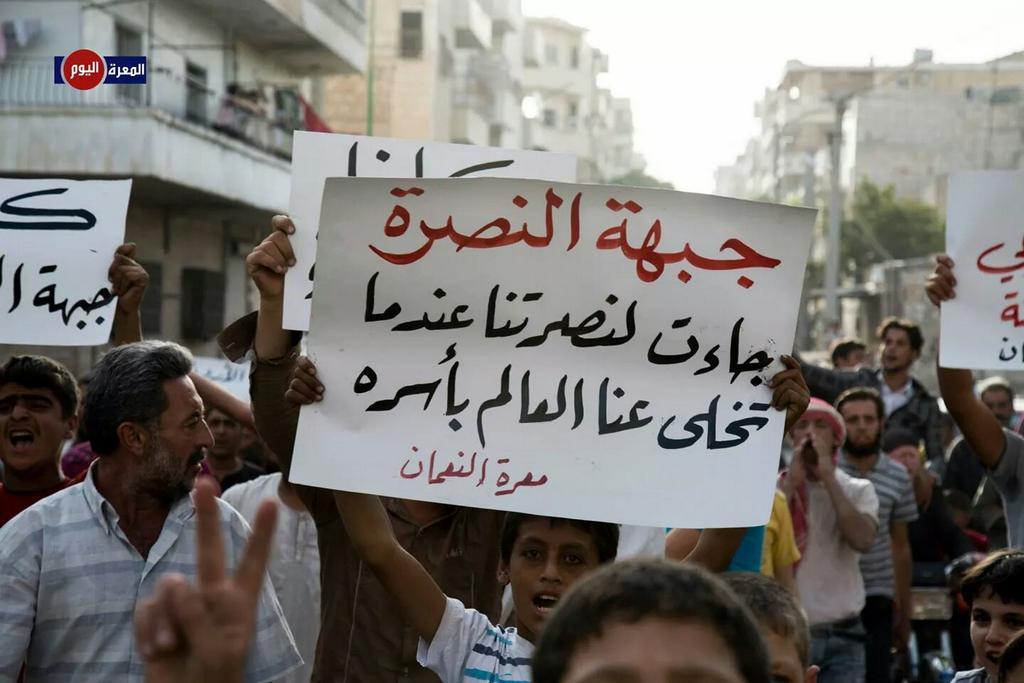
Second, it led to a surge of support to both ISIS and JaN – that ISIS would gain any support was remarkable in and of itself, yet pro-ISIS demonstrations erupted as far west as Idlib, where no ISIS existed; but since most Syrians found this unpalatable even in these circumstances, the swing to “anti-imperialist” jihadism went mostly to JaN. In mass demonstrations throughout Aleppo (https://pbs.twimg.com/media/ByTcYjYCcAEeOnA.jpg:large), Idlib (https://www.youtube.com/watch?v=Ww2LT-Wcpcc&feature=youtu.be) and Homs, demonstrators chanted “We are all Nusra” or “Jabhat al-Nusra came to support us when the world abandoned us” (https://pbs.twimg.com/media/ByTtNQkIYAETWtU.jpg:large).

Further, this also forced the rest of the FSA to take a stand; the US attack on JaN was mainly pressed the first week, and since then the US has focused more closely on ISIS, suggesting the aim was more to cause confusion, division and splits within the revolution camp rather than to militarily decimate JaN; in other words, the US was trying to force the FSA – especially those who had received a few TOWs – to show their worth by finally taking the US’ poisoned chalice. As my article showed (https://mkaradjis.wordpress.com/2014/09/25/syrian-rebels-overwhelmingly-condemn-us-bombing-as-an-attack-on-revolution), the rebels rightly overwhelmingly rejected this US trap and condemned the US attack as an attack in the revolution. This is probably the background to the more open declarations by US leaders in the last few weeks that the FSA is not part of its anti-ISIS strategy, that there is no coordination with the FSA, that the US does not trust the FSA, that the US plan to train “vetted” rebels to fight ISIS does not even mean the FSA, but rather the US will start from scratch, and that they must only fight ISIS and not the regime (http://www.thedailybeast.com/articles/2014/10/14/no-syrian-rebels-allowed-at-isis-war-conference.html, http://www.businessinsider.com.au/the-us-has-officially-given-up-on-the-free-syrian-army-2014-10, http://www.charlotteobserver.com/2014/10/15/5244747/its-official-us-wont-be-working.html#.VESY0hZ0Yg9#storylink=cpy, http://www.washingtonpost.com/world/national-security/syrians-to-be-trained-to-defend-territory-not-take-ground-from-jihadists-officials-say/2014/10/22/8ca13cf2-5a17-11e4-bd61-346aee66ba29_story.html).

The US had tested the FSA, and it has proudly failed this imperialist test (no doubt much to the chagrin of the pro-Genocide Regime sections of the western “anti-imperialist” left).

But this refusal of the FSA, including the SRF and Hazm, to be the Sawha would have made them safer from being painted as traitors by JaN. However, other factors militated against this. First, the opposition exile leadership (the Syrian Opposition Coalition) supported the US attack; second, even the mere fact that some FSA groups had received a few TOWs since April now opened them to accusations of being US agents, as was widely reported in the media, *despite their refusal to play this US game*. Especially since the US was so vocal about what it wanted to FSA groups to do with these weapons. In addition, their backers (the Saudis etc) were part of the US bombing coalition – ie, the US bombing-as-Assad’s-aircraft-coalition, as they see it.

In any case, another factor in JaN’s rapid victory was that the SRF did not really put up much of a fight. Maarouf explained that he withdrew from the villages in Jabal al-Zawiya to avoid massive civilian bloodshed all over Idlib. This suggests precisely that Maarouf still understood the disastrous nature of a full inter-rebel war (ie, he understood the poison of the US game which some accuse him of playing): an Idlib covered with inter-rebel blood will be the end of the revolution; and given JaN’s recent surge of power and obvious lust for conquest, such bloodshed was assured. Worse still, a frontal war may not have received broad rebel support (unlike the war on ISIS), and may also have led to a JaN-SRF war in Aleppo, Hama and the south.

On other hand, however, an Idlib turned into a Nusra emirate – as opposed to what it has been up to now, one of the strongest positions of the secularist FSA forces – is also a disaster. It would not be easy to be the ones making the tactical decisions about fight/no fight just now.

The US attack on Nusra and Islamic Front

On November 5, the US launched bombing raids on JaN and Ahrar Al-Sham throughout northern Idlib, on Harem, Sarmda, Kafer Darain, Bab al-Hawa, Rif Mahamyn, Binish, Basakba etc. These northern Idlib regions had not been involved in the Jan-SRF fighting in the south of the province.

The Pentagon claimed that these strikes “were not in response to the Nusrah Front’s clashes with the Syrian moderate opposition” in Idlib, and the “Khorasan” red-herring was again unearthed as the reason for the strikes on JaN (http://www.centcom.mil/en/news/articles/nov.-6-u.s.-military-forces-conduct-airstrikes-against-khorasan-group-terro).

However, one snag in that story is that Ahrar al-Sham was also bombed, even though no-one has connected them to “Khorasan,” and, for that matter, neither were they connected to the attack on SRF. Ahrar al-Sham said US strikes had levelled one of its bases near Bab al-Hawa, claiming 10 civilians, including children, were killed along with 16 AaS fighters, including the local commander, Abu- Taalha (http://www.dailystar.com.lb/News/Middle-East/2014/Nov-06/276728-syrias-ahrar-al-sham-says-coalition-strikes-on-it-killed-civilians-statement.ashx?utm_source=twitterfeed&utm_medium=twitter#ixzz3IN0xFtGL).

As Syria expert Thomas Pierret tweeted, “No doubt left: Asad now has an extra airforce with F22s in it.”

So, just as the US used the excuse of attacking ISIS in September to attack JaN, which was then largely allied to the Syrian rebels against the regime and ISIS, so now the US uses the excuse of attacking JaN to attack the mainstream Islamist Front.
The aim appears precisely to push the IF towards JaN, while pushing JaN towards ISIS, so that then the US and Assad can jointly bomb hell out of all of the “Islamic terrorists” together, and further split the FSA along the lines of solidarity with Islamists getting bombed versus joining US camp due to being pushed into a corner. And then the US can say “see, as we’ve said for years, the moderates are so small and ineffective, there’s no alternative to Assad if we want to defeat jihadists” and so on, the same game for years.

And the exile-based Syrian Opposition Coalition (SOC) played right into this trap by “requesting coordinated air strikes” on JaN, when I didn’t even hear Maarouf calling for them (http://tinyurl.com/mya4w4h). The only problem with US Sawha strategy was that they had been unsuccessfully goading the FSA to attack JaN first (so they could kill each other), whereas it was not the FSA but JaN that unwittingly played their game. The bombing of JaN, and even the neutral AaS, just after the Idlib events appears aimed at further trying to exacerbate the conflict and further try to force the FSA into the US pocket.

Faysal Itani gives a reasonably good summary of the US policy:

“From the start, the US-led air campaign in Syria—and the accompanying chorus of official statements—have endangered Syrian moderates. US airstrikes on JAN positions (including in Idlib) in the campaign’s opening days were an early indication that actual US policy was directly at odds with claimed US support for the nationalist opposition. While JAN is a US-designated terrorist group, it is also a potent actor in the beleaguered anti-regime insurgency that has received little US support. Relations between JAN and the mainstream insurgency had varied from hostility to uneasy cooperation against ISIS and the regime. Because the moderates are aligned with the United States, US airstrikes on JAN immediately produced a new and powerful rival to already vulnerable moderate forces. By striking JAN without sufficiently strengthening its moderate counterparts first, and promising (publicly, no less) to use them to fight JAN and not the regime, the United States made the opposition appear just threatening enough to provoke JAN, but not so threatening as to deter the jihadist group. The results are on clear display in Idlib” (http://www.atlanticcouncil.org/blogs/menasource/what-went-wrong-in-idlib?utm_content=buffer5ecba&utm_medium=social&utm_source=twitter.com&utm_campaign=buffer#.VFjjW_oeG2c.twitter).

Assad regime emboldened by US bombing

However, analysts need to get over the idea that the 4-year US policy is “misguided,” “ineffective” and so on. Taking into account the home truth that the US would in general much prefer the victory of a mega-capitalist tyranny over an armed revolutionary populace, the entire US strategy becomes very effective and deliberate.

As the regime bombs Idlib right at the same time as does the US, as has been occurring also in Aleppo, in Deir Ezzor and elsewhere; with appearances of US drones just before Assad bombings regularly reported; with statements by US and other western leaders daily becoming softer (ie, more honest) on Assad and his Iranian allies; as we read that “US officials are beginning to see Assad as a vital de facto ally in the fight” against ISIS (http://www.foreignpolicy.com/articles/2014/10/15/obama_turkey_islamic_state_terror_kurds_nato_invasion); as we read of the “belief in Washington that the fall of the Assad regime would be ill-conducive to what President Barack Obama views as the more urgent goal of defeating ISIS” and indeed “[The US] might even be nervous if the Assad regime were to go” (https://now.mmedia.me/lb/en/reportsfeatures/564187-turkish-intervention-talk-more-bark-than-bite); as a workshop of imperialist strategists organised by the Rand Corporation decided that “regime collapse, while not considered a likely outcome, was perceived to be the worst possible outcome for U.S. strategic interests” (http://www.rand.org/pubs/perspectives/PE129.html); it seems only the most still deluded by “anti-imperialist” illusions in the genocide-regime can’t see the US has emerged as Assad’s new air-force.

Certainly Assad knows it; “with global attention focused on the fight against jihadists, Syria’s regime has in recent weeks stepped up its use of deadly barrel bomb strikes, killing civilians and wreaking devastation. In less than a fortnight, warplanes have dropped at least 401 barrel bombs on rebel areas in eight provinces, according to the Syrian Observatory for Human Rights, an anti-regime monitoring group based in Britain.”

The Observatory said at least 232 civilians have been killed in regime air strikes, including barrel bomb attacks, since Oct. 20 (http://tinyurl.com/ozktbos). Regime helicopters barrel bombed a refugee camp in Idlib last Wednesday, killing and wounding dozens of people; then on November 5, the airforce bombed a school in Qaboun in the rebel-controlled Damascus suburbs, murdering 17 children. The regime’s everyday practice of torturing prisoners to death continues apace: last week “74 bodies of detainees tortured to death by Syrian security forces have been delivered to their families in the eastern towns of Homs province in four days” (https://zamanalwsl.net/en/news/7357.html). Roughly one Palestinian from the regime-besieged Yarmouk camp is tortured to death each day, as the regime maintains a criminal starvation siege and has now cut off water. As the regime steps up sieges of other Damascus suburbs, there are reports of 103 children and 5 adults who have died in Douma due to lack of food/medicine from the blockade (http://www.twitlonger.com/show/n_1sds5f3 ). The regime is also carrying out a genocidal siege of the Homs region of al-Waer, where tens of thousands of people are trapped, and hundreds have died, all entirely ignored by the whole world (https://www.zamanalwsl.net/en/news/7062.html).

Many have said the regime has been able to step up its war on the revolution because the US is taking care of its other enemy, ISIS; the regime has its back free, so to speak. The problem with this analysis is that even before the US intervention, ISIS wasn’t bothering the regime at all; the regime diverted no energy away from suppressing the uprising towards fighting ISIS at all; on the contrary, often enough, Assad and ISIS jointly attacked and besieged the FSA and its allied rebels.
Rather, the explanation is worse than that; the actuality of US intervention, in coordination with regime intelligence, has demonstrated to the regime in practice that imperialism is its ally as both bomb its country simultaneously.

Finally, back to Idlib

A final note on the Idlib events. How big a setback is JaN’s aggression against the SRF? This of course is too early to say.

First, why should it be considered a setback? Some are saying they are just as bad as each other, it is just a fight among thugs, or even that it is good that the clean JaN has driven out the corrupt FSA. This is entirely misguided.

Whatever the errors of its various components, the FSA stands for a democratic, non-sectarian Syria. JaN, whatever its compromises in practice with the FSA over the last year, is opposed to this and stands openly for a clerical regime which is explicitly Sunni-sectarian. While it has not in practice shown an ISIS-like tendency to openly slaughter minorities (despite some unclear or disputed cases), its explicit view that Alawites and Shittes can only be offered oppression under its rule can only strengthen the attachment of these minorities to the regime, despite the growing disenchantment among the Alawites with the regime, which includes open anti-regime demonstrations.

There is thus a huge difference between a JaN that is largely subordinate to the overall rebel alliance and an overconfident, aggressive JaN that seeks to become the dominant element.

The same applies if an arrogant JaN ruling unchallenged feels confident enough to impose a state of religious repression, even if to date it has not acted like ISIS. Unfortunately, Idlib JaN in particular looks headed that way, with a JaN “Islamic court in Darkoush executing a man and woman through stoning (https://t.co/TlrKDkEZOt). This is opposite of the liberatory spirit of the Syrian revolution, and most strikingly in Idlib, the heart and soul of the revolution in many ways, full of towns with names like Kafranbel, Saraqueb, Tatanaz and so on that supporters of the revolution recognise, where the most liberatory messages of the revolution have been projected to the world.

On a larger scale, a decisive JaN victory over secular or other non-jihadist forces plays directly into the hands of the US and Assad, and their “anti-terrorist war” discourse as explained above.

If SRF corrupt practices contributed to their own defeat, that of course should be criticised, but that does not alter the fact that they have thereby contributed to a setback for the revolution.

Second, however, we also need to assess what the extent of the JaN victory is over the secular forces.

Maarouf claimed “we liberated [Idlib] from the regime, and from ISIS, and we will liberate it from you.” It is hard to say how realistic this is. While evidence of Maarouf’s corruption suggests it is significant and he may have burnt some of his bridges with locals, an overconfident JaN will likely also burn its bridges with the populace if it imposes religious repression. This will be even more so if the suggestions that Idlib JaN is closer to ISIS than elsewhere.

Also, with SRF forces largely intact, their flow out of Idlib into neighbouring Hama and Aleppo may now boost the struggle against the regime on those fronts. Much has been claimed about SRF and Hazm troops defecting to JaN, but very little concrete evidence has emerged. In Syrian conditions, even defectors may essentially be doing “entry” work, like the FSA’s Raqqa Revolutionaries Brigade, which spent some 8 months inside Raqqa JaN before re-emerging in April (it is now also fighting in Kobane alongside the YPG against ISIS).

In addition, the refusal of other Islamist brigades to join JaN’s attack and their attempts to negotiate show a positive degree of coordination; it also suggests that if JaN over-reaches, it may end up encouraging a rebel coalition against it. It is also important to remember that while JaN is attacking other FSA units in the region, it may have much less dirt on many of them than it apparently has on Maarouf’s group – it may be one thing to defeat a group with a reputation and another to successfully rule an Idlib emirate with the rest of the FSA and IF subordinate or crushed. Large numbers of non-SRF FSA groups also still cover north-west Syria, and it is uncertain that even the SRF has been expelled from the whole of Idlib – the battles occurred in the south.

Despite the overall grim situation, as defense against criminal regime sieges becomes paramount in Aleppo, Hama, Homs and Damascus suburbs, all just as critical and horrific, if not far more so, than the ISIS siege of Kobane, we should remember that the Syrian revolution has often had a way of showing extraordinary resilience and coming up with bewildering surprises.

The Syrian Revolution and the struggle for Kurdish Liberation

The article linked to below is overall an excellent article. I don’t have a strong position on some of the allegations in this article about alleged past PYD collaboration with the regime; in my view its open position of “neutrality” was already wrong (as was the FSA’s refusal to recognise Kurdish self-determination). However, a number of the allegations seem serious, and the overall weight of evidence suggests that  at least not all was right in its relations with the regime at all times. My view has been that neither the FSA nor the PYD/YPG have ever been angels, both have skeletons in their closets, but that is only to be expected in conditions of revolutionary semi-anarchy and ferocious counterrevolutionary repression. Neither romanticisation nor demonisation will get us anywhere. The tendency of some to demonise the FSA while romanticising the PYD/YPG rests on blatant double standards and highly self-serving.

In any case, the fraternisation that is presumably taking place now between Arab and Kurdish revolutionaries on the ground in Kobani gives us cause for hope for evolution in the thinking of both sides. The heroic resistance of the YPG fighters, particularly their amazing women fighters who challenge the arch-patriarchal views of their barbarian ISIS attackers, have helped lead to this. However, the fact that the FSA units have essentially taken the shirts off their own backs by going to defend Kobani when their people are under continual genocidal siege by the Assad tyranny in Aleppo, Hama, Damascus etc also demonstrates amazing solidarity and is just as important symbolically as the Kurds’ resistance.

Many FSA units in the country have expressed annoyance, or worse, at the decision of some FSA units to aid the YPG given the incredible sieges they are under; they complain that, given the PYD’s “neutrality” (thus this does not even require the allegations of collaboration to be true), they have never had the benefit of YPG cadres coming to fight for them in their breathtakingly heroic resistance against amazingly murderous regime and ISIS sieges. That view is entirely understandable, and underlines the PYD’s political error. However, I believe the politics of those FSA forces who have gone to fight in Kobani is superior, in demonstrating the unity of the Syrian revolution and the power of solidarity, so that the result may well be a PYD/YPG more engaged with the rest of the anti-fascist resistance after this; with the FSA also getting up to speed on issues of national self-determination, and learning from the revolutionary political, social and economic transformations the PYD has been able to carry out in the 2 years since Assad left them alone.

These inspiring transformations are more advanced than, yet in many ways similar to, the kinds of transformative politics of revolutionary councils we saw elsewhere in Syria earlier in the revolution – while they still hang on in places, trying to make comparisons, let alone value judgements, is absurd, as it is clearly not so easy to carry out such revolutionary transformations when you are barrel-bombed, scud missiled, chlorine gassed, besieged, starved, burnt, tortured to death in massive numbers – the lot of the mostly Sunni Arab majority in Syria. “Neutrality” was never an option for those on the receiving end.

revolution101's avatarRevolution101

FSA and YPG units announce the formation of the Burkan Al-Firat coalition to combat ISIS and defend Kobanê. FSA and YPG units announce the formation of the Burkan Al-Firat coalition to combat ISIS and defend Kobanê.

The Kurdish people have entered a new phase in the struggle to control their future.  The current context is born of the Syrian revolution that emerged as part of the “Arab Spring” of early 2011. The outcome of the Kurdish struggle in Syria (and neighboring countries) is intimately tied to unfolding of the revolutionary civil war in Syria. Their heroic resistance in the northern Syrian town of Kobanê (‘Ayn al-Arab) against the fighters of the right-wing ISIS organization is just one part of it.

Importantly though the need to resist ISIS in the region of Rojava in northern Syria has brought together political groups which previously were facing-off against each other. The success of an allied force combining Kurdish YPG and forces aligned to the predominantly Arab Free Syrian Army (FSA) in…

View original post 1,296 more words

Critique of Patrick Cockburn’s ‘Whose Side is Turkey on?’

Critique of Patrick Cockburn’s ‘Whose Side is Turkey on?’

By Michael Karadjis

Introduction

The November 6 London Review of Books has published Patrick Cockburn’s latest article (http://www.lrb.co.uk/v36/n21/patrick-cockburn/whose-side-is-turkey-on), ‘Whose Side is Turkey On?’. Now, as I support the struggle of the Syrian Kurds, led by the PYD and its armed militia, the YPG, against ISIS’ genocidal siege, I have no interest in defending Turkey’s shabby role in this, even if I think both the US and Turkey, in their current difference on this issue are both being totally cynical in their different ways. So this critique will not deal with these issues.

Unfortunately, the angle from which Cockburn criticises Turkey is full of the same contradictions that significant parts of the left espouse, basked in an overall hostility to the Syrian revolution. Valid criticism of Turkey’s sabotage of the defence of Kobani – connected to Turkey’s own oppression of its Kurdish minority – is mixed in with criticism of Turkey for allegedly wanting to help overthrow the Syrian tyranny of Bashar Assad. As if there were something wrong with wanting the overthrow of a tyrant who has burnt his whole country, sending 1.5 million Syrian refugees into Turkey.

Indeed, the fact that Turkey plays an otherwise positive role (for its own reasons which I can’t go into here) in allowing Syrian resistance fighters to cross the border is labelled “facilitating ISIS”, as if the Syrian rebellion has anything to do with ISIS, its vicious enemy. Don’t get me wrong – Turkey may well be facilitating ISIS around the Kurdish regions of the north-east for specifically anti-Kurdish regions, but that simply has nothing to with its *rightful* facilitation of the anti-Assad rebellion elsewhere.

Unless one held the view that only the Syrian Kurds had the right to resist massacre, torture, ethnic cleansing and so on. After all, the Syrian rebellion, based largely among the vast impoverished Sunni Arab majority, has faced a regime that makes ISIS’ tyranny appear amateurish in comparison, and considering how barbaric ISIS is, this is a big claim, yet one that is simply empirically true.

Indeed, and I digress a little here – not understanding that it is the Syrian and Iraqi Sunni Arab populations that have been bombed to pieces, ethnically cleansed, dispossessed physically, politically and in every other way, by both the American invasion of Iraq and the Assad regime’s burning of its whole country to keep a narrow mega-plutocracy in power, is one of the keys to the left’s misunderstanding of many of these issues. It is the Sunni Arab populations of both countries that have suffered a decade-long apocalypse, not, overall, the Shia, Alawites or Kurds.

Who arms “jihadis”?

Referring to the “coalition” that the US has built to confront ISIS in Iraq and Syria, Cockburn writes:

“When the bombing of Syria began in September, Obama announced with pride that Saudi Arabia, Jordan, the United Arab Emirates, Qatar, Bahrain and Turkey were all joining the US as military partners against Isis. But, as the Americans knew, these were all Sunni states which had played a central role in fostering the jihadis in Syria and Iraq.”

Ah, no, they didn’t actually. And just because Cockburn continues to make that assertion, always evidence-free, doesn’t make a non-fact a fact. Actually, only less than 5 percent of ISIS funds came from outside donations at all, and of that, what came from the Gulf certainly didn’t come from the regimes (http://www.mcclatchydc.com/2014/06/23/231223/records-show-how-iraqi-extremists.html?sp=/99/117/).

“This was a political problem for the US, as Joe Biden revealed to the embarrassment of the administration in a talk at Harvard on 2 October. He said that Turkey, Saudi Arabia and the UAE had promoted ‘a proxy Sunni-Shia war’ in Syria and ‘poured hundreds of millions of dollars and tens of thousands of tons of weapons into anyone who would fight against Assad – except that the people who were being supplied were al-Nusra and al-Qaida and the extremist element of jihadis coming from other parts of the world’.”

Biden is here expressing the view of US imperialism which has been hostile to the Syrian revolution from Day 1 and hence sought to slander it is a “Sunni jihadist terrorist” war in the same way as does “the left”, except the latter believe they are saying something different from the former. Beats me why. And so while the US has generally used diplomatic means to try to curb Arab support for the uprising, or mild co-option (almost entirely unsuccessful since the US never offered more than the odd bone) of sections of its leadership (mostly the exile-based sections), Biden is the kind of guy who, like many others, lashes out with his honest opinion.

It is only in the imagination of those leftists who don’t view things through the angle of class that Biden is being truthful in his description of the entire revolution as nothing but a bunch of jihadis or that all the arms the Gulf sent to the uprising leadership ended up in the hands of “al-Qaida” etc – in fact, this is just US code for the entire revolution, from the most democratic and secular through the mildly Islamist through the harder Islamist through jihadist sections. But slandering it all as “al-Qaida” (like “the left” does) sounds better propaganda.

By pretending that it would like to support the secular or “moderate” rebels, those the media continually calls “western-backed rebels”, while for years explaining that it could give them nothing because anything it might give them would go to the jihadists, the US was just using code for its hostility to the secular FSA, while offering the pretence that of course it “would like to” back democratic, secular forces if it could.

The “left” then gets it all wrong and criticises the US not for the pretence, but because the left has fallen for the pretence, and then goes on to explain to US imperialism what the latter already agrees with “the left” on – that there can be no such thing as a Syrian “moderate,” if you give a gun to an Arab “moderate” he will inevitably give it to a jihadist, because such oriental folk are not to be trusted.

To repeat – the Gulf monarchies – ESPECIALLY Saudi Arabia and UAE – NEVER armed Nusra (let alone ISIS). Sections of the Gulf oppositional bourgeoisie did arm Nusra (I doubt even they armed ISIS) and these were precisely the sections who, like al-Qaida, see the Gulf monarchies as apostates who they aim to overthrow just as surely as they aim to overthrow non-Sunni or secular regimes.

Who is excluded from the anti-ISIS coalition?

Cockburn continues:

“He (Biden) admitted that the moderate Syrian rebels, supposedly central to US policy in Syria, were a negligible military force.”

1. No, the FSA was never central to US policy. Actually, they were central only in as much as the US wanted them destroyed. In recent weeks this has come right out in the open – the US has never trusted the FSA, it is not coordinating with the FSA in its bombing (in fact it is coordinating with Assad, sometimes very closely, and not only against ISIS), it does not see the FSA as having anything to do with its anti-ISIS strategy or coalitions, its money to train “moderates” in exile over the next 2 years or so does NOT mean the FSA but rather the US will build its own force from scratch, this puppet force will ONLY fight ISIS and NOT the regime, and even then only to hold territory rather than take it, etc etc. One only has to know how to read: http://www.thedailybeast.com/articles/2014/10/14/no-syrian-rebels-allowed-at-isis-war-conference.html, http://www.businessinsider.com.au/the-us-has-officially-given-up-on-the-free-syrian-army-2014-10, http://www.charlotteobserver.com/2014/10/15/5244747/its-official-us-wont-be-working.html#.VESY0hZ0Yg9#storylink=cpy, http://www.washingtonpost.com/world/national-security/syrians-to-be-trained-to-defend-territory-not-take-ground-from-jihadists-officials-say/2014/10/22/8ca13cf2-5a17-11e4-bd61-346aee66ba29_story.html.

2. “Negligible”. Again, by using the word “admitted,” Cockburn is falling for US propaganda while imagining himself to be criticising it. This of course is precisely the view recently expressed by dozens of top US and UK imperialist officials, military and intelligence leaders, former and current diplomats, CIA heads and countless others, to justify an accommodation with Assad. Before explaining why this is nonsense, let’s just put this together with another of Cockburn’s lines:

“Excluded from this bizarre coalition were almost all those actually fighting Isis, including Iran, the Syrian army, the Syrian Kurds and the Shia militias in Iraq.”

So let’s look at who Cockburn says are “actually fighting ISIS” in light of this claim about the “negligible” FSA.

1. Iran. Really? OK, yes, since the US began fighting ISIS in Iraq several months ago, Iran entered Iraq as a US ally. This alliance is growing daily, now described as “detente.” The coordination with Iran is open – no-one even tries to deny it any more (unlike the laughable denials about coordination with Assad). Whether Iran has been terribly effective against ISIS or not is hard to say since most actual fighting in Iraq has been done by Iranian-backed Iraqi Shiite militias, or Iraqi Kurds, not the few hundred Iranian “Revolutionary” Guard themselves, and has been done under the cover of US bombs. But this close coordination and growing alliance itself belies Cockburn’s claim that Iran is being “excluded” by the US from the anti-ISIS fight.

2. The Syrian Army. Poor Cockburn. He ought to do the research first. It is well-known among virtually all close Syria watchers that the Assad regime and ISIS didn’t fight each other for pretty much an entire year (that is, most of ISIS’ time in Syria) but both instead focused on fighting the FSA and other Syrian rebel groups, indeed often even jointly besieging towns and cities, such as with Deir Ezzor in mid-2014 after ISIS’ spectacular conquest of Mosul, and the last few months in Aleppo. Actually, the Syrian regime only began to change policy in mid-2014 and began bombing ISIS in Raqqa in the north east (from where ISIS had expelled the FSA) at the time the US began bombing ISIS in Iraq – in other words, *just like “anti-imperialist” Iran*, so likewise, the “resistant” Assad regime *only* began to bomb ISIS as a quasi-US ally. For a year, the grand, out in the open, ISIS headquarters in Raqqa had been untouched even though Assad had bombed everything else in the country to bits. And since that time, the Assad regime’s score sheet has been bombing several bakeries in Raqqa, along with scores of civilians, but when ISIS moved against the regime’s remaining air base in the north-west, regime “resistance” was a spectacular failure, and ISIS slaughtered several hundred poor Syrian regime cannon fodder following its victory.

3. The Shia militias of Iraq. I’m glad he didn’t say the US- and Iran-backed Iraqi Shiite regime, which ran away from Mosul with its tail between its legs. As for the Shia militias, Cockburn is referring to the Shiite sectarian death squads which are slaughtering and ethnically cleansing Sunni everywhere they go in Iraq, and are frankly no different at all from ISIS, even the penchant for beheadings is not much different. There’s been plenty in the media. They absolutely SHOULD be excluded, because they fight the Sunni people, not just ISIS, but as they are auxiliaries of the US-backed and armed Iraqi army, just how they are “excluded” by the US is anybody’s guess.

4. The Syrian Kurds. Yes, the YPG has valiantly fought ISIS, including in the initial phase in Iraq. But however you look at it, what the Kurds are good at doing is defending majority Kurdish regions from ISIS. ISIS’ base is among Sunni Arabs in both countries, so neither Shiite nor Kurdish forces can do much outside their own areas (except when Shiite sectarian death squads do to Sunnis what ISIS does to Shia). Are they being “excluded”? Well, initially they were in the sense that the US has long called the PYD/YPG’s Turkish-Kurdish partner, the PKK, “terrorist” and refused to cooperate with it in deference to Turkey, preferring to work with the right-wing and corrupt Iraqi Kurdish leadership.

However, like it or not “anti-imperialists,” the US engaged in its most intensive bombing of one spot anywhere in the Mideast region since Tora Bora in 2001 during its bombing of ISIS to defend Kobani, bombings which it carried out in direct coordination with the PYD/YPG, while also dropping arms directly to the YPG. We need to deal with facts, not our fantasies about where the PKK or anyone else sits within some “anti-imperialist” geopolitical schema – and these facts make the idea that the Syrian Kurds remain “excluded” absurd.

To clarify, the Kurds receipt of US weapons and benefiting from US bombing of ISIS is not a criticism of the PYD/YPG from the kind of rubbish “anti-imperialist” view that I oppose; under genocidal siege they can get help from wherever possible in the circumstances. However, it is a criticism of precisely this “anti-imperialist” logic as uninformed leftists have applied it to the FSA and Syrian rebellion over the last 3 years, so high time for leftist “anti-imperialists” to work through their contradictions – sorry, it is consistency or nothing.

5. I’m glad Cockburn was smart enough to not add Hezbollah to his list, as others sometimes do in similar silly lists of who they imagine to be “really” fighting ISIS, for example Tariq Ali in his recent interview with Cockburn. Hezbollah has spent a great deal of time in western Syria fighting for the Syrian tyranny against the FSA and other mainstream rebels’; ISIS has mostly been in the northeast. Thus Hezbollah has barely fought ISIS at all. Actually Hezbollah and ISIS mostly fight against the same people, almost never against each other.

So who has effectively fought ISIS?

OK, so apart from the Kurds *within the Kurdish regions*, who actually has successfully fought ISIS?

Oh, that’s right, that would be the “negligible” FSA and allied Syrian rebels. Which kind of makes a mockery of the continual discourse about them being “negligible,” “ineffective,” “disunited” etc etc, and therefore of no use against ISIS. Perhaps this chatter is aimed precisely at covering the fact that the last people US imperialism would ever want to actually support (as opposed to occasionally give some supportive words to) would be forces leading a popular revolution against a capitalist tyranny.

In July 2013, ISIS assassinated a prominent FSA leader, following months of low-level conflict, and the FSA declared “war” on ISIS. The following month, ISIS declared a campaign to “eradicate filth,” namely, the FSA. The problem between July and December was where the other non-FSA rebels (mostly Islamists of one stripe or another) would stand if the FSA’s war on ISIS moved from ongoing/sporadic to all-out attack, and how such fighting would play out given the absolutely greater degree of killing power possessed by the regime.

However, as ISIS continued to encroach on liberated Syria in late 2013 and impose a vicious new dictatorship, the rest of the revolutionary leaderships could see their revolution was being strangled. On January 3, the weekly Friday protests, co-ordinated nationally by the civil resistance (yes, it still exists), declared their theme to be that ISIS are foreign criminals that have nothing to do with their revolution.

The very next day – underlining continual coordination, whatever the weaknesses, between the civil and military resistance – the FSA, a new mildly Islamist-leaning coalition in Aleppo (Jaish Mujahideen), and the main militias of the Islamic Front launched a nation-wide, coordinated attack on ISIS.

In north-west Syria, one of the revolution’s heartlands (Idlib and Hama), the new coalition of FSA brigades, the Syrian Revolutionary Front (SRF), consisting of some 25,000 troops, played the major role in driving ISIS, root and branch, out of that entire region. In Aleppo, the FSA (including SRF) fought alongside Jaish Mujahideen and the Islamic Front and expelled ISIS from that region as well. Further east, the FSA and IF were joined by Nusra in expelling ISIS from Raqqa and Deir Ezzor, that is, pretty much right out of Syria considering ISIS’ negligible presence on the southern front, which is heavily dominated by tens of thousands of FSA troops (and more recently Nusra), and in Damascus, dominated by by the FSA and IF. Only in Raqqa did ISIS put all its energy into making a comeback and re-took the city as its capital, but failed to re-take Deir Ezzor.

After ISIS spectacular victory in Mosul in June 2014, it was re-energised with tons of advanced US weapons it had seized from the Iraqi army, and its victory there had a magnetic effect on jihadists previously less committed. From June, ISIS launched a new attack on FSA/IF/Nusra-held Deir Ezzor, and the city put up an epic resistance. The Assad regime aided ISIS by bombing the city, but not bombing ISIS. The rebels, completely surrounded, called for arms drops, announcing they could not hold out forever. The US, like in the last 3 years, made sure nothing like that occurred. ISIS seized the town and the rebels fled, but local Sunni tribes who had opposed ISIS rose up in rebellion, which was crushed by ISIS who then murdered 700 tribal opponents. An ongoing resistance in Raqqa and Deir Ezzor regions by local Sunni, the ‘White Shroud’ rebellion, kills ISIS scum in small-scale hits. The revolution is ongoing, taking many forms.

More recently, ISIS did appear around Damascus. The united rebel forces expelled them root and branch. Despite being expelled from Homs, ISIS has made a comeback in eastern Homs province. The city itself, of course, surrendered to the regime earlier this year – if you take a look at footage of Homs, you can understand that there are only so many Hiroshimas that a population can withstand.

Let’s be absolutely clear – the entire discourse about a “negligible” FSA that is “ineffective” against ISIS is bogus, and is propounded for a reason. Only a fool would deny the serious problems – political, material, coordination-wise etc – that do exist for the FSA and the revolution’s leadership more generally. There is no reason to romanticise – actually I’m not aware of any supporter of the revolution that does.

However, only someone who has simply ignored this real history would deny that the only forces in the entire region that have actually pushed back ISIS from a very significant amount of territory – much of Syria in fact – and crucially, pushed ISIS out of Sunni Arab regions, has been the FSA and its rebel allies, not anyone on Cockburn’s list.

Discussion welcome. But please argue against this conclusion with facts and evidence. Those who know my writing know that every claim I have made here can be backed up, but just to not slow myself down I’m sending out this one without my usual massive quantity of references which can be seen in all my other articles on this site.

Yet again on those hoary old allegations that the US has armed the FSA since 2012

Again on allegations that the US has armed the FSA since 2012

By Michael Karadjis

Ian Sinclair, in an article entitled “It never happened – US intervention in Syria” (http://www.huffingtonpost.co.uk/ian-sinclair/us-syria_b_5859930.html), writes:

“So to summarise, in mid-2012 the most influential newspaper in the world reported that the US was helping to arm the rebels,” and then goes to quote other sources that the US was not itself arming the rebels. His point being that although some mainstream media have already written what he thinks is the ‘truth,” most continue to deny this “truth.”

In reality, it is true that the US has not armed the FSA. As for the first part of his summary, regarding what the “most influential newspaper in the world” allegedly said, it all depends what “helping” to arm means, and the nature of this “help.”

At the end of his piece, Sinclair even throws that tiny bit of caution to the wind, criticising the western media for “refusing to inform their readers that *the US has been arming the rebels* in Syria since 2012.”

To be blunt, I believe that Sinclair, like many others, needs to “learn to read.”

The contention those who have actually studied the war have made is that the US never sent arms to the FSA. The articles Sinclair links to do not belie that. In none of the articles is the US providing arms.

No-one ever suggested that the US, as sensible (sometimes) imperialists, would not do what they could to co-opt any movement if it could. After all, for what is all the non-lethal aid that the US has supplied parts of the FSA – the tents, radios, night goggles and “ready-meals”, meant, presumably to fight MiG killer jets, ballistic missiles, barrel bombs etc – if not to try to co-opt whoever they can?

And so to summarise, the articles reveal that during 2012, the US became concerned about an existing “arms pipeline”, apparently set up via Qatari-Muslim Brotherhood networks, from Libya to bases in Turkey, and so moved in the CIA to try to control it, via limiting quantities of arms that got into Syria, ensuring the arms didn’t go to anyone the US didn’t like, and ensuring advanced weapons, especially anti-tank and anti-aircraft missiles, didn’t get to anyone. Thus the operation Sinclair talks about was a limiting operation.

When reading media reports from the time, what stands out is the glaring contradiction between certain reports of massive Saudi and Qatari (not US) arms being sent to Turkey and Jordan, and the constant reports from rebels on the ground that very little actually got into Syria.

For example, an article on the role of the CIA in Turkey (http://www.nytimes.com/2013/03/25/world/middleeast/arms-airlift-to-syrian-rebels-expands-with-cia-aid.html?pagewanted=all&_r=0) claimed the arms airlift from the Gulf “has grown to include more than 160 military cargo flights by Jordanian, Saudi and Qatari military-style cargo planes” landing in Turkey or Jordan since early 2012, estimated to be 3500 tons of military equipment.

Yet on the ground we read:

“Still, rebel commanders have criticized the shipments as insufficient, saying the quantities of weapons they receive are too small and the types too light to fight Mr. Assad’s military effectively … ‘The outside countries give us weapons and bullets little by little’, said Abdel Rahman Ayachi, a commander in Soquor al-Sham, an Islamist fighting group in northern Syria. He made a gesture as if switching on and off a tap. ‘They open and they close the way to the bullets like water’, he said.”

Thus rhetoric about “massive” quantities of arms going to the rebels from the Gulf and “escalating the war” needs to be taken with entire silos full of salt. What then is behind this apparent contradiction?

The article “Arms Airlift to Syria Rebels Expands, With Aid From C.I.A.” (http://www.nytimes.com/2013/03/25/world/middleeast/arms-airlift-to-syrian-rebels-expands-with-cia-aid.html?pagewanted=all&_r=0) from the March 24 New York Times, has often been quoted by those who want to show that the US is already involved. And the article does show this. But what it also shows about the US is far from what those highlighting this often want to show. Indeed, it is the CIA’s role in this operation that precisely explains the contradiction noted. One need go no further than the article itself, which describes the CIA’s specific role in the following terms:

“The C.I.A. role in facilitating the shipments, he said, gave the United States a degree of influence over the process, including trying to steer weapons away from Islamist groups and persuading donors to withhold portable antiaircraft missiles that might be used in future terrorist attacks on civilian aircraft. “These countries were going to do it one way or another”, the former official said. “They weren’t asking for a ‘Mother, may I?’ from us.”

“But the rebels were clamoring for even more weapons, continuing to assert that they lacked the firepower to fight a military armed with tanks, artillery, multiple rocket launchers and aircraft. Many were also complaining, saying they were hearing from arms donors that the Obama administration was limiting their supplies and blocking the distribution of the antiaircraft and anti-armor weapons they most sought.”

To summarise the article: the arming of the Syrian rebels was a Saudi-Qatari initiative, who were not asking US permission; the US steps in to help “coordinate” it by “limiting supplies”, “steering weapons away” from groups they don’t like, and making sure that none of the weapons the rebels actually needed to fight Assad’s heavy weaponry, e.g. anti-tank and anti-aircraft missiles, got through to the rebels.

Yes, that’s what happens when you actually read the article. But to make the point even stronger we can look at other articles from the period.

For example, a report by Nour Malas in the Wall Street Journal (http://online.wsj.com/article/SB10000872396390443684104578062842929673074.html) was even more explicit, pointing out that “the Pentagon and CIA ramped up their presence on Turkey’s southern border” precisely after more weapons began to flow in to the rebels in mid-2012, especially small numbers of portable anti-aircraft weapons (Manpads), some from Libya, “smuggled into the country through the Turkish border”, others “supplied by militant Palestinian factions now supporting the Syrian uprising and smuggled in through the Lebanese border”, or some even bought from regime forces.

“In July, the U.S. effectively halted the delivery of at least 18 Manpads sourced from Libya, even as the rebels pleaded for more effective antiaircraft missiles to counter regime airstrikes in Aleppo, people familiar with that delivery said.”

Exactly. So, if in doubt, “knee-jerk anti-imperialists” can do this little test. I’ll do it with you:

Q1: Do you, as a good anti-imperialist, believe the US/CIA should have got right out of this operation in Turkey referred to here?
A: From me: Yes. From you? I assume as anti-imperialists, Yes.
Q2: What would have been the effects of such a withdrawal?
A: I don’t need your opinion for Q2, the answer is factual: greater quantities of weapons would have got into Syria from Turkey or Jordan; a greater variety of rebel groups would have got these weapons without US “vetting”; actually useful to the rebels weapons, namely anti-tank and anti-aircraft missiles, would have got through to the rebels.
Q3: Given the answer to Q2, do you still have the same answer to Q1?
A: Me: Of course, that is what I want. You: I wouldn’t have a clue. You work out your confusion.

Interestingly, the situation in the south, in Jordan, was if anything worse, and an interesting prelude to the sharp US-Saudi spat we saw late 2013. Not because the Saudis wanted to arm Islamists and the US said no  – the US has always said no to arming Islamists, but that’s a different question – but because the US went out of its way to block the Saudis sending their weapons in Jordanian storehouses to the secular FSA southern resistance:

“While Saudi Arabia has built up large stockpiles of arms and ammunition for the Free Syrian Army, the US blocked shipments until last Thursday. The US and the Saudis are involved in a multilateral effort to support the insurgency from Jordanian bases. But, according to the sources, Washington had not only failed to supply “a single rifle or bullet to the FSA in Daraa” but had actively prevented deliveries, apparently because of concerns over which factions would receive the weapons. The situation also appears to be complicated by Jordan’s fears that arms might find their way back into the Kingdom and contribute to instability there. The sources said the Saudi-backed weapons and ammunition are in warehouses in Jordan, and insurgents in Daraa and Damascus could be supplied “within hours” with anti-tank rockets and ammunition. The Saudis also have more weapons ready for airlift into Jordan, but US representatives are preventing this at the moment” (http://eaworldview.com/2013/06/23/syria-special-the-us-saudi-conflict-over-arms-to-insurgents).

This report, incidentally, makes clear that the famous incident of the glaring failure of the exile-based military leadership in Jordan to supply weapons to the rebels in a strategic south Syrian town that the Assad regime then conquered, around mid-2013, was directly due to US pressure.

Despite all this, once can’t but help notice that one of the pieces Sinclair “quotes”, while still not directly saying the US sent arms, seems to say that the US actually delivered these non-US arms directly to the rebels. Sinclair writes:

“In June 2012 the New York Times, published a report headed ‘CIA Said To Aid In Steering Arms To Syrian Opposition.’ According to the report ‘a small number of CIA officers are operating secretly in southern Turkey’ coordinating the delivery of arms to rebels in Syria, including ‘automatic rifles, rocket-propelled grenades, ammunition and some antitank weapons’.”

You note where Sinclair carefully drops the quote marks. The way he has constructed this sentence can make it mean whatever anyone wants. It is obvious what Sinclair wants it to mean. Better however to go to the source. It says:

“A small number of C.I.A. officers are operating secretly in southern Turkey, helping allies decide which Syrian opposition fighters across the border will receive arms to fight the Syrian government, according to American officials and Arab intelligence officers.

“The weapons, including automatic rifles, rocket-propelled grenades, ammunition and some antitank weapons, are being funneled mostly across the Turkish border by way of a shadowy network of intermediaries including Syria’s Muslim Brotherhood and paid for by Turkey, Saudi Arabia and Qatar, the officials said.”

Thus, others, such as the Muslim Brotherhood, were distributing the weapons, already distributing to the rebels before the CIA showed up, indeed got the actual weapons to Turkey in the first place . The only role of the CIA, once it later showed up, was to try to influence the process of who gets the weapons and who doesn’t. As the article further elaborates:

“The C.I.A. officers have been in southern Turkey for several weeks, in part to help keep weapons out of the hands of fighters allied with Al Qaeda or other terrorist groups, one senior American official said.”

Another article, “U.S. Bolsters Ties to Fighters in Syria” (The Wall Street Journal, June 13, 2012, http://online.wsj.com/news/articles/SB10001424052702303410404577464763551149048?mg=reno64-wsj&url=http%3A%2F%2Fonline.wsj.com%2Farticle%2FSB10001424052702303410404577464763551149048.html), usefully discusses some of the purposes of the operation:

“The U.S.’s stepped-up links with the FSA are also part of an effort to gain a better understanding of the rebels’ capabilities and of the identities and allegiances of fighters spread in disparate groups across the country, the U.S. officials said. The U.S. officials remain wary of some rebels’ suspected ties to hard-line Islamists, including elements of al Qaeda …” Some of [this communication] is dedicated to figuring out who these people are by talking to them,” said a U.S. official briefed on Syria.” The article further down explains that the US is also concerned about the role the Muslim Brotherhood was playing in the conflict, ie, the very organisation allegedly involved in the pipeline.

More on that murky 2012 stuff on the Turkish border, I think this article from the Australian (originally from Sunday Times) gets the emphasis right, as can be seen from the title: ‘CIA polices weapons entry to Syria as spooks invade Turkey’ (John Follain and Tony Allen-Mills, August 13, 2012, http://www.theaustralian.com.au/news/world/cia-polices-weapons-entry-to-syria-as-spooks-invade-turkey/story-fnb64oi6-1226448705909). The article reads in part:

“Despite mounting calls in Washington for a more aggressive US military role in Syria, the CIA has been quietly working along its northern border with Turkey to limit the supplies of weapons and ammunition reaching rebel forces, Syrian opposition officials say.

“Over the past 10 months, a Syrian opposition official told The Sunday Times, the CIA has blocked shipments of heavy anti-tank and anti-aircraft weapons, which rebel units of the Free Syrian Army have long said are vital to their efforts to overthrow the regime of President Bashar al-Assad. At the same time they have approved supplies of AK-47 Kalashnikov rifles, and just over a month ago gave the green light to a shipment of 10,000 Russian-made rocket-propelled grenades.

“The weapons are either bought on the black market in Istanbul or supplied by the rebels’ allies in Turkey, Qatar and Saudi Arabia.

“Yet rebel frustration is mounting at the CIA’s reluctance to allow heavy weaponry across the border for fear that it may eventually be used against America’s allies.

“The RPGs aren’t enough,” the opposition official said. “You have to be close to the tank to make any impact, and often the fighter using it gets killed” (probably the CIA’s aim – MK)

“Bob Grenier, a former director of the CIA counter-terrorism centre, said the CIA’s policing activities along the border were intended to protect the administration from future embarrassment if the rebel groups it supported turned out to be hostile to Israel or the US should they gain power. “It would not be good if it was later established that weapons reached people identified with al-Qa’ida, and we could have done something about it,” he said.

“The CIA vetoes al-Qa’ida and it’s not very keen on the Muslim Brotherhood,” a Syrian opposition official said.”
………………………………………………………………………………………….

Where does all that leave Sinclair? I would say this is part of the well-discussed phenomenon of the decline of left journalism due to the Syria crisis, with reference to Cockburn, Fisk, Hersch and the like.

By the way, Harold Pinter, whose quote “It never happened” Sinclair uses to make his point, is dead, and has no way to defend himself from being associated with apologists for a fascist dictatorship that has killed 190,000 people and destroyed every city in its country just to keep a narrow mega-capitalist clique in power.

Sinclair ends his piece by claiming that “by so closely following the US and UK Governments’ preferred narrative, the media continues to minimise the US’s responsibility for the on-going carnage in Syria and the rise of Islamic State.”

Since this doesn’t make sense at all, I can only attempt to interpret it. I think he means that by arming the FSA, which he alleges (but fails to demonstrate) the US was doing “since 2012,” this led to the rise of ISIS, because he is shameless enough (like countless other “left”, right and mainstream imperialist journalists) to try to shove together the secular FSA, the moderate Islamist groups, harder Islamists, al-Qaida and ISIS as all much the same thing. He apparently believes, like most imperialist media by the way, that everyone fighting in Syria against the regime is a “jihadist”, some more open than others, that anti-Assad Syrians are by definition all “extremists,” that there cannot be such a thing as an anti-Assad “moderate,” that if you give a gun to an Arab moderate he will automatically give it to a jihadist, and other such breathtakingly racist and orientalist garbage.

The allegation is all the more disgusting given that it has only actually been the FSA and its allies that have fought ISIS, and earlier this year valiantly pushed ISIS out of large parts of Syria, at a cost of thousands of fighters’ lives. If only they did have the weapons Sinclair falsely alleges they have they could have done an even better job.

Question: why do people like Sinclair write things that simply don’t make sense? In fact, he answers this himself, just that he isn’t looking in the mirror when he does so:

“There is a certain discourse that becomes normalized, in which certain views are acceptable and others not.” In this atmosphere, if you make obvious factual statements “you are often marginalised as some sort of looney figure … It is through this process that the mainstream media basically becomes a tool of misinforming people, rather than informing people.”

Yes, not just the mainstream media, but its “anti-imperialist left” echo as well. Sinclair, for example, for repeating this imperialist propaganda that any arms sent to the FSA will inevitably fall into the hands of the jihadists.

Ironically for these “anti-imperialists,” from April 2014, the US actually did start to send a handful of TOW anti-tank missiles to a handful of FSA groups in the context of the FSA’s magnificent attack on ISIS from January 2014. The US had always insisted the FSA had to first attack ISIS and Jabhat al-Nusra before the US would consider sending any arms. The FSA had always refused to be the “Sawha” (ie, the name of the Iraqi Sunni forces backed by the US and Saudis that defeated al-Qaida in Iraq in 2007-8). But since ISIS fascism became unbearable, the FSA went to war on ISIS from August 2013, and then the FSA and its allies decided, in January 2014, based on their own needs and not those of the US, to launch a nation-wide, coordinated, frontal attack on ISIS, with no military support from the US (but not on Nusra, which in fact joined the FSA/IF attack on ISIS).

So some months after this, the US, which had never armed them against Assad, decided it was time to test them out. The TOWs were never very many (here’s a good article on the reality of these shipments: http://www.latimes.com/world/middleeast/la-fg-syria-harakat-hazm-20140907-story.html#page=1); in some cases the US tried to get them to attack Nusra as well as ISIS, but they refused; in other cases they explicitly gave them weapons to fight ISIS only but not the regime (I have documented all this here: https://mkaradjis.wordpress.com/2014/06/25/iraq-and-syria-the-struggle-against-the-multi-sided-counterrevolution/).

The outcome of this? For brave, “anti-imperialist” leftists on their computers in the West, they would be sure this meant the FSA was now bought by the US, since they have bravely asserted this for years. And yet, virtually all the FSA and rebel units and coalitions on the ground, including virtually all the groups that got a few TOWs, have condemned the current US bombing of Syria as an attack on the revolution, and stand in solidarity (even if holding their noses) with Nusra, which came under US attack from the very first day of the US intervention “against ISIS.” Above all, the 7000-strong FSA militia Harakat Hazm – the first to famously receive TOWS in April 2014, discussed in that LA Times piece I just linked to – came out with the best and strongest anti-imperialist statement condemning the US bombings (see my new article detailing the reactions of the bulk of FSA and allied rebel units to these strikes: https://mkaradjis.wordpress.com/2014/09/25/syrian-rebels-overwhelmingly-condemn-us-bombing-as-an-attack-on-revolution/). No surprise, therefore, that Harakat Hazm stopped receiving US TOWs, and indeed, by the end of 2014, the TOW program as a whole had dwindled to nothing.

Revolutionaries that face the actual heat of the double battle against a fascist regime that dwarfs most of the Latin American tyrants of the 1970s-1980s, and a clerical-fascist ISIS as well, who have to make real decisions in these circumstances, receive a handful of half-useful arms after being starved of them for years against such massively armed opponents, and then when the US attacks their country “to help them” they take a principled revolutionary stance. Meanwhile other “revolutionaries” who have never had to make these kinds of decisions in their lives, and never will, content themselves with sitting back and condemning the revolutionaries in Syria for dirtying their hands by finally receiving a little something from the West (never mind that what they need for defense against the regime’s mostly air war is Manpads, which the US Congress explicitly forbade sending).

What is it that causes leftists to think that it is a big deal, that they should “expose,” if those fighting against such a mass-murderous, massively armed, fascist tyranny waging unlimited war on its population, get some arms that, I guess, they are “not supposed to” get? As I’ve repeatedly said, I’m in favour of them getting whatever weapons they can from whoever they can. Just as I would have been for the FSLN, FMLN, MIR, Tupumaros, and all the other Latin American armed movements that fought various lighter shades of Assadist regimes.

Hell, sometimes it was more than just a few arms. In 1994, the US invaded Haiti to bring the leftist Aristide back to power, overthrowing the Assadist-style Cedras tyranny. From memory, I don’t think that meant “revolutionaries” therefore backed Cedras and opposed Aristide. Even though Latin America had always been “easier” than the Middle East, this issue (and likewise the US invasion of Panama that ousted the CIA’s former stooge Noriega) showed even Latin America could be “complex.” A quarter of a century later, some are still confused.

We’ve come a long way when that is the distinction between revolutionaries and “revolutionaries”.

Syrian rebels overwhelmingly condemn US bombing as an attack on revolution

By Michael Karadjis

In extraordinary developments, the United States, Saudi Arabia, the United Arab Emirates, Qatar and Jordan have launched a joint air war, on Syrian territory, with the full support of the Syrian tyranny of Bashar al-Assad, on the Islamic State of Iraq and Sham (ISIS).

There are plenty of good reasons to oppose any US war in any circumstances; and in this case, a war that is targeting only the Sunni-sectarian ISIS, yet sparing the viciously anti-Sunni Assad regime, indeed collaborating with the regime, which is responsible for a hundred times more massacre and destruction than ISIS, with which it has long collaborated in any case, is likely to boost support for ISIS among a large section of the poverty-stricken, dispossessed Sunni majority.
However, ISIS is so reviled that it was just possible a very well-targeted war on ISIS may have won some hearts and minds. Certainly, even for those of us solidly anti-war, there should be no talk of “defending” ISIS, whatever that may mean. Likewise, if last year’s proposed (in my view imaginary) US attack on the Assad regime had become reality, it would have been necessary to oppose the war without giving a skerrick of “defense” to the genocidal regime that had just gassed hundreds of sleeping children to death with sarin.

The US launches war on Jabhat al-Nusra

However, the US is not only attacking ISIS – which the Free Syrian Army (FSA) and the united rebel alliance has been at war with for the last year – but from the outset has also attacked Jabhat al-Nusra (JaN). Despite also being a sectarian organisation which the FSA will have to deal with in the future in its own time, based on its own decision-making, JaN has for the most part been fighting on the side of the FSA and the other rebels against both the Assad regime and ISIS.
There have also been unconfirmed reports that the US has attacked Ahrar al-Sham in Aleppo – AaS is what might be called the most “jihadist” wing of the Syrian rebels other than JaN, which, however, unlike JaN, is not associated with al-Qaida. AaS has been operationally allied to the Free Syrian Army (FSA) and, along with the FSA, has been at war with both the regime and with ISIS. US officials seemed unconcerned by the possibility – one explained “we’re characterizing our targets as Khorasan and [ISIS] but it’s possible others were there. It is a toxic soup of terrorists” (http://www.buzzfeed.com/mikegiglio/us-goes-to-war-with-jabhat-al-nusra#39p8mlr).

In other words, the US and its allies have taken advantage of the revulsion against the clerical-fascist ISIS barbarians to launch an attack on the Syrian revolution on behalf of the secular-fascist Assad regime.

According to early reports from the Syrian Observatory for Human Rights, US air strikes killed 50 Al-Nusra militants and eight civilians, including children, in northern Syria on Tuesday (http://www.dailystar.com.lb/News/Middle-East/2014/Sep-23/271641-eight-civilians-30-fighters-killed-in-us-led-strikes-on-nusra-front-in-syria-activists.ashx#ixzz3E8z2uYK4). “Northern Syria” here refers to Idlib and Aleppo.

For the record, there is no ISIS whatsoever in Idlib – ISIS was driven out root and branch by the FSA’s Syrian Revolutionaries Front (SRF) in January, probably the most successful anti-ISIS operation carried out by any of the forces at one time or another fighting ISIS, whether the Syrian Army, the Iraqi Army or the Kurdish forces.

Yet while ISIS is comprehensively absent, the US air force launched a series of air strikes on the Kafr Dariyan region of Idlib, killing dozens of al-Nusra militants, while the civilian death toll shot up considerably compared to the initial reports (https://www.facebook.com/RadioFreeSyria/posts/706573779427832). Here’s also video footage of this terror: https://www.youtube.com/watch?v=dnQMgCo0Z2I. According to Nusra, their weapons factory near Sarmada in rural Idlib – where they produce weapons to fight the regime and ISIS – was targeted by US airstrikes (https://twitter.com/JihadNews2/status/514264176060301312).

In particular, given the grave situation in Aleppo, where the revolutionary forces are being jointly besieged from the south and the north-east by Assad and ISIS, the fact that the first US attacks were on JaN inside Aleppo – where JaN is playing an important role in the epic defense of the rebel-held, working—class, half of that city, alongside the FSA and other Islamist groups – is perhaps the most blatant attack on the revolution possible.

Perhaps once the revolutionary forces have been crushed in Aleppo, Assad and ISIS may fight: the former will then present the world with a fait accompli, it’s my regime or ISIS, while the latter will present the impoverished, Assad-hating Sunni masses with precisely the opposite dilemma.

That is why the defense of Aleppo now is all important. And at precisely that moment, dozens of Nusra fighters have been slaughtered by US bombers right there, in Aleppo. According to Nusra, “US airstrikes (with the help of Qatar, KSA, Jordan, UAE) hit positions of Jabhat an Nusra in Rural Muhandiseen Aleppo” (https://twitter.com/JihadNews2/status/514264771060072449) and scores of fighters were martyted in Jabhat al-Nusra headquarters in Urm al-Sogra, Aleppo (https://pbs.twimg.com/media/ByM2AKsCcAEO31v.jpg:large).

Oddly, US warplanes have also bombed positions in Jabal Sha’er in Homs countryside, killing some Bedouins (https://twitter.com/SN4HR/status/514407392801718272). It is unclear what the intended targets were.
Seniorj Jabhat al-Nusra leader, Muhsin al Fadhli, was martyred by the US bombing (https://pbs.twimg.com/media/ByNu9kqCcAAjfSE.jpg:large), as was Abū Yusuf at-Turkī, Nusra’s no.1 sniper, in US air strikes on Idlib.
The Assad regime must be very pleased with having acquired for itself a new airforce.

Some background

These developments are remarkable not for the fact they happened – this was basically my exact prognosis in June (www.links.org.au/node/3928) based on class analysis – but rather in its sheer brazenness and rapidity. That a US attack “on ISIS’ in Syria will become an attack on the revolution, via the device of attacking al-Nusra. Despite the jihadist Nusra leadership, much of its ranks are decent revolutionaries, often former FSA cadre just going where the money and arms are; and despite some its recent provocations (caused by the impact of ISIS’ victory in Mosul on the more jihadist part of the ranks), it still mostly fights the regime and ISIS. Attacking JaN is a way of attacking the revolution, just as the US has been trying to turn the FSA into a Sawha against JaN (not only against ISIS) since 2012 (http://www.thenational.ae/…/americas-hidden-agenda-in…). The FSA has always rejected this imperialist “advice.” According to FSA Colonel Akaidi last year, the US wants to turn the FSA “into the Sahwa,” but “if they [the US] help us so that we kill each other, then we don’t want their help” (http://www.ft.com/…/71e492d0-acdd-11e2-9454…). Then we had the recent UN resolution against ISIS that just happened to also be against JaN as well, nicely slipped in by Obama.

Assad regime hails US attacks

Furthermore, all this is in the context of the open collaboration between the US (and its Saudi, UAE etc allies) and the Assad regime, which the US informed of the attacks, with which the US is sharing intelligence, and which has expressed strong support for the US attacks on its own country.

Ali Haidar, Syrian minister for national reconciliation, told Reuters:

“As for the raids in Syria, I say that what has happened so far is proceeding in the right direction in terms of informing the Syrian government and by not targeting Syrian military installations and not targeting civilians” (http://www.reuters.com/article/2014/09/24/us-syria-crisis-minister-idUSKCN0HJ19S20140924?utm_source=twitter).
The US strikes have of course killed some dozens of civilians, but that is hardly a concern of a regime that has killed so many tens of thousands of civilians, as a grand underestimate.

Meanwhile, the pro-government news network Damascus Now hailed the strikes as a historic moment, in which “happiness was etched on the faces of the majority of Syrians, because they found international support towards eradicating a cancer which has been rooted in the diseased Syrian body,” referring to the rebels (http://syriadirect.org/rss/1580-syria-direct-news-update-9-24-14), and the regime’s Al-Watan newspaper declared “the US coalition and the Syrian Arab Army are on the same front against terrorism” (https://twitter.com/MousaAlomar/status/514789879180701697/photo/1).

Mass revulsion against US strikes

Revulsion has erupted right across Syria. In mass demonstrations throughout Aleppo (https://pbs.twimg.com/media/ByTcYjYCcAEeOnA.jpg:large), Idlib (https://www.youtube.com/watch?v=Ww2LT-Wcpcc&feature=youtu.be) and Homs, demonstrators chant “We are all Nusra” or “Jabhat al-Nusra came to support us when the world abandoned us” (https://pbs.twimg.com/media/ByTtNQkIYAETWtU.jpg:large).

Now, as stated above, I certainly don’t love Nusra. But these chants mean the people identify with those getting bombed by Assad’s newly acquired airforce. For those who want to emphasise the reactionary nature of the Nusra leadership (which I would distinguish from its ranks), this development underlines the fact that creating counterrevolution works in differing ways: one way is to directly militarily attack a militia, like Nusra, that *at this point* is on the side of the revolutionary forces; another is to put extra pressure on the more pro-Western elements within the FSA to take the US side against Nusra, thus weakening and splitting their forces on the ground; and a third way is precisely allowing Nusra to denounce anyone who doesn’t support it now as a US agent, thus exactly strengthening Nusra, the most jihadist pole, within the anti-Assad, anti-ISIS front.

Though this is by no means straightforward. The “we are all Nusra” chants may simply be identifying with those under US attack rather than expressing political support for Nusra; thus these demonstrations could equally be seen as a new, clearer anti-imperialist grounding of the revolution. It may take some time to work through what this dilemma means.

But worse is the fact that by allowing its attack on ISIS – who everyone hates – to become an attack on Nusra, and a collaboration with the regime, which all rebel forces and most of the impoverished, dispossessed Sunni masses see as their main enemy, the attacks have also led to a surge in support for ISIS in some quarters. To see mass demonstrations in support not only of Nusra, but also of ISIS, in areas as far west as Homs (https://www.youtube.com/watch?v=AlsxciMWxQQ&feature=youtu.be), and Idlib, underlines the multiple ways in which imperialist attack promotes counterrevolution: a mass demonstration supporting ISIS even occurred in Kafranbel in Idlib (https://www.youtube.com/watch?v=o2WegUb7Omc&feature=youtu.be, https://www.youtube.com/embed/V3-BRbeGmTI?feature=player_detailpage), the very heart and soul of the revolution!

The reactions of the FSA and other rebels

In any case, it is the reactions from the FSA and other rebels which are most remarkable.

One of the first statements condemning the US attacks came from Harakat Hazm, a 7000-strong secular FSA militia operating mostly in Hama. Hazm stated (23/9/2014):

“The Hazem Movement rejects the external intervention of the US Coalition, which launched its first airstrikes on Tuesday in the governorates of Deir el Zour, Raqqa, al Hasaka, Aleppo, Idlib and Homs, with 11 civilians killed in rural Idlib province and five others in rural Homs province, as well as fighters from Jabhat al Nusra and the ISIS.

“These air attacks amount to *an attack on national sovereignty* and work to *undermine the Syrian revolution* and demonstrate the international community’s continuing ignorance of the demands of the Syrian revolution and failure to provide unconditional military aid to the FSA is simply an indication of massive failure and a harbinger of further catastrophes that will harm the entire region.

“We of the Hazem Movement hereby reaffirm our full commitment to the principles of the revolution, and emphasize that *our actions are guided solely by revolutionary principles and national interest, not by the demands of the international coalition.*

“We also affirm that the international community’s unilateral decisions taken in an effort to win public support globally will not succeed in combating extremism, but will actively promote its growth. The only way to achieve the peace in the nation and region will come through fulfilling the aspirations of the people of Syria at the hands of Syrians.

“The only beneficiaries from the US coalition’s military intervention will be the Assad regime, in the light of an absence of any real strategy to oust it, and the regime will spare no efforts in its attacks on civilians in its attempt to rehabilitate itself internationally.

“We pray for mercy for our martyrs, healing for our wounded, and freedom for the detainees imprisoned in Syria, and life and freedom for our beloved people” (https://pbs.twimg.com/media/ByPSsxMIYAQy2Wt.jpg).

One of the extraordinary things about this statement is that, after all the years of “leftists” falsely asserting that the US was arming the FSA, when in fact it never sent them a bullet, is that Hazm is precisely one of the very few FSA units that *did* receive a handful of US anti-tank weapons beginning in April 2014. It was never very many, but Hazm could possibly have expected more if it palyed ball. This magnificent declaration indicates that while the US might be able to buy some dozens of puppets here and there, it is very difficult to buy an army of 7000 fighters to be your puppets.

Meanwhile, Jaish al-Mujadeen, a markedly soft-Islamist coalition that was set up last December and which then played a major role, alongside the FSA and important components of the Islamic Front (of which it is not a member), in driving ISIS out of Aleppo in January, also condemned the US attacks and said their aim was to put down the rebellion (https://www.youtube.com/watch?v=9ClRaIMESbk&feature=youtu.be).

Abu Ratib, head of the Sufi-led Al-Haq Brigade, part of the Islamic Front, termed the intervention “a total war against Muslims” (http://syriadirect.org/rss/1580-syria-direct-news-update-9-24-14); Suqour al-Sham, the main Islamic Front unit in Idlib, condemned the airstrikes and said they “will breed more extremism and terrorism” (https://twitter.com/zaidbenjamin/status/514831422675513344/photo/1); the Army of islam, the IF unit in Damascus, which drove ISIS out of the Damascus region several months ago, also condemned the strikes; the secularist FSA Forqat 13 issued a statement condemning US-led airstrikes as “aimed at weakening the revolution” in Syria (https://pbs.twimg.com/media/ByTaFn8IEAAANl3.png:large).

Then in a joint statement, the Syrian Revolutionaries Front (SRF – the major secular FSA coalition in the north-west, which single-handedly drove ISIS out of Idlib in January), Jaish al-Mujahidin, Al Zinki, Hazm and others condemned the US airstrikes, declaring “you help Bashar” (https://pbs.twimg.com/media/ByUiHcTIMAAmTDF.jpg).

So while we haven’t yet accessed statements from every group, it is clear all the major groups have declared solidly against the US air war.

In similar vein, Syria’s Muslim Brotherhood spokesman Zuhair Salem declared “A new killer joins the band of the Syrian people killers. The war on Da’ash is an American pretext to continue the war on the Syrian revolution. We won’t wait for long to watch how the American war is eating revolutionary forces. We condemn the American crime of the aggression on Syrian territories” (https://twitter.com/zaidbenjamin). Earlier, a statement by the Syrian Islamic Council, close to the Muslim Brotherhood, rejected intervention in Syria by Western countries and their allies in the region. It condemned “the silence of the international community, Governments and organizations, at the daily massacres against the Syrians, with all kinds of internationally proscribed weapons, by the Assad regime,” describing the US move against ISIS in this context as a double standard (https://twitter.com/troublejee/status/510618525736894464). The MB itself rejected any collaboration with the US attack on ISIS unless the first bomb lands “on Assad’s head.”

Finally, the founder and former leader of the FSA, Colonel Riad al-Asaad, who still has significant influence, declared “The Coalition kills the remaining children that the Syrian regime couldn’t kill” (https://pbs.twimg.com/media/ByO1CbHIIAABquB.jpg:large). Earlier, he had already declared that the FSA will not collaborate with the US in the war against ISIS, claiming the US is working to destroy the FSA, noting that since 2011 the Americans promised aid that never materialised, and meanwhile they worked to split the rebels and to help al-Assad.

Asaad claimed that the real target of the strikes would not be ISIS, but rather “the Syrian revolution will be eliminated under this pretext.” He also called on moderate rebels to make efforts for more unity to revive the Syrian revolution after having been hijacked by radical Islamist groups and West-backed agendas. “We are looking for rebel commanders who share us the national concern” (https://www.zamanalwsl.net/en/news/6704.html).

The Local Coordination Committees of Syria (LCCs), a grassroots network that coordinates civil disobedience and other non-violent campaigns, was a little more ambivalent, but have been documenting the civilian and other deaths from US air strikes. The LCC declared that “an end to the Islamic State needs to happen concurrently with an end to the equal terrorist threat represented by Bashar al-Assad’s regime,” and note that they “are herewith confirming their previous stances considering Assad’s regime the foremost enemy of the Syrian people and assuring that extremism and terrorism were the products of the regime’s crimes.”

LCC also emphasised the following:

1- Assad’s regime is holding the sole responsibility of this violation of the Syrian State’s sovereignty since it was the first to do that bringing the sectarian death militias from Iran, Iraq and Lebanon.
2- Assad’s regime and ISIS are alike when it comes to terrorism and crimes violating the Syrian people dignity and decent lives.
3- The necessity of coordinating with the political and military forces of the Syrian revolution so they can regain control of the positions under ISIS conquer as well as helping these forces with their continuous battles against Assad’s regime till it is toppled.
4- Taking intense precautions that these air strikes do not give any form of political or military benefits to Assad’s regime.
5- Taking extra care of the civilians’ lives and their properties in the targeted areas.
6- The United Nations must take its responsibility towards the civilians by immediately responding to their humanitarian basic needs.
7- The Syrians salvation from ISIS should be synchronized with their liberty of the tyrant Assad’s regime and its terrorism against them.
Local Coordination Committees (23/ 9/ 2014, from https://www.facebook.com/RadioFreeSyria/photos/a.382885705129976.91927.363889943696219/706708506081026/?type=1&fref=nf).

The only more or less clear support for the intervention came from the pro-West and Gulf leadership of the exile-based Syrian Opposition Coalition (SOC) and its associated Supreme Military Command, supposedly of the FSA but in reality largely representing itself. The SMC declared support to “all earnest national forces and free international forces” who are trying to “fight terrorism,” but stressed that this should start with “the Assad gangs and Shabiha” and “ending with their new creation, ie, ISIS” (https://pbs.twimg.com/media/ByPX7XDIAAA7RNW.png).

The only other apparent support to the US coalition’s actions came from, somewhat understandably, the Kurdish PYD. PYD leader salih Moslem declared that the US attacks were a positive step for the fight against ISIS (http://civiroglu.net/2014/09/23/pyd_airstrikes/). Considering ISIS’ current genocidal attacks on the Syrian Kurds around Kobane which have driven some 150,000 Kurds acrosss the Turkish border (Turkey already holds 1.5 million Syrian refugees), the PYD’s position is understandable. It is unclear at this point, however, how much the US has targeted the ISIS units doing the besieging of Kobane – at the outset, at least, the US seems to have been too busy bombing ISIS in Raqqa (from where most ISIS militants had already been evacuated) and non-ISIS targets over in western Syria, to simply bomb the ISIS advancing front line around Kobane (just as the Assad regime, while good at bombing bakeries in Raqqa and killing dozens of civilians, also couldn’t seem to target the ISIS siege).

Where does this leave the US Sawha plans?

This rather solid opposition to the US air campaign from the bulk of the FSA and their allies on the ground raises serious issues regarding the US intention to arm and train a small puppet segment of the FSA as a Sawha to fight ISIS, and premably Nusra, but not the regime. It seems likely there will be relatively few takers. Of course many may officially agree in order to get the arms, and then hope to do as they please and direct their energies at the regime; but the current united stand against the US shows not only that the FSA are not puppets, but moreover has rubbbed this fact in the US’ face. Hazm seems to have performed this trick earlier this year to get some US anti-tank weapons; it now releases the most solidly anti-imperialist declaration.

It is worthwhile looking at the full text of the resolution in Congress to provide “training, equipment, supplies, and sustainment” some 5000 “vetted” rebels (https://www.govtrack.us/congress/bills/113/hjres124/text). Anyone in doubt that the aim is for them to fight ISIS but not the regime only needs to read the opening, which states the purpose is firstly, for “defending the Syrian people from attacks by the Islamic State of Iraq and the Levant (ISIL), and securing territory controlled by the Syrian opposition,” secondly, “protecting the United States, its friends and allies, and the Syrian people from the threats posed by terrorists in Syria, and thirdly, the bit that refers to the regime, “promoting the conditions for a negotiated settlement to end the conflict in Syria.” So, smash ISIS (and Nusra), and negotiate with the regime.

More interesting is the section on what “vetted” means:

“The term appropriately vetted means, with respect to elements of the Syrian opposition and other Syrian groups and individuals, at a minimum, assessments of such elements, groups, and individuals for associations with terrorist groups, Shia militias aligned with or supporting the Government of Syria, and groups associated with the Government of Iran. Such groups include, but are not limited to, the Islamic State of Iraq and the Levant (ISIL), Jabhat al Nusrah, Ahrar al Sham, other al-Qaeda related groups, and Hezbollah.”

Now of course, the references to Shia groups associated with Iran, Hezbollah etc are just fluff, since this is a resolution on “vetting” members of the Syrian opposition. Hezbollah is works for the regime, so is irrelevant to this resolution. But if “vetting” is to check if any “elements, groups, individuals” have any “associations” not only with ISIS, but also with Jabhat al-Nusra, and even Ahrar al-Sham, then the resolution effectively wipes out 90 percent, if not more of the FSA and of the Syrian opposition as a whole. Since they all actively cooperate with Jabhat al-Nusra on the ground against both the regime and ISIS, and even more so with Ahrar al-Sham, whose leadership was just wiped out by a regime- or ISIS-bombing.

By ruling out any “group” that has had any “association” with JaN and even with AaS, the US ensures its Sawha operation will remain with a very small group (perhaps even the proposed 5000, out of some 60,000 FSA fighters alone, cannot be reached) – always the intention anyway – so people should not confuse this with “training the FSA” and they should not confuse the US term “vetted” or the US use of the term “moderate” with “secular’ and “non-Islamist” as a whole – these few thousand will be secular/non-Islamist, but they will also be the most subservient – basically those who agree to fight only ISIS and leave the war on the regime till the future: the exact opposite of the priorities of the 95% that won’t be trained for Sawha.

Former US ambassador Robert Ford explained this more clearly than usual recently: “One prominent American observer says it is folly to think that we can aid the moderate armed fighters to topple al-Assad. But toppling wasn’t our goal before and shouldn’t be now.” Certainly, extra arms can help the opposition “put pressure” on Assad to form a “new” expanded government, like just happened in Iraq, whose first aim would be to expel ISIS from Syria, so therefore “as we boost aid to the moderate armed rebels, we must condition that help on their reaching out to disaffected regime supporters and developing with them a common political stance for a new, negotiated national unity government, **with or without al-Assad**” (my emphasis) (http://us.cnn.com/2014/08/26/opinion/ford-isis-syria/index.html?sr=sharebar_twitter).

In other words, while Obama long ago called on Assad to “step down” (this is the sole basis on which leftists imagine Obama called for “regime change”) in order to preserve his regime and state in a “Yemeni solution,” Ford is here making clear that if it could be negotiated, a “national unity government” would be fine even *with* Assad.

But who can replace ISIS? Assad can’t.

However, the US knows that it can not simply be Assad’s airforce. The US aim now seems to be to further eviscerate the revolution, in a number of different ways as explained. However, the question of who will replace ISIS on the ground if the US really wants to wipe it out – let alone if it also wants to wipe out Nusra – remains. Quite simply, in neither Syria nor in Iraq can ISIS be replaced by non-Sunni forces, still less by muderously anti-Sunni regimes. Some kind of Sunni forces will be necessary, just as the US needed to arm the Iraqi Sunni tribes in their “Sawha” against al-Qaida in Iraq in 2007-8.

The Kurds have been valiant fighters against ISIS, but in defending their own Kurdish turf; only Sunni Arabs can replace ISIS on the ground among their Sunni base that they now control.

The act of replacing the descredited Shiite chauvinist Maliki in Iraq before beginning to bomb ISIS was necessary façade; yet Maliki has been replaced by another member of his own party, only slighly less sectarian, with the hope that this may win over some Sunnis. So far, there has been little success; and fighting ISIS with Shiite sectarian militias simply consolidates Sunnis behind ISIS, including those who previously fought it.

What hope is there then in Syria, where the Assad regime has been far more murderous than Maliki, has wiped entire Sunni towns and cities off the map and sent millions into exile? While the US now acts as Assad’s airforce to help smash the revolution, a stabilisation of the situation will eventually require the long-term US aim of doing some deal that encourages Assad and a narrow circle around him to “step down” in order to save the Baathist regime and its military-security apparatus, and to “widen” it by allowing in some select conservative opponents into the regime. The so-called ‘Yemeni solution.’ The difficulty being that the Assad ruling family and mega-capitalist clique is so much more completely associated with the state than a mere Saleh or Mubarak ever was.

Is an attempt to crush the revolution for the regime a prelude to a plan with regime insiders and international factors to gently push Assad aside when it’s over to gain a modicum of Sunni support to replace ISIS on the ground? Like everything else, this remains to be seen, but is one of the possibilities – as is the possibility that the crushing of the revolution simply means the current regime becomes the “factor of stability” in the region.

On accusations of FSA truces with ISIS or subservience to the US

Several days ago, several conspiracist media outlets “reported” that a number of units of the Free Syrian Army (FSA) near Damascus had signed a non-aggression pact with the local Islamic State of Iraq and Sham (ISIS). As is well-known, the FSA has been the main force fighting ISIS in Syria for over a year.

The “news” spread like wildfire around conspiracist, “anti-imperialist”, right-wing Islamophobic and similar networks, “evidence” yet again that can never trust an Arab moderate, because no such thing exists etc, and if “we” let them get arms they’ll give them to jihadists etc.

Then the entire story, predictably, turned out to be a bunch of lies: http://www.thedailybeast.com/articles/2014/09/16/syrian-opposition-blasts-reports-it-signed-a-truce-with-isis.html

But here I want to make some more general points about the issue. The FSA are not America’s puppets, to simply dance to the tune of the master. The USA did not arm the FSA in their heroic 3-year fight against a fascist tyranny, and the USA did not arm them in their year-long fight against fascist ISIS. For the last year, tens of thousands of FSA fighters have borne the brunt (alongside further tens of thousands in various mainstream Islamist militias) in this 2-sided war against the allied double fascisms Assad/ISIS. The entire time, the regime and ISIS did not attack each other, but both focused on destroying the revolutionary forces. The US gave them nothing, unless one includes radios, night-goggles, tents and “ready-meals” as useful weapons against barrel-bombs, ballistic missiles, chemical weapons etc..

The Idlib-based Syrian Revolutionaries Front (SRF), a coordinated network of FSA units in the north-west region of Syria, virtually single-handedly drove ISIS out of that part of Syria in January. With no help from the US.

In this context, revolutionary fighters are entitled to make truces or non-aggression pacts with whoever they feel like. That’s a question of tactics, of pragmatism, of avoiding exhaustion etc. If several FSA groups near Damascus (the original false articles suggested four groups, even if subsequent propaganda turned it into the FSA as a whole) had indeed signed a non-aggression pact with ISIS, that would have been their freaking business. In fact, some other FSA units have similarly signed temporary truces with the regime in recent months. That’s also their business. “Revolutionaries” in the West have no business judging fighters going through hell on the basis of what truces they are forced to make.

Question: why did a good part of “the left”, an increasingly meaningless term regarding such issues, scream blue murder when they thought some FSA units had signed a tactical truce in one area with ISIS, but haven’t been doing the same when some other FSA units sign tactical truces with the regime? Indeed, many of the same leftists probably think the latter is a good thing.

After all, it cannot be based on any objective weighing up of the nature of the regime and ISIS; because objectively speaking, leftists have always understood that it is those possessing capitalist state power, that systematically use the most horrific weaponry against the people, that are a greater problem than the similar crimes at a far lower-tech level carried out by groups of semi-state goons like ISIS. Certainly, ISIS shows of their horrific low-tech barbarism in a way designed to shock and sicken. But a regime that has tortured at least 11,000 to death in its dungeons (just during the war years, not to mention all the 10s of 1000s before that), that has been hammering Aleppo with barrel bombs non-stop for a year, that turned Homs into Hiroshima, that fires long-range missiles at apartment blocks, that has destroyed hundreds of hospitals, that gassed hundreds of sleeping children to death with sarin, that is guilty of systematic rape (http://www.iht.com/2014/03/12/syrias-silent-war-crime-systematic-rape/), that is responsible for 53,000 disappearances (http://www.iamsyria.org/syria-in-the-international-day-of-the-victims-of-enforced-disappearance.html, most of which are on top of the 191,000 killed), that has flattened the whole country – that surely, by any objective basis, doing any kind of deal with this kind of regime is worse than doing one with ISIS, no?

Just one example from right now – 120 civilians, one third children, killed in regime airstrikes on Douma in working-class Damascus suburbs in just 4 days: https://www.zamanalwsl.net/en/news/6570.html

So why does “the left” disagree? Simple, because, like everything else about this conflict, “the left” is in full agreement with imperialism, while imagining, as always, that when they say the same as the imperialists they are being “anti-imperialist.”

So, for years, imperialism has refused to arm the FSA using the excuse that any arms they get will inevitably end up going to the “jihadists”; likewise “the left” right through the war had insisted that any arms the FSA might get would inevitably end up in the hands of the “jihadists”, so they warned the imperialists not to send any arms, as if imperialism had any such intention, and in saying the same thing they imagined they were being “anti-imperialist.”

Fast forward to now, US imperialism is leading a war on ISIS, not on the Assad regime. That is the first thing that is difficult for leftists to get their heads around. The “left” agrees with imperialism that ISIS is worse than the regime, but it wants to imagine that imperialism thinks otherwise, despite the actual war in their face.

Secondly, as part of this war, the US aims to train and arm a very small number of highly “vetted” rebels to use as a battering ram against ISIS. That is, the US aims to change some small part of the FSA from the armed wing of the popular uprising against the regime and also ISIS into merely a “Sawha” against ISIS. The US states this explicitly. I know “leftists” don’t like reading what doesn’t agree with them, but Obama and all the other US leaders have made crystal clear that the arms and training will be to defeat ISIS *and not the regime*.

Of course, once again the left agrees that it is better to fight ISIS than the regime. But since “the left” hates the FSA worse than either ISIS or the regime, they have to find a spanner in the works. Since they have slandered the FSA since Day 1 as “US-backed jihadists,” they jump at both the proposed US arming of some FSA units, and this alleged truce between some other FSA units and ISIS, somehow without realising that these are totally contradictory positions, which relate to completely different FSA units, which make their “US-backed jihadist” theory of the FSA positively UFOish.

They think they have a difference with the imperialists here because imperialism has supposedly found at least some FSA moderates to arm against ISIS, whereas “the left” prides itself on being even more essentialist, racist and Islamophobic than the imperialists: they “know” there are, and can be, zero moderate FSA rebels. In reality, the difference is tiny: the reason the US is proposing to arm and train such tiny numbers is precisely because for the most part, regarding the great bulk of the FSA, imperialist strategists are on the same page as “the left.”

A few important quotes here. First on the size of the vetted Sawha:

“Rough estimates, presented by military officials to key congressional committees in closed-door briefings last week, called for using $500 million to train a *2,300-man force*—*less than the size of a single brigade*—over an 18-month period that probably *won’t begin until next year*, according to officials” (http://online.wsj.com/news/articles/SB40001424052702304223004580033052289746586?mg=reno64-wsj&url=http%3A%2F%2Fonline.wsj.com%2Farticle%2FSB40001424052702304223004580033052289746586.html).

There you go, a 2,300 man force, so not the 60,000 strong FSA. The bill that finally came through suggests 5000, though, as we will see below, this seems unlikely. But even the bigger figure leaves rather a lot of FSA that do not get US arms or training, some of whom may form the odd truce with ISIS if necessary, or, more likely, will not, and may continue fighting on two fronts without help from the US etc.

If $500 million sounds like a lot of money to arm a mere 2300-5000 rebels, it is: the point is, it is mostly about “training” rather than “arming.” The FSA, of course, says it has been on the battlefield 3 years, they need arms, not “training” (http://news.yahoo.com/syrias-moderate-rebels-weapons-not-training-094000772.html), while others that have done some of this “training” report that they learnt nothing they didn’t know; rather, the US officers “just wanted to see us, see what our thinking is” (http://www.latimes.com/world/middleeast/la-fg-syria-harakat-hazm-20140907-story.html#page=1).

But when the US pays its military “consultants” to do “training” in a distant and “hostile” part of the world, how much does it pay? Think about it? $15,000 a month? Hard to imagine less. So how many “consultants” would you need over 18 months to “train” 5000 fighters, plus their accommodation, transport and everything else “consultants” get – yes, the “training” money can be used.

Second quote, about the aim:

“Pentagon and State Department officials told key congressional committees that the purpose of the military-led training-and-arming effort would be limited to enabling the moderate opposition to hold the ground it now controls and to *fight against extremists*, rather than to enable the moderates to mount offensive operations against the Assad regime, according to officials” (http://online.wsj.com/news/articles/SB40001424052702304223004580033052289746586?mg=reno64-wsj&url=http%3A%2F%2Fonline.wsj.com%2Farticle%2FSB40001424052702304223004580033052289746586.html).

As former US ambassador Robert Ford explained recently, “One prominent American observer says it is folly to think that we can aid the moderate armed fighters to topple al-Assad. *But toppling wasn’t our goal before and shouldn’t be now*.” Certainly, extra arms can help the opposition “put pressure” on Assad to form a “new” expanded government, like just happened in Iraq, whose first aim would be to expel ISIS from Syria, so therefore “as we boost aid to the moderate armed rebels, we must condition that help on their reaching out to disaffected regime supporters and developing with them a common political stance for a new, negotiated national unity government, **with or without al-Assad**” (my emphasis) (http://us.cnn.com/2014/08/26/opinion/ford-isis-syria/index.html?sr=sharebar_twitter).

In other words, while Obama long ago called on Assad to “step down” (this is the sole basis on which leftists imagine Obama called for “regime change”) in order to preserve his regime and state in a “Yemeni solution,” Ford is here making clear that if it could be negotiated, a “national unity government” would be fine even *with* Assad.

Over on marxmail, one poster, Ron Jacobs, sent a message that claimed that once those favoured by the US start getting arms, they will become puppets and do whatever the US wants them to. That is of course debatable; given the numbers are small and they are highly “vetted” anyway, this may, or may not, be true. But the curious thing was that he didn’t seem to understand that he was totally contradicting himself when he then sent another message with this false news of the non-aggression pact between certain FSA units and ISIS near Damascus.

Let’s see – the US is at war with ISIS, not Assad; the US aims to train and arm a small group to fight ISIS, not Assad; then a group of FSA brigades allegedly sign a truce with ISIS. I’m sorry, but common logic tells you that this example indicates that these FSA groups would have been telling the US to get stuffed. They would precisely be not doing what they are told. But I’m not sure why leftists are just not getting this elementary logic. I’m sure its deliberate self-delusion. Possibly that was not Ron’s meaning, I can’t read his mind. But this illogic is definitely the explicit thinking of a lot of left commentators on this issue.

Of course there are other aspects here – just because 4 FSA groups were accused of signing a truce with ISIS, this does not mean that these 4 groups were among the small number of “vetted” groups that the US aims to arm and train – they are not.

A further point is that, while Jabhat al-Nusra (JaN) is the Syrian wing of al-Qaida and is certainly no likeable organisation – it is a sectarian organisation that the FSA has already had its own problems with and which it will no doubt have to deal with at a later time – it is also very, very different to ISIS. It does not lop off heads. It does not threaten minorities with genocide. It does not slaughter hundreds of POWS at a time. Throughout the entire past year, JaN has been fighting alongside the FSA and the Islamic Front and other soft-line Islamists against both the regime and ISIS. However, ever since late 2012, a key US war aim has been to turn the FSA into a “Sawha” against JaN (http://www.thenational.ae/news/world/middle-east/americas-hidden-agenda-in-syrias-war), and even after its break with ISIS, the US continues to view JaN as, if anything, worse than ISIS, perhaps precisely because it really does focus on fighting the enemy rather than just slaughtering the wrong religion as part of a conservative state-building project (ie, ISIS). The US still insists on this; I don’t know how many noticed the UN resolution “against ISIS” was also explicitly directed against JaN! Totally sneaky, and in a Syrian context at this particular moment, counterrevolutionary.

One of the articles on the bogus FSA-ISIS truce quotes SRF leader Jamal Maarouf saying that he would not fight Al-Qaeda as it was not his problem and that he would welcome “anyone who fights against the regime inside Syria” (http://rt.com/news/187580-isis-deal-syrian-rebels). Of course, the article pretends he is talking about ISIS. But this quote was from earlier this year, precisely when the SRF was the leader of the war on ISIS and drove it right out of Idlib and Hama. It is therefore obvious he was referring to actual al-Qaida, ie, JaN. So who would have asked him to fight JaN in exchange for arms, that this refusal refers to? Obviously, the US. As a result of which, he got no arms. And is therefore no US puppet. Yet as the only force that has actually driven ISIS back from anywhere in Syria or Iraq in the last year, also no jihadist. That’s why, I guess, “leftists” would probably insist that Maarouf and his SRF are a bunch of “US-backed jihadists.”

On celebrity revolutionaries, shallow analysis, and rebels bearing arms

Below is a comment I sent to an interview with Tariq Ali on “Gaza, BDS, ISIS and Iraq” in Links http://links.org.au/node/4009.

Asked whether he agrees with the widely held view (not just Clinton’s) that the rise of ISIS can be attributed to the failure of the US (or anyone else) to help rebels in Syria, Tariq Ali responds:
“Another absurdity. The US did help and arm the Syrian rebels via Turkey.”

I guess when you are a celebrity revolutionary like Ali you don’t actually have to know much, still less try to provide evidence, any sweeping statement will do because you think everyone will just listen to you because you’re Tariq Ali. Unfortunately, for thousands of activists who are very well aware of what has been going on in Syria, Ali’s shallowness is self-evident. The US did not “arm” the rebels as Ali baldly states, and even then “help” via Turkey can only mean one of two things, either (1) the non-lethal aid, ie, tents, radios, night-goggles, ready-meals and so much other useless rubbish, which presumably Ali thinks “helped” them confront Assad’s helicopter gunships, barrel bombs, ballistic missiles, incendiary bombs, chemical weapons etc, or (2) it means the CIA role in making sure an already existing (no thanks to the CIA) arms pipeline via Turkey greatly limited what weapons actually got from the storehouses in Turkey into Syria, in actively vetoing any groups they didn’t like getting anything, and in preventing Manpads (shoulder-fired anti-aircraft guns, the actually useful thing) getting in at all to anyone.

The absolute paucity of the rebels’ weapons right throughout the conflict, in comparison to the regime’s massive use of conventional wmd, is only too obvious to anyone that actually looks. Whatever the FSA and others did get from Saudi Arabia and Qatar (*not* from the US) was never of any kind of quantity, still less quality, to make any difference to the struggle.

Ali simply avoids the fact that if the secular and moderate Islamist forces had better access to proper arms they would have been much better able to fight both the regime and ISIS but also would be able to be a more effective force themselves, holding back the kind of radicalisation and hopelessness that results from extraordinary suffering, which groups like ISIS can prey on, and also preventing so many rebels drifting over to better armed and thus more effective jihadist groups, including at the most extreme end ISIS.

He also avoids the well-known fact, at least to anyone who reads and has an analysis beyond the Ali-style shallow, that it has been only the FSA and its allies that have actually been fighting ISIS for the last year, all across Syria, while the whole time the regime hasn’t touched ISIS and in fact has often actively collaborated with it against the rebels. How could it be that arming the main force fighting ISIS would not have stemmed its rise?

Yet Ali then jumps on to a complete red herring:
“They did not bomb Assad out of existence, as they were unsure of the consequences.”

The question was about whether the popular masses and their armed organisations confronting a fascist regime should have been able to get better arms and Ali responds that the US didn’t bomb Assad out of existence! What a bombastic fool. As if there is any connection between the two. Moreover, as if there was ever even the remotest likelihood or interest in the US in “bombing Assad out of existence”. What a non-sequitir. Even last August, the one moment in the last 4 years when it looks vaguely possible that the US might send a few air strikes after Assad’s chemical genocide in East Ghouta, “bombing Assad out of existence” was not on the table. Then only thing on the table was a few “punishment strikes,” which in any case were mostly more a figment of the “anti-imperialist” left’s imaginations than a serious likelihood.

He continues:
“After all, Clinton, who supported the war on Iraq, should see what happens if you destroy a regime unilaterally. The rise of ISIS in Iraq is because they destroyed all the structures of the old regime. Had they done the same in Syria, we would have had an even worse situation than now, with at least three different wars taking place.”

The guy has completely lost it. The question is about allowing the FSA a few arms to fight itself, he takes that to an imaginary US bombing of Syria, and then a full-scale Iraq-style invasion, which has never even remotely been US strategy – the maximum US strategy for Syria has always been the “Yemeni solution” of rearranging the Baathist state, ensuring the “core” of the regime, especially the “military-security apparatus”, is maintained, in order for it to better crush the revolution (the imperialists usually put this in the language of “fighting terrorists” or “fighting jihadists”, which, by some amazing coincidence, just happens to be the same language as that of “the anti-imperialist left”).

Shameless Cooke knifes Syrian people’s resistance to Assad/ISIS fascism

On August 10, the writer Shamus Cooke penned an article, “How ISIS finally became Obama’s enemy” (http://www.commondreams.org/views/2014/08/10/how-isis-finally-became-obamas-enemy).

Cooke writes: “Suddenly the Islamic State of Iraq and Syria (ISIS) has become a threat worthy of American missiles. For almost two years President Obama completely ignored the biggest and most brutal terror group in the Middle East, allowing it to balloon into a regional power. No matter how many heads it severed or how much territory it conquered, ISIS just couldn’t draw Obama’s attention.” Claiming that as the ISIS threat grew, “Obama ignored it, and so did the U.S. media,” concentrating instead on the Ukraine and Gaza.

At times it is difficult to work out what all this “ignoring” and “allowing” means. It could be interpreted from a number of perspectives. It could mean, perhaps, that unlike George Bush, who had the army in Iraq fighting ISIS’s predecessor, Al-Qaida in Iraq, Obama has withdrawn, chickened out, thus “allowing” ISIS to do all this. About time he started bombing Iraq again.

Or it could mean that till now, the US did not see ISIS as an enemy, it perhaps even saw it as an ally of sorts, but circumstances have changed, and when US interests are threatened, we often see a rapid change of heart among US leaders. That may or may not be, as we will discuss below, but that ought not be confused with either “ignoring” or “allowing.”

I don’t know what Cooke has been reading, but I have seen so many articles about the threat of jihadists, mainly Jabhat al-Nusra in Syria and ISIS in both Syria and Iraq, in the US and western media that it has been clear for quite some time that they are seen as the main enemy of the US in the region. I don’t have time to do a list (which in any case would be prohibitively long), though I have plenty of references in some of my articles, such as here https://mkaradjis.wordpress.com/2014/06/25/iraq-and-syria-the-struggle-against-the-multi-sided-counterrevolution/ and here https://mkaradjis.wordpress.com/2013/12/04/the-us-iran-russia-syria-and-the-geopolitical-shift-anything-for-the-regions-oppressed/ for example. And that’s not just the media, because these media reports are full of statements by US politicians.

So if it is entirely untrue that either Obama or the US media “completely ignored” ISIS, does Cooke simply mean that Obama hadn’t bombed ISIS till now? OK, this is true. But we assume Cooke, as a good anti-imperialist, opposes US bombing ISIS. So he is not necessarily criticising the US for not bombing ISIS, he is just saying that the lack of bombing, till now, is evidence that the US did not see ISIS as a problem, despite what US leaders and media were screaming about – because if they really did see ISIS as a problem, they would have bombed it long ago. I hope I have that right.

In that case, we can apply the same to the regime of Assad in Syria, right? Despite occasional rhetoric, the US and western powers have “completely ignored” the genocide that the Assad regime has been imposing on Syria the last 3 years, has “allowed” it all to happen, as a regime levelled every city in the country, turned the country into a giant moonscape, killed upwards of 100,000 people, turned 9 million people into refugees, gassed hundreds of sleeping children with chemical weapons, barrel-bombed Aleppo into oblivion, turned Homs into Hiroshima, tortured tens of thousands to death. None of this was worth a single air strike, evidence that Obama and his ruling class have completely ignored this situation and allowed it to happen.

Actually, that statement would be more correct than what Cooke says about ISIS. But even if one disagrees, since for Cooke the measure is whether or not you get bombed, then presumably he would now agree that, since the US is bombing ISIS but not Assad, the US sees ISIS as a far more serious threat or enemy than its sees Assad.

OK, so now we’re getting somewhere. Or are we?

As we read on, we see that we aren’t. Cooke then writes:

“For well over two years ISIS and other al-Qaeda-style groups have been the main driving force in the Syrian war that has claimed over 170,000 lives, with millions made refugees.”

Shameless Cooke is scabbing on the Syrian people and their 3-year uprising with this statement of breathtaking ignorance. Well, it would be ignorance if I believed that Cooke didn’t know better. It is the fact that he almost certainly does know better that is the problem with such extraordinarily dishonest statements.

Anyone who actually knows anything about Syria knows that the Free Syrian Army, a variety of moderate Islamist militias, the Islamic Front and even Jabhat al-Nusra, the Syrian al-Qaida, have been at war with ISIS for at least a year. No supporters of the Syrian revolution view ISIS as having anything to do with their uprising against Assad’s tyranny; all of them regard ISIS as the other enemy alongside the regime.

Actually, most believe either that the regime and ISIS actively collaborate, or even that they are secretly allied; whether or not this is true, it is certainly true that the regime and ISIS have barely fired a shot at each other for the past year, and the only force in the region, apart from the Syrian Kurds, who have actually been fighting ISIS have been the FSA and its allies.

These are the same forces that have led and continue to lead the mass uprising against Assad’s fascist tyranny. They have been the “driving force” in the revolt against the regime, not ISIS. In the entire southern front, there is virtually no ISIS. In the Homs, Hama, Idlib northwest front there is virtually no ISIS. In Aleppo city there is no ISIS. ISIS has focused on conquering already liberated zones from the Syrian resistance, and has had most success in the northeast, along the Iraqi border, and some of the northern countryside of Aleppo province.

By late 2013, ISIS had conquered more regions of Aleppo and Idlib, but in January this year, as everyone who actually reads knows very well, the FSA (which had already declared war on ISIS last August) was joined by a moderate Islamist coalition, the Mujahideen Army, and by the Islamic Front (which groups together some moderate to harder Islamist groups), and, a little later, Jabhat al-Nusra, in a nation-wide coordinated attack on ISIS, which drove it completely out of Idlib and Hama and large sections of Aleppo province, Deir-Azour, Raqqa and elsewhere. ISIS made a comeback in Raqqa despite furious resistance, and since then has been laying siege to Deir-Azour.

In the weeks leading up to ISIS’ seizure of Mosul, the Syrian rebel alliance waged a furious resistance attempting to keep hold of Deir-Azour, the only non-ISIS or non-Kurdish controlled part of the northeast, against a sustained ISIS siege. While the rebels fought ISIS, Assad helped ISIS by terror bombing the city (http://syriadirect.org/main/36-interviews/1448-isis-regime-close-in-on-deir-e-zor-rebels), in effect, a joint siege; and after ISIS murdered 3 FSA commanders in Deir-Azour in June, regime warplanes bombed the FSA mourning tent, killing 16 people (http://english.alarabiya.net/en/News/2014/06/21/ISIS-executes-three-Syrian-rebel-officers.html).
The rebels put out a call to the world for arms, or otherwise they would have to abandon the city. As with the last 3 years, they were ignored and got nothing from the US or the West; ISIS took the city. Since then, there has already been another uprising in Deir-Azour against ISIS, which the latter suppressed.

If Cooke was pointing out that this blatant betrayal of the Syrian rebels as they resisted ISIS was evidence of US acquiescence with ISIS, he would be right in this sense. As against the forces of the Syrian revolution, yes, the US acquiesces with ISIS just as the Assad regime does. That is because in relation to revolution, the US, the Assad regime and ISIS are all on the side of counterrevolution, regardless of whether or not they love each other otherwise.

But Cooke is not saying that at all. On the contrary, by identifying ISIS with the Syrian uprising against Assad, by calling it the “driving force” in the Syrian war against the regime, Cooke is not just echoing Assadist propaganda, he is also slandering the entire cast of Syrian rebel organisations, all of whom have shed rivers of blood to drive ISIS out of as much of Syria as possible, to ensure the liberation from one form of tyranny does not bequeath another, all the time being bombed from the skies by the fascist regime while doing so.

It is interesting that in falsely claiming ISIS was the “driving force” of the revolution, he notes that this war “has claimed over 170,000 lives, with millions made refugees.” While he doesn’t say who is mostly responsible for these 170,000 lives and 9 million refugees, his implication is that it is those who have “spearheaded” the revolt, whether ISIS or all the actual anti-Assad rebels who he pretends are the same thing. So apparently it is not a regime that has bombed the whole country to bits with a vast array of conventional weapons of mass destruction that killed all those people, it is the people with few arms trying to overthrow the regime that are responsible.

Cooke of course rightly supports the Palestinian people in their struggle against the Zionist regime’s savage occupation and constant mass murder, yet if he applied the same standards he should be blaming the lightly-armed Palestinian resistance for destroying Gaza rather than the regime that actually does the destroying.

It is strange that Cooke quotes a number of people, including Patrick Cockburn, claiming that the US and West showed little alarm even after ISIS took Mosul, the New York Times claiming that “the president expressed no enthusiasm for American military action,” with Cooke adding “or any action for that matter.”

Right, so just because every western politician and media source jumped on the conquest of Mosul and made it a top international issue, and the US immediately moved the aircraft carrier USS George H.W. Bush, its air wing, the cruiser USS Philippine Sea and destroyer USS Truxton towards the Gulf, and on June 20 Obama announced that 300 “special forces members” would be sent to Iraq to “train and advise the Iraqi security forces” (on top of 160 troops which were already in Iraq, including 50 marines and more than 100 soldiers) and threatened “targeted” air strikes against the Sunni militia (http://www.theaustralian.com.au/news/world/obama-flags-targeted-action-in-iraq/story-fnb64oi6-1226960737639?from=public_rss), all this is doing “nothing at all” because Obama didn’t immediately launch massive air strikes on ISIS.

Anyone would think that after invading Iraq, destroying the country, being humiliated by the level of failure, finally withdrawing with the overwhelming majority of Americans and people around the world opposed to the US intervention and glad they were finally out, that it is hardly surprising that Obama didn’t order full-scale massive US intervention the day after Mosul was taken. That moving warships and special forces into Iraq might already be a big deal in the circumstances. That launching air strikes inside Iraq within 2 months of the latest crisis breaking out is in fact relatively rapid.

Not for Cooke – massive air strikes the next day, anything less proves Obama is doing nothing and even “allowing” ISIS to do all this!

OK, so let’s do a comparison. ISIS takes Mosul in June 2014, and Obama launches air strikes in August. The Assad regime begins slaughtering peaceful protestors en-masse in March 2011, for months and months until they finally take up arms, then by late 2011-early 2012 Assad is already destroying Homs with massive quantities of sophisticated weaponry and by mid-2012 the regime is basically using its air force, long-range missiles, barrel-bombs etc on a daily basis, and after 3.5 years Obama hasn’t launched a sausage at the regime.

I’ll let Cooke draw his conclusions from that.

Oh, but no, he doesn’t; it just gets worse:

“For example, after Obama publicly targeted the Syrian government for destruction he had no qualms about using ISIS and the other al-Qaeda-linked groups as proxies in the fight.”

Really? Firstly, the claim that Obama “targeted the Syrian regime for destruction” is just so much waffle. The Syrian people rose against the regime; Assad slaughtered them; after months and months of this Obama started trying to get Assad to exit via a “Yemeni” solution that saved the regime via a cosmetic change at the very top. If the US had targeted the regime for destruction, it would have actually done something about it, not simply mouthed platitudes about how terrible the regime was, which anyone with a brain could see.

Oh, but Cooke says the US did that – it used ISIS and other al-Qaida groups as proxies to fight Assad. Of course, the US did nothing of the sort. Cooke offers not a shred of evidence for this outlandish claim, and nor would he find any if he tried. It seems that when you write Assadista crap, you don’t need to, but Cooke is hardly alone in this.

The US never sent any arms to the secular FSA, or the moderate Islamists, or Islamic Front, or Jabhat al-Nusra, or ISIS. The only way we can say the US encouraged ISIS was precisely by not arming the FSA, because ISIS could get plenty of money and arms across the Iraq border anyway, so in comparison with the FSA, which mainly relied on weapons captured or made in back-yards, ISIS was much better armed.

Cooke claims that:

“These terror groups were encouraged to grow exponentially in their fight against al-Assad, with Obama knowing full well that Saudi Arabia and other U.S. allied Gulf States were sending mountains of money, guns, and fighters to the jihadists.”

Lies. But why do I have to prove what Cooke doesn’t even attempt to show? He will find no evidence of such nonsense. Saudi Arabia and the al-Qaida franchises regard each other to be arch-enemies, as anyone with a clue about the Middle East knows. That is aside from the fact that even if the Saudis and Gulf had been arming them, that would not prove much about the US; anyone looking would see the very constant US pressure on the Gulf to not arm any Islamists in Syria, no matter how moderate, in fact even to not arm the FSA. Here is some information: https://mkaradjis.wordpress.com/2014/06/03/the-gulf-and-islamism-in-syria-myths-and-misconceptions/

Cooke goes on:

“There was simply was no one else effectively fighting al-Assad, a dynamic that has artificially lengthened a war that would have ended years ago, while creating the environment that ISIS thrived in.”

Lies. It was every other group, rather than ISIS, that was fighting Assad. Then they had to fight ISIS too. If western or Gulf arming of the rebels “artificially lengthened a war that would have ended years ago” then indeed it would have ended years ago, given the large amount of nothing very much the rebels have received, especially in relation to the gigantic arsenal of heavy weaponry possessed by the regime. Actually ISIS and Jabhat al-Nusra became “more effective” precisely due to the lack of arms in the hands of the FSA. Funny how “leftists” think uprisings against dictatorships should properly be “ended” unless someone outside is allegedly arming them; apparently the peace of the grave is the preferred situation for the likes of Cooke.

But it gets worse:

“Much of the money and guns that Obama shipped to the “moderate” Islamists rebels of course found its way into the hands of the jihadists, since thousands of moderates have since joined ISIS.”

First, which “guns” did Obama ship to “moderate Islamist rebels”? I know of none. In fact I know of virtually none even to moderate secular rebels, let alone “moderate Islamists” that Cooke assumes to be everyone who is not al-Qaida. There have been a few US weapons this year since April, in the hands of one single, smallish, very secular rebel group, Hazm Hazara, a new group. Certainly none of its small handful of US arms have gone to the jihadists, despite the confident “of course” by Cooke. You see Cooke knows – you can’t trust these Arabs – give a gun to an Arab moderate, he’ll give it to a jihadist. Of course. Evidence is superfluous. Hazm’s US arms are so few they are not enough for Hazm; and apart from the fact that Hazm is part of the joint rebel war on ISIS, it is also the group least likely to collaborate operationally even with Jabhat al-Nusra – indeed, precisely the reason the US decided to slip it a few arms, in its long-term search for some section of the FSA to become a Sawha movement to fight the jihadists rather than Assad. A quest which to date has been unsuccessful.

Let’s just compare Cooke’s evidence-free assertions about US arms to Syrian rebels and US-backed Saudi arms to ISIS to what he says about US arms to the Maliki regime in Iraq:

“When ISIS invaded Iraq from Syria, Obama barely batted an eyelash, making excuse after excuse about why the U.S. couldn’t send the Iraqi government military equipment to fight ISIS.”

Now, leaving aside the actual intervention with warships and special forces noted above, isn’t it strange that Cooke has managed to not notice that “since January, the Pentagon has been expediting sales of Hellfire air-to-ground missiles, anti-tank rounds, small arms and ammunition, under the Foreign Military Sales program. Approximately 800 Hellfire missiles, which can be loaded onto the small Beechcraft and Cessna planes the Iraqi security forces possess, have been delivered since January, with 5,000 of them authorized for sale” (http://www.theguardian.com/world/2014/aug/12/iraq-us-arms-weapons-isis-new-government), not to mention all the tanks, Humvees, helicopters etc previously delivered – everyone and their dog has noted the heavy weapons windfall gained by ISIS when it took Mosul from the Iraqi army – only Cooke doesn’t know that these weapons were from the US. This is all open, above board, no secret – but all this arming of the sectarian regime in Iraq was not enough for Cooke, if the US didn’t provide it with nuclear weapons that proves the US supported ISIS, whereas all the imaginary weaponry that the US was in his opinion supplying Syrian rebels was too much, even if in fact it was only radios, night goggles, water filters and ready-meals.

Cooke finishes: “Gazans are allowed to be slaughtered, Syrian’s massacred, and half of Iraq torn to shreds while Obama has busied himself with making threats to Russia.”

The note about US and western hypocrisy is of course something we all agree on, especially in relation to the US total and absolute support for the savage Zionist entity occupying Palestine. Yet there is something deeply ironic about his statement that Syrians can be “massacred” without the US giving a stuff – because it is absolutely true. The US, like Cooke and many other leftists, are quite happy to watch the regime of Bashar Assad slaughter Syrians for years. The US, and Israel, know very well that the Syrian and Palestinian Intifadas are one, that a victory against a fascist tyranny in an Arab country is a victory for the peoples of the region, which can only boost the struggle of the Palestinians.

But that’s if you understand class, and not some abstract, meaningless, purely rhetorical, without-substance “anti-imperialism” so popular in parts of the left these days – a quality they mistakenly identify with a regime in Damascus that has collaborated with imperialism right through its career.